park TOYOTA RAV4 PRIME 2021 Owners Manual (in English)
[x] Cancel search | Manufacturer: TOYOTA, Model Year: 2021, Model line: RAV4 PRIME, Model: TOYOTA RAV4 PRIME 2021Pages: 616, PDF Size: 34.66 MB
Page 3 of 616
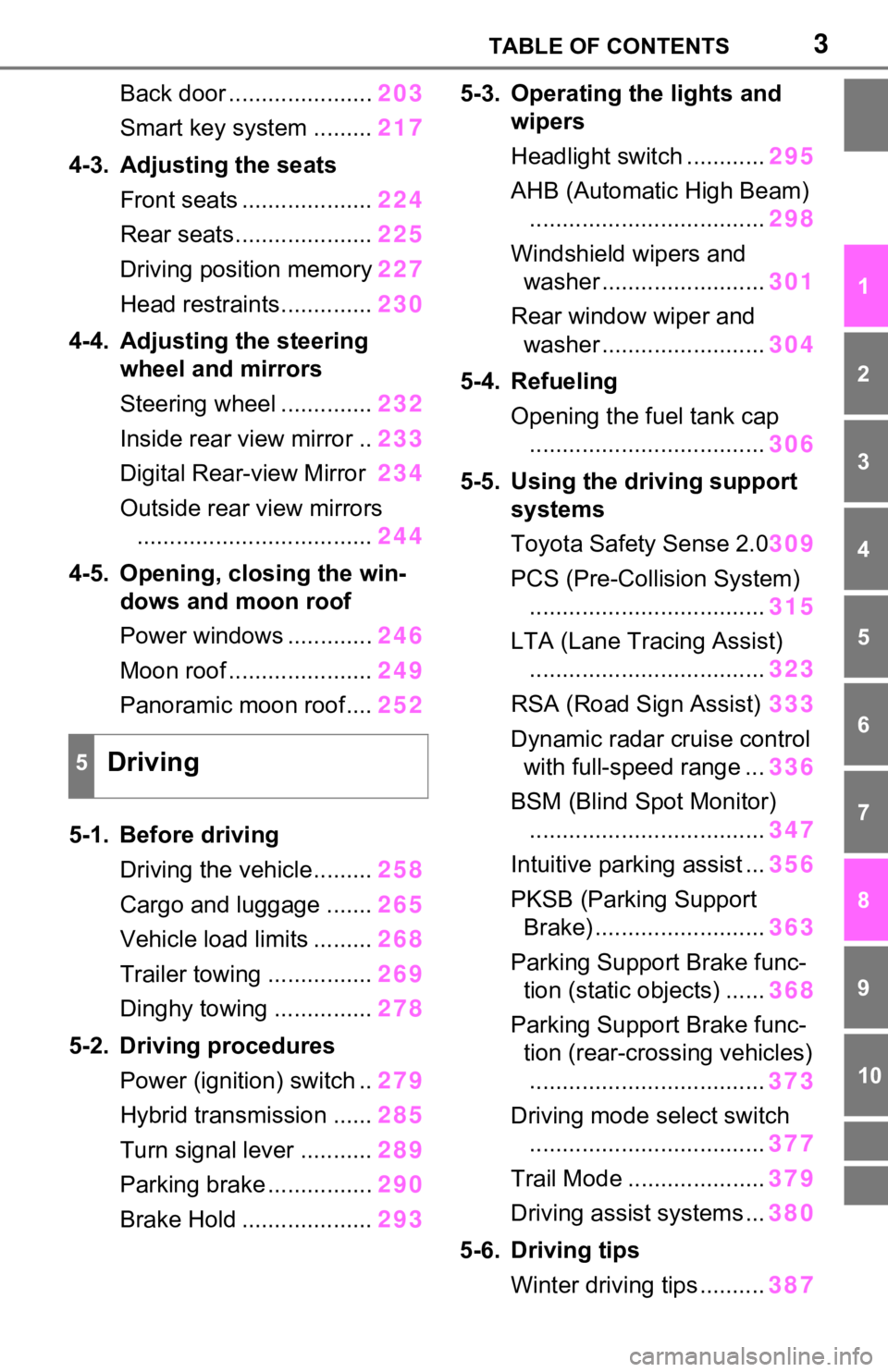
3TABLE OF CONTENTS
1
2
3
4
5
6
7
8
9
10
Back door ......................203
Smart key system ......... 217
4-3. Adjusting the seats Front seats .................... 224
Rear seats..................... 225
Driving position memory 227
Head restraints.............. 230
4-4. Adjusting the steering wheel and mirrors
Steering wheel .............. 232
Inside rear view mirror .. 233
Digital Rear-view Mirror 234
Outside rear view mirrors .................................... 244
4-5. Opening, closing the win- dows and moon roof
Power windows ............. 246
Moon roof ...................... 249
Panoramic moon roof.... 252
5-1. Before driving Driving the vehicle......... 258
Cargo and luggage ....... 265
Vehicle load limits ......... 268
Trailer towing ................ 269
Dinghy towing ............... 278
5-2. Driving procedures Power (ignition) switch .. 279
Hybrid transmission ...... 285
Turn signal lever ........... 289
Parking brake ................ 290
Brake Hold .................... 2935-3. Operating the lights and
wipers
Headlight switch ............ 295
AHB (Automatic High Beam) .................................... 298
Windshield wipers and washer ......................... 301
Rear window wiper and washer ......................... 304
5-4. Refueling Opening the fuel tank cap.................................... 306
5-5. Using the driving support systems
Toyota Safety Sense 2.0 309
PCS (Pre-Collision System) .................................... 315
LTA (Lane Tracing Assist) .................................... 323
RSA (Road Sign Assist) 333
Dynamic radar cruise control with full-speed range ... 336
BSM (Blind Spot Monitor) .................................... 347
Intuitive parking assist ... 356
PKSB (Parking Support Brake) .......................... 363
Parking Support Brake func- tion (static objects) ...... 368
Parking Support Brake func- tion (rear-crossing vehicles). ... ...
............................. 373
Driving mode s elect switch
.................................... 377
Trail Mode ..................... 379
Driving assist systems ... 380
5-6. Driving tips Winter driving tips .......... 387
5Driving
Page 15 of 616
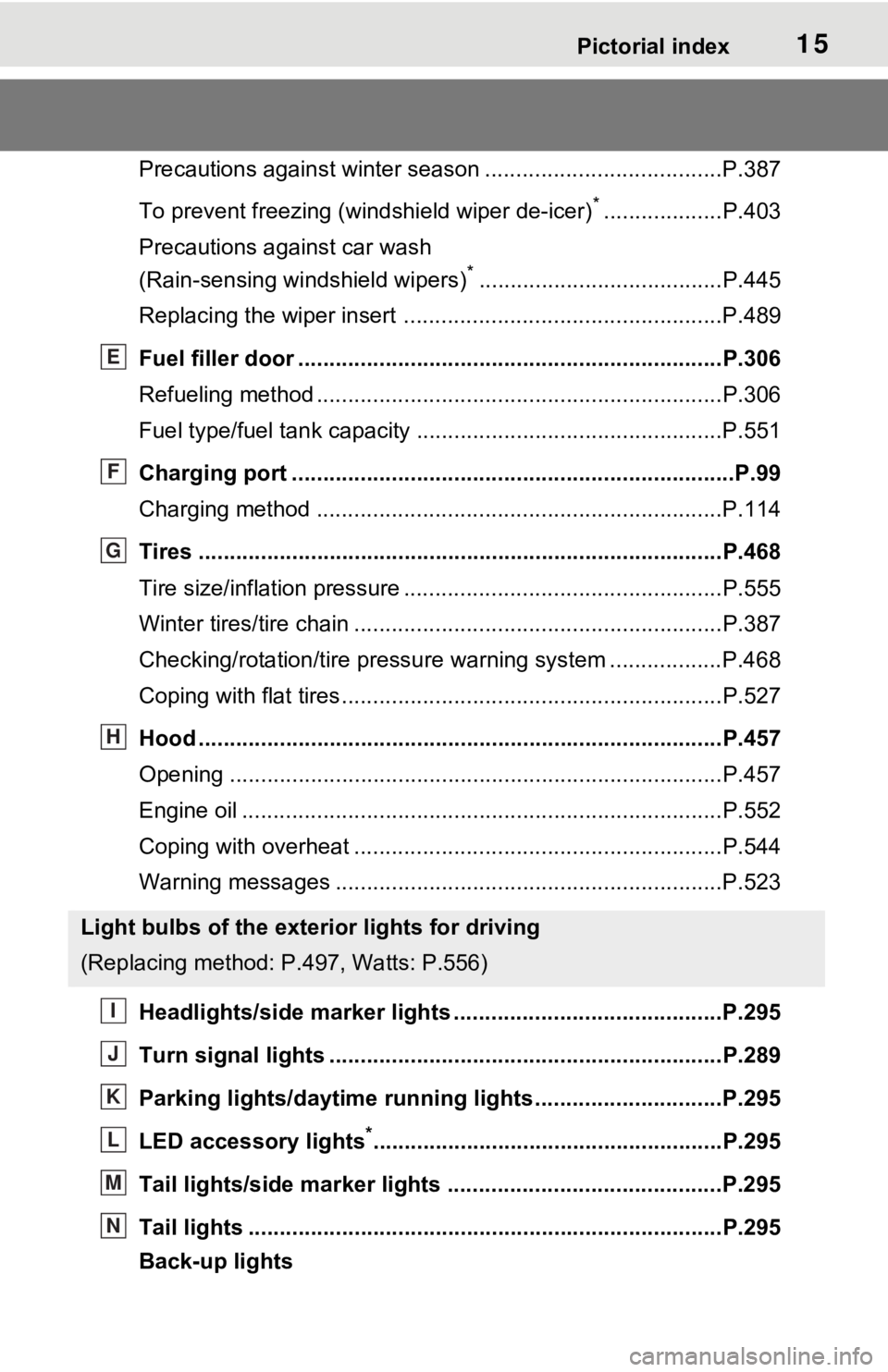
15Pictorial index
Precautions against winter season ......................................P.387
To prevent freezing (windshield wiper de-icer)
*...................P.403
Precautions against car wash
(Rain-sensing windshield wipers)
*.......................................P.445
Replacing the wiper insert .................................... ...............P.489
Fuel filler door ............................................... .....................P.306
Refueling method ............................................... ..................P.306
Fuel type/fuel tan k capacity .................................................P.551
Charging port .................................................. .....................P.99
Charging method ................................................ .................P.114
Tires ....................................................................................P.468
Tire size/inflation pressure ................................... ................P.555
Winter tires/tire chain ........................................ ...................P.387
Checking/rotation/tire pressur e warning system ..................P.468
Coping with flat tires......................................... ....................P.527
Hood ....................................................................................P.457
Opening ........................................................ .......................P.457
Engine oil ..................................................... ........................P.552
Coping with overheat ........................................... ................P.544
Warning messages ..............................................................P.523
Headlights/side marker lights .................................. .........P.295
Turn signal lights ...............................................................P.289
Parking lights/dayt ime running lights .......................... ....P.295
LED accessory lights
*........................................................P.295
Tail lights/side marker lights ............................................P.295
Tail lights .................................................... ........................P.295
Back-up lights
Light bulbs of the exterior lights for driving
(Replacing method: P .497, Watts: P.556)
E
F
G
H
I
J
K
L
M
N
Page 18 of 616
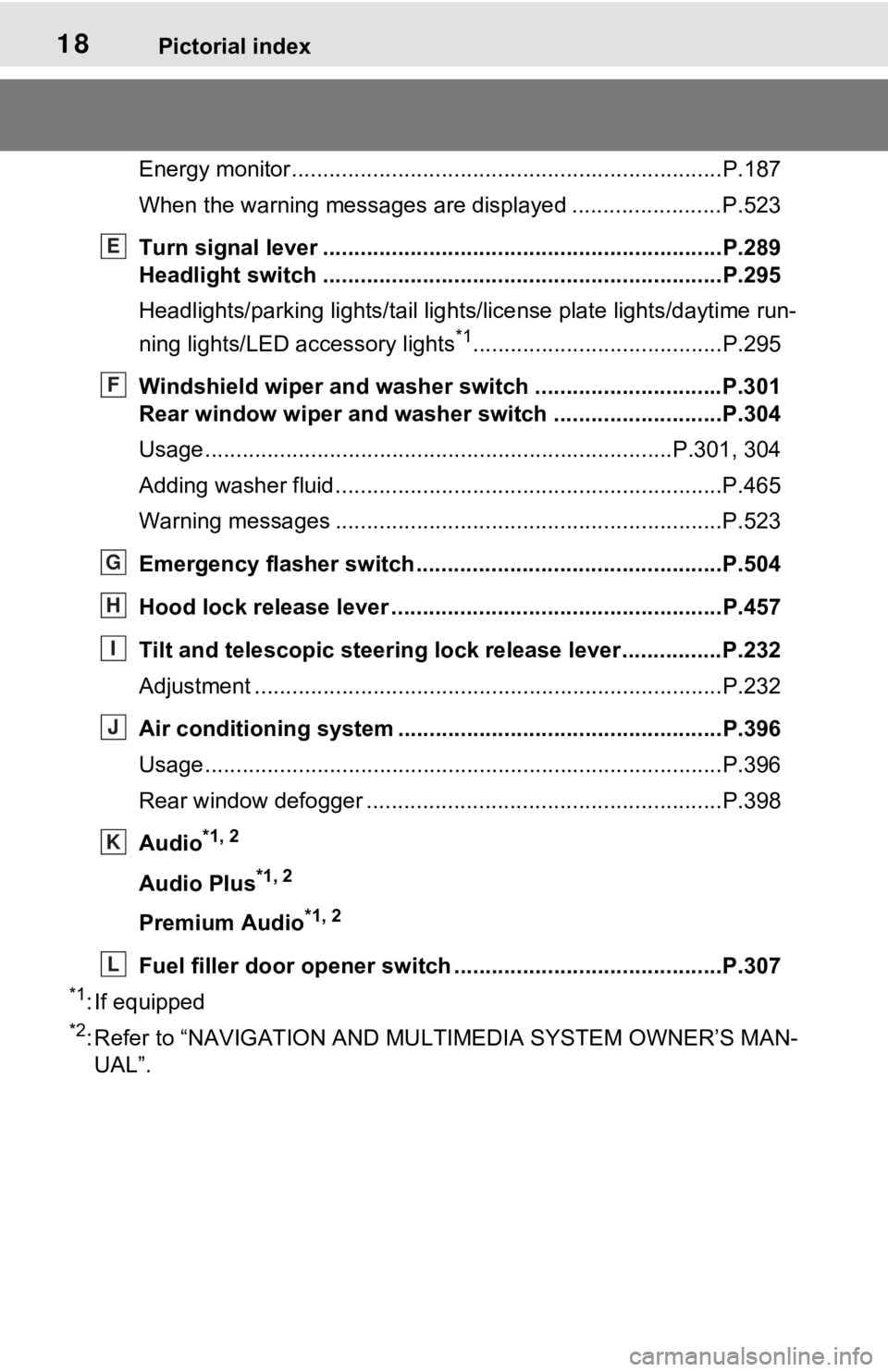
18Pictorial index
Energy monitor.....................................................................P.187
When the warning messages are displayed ........................ P.523
Turn signal lever ................................................................P.289
Headlight switch ................................................................P.295
Headlights/parking lights/tail lig hts/license plate lights/daytime run-
ning lights/LED accessory lights
*1........................................P.295
Windshield wiper and washer switch ..............................P.301
Rear window wiper and washer switch ...........................P.304
Usage.......................................................... .................P.301, 304
Adding washer fluid ..............................................................P.465
Warning messages ..............................................................P.523
Emergency flasher switch ....................................... ..........P.504
Hood lock release lever ........................................ .............P.457
Tilt and telescopic steering lock release lever ................P.232
Adjustment ..................................................... ......................P.232
Air conditioning system ............................. .......................P.396
Usage.......................................................... .........................P.396
Rear window defogger ........................................... ..............P.398
Audio
*1, 2
Audio Plus*1, 2
Premium Audio*1, 2
Fuel filler door opener swi tch ...........................................P.307
*1: If equipped
*2: Refer to “NAVIGATION AND MULTIMEDIA SYSTEM OWNER’S MAN-
UAL”.
E
F
G
H
I
J
K
L
Page 21 of 616

21Pictorial index
VSC OFF switch .................................................................P.382
Front seat heater switches
*...............................................P.408
Front seat heater/seat ventilator switches
*.....................P.408
Parking brake switch ........................................... ..............P.290
Applying/releasing............................................. ...................P.290
Precautions against winter season .............................. ........P.388
Warning buzzer/message ... .........................................P.517, 523
Brake hold switch .............................................. ................P.293
AUTO EV/HV mode switch ......................................... .........P.78
EV/HV mode selection switc h .............................................P.78
Driving mode select switch ..................................... ..........P.377
Trail Mode switch ...............................................................P.379
*: If equipped
A
B
C
D
E
F
G
H
I
Page 37 of 616

371-1. For safe use
1
For safety and security
ing situations:
• If the vehicle strikes an object, such as a parked vehicle or sign
pole, which can move or deform
on impact
• If the vehicle is involved in an underride collision, such as a colli-
sion in which the front of the vehi-
cle underrides, or goes under, the
bed of a truck
●Depending on the type of collision,
it is possible that only the seat belt
pretensioners will activate.
●The SRS front airbags for the front
passenger will not activate if there
is no passenger sitting in the front
passenger seat. However, the
SRS front airbags for the front
passenger may de ploy if luggage
is put in the seat, even if the seat
is unoccupied.
●The SRS seat cushion airbag on
the front passen ger seat will not
operate if the occupant is not
wearing a seat belt.
■SRS airbag deployment condi-
tions (SRS side and curtain
shield airbags)
●The SRS side and curtain shield
airbags will deploy i n the event of
an impact that exceeds the set
threshold level (the level of force
corresponding to the impact force
produced by an approximately
3300 lb. [1500 kg] vehicle colliding
with the vehicle cabin from a
direction perpendicular to the
vehicle orientation at an approxi-
mate speed of 12 -18 mph [20 -30
km/h]).
●Both SRS curtain shield airbags
may deploy in the event of a
severe side collision.
●Both SRS curtain shield airbags
will deploy in the event of vehicle
rollover.
●Both SRS curtain shield airbags
may also deploy in the event of a
severe frontal collision.
■Conditions under which the
SRS airbags may deploy
(inflate), other t han a collision
The SRS front airbags and SRS cur-
tain shield airbag s may also deploy
if a serious impact occurs to the
underside of your vehicle. Some
examples are shown in the illustra-
tion.
●Hitting a curb, edge of pavement
or hard surface
●Falling into or jumping over a deep
hole
●Landing hard or falling
The SRS curtain shield airbags may
also deploy under the situations
shown in the illustration.
●The angle of vehicle tip-up is mar-
ginal.
●The vehicle skids and hits a curb
stone.
■Types of collisions that may not
deploy the SRS airbags (SRS
front airbags)
The SRS front airbags do not gener-
ally inflate if the vehicle is involved
in a side or r ear collision, if it rolls
over, or if it is involved in a low-
speed frontal collision. But, when-
ever a collision o f any type causes
sufficient forward deceleration of the
vehicle, deploym ent of the SRS
Page 49 of 616

491-1. For safe use
1
For safety and security
Exhaust gas precau-
tions
Harmful substance to the
human body is included in
exhaust gases if inhaled.
WARNING
Exhaust gases contain harmful
carbon monoxide (CO), which is
colorless and odorless. Observe
the following precautions.
Failure to do so may cause
exhaust gases to enter the vehicle
and may lead to an accident
caused by light-headedness, or
may lead to death or a serious
health hazard.
■Important points while driving
●Keep the back door closed.
●If you smell exhaust gases in
the vehicle even when the back
door is closed, open the side
windows and have the vehicle
inspected at your Toyota dealer
as soon as possible.
■When parking
●If the vehicle is in a poorly venti-
lated area or a closed area,
such as a garage, stop the
hybrid system.
●Do not leave the vehicle with
the hybrid system operating for
a long time.
If such a situation cannot be
avoided, park the vehicle in an
open space and ensure that
exhaust fumes do not enter the
vehicle interior.
●Do not leave the hybrid system
operating in an area with snow
build-up, or where it is snowing.
If snowbanks build up around
the vehicle while the hybrid sys-
tem is operating, exhaust gases
may collect and enter the vehi-
cle.
■Exhaust pipe
The exhaust system needs to be
checked periodically. If there is a
hole or crack caused by corro-
sion, damage to a joint or abnor-
mal exhaust noise, be sure to
have the vehicle inspected and
repaired by your Toyota dealer.
Page 80 of 616

802-1. Plug-in hybrid system
external power source.
■If the plug-in hybrid system
operation mode cannot be
changed
In the following si tuations, the plug-
in hybrid system operation mode
cannot be changed even if the
AUTO EV/HV mode switch or
EV/HV mode selection switch is
pressed. (In this case, the warning
message is displaye d on the multi-
information displa y when the switch
is pressed.)
●When electricity needed for EV
driving is not remaining (when in
EV mode or AUTO EV/HV mode)
●When the traction battery is
almost completely charged (hybrid
battery [traction battery] charge
mode)
■When switching from EV mode
to another mode using the
switch
When the power switch is turned off,
operation mode switching is can-
celed and the system returns to EV
mode the next time the vehicle is
started.
*
*
: If there is not enough charge remaining in the hybrid battery
(traction battery) to allow EV driv-
ing, the system s witches to HV
mode.
■Hybrid battery (traction battery)
charge mode
●The following may occur to protect the system, etc.
• Cannot switch to hybrid battery (traction battery) charge mode or
cannot cancel it
• Gasoline engine does not start or stops even after switching to
hybrid battery (traction battery)
charge mode
●If a load to the system is large,
such as when the power con-
sumption of the air conditioning
system is large or when the tem-
perature of the engine coolant is
high, it may take longer time than
usual to charge using the hybrid
battery (traction battery) charge
mode, or charging to the hybrid
battery (traction battery) may not
be performed.
■When in EV mode
In EV mode, EV driving (driving
WARNING
■When using the hybrid bat-
tery (traction battery) charge
mode
Observe the following precautions
when using the hybrid battery
(traction battery) charge mode
while parking.
Failure to do so may lead to death
or serious health hazard, as the
gasoline engine operates when in
the hybrid battery (traction bat-
tery) charge mode.
●Do not stop the vehicle near
flammable materials.
●Do not use the hybrid battery
(traction battery) charge mode
in a closed area where ventila-
tion is insufficien t, such as in a
garage or area with snow
buildup.
Control when driving in
each mode
Page 83 of 616

832-1. Plug-in hybrid system
2
Plug-in hybrid system
driving range (P.172) is being dis-
played on the multi-information dis-
play, EV driving (driving using only
the electric motor) may be canceled
and both gasoline engine and elec-
tric motor are used depending on
the situation (EV driving will be
returned to automatically after EV
driving becomes possible again).
EV driving may be canceled auto-
matically in the following circum-
stances
*1:
●When vehicle speed is more than
approximately 84 mph (135 km/h).
●When power is needed temporar-
ily, for example when the acceler-
ator pedal is depressed firmly or
when accelerating suddenly.
*2
●When the temperature of the
hybrid system is high.
The vehicle has been left in the
sun, driven on a hill, driven at high
speeds, etc.
●When the temperature of the
hybrid system is low.
●When the heater is switched on
when the outside temperature is
below about 14°F (-10°C).
●When the windshield defogger
switch is pressed. ( P.398)
●When the system determines that
the gasoline engine needs to be
started.
*1: The gasoline engine may also
operate in circumstances other
than those listed above, depend-
ing on conditions.
*2: When driving in AUTO EV/HV mode. Even in EV mode, the gas-
oline engine may start, depend-
ing on the condition of the hybrid
battery (traction battery).
■If “Engine Started to Protect
System EV driving unavailable”
is displayed on the multi-infor-
mation display
EV driving may be canceled in order to protect the hybrid system, etc.
In this case, perform driving with the
gasoline engine until EV driving will
be returned to automatically.
■Conditions in which the gaso-
line engine may not stop
The gasoline engine starts and
stops automatically. However, it
may not stop automatically in the
following conditions
*:
●During gasoline engine warm-up
●During hybrid battery (traction bat-
tery) charging
●When the temperature of the
hybrid battery (traction battery) is
high or low
●When the windshield defogger
switch is pressed. ( P.398)
*: Depending on the circumstances,
the gasoline engine may also not
stop automatically in situations
other than those above.
■Sounds and vibrations specific
to a hybrid vehicle
There may be no e ngine sound or
vibration even thoug h the vehicle is
able to move with the “READY” indi-
cator is illuminated. For safety,
apply the parking brake and make
sure to shift the shift lever to P when
parked.
The following sounds or vibrations
may occur when the hybrid system
is operating and are not a malfunc-
tion.
●Motor sounds may be heard from
the engine compartment.
●Sounds may be heard from the
hybrid battery (traction battery)
when the hybrid sy stem starts or
stops.
●Relay operating sounds such as a
snap or soft clank will be emitted
from the hybrid ba ttery (traction
battery), behind the rear seats,
when the hybrid system is started
or stopped.
Page 89 of 616
892-1. Plug-in hybrid system
2
Plug-in hybrid system
WARNING
●Never touch, disassemble,
remove or replace the high volt-
age parts, cables or their con-
nectors.
●The hybrid system will become
hot after starting as the system
uses high voltage. Be careful of
both the high voltage and the
high temperature, and always
obey the caution labels
attached to the vehicle.
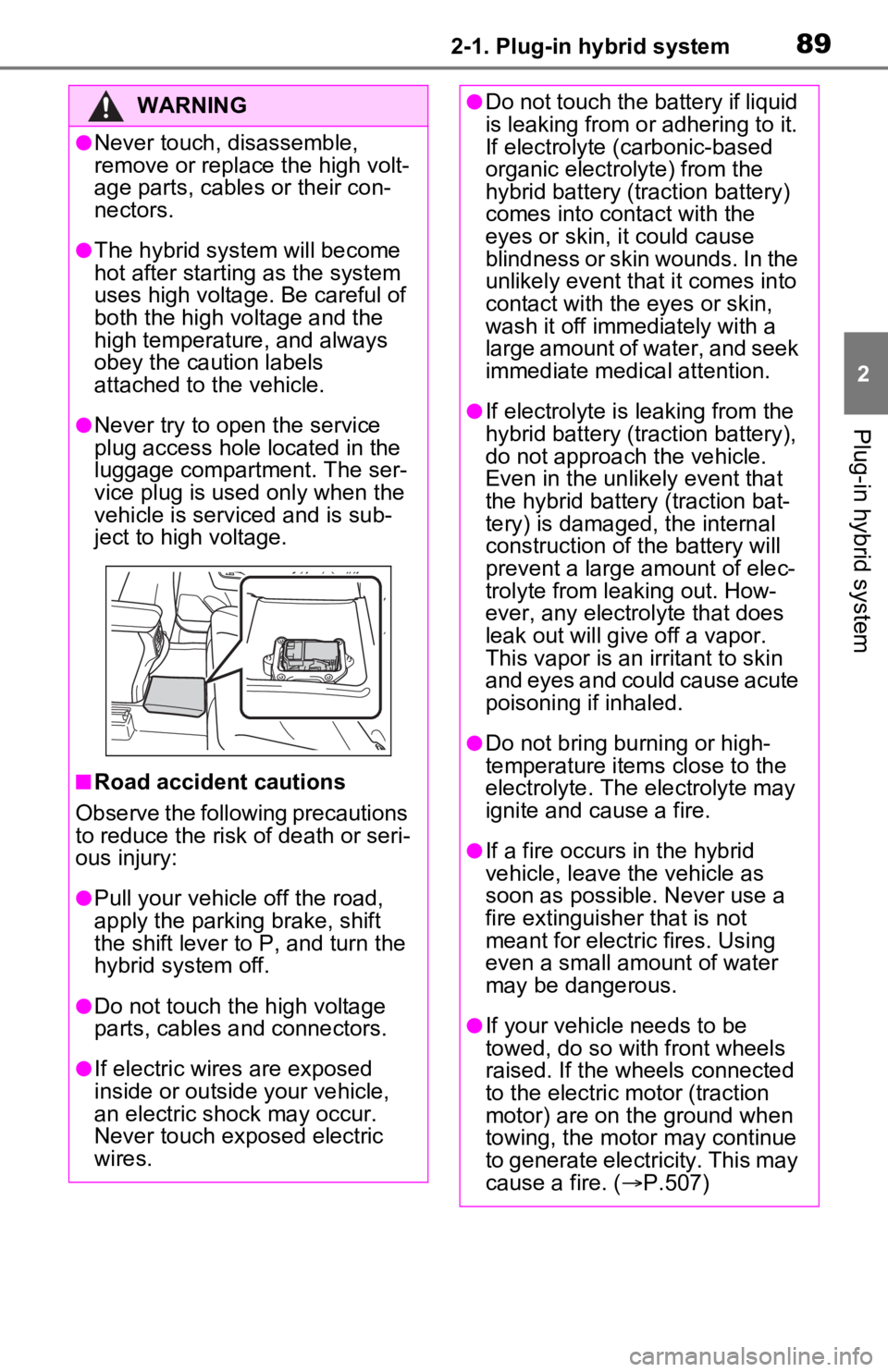
●Never try to open the service
plug access hole located in the
luggage compartment. The ser-
vice plug is used only when the
vehicle is serviced and is sub-
ject to high voltage.
■Road accident cautions
Observe the following precautions
to reduce the risk of death or seri-
ous injury:
●Pull your vehicle off the road,
apply the parking brake, shift
the shift lever to P, and turn the
hybrid system off.
●Do not touch the high voltage
parts, cables and connectors.
●If electric wires are exposed
inside or outside your vehicle,
an electric shock may occur.
Never touch exposed electric
wires.
●Do not touch the battery if liquid
is leaking from or adhering to it.
If electrolyte (carbonic-based
organic electrolyte) from the
hybrid battery (traction battery)
comes into contact with the
eyes or skin, it could cause
blindness or skin wounds. In the
unlikely event that it comes into
contact with the eyes or skin,
wash it off immediately with a
large amount of water, and seek
immediate medical attention.
●If electrolyte is leaking from the
hybrid battery (traction battery),
do not approach the vehicle.
Even in the unlikely event that
the hybrid battery (traction bat-
tery) is damaged, the internal
construction of the battery will
prevent a large amount of elec-
trolyte from leaking out. How-
ever, any electrolyte that does
leak out will give off a vapor.
This vapor is an irritant to skin
and eyes and could cause acute
poisoning if inhaled.
●Do not bring burning or high-
temperature items close to the
electrolyte. The electrolyte may
ignite and cause a fire.
●If a fire occurs in the hybrid
vehicle, leave the vehicle as
soon as possible. Never use a
fire extinguisher that is not
meant for electric fires. Using
even a small amount of water
may be dangerous.
●If your vehicle needs to be
towed, do so with front wheels
raised. If the wheels connected
to the electric motor (traction
motor) are on the ground when
towing, the motor may continue
to generate electricity. This may
cause a fire. ( P.507)
Page 93 of 616

932-1. Plug-in hybrid system
2
Plug-in hybrid system
Shift the shift lever to D when
stopped at a traffic light, or driv-
ing in heavy traffic etc. Shift the
shift lever to P when parking.
When using the N, there is no
positive effect on fuel consump-
tion. In the N, the gasoline
engine operates but electricity
cannot be generated. Also,
when using the air conditioning
system, etc., the hybrid battery
(traction battery) power is con-
sumed.
Drive your vehicle smoothly.
Avoid abrupt acceleration and
deceleration. Gradual accel-
eration and deceleration will
make more effective use of
the electric motor (traction
motor) without having to use
gasoline engine power.
Avoid repeated acceleration.
Repeated acceleration con-
sumes hybrid battery (trac-
tion battery) power, resulting
in poor fuel consumption. Bat-
tery power can be restored by
driving with the accelerator
pedal slightly released.
Make sure to operate the brakes
gently and a timely manner. A greater amount of electrical
energy can be regenerated
when slowing down.
Repeated acceleration and
deceleration, as well as long
waits at traffic lights, will lead to
high fuel and electricity con-
sumption. Check traffic reports
before leaving and avoid delays
as much as possible. When driv-
ing in a traffic jam, gently
release the brake pedal to allow
the vehicle to move forward
slightly while avoiding overuse
of the accelerator pedal. Doing
so can help control excessive
electricity and fuel consumption.
Control and maintain the vehi-
cle at a constant speed.
Before stopping at a toll booth
or similar, allow plenty of time
to release the accelerator and
gently apply the brakes. A
greater amount of electrical
energy can be regenerated
when slowing down.
Electricity consumption will
increase significantly when
driving at high speeds in EV
mode or AUTO EV/HV mode.
If there will be a long distance
to the next external charging
point after leaving a freeway,
it is recommended to drive in
Shift lever operation
Accelerator pedal/brake
pedal operation
When braking
Delays
Highway driving