traction control TOYOTA RAV4 PRIME 2022 Owners Manual
[x] Cancel search | Manufacturer: TOYOTA, Model Year: 2022, Model line: RAV4 PRIME, Model: TOYOTA RAV4 PRIME 2022Pages: 624, PDF Size: 24.01 MB
Page 10 of 624

10
WARNING
■General precautions while
driving
Driving under the influence: Never
drive your vehicle when under the
influence of alcohol or drugs that
have impaired your ability to oper-
ate your vehicle. Alcohol and cer-
tain drugs delay reaction time,
impair judgment and reduce coor-
dination, which could lead to an
accident that could result in death
or serious injury.
Defensive drivin g: Always drive
defensively. Anticipate mistakes
that other drivers or pedestrians
might make and be ready to avoid
accidents.
Driver distraction: Always give
your full attention to driving. Any-
thing that distracts the driver,
such as adjusting controls, talking
on a cellular phone or reading can
result in a collision with resulting
death or serious injury to you,
your occupant s or others.
■General precaution regarding
children’s safety
Never leave children unattended
in the vehicle, and never allow
children to have or use the key.
Children may be able to start the
vehicle or shift the vehicle into
neutral. There is also a danger
that children may injure them-
selves by playing with the side
windows, the moon roof or the
panoramic moon roof, or other
features of the vehicle. In addi-
tion, heat build-up or extremely
cold temperatures inside the vehi-
cle can be fatal to children.
Page 76 of 624
762-1. Plug-in hybrid system
2-1.Plug-in hybrid system
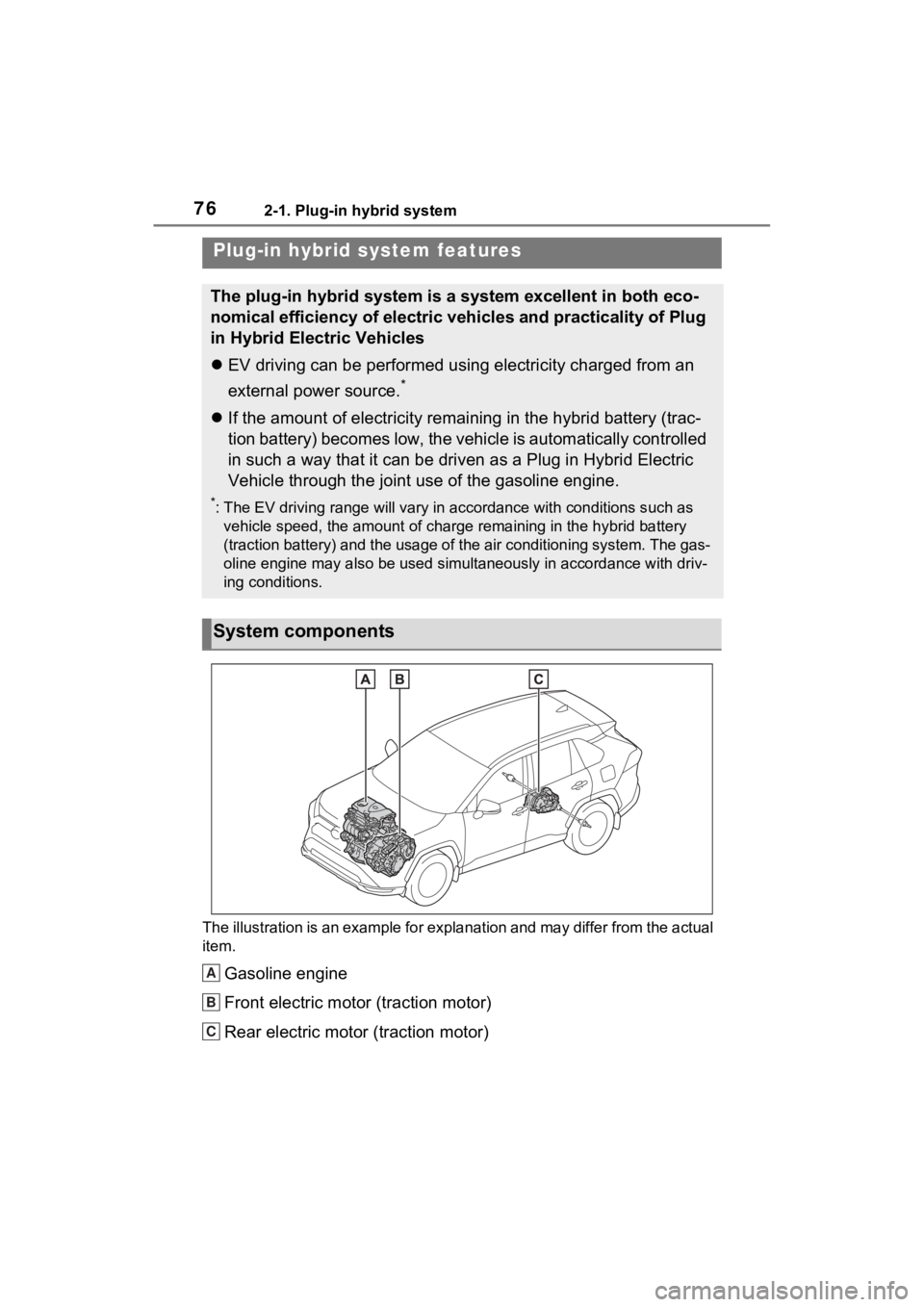
The illustration is an example for explanation and may differ from the actual
item.
Gasoline engine
Front electric motor (traction motor)
Rear electric motor (traction motor)
Plug-in hybrid system features
The plug-in hybrid system is a system excellent in both eco-
nomical efficiency of electric vehicles and practicality of Plu g
in Hybrid Electric Vehicles
EV driving can be performed using electricity charged from an
external power source.
*
If the amount of electricity remaining in the hybrid battery (t rac-
tion battery) becomes low, the vehicle is automatically controlled
in such a way that it can be driven as a Plug in Hybrid Electri c
Vehicle through the joint use of the gasoline engine.
*: The EV driving range will vary in accor dance with conditions such as
vehicle speed, the amount of charge remaining in the hybrid bat tery
(traction battery) and the usage of the air conditioning system . The gas-
oline engine may also be used si multaneously in accordance with driv-
ing conditions.
System components
A
B
C
Page 80 of 624
802-1. Plug-in hybrid system
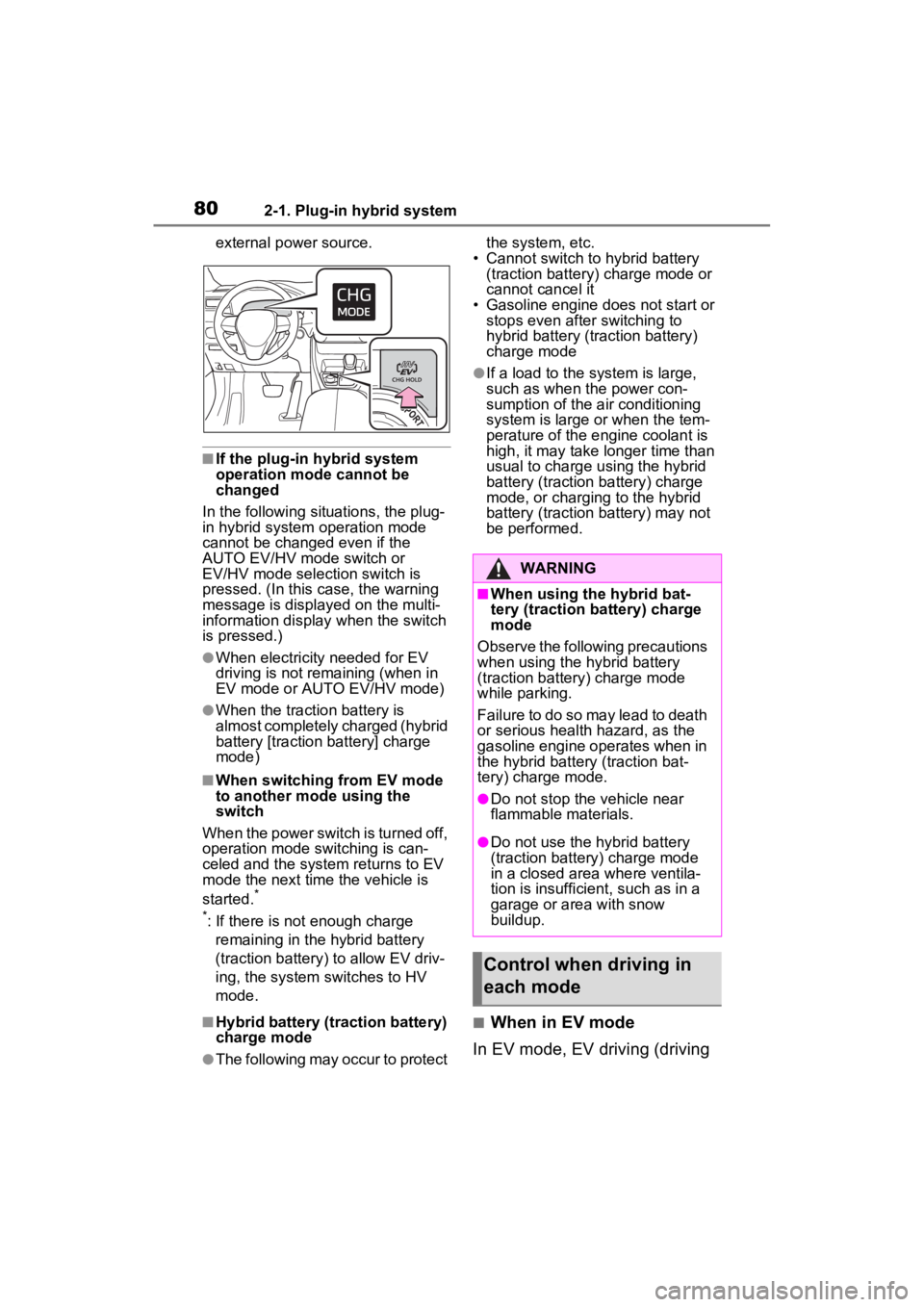
external power source.
■If the plug-in hybrid system
operation mode cannot be
changed
In the following si tuations, the plug-
in hybrid system operation mode
cannot be changed even if the
AUTO EV/HV mode switch or
EV/HV mode selection switch is
pressed. (In this case, the warning
message is displaye d on the multi-
information displa y when the switch
is pressed.)
●When electricity needed for EV
driving is not remaining (when in
EV mode or AUTO EV/HV mode)
●When the traction battery is
almost completely charged (hybrid
battery [traction battery] charge
mode)
■When switching from EV mode
to another mode using the
switch
When the power switch is turned off,
operation mode switching is can-
celed and the system returns to EV
mode the next time the vehicle is
started.
*
*
: If there is not enough charge remaining in the hybrid battery
(traction battery) to allow EV driv-
ing, the system s witches to HV
mode.
■Hybrid battery (traction battery)
charge mode
●The following may occur to protect the system, etc.
• Cannot switch to hybrid battery (traction battery) charge mode or
cannot cancel it
• Gasoline engine does not start or stops even after switching to
hybrid battery (traction battery)
charge mode
●If a load to the system is large,
such as when the power con-
sumption of the air conditioning
system is large or when the tem-
perature of the engine coolant is
high, it may take longer time than
usual to charge using the hybrid
battery (traction battery) charge
mode, or charging to the hybrid
battery (traction battery) may not
be performed.
■When in EV mode
In EV mode, EV driving (driving
WARNING
■When using the hybrid bat-
tery (traction battery) charge
mode
Observe the following precautions
when using the hybrid battery
(traction battery) charge mode
while parking.
Failure to do so may lead to death
or serious health hazard, as the
gasoline engine operates when in
the hybrid battery (traction bat-
tery) charge mode.
●Do not stop the vehicle near
flammable materials.
●Do not use the hybrid battery
(traction battery) charge mode
in a closed area where ventila-
tion is insufficien t, such as in a
garage or area with snow
buildup.
Control when driving in
each mode
Page 81 of 624

812-1. Plug-in hybrid system
2
Plug-in hybrid system
using only the electric motor)* is
possible. However, depending
on the situation, EV driving may
be canceled and both gasoline
engine and electric motor are
used ( P.82). Also, if a little
electricity is remaining in the
hybrid battery (traction battery),
HV mode is automatically
selected. To drive in EV mode
long, observe the followings.
Avoid sudden acceleration
and sudden deceleration, and
be sure to drive smoothly. If
you repeatedly accelerate,
the hybrid battery (traction
battery) charge will deplete
quickly. Also, EV driving may
be canceled by rapid acceler-
ation or vehicle speed.
Restrain your speed as much
as possible. The distance that
can be driven in EV mode will
reduce considerably at high
speeds.
*: The EV driving range can be
checked using the multi-informa-
tion display. ( P.172)
■When in AUTO EV/HV mode
Only the electric motor is used
for EV driving
* during normal
driving, but when the accelera-
tor pedal is strongly depressed,
the gasoline engine starts.
( P.82)
Also, when the hybrid battery
(traction battery) level is low, the
mode switches to HV mode automatically the same as in EV
mode.
AUTO EV/HV mode is suitable
for driving conditions when more
power is required, such as for
driving uphill or accelerating
suddenly. However, because
the gasoline engine will start
more easily, it is recommended
to drive in EV mode usually.
*: The EV driving range can be
checked using th e multi-informa-
tion display. ( P.172)
■When in HV mode
The vehicle can be used in the
same way as a standard Plug in
Hybrid Electric Vehicle
In HV mode, controls are pri-
marily carried out as follows in
accordance with the driving con-
ditions.
The gasoline engine stops
*
when the vehicle is stopped.
During start off, the electric
motor (traction motor) drives
the vehicle.
During normal driving, the
gasoline engine and electric
motor (traction motor) are
controlled effectively, and the
vehicle is driven with optimum
fuel efficiency. Also, when
necessary, the electric motor
(traction motor) operates as
an electrical generator to
charge the hybrid battery
(traction battery).
Page 87 of 624
872-1. Plug-in hybrid system
2
Plug-in hybrid system
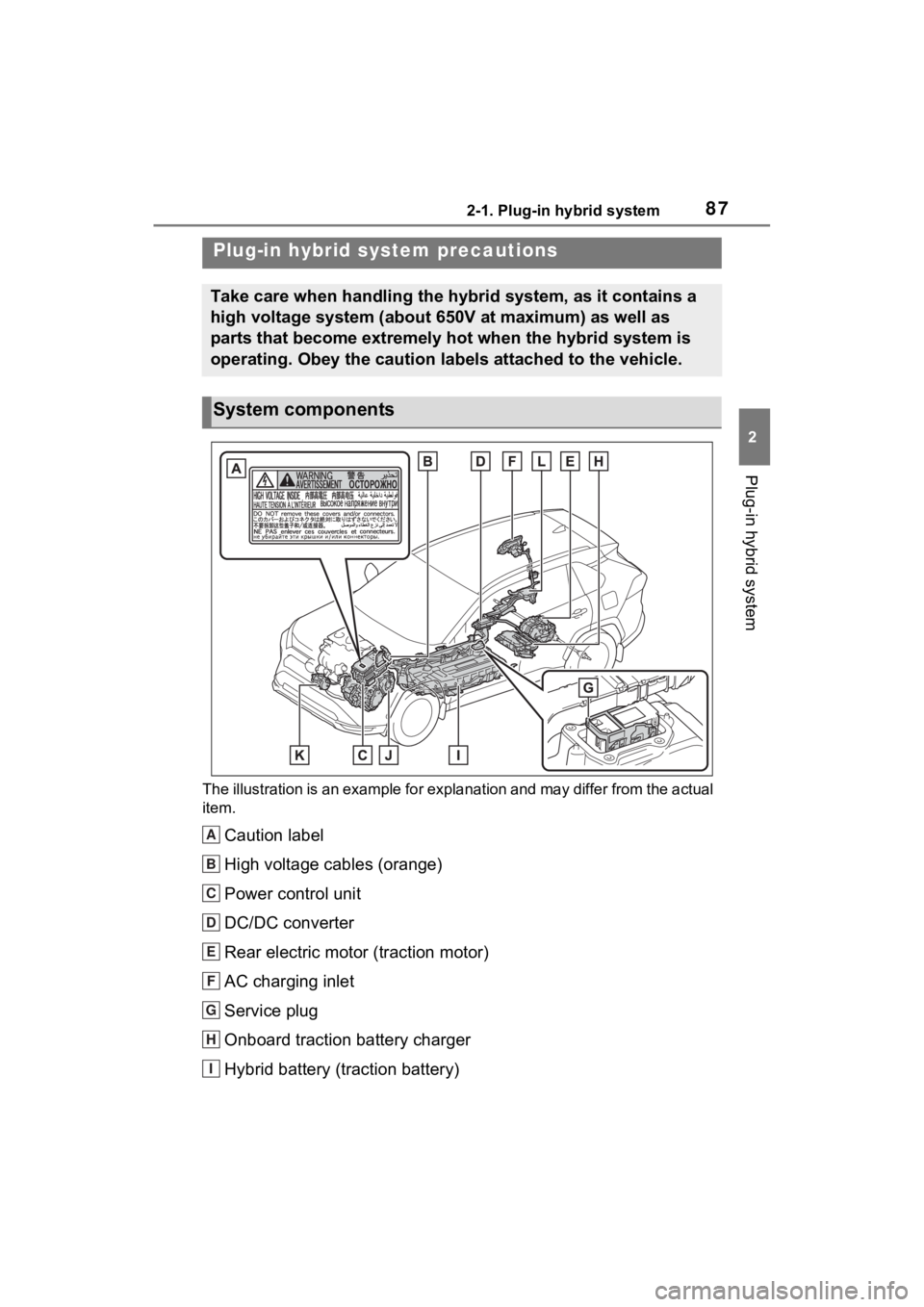
The illustration is an example for explanation and may differ from the actual
item.
Caution label
High voltage cables (orange)
Power control unit
DC/DC converter
Rear electric motor (traction motor)
AC charging inlet
Service plug
Onboard traction battery charger
Hybrid battery (traction battery)
Plug-in hybrid system precautions
Take care when handling the hybrid system, as it contains a
high voltage system (about 650V at maximum) as well as
parts that become extremely hot when the hybrid system is
operating. Obey the caution labels attached to the vehicle.
System components
A
B
C
D
E
F
G
H
I
Page 93 of 624
932-1. Plug-in hybrid system
2
Plug-in hybrid system
Shift the shift lever to D when
stopped at a traffic light, or driv-
ing in heavy traffic etc. Shift the
shift lever to P when parking.
When using the N, there is no
positive effect on fuel consump-
tion. In the N, the gasoline
engine operates but electricity
cannot be generated. Also,
when using the air conditioning
system, etc., the hybrid battery
(traction battery) power is con-
sumed.
Drive your vehicle smoothly.
Avoid abrupt acceleration and
deceleration. Gradual accel-
eration and deceleration will
make more effective use of
the electric motor (traction
motor) without having to use
gasoline engine power.
Avoid repeated acceleration.
Repeated acceleration con-
sumes hybrid battery (trac-
tion battery) power, resulting
in poor fuel consumption. Bat-
tery power can be restored by
driving with the accelerator
pedal slightly released.
Make sure to operate the brakes
gently and a timely manner. A greater amount of electrical
energy can be regenerated
when slowing down.
Repeated acceleration and
deceleration, as well as long
waits at traffic lights, will lead to
high fuel and electricity con-
sumption. Check traffic reports
before leaving and avoid delays
as much as possible. When driv-
ing in a traffic jam, gently
release the brake pedal to allow
the vehicle to move forward
slightly while avoiding overuse
of the accelerator pedal. Doing
so can help control excessive
electricity and fuel consumption.
Control and maintain the vehi-
cle at a constant speed.
Before stopping at a toll booth
or similar, allow plenty of time
to release the accelerator and
gently apply the brakes. A
greater amount of electrical
energy can be regenerated
when slowing down.
Electricity consumption will
increase significantly when
driving at high speeds in EV
mode or AUTO EV/HV mode.
If there will be a long distance
to the next external charging
point after leaving a freeway,
it is recommended to drive in
Shift lever operation
Accelerator pedal/brake
pedal operation
When braking
Delays
Highway driving
Page 96 of 624

962-1. Plug-in hybrid system
of occupants.
The distance that EV driving is
possible can be extended if the
following is performed:
■When starting off, depress
the accelerator pedal
smoothly to accelerate
As a guide, accelerate up to
approximately 12mph (20 km/h)
in the first 5 seconds.
Electrical and fuel efficiency can
be improved just by using the
ECO Accelerator Guidance dis-
played on the multi-information
display and taking care to start
off gently. ( P.173)
When the driving mode is set to
Eco drive mode, depressing the
accelerator pedal generates
smooth torque that makes it easier
to operate the accelerator gently.
At the same time, the air condition-
ing control is switched to eco air
conditioning mode ( P.391) to
reduce the strength of the air condi-
tioning operation.
■Maintain sufficient vehicle-
to-vehicle distance and do
not accelerate or decelerate
unnecessarily
Try to maintain a fixed speed
while driving. Driving at a short
vehicle-to-vehicle distance will
result in repeating wasteful
acceleration and deceleration,
which will worsen the electrical
and fuel efficiency.
■Release the accelerator
pedal early before stopping
the vehicle, such as at a
traffic light
The regenerative brake will
operate to convert the kinetic
energy of the vehicle into electri-
cal energy, which will charge the
hybrid battery (traction battery).
The regeneration status can be
checked from the Hybrid Sys-
tem Indicator. ( P.167)
When the brake pedal is
depressed lightly during decel-
eration, the regeneration
amount increases, enabling
more electrical energy to be
recovered.
If the brake pedal is depressed too
strongly, the recovered amount
indicator will reac h the maximum
level and the upper limit of the
recoverable energy will be
exceeded. Theref ore, be sure to
operate the brak e pedal early.
■Use the air conditioning
system appropriately, and
also utilize the heated steer-
ing wheel (if equipped) and
seat heaters
In EV mode, the vehicle is
cooled and heated by electrical
energy. (Except in extremely
cold temperatures of approxi-
mately 14°F (-10°C) or less.)
Preventing excessive cooling or
heating of the vehicle will reduce
power consumption and
improve electrical efficiency.
Page 112 of 624
1122-2. Charging
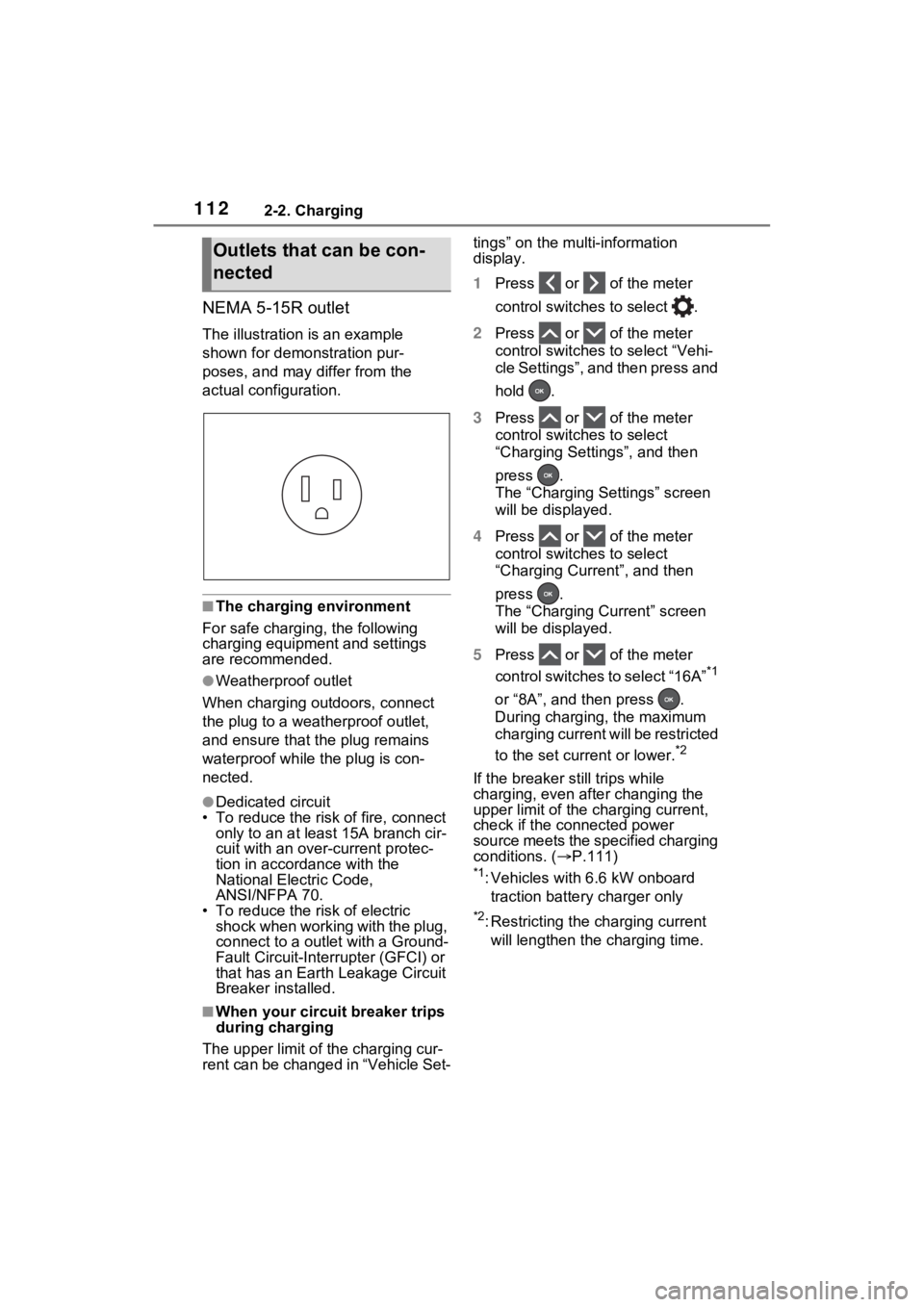
NEMA 5-15R outlet
The illustration is an example
shown for demonstration pur-
poses, and may differ from the
actual configuration.
■The charging environment
For safe charging, the following
charging equipment and settings
are recommended.
●Weatherproof outlet
When charging outdoors, connect
the plug to a weatherproof outlet,
and ensure that the plug remains
waterproof while the plug is con-
nected.
●Dedicated circuit
• To reduce the risk of fire, connect
only to an at least 15A branch cir-
cuit with an over- current protec-
tion in accordance with the
National Electric Code,
ANSI/NFPA 70.
• To reduce the risk of electric
shock when working with the plug,
connect to a outlet with a Ground-
Fault Circuit-Interrupter (GFCI) or
that has an Earth Leakage Circuit
Breaker installed.
■When your circuit breaker trips
during charging
The upper limit of the charging cur-
rent can be changed in “Vehicle Set- tings” on the multi-information
display.
1
Press or of the meter
control switches to select .
2 Press or of the meter
control switches to select “Vehi-
cle Settings”, and then press and
hold .
3 Press or of the meter
control switches to select
“Charging Settings”, and then
press .
The “Charging Settings” screen
will be displayed.
4 Press or of the meter
control switches to select
“Charging Current”, and then
press .
The “Charging Current” screen
will be displayed.
5 Press or of the meter
control switches to select “16A”
*1
or “8A”, and then press .
During charging, the maximum
charging current will be restricted
to the set current or lower.
*2
If the breaker still trips while
charging, even after changing the
upper limit of the charging current,
check if the connected power
source meets the specified charging
conditions. ( P.111)
*1: Vehicles with 6.6 kW onboard
traction battery charger only
*2: Restricting the charging current will lengthen the charging time.
Outlets that can be con-
nected
Page 116 of 624

1162-2. Charging
■Hybrid battery (traction bat-
tery) warming control
(Alaska and Canada only)
This control operates after the
AC charging cable remains con-
nected to the vehicle for 3 days
and “Battery Heater” automati-
cally stops. It automatically insu-
lates the hybrid battery (traction
battery) in extremely low tem-
peratures.
This control stops 31 days
after the AC charging cable is
connected, even if it is still
connected to the vehicle.
When this control operates,
charging schedule settings
are ignored and charging
starts.
■“Battery Cooler”
When the hybrid battery (trac-
tion battery) is hot and the AC
charging cable is connected to
the vehicle, this function cools
the hybrid battery (traction bat-
tery) before charging is carried
out.
“Battery Cooler” will operate
when the “Battery Cooler” of
the “Charging Settings” on the
multi-information display is
on. ( P.178)
When the charging voltage is
120 V, the function does not
operate.
■Traction battery heating and
cooling system (“Battery
Heater” and “Battery Cooler”)
●The system ope rates when the
hybrid battery (traction battery) is
below or above a certain tempera-
ture.
●The system may operate when
charging is not being performed.
●When the charging schedule is
used ( P.130), this function will
operate according to the charging
schedule.
■“Battery Heater”
●When “Battery Heater” is operat-
ing, the charging indicator illumi-
nates.
●When the AC charging cable is
removed from the vehicle or
remains connected to the vehicle
for approximately 3 days, the sys-
tem automatically stops.
●When “Battery Heater” is operat-
ing during charging, the charging
time may be longer than normal.
●If the outside temperature
becomes high w hile “Battery
Heater” is operating, charging
may complete ear lier than the
“Departure” time set. ( P.130)
●When the following operations are
performed while “Battery Heater”
is operating, the hybrid battery
(traction battery) heating opera-
tion stops.
• The shift lever is changed to any position other than P
• The Remote Air Conditioning Sys-
tem is operated ( P.399)
●“Battery Heater” may operate
even when the hybrid battery
(traction battery) is fully charged
depending on the temperature of
the hybrid battery (traction bat-
tery).
• The remaining charge of the
hybrid battery (traction battery)
decreases when “Battery Heater”
operates. The charging operation
Page 129 of 624
1292-2. Charging
2
Plug-in hybrid system
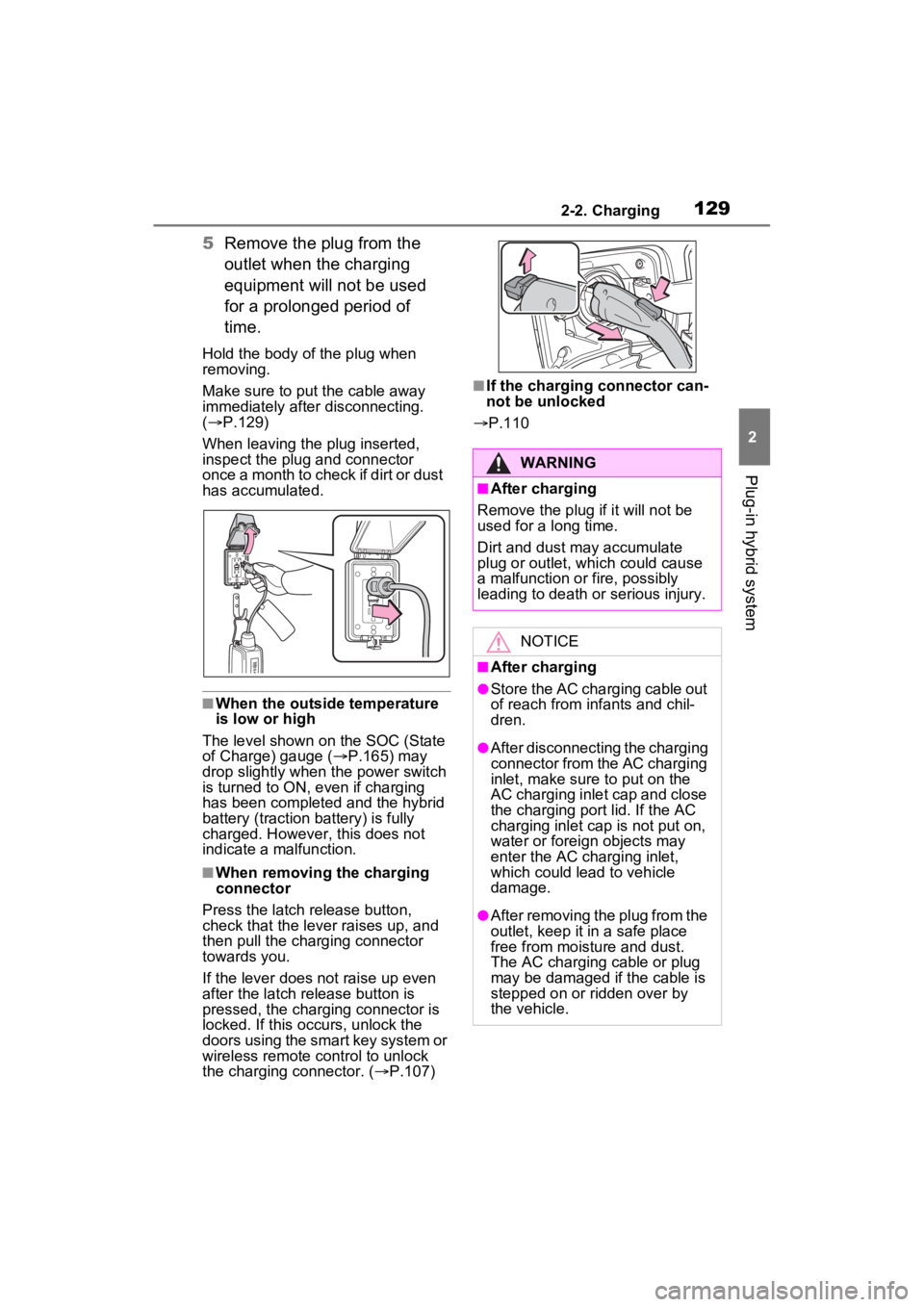
5Remove the plug from the
outlet when the charging
equipment will not be used
for a prolonged period of
time.
Hold the body of the plug when
removing.
Make sure to put the cable away
immediately afte r disconnecting.
( P.129)
When leaving the plug inserted,
inspect the plug and connector
once a month to check if dirt or dust
has accumulated.
■When the outside temperature
is low or high
The level shown on the SOC (State
of Charge) gauge ( P.165) may
drop slightly when the power switch
is turned to ON, e ven if charging
has been completed and the hybrid
battery (traction battery) is fully
charged. However, this does not
indicate a malfunction.
■When removing the charging
connector
Press the latch release button,
check that the lever raises up, and
then pull the charging connector
towards you.
If the lever does not raise up even
after the latch release button is
pressed, the charging connector is
locked. If this occurs, unlock the
doors using the smart key system or
wireless remote control to unlock
the charging connector. ( P.107)
■If the charging connector can-
not be unlocked
P.110
WARNING
■After charging
Remove the plug if it will not be
used for a long time.
Dirt and dust may accumulate
plug or outlet, which could cause
a malfunction or fire, possibly
leading to death or serious injury.
NOTICE
■After charging
●Store the AC charging cable out
of reach from infants and chil-
dren.
●After disconnecting the charging
connector from the AC charging
inlet, make sure to put on the
AC charging inlet cap and close
the charging port lid. If the AC
charging inlet cap is not put on,
water or foreign objects may
enter the AC cha rging inlet,
which could lead to vehicle
damage.
●After removing the plug from the
outlet, keep it in a safe place
free from moisture and dust.
The AC charging cable or plug
may be damaged if the cable is
stepped on or ridden over by
the vehicle.