airbag TOYOTA RAV4 PRIME 2023 Owners Manual
[x] Cancel search | Manufacturer: TOYOTA, Model Year: 2023, Model line: RAV4 PRIME, Model: TOYOTA RAV4 PRIME 2023Pages: 662, PDF Size: 25.4 MB
Page 1 of 662

RAV4 PRIME_OM_OM42E79U_(U)
1
2
3
4
5
6
7
8
9
10
Pictorial indexSearch by illustration
For safety
and securityMake sure to read through them
(Main topics: Child seat, theft deterrent system)
Plug-in hybrid
systemPlug-in hybrid system features, charging method,
etc.
(Main topics: Driving tips, charging methods)
Vehicle status
information and
indicatorsReading driving-related information
(Main topics: Meters, multi-information display)
Before driving
Opening and closing the doors and windows,
adjustment before driving
(Main topics: Keys, doors, seats, power windows)
Driving
Operations and advice which are necessary for
driving
(Main topics: Starting hybrid system, refueling)
Interior featuresUsage of the interior features
(Main topics: Air conditioner, storage features)
Maintenance
and careCaring for your vehicle and maintenance
procedures
(Main topics: Interior and exterior, light bulbs)
When trouble
arisesWhat to do in case of malfunction and emergency
(Main topics: 12-volt battery discharge, flat tire)
Vehicle
specificationsVehicle specifications, customizable features
(Main topics: Fuel, oil, tire inflation pressure)
For ownersReporting safety defects for U.S. owners, and seat
belt, SRS airbag and headlight aim instructions for
Canadian owners
IndexSearch by symptom
Search alphabetically
Page 2 of 662
2TABLE OF CONTENTS
For your information...................6
Reading this manual ................ 11
How to search .......................... 12
Pictorial index .......................... 14
1-1. For safe use Before driving ................... 26
For safe driving ................ 27
Seat belts ......................... 29
SRS airbags ..................... 33
Front passenger occupant classification system ...... 43
Exhaust gas precautions.. 48
1-2. Child safety Riding with children .......... 49
Child restraint systems..... 50
1-3. Emergency assistance Safety Connect ................ 65
1-4. Theft deterrent system Immobilizer system .......... 70
Alarm................................ 71
2-1. Plug-in hybrid system Plug-in hybrid system fea-tures ............................... 74
Plug-in hybrid system pre- cautions .......................... 85
Plug-in Hybrid Electric Vehi- cle driving tips ................ 90
EV driving range .............. 93
2-2. Charging Charging equipment......... 97AC charging cable .........
100
Locking and unlocking the charging port lid and
charging connector ...... 105
Power sources that can be used............................. 110
Charging methods ......... 113
Charging tips ................. 115
Things to know before charging....................... 117
How to charge ............... 121
Using the charging schedule function ........................ 128
Using the “My Room Mode” .................................... 148
When charging cannot be carried out ................... 152
3-1. Instrument cluster Warning lights and indicators.................................... 166
Gauges and meters (with 7- inch display) ................ 173
Gauges and meters (with 12.3-inch display) ........ 178
Multi-information display (with 7-inch display)..... 185
Multi-information display (with 12.3-inch display) 196
Head-up display ............ 208
Energy monitor/consumption screen.......................... 212
1For safety and security
2Plug-in hybrid system
3
Vehicle status
information and
indicators
Page 5 of 662
5TABLE OF CONTENTS
1
2
3
4
5
6
7
8
9
10
8-1. Essential informationEmergency flashers ...... 534
If your vehicle has to be stopped in an emergency.................................... 535
If the vehicle is submerged or water on the road is rising.................................... 536
8-2. Steps to take in an emer- gency
If your vehicle needs to be towed........................... 538
If you think something is wrong .......................... 540
If a warning light turns on or a warning buzzer sounds
.................................... 541
If a warning message is dis- played.......................... 552
If you have a flat tire...... 557
If the hybrid system will not start ............................. 564
If you lose your keys ..... 566
If the fuel filler door cannot be opened ................... 566
If the electronic key does not operate properly .......... 567
If the 12-volt battery is dis- charged ....................... 569
If your vehicle overheats 574
If the vehicle becomes stuck .................................... 5789-1. Specifications
Maintenance data (fuel, oil level, etc.) .................... 580
Fuel information............. 587
Tire information ............. 589
9-2. Customization Customizable features... 599
9-3. Initialization Items to initialize ............ 615
10-1.For owners Reporting safet y defects for
U.S. owners ................. 618
Reporting safet y defects for
Canadian owners ........ 619
Seat belt instructions for Canadian owners (in
French) ........................ 619
SRS airbag instructions for Canadian owners (in
French) ........................ 621
Headlight aim instructions for Canadian owners (in
French) ........................ 628
What to do if... (Trouble- shooting) ..................... 632
Alphabetical Index ........ 635
8When trouble arises9Vehicle specifications
10For owners
Index
Page 7 of 662

7
work properly or the danger that
it may work in situations where it
should not be working.
Installing electronic devices and
radios increases the risk of
cyber attacks through the
installed parts, which may lead
to unexpected accidents and
leakage of personal informa-
tion. Toyota does not make any
guarantees for problems caused
by installing non-genuine Toyota
products.
The installation of a mobile two-
way radio system in your vehicle
could affect electronic systems
such as:
Hybrid system
Multiport fuel injection sys-
tem/sequential multiport fuel
injection system
Toyota Safety Sense 2.5 +
Anti-lock brake system
SRS airbag system
Seat belt pretensioner system
Be sure to check with your
Toyota dealer for precautionary
measures or special instructions
regarding installation of a mobile
two-way radio system.
High voltage parts and cables on the Plug-in Hybrid Electric
Vehicles emit approximately the
same amount of electromag-
netic waves as the conventional
gasoline powered vehicles or
home electronic appliances
despite of their electromagnetic
shielding.
Unwanted noise may occur in
the reception of the mobile two-
way radio.
The vehicle is equipped with
sophisticated computers that will
record certain data, such as:
• Engine speed/ Electric motor
speed (traction motor speed)
• Accelerator status
• Brake status
• Vehicle speed
• Operation status of the driving assist systems
• Images from the cameras Your vehicle is equipped with
cameras. Contact your
Toyota dealer for the location
of recording cameras.
The recorded data varies
according to the vehicle grade
level and options with which it is
equipped.
These computers do not record
conversations or sounds, and
only record images outside of
the vehicle in certain situations.
Data Transmission
Your vehicle may transmit the data
Cyber Attack Risk
Installation of a mobile
two-way radio system
Vehicle data recording
Page 9 of 662

9
better understanding of the cir-
cumstances in which crashes
and injuries occur.
NOTE: EDR data are recorded
by your vehicle only if a non-triv-
ial crash situation occurs; no
data are recorded by the EDR
under normal driving conditions
and no personal data (e.g.,
name, gender, age, and crash
location) are recorded. How-
ever, other parties, such as law
enforcement, could combine the
EDR data with the type of per-
sonally identifying data rou-
tinely acquired during a crash
investigation.
To read data recorded by an
EDR, special equipment is
required, and access to the
vehicle or the EDR is needed. In
addition to the vehicle manufac-
turer, other parties, such as law
enforcement, that have the spe-
cial equipment, can read the
information if they have access
to the vehicle or the EDR.
Disclosure of the EDR data
Toyota will not disclose the data
recorded in an EDR to a third party
except when:
• An agreement from the vehicle’s
owner (or the less ee for a leased
vehicle) is obtained
• In response to an official request by the police, a court of law or a
government agency
• For use by Toyota in a lawsuit
However, if necessary, Toyota may:
• Use the data for research on
vehicle safety performance
• Disclose the data to a third party for research pur poses without
disclosing information about the
specific vehicle or vehicle owner
The SRS airbag and seat belt
pretensioner devices in your
Toyota contain ex plosive chemi-
cals. If the vehicle is scrapped
with the airbags and seat belt
pretensioners left as they are,
this may cause an accident such
as fire. Be sure to have the sys-
tems of the SRS airbag and seat
belt pretensioner removed and
disposed of by a qualified ser-
vice shop or by your Toyota
dealer before you scrap your
vehicle.
Special handling may apply,
See www.dtsc.ca.gov/
hazardouswaste/perchlorate.
Your vehicle has components
that may contain perchlorate.
These components may include
the airbags, seat belt preten-
sioners, wireless remote control
batteries, and the batteries in
the tire pressure warning valve
and transmitters.
Scrapping of your Toyota
Perchlorate Material
Page 22 of 662
22Pictorial index
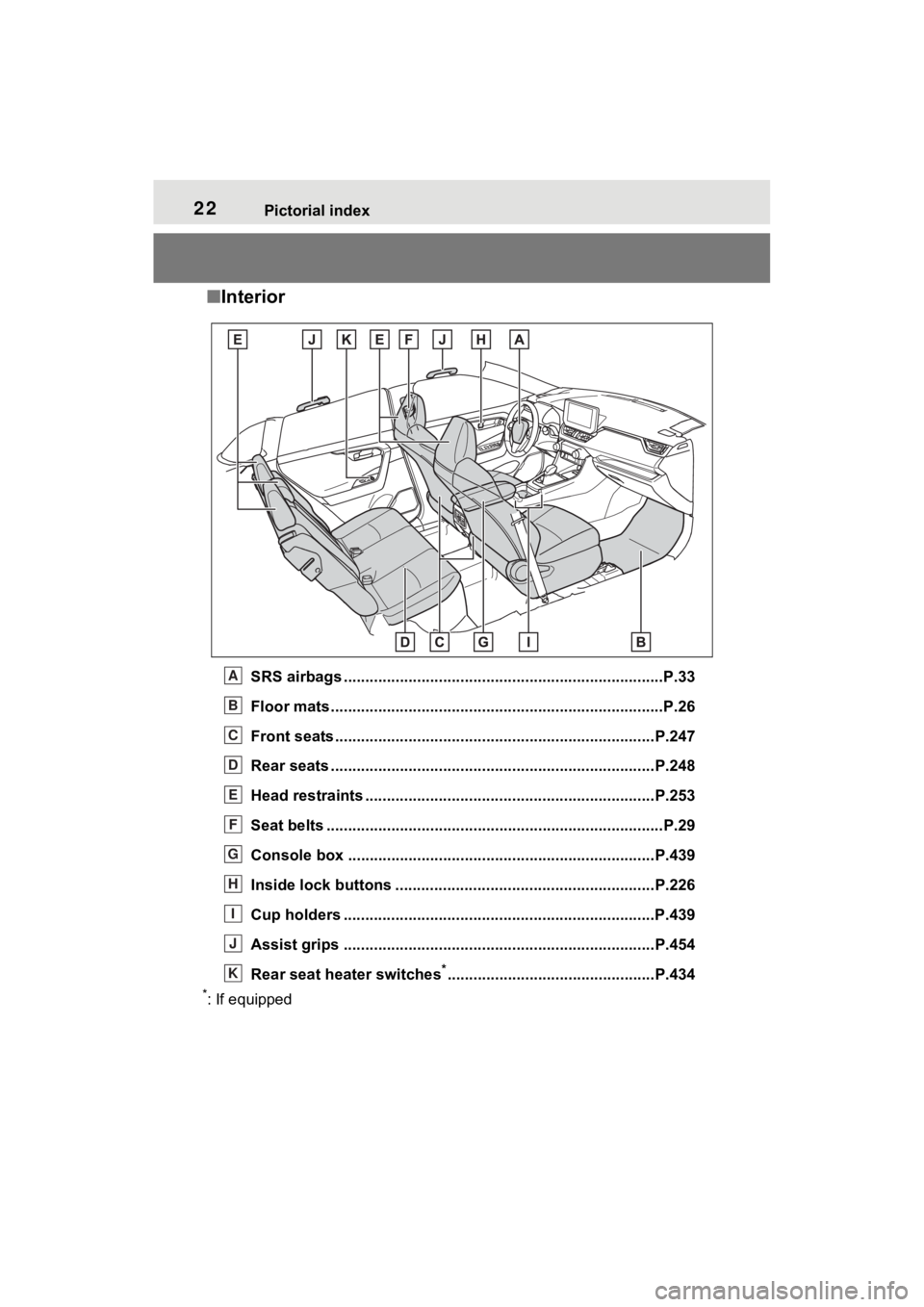
■Interior
SRS airbags .................................................... ......................P.33
Floor mats..................................................... ........................P.26
Front seats .................................................... ......................P.247
Rear seats ..................................................... ......................P.248
Head restraints ...................................................................P.253
Seat belts ..................................................... .........................P.29
Console box .................................................... ...................P.439
Inside lock buttons ............................................ ................P.226
Cup holders ........................................................................P.439
Assist grips ................................................... .....................P.454
Rear seat heater switches
*................................................P.434
*: If equipped
A
B
C
D
E
F
G
H
I
J
K
Page 25 of 662

25
1
1
For safety and security
For safety and security
1-1. For safe useBefore driving ................. 26
For safe driving .............. 27
Seat belts ....................... 29
SRS airbags ................... 33
Front passenger occupant classification system .... 43
Exhaust gas precautions 48
1-2. Child safety Riding with children ........ 49
Child restraint systems... 50
1-3. Emergency assistance Safety Connect .............. 65
1-4. Theft deterrent system Immobilizer sys tem ........70
Alarm.............................. 71
Page 33 of 662
331-1. For safe use
1
For safety and security
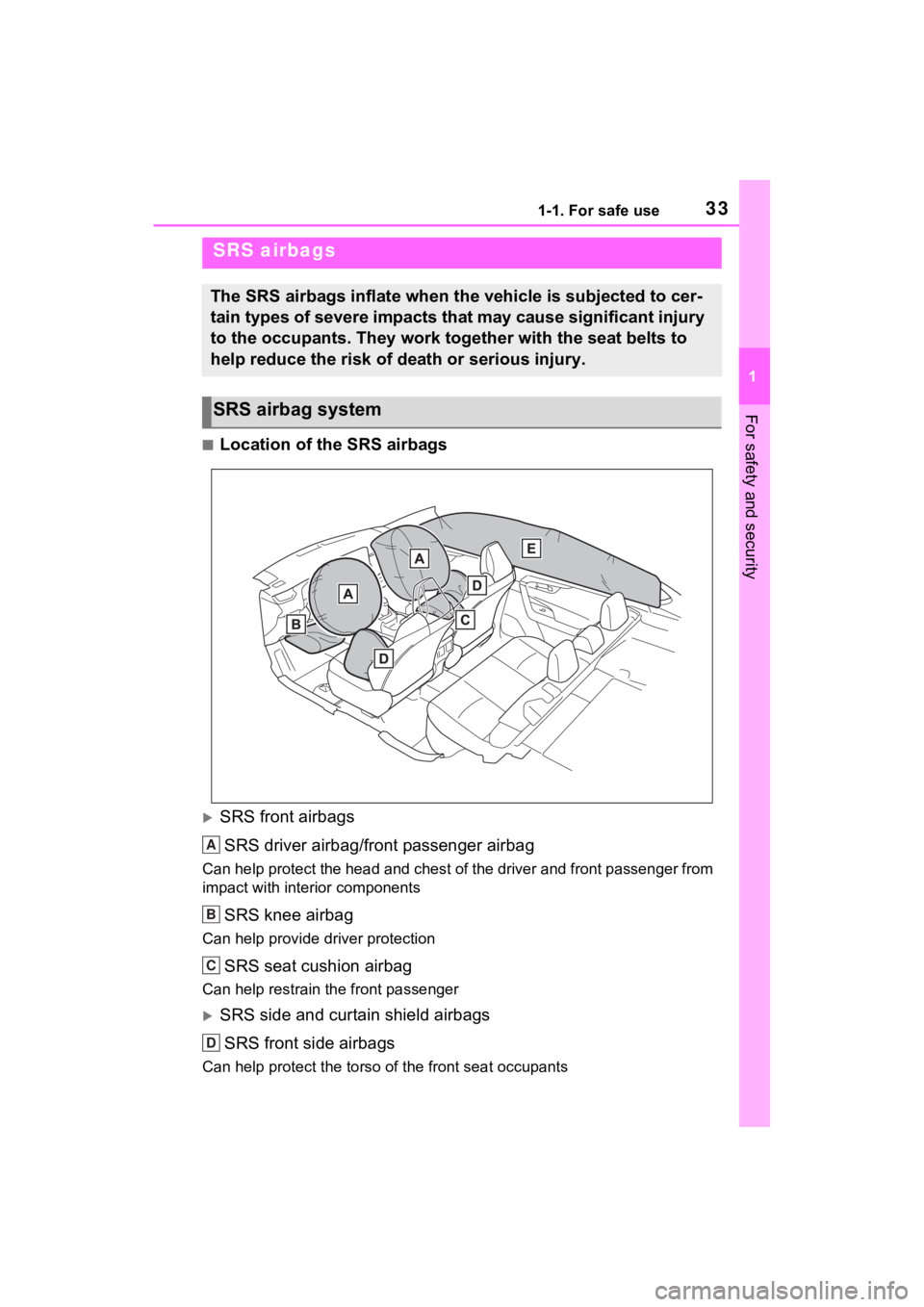
■Location of the SRS airbags
SRS front airbagsSRS driver airbag/front passenger airbag
Can help protect the head and chest of the driver and front passenger from
impact with interior components
SRS knee airbag
Can help provide dr iver protection
SRS seat cushion airbag
Can help restrain the front passenger
SRS side and curtain shield airbags
SRS front side airbags
Can help protect the torso of the front seat occupants
SRS airbags
The SRS airbags inflate when the vehicle is subjected to cer-
tain types of severe impacts that may cause significant injury
to the occupants. They work together with the seat belts to
help reduce the risk of death or serious injury.
SRS airbag system
A
B
C
D
Page 34 of 662
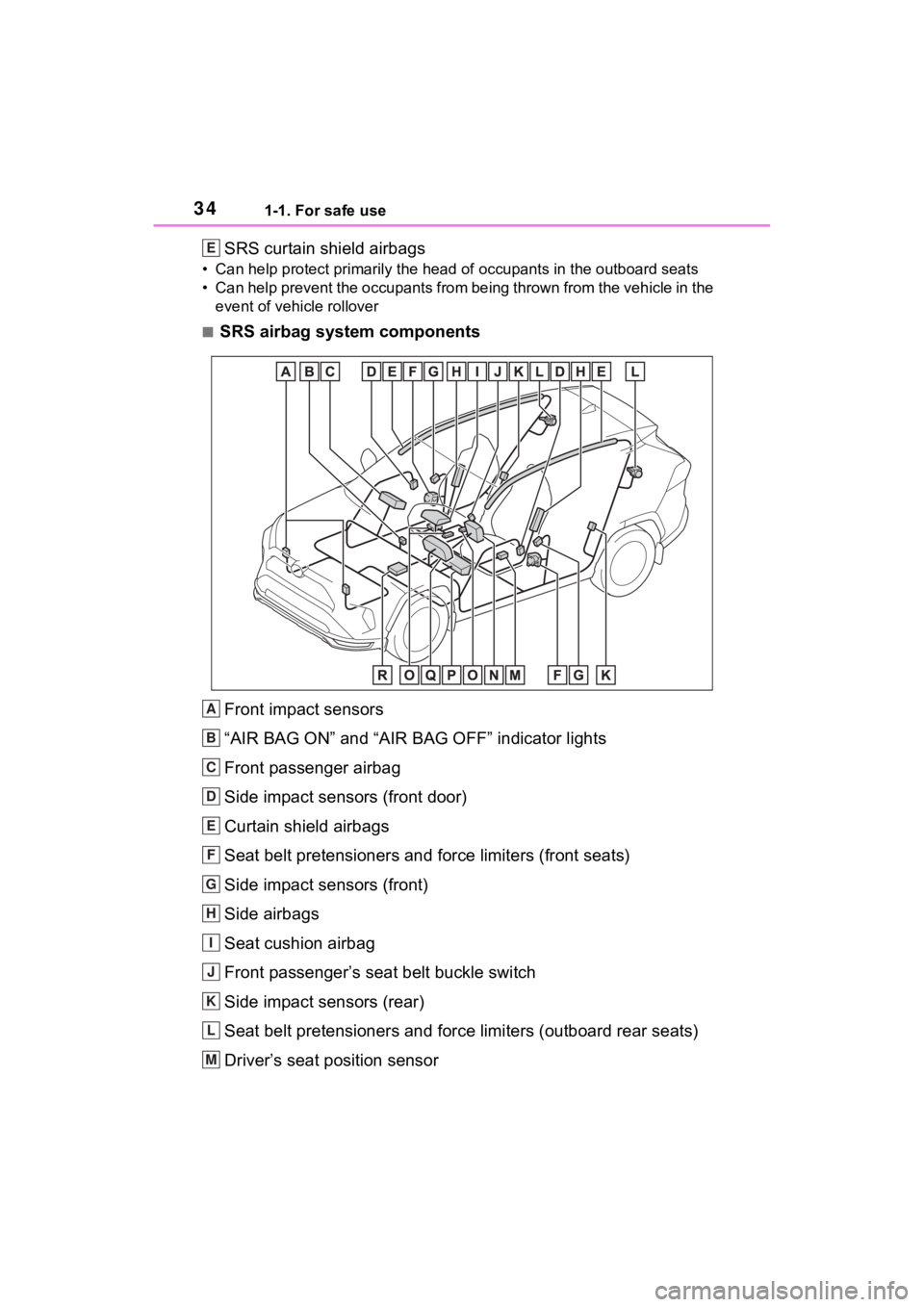
341-1. For safe use
SRS curtain shield airbags
• Can help protect primarily the head of occupants in the outboard seats
• Can help prevent the occupants from being thrown from the vehi cle in the
event of vehicle rollover
■SRS airbag system components
Front impact sensors
“AIR BAG ON” and “AIR BAG OFF” indicator lights
Front passenger airbag
Side impact sensors (front door)
Curtain shield airbags
Seat belt pretensioners and force limiters (front seats)
Side impact sensors (front)
Side airbags
Seat cushion airbag
Front passenger’s seat belt buckle switch
Side impact sensors (rear)
Seat belt pretensioners and force limiters (outboard rear seats)
Driver’s seat position sensor
E
A
B
C
D
E
F
G
H
I
J
K
L
M
Page 35 of 662

351-1. For safe use
1
For safety and security
Driver airbag
Front passenger occupant classification sensors
Knee airbag
SRS warning light
Airbag sensor assembly
Your vehicle is equipped with ADVANCED AIRBAGS designed
based on the US motor vehicle safety standards (FMVSS208). The
airbag sensor assembly (ECU) cont rols airbag deployment based on
information obtained from the sensors etc. shown in the system
components diagram above. This in formation includes crash sever-
ity and occupant information. As the airbags deploy, a chemical
reaction in the inflators quickly fills the airbags with non-toxic gas to
help restrain the motion of the occupants.
■If the SRS airbags deploy
(inflate)
●Slight abrasions, burns, bruising
etc., may be sustained from SRS
airbags, due to the extremely high
speed deployment (inflation) by
hot gases.
●A loud noise and white powder will
be emitted.
●Parts of the airbag module (steer-
ing wheel hub, airbag cover and
inflator) as well as the front seats,
parts of the front and rear pillars,
and roof side rails, may be hot for
several minutes. T he airbag itself
may also be hot.
●The windshield may crack.
●The hybrid system will be stopped
and fuel supply to the engine will
be stopped. ( P.89)
●All of the doors will be unlocked.
( P.223)
●The brakes and st op lights will be
controlled automatically.
( P.408)
●The interior lights will turn on auto-
matically. ( P.436)
●The emergency flashers will turn
on automatically. ( P.534)
●For Safety Connect subscribers, if
any of the following situations
occur, the system is designed to
send an emergency call to the
response center, notifying them of
the vehicle’s location (without
needing to push the “SOS” button)
and an agent will attempt to speak
with the occupants to ascertain
the level of emergency and assis-
tance required. If the occupants
are unable to communicate, the
agent automatically treats the call
as an emergency and helps to dis-
patch the necessary emergency
services. ( P.65)
• An SRS airbag is deployed.
• A seat belt pretensioner is acti-
vated.
• The vehicle is involved in a severe
rear-end collision.
■SRS airbag deployment condi-
tions (SRS front airbags)
●The SRS front airbags will deploy
in the event of an impact that
exceeds the set threshold level
(the level of forc e corresponding
to an approximately 12 - 18 mph
[20 - 30 km/h] frontal collision with
a fixed wall that does not move or
deform).
However, this threshold velocity will
N
O
P
Q
R