height TOYOTA SEQUOIA 2008 2.G User Guide
[x] Cancel search | Manufacturer: TOYOTA, Model Year: 2008, Model line: SEQUOIA, Model: TOYOTA SEQUOIA 2008 2.GPages: 596, PDF Size: 12.93 MB
Page 204 of 596
204 2-4. Using other driving systems
■Automatic leveling function
Regardless of the number of occupants or the luggage load, vehicle height
in any mode is always adjusted to a fixed height by the automatic leveling
function.
■ When HI mode is selected
The vehicle height will change to N mode when driving at the speeds of 1\
8
mph (30 km/h).
■ When LO mode is selected
●The vehicle height will change to N mode when vehicle speed exceeds 7
mph (12 km/h).
● This mode allows for easy access to the vehicle (getting in and out) and
easy loading and unloading.
■ The electronically modulated air susp ension will not operate in the fol-
lowing cases:
● The underbody of the vehicle is touching the surface of the road.
● The area around the suspension is covered with ice.
The indicators will blink, turn off and then turn on continuously to indicate
that the electronically modulated air suspension is not operational.
To re-enable operation, turn off the engine and then restart it.
■ Even if you hear an operating noise
This does not indicate a problem in the electronically modulated air suspen-
sion.
■ If there is a problem somewhere in the electronically modulated air
suspension
The height control MAN. indicator will behave as follows:
●The indicator will not come on when the engine switch is turned on.
● The indicator will blink.
Although the vehicle may be driven, have the vehicle inspected by your Toy-
ota dealer.
Page 205 of 596
205
2-4. Using other
driving systems
2
When driving
CAUTION
■The electronically modulated air susp ension must be turned off in the
following circumstances:
Otherwise, the automatic leveling function may cause the vehicle’s height to
change, resulting in an unexpected accident.
● When driving through water such as shallow streams (Put the vehicle
height in HI mode and turn off the electronically modulated air suspension.
Drive at 18 mph [30 km/h] or slower.)
● When jacking up the vehicle, installing tire chains or tying the vehicle with
chains/wires for transportation via flat bed truck (Turn the system to the
manual mode and stop the engine.)
● When the vehicle must be towed (Put the vehicle height in N mode and
turn the system to the manual mode.)
● When the vehicle gets stuck (Turn the system to the manual mode.)
● When disconnecting a trailer (Put the vehicle height in LO mode and turn
the system to the manual mode.)
■ Selecting the correct height mode
Observe the following precautions to prevent accidents.
Failure to do so may cause damage to parts of the vehicle, as well as dan-
gerous handling characteristics, which may lead to fatal or injury accidents.
●Before you lower the vehicle’s height, check under the vehicle to make
sure that no one is there.
● The HI mode should be used for off-road driving conditions.
As the vehicle’s center of gravity is higher in this setting, the vehicle may
become unstable when turning abruptly.
● Do not select HI mode when you load cargo on the roof luggage carrier.
This may result in a loss of control or vehicle rollover.
Page 206 of 596
206 2-4. Using other driving systems
NOTICE
■Be careful in any place where overhead space is limited.
When changing to a higher mode or after unloading, the vehicle height will
rise. This may cause damage to the vehicle.
■ Do not select LO mode when driving on bumpy roads.
If the underbody of the vehicle touches a rugged road surface, the vehicle
may be damaged.
■ Do not change the vehicle height frequently.
The compressor might overheat and cause the operation to stop.
■ When on the extremely uneven roads with rocks
Sometimes the vehicle height is not adjusted because it is judged as uneven
road driving.
Page 219 of 596
219
2
When driving
2-5. Driving information
Off-road precautions
Off-road vehicle feature● Specific design characteristics give it a higher center of gravity
than ordinary passenger cars. This vehicle design feature causes
this type of vehicle to be more likel y to rollover. And, utility vehicles
have a significantly higher rollover rate than other types of vehi-
cles.
● An advantage of the higher ground clearance is a better view of the
road allowing you to anticipate problems.
● It is not designed for cornering at the same speeds as ordinary
passenger cars any more than lo w-slung sports cars designed to
perform satisfactorily under off-r oad conditions. Therefore, sharp
turns at excessive speeds may cause rollover.
This vehicle belongs to the utility vehicle class, which has higher
ground clearance and narrower tread in relation to the height of its
center of gravity to make it capable of performing in a wide variety of
off-road applications.
Page 243 of 596
243
2-5. Driving information
2
When driving
■
Before towing
Check that the following conditions are met:
●Ensure that your vehicle’s tires are properly inflated. ( P. 553)
● Trailer tires should be inflated according to the trailer manufacturer’s rec-
ommendation.
● All trailer lights work to be legal.
● All lights work each time you connect them.
● The trailer ball is set up at the proper height for the coupler on the t\
railer.
● The vehicle remains level when a loaded or unloaded trailer is hitched.
Do not drive if the vehicle is not level, and check for improper tongue
load, overloading, worn suspension, or other possible causes.
● The trailer cargo is securely loaded.
● The rear view mirrors conform to all applicable federal, state/provincial or
local regulations. If they do not, instal l rear view mirrors appropriate for
towing purposes.
● Depress TOW/HAUL button (if equipped)
■ When connecting and disconnecting a trailer
Set the electronically modulated air suspension system to MAN., or turn off
the engine, when the system is in N mode. (if equipped)
■ AVS (adaptive variable suspension system) (if equipped)
The suspension can be switched for improvement in driveability. ( P. 207)
■ Break-in schedule
●Toyota recommends that you do not use a new vehicle or a vehicle with
any new power train components (engine, transmission, differential,
wheel bearings, etc.) to tow a trailer for the first 500 miles (800 km) of
driving.
● Drive the vehicle at a speed of less than 50 mph (80 km/h) when towing a
trailer for another 500 miles (800 km/h).
● Avoid full throttle acceleration.
■ Maintenance
●If you tow a trailer, your vehicle will require more frequent maintenance
due to the additional load. (See “Scheduled Maintenance Guide” or
“Owner’s Manual Supplement”.)
Page 519 of 596
5
When trouble arises
519
5-2. Steps to take in an emergency
If you have a flat tire
Remove the flat tire and replace it with the spare provided.
■Before jacking up the vehicle
●Stop the vehicle on a hard, flat surface.
● Press the height control mode select switch to set the height
control system to manual mode (if equipped)
● Set the parking brake.
● Shift the shift lever to P.
● Stop the engine.
● Turn on the emergency flashers.
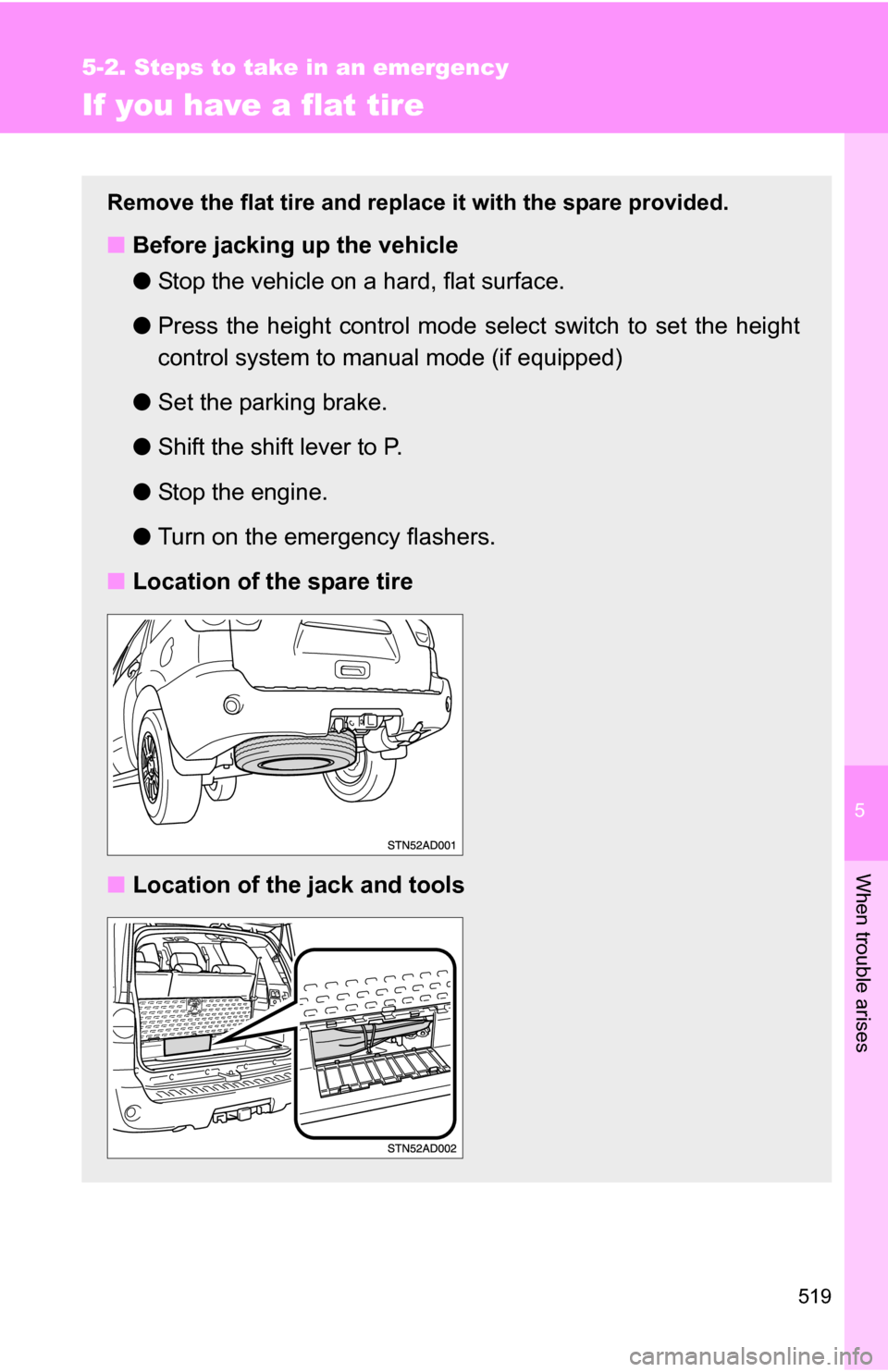
■ Location of the spare tire
■ Location of the jack and tools
Page 542 of 596
542
6-1. Specifications
Maintenance data (fuel, oil level, etc.)
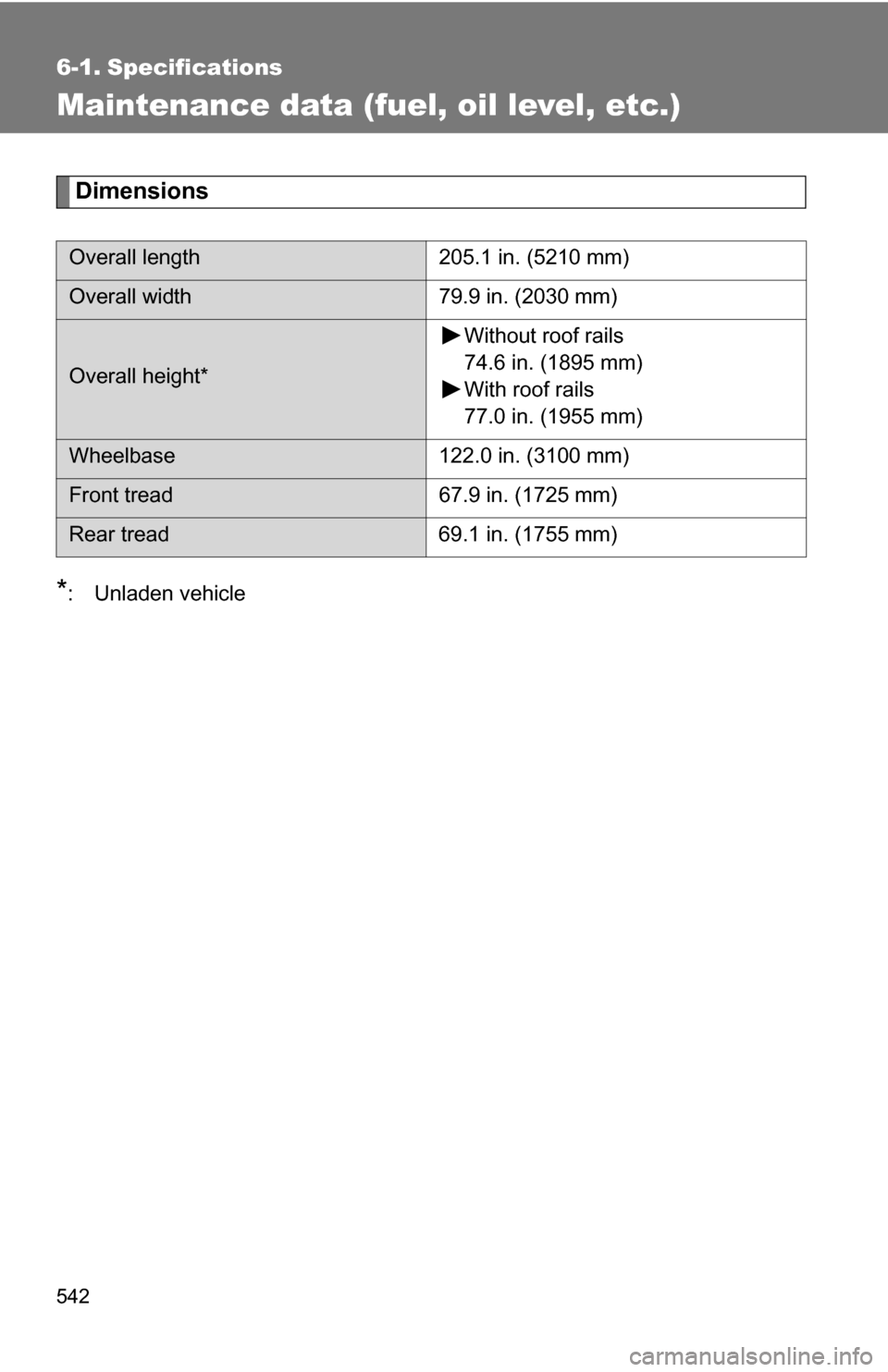
Dimensions
*: Unladen vehicle
Overall length205.1 in. (5210 mm)
Overall width79.9 in. (2030 mm)
Overall height* Without roof rails
74.6 in. (1895 mm)
With roof rails
77.0 in. (1955 mm)
Wheelbase
122.0 in. (3100 mm)
Front tread 67.9 in. (1725 mm)
Rear tread69.1 in. (1755 mm)
Page 560 of 596
560 6-1. Specifications
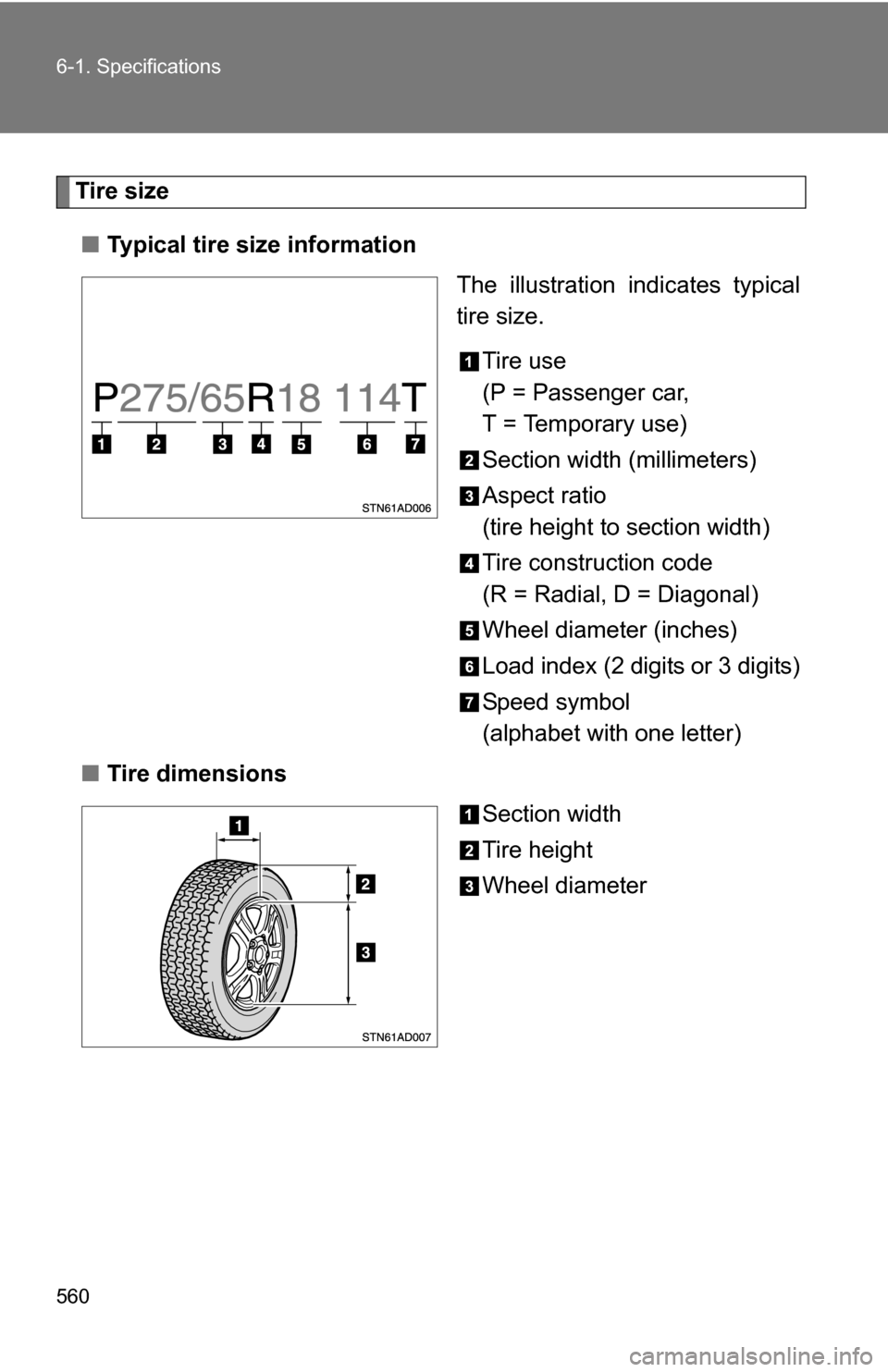
Tire size■ Typical tire size information
The illustration indicates typical
tire size.
Tire use
(P = Passenger car,
T = Temporary use)
Section width (millimeters)
Aspect ratio
(tire height to section width)
Tire construction code
(R = Radial, D = Diagonal)
Wheel diameter (inches)
Load index (2 digits or 3 digits)
Speed symbol
(alphabet with one letter)
■ Tire dimensions
Section width
Tire height
Wheel diameter
Page 587 of 596
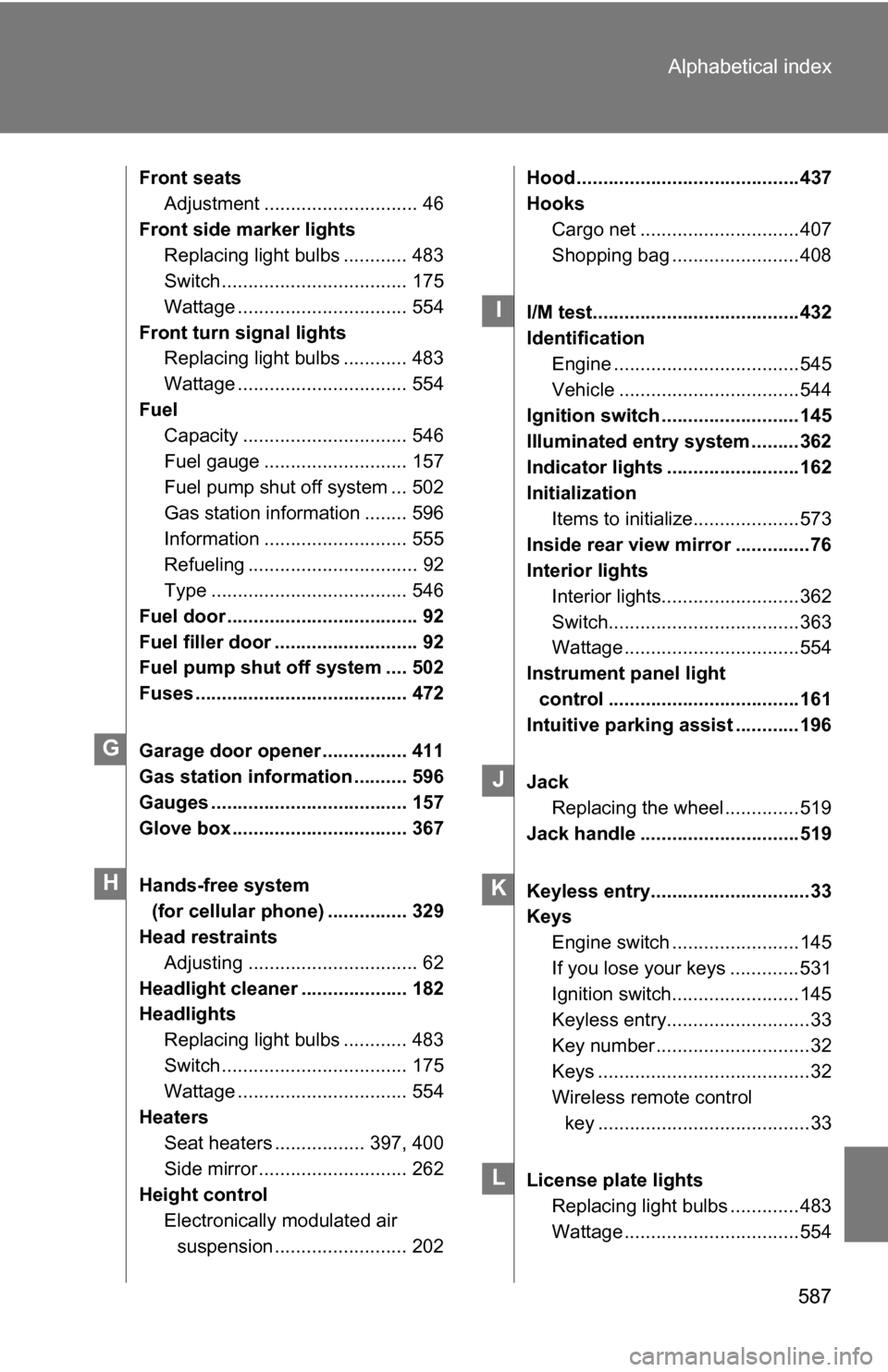
587
Alphabetical index
Front seats
Adjustment ............................. 46
Front side marker lights Replacing light bulbs ............ 483
Switch ................................... 175
Wattage ................................ 554
Front turn signal lights Replacing light bulbs ............ 483
Wattage ................................ 554
Fuel Capacity ............................... 546
Fuel gauge ........................... 157
Fuel pump shut off system ... 502
Gas station information ........ 596
Information ........................... 555
Refueling ................................ 92
Type ..................................... 546
Fuel door .................................... 92
Fuel filler door ........................... 92
Fuel pump shut off system .... 502
Fuses ........................................ 472
Garage door opener ................ 411
Gas station information .......... 596
Gauges ..................................... 157
Glove box ................................. 367
Hands-free system (for cellular phone) ............... 329
Head restraints
Adjusting ................................ 62
Headlight cleaner .................... 182
Headlights Replacing light bulbs ............ 483
Switch ................................... 175
Wattage ................................ 554
Heaters Seat heaters ................. 397, 400
Side mirror ............................ 262
Height control Electronically modulated air suspension ......................... 202 Hood ..........................................437
Hooks
Cargo net ..............................407
Shopping bag ........................408
I/M test.......................................432
Identification Engine ...................................545
Vehicle ..................................544
Ignition switch ..........................145
Illuminated entry system .........362
Indicator lights .........................162
Initialization
Items to initialize....................573
Inside rear view mirror ..............76
Interior lights Interior lights..........................362
Switch....................................363
Wattage .................................554
Instrument panel light control ....................................161
Intuitive parking assist ............196
Jack
Replacing the wheel ..............519
Jack handle ..............................519
Keyless entry..............................33
Keys Engine switch ........................145
If you lose your keys .............531
Ignition switch........................145
Keyless entry...........................33
Key number .............................32
Keys ........................................32
Wireless remote control key ........................................33
License plate lights Replacing light bulbs .............483
Wattage .................................554
G
H
I
J
K
L