lights TOYOTA SEQUOIA 2008 2.G User Guide
[x] Cancel search | Manufacturer: TOYOTA, Model Year: 2008, Model line: SEQUOIA, Model: TOYOTA SEQUOIA 2008 2.GPages: 596, PDF Size: 12.93 MB
Page 98 of 596
98
1-6. Theft deterrent system
Alarm
The system sounds the alarm and flashes lights when forcible entry
is detected.
■ Triggering of the alarm
The alarm is triggered in the following situations.
●A locked door is unlocked or opened in any way other than
using the wireless remote control door lock function or key.
The doors will lock again automatically.
● The hood is opened while t he vehicle is locked.
● Vehicles with the glass breakage sensor (if equipped): The
side windows are tapped or broken.
● The battery is reconnected.
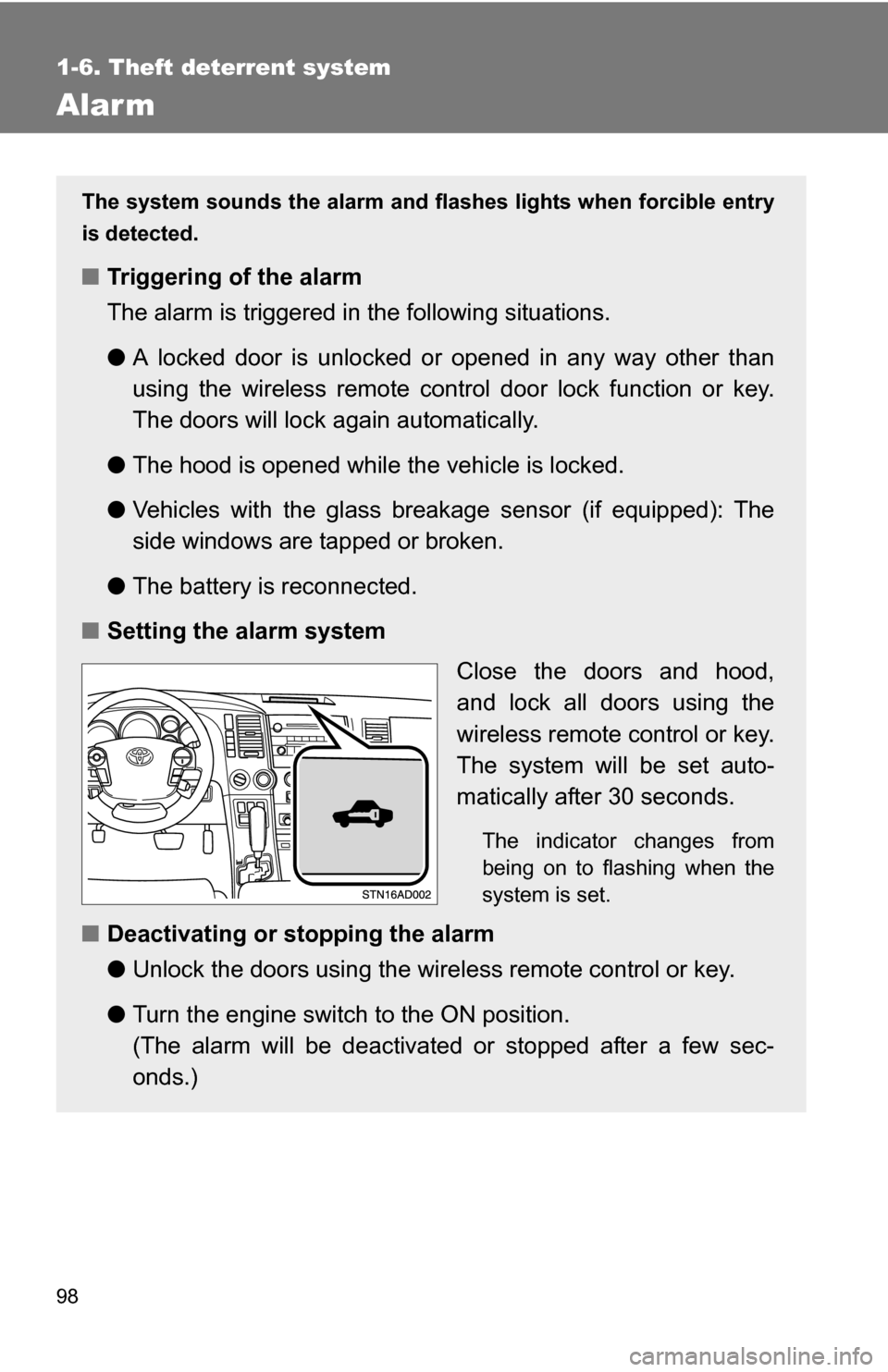
■ Setting the alarm system
Close the doors and hood,
and lock all doors using the
wireless remote control or key.
The system will be set auto-
matically after 30 seconds.
The indicator changes from
being on to flashing when the
system is set.
■Deactivating or stopping the alarm
●Unlock the doors using the wire less remote control or key.
● Turn the engine switch to the ON position.
(The alarm will be deactivated or stopped after a few sec-
onds.)
Page 104 of 596
104 1-7. Safety information
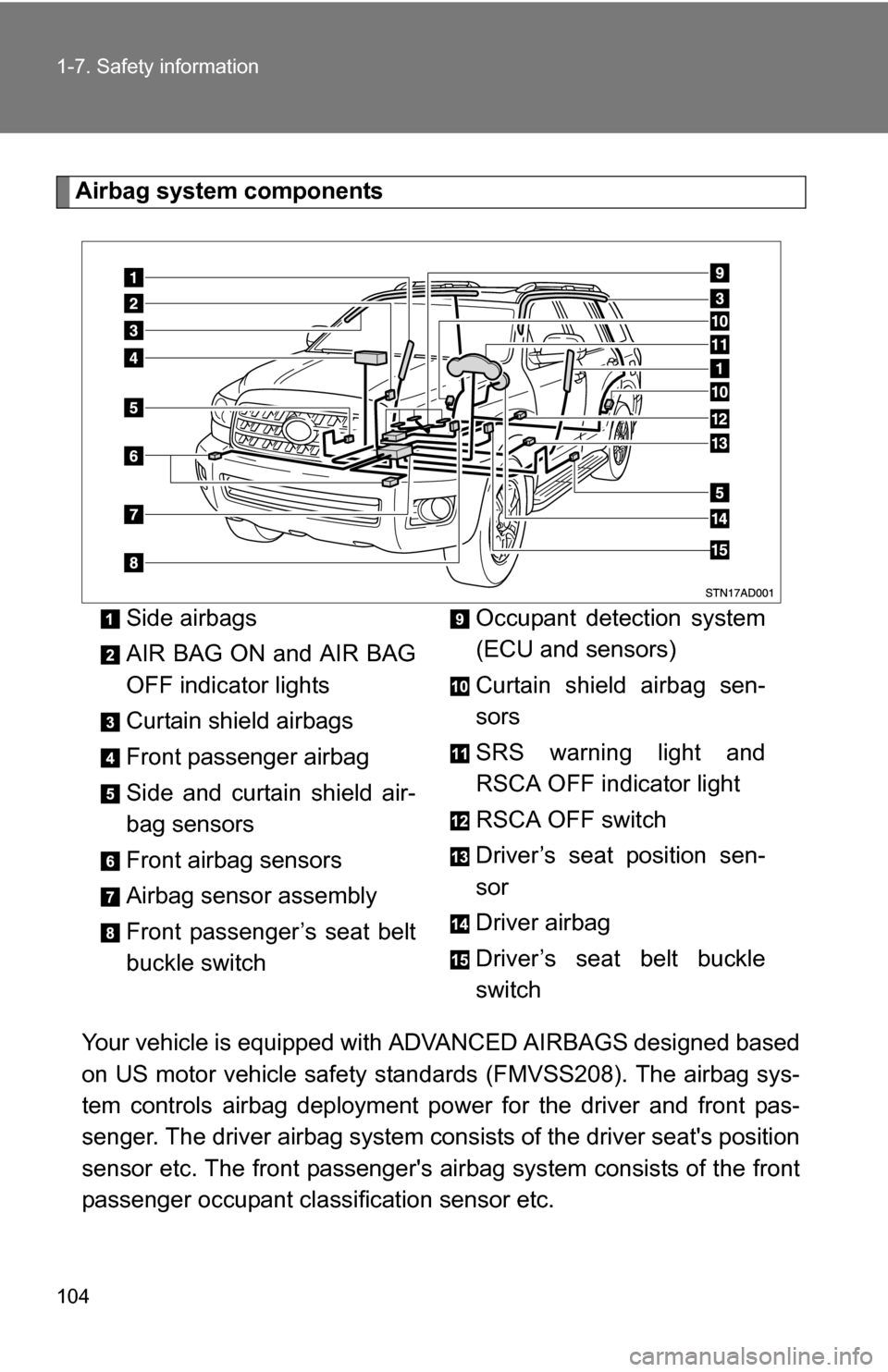
Airbag system componentsYour vehicle is equipped with ADVANCED AIRBAGS designed based
on US motor vehicle safety standards (FMVSS208). The airbag sys-
tem controls airbag deployment po wer for the driver and front pas-
senger. The driver airbag system cons ists of the driver seat's position
sensor etc. The front passenger's airbag system consists of the front
passenger occupant classification sensor etc. Side airbags
AIR BAG ON and AIR BAG
OFF indicator lights
Curtain shield airbags
Front passenger airbag
Side and curtain shield air-
bag sensors
Front airbag sensors
Airbag sensor assembly
Front passenger’s seat belt
buckle switch
Occupant detection system
(ECU and sensors)
Curtain shield airbag sen-
sors
SRS warning light and
RSCA OFF indicator light
RSCA OFF switch
Driver’s seat position sen-
sor
Driver airbag
Driver’s seat belt buckle
switch
Page 105 of 596
105
1-7. Safety information
1
Before driving
The main SRS airbag system components are shown above. The
SRS airbag system is controlled by
the airbag sensor assembly. The
airbag sensor assembly consists of a safing sensor and an airbag
sensor.
In certain types of severe frontal or side impacts, the SRS airbag sys-
tem triggers the airbag inflators. A chemical reaction in the inflators
quickly fills the airbags with non-toxic gas to help rest rain the motion
of the occupants.
■ SRS warning light
This warning light system monitors the airbag sensor assembly, front airbag
sensors, side and curtain shield airbag sensor assemblies, curtain shield air-
bag sensor assemblies, driver's seat position sensor, driver's seat belt
buckle switch, front passenger occupant classification system, AIR BAG ON
and AIR BAG OFF indicator lights, front passenger’s seat belt buckle switch,
front seat belt pretensioner assemblies , RSCA OFF indicator light, inflators,
interconnecting wiring and power sources. ( P. 506)
■ If the SRS airbags deploy (inflate)
●Bruising and slight abrasions may result from contact with a deploying
(inflating) SRS airbag.
● A loud noise and white powder will be emitted.
● Parts of the airbag module (steering wheel hub, airbag cover and inflator)
as well as the front seats, and parts of the front and rear pillars and roof
side rail, may be hot for several minutes. The airbag itself may also be
hot.
● The front windshield may crack.
Page 117 of 596
117
1-7. Safety information
1
Before driving
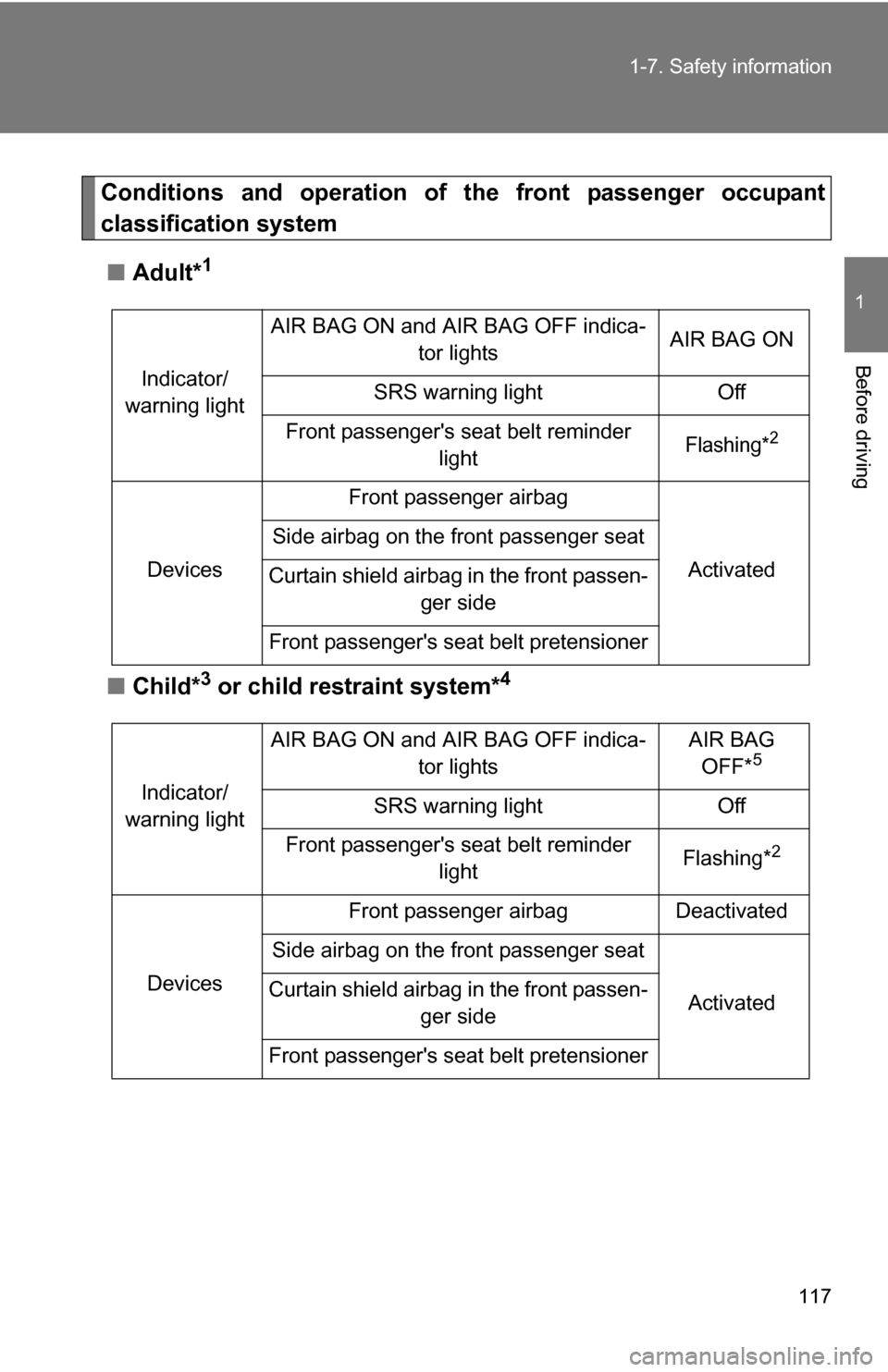
Conditions and operation of
the front passenger occupant
classification system
■ Adult*
1
■Child*3 or child restraint system*4
Indicator/
warning light AIR BAG ON and AIR BAG OFF indica-
tor lights AIR BAG ON
SRS warning light Off
Front passenger's seat belt reminder light
Flashing*2
Devices Front passenger airbag
Activated
Side airbag on the front passenger seat
Curtain shield airbag in the front passen- ger side
Front passenger's seat belt pretensioner
Indicator/
warning light AIR BAG ON and AIR BAG OFF indica-
tor lights AIR BAG
OFF*
5
SRS warning light Off
Front passenger's seat belt reminder light Flashing*
2
DevicesFront passenger airbag Deactivated
Side airbag on the front passenger seat
Activated
Curtain shield airbag in the front passen-
ger side
Front passenger's seat belt pretensioner
Page 118 of 596
118 1-7. Safety information
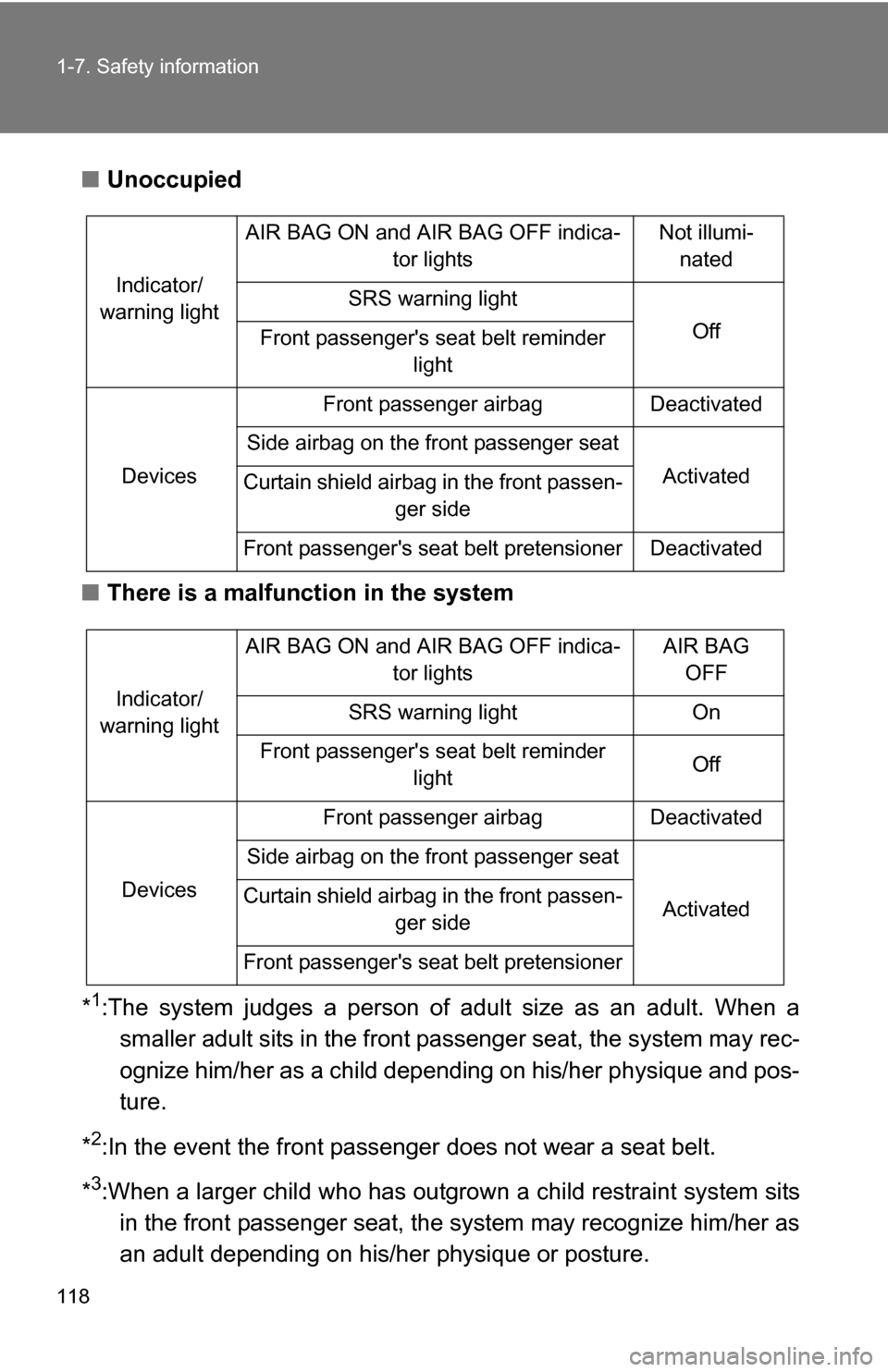
■Unoccupied
■ There is a malfunction in the system
*
1:The system judges a person of adult size as an adult. When a smaller adult sits in the front passenger seat, the system may rec-
ognize him/her as a child depending on his/her physique and pos-
ture.
*
2:In the event the front passenger does not wear a seat belt.
*
3:When a larger child who has outgrow n a child restraint system sits
in the front passenger seat, the system may recognize him/her as
an adult depending on his/her physique or posture.
Indicator/
warning light AIR BAG ON and AIR BAG OFF indica-
tor lights Not illumi-
nated
SRS warning light Off
Front passenger's seat belt reminder
light
Devices Front passenger airbag Deactivated
Side airbag on the front passenger seat Activated
Curtain shield airbag in the front passen-
ger side
Front passenger's seat belt pretensioner Deactivated
Indicator/
warning light AIR BAG ON and AIR BAG OFF indica-
tor lights AIR BAG
OFF
SRS warning light On
Front passenger's seat belt reminder light Off
Devices Front passenger airbag Deactivated
Side airbag on the front passenger seat
Activated
Curtain shield airbag in the front passen-
ger side
Front passenger's seat belt pretensioner
Page 135 of 596
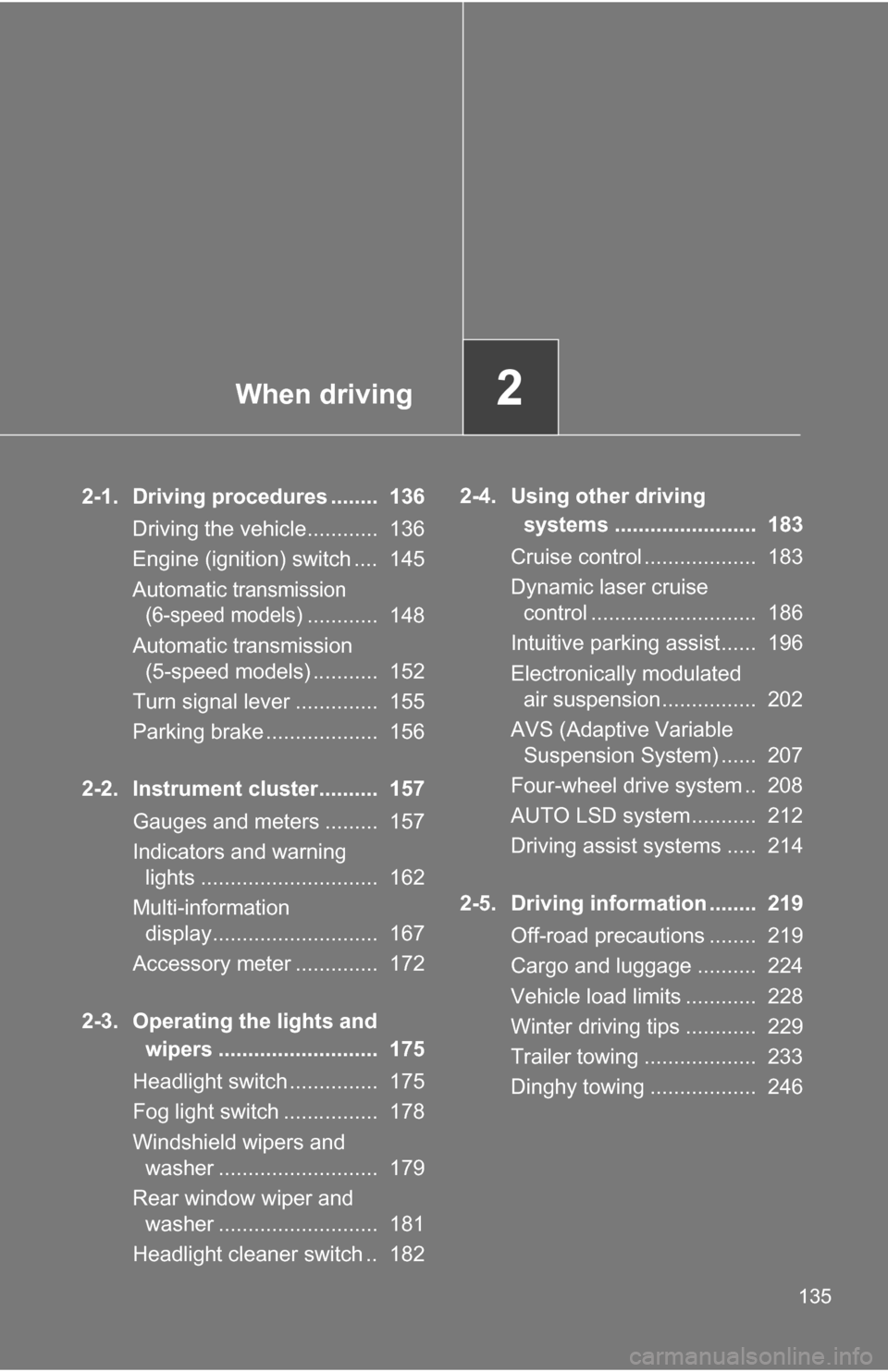
When driving2
135
2-1. Driving procedures ........ 136Driving the vehicle............ 136
Engine (ignition) switch .... 145
Automatic
transmission
(6-speed models)
............ 148
Automatic transmission (5-speed models) ........... 152
Turn signal lever .............. 155
Parking brake ................... 156
2-2. Instrument cluster.......... 157 Gauges and meters ......... 157
Indicators and warning lights .............................. 162
Multi-information display............................ 167
Accessory meter .............. 172
2-3. Operating the lights and wipers ........................... 175
Headlight switch ............... 175
Fog light switch ................ 178
Windshield wipers and washer ........................... 179
Rear window wiper and washer ........................... 181
Headlight cleaner switch .. 182 2-4. Using other driving
systems ........................ 183
Cruise control ................... 183
Dynamic laser cruise control ............................ 186
Intuitive parking assist...... 196
Electronically modulated air suspension ................ 202
AVS (Adaptive Variable Suspension System) ...... 207
Four-wheel drive system .. 208
AUTO LSD system........... 212
Driving assist systems ..... 214
2-5. Driving information ........ 219 Off-road precautions ........ 219
Cargo and luggage .......... 224
Vehicle load limits ............ 228
Winter driving tips ............ 229
Trailer towing ................... 233
Dinghy towing .................. 246
Page 155 of 596
155
2-1. Driving procedures
2
When driving
Tur n signal lever
■Turn signals can be operated when
The engine switch is in the ON position.
■ If the indicators flash faster than usual
Check that a light bulb in the front or rear turn signal lights has not burned
out.
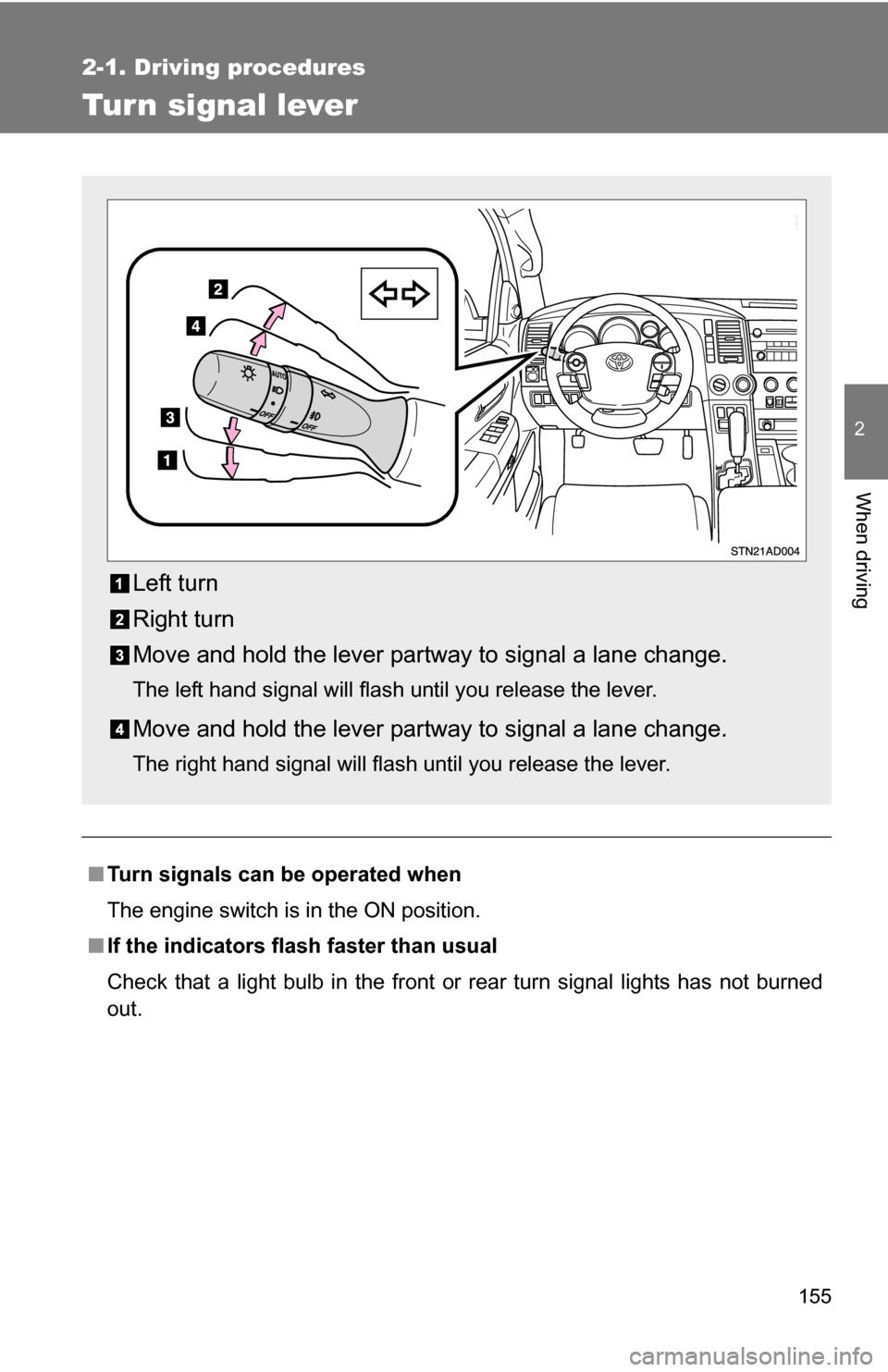
Left turn
Right turn
Move and hold the lever partway to signal a lane change.
The left hand signal will flash until you release the lever.
Move and hold the lever partway to signal a lane change.
The right hand signal will flash until you release the lever.
Page 161 of 596
161
2-2. Instrument cluster
2
When driving
Instrument panel light control
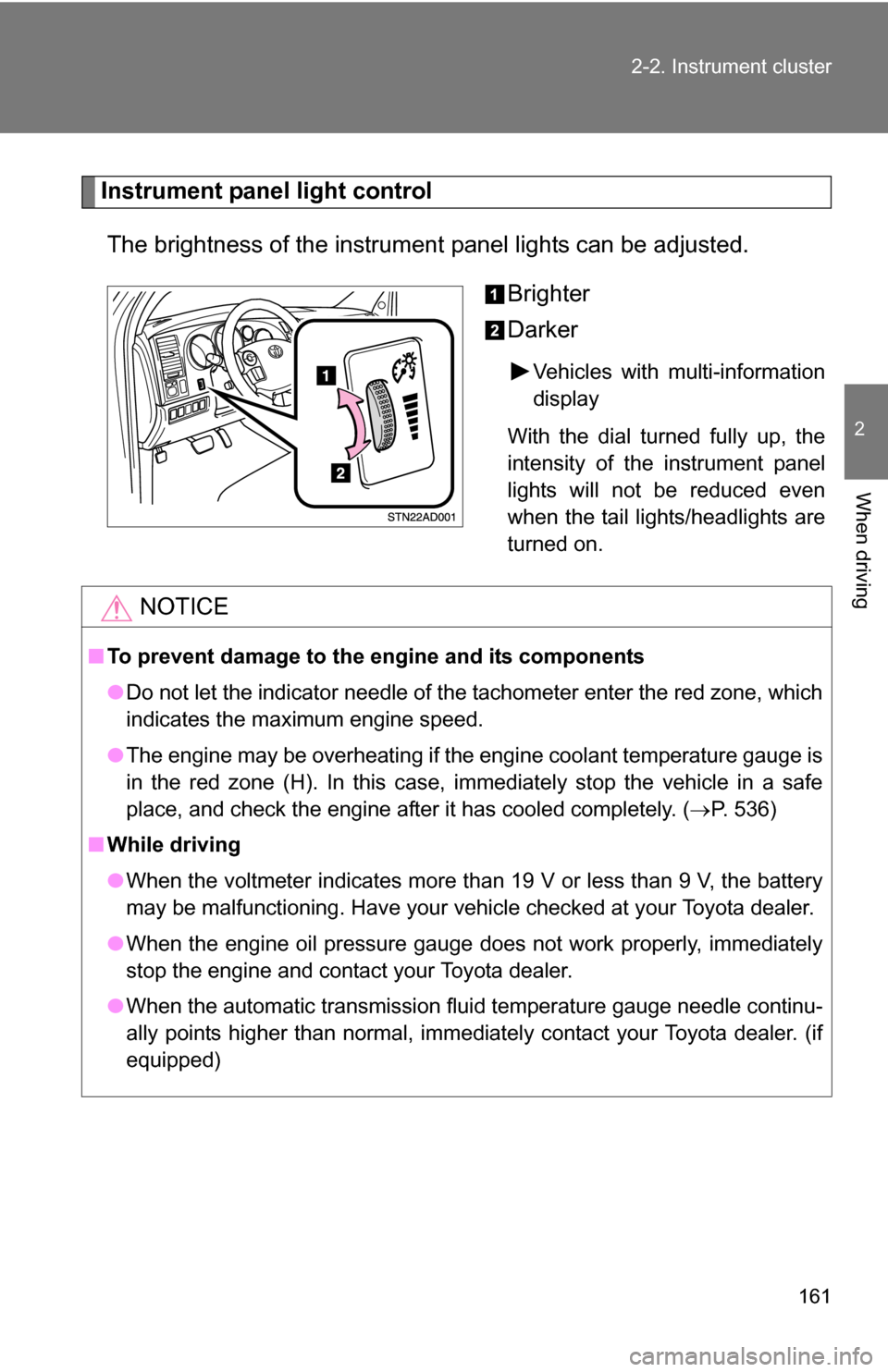
The brightness of the instrument panel lights can be adjusted.
Brighter
Darker
Vehicles with multi-information
display
With the dial turned fully up, the
intensity of the instrument panel
lights will not be reduced even
when the tail lights/headlights are
turned on.
NOTICE
■ To prevent damage to the engine and its components
●Do not let the indicator needle of the tachometer enter the red zone, which
indicates the maximum engine speed.
● The engine may be overheating if the engine coolant temperature gauge is
in the red zone (H). In this case, immediately stop the vehicle in a safe
place, and check the engine after it has cooled completely. ( P. 536)
■ While driving
●When the voltmeter indicates more than 19 V or less than 9 V, the battery
may be malfunctioning. Have your vehicle checked at your Toyota dealer.
● When the engine oil pressure gauge does not work properly, immediately
stop the engine and contact your Toyota dealer.
● When the automatic transmission fluid temperature gauge needle continu-
ally points higher than normal, immediately contact your Toyota dealer. (if
equipped)
Page 162 of 596
162
2-2. Instrument cluster
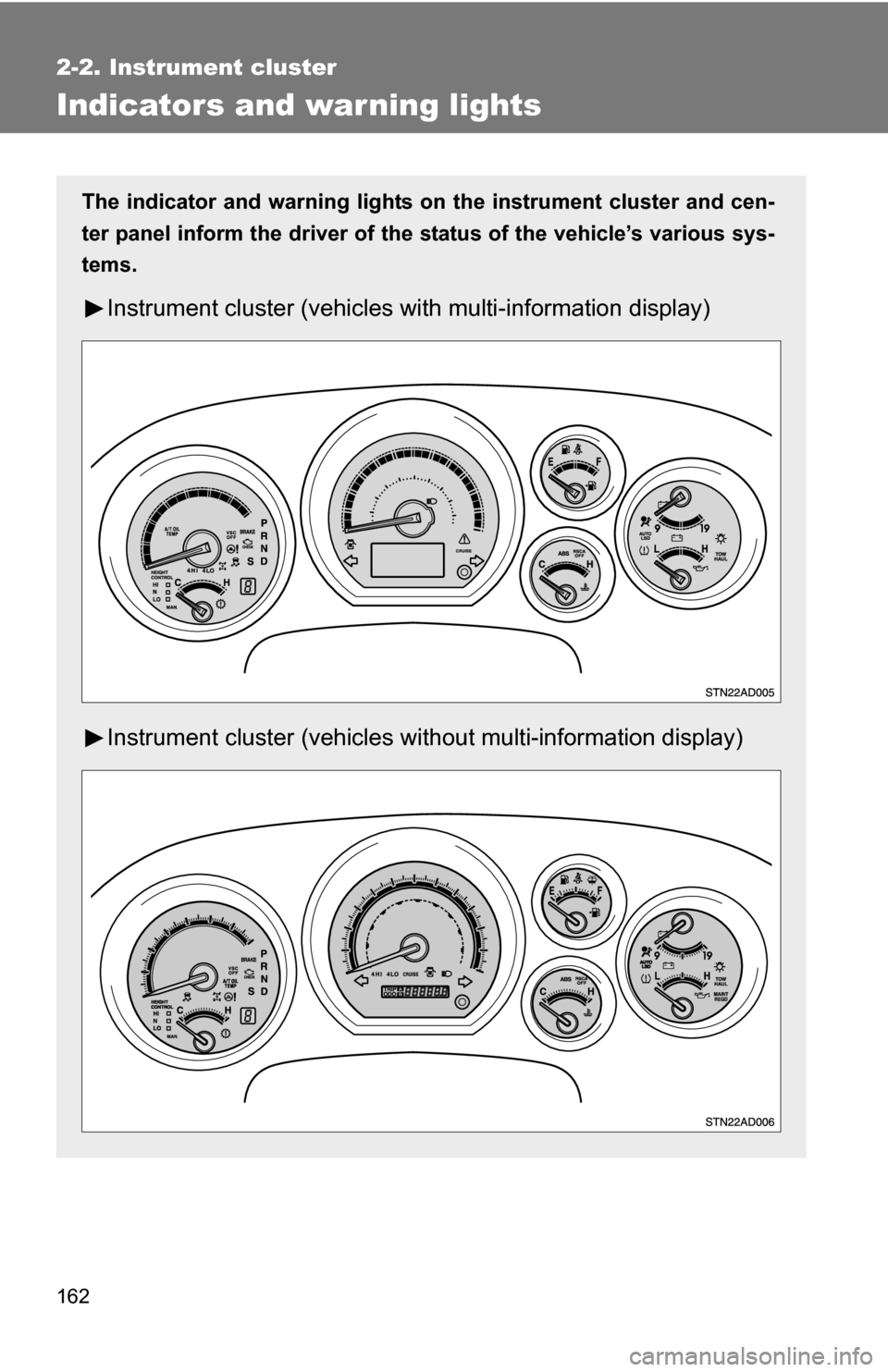
Indicators and warning lights
The indicator and warning lights on the instrument cluster and cen-
ter panel inform the driver of the status of the vehicle’s various sys-
tems.
Instrument cluster (vehicles with multi-information display)
Instrument cluster (vehicles without multi-information display)
Page 165 of 596
165
2-2. Instrument cluster
2
When driving
■
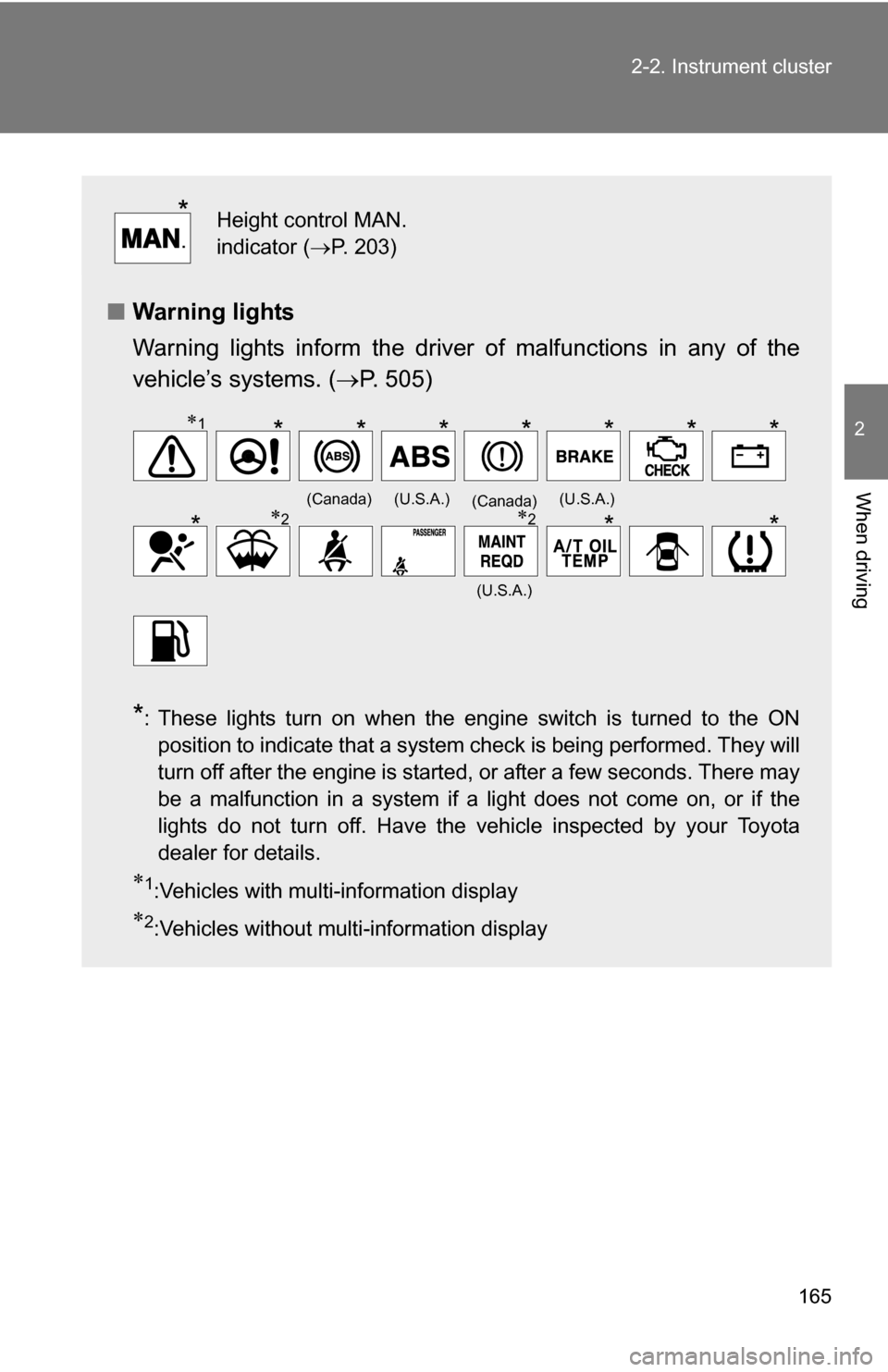
Warning lights
Warning lights inform the driver of malfunctions in any of the
vehicle’s systems. ( P. 505)
*: These lights turn on when the engine switch is turned to the ON
position to indicate that a system check is being performed. They will
turn off after the engine is started, or after a few seconds. There may
be a malfunction in a system if a light does not come on, or if the
lights do not turn off. Have the vehicle inspected by your Toyota
dealer for details.
1:Vehicles with multi-information display
2:Vehicles without multi-information display
*Height control MAN.
indicator ( P. 203)
(Canada)(U.S.A.)(Canada)(U.S.A.)
(U.S.A.)
1*******
*22**