airbag TOYOTA SEQUOIA 2009 2.G Owners Manual
[x] Cancel search | Manufacturer: TOYOTA, Model Year: 2009, Model line: SEQUOIA, Model: TOYOTA SEQUOIA 2009 2.GPages: 612
Page 2 of 612
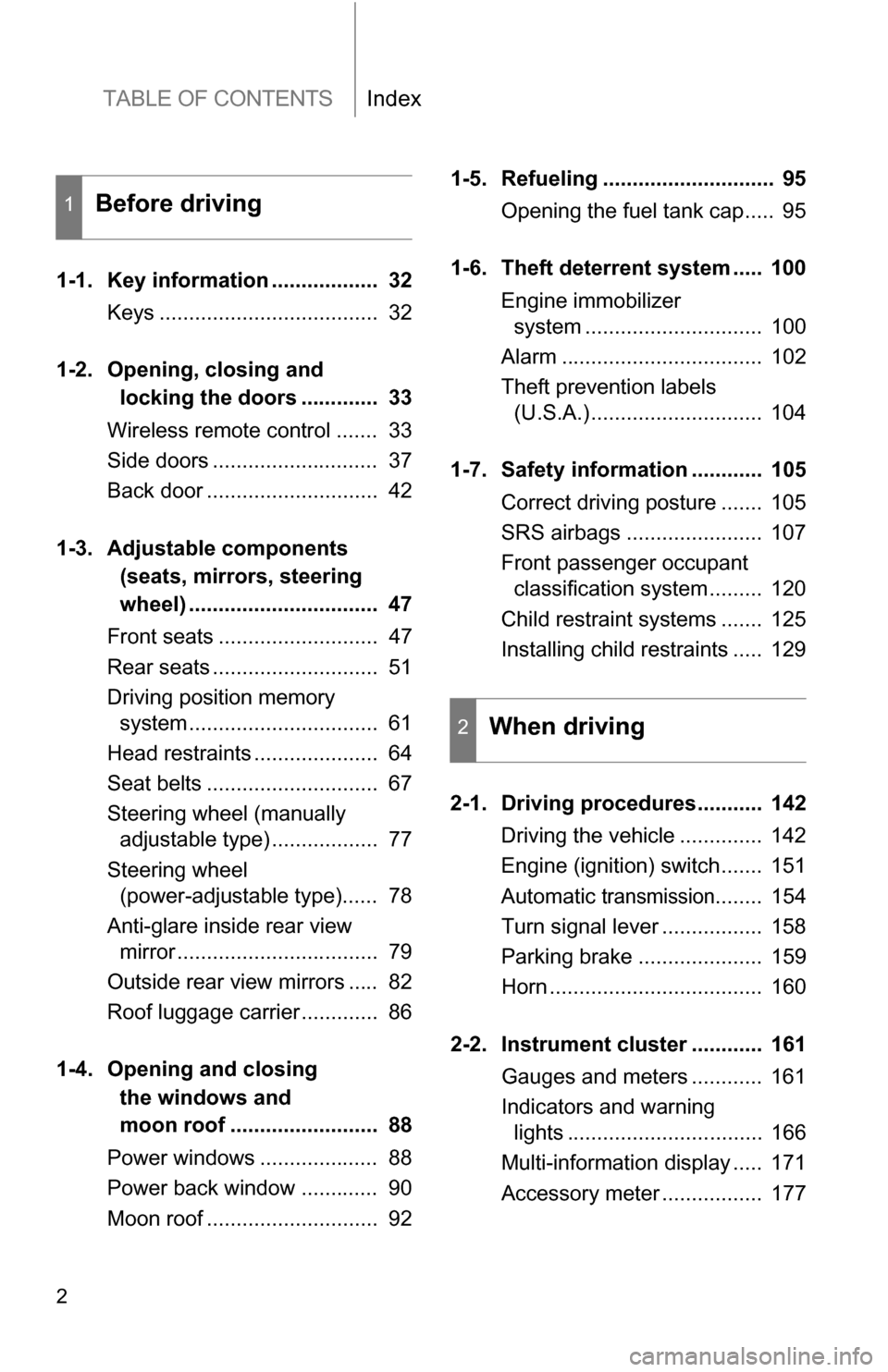
TABLE OF CONTENTSIndex
2
1-1. Key information .................. 32Keys ..................................... 32
1-2. Opening, closing and locking the doors ............. 33
Wireless remote control ....... 33
Side doors ............................ 37
Back door ............................. 42
1-3. Adjustable components (seats, mirrors, steering
wheel) ................................ 47
Front seats ........................... 47
Rear seats ............................ 51
Driving position memory system ................................ 61
Head restraints ..................... 64
Seat belts ............................. 67
Steering wheel (manually adjustable type) .................. 77
Steering wheel (power-adjustable type)...... 78
Anti-glare inside rear view mirror .................................. 79
Outside rear view mirrors ..... 82
Roof luggage carrier............. 86
1-4. Opening and closing the windows and
moon roof ......................... 88
Power windows .................... 88
Power back window ............. 90
Moon roof ............................. 92 1-5. Refueling ............................. 95
Opening the fuel tank cap..... 95
1-6. Theft deterrent system ..... 100 Engine immobilizer system .............................. 100
Alarm .................................. 102
Theft prevention labels (U.S.A.)............................. 104
1-7. Safety information ............ 105 Correct driving posture ....... 105
SRS airbags ....................... 107
Front passenger occupant classification system ......... 120
Child restraint systems ....... 125
Installing child restraints ..... 129
2-1. Driving procedures........... 142 Driving the vehicle .............. 142
Engine (ignition) switch....... 151
Automatic
transmission........ 154
Turn signal lever ................. 158
Parking brake ..................... 159
Horn .................................... 160
2-2. Instrument cluster ............ 161 Gauges and meters ............ 161
Indicators and warning lights ................................. 166
Multi-information display ..... 171
Accessory meter ................. 177
1Before driving
2When driving
Page 10 of 612
10
Pictorial indexInterior
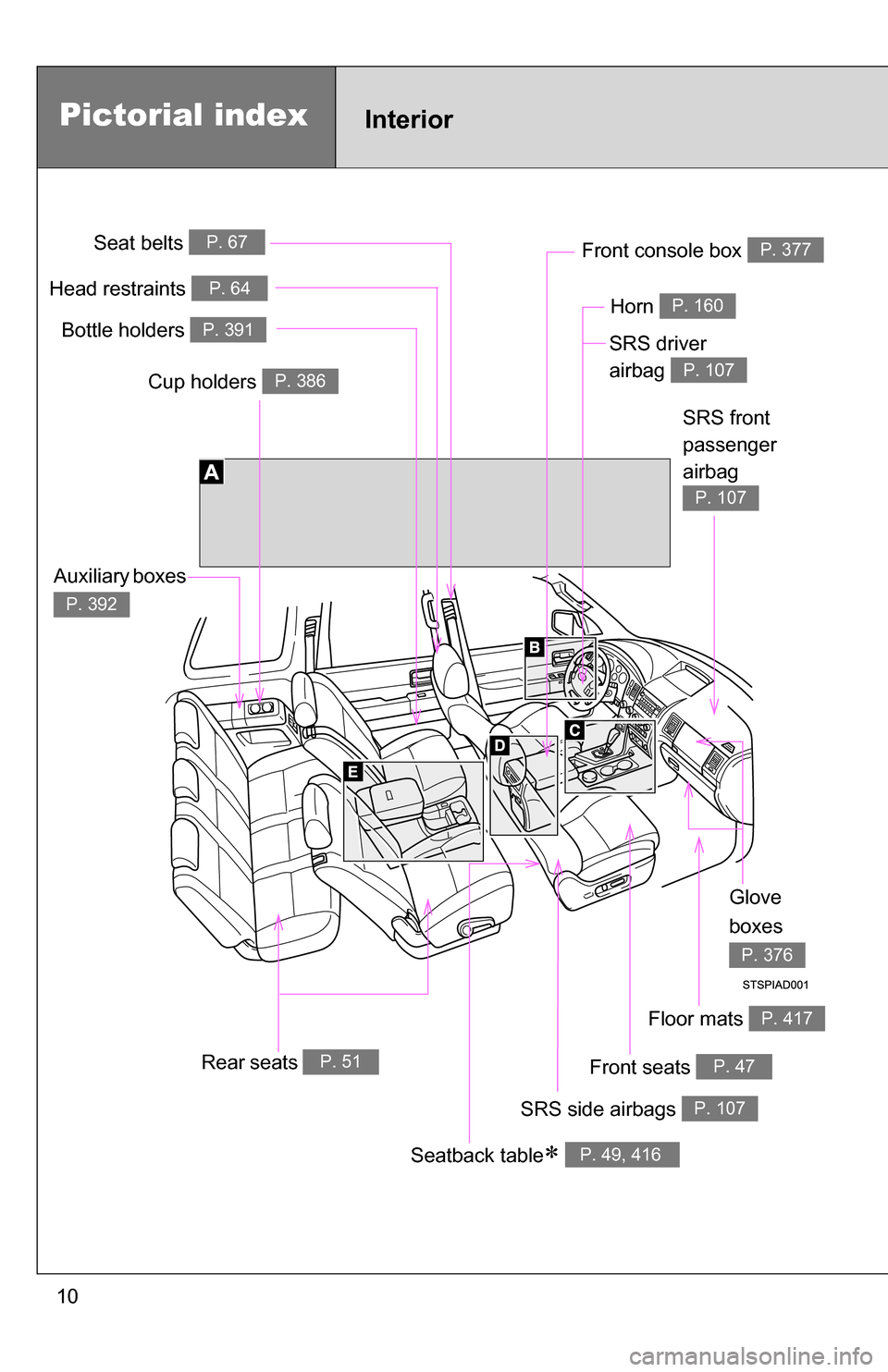
Seat belts P. 67
SRS driver
airbag
P. 107
Head restraints P. 64
Bottle holders P. 391
SRS side airbags P. 107
Floor mats P. 417
SRS front
passenger
airbag
P. 107
Rear seats P. 51Front seats P. 47
Front console box P. 377
Seatback table P. 49, 416
Cup holders P. 386
Auxiliary boxes
P. 392
Glove
boxes
P. 376
Horn P. 160
Page 11 of 612
11
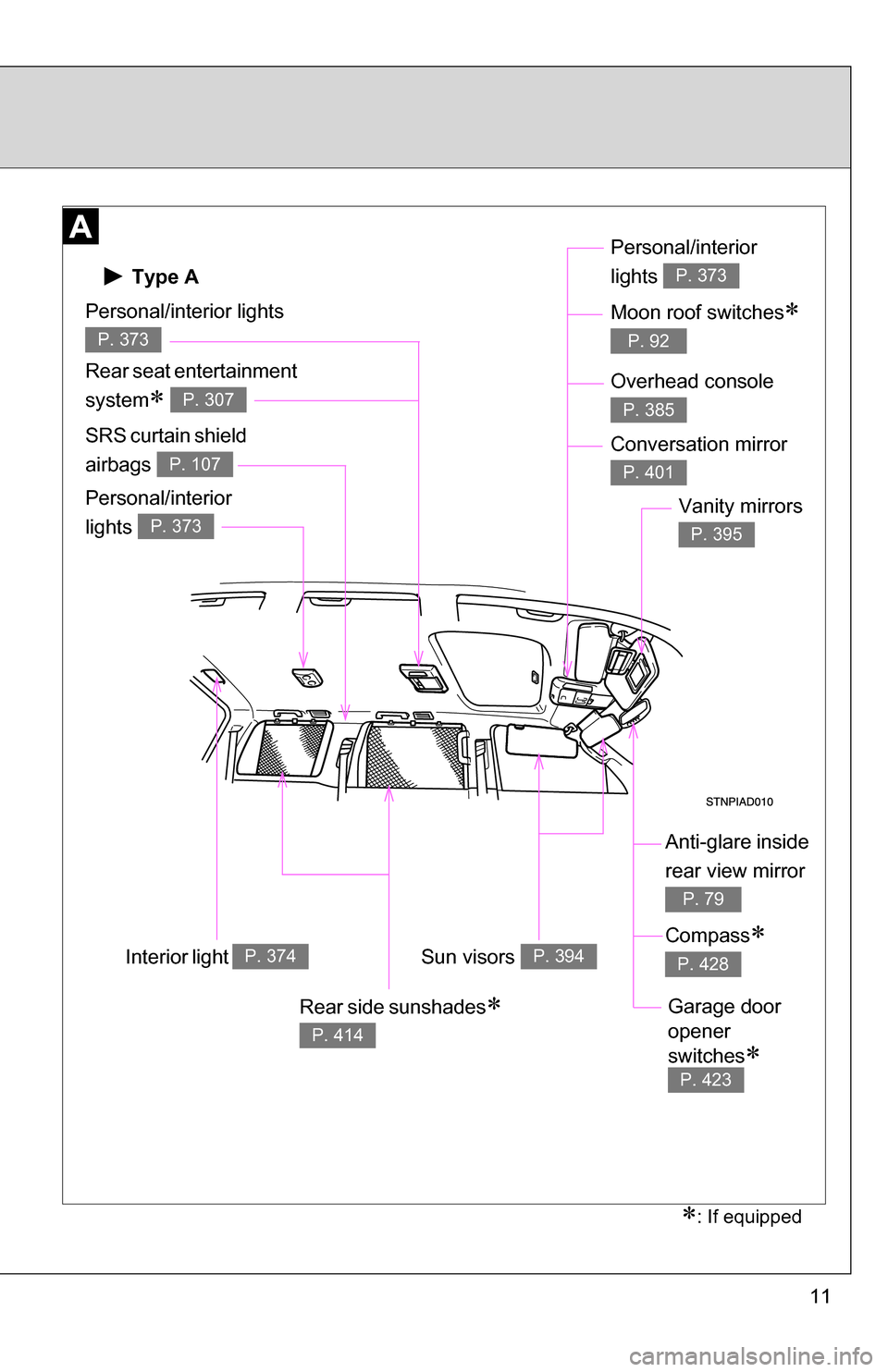
Anti-glare inside
rear view mirror
P. 79
Sun visors P. 394
SRS curtain shield
airbags
P. 107
Vanity mirrors
P. 395
Interior light P. 374
Type A
Personal/interior lights
P. 373
Rear seat entertainment
system
P. 307
Personal/interior
lights
P. 373
Personal/interior
lights
P. 373
Moon roof switches
P. 92
: If equipped
Overhead console
P. 385
Conversation mirror
P. 401
Compass
P. 428
Garage door
opener
switches
P. 423
Rear side sunshades
P. 414
Page 12 of 612
12
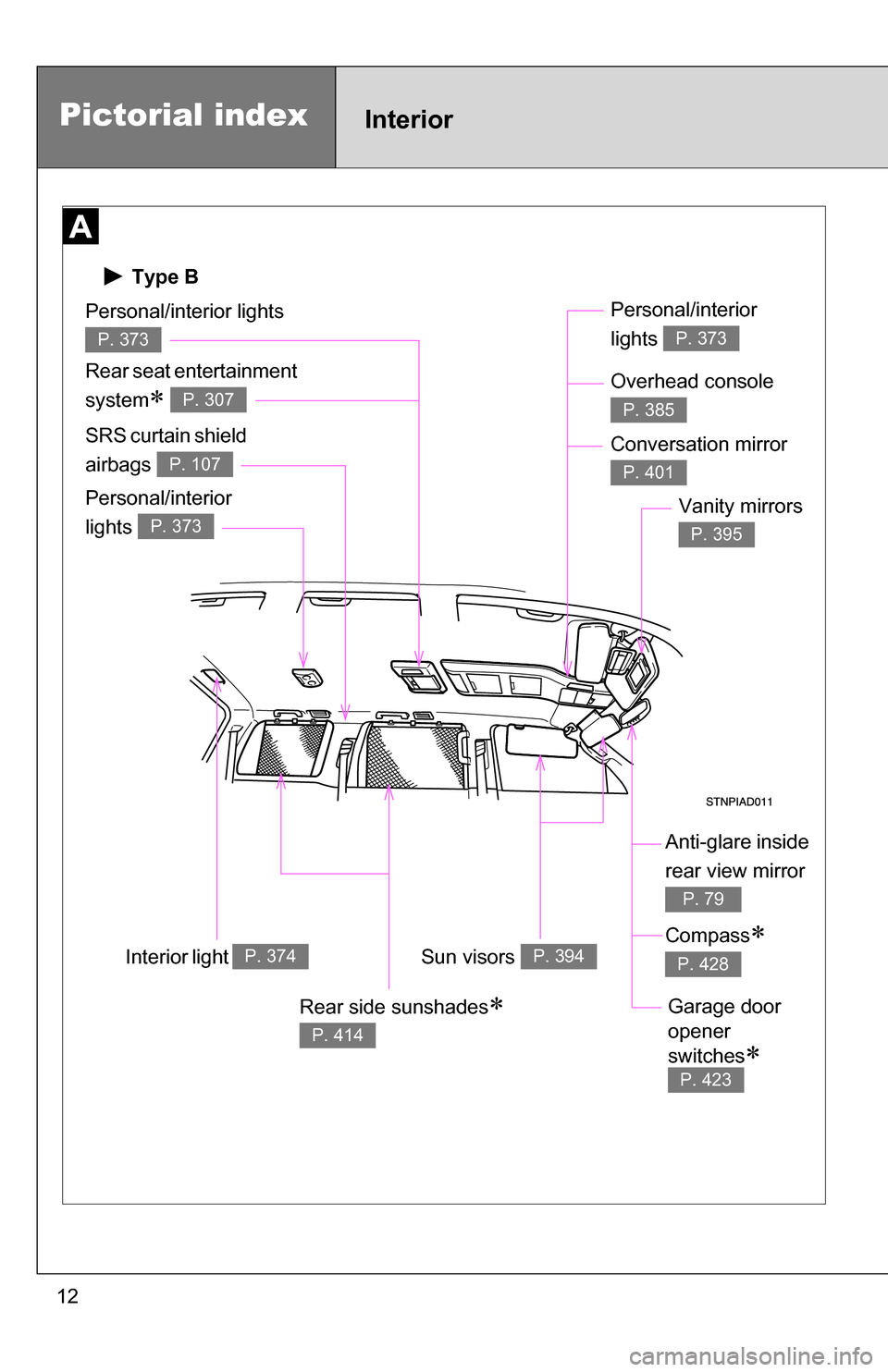
Type B
Pictorial indexInterior
Anti-glare inside
rear view mirror
P. 79
Sun visors P. 394
SRS curtain shield
airbags
P. 107
Vanity mirrors
P. 395
Interior light P. 374
Personal/interior lights
P. 373
Rear seat entertainment
system
P. 307
Personal/interior
lights
P. 373
Personal/interior
lights
P. 373
Overhead console
P. 385
Conversation mirror
P. 401
Compass
P. 428
Garage door
opener
switches
P. 423
Rear side sunshades
P. 414
Page 26 of 612
26
For your information
Main Owners Manual
Please note that this manual applies to all models explains and all equip-
ment, including options. Therefore, you may find some explanations for
equipment not installed on your vehicle.
All specifications provided in this manual are current at the time of printing.
However, because of the Toyota policy of continual product improvement, we
reserve the right to make changes at any time without notice.
Depending on specifications, the vehicle shown in the illustrations may differ
from your vehicle in terms of equipment.
Accessories, spare parts and modification of your Toyota
A wide variety of non-genuine spare parts and accessories for Toyota
vehicles are currently available in the market. You should know that Toyota
does not warrant these products and is not responsible for their
performance, repair, or replacement, or for any damage they may cause to,
or adverse effect they may have on, your Toyota vehicle.
This vehicle should not be modified with non-genuine Toyota products.
Modification with non-genuine Toyota products could affect its performance,
safety or durability, and may even violate governmental regulations. In
addition, damage or performance problems resulting from the modification
may not be covered under warranty.
Installation of a mobile two-way radio system
As the installation of a mobile two-way radio system in your vehicle could
affect electronic systems such as the multiport fuel injection system/sequen-
tial multiport fuel injection system, cruise control system, anti-lock brake sys-
tem, SRS airbag system and seat belt pretensioner system, be sure to check
with your Toyota dealer for precautionary measures or special instructions
regarding installation.
Page 27 of 612
27
Scrapping your Toyota
The SRS airbag and seat belt pretensioner devices in your Toyota contain
explosive chemicals. If the vehicle is scrapped with the airbags and seat belt
pretensioners left as they are, this may cause an accident such as fire. Be
sure to have the systems of the SRS airbag and seat belt pretensioner
removed and disposed of by a qualified service shop or by your Toyota
dealer before you scrap your vehicle.
Perchlorate Material
Special handling may apply,
See www.dtsc.ca.gov/hazardouswaste/perchlorate.
Your vehicle has components that may contain perchlorate. These compo-
nents may include airbag, seat belt pretensioners, and wireless remote con-
trol batteries.
CAUTION
■General precautions while driving
Driving under the influence: Never drive your vehicle when under the influ-
ence of alcohol or drugs that have impaired your ability to operate your vehi-
cle. Alcohol and certain drugs delay reaction time, impair judgment and
reduce coordination, which could lead to an accident that will hurt or kill you,
your occupants or others.
Defensive driving: Always drive defensively. Anticipate mistakes that other
drivers or pedestrians might make and be ready to avoid accidents.
Driver distraction: Always give your full attention to driving. Anything that dis-
tracts the driver, such as adjusting controls, talking on a cellular phone or
reading can result in a collision with resulting death or serious injury to you,
your occupants or others.
Page 31 of 612
Before driving1
31
1-1. Key information................ 32Keys ................................... 32
1-2. Opening, closing and locking the doors ........... 33
Wireless remote control ..... 33
Side doors .......................... 37
Back door ........................... 42
1-3. Adjustable components (seats, mirrors, steering
wheel).............................. 47
Front seats ......................... 47
Rear seats.......................... 51
Driving position memory system ............................. 61
Head restraints................... 64
Seat belts ........................... 67
Steering wheel (manually adjustable type) ............... 77
Steering wheel (power-adjustable type) ... 78
Anti-glare inside rear view mirror ............................... 79
Outside rear view mirrors ... 82
Roof luggage carrier .......... 86 1-4. Opening and closing
the windows and
moon roof ....................... 88
Power windows .................. 88
Power back window ........... 90
Moon roof ........................... 92
1-5. Refueling........................... 95 Opening the fuel tank cap ................................... 95
1-6. Theft deterrent system ........................... 100
Engine immobilizer system ........................... 100
Alarm................................ 102
Theft prevention labels (U.S.A.) .......................... 104
1-7. Safety information ......... 105 Correct driving posture..... 105
SRS airbags ..................... 107
Front passenger occupant classification system ...... 120
Child restraint systems..... 125
Installing child restraints ........................ 129
Page 107 of 612
107
1
1-7. Safety information
Before driving
SRS airbags
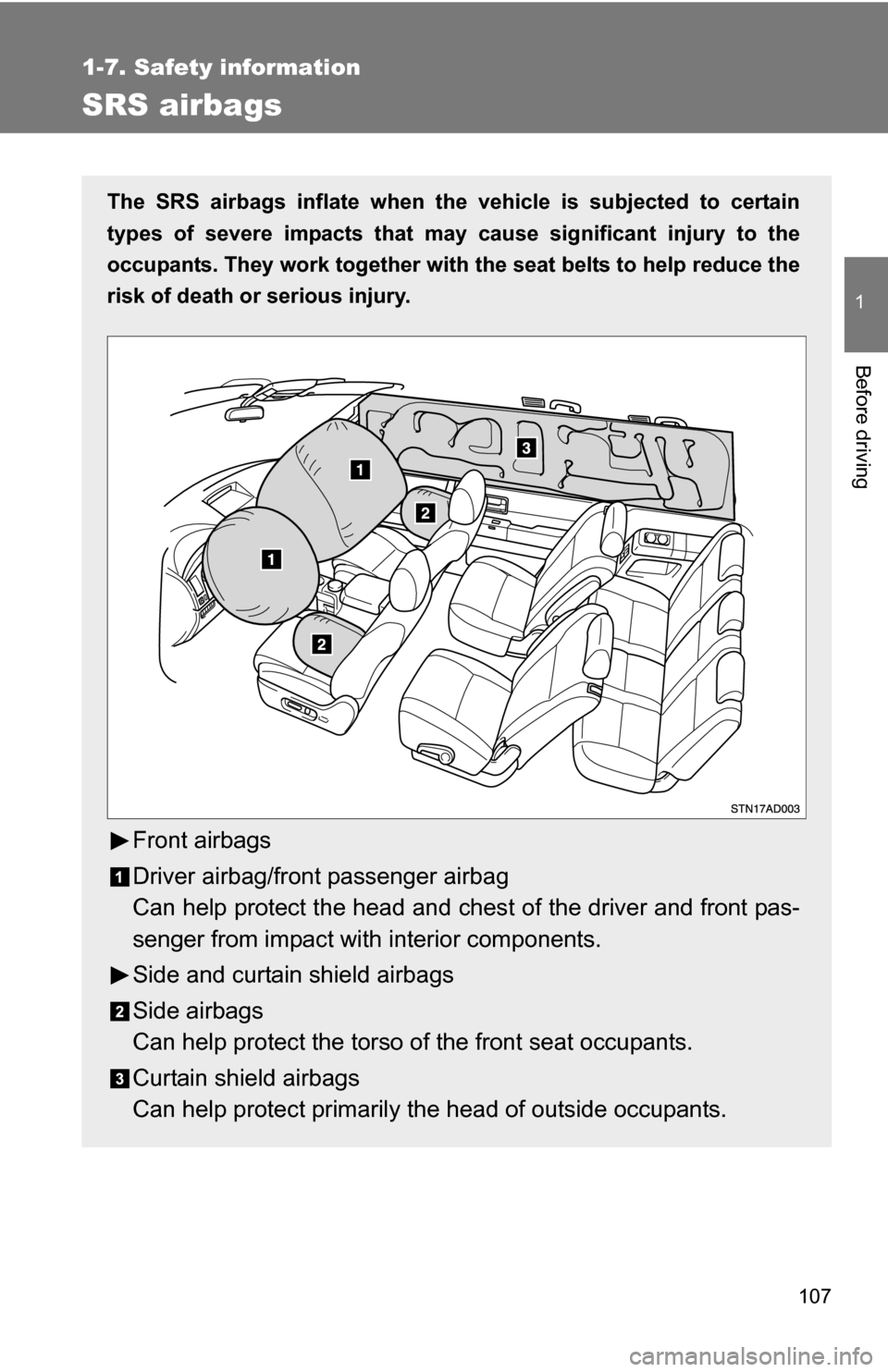
The SRS airbags inflate when the vehicle is subjected to certain
types of severe impacts that may cause significant injury to the
occupants. They work together with the seat belts to help reduce the
risk of death or serious injury.
Front airbags
Driver airbag/front passenger airbag
Can help protect the head and ches t of the driver and front pas-
senger from impact with interior components.
Side and curtain shield airbags
Side airbags
Can help protect the torso of the front seat occupants.
Curtain shield airbags
Can help protect primarily the head of outside occupants.
Page 108 of 612
108 1-7. Safety information
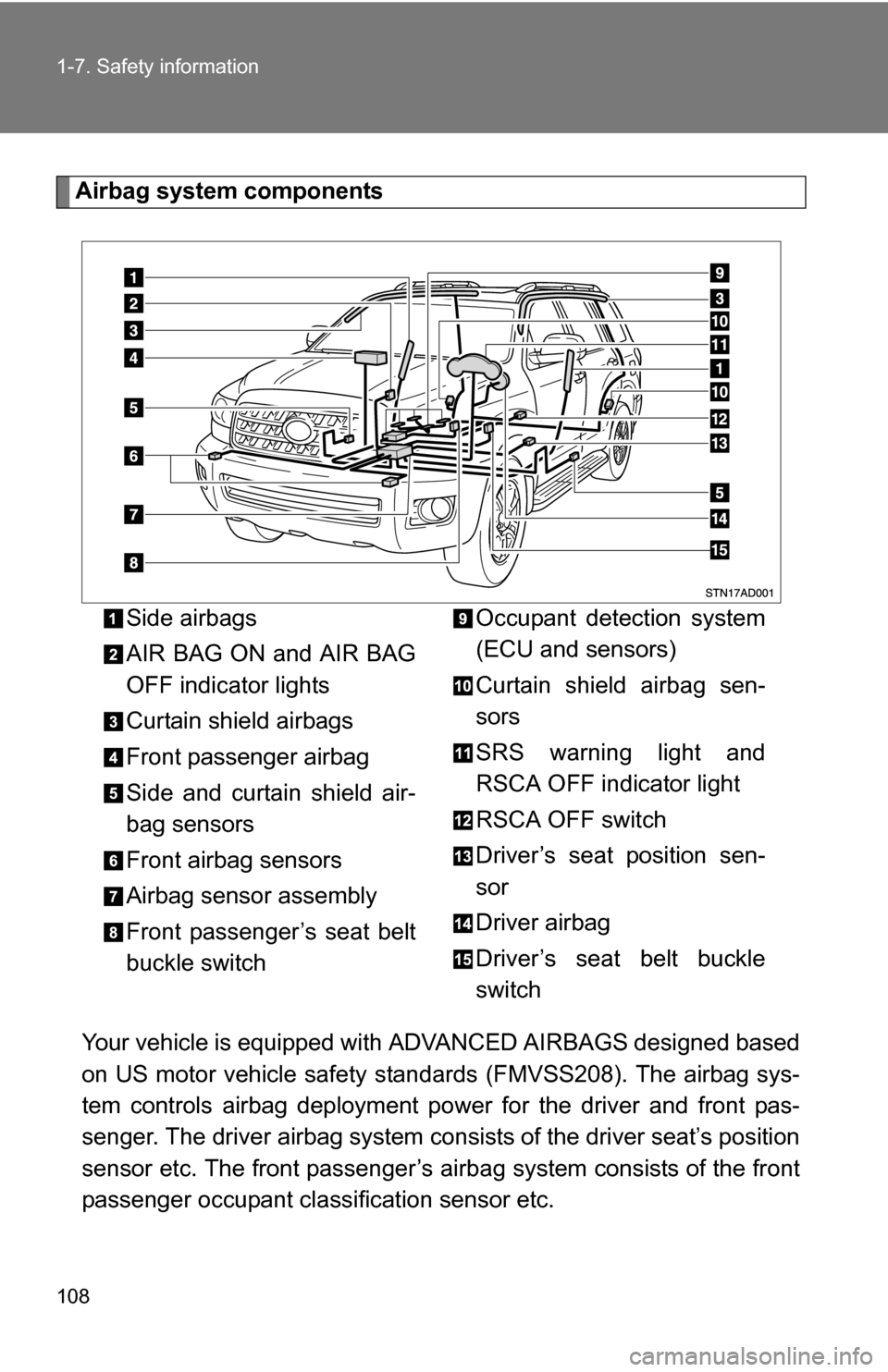
Airbag system componentsYour vehicle is equipped with ADVANCED AIRBAGS designed based
on US motor vehicle safety standards (FMVSS208). The airbag sys-
tem controls airbag deployment po wer for the driver and front pas-
senger. The driver airbag system consists of the driver seat’s position
sensor etc. The front passenger’s airbag system consists of the front
passenger occupant classification sensor etc. Side airbags
AIR BAG ON and AIR BAG
OFF indicator lights
Curtain shield airbags
Front passenger airbag
Side and curtain shield air-
bag sensors
Front airbag sensors
Airbag sensor assembly
Front passenger’s seat belt
buckle switch
Occupant detection system
(ECU and sensors)
Curtain shield airbag sen-
sors
SRS warning light and
RSCA OFF indicator light
RSCA OFF switch
Driver’s seat position sen-
sor
Driver airbag
Driver’s seat belt buckle
switch
Page 109 of 612
109
1-7. Safety information
1
Before driving
The main SRS airbag system components are shown above. The
SRS airbag system is controlled by
the airbag sensor assembly. The
airbag sensor assembly consists of a safing sensor and an airbag
sensor.
In certain types of severe frontal or side impacts, the SRS airbag sys-
tem triggers the airbag inflators. A chemical reaction in the inflators
quickly fills the airbags with non-toxic gas to help rest rain the motion
of the occupants.
■ SRS warning light
This warning light system monitors the airbag sensor assembly, front airbag
sensors, side and curtain shield airbag sensor assemblies, curtain shield air-
bag sensor assemblies, driver’s seat position sensor, driver’s seat belt
buckle switch, front passenger occupant classification system, AIR BAG ON
and AIR BAG OFF indicator lights, front passenger’s seat belt buckle switch,
front seat belt pretensioner assemblies , RSCA OFF indicator light, inflators,
interconnecting wiring and power sources. ( P. 519)
■ If the SRS airbags deploy (inflate)
●Bruising and slight abrasions may result from contact with a deploying
(inflating) SRS airbag.
● A loud noise and white powder will be emitted.
● Parts of the airbag module (steering wheel hub, airbag cover and inflator)
as well as the front seats, and parts of the front and rear pillars and roof
side rail, may be hot for several minutes. The airbag itself may also be
hot.
● The front windshield may crack.