automatic transmission TOYOTA SEQUOIA 2009 2.G Owners Manual
[x] Cancel search | Manufacturer: TOYOTA, Model Year: 2009, Model line: SEQUOIA, Model: TOYOTA SEQUOIA 2009 2.GPages: 612
Page 2 of 612
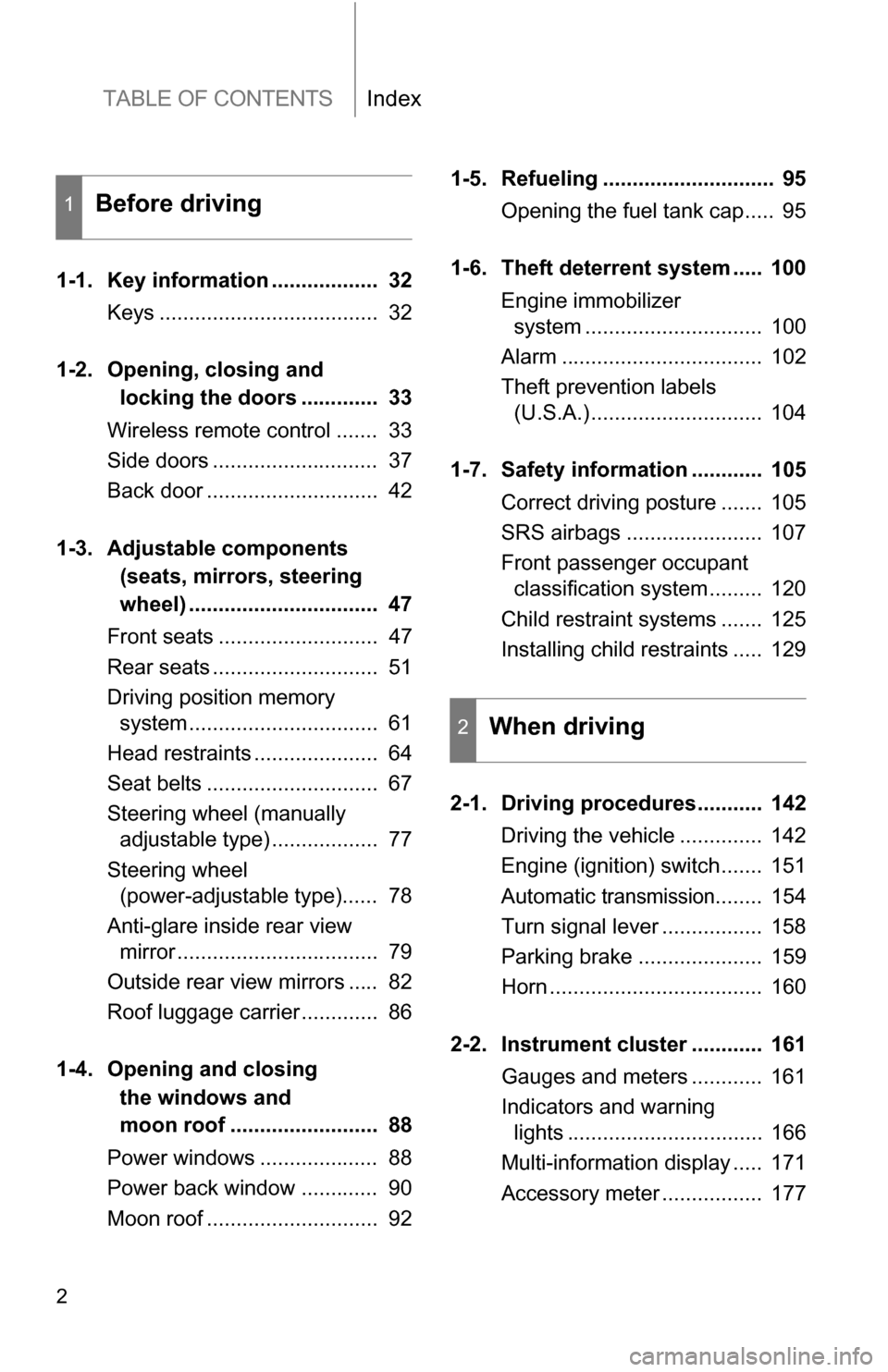
TABLE OF CONTENTSIndex
2
1-1. Key information .................. 32Keys ..................................... 32
1-2. Opening, closing and locking the doors ............. 33
Wireless remote control ....... 33
Side doors ............................ 37
Back door ............................. 42
1-3. Adjustable components (seats, mirrors, steering
wheel) ................................ 47
Front seats ........................... 47
Rear seats ............................ 51
Driving position memory system ................................ 61
Head restraints ..................... 64
Seat belts ............................. 67
Steering wheel (manually adjustable type) .................. 77
Steering wheel (power-adjustable type)...... 78
Anti-glare inside rear view mirror .................................. 79
Outside rear view mirrors ..... 82
Roof luggage carrier............. 86
1-4. Opening and closing the windows and
moon roof ......................... 88
Power windows .................... 88
Power back window ............. 90
Moon roof ............................. 92 1-5. Refueling ............................. 95
Opening the fuel tank cap..... 95
1-6. Theft deterrent system ..... 100 Engine immobilizer system .............................. 100
Alarm .................................. 102
Theft prevention labels (U.S.A.)............................. 104
1-7. Safety information ............ 105 Correct driving posture ....... 105
SRS airbags ....................... 107
Front passenger occupant classification system ......... 120
Child restraint systems ....... 125
Installing child restraints ..... 129
2-1. Driving procedures........... 142 Driving the vehicle .............. 142
Engine (ignition) switch....... 151
Automatic
transmission........ 154
Turn signal lever ................. 158
Parking brake ..................... 159
Horn .................................... 160
2-2. Instrument cluster ............ 161 Gauges and meters ............ 161
Indicators and warning lights ................................. 166
Multi-information display ..... 171
Accessory meter ................. 177
1Before driving
2When driving
Page 141 of 612
When driving2
141
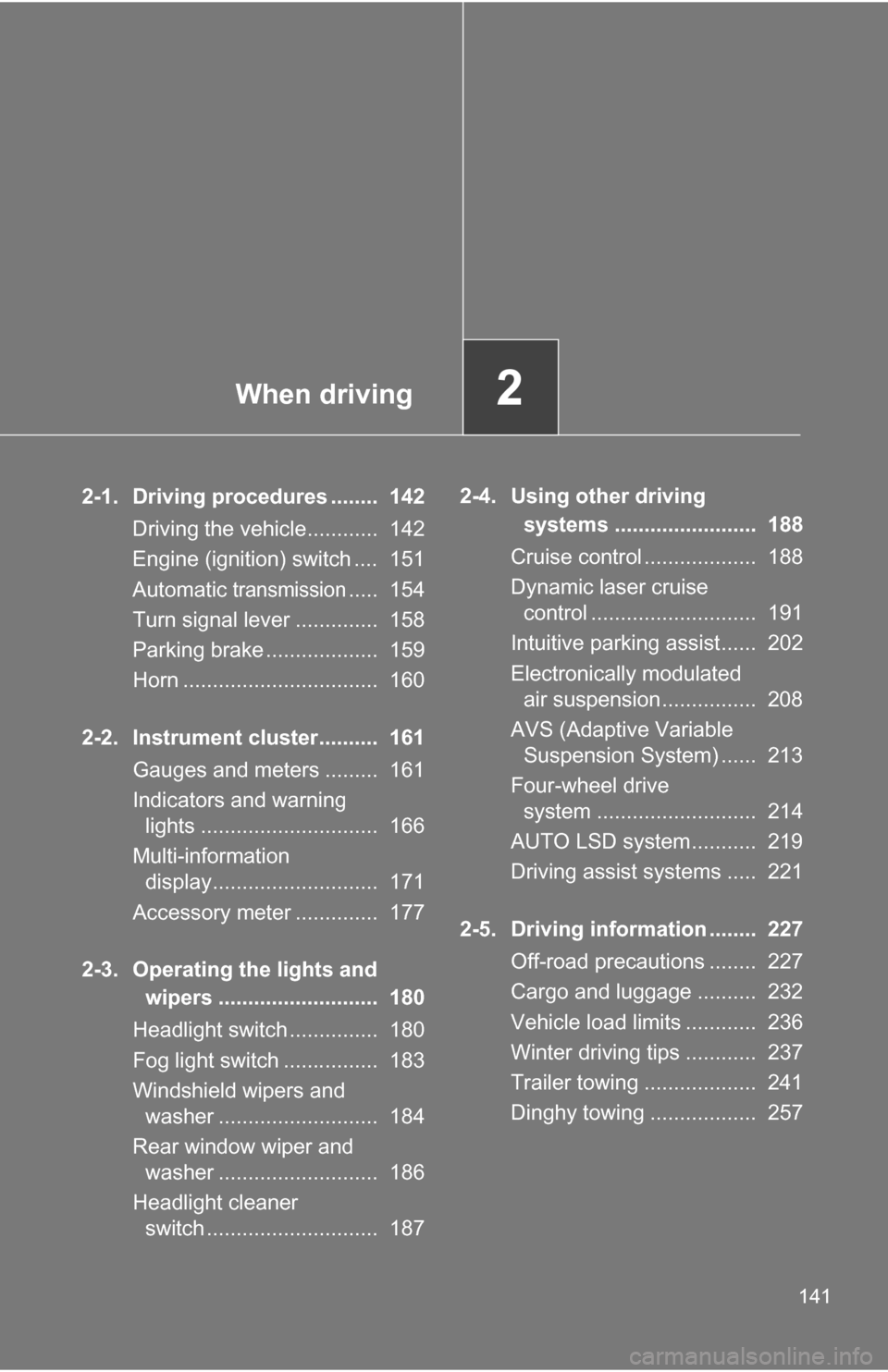
2-1. Driving procedures ........ 142Driving the vehicle............ 142
Engine (ignition) switch .... 151
Automatic
transmission..... 154
Turn signal lever .............. 158
Parking brake ................... 159
Horn ................................. 160
2-2. Instrument cluster.......... 161 Gauges and meters ......... 161
Indicators and warning lights .............................. 166
Multi-information display............................ 171
Accessory meter .............. 177
2-3. Operating the lights and wipers ........................... 180
Headlight switch ............... 180
Fog light switch ................ 183
Windshield wipers and washer ........................... 184
Rear window wiper and washer ........................... 186
Headlight cleaner switch ............................. 187 2-4. Using other driving
systems ........................ 188
Cruise control ................... 188
Dynamic laser cruise control ............................ 191
Intuitive parking assist...... 202
Electronically modulated air suspension ................ 208
AVS (Adaptive Variable Suspension System) ...... 213
Four-wheel drive system ........................... 214
AUTO LSD system........... 219
Driving assist systems ..... 221
2-5. Driving information ........ 227 Off-road precautions ........ 227
Cargo and luggage .......... 232
Vehicle load limits ............ 236
Winter driving tips ............ 237
Trailer towing ................... 241
Dinghy towing .................. 257
Page 147 of 612
147
2-1. Driving procedures
2
When driving
CAUTION
■
When the vehicle is parked
●Do not leave glasses, cigarette lighters, spray cans, or soft drink cans in
the vehicle when it is in the sun.
Doing so may result in the following.
• Gas may leak from a cigarette lighter or spray can, and may lead to a
fire.
• The temperature inside the vehicle may cause the plastic lenses and plastic material of eye glasses to deform or crack.
• Soft drink cans may fracture, causing the contents to spray over the interior of the vehicle, and may also cause a short circuit in the vehi-
cle’s electrical components.
● Always apply the parking brake, shift the shift lever to P, stop the engine
and lock the vehicle.
Do not leave the vehicle unattended while the engine is running.
● If the shift lever is moved before the 4LO indicator turns on/off, the transfer
mode may not be shifted completely. The transfer mode disengages both
the front and rear driveshafts from the powertrain and allows the vehicle to
move regardless of the shift position. (At this time, the indicator blinks and
the buzzer sounds.)
Therefore, the vehicle is free to roll even if the automatic transmission is in
P. You or someone else could be seriously injured. You must complete the
shifting of the transfer mode. ( P. 214)
● Do not touch the exhaust pipe while the engine is running or immediately
after turning the engine off.
Doing so may cause burns.
● Do not leave the engine running in an area with snow build-up, or where it
is snowing. If snowbanks build up around the vehicle while the engine is
running, exhaust gases may collect and enter the vehicle. This may lead
to death or a serious health hazard.
■ Exhaust gases
Exhaust gases include harmful carbon monoxide (CO) that is colorless and
odorless. Inhaling exhaust gases may lead to death or a serious health haz-
ard.
Page 154 of 612
154
2-1. Driving procedures
Automatic transmission
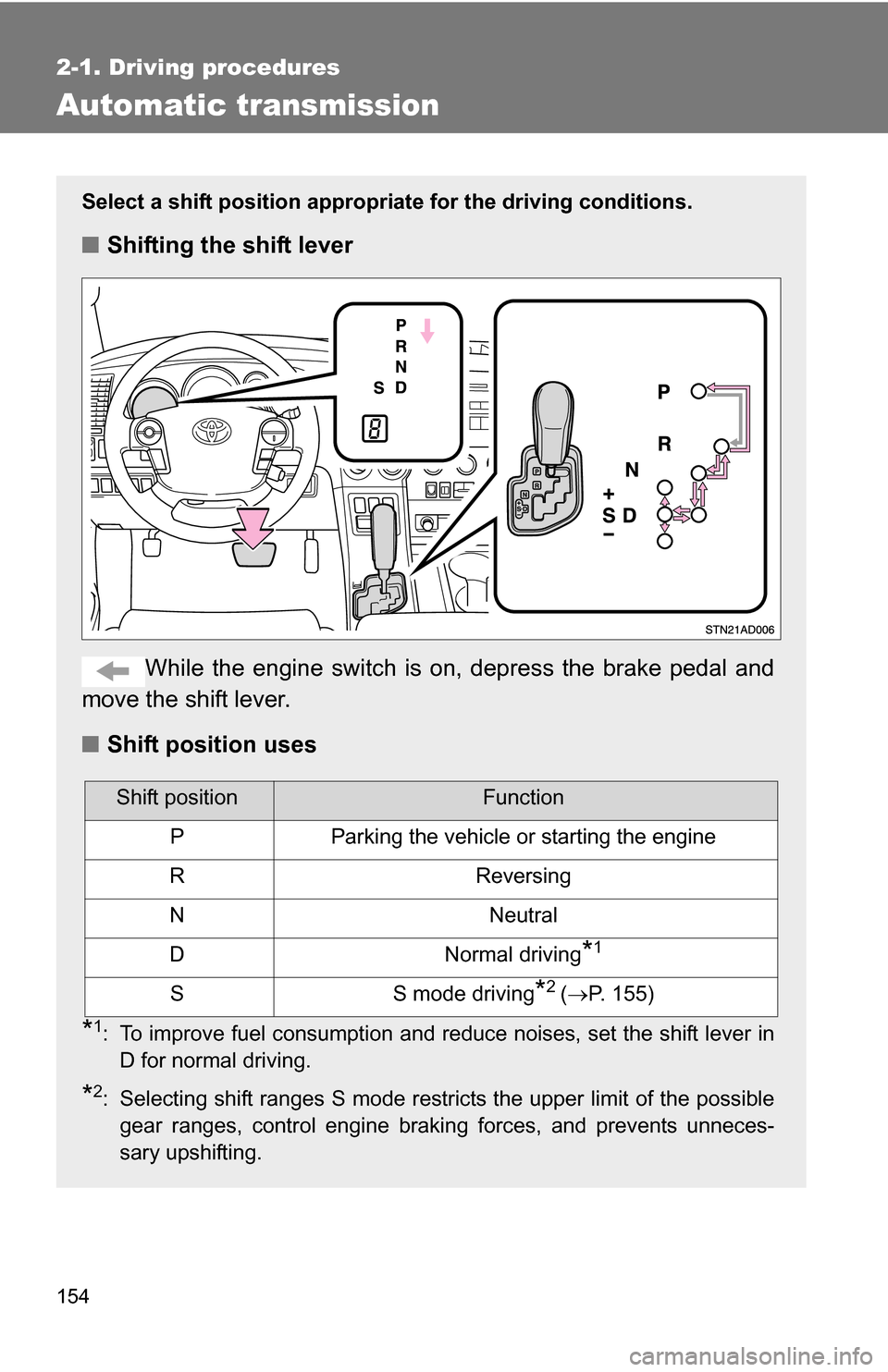
Select a shift position appropriate for the driving conditions.
■Shifting the shift lever
While the engine switch is on, depress the brake pedal and
move the shift lever.
■ Shift position uses
*1: To improve fuel consumption and reduce noises, set the shift lever in
D for normal driving.
*2: Selecting shift ranges S mode restricts the upper limit of the possiblegear ranges, control engine braking forces, and prevents unneces-
sary upshifting.
Shift positionFunction
PParking the vehicle or starting the engine
RReversing
NNeutral
DNormal driving*1
SS mode driving*2 (P. 155)
Page 156 of 612
156 2-1. Driving procedures
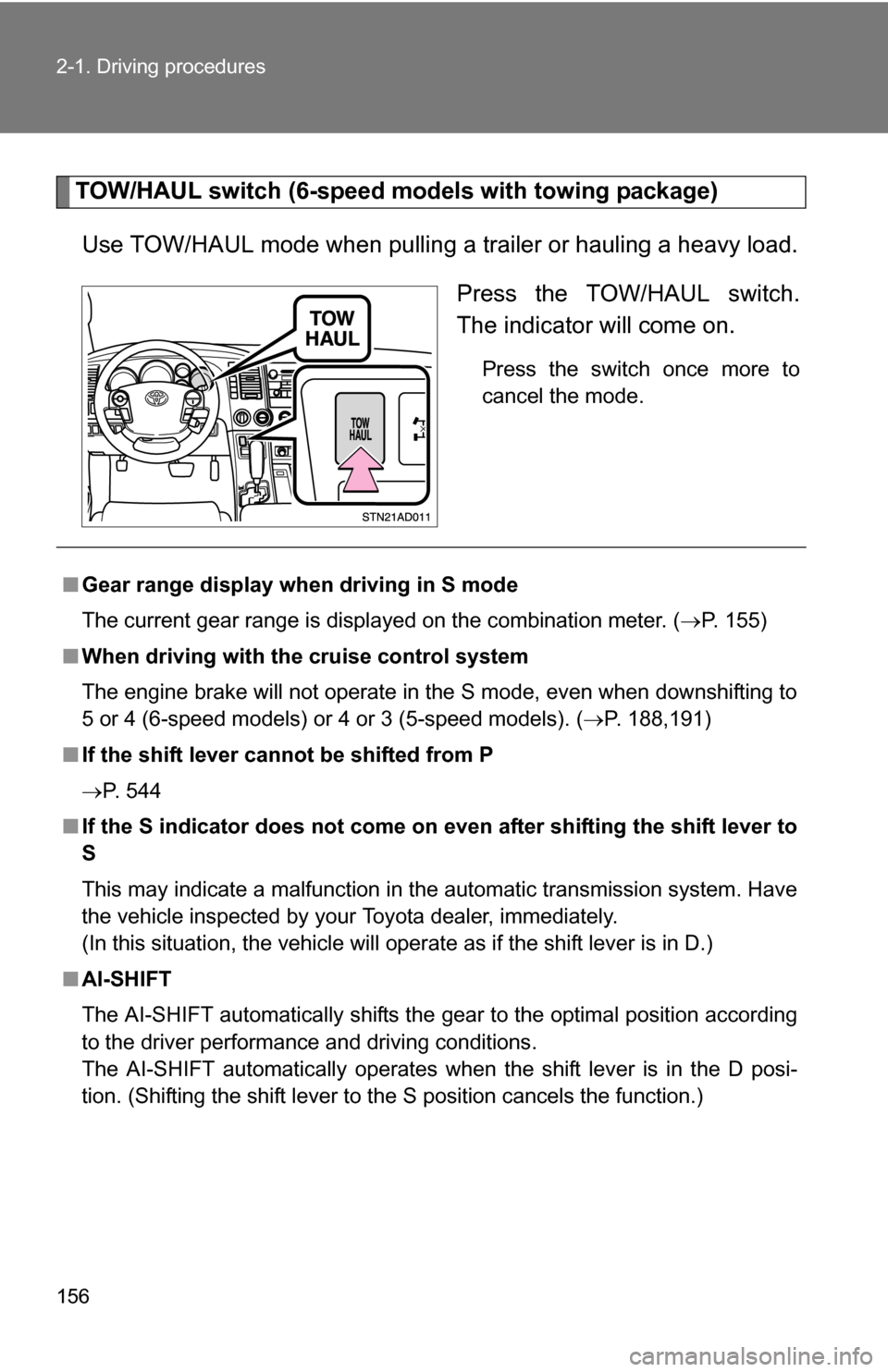
TOW/HAUL switch (6-speed models with towing package)Use TOW/HAUL mode when pulling a trailer or hauling a heavy load. Press the TOW/HAUL switch.
The indicator will come on.
Press the switch once more to
cancel the mode.
■Gear range display when driving in S mode
The current gear range is displayed on the combination meter. ( P. 155)
■ When driving with the cruise control system
The engine brake will not operate in the S mode, even when downshifting to
5 or 4 (6-speed models) or 4 or 3 (5-speed models). ( P. 188,191)
■ If the shift lever cannot be shifted from P
P. 544
■ If the S indicator does not come on even after shifting the shift lever to
S
This may indicate a malfunction in the automatic transmission system. Have
the vehicle inspected by your Toyota dealer, immediately.
(In this situation, the vehicle will operate as if the shift lever is in D.)
■ AI-SHIFT
The AI-SHIFT automatically shifts the gear to the optimal position according
to the driver performance and driving conditions.
The AI-SHIFT automatically operates when the shift lever is in the D posi-
tion. (Shifting the shift lever to the S position cancels the function.)
Page 162 of 612
162 2-2. Instrument cluster
Multi-information display
P. 171
Automatic transmission fluid temperature gauge
Displays the automatic transmission fluid temperature.
Page 164 of 612
164 2-2. Instrument cluster
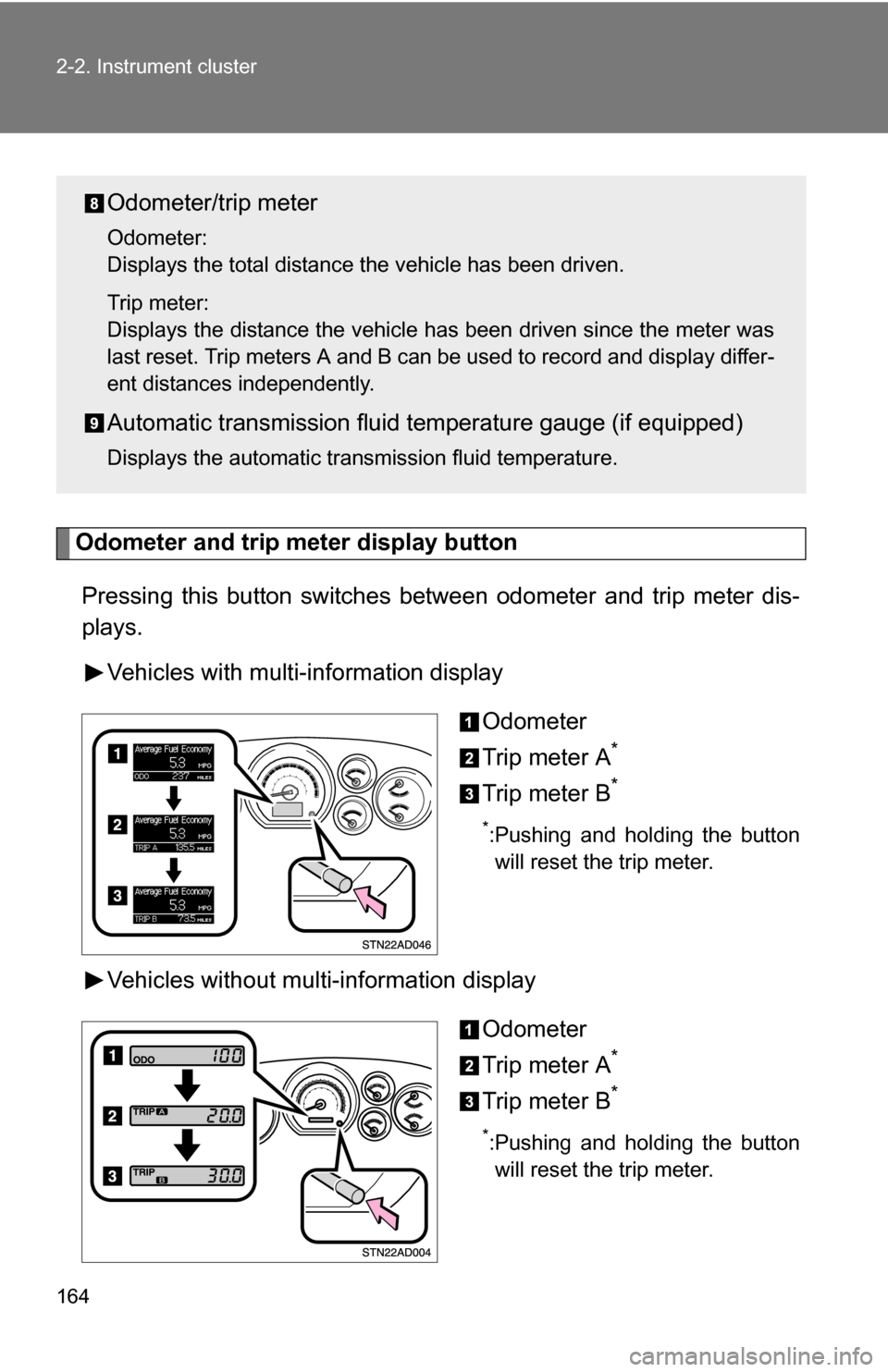
Odometer and trip meter display button
Pressing this button switches between odometer and trip meter dis-
plays.
Vehicles with multi-information display
Odometer
Trip meter A
*
Trip meter B*
*:Pushing and holding the buttonwill reset the trip meter.
Vehicles without multi-information display
Odometer
Trip meter A
*
Trip meter B*
*:Pushing and holding the buttonwill reset the trip meter.
Odometer/trip meter
Odometer:
Displays the total distance the vehicle has been driven.
Trip meter:
Displays the distance the vehicle has been driven since the meter was
last reset. Trip meters A and B can be used to record and display differ-
ent distances independently.
Automatic transmission fluid temperature gauge (if equipped)
Displays the automatic transmission fluid temperature.
Page 165 of 612
165
2-2. Instrument cluster
2
When driving
Instrument panel light control
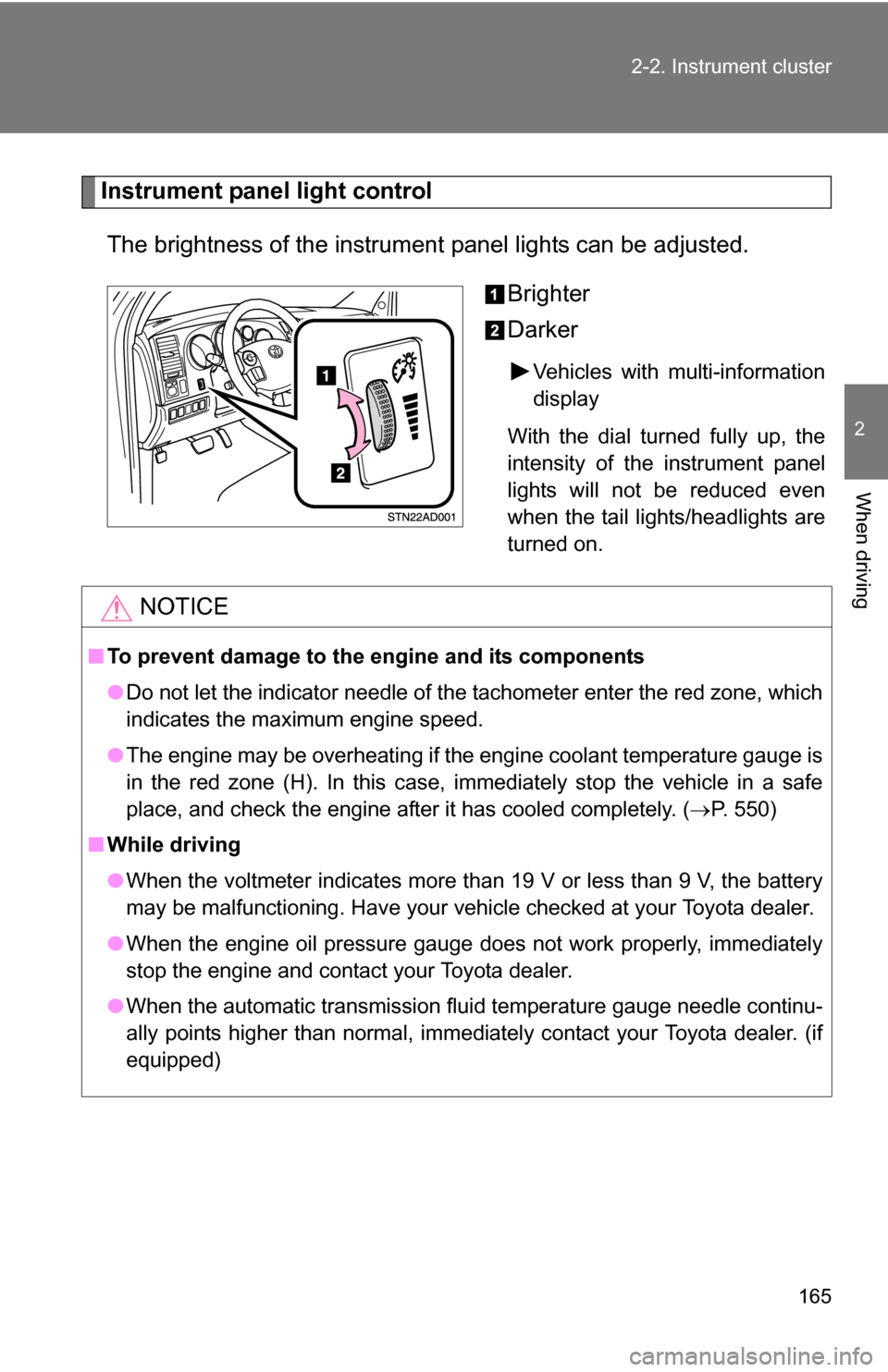
The brightness of the instrument panel lights can be adjusted.
Brighter
Darker
Vehicles with multi-information
display
With the dial turned fully up, the
intensity of the instrument panel
lights will not be reduced even
when the tail lights/headlights are
turned on.
NOTICE
■ To prevent damage to the engine and its components
●Do not let the indicator needle of the tachometer enter the red zone, which
indicates the maximum engine speed.
● The engine may be overheating if the engine coolant temperature gauge is
in the red zone (H). In this case, immediately stop the vehicle in a safe
place, and check the engine after it has cooled completely. ( P. 550)
■ While driving
●When the voltmeter indicates more than 19 V or less than 9 V, the battery
may be malfunctioning. Have your vehicle checked at your Toyota dealer.
● When the engine oil pressure gauge does not work properly, immediately
stop the engine and contact your Toyota dealer.
● When the automatic transmission fluid temperature gauge needle continu-
ally points higher than normal, immediately contact your Toyota dealer. (if
equipped)
Page 217 of 612
217
2-4. Using other
driving systems
2
When driving
Therefore, the vehicle is free to roll even if the automatic transmission is in
P. You or someone else could be seriously injured. You must complete the
shifting of the transfer mode.
To complete the shifting, stop the vehicle completely, return the shift lever
to N, and confirm that the shift was completed (The indicator turns on/off).
● If the engine coolant temperature is too low, transfer mode may not be
able to shift. When the engine is warmer, turn the switch again.
If the 4LO indicator, 4HI indicator or the center differential lock indicator con-
tinues to blink even after attempting the above, there may be a malfunction
in the engine, the brake system or the four-wheel drive system. In this case,
you may not be able to shift between 2WD and 4H, 4H and 4L, and the cen-
ter differential lock may not be operable. Have the vehicle inspected by your
Toyota dealer immediately.
■ Shifting to 4L
The VSC OFF indicator will come on.
However, the VSC remains activated.
CAUTION
■Shifting from 2WD to 4H while driving
Never operate the front wheel drive cont rol switch if the wheels are slipping.
Stop the slipping or spinning before shifting.
■ When the vehicle is parked
●If the shift lever is moved before the 4LO indicator turns on/off, the transfer
mode may not be shifted completely. The transfer mode disengages both
the front and rear driveshafts from the powertrain and allows the vehicle to
move regardless of the shift position. (At this time, the indicator blinks and
the buzzer sounds.)
Therefore, the vehicle is free to roll even if the automatic transmission is in
P. You or someone else could be seriously injured. You must complete the
shifting of the transfer mode. ( P. 214)
Page 231 of 612

231
2-5. Driving information
2
When driving
NOTICE
■
To prevent the water damage
●Take all necessary safety measures to ensure that water damage to the
engine or other components does not occur.
● Water entering the engine air intake will cause severe engine damage.
● Water entering the automatic transmission will cause deterioration in shift
quality, locking up of your transmission accompanied by vibration, and ulti-
mately damage.
● Water can wash the grease from wheel bearings, causing rusting and pre-
mature failure, and may also enter the differentials, transmission and
transfer case, reducing the gear oil’s lubricating qualities.
■ When you drive through water
If driving through water, such as when crossing shallow streams, first check
the depth of the water and the bottom of the river bed for firmness. Drive
slowly and avoid deep water.
■ Inspection after off-road driving
●Sand and mud that has accumulat ed in brake drums and around brake
discs may affect braking efficiency and may damage brake system compo-
nents.
● Always perform a maintenance inspection after each day of off-road driv-
ing that has taken you through rough terrain, sand, mud, or water. For
scheduled maintenance information, refer to the “Scheduled Maintenance
Guide” or “Owner’s Manual Supplement”.