heating TOYOTA SEQUOIA 2009 2.G Owners Manual
[x] Cancel search | Manufacturer: TOYOTA, Model Year: 2009, Model line: SEQUOIA, Model: TOYOTA SEQUOIA 2009 2.GPages: 612
Page 148 of 612
148 2-1. Driving procedures
CAUTION
■Exhaust gases
●If the vehicle is in a poorly ventilated area, stop the engine. In a closed
area, such as a garage, exhaust gases may collect and enter the vehicle.
This may lead to death or a serious health hazard.
● The exhaust should be checked occasionally. If there is a hole or crack
caused by corrosion, damage to a joint or abnormal exhaust noise, be
sure to have the vehicle inspected and repaired by your Toyota dealer.
Failure to do so may allow exhaust gases to enter the vehicle, resulting in
death or a serious health hazard.
■ When taking a nap in the vehicle
Always turn the engine off. Otherwise, you may accidentally move the shift
lever or depress the accelerator pedal, which could cause an accident or fire
due to engine overheating. Additionally, if the vehicle is parked in a poorly
ventilated area, exhaust gases may collect and enter the vehicle, leadin\
g to
death or a serious health hazard.
■ When braking the vehicle
●When the brakes are wet, drive more cautiously.
Braking distance increases when the brakes are wet, and may cause one
side of the vehicle to brake differently than the other side. Also the parking
brake may not securely hold the vehicle.
● If the power brake assist function does not operate, do not follow other
vehicles closely and avoid downhills or sharp turns that require braking.
In this case, braking is still possible, but it will require more force on the
pedal than usual. Braking distance may also increase.
● Do not pump the brake pedal if the engine stalls.
Each push on the brake pedal uses up the reserve for the power-assisted
brakes.
● The brake system consists of 2 individual hydraulic systems: If one of the
systems fails, the other will still operate. In this case, the brake pedal
should be depressed more firmly than usual and braking distance
becomes longer.
Do not drive your vehicle with only a single brake system. Have your
brakes fixed immediately.
Page 159 of 612
159
2-1. Driving procedures
2
When driving
Parking brake
■Parking brake engaged warning buzzer
The buzzer sounds to indicate that parking brake is still engaged (with the
vehicle having reached a speed of 3 mph [5 km/h]).
NOTICE
■Before driving
Fully release the parking brake.
Driving the vehicle with the parking brake set will lead to brake components
overheating, which may affect braking performance and increase brake
wear.
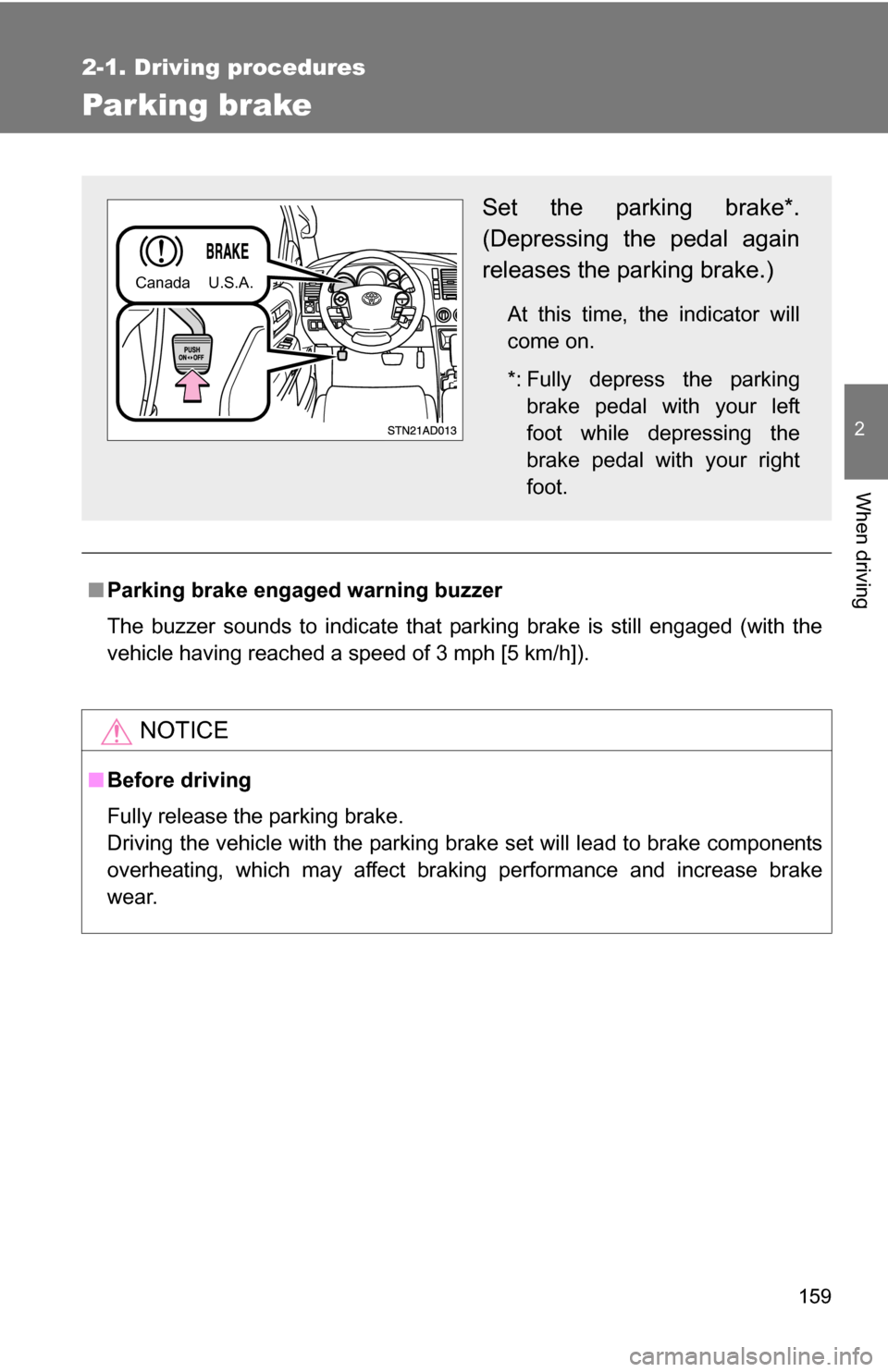
Set the parking brake*.
(Depressing the pedal again
releases the parking brake.)
At this time, the indicator will
come on.
*: Fully depress the parking
brake pedal with your left
foot while depressing the
brake pedal with your right
foot.
Canada U.S.A.
Page 165 of 612
165
2-2. Instrument cluster
2
When driving
Instrument panel light control
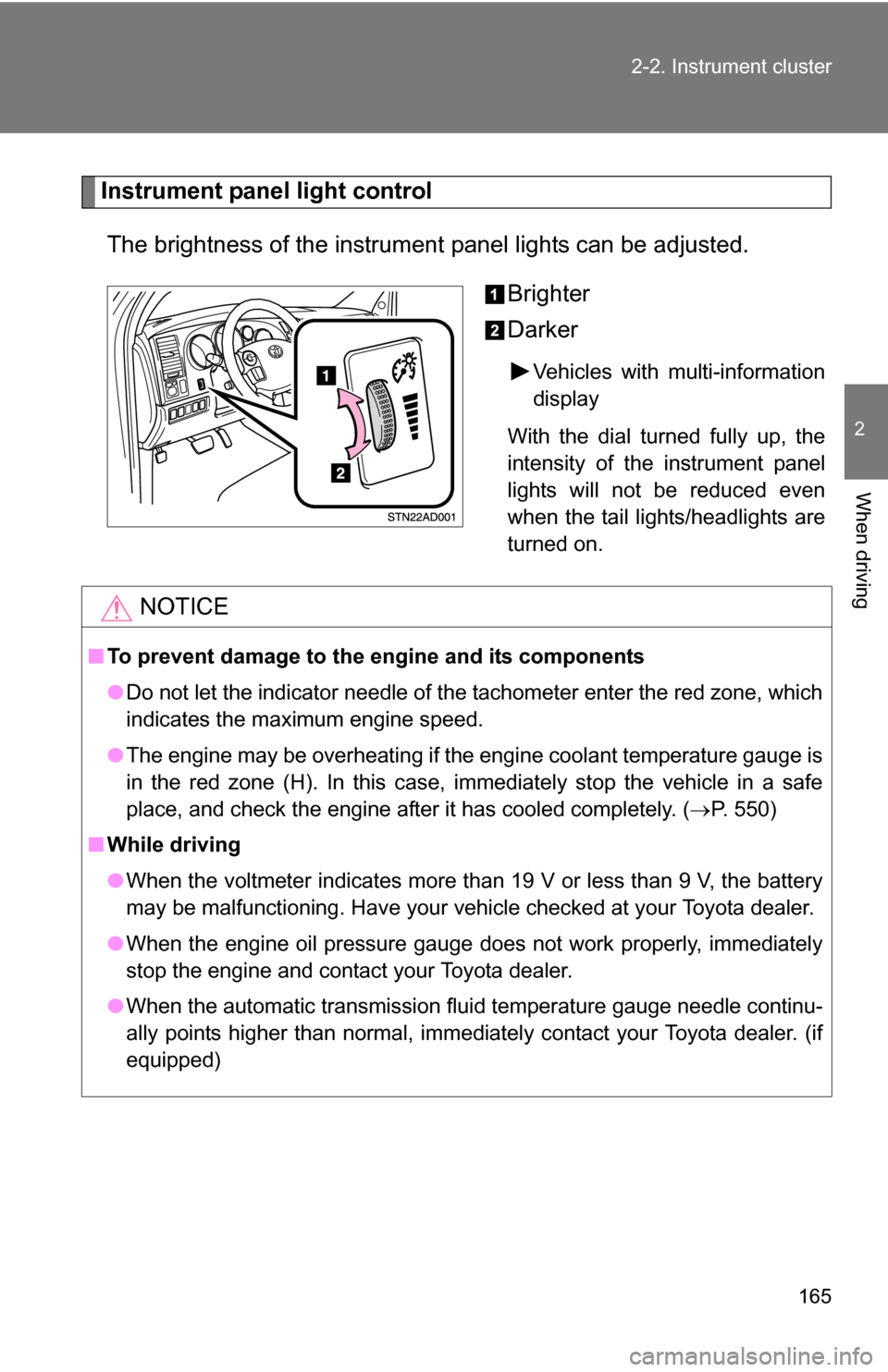
The brightness of the instrument panel lights can be adjusted.
Brighter
Darker
Vehicles with multi-information
display
With the dial turned fully up, the
intensity of the instrument panel
lights will not be reduced even
when the tail lights/headlights are
turned on.
NOTICE
■ To prevent damage to the engine and its components
●Do not let the indicator needle of the tachometer enter the red zone, which
indicates the maximum engine speed.
● The engine may be overheating if the engine coolant temperature gauge is
in the red zone (H). In this case, immediately stop the vehicle in a safe
place, and check the engine after it has cooled completely. ( P. 550)
■ While driving
●When the voltmeter indicates more than 19 V or less than 9 V, the battery
may be malfunctioning. Have your vehicle checked at your Toyota dealer.
● When the engine oil pressure gauge does not work properly, immediately
stop the engine and contact your Toyota dealer.
● When the automatic transmission fluid temperature gauge needle continu-
ally points higher than normal, immediately contact your Toyota dealer. (if
equipped)
Page 250 of 612
250 2-5. Driving information
●Crosswinds and rough roads will adversely affect handling of your
vehicle and trailer, causing sway . Periodically check the rear to
prepare for being passed by large trucks or buses, which may
cause your vehicle and trailer to sway. If swaying occurs, firmly grip
the steering wheel, reduce speed immediately but gradually, and
steer straight ahead. Never increase speed. If you make no
extreme correction with the stee ring or brakes, your vehicle and
trailer will stabilize.
● Take care when passing other v ehicles. Passing requires consider-
able distance. After passing a vehi cle, do not forget the length of
your trailer, and be sure you hav e plenty of room before changing
lanes.
● In order to maintain engine braking efficiency when driving on a
long steep downgrade, do not use the transmission in D.
Transmission shift range position must be in 5 in the S mode (6-
speed models) or in 4 in the S mode (5-speed models).
● Due to the added load of the trailer, your vehicle’s engine may
overheat on hot days (at temper atures over 85°F [30°C]) when
driving up a long or steep grade. If the engine coolant temperature
gauge indicates overheating, immediately turn off the air condition-
ing (if in use), pull your vehicle off the road and stop in a safe spot.
( P. 550)
● Always place wheel blocks under both the vehicle and the trailer
wheels when parking. Apply the parking brake firmly, and put the
transmission in P. Avoid parking on a slope, but if unavoidable, do
so only after performing the following:
Apply the brakes and keep them applied.
Have someone place wheel bloc ks under both the vehicle and
trailer wheels.
When the wheel blocks are in place, release the brakes slowly
until the blocks absorb the load.
Apply the parking brake firmly.
Page 405 of 612
405
3-7. Other interior features
3
Interior features
■
The power outlet can be used when
12V
The engine switch is in the ACC or ON position.
115V AC
The engine switch is in the ON position.
CAUTION
■Using a power outlet
Observe the following precautions to reduce the risk of injury.
●Use of the power outlet when it is wet with drinking water or snow may
result in electrical shocks and is extremely dangerous. The power outlet
must be thoroughly dried before use.
● Do not allow children to use or play with the power outlet.
● Be careful not to get any part of your body caught in the power outlet lid.
● When using electrical appliances, strictly follow any cautions and notices
written on their labels and in the manufacturers’ instruction manuals.
● Do not modify, disassemble or repair the power outlet or its inverter, in any
way. Doing so may result in unexpected malfunctions or accidents, which
could cause serious damage or injuries. Contact a Toyota dealer for any
necessary repairs.
■ To prevent injuries and accidents, secu rely fix all electric appliances
before use and do not use any app liances that may do any of the fol-
lowing:
● Distract the driver while driving, or hamper safe driving.
● Result in a fire or burn injuries due to the appliance rolling, falling or over-
heating while driving.
● Emit steam, while the windows of the cabin are closed.
Page 410 of 612
410 3-7. Other interior features
CAUTION
■Burns
●Use caution when seating the following persons in a seat with the seat
heater on to avoid the possibility of burns:
• Babies, small children, the elderly, the sick and the disabled
• Persons with sensitive skin
• Persons who are fatigued
• Persons who have taken alcohol or drugs that induce sleep (sleeping
drugs, cold remedies, etc.)
● Do not cover the seat with anything when using the seat heater.
Using the seat heater with a blanket or cushion increases the temperature
of the seat and may lead to overheating.
NOTICE
■To prevent seat heater damage
Do not put unevenly weighted objects on the seat and do not stick sharp
objects (needles, nails, etc.) into the seat.
■ To prevent battery discharge
Turn the switches off when the engine is not running.
Page 412 of 612
412 3-7. Other interior features
CAUTION
■Burns
●Use caution when seating the following persons in a seat with the seat
heater on to avoid the possibility of burns:
• Babies, small children, the elderly, the sick and the disabled
• Persons with sensitive skin
• Persons who are fatigued
• Persons who have taken alcohol or drugs that induce sleep (sleeping
drugs, cold remedies, etc.)
● Do not cover the seat with anything when using the seat heater.
Using the seat heater with a blanket or cushion increases the temperature
of the seat and may lead to overheating.
NOTICE
■To prevent seat heater damage
Do not put unevenly weighted objects on the seat and do not stick sharp
objects (needles, nails, etc.) into the seat.
■ To prevent battery discharge
Turn the switches off when the engine is not running.
Page 552 of 612
552 5-2. Steps to take in an emergency
■Overheating
If you observe the following, your vehicle may be overheating.
●The engine coolant temperature gauge enters the red zone or a loss of
power is experienced.
● Steam is coming from under the hood.
● “ENGINE COOLANT HOT” is shown on the multi-information display
(vehicles with multi-information display).
CAUTION
■To prevent an accident or injury when inspecting under the hood of
your vehicle
● If steam is seen coming from under the hood, do not open the hood until
the steam has subsided. The engine compartment may be very hot, caus-
ing serious injury such as burns.
● Keep hands and clothing away from the fan and other belts while the
engine is running.
● Do not loosen the radiator cap while the engine and radiator are hot.
Serious injury, such as burns, may result from hot coolant and steam
released under pressure.
NOTICE
■When adding engine coolant
Wait until the engine has cooled down before adding engine coolant.
When adding coolant, do so slowly. Adding cool coolant to a hot engine too
quickly can cause damage to the engine.
Page 599 of 612
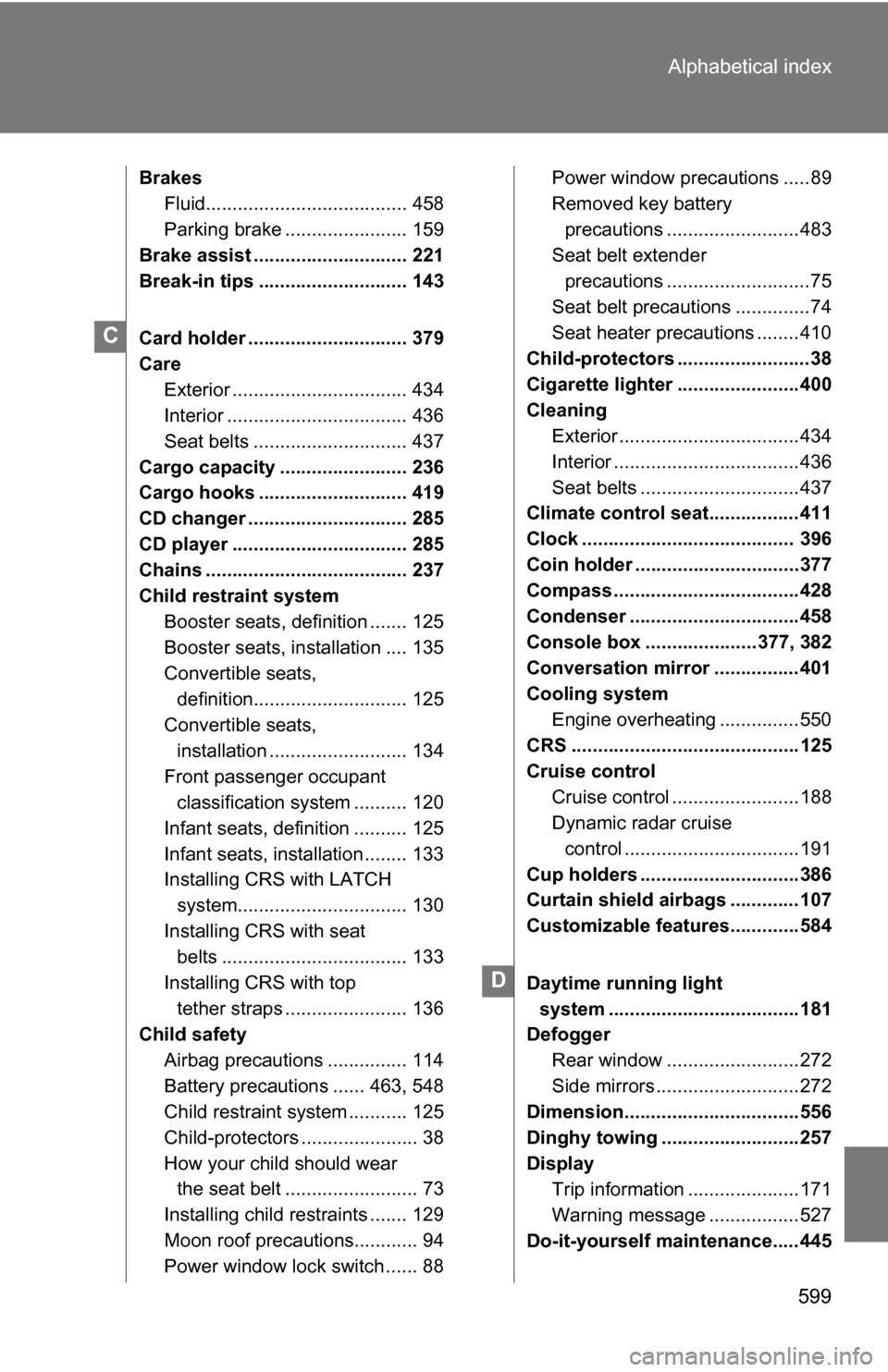
599
Alphabetical index
Brakes
Fluid...................................... 458
Parking brake ....................... 159
Brake assist ............................. 221
Break-in tips ............................ 143
Card holder .............................. 379
Care Exterior ................................. 434
Interior .................................. 436
Seat belts ............................. 437
Cargo capacity ........................ 236
Cargo hooks ............................ 419
CD changer .............................. 285
CD player ................................. 285
Chains ...................................... 237
Child restraint system Booster seats, definition ....... 125
Booster seats, installation .... 135
Convertible seats, definition............................. 125
Convertible seats,
installation .......................... 134
Front passenger occupant classification system .......... 120
Infant seats, definition .......... 125
Infant seats, installation ........ 133
Installing CRS with LATCH system................................ 130
Installing CRS with seat belts ................................... 133
Installing CRS with top tether straps ....................... 136
Child safety
Airbag precautions ............... 114
Battery precautions ...... 463, 548
Child restraint system ........... 125
Child-protectors ...................... 38
How your child should wear the seat belt ......................... 73
Installing child restraints ....... 129
Moon roof precautions............ 94
Power window lock switch ...... 88 Power window precautions .....89
Removed key battery
precautions .........................483
Seat belt extender precautions ...........................75
Seat belt precautions ..............74
Seat heater precautions ........410
Child-protectors .........................38
Cigarette lighter .......................400
Cleaning Exterior ..................................434
Interior ...................................436
Seat belts ..............................437
Climate control seat.................411
Clock ........................................ 396
Coin holder ...............................377
Compass ...................................428
Condenser ................................458
Console box .....................377, 382
Conversation mirror ................401
Cooling system
Engine overheating ...............550
CRS ...........................................125
Cruise control
Cruise control ........................188
Dynamic radar cruise control .................................191
Cup holders ..............................386
Curtain shield airbags .............107
Customizable features.............584
Daytime running light system ....................................181
Defogger
Rear window .........................272
Side mirrors ...........................272
Dimension.................................556
Dinghy towing ..........................257
Display Trip information .....................171
Warning message .................527
Do-it-yourself main tenance.....445
C
D
Page 600 of 612
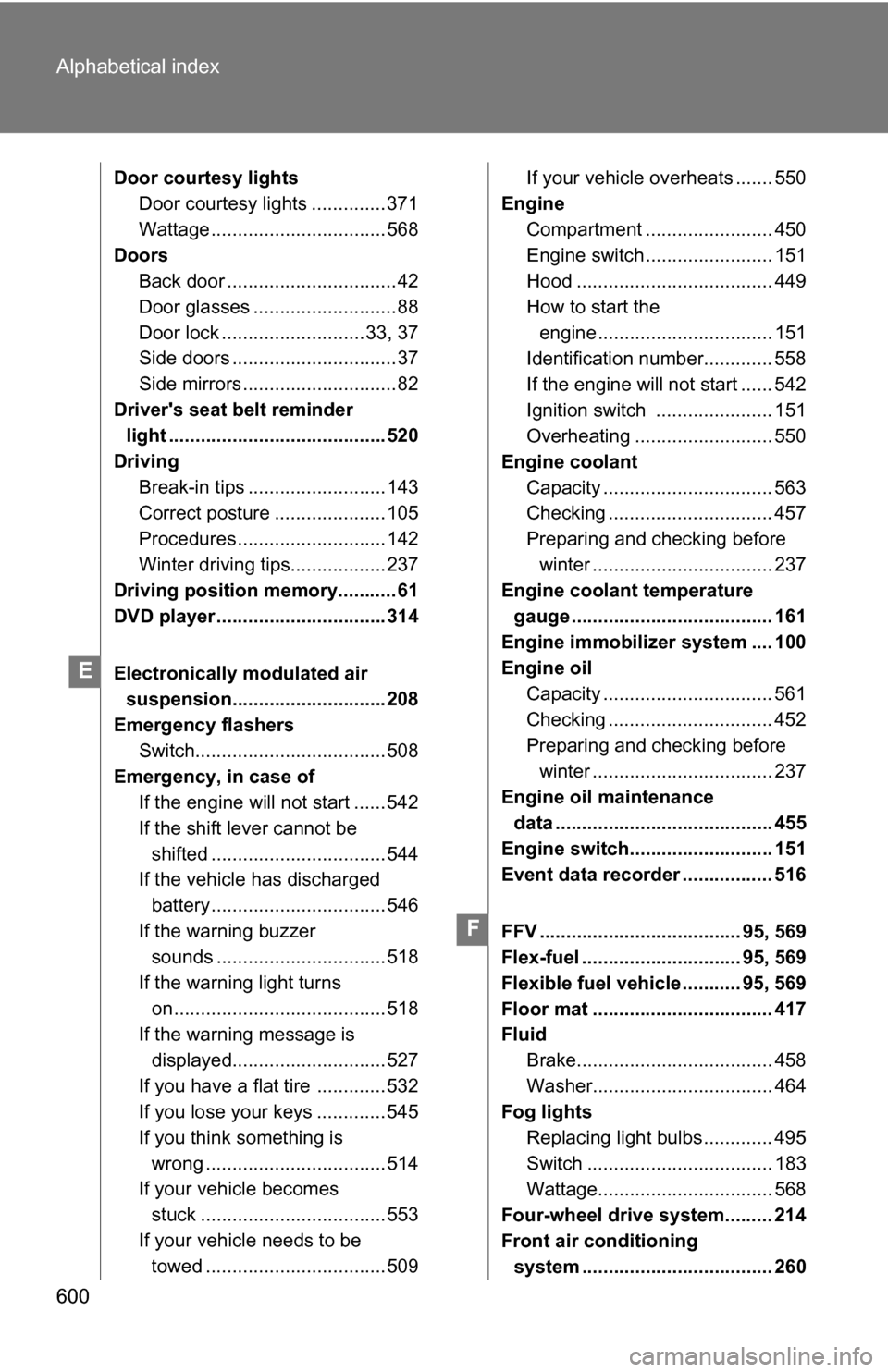
600 Alphabetical index
Door courtesy lightsDoor courtesy lights .............. 371
Wattage ................................. 568
Doors Back door ................................42
Door glasses ...........................88
Door lock ...........................33, 37
Side doors ...............................37
Side mirrors .............................82
Driver's seat belt reminder light ......................................... 520
Driving Break-in tips .......................... 143
Correct posture ..................... 105
Procedures ............................ 142
Winter driving tips.................. 237
Driving position memory...........61
DVD player ................................ 314
Electronically modulated air
suspension............................. 208
Emergency flashers
Switch.................................... 508
Emergency, in case of If the engine will not start ...... 542
If the shift lever cannot be
shifted ................................. 544
If the vehicle has discharged
battery ................................. 546
If the warning buzzer sounds ................................ 518
If the warning light turns on ........................................ 518
If the warning message is
displayed............................. 527
If you have a flat tire ............. 532
If you lose your keys ............. 545
If you think something is wrong .................................. 514
If your vehicle becomes
stuck ................................... 553
If your vehicle needs to be towed .................................. 509 If your vehicle overheats ....... 550
Engine
Compartment ........................ 450
Engine switch ........................ 151
Hood ..................................... 449
How to start the engine ................................. 151
Identification number............. 558
If the engine will not start ...... 542
Ignition switch ...................... 151
Overheating .......................... 550
Engine coolant Capacity ................................ 563
Checking ............................... 457
Preparing and checking before winter .................................. 237
Engine coolan t temperature
gauge ...................................... 161
Engine immobilizer system .... 100
Engine oil Capacity ................................ 561
Checking ............................... 452
Preparing and checking before winter .................................. 237
Engine oil maintenance data ......................................... 455
Engine switch........................... 151
Event data recorder ................. 516
FFV ...................................... 95, 569
Flex-fuel .............................. 95, 569
Flexible fuel vehicle ........... 95, 569
Floor mat .................................. 417
Fluid Brake..................................... 458
Washer.................................. 464
Fog lights
Replacing light bulbs ............. 495
Switch ................................... 183
Wattage................................. 568
Four-wheel drive system......... 214
Front air conditioning system .................................... 260
E
F