ECU TOYOTA SEQUOIA 2011 2.G Workshop Manual
[x] Cancel search | Manufacturer: TOYOTA, Model Year: 2011, Model line: SEQUOIA, Model: TOYOTA SEQUOIA 2011 2.GPages: 688, PDF Size: 14.76 MB
Page 494 of 688
494 3-8. Other interior features
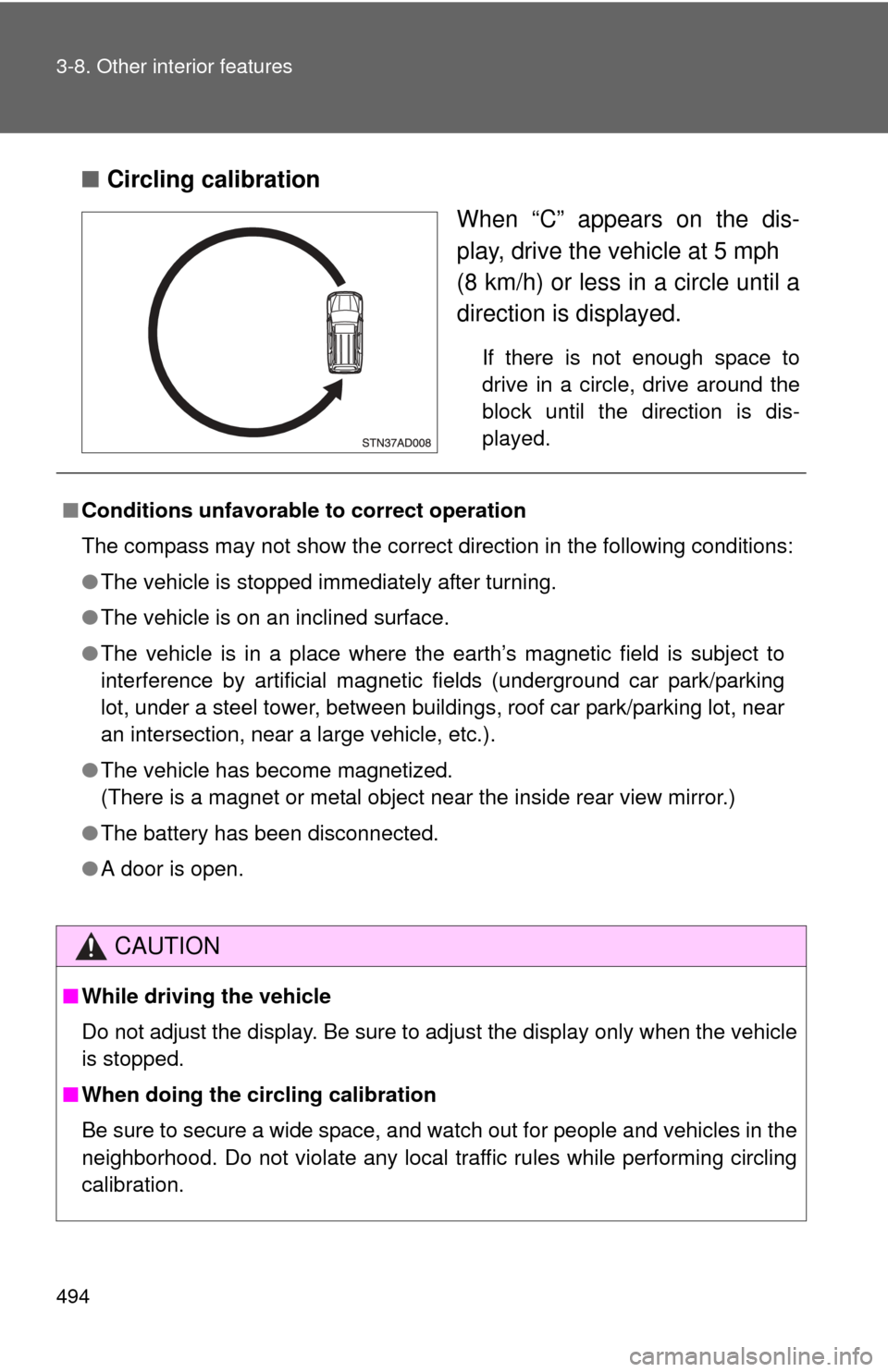
■Circling calibration
When “C” appears on the dis-
play, drive the vehicle at 5 mph
(8 km/h) or less in a circle until a
direction is displayed.
If there is not enough space to
drive in a circle, drive around the
block until the direction is dis-
played.
■Conditions unfavorable to correct operation
The compass may not show the correct direction in the following conditions:
●The vehicle is stopped immediately after turning.
● The vehicle is on an inclined surface.
● The vehicle is in a place where the earth’s magnetic field is subject to
interference by artificial magnetic fields (underground car park/parking
lot, under a steel tower, between buildings, roof car park/parking lot, near
an intersection, near a large vehicle, etc.).
● The vehicle has become magnetized.
(There is a magnet or metal object near the inside rear view mirror.)
● The battery has been disconnected.
● A door is open.
CAUTION
■While driving the vehicle
Do not adjust the display. Be sure to adjust the display only when the vehicle
is stopped.
■ When doing the circling calibration
Be sure to secure a wide space, and watch out for people and vehicles in the
neighborhood. Do not violate any local traffic rules while performing circling
calibration.
Page 506 of 688

506 4-2. Maintenance
Vehicle interior
ItemsCheck points
Accelerator pedal • Moves smoothly (without uneven
pedal effort or catching)?
Automatic transmission “Park”
mechanism • Can the vehicle be held securely
on an incline with the shift lever in
P?
Brake pedal • Moves smoothly?
• Does it have appropriate clear-
ance and correct amount of free
play?
Brakes • Not pull to one side when
applied?
• Loss of brake effectiveness?
• Spongy feeling brake pedal?
• Pedal almost touches floor?
Head restraints • Move smoothly and lock
securely?
Indicators/buzzers • Function properly?
Lights • Do all the lights come on?
• Headlights aimed correctly?
Parking brake • Moves smoothly?
• Can hold the vehicle securely on
an incline?
Seat belts • Does the seat belt system oper-
ate smoothly?
• Are the belts undamaged?
Seats • Do the seat controls operate
properly?
Steering wheel • Moves smoothly?
• Has correct free play?
• No strange noises?
Page 551 of 688
551
4-3. Do-it-yourself maintenance
4
Maintenance and care
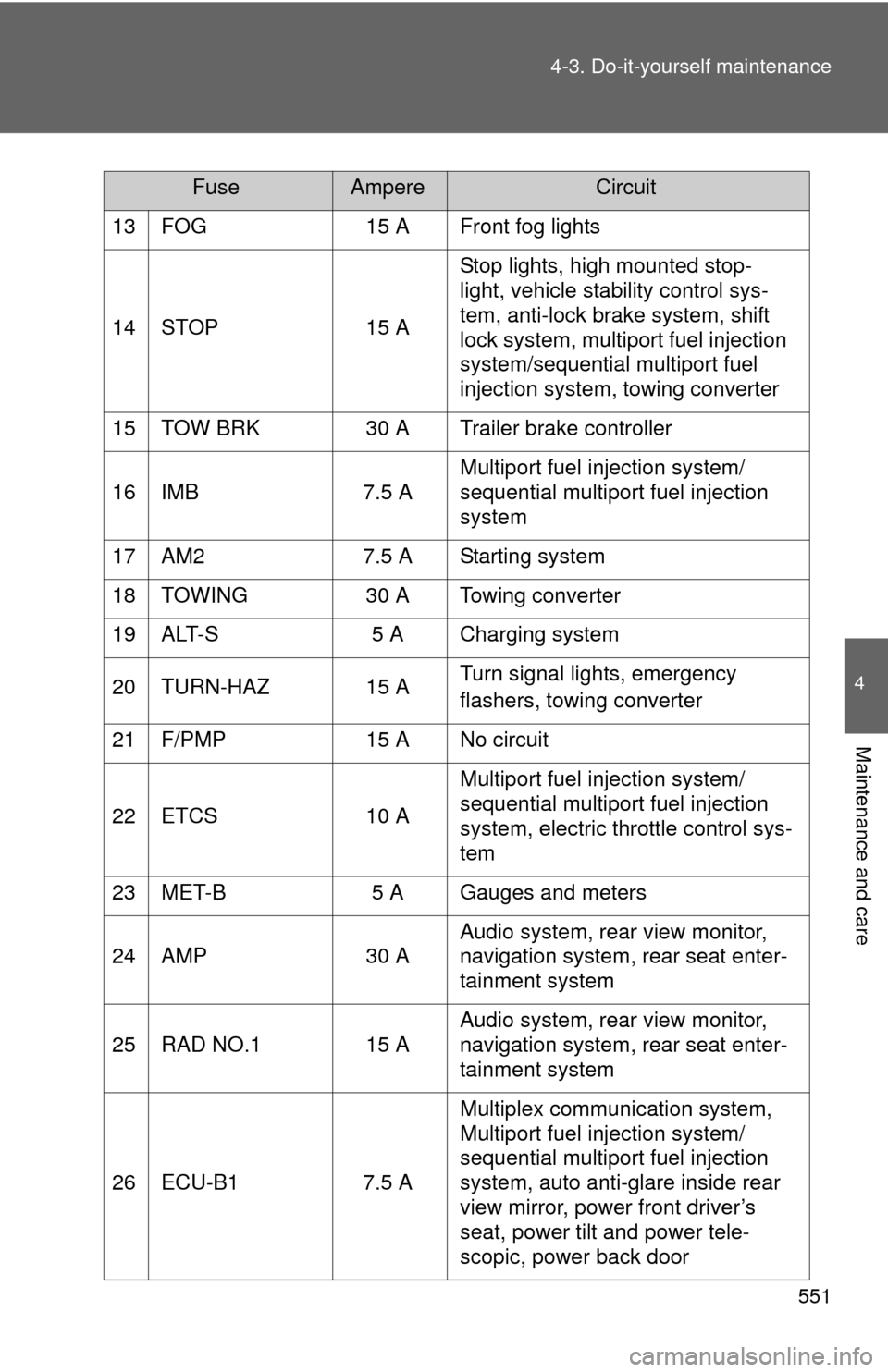
13 FOG
15 A Front fog lights
14 STOP 15 AStop lights, high mounted stop-
light, vehicle stability control sys-
tem, anti-lock brake system, shift
lock system, multiport fuel injection
system/sequential multiport fuel
injection system, towing converter
15 TOW BRK 30 A Trailer brake controller
16 IMB 7.5 AMultiport fuel injection system/
sequential multiport fuel injection
system
17 AM2 7.5 A Starting system
18 TOWING 30 A Towing converter
19 ALT-S 5 A Charging system
20 TURN-HAZ 15 A Turn signal lights, emergency
flashers, towing converter
21 F/PMP 15 A No circuit
22 ETCS 10 AMultiport fuel injection system/
sequential multiport fuel injection
system, electric throttle control sys-
tem
23 MET-B 5 A Gauges and meters
24 AMP 30 AAudio system, rear view monitor,
navigation system, rear seat enter-
tainment system
25 RAD NO.1 15 A Audio system, rear view monitor,
navigation system, rear seat enter-
tainment system
26 ECU-B1 7.5 AMultiplex communication system,
Multiport fuel injection system/
sequential multiport fuel injection
system, auto anti-glare inside rear
view mirror, power front driver’s
seat, power tilt and power tele-
scopic, power back door
FuseAmpereCircuit
Page 553 of 688
553
4-3. Do-it-yourself maintenance
4
Maintenance and care
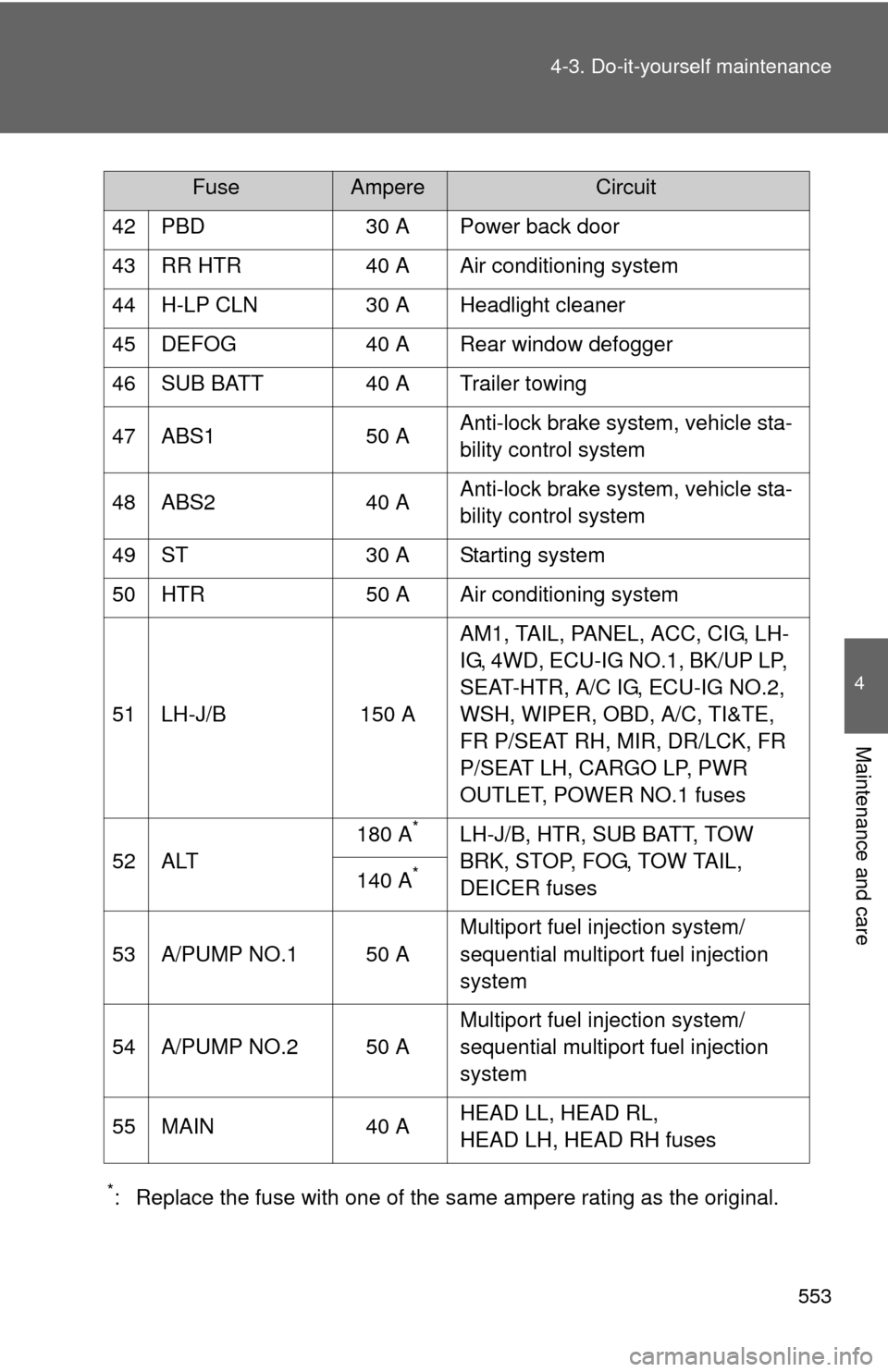
*: Replace the fuse with one of the same ampere rating as the original.
42 PBD 30 A Power back door
43 RR HTR 40 A Air conditioning system
44 H-LP CLN 30 A Headlight cleaner
45 DEFOG 40 A Rear window defogger
46 SUB BATT 40 A Trailer towing
47 ABS1 50 A
Anti-lock brake system, vehicle sta-
bility control system
48 ABS2 40 A Anti-lock brake system, vehicle sta-
bility control system
49 ST 30 A Starting system
50 HTR 50 A Air conditioning system
51 LH-J/B 150 A AM1, TAIL, PANEL, ACC, CIG, LH-
IG, 4WD, ECU-IG NO.1, BK/UP LP,
SEAT-HTR, A/C IG, ECU-IG NO.2,
WSH, WIPER, OBD, A/C, TI&TE,
FR P/SEAT RH, MIR, DR/LCK, FR
P/SEAT LH, CARGO LP, PWR
OUTLET, POWER NO.1 fuses
52 ALT 180 A
*LH-J/B, HTR, SUB BATT, TOW
BRK, STOP, FOG, TOW TAIL,
DEICER fuses
140 A
*
53 A/PUMP NO.1 50 A Multiport fuel injection system/
sequential multiport fuel injection
system
54 A/PUMP NO.2 50 A Multiport fuel injection system/
sequential multiport fuel injection
system
55 MAIN 40 A HEAD LL, HEAD RL,
HEAD LH, HEAD RH fuses
FuseAmpereCircuit
Page 555 of 688
555
4-3. Do-it-yourself maintenance
4
Maintenance and care
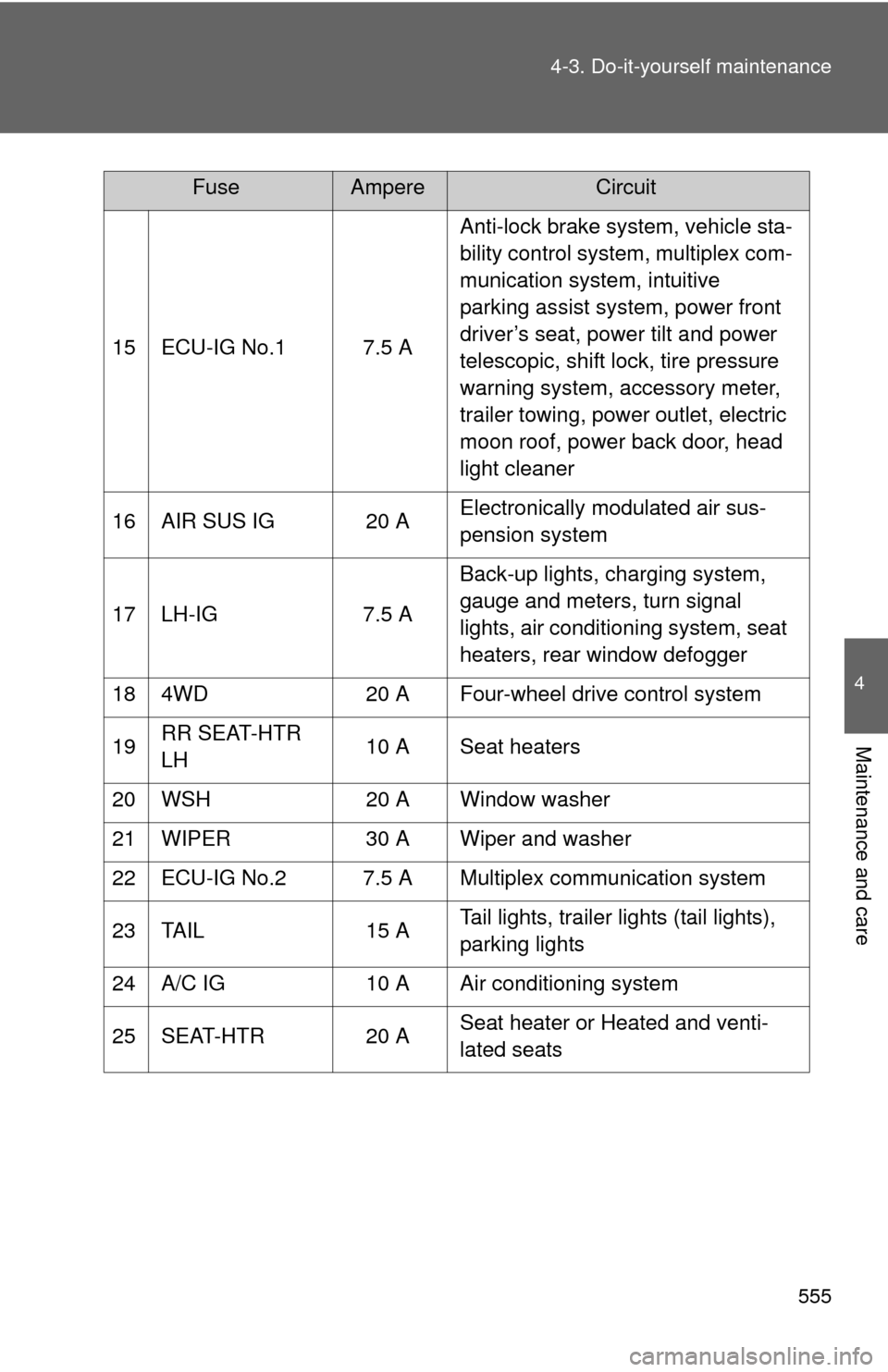
15 ECU-IG No.1 7.5 A
Anti-lock brake system, vehicle sta-
bility control system, multiplex com-
munication system, intuitive
parking assist system, power front
driver’s seat, power tilt and power
telescopic, shift lock, tire pressure
warning system, accessory meter,
trailer towing, power outlet, electric
moon roof, power back door, head
light cleaner
16 AIR SUS IG 20 A Electronically modulated air sus-
pension system
17 LH-IG 7.5 A Back-up lights, charging system,
gauge and meters, turn signal
lights, air conditioning system, seat
heaters, rear window defogger
18 4WD 20 A Four-wheel drive control system
19 RR SEAT-HTR
LH 10 A Seat heaters
20 WSH 20 A Window washer
21 WIPER 30 A Wiper and washer
22 ECU-IG No.2 7.5 A Multiplex communication system
23 TAIL 15 A Tail lights, trailer lights (tail lights),
parking lights
24 A/C IG 10 A Air conditioning system
25 SEAT-HTR 20 A Seat heater or Heated and venti-
lated seats
FuseAmpereCircuit
Page 569 of 688
569
4-3. Do-it-yourself maintenance
4
Maintenance and care
CAUTION
■
Replacing light bulbs
●Turn off the headlights. Do not attempt to replace the bulb immediately
after turning off the headlights.
The bulbs become very hot and may cause burns.
● Do not touch the glass portion of the light bulb with bare hands. Hold the
bulb by the plastic or metal portion.
If the bulb is scratched or dropped it may blow out or crack.
● Fully install light bulbs and any parts used to secure them. Failing to do so
may result in heat damage, fire, or water entering the headlight unit. This
may damage the headlights or cause condensation to build up on the lens.
■ To prevent damage or fire
Make sure bulbs are fully seated and locked.
Page 573 of 688
5
When trouble arises
573
5-1. Essential information
If your vehicle needs to be towed
Before towingThe following may indicate a problem with your transmission. Contact
your Toyota dealer before towing.
● The engine is running, but the vehicle will not move.
● The vehicle makes an abnormal sound.
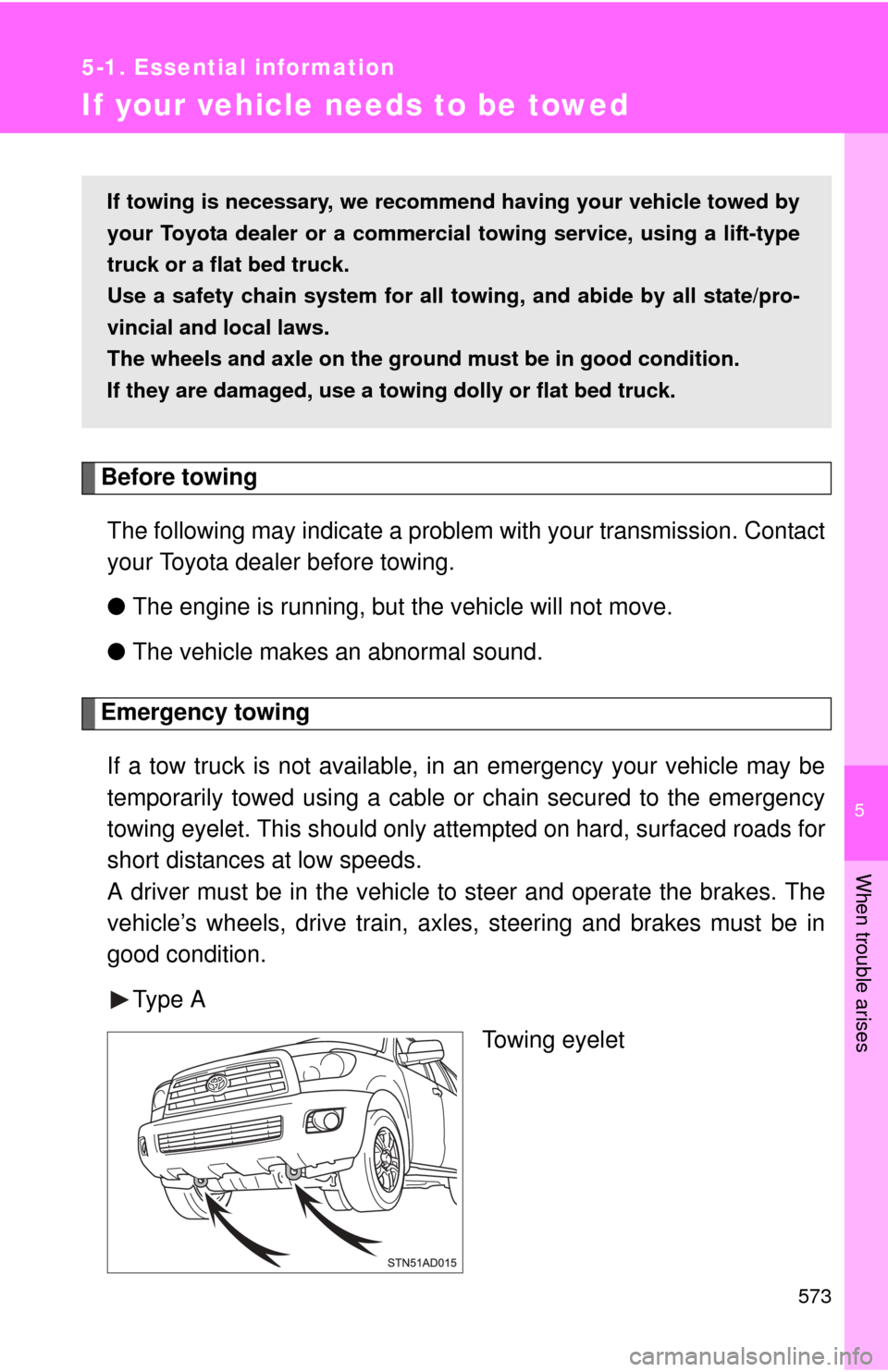
Emergency towing
If a tow truck is not available, in an emergency your vehicle may be
temporarily towed using a cable or chain secured to the emergency
towing eyelet. This should only attempted on hard, surfaced roads for
short distances at low speeds.
A driver must be in the vehicle to steer and operate the brakes. The
vehicle’s wheels, drive train, axles, steering and brakes must be in
good condition.
Type A Towing eyelet
If towing is necessary, we recommend having your vehicle towed by
your Toyota dealer or a commerci al towing service, using a lift-type
truck or a flat bed truck.
Use a safety chain system for all to wing, and abide by all state/pro-
vincial and local laws.
The wheels and axle on the groun d must be in good condition.
If they are damaged, use a towing dolly or flat bed truck.
Page 575 of 688
5
When trouble arises
575
5-1. Essential information
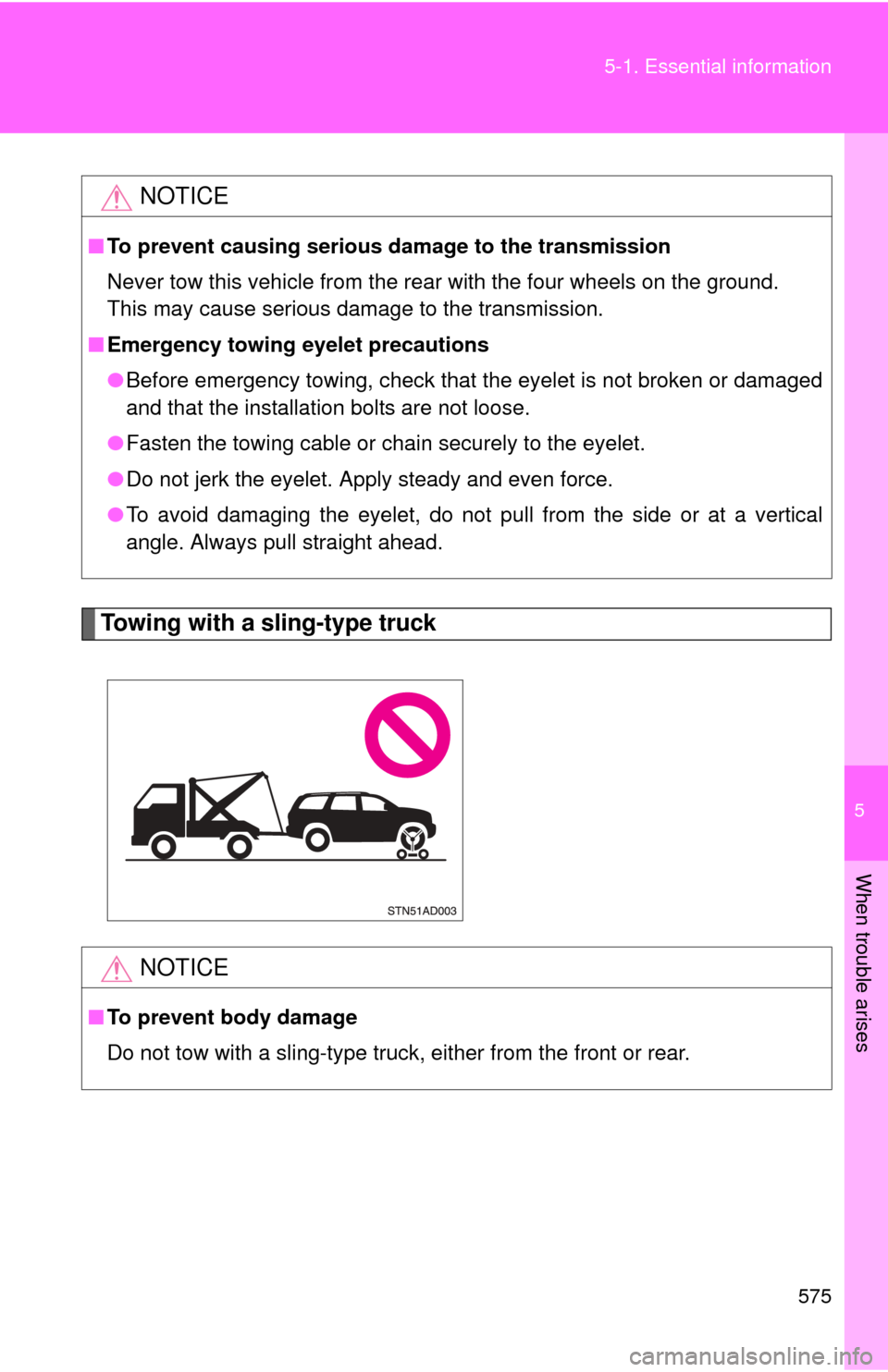
Towing with a sling-type truck
NOTICE
■
To prevent causing serious da mage to the transmission
Never tow this vehicle from the rear with the four wheels on the ground.
This may cause serious damage to the transmission.
■ Emergency towing eyelet precautions
● Before emergency towing, check that the eyelet is not broken or damaged
and that the installation bolts are not loose.
● Fasten the towing cable or chain securely to the eyelet.
● Do not jerk the eyelet. Apply steady and even force.
● To avoid damaging the eyelet, do not pull from the side or at a vertical
angle. Always pull straight ahead.
NOTICE
■To prevent body damage
Do not tow with a sling-type truck, either from the front or rear.
Page 588 of 688

588 5-2. Steps to take in an emergency
■Open moon roof reminder buzzer
The buzzer indicate that the moon roof is still opened (with the engine switch
in the ACC or LOCK position and the driver’s door opened).
■ If the malfunction indicator lamp comes on while driving
First check the following:
● Is your vehicle low on gas?
If it is, refuel the vehicle immediately.
● Is the fuel tank cap loose?
If it is, tighten it securely.
The light will go off after taking several driving trips.
If the light does not go off even after several trips, contact your Toyota dealer
as soon as possible.
■ Front passenger detect ion sensor and passenger seat belt reminder
If luggage or other load is placed on the front passenger seat, depending on
its weight, the reminder light to flash and buzzer to sound.
■
When the tire pressure warning light comes on
Check the tire inflation pressure and adjust to the appropriate level.
Pushing the tire pressure warning reset switch does not turn off the tire
pressure warning light.
■The tire pressure warning light ma y turn on due to natural causes
The tire pressure warning light may turn on due to natural causes such
as natural air leaks or tire inflation pressure changes caused by temper-
ature. In this case, adjusting the ti re inflation pressure will turn off the
warning light (after several minutes).
■When a tire is replaced with a spare tire
The temporary spare tire is not equipped with the tire pressure warning
valve and transmitter. If a tire goes flat, the tire pressure warning light will
not turn off even though the flat tire is replaced with the temporary spare
tire. Replace the temporary spare tire with the repaired tire and adjust
the proper tire inflatio n pressure. The tire pres sure warning light will turn
off after several minutes.
Page 603 of 688
5
When trouble arises
603
5-2. Steps to take in an emergency
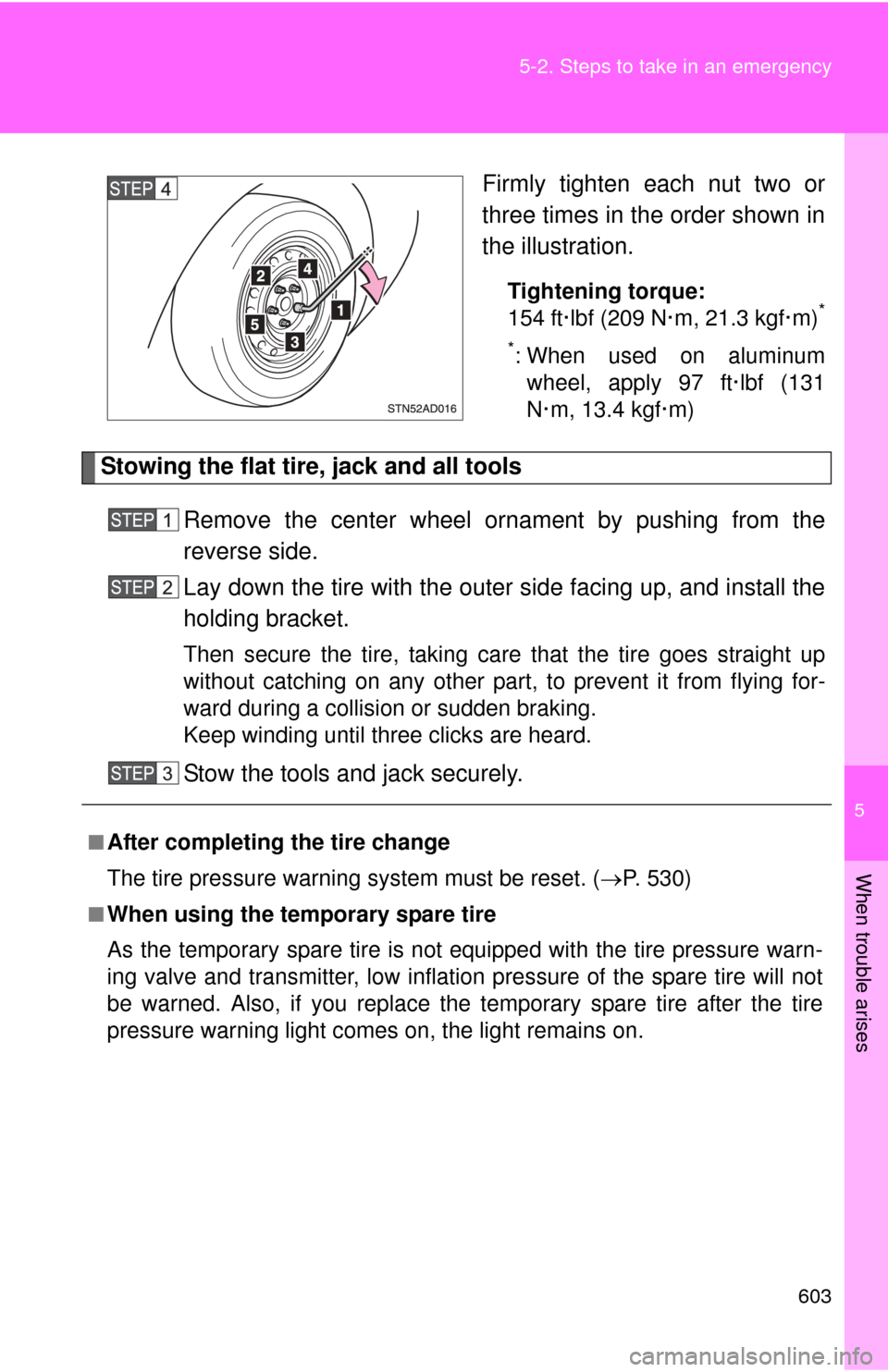
Firmly tighten each nut two or
three times in the order shown in
the illustration.
Tightening torque:
154 ft·lbf (209 N·m, 21.3 kgf·m)*
*
: When used on aluminum wheel, apply 97 ft·lbf (131
N·m, 13.4 kgf·m)
Stowing the flat tire, jack and all tools
Remove the center wheel ornament by pushing from the
reverse side.
Lay down the tire with the outer side facing up, and install the
holding bracket.
Then secure the tire, taking care that the tire goes straight up
without catching on any other part, to prevent it from flying for-
ward during a collision or sudden braking.
Keep winding until three clicks are heard.
Stow the tools and jack securely.
■After completing the tire change
The tire pressure warning system must be reset. (P. 530)
■When using the temporary spare tire
As the temporary spare tire is not equipped with the tire pressure warn-
ing valve and transmitter, low inflation pressure of the spare tire will not
be warned. Also, if you replace the temporary spare tire after the tire
pressure warning light comes on, the light remains on.