horn TOYOTA SEQUOIA 2012 2.G Owners Manual
[x] Cancel search | Manufacturer: TOYOTA, Model Year: 2012, Model line: SEQUOIA, Model: TOYOTA SEQUOIA 2012 2.GPages: 708, PDF Size: 15.12 MB
Page 2 of 708

TABLE OF CONTENTSIndex
2
1-1. Key informationKeys ..................................... 32
1-2. Opening, closing and locking the doors
Wireless remote control ....... 33
Side doors ............................ 37
Back door ............................. 42
1-3. Adjustable components (seats, mirrors, steering
wheel)
Front seats ........................... 50
Rear seats ............................ 54
Driving position memory (driver’s seat) ..................... 65
Head restraints ..................... 68
Seat belts ............................. 72
Steering wheel (manually adjustable type) .................. 82
Steering wheel (power-adjustable type)...... 83
Anti-glare inside rear view mirror.......................... 84
Outside rear view mirrors ..... 87
Roof luggage carrier............. 91
1-4. Opening and closing the windows and moon roof
Power windows .................... 93
Power back window ............. 96
Moon roof ............................. 99 1-5. Refueling
Opening the fuel tank cap... 102
1-6. Theft deterrent system Engine immobilizer system .............................. 107
Alarm .................................. 109
1-7. Safety information Correct driving posture ....... 112
SRS airbags ....................... 114
Front passenger occupant classification system ......... 127
Child restraint systems ....... 132
Installing child restraints ..... 136
2-1. Driving procedures Driving the vehicle .............. 150
Engine (ignition) switch....... 159
Automatic transmission ...... 162
Turn signal lever ................. 166
Parking brake ..................... 167
Horn .................................... 168
2-2. Instrument cluster Gauges and meters ............ 169
Indicators and warning lights ................................. 174
Multi-information display ..... 179
Accessory meter ................. 185
1Before driving
2When driving
Page 10 of 708
10
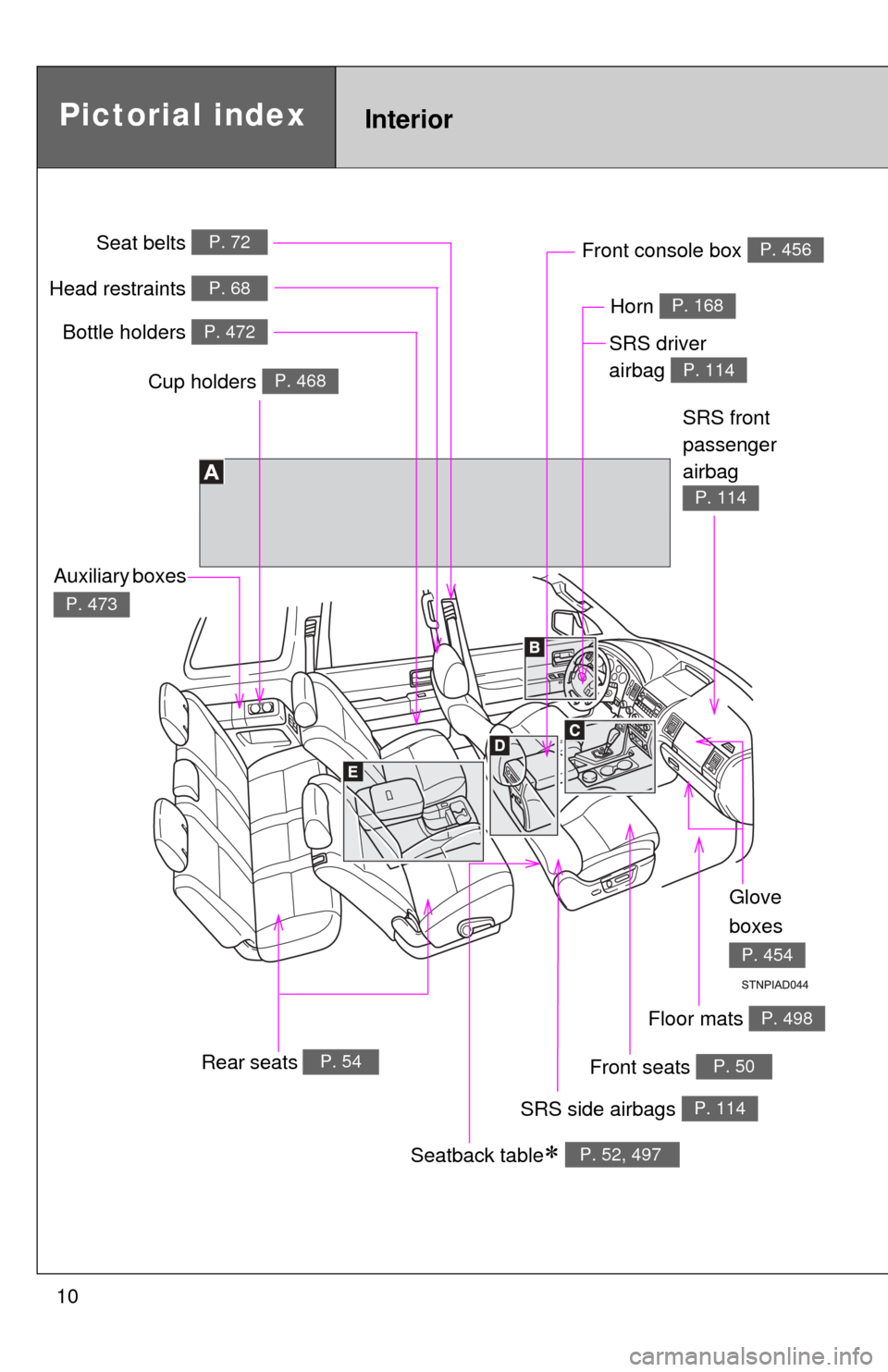
Pictorial indexInterior
Seat belts P. 72
SRS driver
airbag
P. 114
Head restraints P. 68
Bottle holders P. 472
SRS side airbags P. 114
Floor mats P. 498
SRS front
passenger
airbag
P. 114
Rear seats P. 54Front seats P. 50
Front console box P. 456
Seatback table P. 52, 497
Cup holders P. 468
Auxiliary boxes
P. 473
Glove
boxes
P. 454
Horn P. 168
Page 149 of 708
When driving2
149
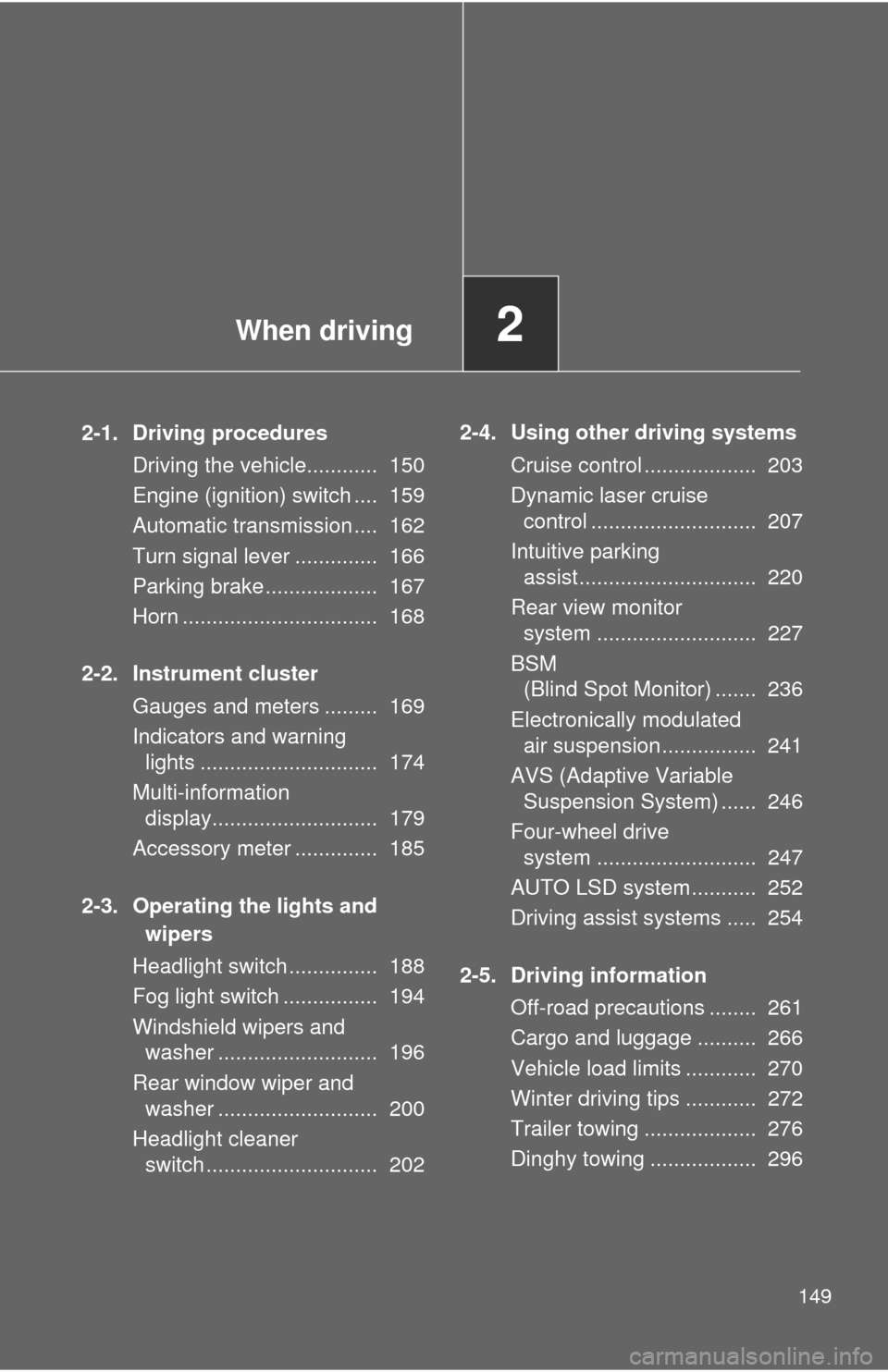
2-1. Driving proceduresDriving the vehicle............ 150
Engine (ignition) switch .... 159
Automatic transmission .... 162
Turn signal lever .............. 166
Parking brake ................... 167
Horn ................................. 168
2-2. Instrument cluster Gauges and meters ......... 169
Indicators and warning lights .............................. 174
Multi-information display............................ 179
Accessory meter .............. 185
2-3. Operating the lights and wipers
Headlight switch ............... 188
Fog light switch ................ 194
Windshield wipers and washer ........................... 196
Rear window wiper and washer ........................... 200
Headlight cleaner switch ............................. 202 2-4. Using other driving systems
Cruise control ................... 203
Dynamic laser cruise control ............................ 207
Intuitive parking assist.............................. 220
Rear view monitor system ........................... 227
BSM (Blind Spot Monitor) ....... 236
Electronically modulated air suspension ................ 241
AVS (Adaptive Variable Suspension System) ...... 246
Four-wheel drive system ........................... 247
AUTO LSD system........... 252
Driving assist systems ..... 254
2-5. Driving information Off-road precautions ........ 261
Cargo and luggage .......... 266
Vehicle load limits ............ 270
Winter driving tips ............ 272
Trailer towing ................... 276
Dinghy towing .................. 296
Page 168 of 708
168
2-1. Driving procedures
Hor n
■After adjusting the steering wheel (veh icles with manual tilt and tele-
scopic steering)
Make sure that the steering wheel is securely locked.
The horn may not sound if the steering wheel is not securely locked.
( P. 82)
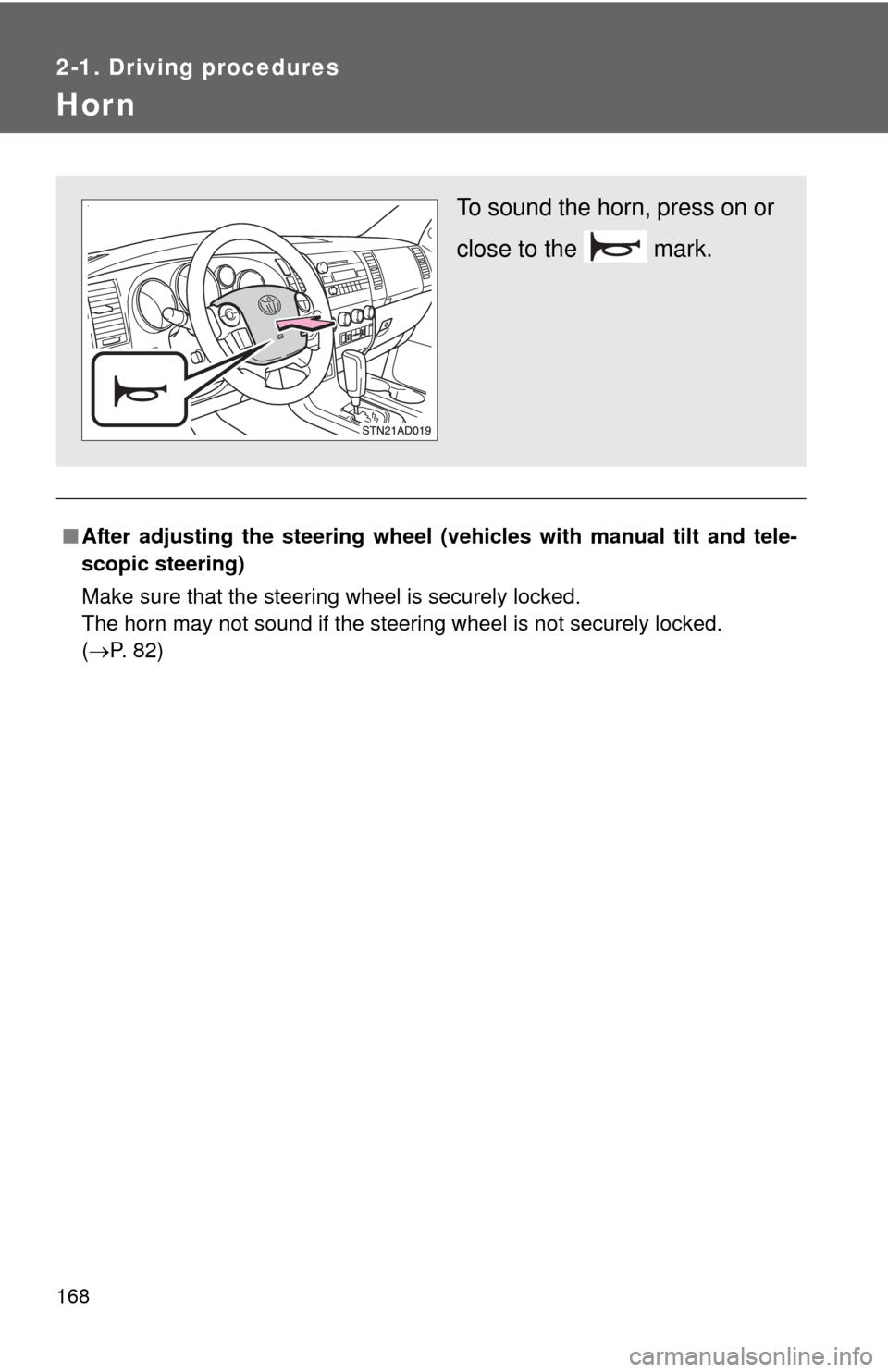
To sound the horn, press on or
close to the mark.
Page 225 of 708

225
2-4. Using other
driving systems
2
When driving
■Sensor detection information
●Certain vehicle conditions and the surrounding environment may affect
the ability of a sensor to correctly detect an obstacle. Particular instances
where this may occur are listed below.
• There is dirt, snow or ice on a sensor.
• A sensor is frozen.
• A sensor is covered in any way.
• The vehicle is leaning considerably to one side.
• On an extremely bumpy road, on an incline, on gravel, or on grass.
• The vicinity of the vehicle is noisy due to vehicle horns, motorcycle
engines, air brakes of large vehicles, or other loud noises producing
ultrasonic waves.
• There is another vehicle equipped with parking assist sensors in the vicinity.
• A sensor is coated with a sheet of spray or heavy rain.
• The vehicle is equipped with a fender pole or radio antenna.
• A bumper or sensor receives a strong impact.
• The vehicle is approaching a tall or right-angled curb.
• In harsh sunlight or intense cold weather.
• The area directly under the bumpers is not detected. Objects lower than the sensors or thin stakes etc. may be detected ini-
tially, but as they draw closer, they may cease to be detected.
• A towing hitch is mounted to the vehicle.
• A non-genuine Toyota suspension (lowered suspension etc.) is installed.
• When attaching a two-way radio antenna.
• When a towing eyelet is mounted on your vehicle.
• When the bumper is damaged.
In addition to the examples above, there are instances in which, because of
their shapes, signs and other objects may be judged by a sensor to be closer
than they are.
● The shape of the obstacle may prevent a sensor from detecting it. Pay
particular attention to the following obstacles:
• Wires, fences, ropes, etc.
• Cotton, snow and other materials that absorb sound waves
• Sharply-angled objects
• Low obstacles
Page 571 of 708
571
4-3. Do-it-yourself maintenance
4
Maintenance and care
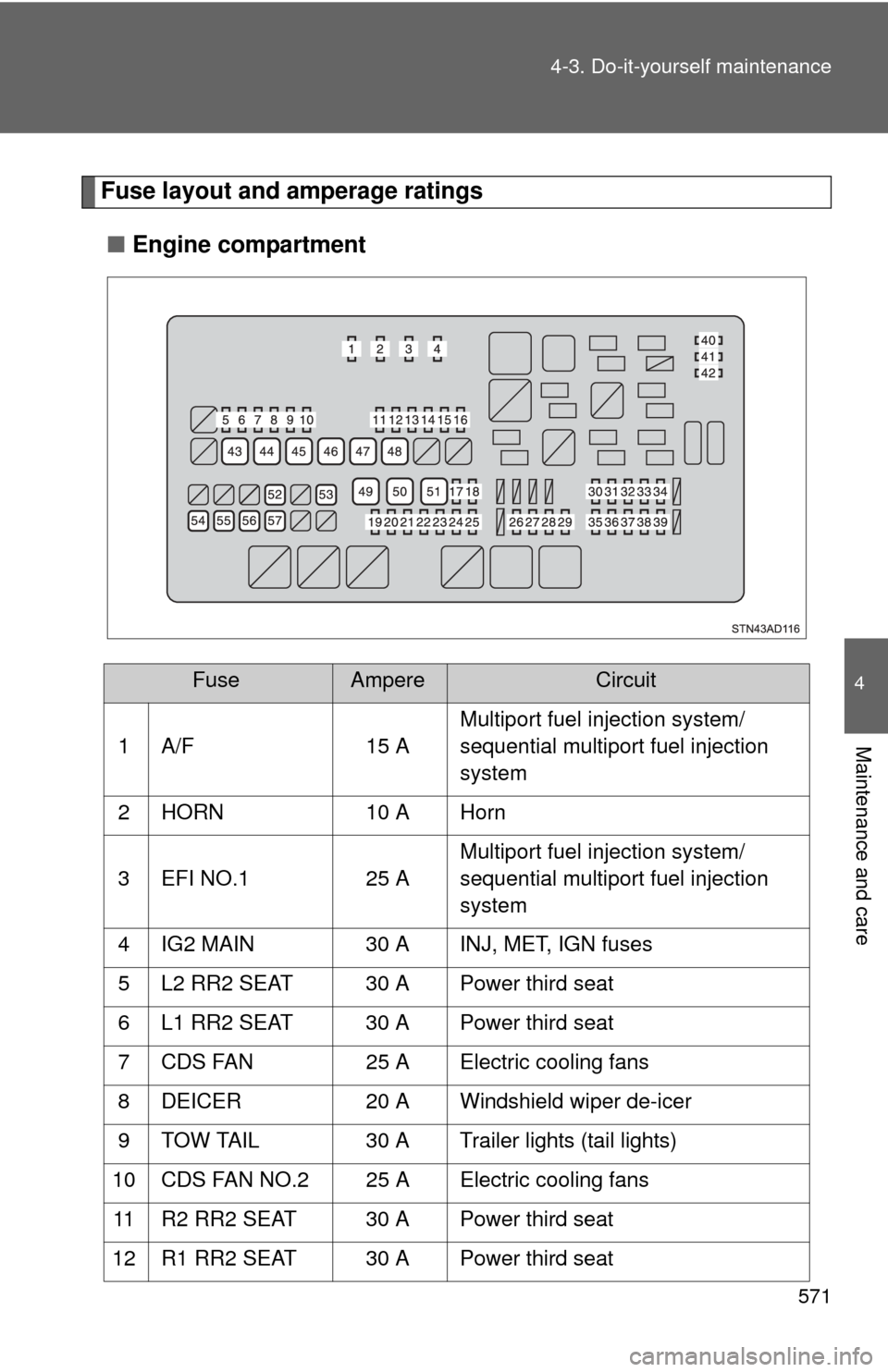
Fuse layout and amperage ratings
■ Engine compartment
FuseAmpereCircuit
1 A/F 15 A Multiport fuel injection system/
sequential multiport fuel injection
system
2 HORN 10 A Horn
3 EFI NO.1 25 A Multiport fuel injection system/
sequential multiport fuel injection
system
4 IG2 MAIN 30 A INJ, MET, IGN fuses
5 L2 RR2 SEAT 30 A Power third seat
6 L1 RR2 SEAT 30 A Power third seat
7 CDS FAN 25 A Electric cooling fans
8 DEICER 20 A Windshield wiper de-icer
9 TOW TAIL 30 A Trailer lights (tail lights)
10 CDS FAN NO.2 25 A Electric cooling fans
11 R2 RR2 SEAT 30 A Power third seat
12 R1 RR2 SEAT 30 A Power third seat
Page 630 of 708
630
5-2. Steps to take in an emergency
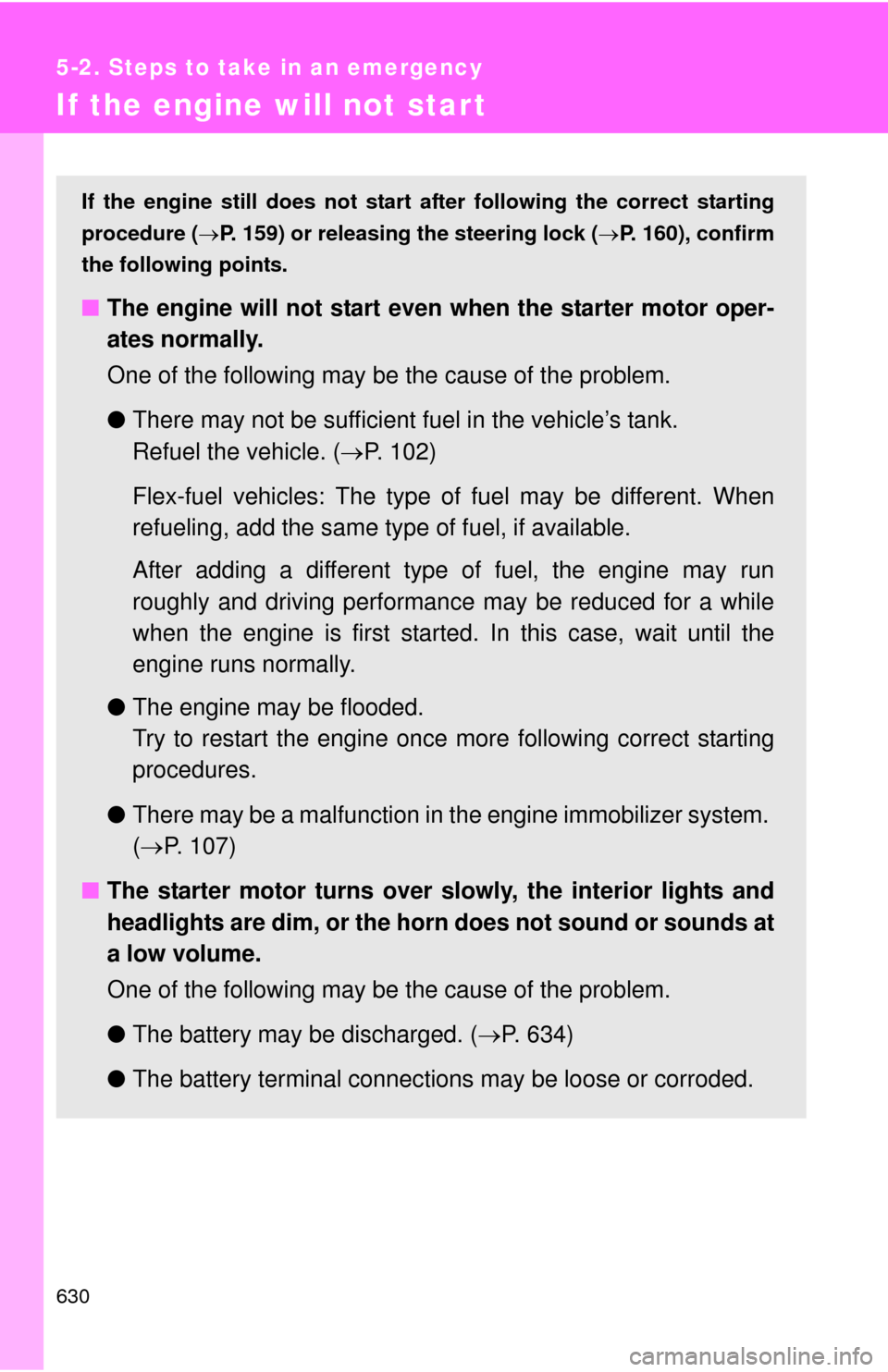
If the engine will not start
If the engine still does not start after following the correct starting
procedure ( P. 159) or releasing the steering lock (P. 160), confirm
the following points.
■ The engine will not start even when the starter motor oper-
ates normally.
One of the following may be the cause of the problem.
●There may not be sufficient fuel in the vehicle’s tank.
Refuel the vehicle. ( P. 102)
Flex-fuel vehicles: The type of fuel may be different. When
refueling, add the same type of fuel, if available.
After adding a different type of fuel, the engine may run
roughly and driving performance may be reduced for a while
when the engine is first started. In this case, wait until the
engine runs normally.
● The engine may be flooded.
Try to restart the engine once more following correct starting
procedures.
● There may be a malfunction in the engine immobilizer system.
( P. 107)
■ The starter motor turns over slowly, the interior lights and
headlights are dim, or the horn does not sound or sounds at
a low volume.
One of the following may be the cause of the problem.
●The battery may be discharged. ( P. 634)
● The battery terminal connec tions may be loose or corroded.
Page 631 of 708
5
When trouble arises
631
5-2. Steps to take in an emergency
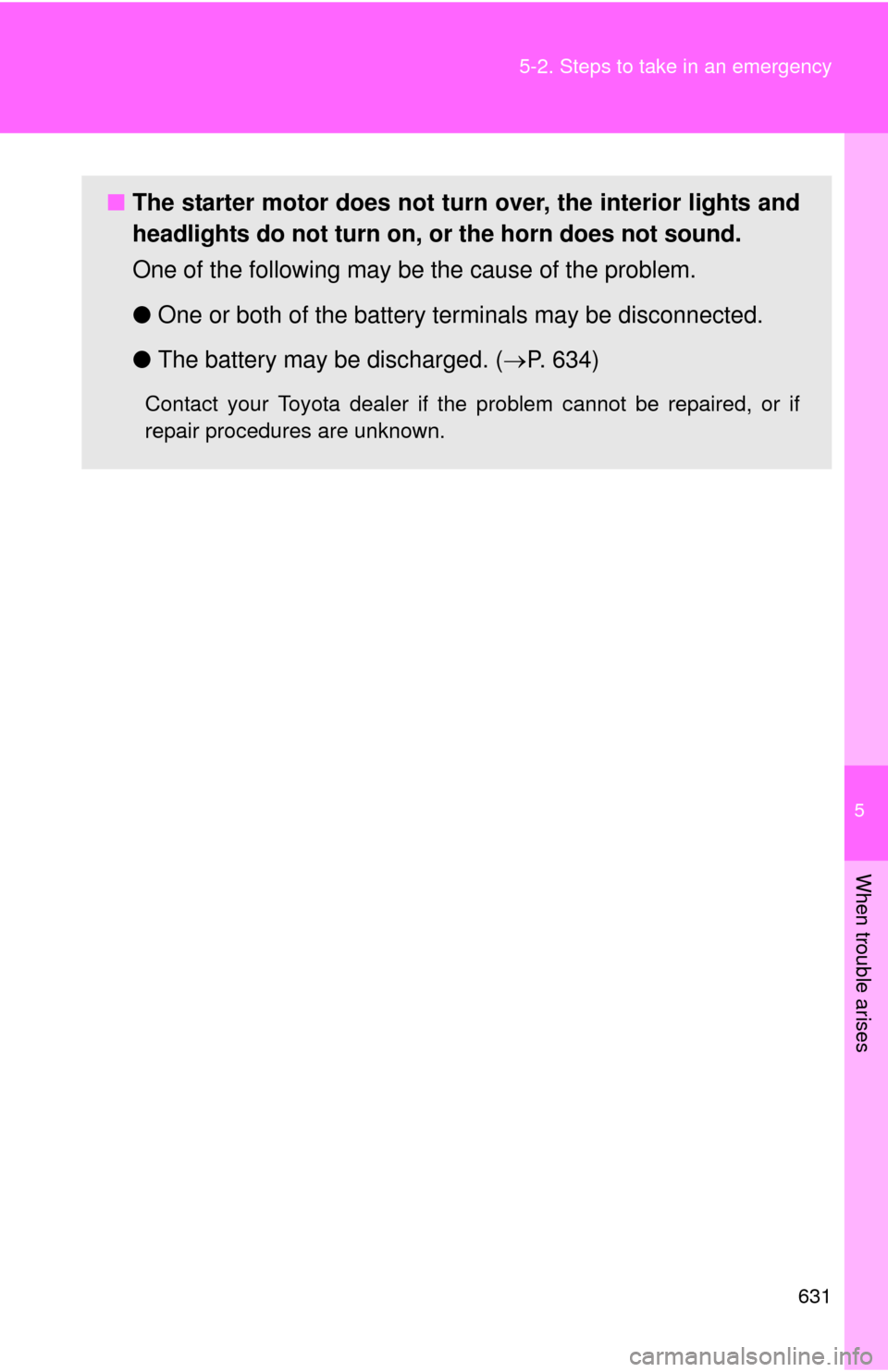
■
The starter motor does not turn over, the interior lights and
headlights do not turn on, or the horn does not sound.
One of the following may be the cause of the problem.
● One or both of the battery terminals may be disconnected.
● The battery may be discharged. ( P. 634)
Contact your Toyota dealer if the problem cannot be repaired, or if
repair procedures are unknown.
Page 699 of 708

699
Alphabetical index
FFV ................................... 102, 656
Flex-fuel ........................... 102, 656
Flexible fuel vehicle ........ 102, 656
Floor mat .................................. 498
Fluid
Brake .................................... 541
Washer ................................. 547
Fog lights
Replacing light bulbs ............ 580
Switch ................................... 194
Wattage ................................ 655
Four-wheel drive system ........ 247
Front air conditioning system ................................... 300
Front passenger occupant classification system............ 127
Front passenger’s seat belt
reminder light ........................ 606
Front seats Adjustment ............................. 50
Front side marker lights Replacing light bulbs ............ 580
Switch ................................... 188
Wattage ................................ 655
Front turn signal lights Replacing light bulbs ............ 580
Wattage ................................ 655
Fuel Capacity ............................... 648
Fuel gauge ........................... 169
Fuel pump shut off system ... 602
Gas station information ........ 708
Information ........................... 656
Refueling .............................. 102
Type ..................................... 648
Fuel filler door ......................... 102
Fuel pump shut off system .... 602
Fuses ........................................ 568 Garage door opener.................505
Gas station information...........708
Gauges ......................................169
Glove box..................................454
Hands-free system
(for cellular phone) ................419
Hazard lights Switch....................................594
Head restraints
Adjusting ................................68
Headlight cleaner .....................202
Headlights Replacing light bulbs .............580
Switch....................................188
Wattage .................................655
Heaters Seat heaters ..................489, 492
Side mirror.............................312
Height control Electronically modulated air suspension..........................241
Hood ..........................................533
Hooks Cargo net ..............................501
Shopping bag ........................502
Horn...........................................168
I/M test.......................................528
Identification Engine ...................................647
Vehicle ..................................646
Ignition switch ..........................159
Illuminated entry system .........449
Indicator lights .........................174
Initialization
Items to initialize....................676
Inside rear view mirror ..............84
Interior lights Interior lights..........................449
Switch....................................450
Wattage .................................655FG
H
I
Page 705 of 708
705
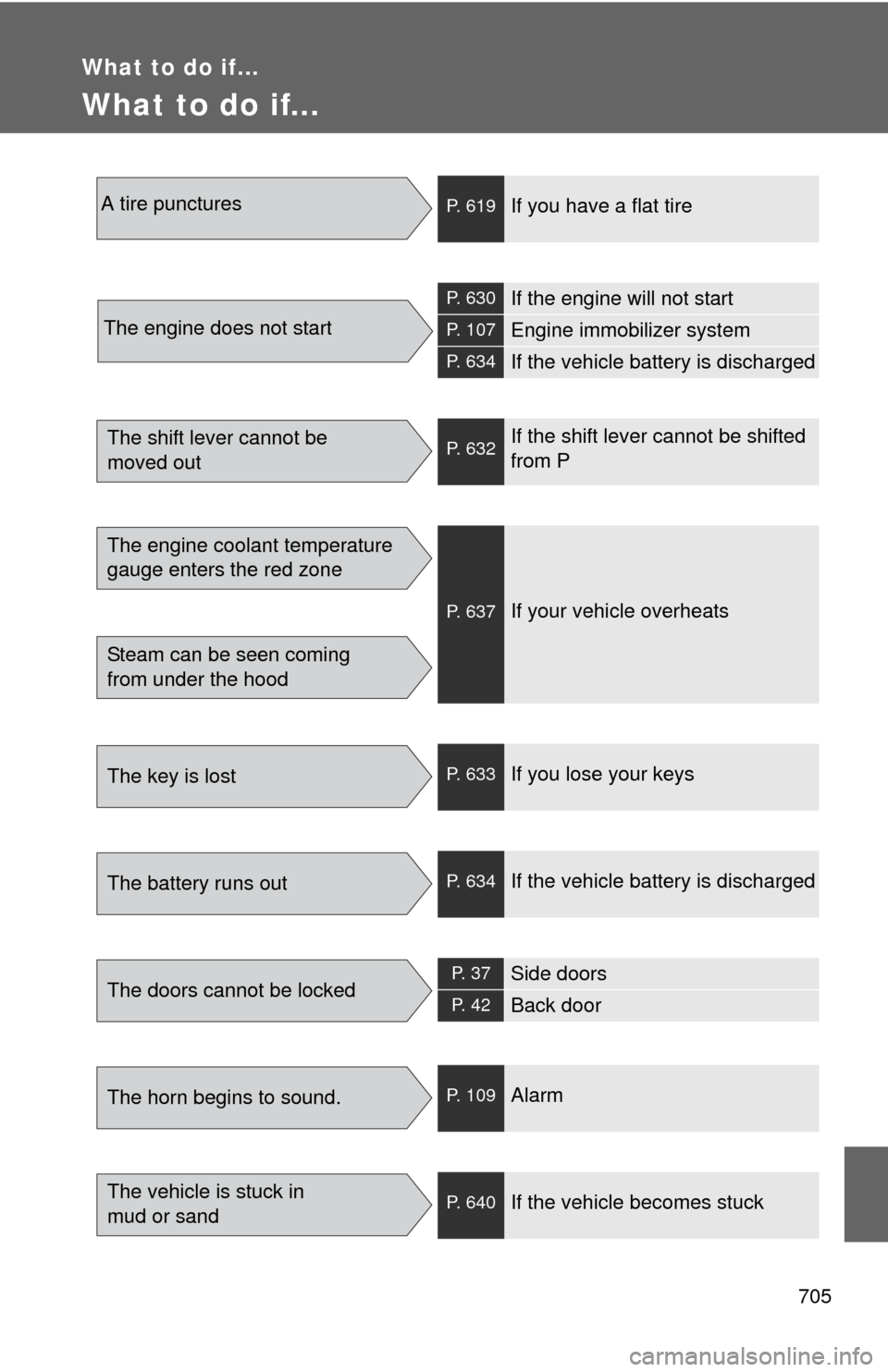
What to do if...
What to do if...
A tire puncturesP. 619If you have a flat tire
The engine does not start
P. 630If the engine will not start
P. 107Engine immobilizer system
P. 634If the vehicle battery is discharged
The shift lever cannot be
moved outP. 632If the shift lever cannot be shifted
from P
The engine coolant temperature
gauge enters the red zone
Steam can be seen coming
from under the hood
P. 637If your vehicle overheats
The key is lostP. 633If you lose your keys
The battery runs outP. 634If the vehicle battery is discharged
The doors cannot be lockedP. 3 7Side doors
P. 4 2Back door
The horn begins to sound.P. 109Alarm
The vehicle is stuck in
mud or sandP. 640If the vehicle becomes stuck