engine coolant TOYOTA SEQUOIA 2013 2.G User Guide
[x] Cancel search | Manufacturer: TOYOTA, Model Year: 2013, Model line: SEQUOIA, Model: TOYOTA SEQUOIA 2013 2.GPages: 740, PDF Size: 15.34 MB
Page 570 of 740
570 4-3. Do-it-yourself maintenance
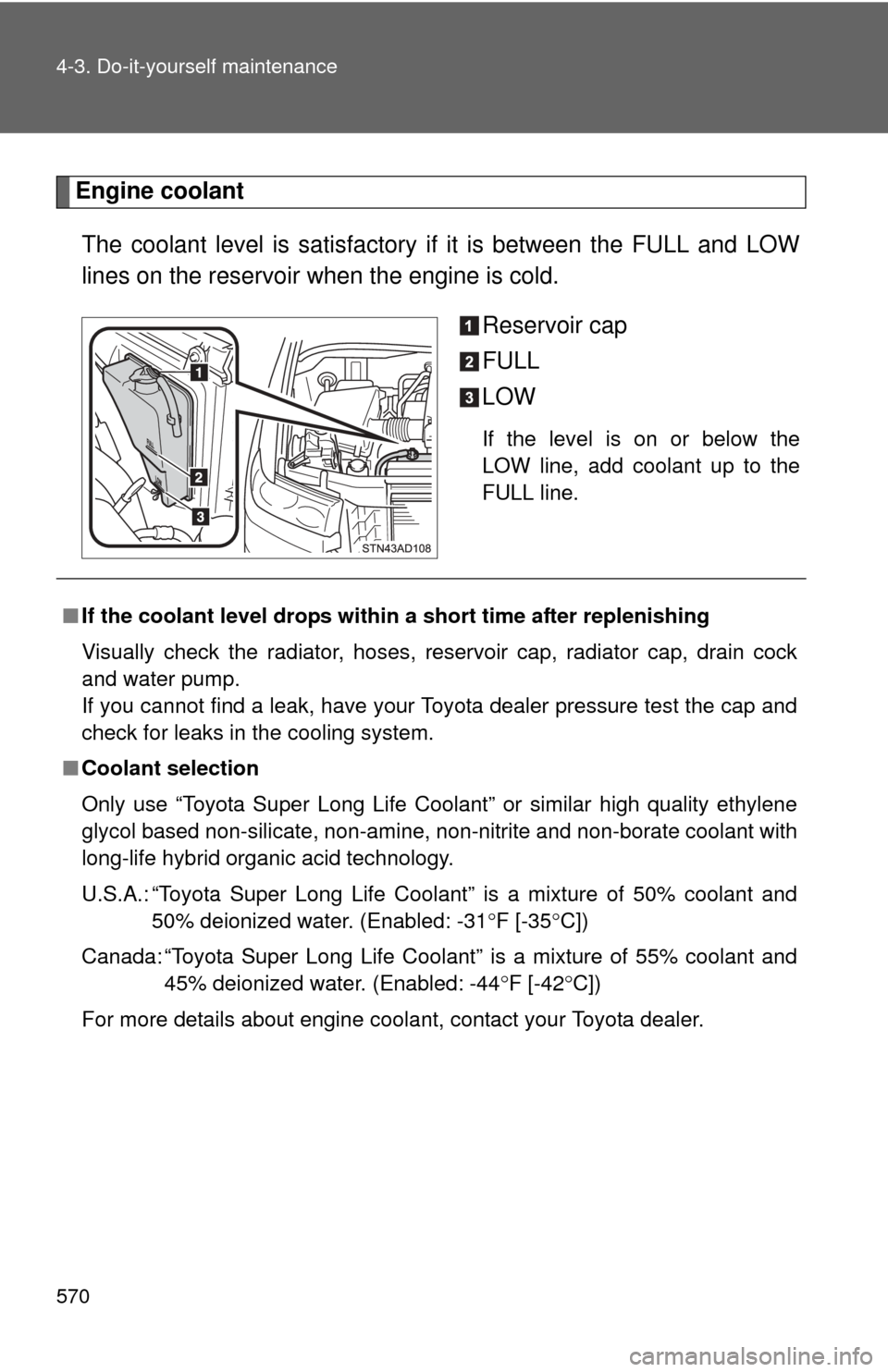
Engine coolantThe coolant level is satisfactory if it is between the FULL and LOW
lines on the reservoir when the engine is cold. Reservoir cap
FULL
LOW
If the level is on or below the
LOW line, add coolant up to the
FULL line.
■If the coolant level drops within a short time after replenishing
Visually check the radiator, hoses, reservoir cap, radiator cap, drain cock
and water pump.
If you cannot find a leak, have your Toyota dealer pressure test the cap and
check for leaks in the cooling system.
■ Coolant selection
Only use “Toyota Super Long Life Coolant” or similar high quality ethylene
glycol based non-silicate, non-amine, non-nitrite and non-borate coolant with
long-life hybrid organic acid technology.
U.S.A.: “Toyota Super Long Life Coolant” is a mixture of 50% coolant and
50% deionized water. (Enabled: -31 F [-35 C])
Canada: “Toyota Super Long Life Coolant” is a mixture of 55% coolant and 45% deionized water. (Enabled: -44 F [-42 C])
For more details about engine coolant, contact your Toyota dealer.
Page 571 of 740

571
4-3. Do-it-yourself maintenance
4
Maintenance and care
CAUTION
■
When the engine is hot
Do not remove the radiator cap.
The cooling system may be under pressure and may spray hot coolant if the
cap is removed, causing serious injuries, such as burns.
NOTICE
■When adding engine coolant
Coolant is neither plain water nor stra ight antifreeze. The correct mixture of
water and antifreeze must be used to provide proper lubrication, corrosion
protection and cooling. Be sure to read the antifreeze or coolant label.
■ If you spill coolant
Be sure to wash it off with water to prevent damage to parts or paint.
Page 631 of 740
5
When trouble arises
631
5-1. Essential information
If you think something is wrong
If you notice any of the following symptoms, your vehicle probably
needs adjustment or repair. Contact your Toyota dealer as soon as
possible.
■ Visible symptoms
●Fluid leaks under the vehicle
(Water dripping from the air cond itioning after use is normal.)
● Flat-looking tires or uneven tire wear
● Engine coolant temperature g auge needle continually points
higher or lower than normal
● Voltmeter continually points higher or lower than normal
● Engine oil pressure gauge continually points higher or lower
than normal
● Automatic transmission fluid temperature gauge needle con-
tinually points higher or lower than normal (if equipped)
■ Audible symptoms
●Changes in exhaust sound
● Excessive tire squeal when cornering
● Strange noises related to the suspension system
● Pinging or other noises related to the engine
■ Operational symptoms
●Engine misfire, stumbling or running rough
● Appreciable loss of power
● Vehicle pulls heavily to one side when braking
● Vehicle pulls heavily to one side when driving on a level road
● Loss of brake effectiveness, s pongy feeling, pedal almost
touches the floor
Page 644 of 740
644
5-2. Steps to take in an emergency
If a war ning message is displayed (vehicles with multi-infor mation display)
Stop the vehicle immediately.The following warnings indicate the possibility of damage to the vehi-
cle that may lead to an accident. Immediately stop the vehicle in a
safe place and contact your Toyota dealer.
Warning messageDetails
(Flashing) Indicates that the engine coolant temperature is
too high
A buzzer also sounds.
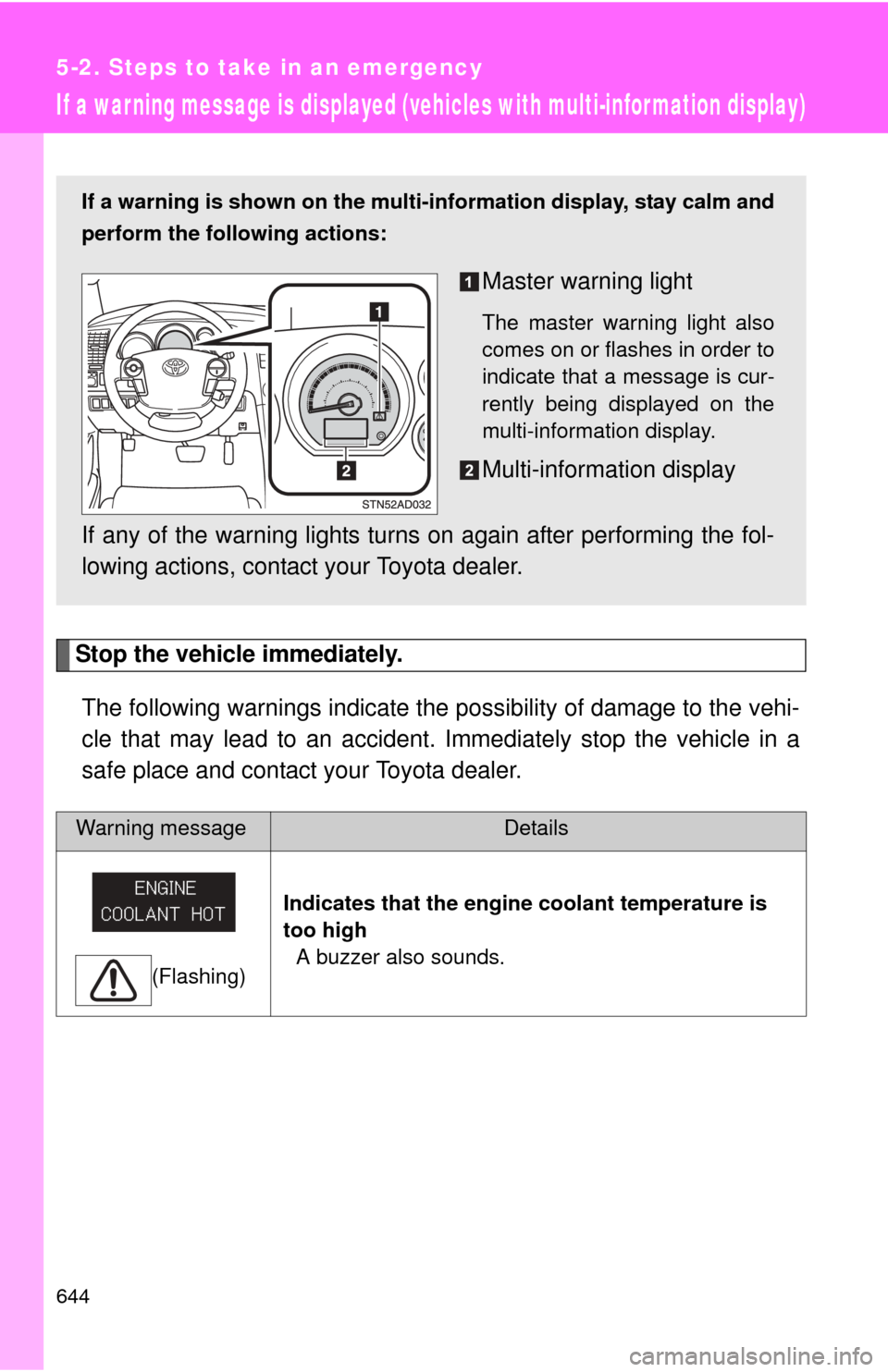
If a warning is shown on the multi- information display, stay calm and
perform the following actions:
Master warning light
The master warning light also
comes on or flashes in order to
indicate that a message is cur-
rently being displayed on the
multi-information display.
Multi-information display
If any of the warning lights turns on again after performing the fol-
lowing actions, contact your Toyota dealer.
Page 669 of 740
5
When trouble arises
669
5-2. Steps to take in an emergency
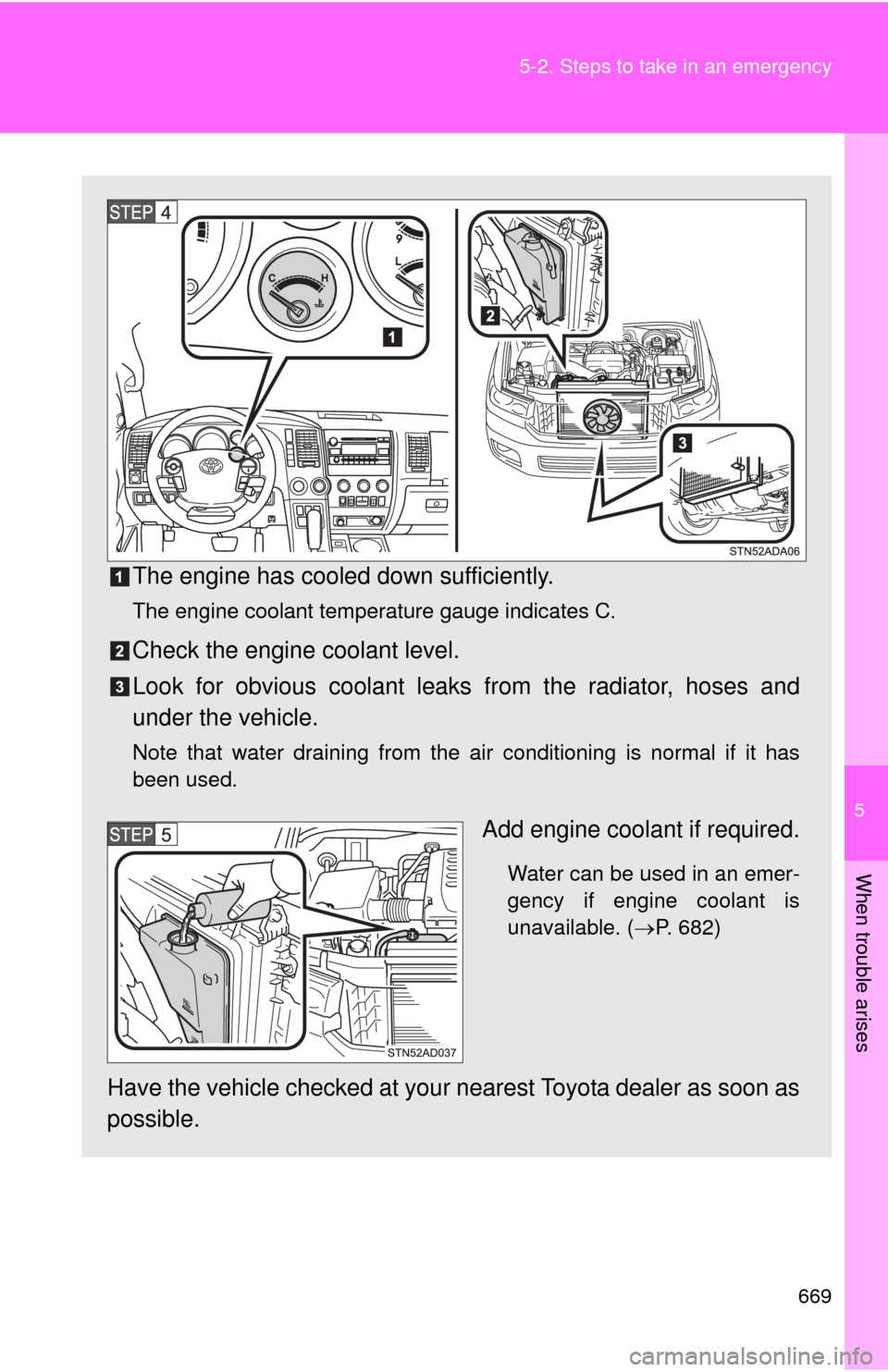
The engine has cooled down sufficiently.
The engine coolant temperature gauge indicates C.
Check the engine coolant level.
Look for obvious coolant leaks
from the radiator, hoses and
under the vehicle.
Note that water draining from the air conditioning is normal if it has
been used.
Add engine coolant if required.
Water can be used in an emer-
gency if engine coolant is
unavailable. ( P. 682)
Have the vehicle checked at your nearest Toyota dealer as soon as
possible.
Page 670 of 740
670 5-2. Steps to take in an emergency
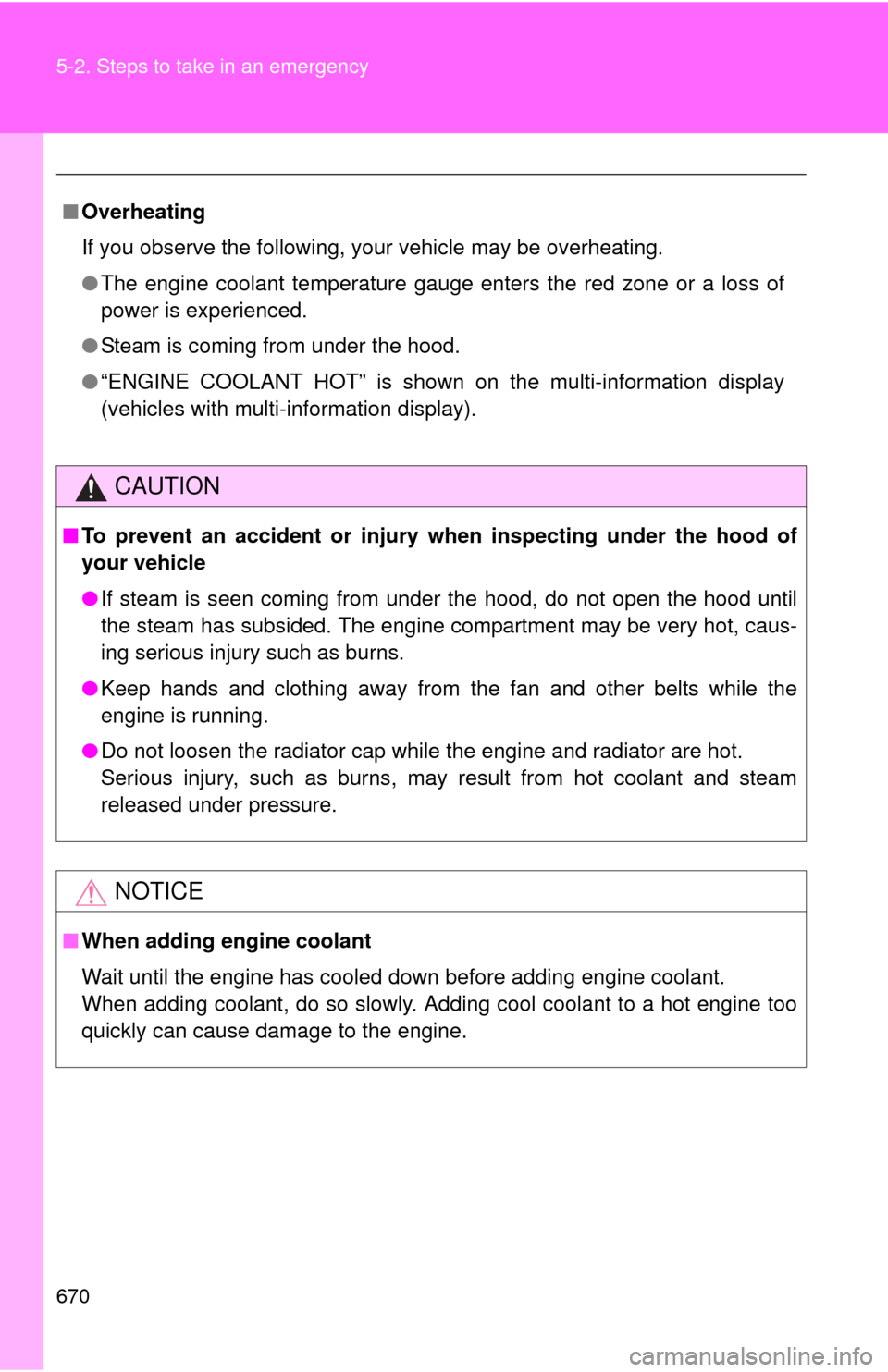
■Overheating
If you observe the following, your vehicle may be overheating.
●The engine coolant temperature gauge enters the red zone or a loss of
power is experienced.
● Steam is coming from under the hood.
● “ENGINE COOLANT HOT” is shown on the multi-information display
(vehicles with multi-information display).
CAUTION
■To prevent an accident or injury when inspecting under the hood of
your vehicle
● If steam is seen coming from under the hood, do not open the hood until
the steam has subsided. The engine compartment may be very hot, caus-
ing serious injury such as burns.
● Keep hands and clothing away from the fan and other belts while the
engine is running.
● Do not loosen the radiator cap while the engine and radiator are hot.
Serious injury, such as burns, may result from hot coolant and steam
released under pressure.
NOTICE
■When adding engine coolant
Wait until the engine has cooled down before adding engine coolant.
When adding coolant, do so slowly. Adding cool coolant to a hot engine too
quickly can cause damage to the engine.
Page 697 of 740
697
6-1. Specifications
6
Vehicle specifications
Warning: The temperature grades for this tire are established for a
tire that is properly inflated and not overloaded.
Excessive speed, underinflation, or
excessive loading, either sepa-
rately or in combination, can caus e heat buildup and possible tire fail-
ure.
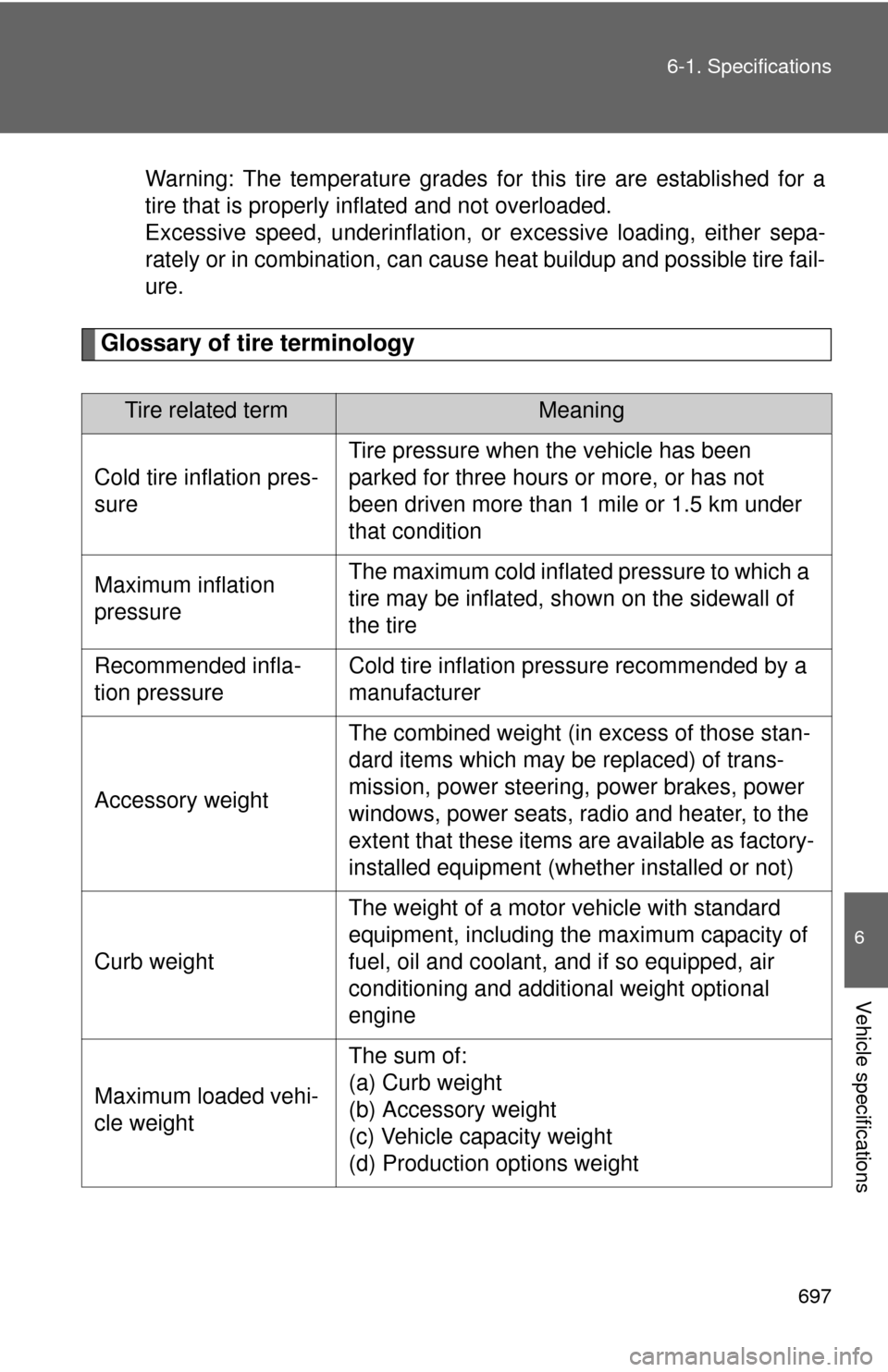
Glossary of tire terminology
Tire related termMeaning
Cold tire inflation pres-
sure
Tire pressure when the vehicle has been
parked for three hours or more, or has not
been driven more than 1 mile or 1.5 km under
that condition
Maximum inflation
pressureThe maximum cold inflated pressure to which a
tire may be inflated, s hown on the sidewall of
the tire
Recommended infla-
tion pressureCold tire inflation pressure recommended by a
manufacturer
Accessory weight
The combined weight (in excess of those stan-
dard items which may be replaced) of trans-
mission, power steering, power brakes, power
windows, power seats, radio and heater, to the
extent that these items are available as factory-
installed equipment (whether installed or not)
Curb weight
The weight of a motor vehicle with standard
equipment, including the maximum capacity of
fuel, oil and coolant, and if so equipped, air
conditioning and additional weight optional
engine
Maximum loaded vehi-
cle weight
The sum of:
(a) Curb weight
(b) Accessory weight
(c) Vehicle capacity weight
(d) Production options weight
Page 731 of 740
731
Alphabetical index
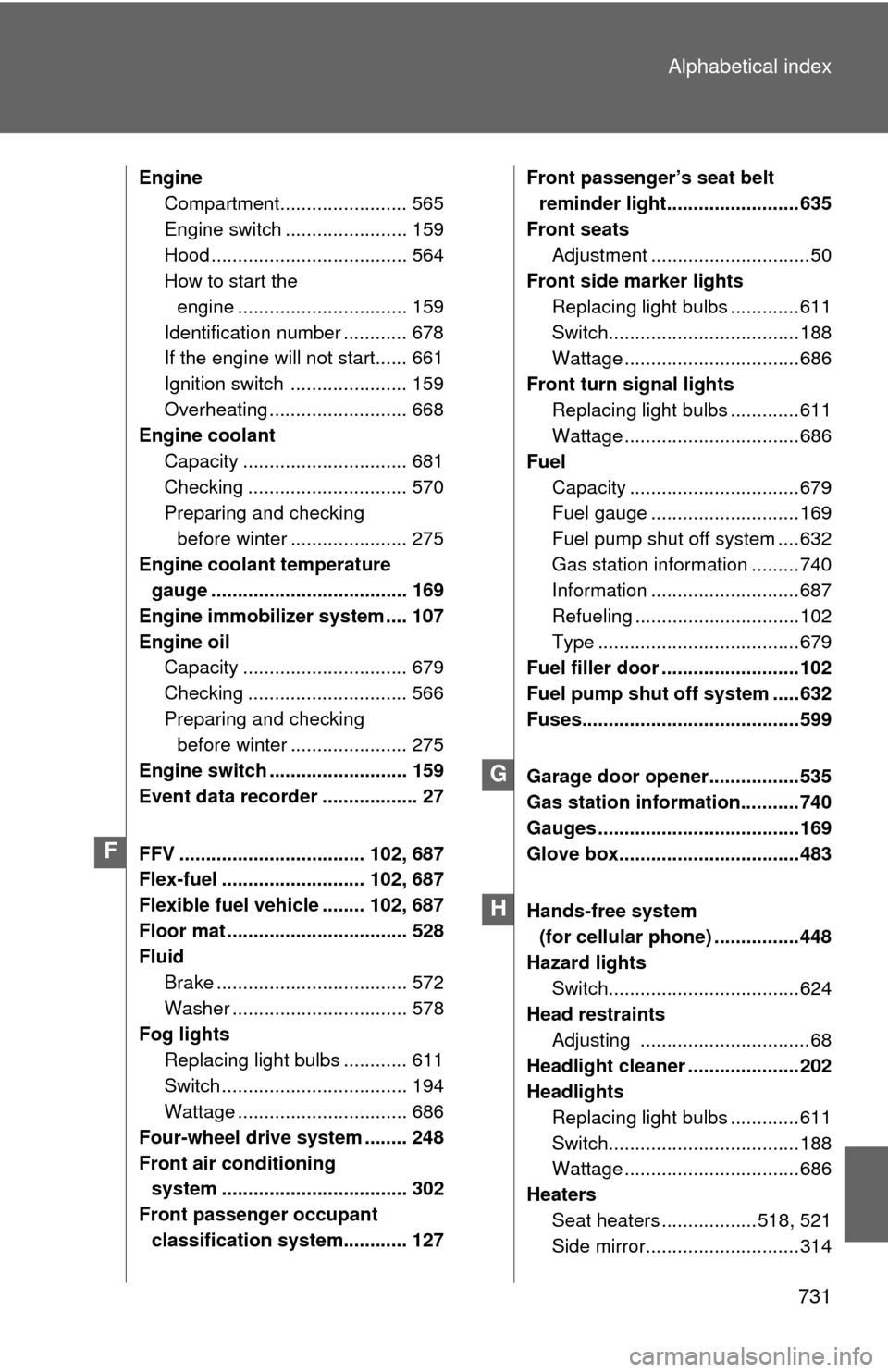
Engine
Compartment........................ 565
Engine switch ....................... 159
Hood ..................................... 564
How to start the
engine ................................ 159
Identification number ............ 678
If the engine will not start...... 661
Ignition switch ...................... 159
Overheating .......................... 668
Engine coolant
Capacity ............................... 681
Checking .............................. 570
Preparing and checking before winter ...................... 275
Engine coolan t temperature
gauge ..................................... 169
Engine immobilizer system .... 107
Engine oil Capacity ............................... 679
Checking .............................. 566
Preparing and checking before winter ...................... 275
Engine switch .......................... 159
Event data recorder .................. 27
FFV ................................... 102, 687
Flex-fuel ........................... 102, 687
Flexible fuel vehicle ........ 102, 687
Floor mat .................................. 528
Fluid Brake .................................... 572
Washer ................................. 578
Fog lights
Replacing light bulbs ............ 611
Switch ................................... 194
Wattage ................................ 686
Four-wheel drive system ........ 248
Front air conditioning system ................................... 302
Front passenger occupant classification system............ 127 Front passenger’s seat belt
reminder light.........................635
Front seats Adjustment ..............................50
Front side marker lights
Replacing light bulbs .............611
Switch....................................188
Wattage .................................686
Front turn signal lights Replacing light bulbs .............611
Wattage .................................686
Fuel Capacity ................................679
Fuel gauge ............................169
Fuel pump shut off system ....632
Gas station information .........740
Information ............................687
Refueling ...............................102
Type ......................................679
Fuel filler door ..........................102
Fuel pump shut off system .....632
Fuses.........................................599
Garage door opener.................535
Gas station information...........740
Gauges ......................................169
Glove box..................................483
Hands-free system (for cellular phone) ................448
Hazard lights Switch....................................624
Head restraints
Adjusting ................................68
Headlight cleaner .....................202
Headlights Replacing light bulbs .............611
Switch....................................188
Wattage .................................686
Heaters Seat heaters ..................518, 521
Side mirror.............................314
F
G
H
Page 737 of 740
737
What to do if...
What to do if...
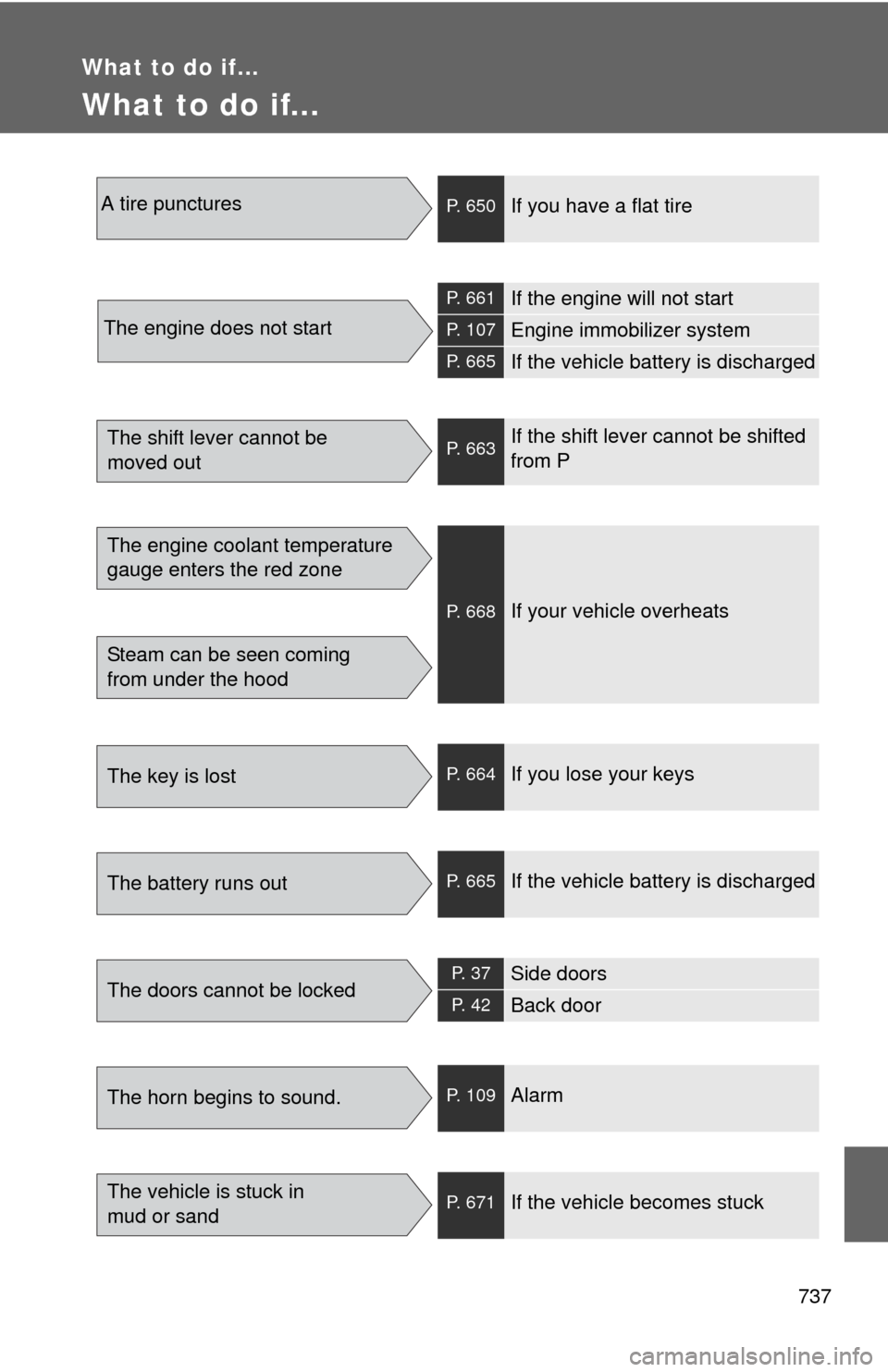
A tire puncturesP. 650If you have a flat tire
The engine does not start
P. 661If the engine will not start
P. 107Engine immobilizer system
P. 665If the vehicle battery is discharged
The shift lever cannot be
moved outP. 663If the shift lever cannot be shifted
from P
The engine coolant temperature
gauge enters the red zone
Steam can be seen coming
from under the hood
P. 668If your vehicle overheats
The key is lostP. 664If you lose your keys
The battery runs outP. 665If the vehicle battery is discharged
The doors cannot be lockedP. 3 7Side doors
P. 4 2Back door
The horn begins to sound.P. 109Alarm
The vehicle is stuck in
mud or sandP. 671If the vehicle becomes stuck