start TOYOTA SEQUOIA 2016 2.G Service Manual
[x] Cancel search | Manufacturer: TOYOTA, Model Year: 2016, Model line: SEQUOIA, Model: TOYOTA SEQUOIA 2016 2.GPages: 576, PDF Size: 12.74 MB
Page 459 of 576
When trouble arises5
459
5-1. Essential informationEmergency flashers ......... 460
If your vehicle needs to be towed ........................ 461
If you think something is wrong ............................. 467
Fuel pump shut off system ........................... 468 5-2. Steps to take in
an emergency
If a warning light turns on or a warning buzzer
sounds... ....................... 469
If a warning message is displayed (vehicles with
multi-information
display) .......................... 480
If you have a flat tire......... 486
If the engine will not start ................................ 497
If the shift lever cannot be shifted from P............ 499
If you lose your keys ........ 500
If the vehicle battery is discharged ..................... 501
If your vehicle overheats ....................... 504
If the vehicle becomes stuck .............................. 507
If your vehicle has to be stopped in
an emergency ................ 509
Page 464 of 576
464 5-1. Essential information
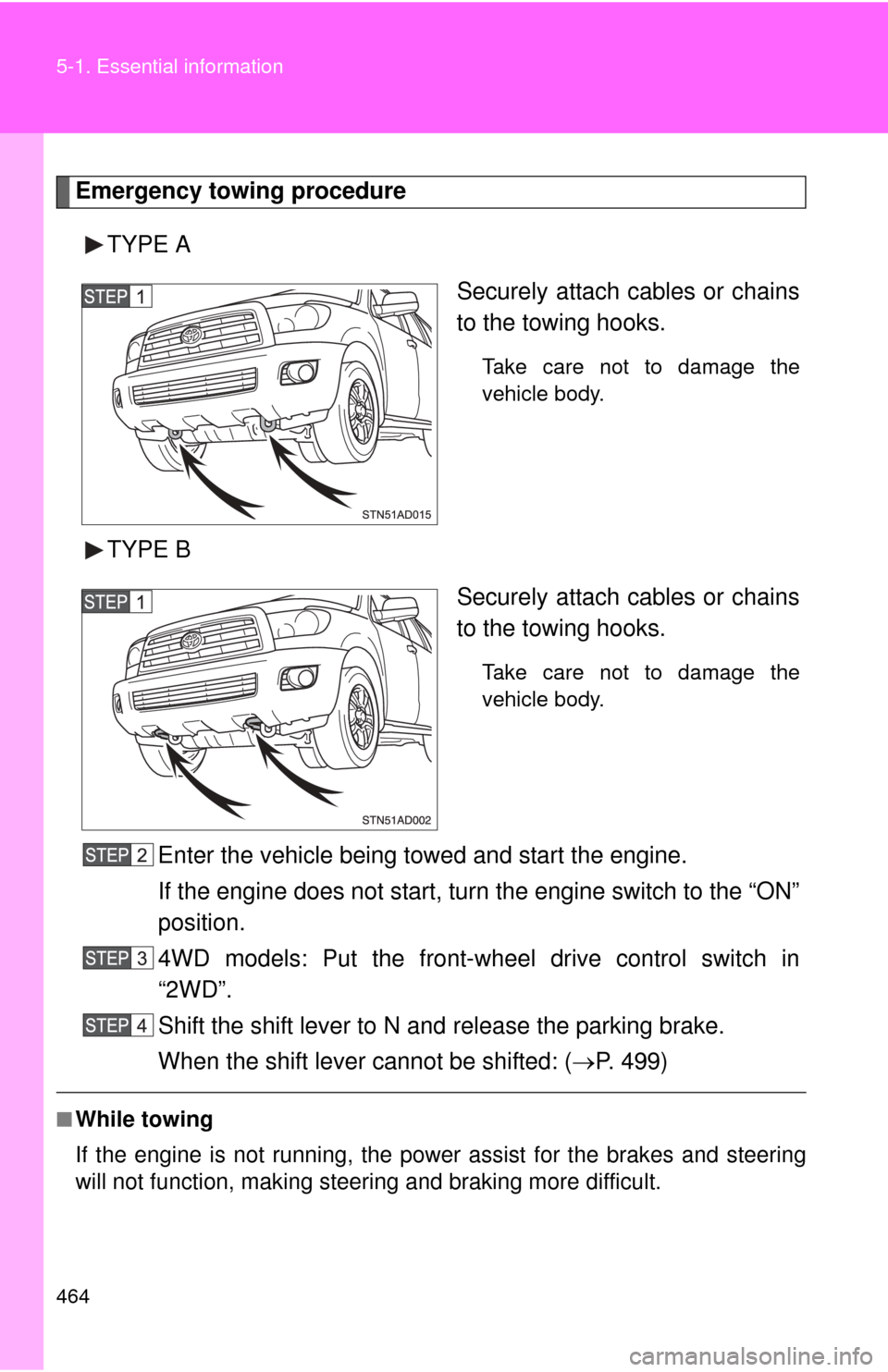
Emergency towing procedureTYPE A Securely attach cables or chains
to the towing hooks.
Take care not to damage the
vehicle body.
TYPE BSecurely attach cables or chains
to the towing hooks.
Take care not to damage the
vehicle body.
Enter the vehicle being towed and start the engine.
If the engine does not start, turn the engine switch to the “ON”
position.
4WD models: Put the front-wheel drive control switch in
“2WD”.
Shift the shift lever to N and release the parking brake.
When the shift lever cannot be shifted: ( P. 499)
■While towing
If the engine is not running, the power assist for the brakes and steering
will not function, making steering and braking more difficult.
Page 465 of 576
5
When trouble arises
465
5-1. Essential information
CAUTION
Observe the following precautions.
Failure to do so may result in death or serious injury.
■
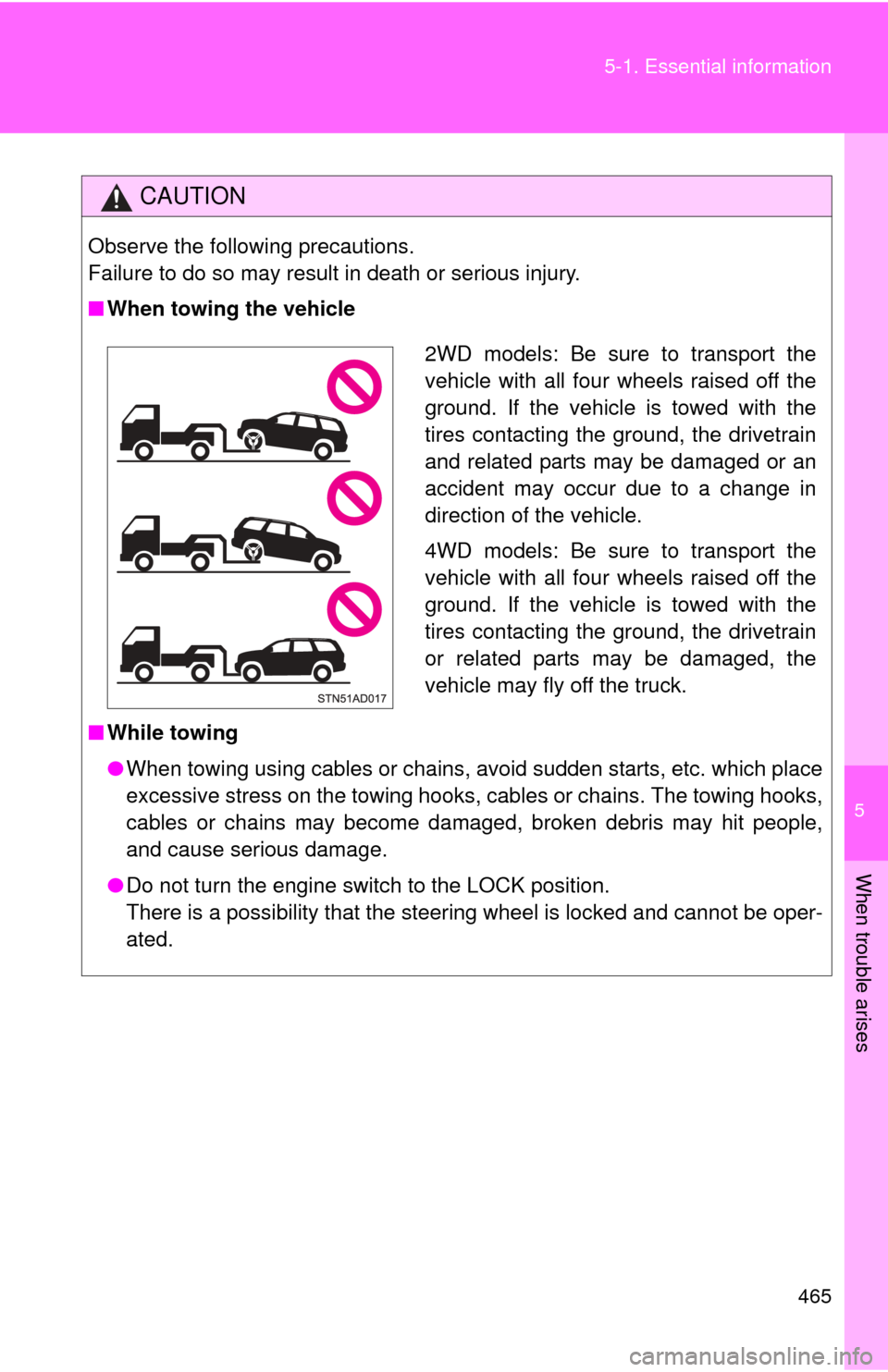
When towing the vehicle
■ While towing
●When towing using cables or chains, avoid sudden starts, etc. which place
excessive stress on the towing hooks, cables or chains. The towing hooks,
cables or chains may become damaged, broken debris may hit people,
and cause serious damage.
● Do not turn the engine switch to the LOCK position.
There is a possibility that the steering wheel is locked and cannot be oper-
ated.
2WD models: Be sure to transport the
vehicle with all four wheels raised off the
ground. If the vehicle is towed with the
tires contacting the ground, the drivetrain
and related parts may be damaged or an
accident may occur due to a change in
direction of the vehicle.
4WD models: Be sure to transport the
vehicle with all four wheels raised off the
ground. If the vehicle is towed with the
tires contacting the ground, the drivetrain
or related parts may be damaged, the
vehicle may fly off the truck.
Page 468 of 576
468
5-1. Essential information
Fuel pump shut off system
Follow the procedure below to restart the engine after the system is
activated.Turn the engine switch to the ACC or LOCK position.
Restart the engine.
NOTICE
■Before starting the engine
Inspect the ground under the vehicle.
If you find that fuel has leaked onto the ground, the fuel system has been
damaged and is in need of repair. Do not restart the engine.
To minimize the risk of fuel leakage when the engine stalls or an air-
bag inflates upon collision, the fuel pump shut off system stops sup-
plying fuel to the engine.
Page 472 of 576
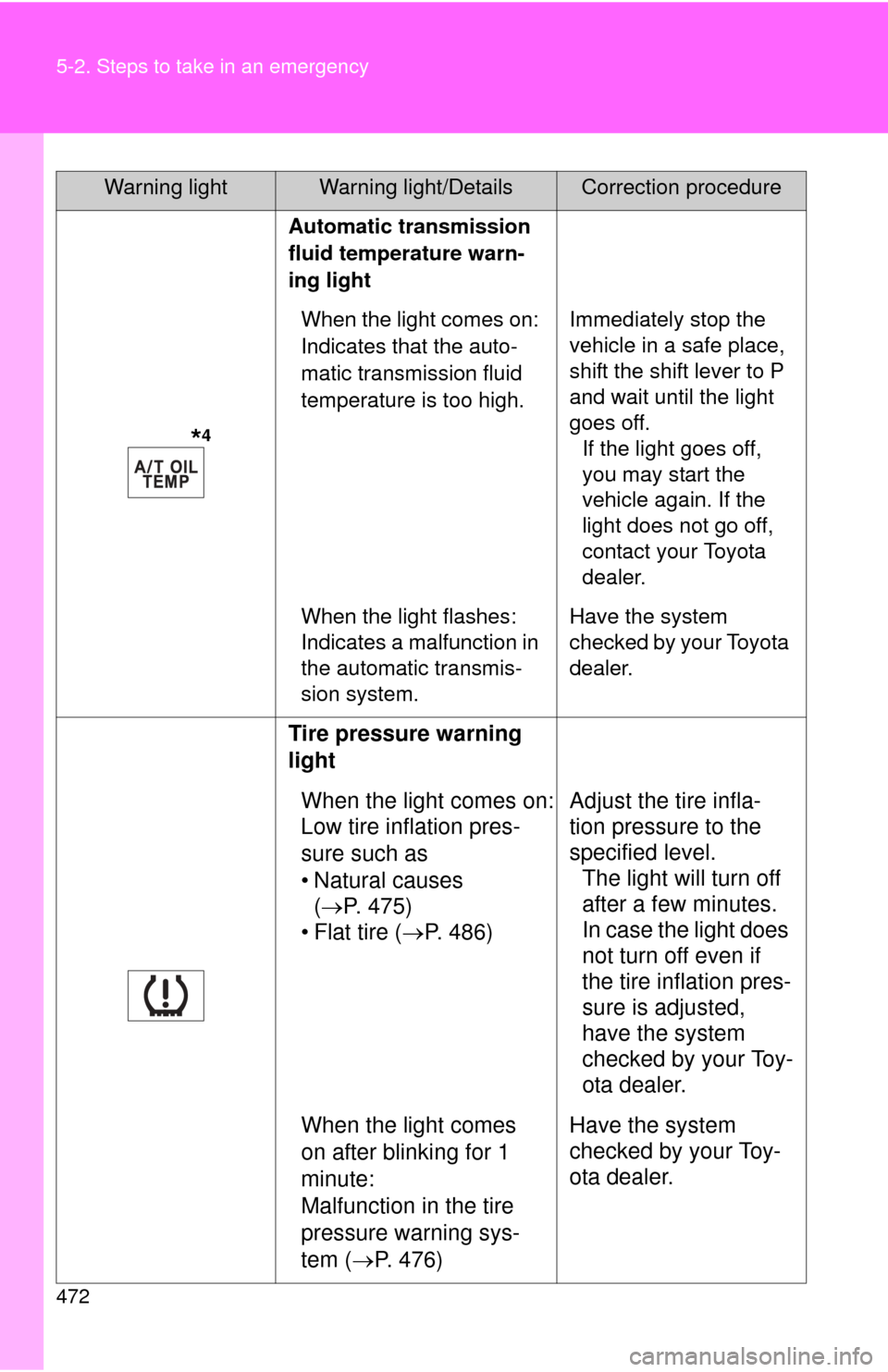
472 5-2. Steps to take in an emergency
*4
Automatic transmission
fluid temperature warn-
ing lightWhen the light comes on:
Indicates that the auto-
matic transmission fluid
temperature is too high. Immediately stop the
vehicle in a safe place,
shift the shift lever to P
and wait until the light
goes off.
If the light goes off,
you may start the
vehicle again. If the
light does not go off,
contact your Toyota
dealer.
When the light flashes:
Indicates a malfunction in
the automatic transmis-
sion system. Have the system
checked by your Toyota
dealer.
Tire pressure warning
light
When the light comes on:
Low tire inflation pres-
sure such as
• Natural causes ( P. 475)
• Flat tire ( P. 486) Adjust the tire infla-
tion pressure to the
specified level.
The light will turn off
after a few minutes.
In case the light does
not turn off even if
the tire inflation pres-
sure is adjusted,
have the system
checked by your Toy-
ota dealer.
When the light comes
on after blinking for 1
minute:
Malfunction in the tire
pressure warning sys-
tem ( P. 476) Have the system
checked by your Toy-
ota dealer.
Warning lightWarning light/DetailsCorrection procedure
Page 474 of 576
![TOYOTA SEQUOIA 2016 2.G Service Manual 474 5-2. Steps to take in an emergency
*1: Open door warning buzzer:The buzzer sounds to indicate that any door is opened (with the vehicle hav-
ing reached a speed of 3 mph [5 km/h])
*2: Driver’s s](/img/14/6782/w960_6782-473.png "TOYOTA SEQUOIA 2016 2.G Service Manual 474 5-2. Steps to take in an emergency
*1: Open door warning buzzer:The buzzer sounds to indicate that any door is opened (with the vehicle hav-
ing reached a speed of 3 mph [5 km/h])
*2: Driver’s s")
474 5-2. Steps to take in an emergency
*1: Open door warning buzzer:The buzzer sounds to indicate that any door is opened (with the vehicle hav-
ing reached a speed of 3 mph [5 km/h])
*2: Driver’s seat belt reminder:The driver’s seat belt reminder sounds to alert the driver that his or her seat
belt is not fastened. Once the engine switch is turned to the ON or START
position, the buzzer sounds for 6 seconds. If the vehicle has reached a
speed of at least 12 mph (20 km/h), the buzzer sounds intermittently f\
or 10
seconds. Then, if the seat belt is still unfastened, the buzzer will sound in a
different tone for 20 more seconds.
*3: Front passenger’s seat belt reminder:
The front passenger’s seat belt reminder sounds to alert the front passenger
that his or her seat belt is not fastened. The buzzer sounds intermittently for
10 seconds after the vehicle has reached a speed of at least 12 mph
(20 km/h). Then, if the seat belt is still unfastened, the buzzer will sound in a
different tone for 20 more seconds.
*4: Vehicles without multi-information display
*5: Vehicles with multi-information display
*6: Refer to the separate “Scheduled Maintenance Guide” or “Owner’s ManualSupplement” for the maintenance interval applicable to your vehicle.
*5
Master warning light A buzzer sounds and the
warning light comes on
and flashes to indicate
that the master warning
system has detected a
malfunction. P. 480
Warning lightWarning light/DetailsCorrection procedure
Page 478 of 576

478 5-2. Steps to take in an emergency
CAUTION
■Maintenance of the tire
Each tire, including the spare (if provided), should be checked monthly
when cold and inflated to the inflation pressure recommended by the
vehicle manufacturer on the vehicle placard or tire inflation pressure
label (tire and load information label). (If your vehicle has tires of a differ-
ent size than the size indicated on the vehicle placard or tire inflation
pressure label [tire and load information label], you should determine the
proper tire inflation pr essure for those tires.)
As an added safety feature, your vehicle has been equipped with a tire
pressure monitoring system (TPMS-ti re pressure warning system) that
illuminates a low tire pressure telltal e (tire pressure warning light) when
one or more of your tires is significantly under-inflated. Accordingly,
when the low tire pressu re telltale (tire pressure warning light) illumi-
nates, you should stop and check your tires as soon as possible, and
inflate them to the proper pressure. Driving on a significantly under-
inflated tire causes the tire to overheat and can lead to tire failure.
Under-inflation also reduces fuel effi ciency and tire tread life, and may
affect the vehicle’s handling and stopping ability.
Please note that the TPMS (tire pressure warning system) is not a sub-
stitute for proper tire main tenance, and it is the driver’s responsibility to
maintain correct tire pressure, even if under-inflation has not reached the
level to trigger illu mination of the TPMS low tire pressure telltale (tire
pressure warning light).
Your vehicle has also been equipped with a TPMS (tire pressure warning
system) malfunction indicator to indi cate when the system is not operat-
ing properly. The TPMS (tire pressure warning system) malfunction indi-
cator is combined with the low tire pressure telltale (tire pressure
warning light). When the system det ects a malfunction, the telltale will
flash for approximately one minute an d then remain continuously illumi-
nated. This sequence will continue upon subsequent vehicle start-ups as
long as the malfunction exists. When the malfunction indi cator is illumi-
nated, the system may not be able to detect or signal low tire pressure
as intended.
Page 482 of 576
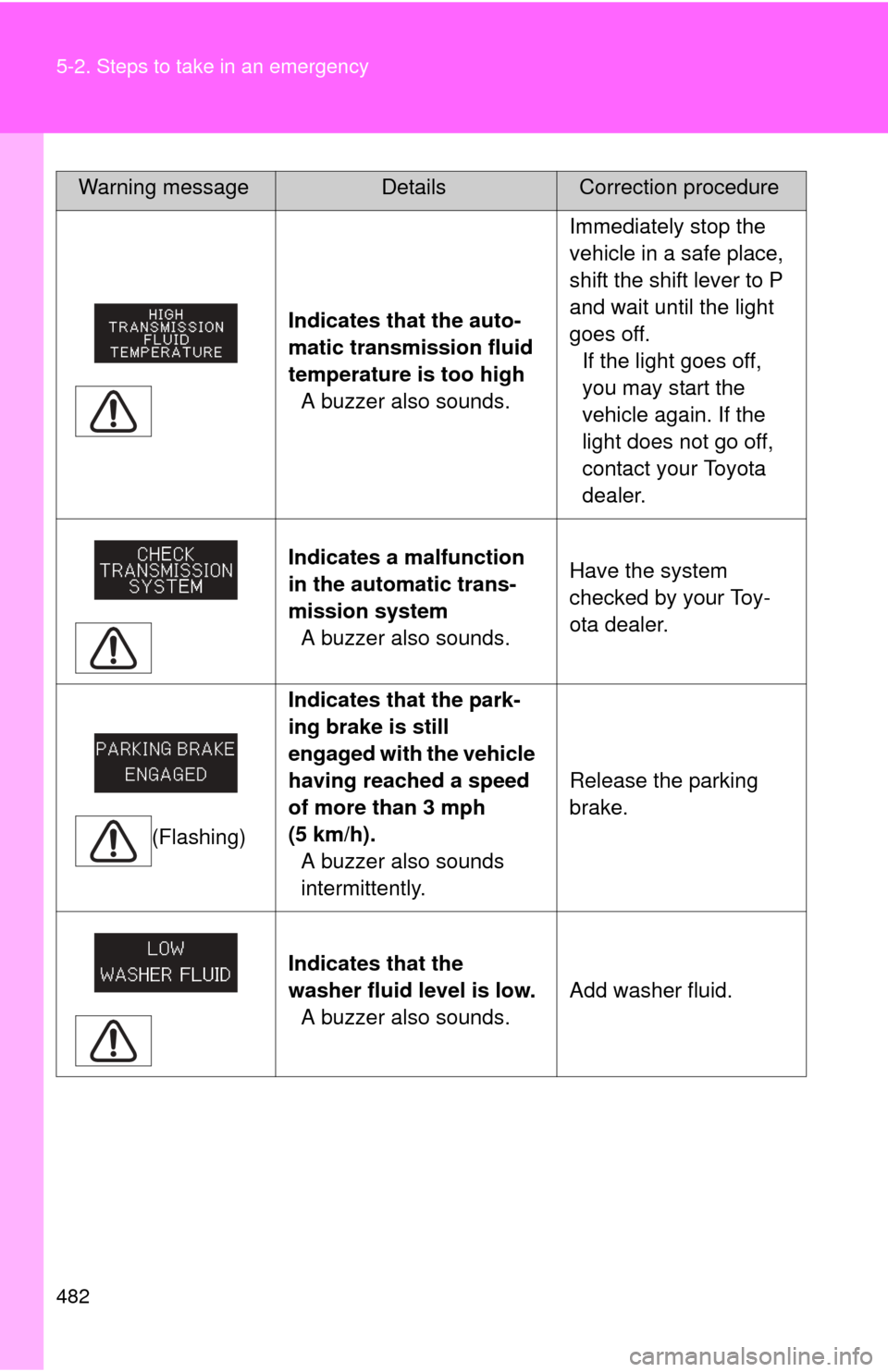
482 5-2. Steps to take in an emergency
Indicates that the auto-
matic transmission fluid
temperature is too highA buzzer also sounds. Immediately stop the
vehicle in a safe place,
shift the shift lever to P
and wait until the light
goes off.
If the light goes off,
you may start the
vehicle again. If the
light does not go off,
contact your Toyota
dealer.
Indicates a malfunction
in the automatic trans-
mission system A buzzer also sounds. Have the system
checked by your Toy-
ota dealer.
(Flashing) Indicates that the park-
ing brake is still
engaged with the vehicle
having reached a speed
of more than 3 mph
(5 km/h).
A buzzer also sounds
intermittently. Release the parking
brake.
Indicates that the
washer fluid level is low. A buzzer also sounds. Add washer fluid.
Warning messageDetailsCorrection procedure
Page 493 of 576
5
When trouble arises
493
5-2. Steps to take in an emergency
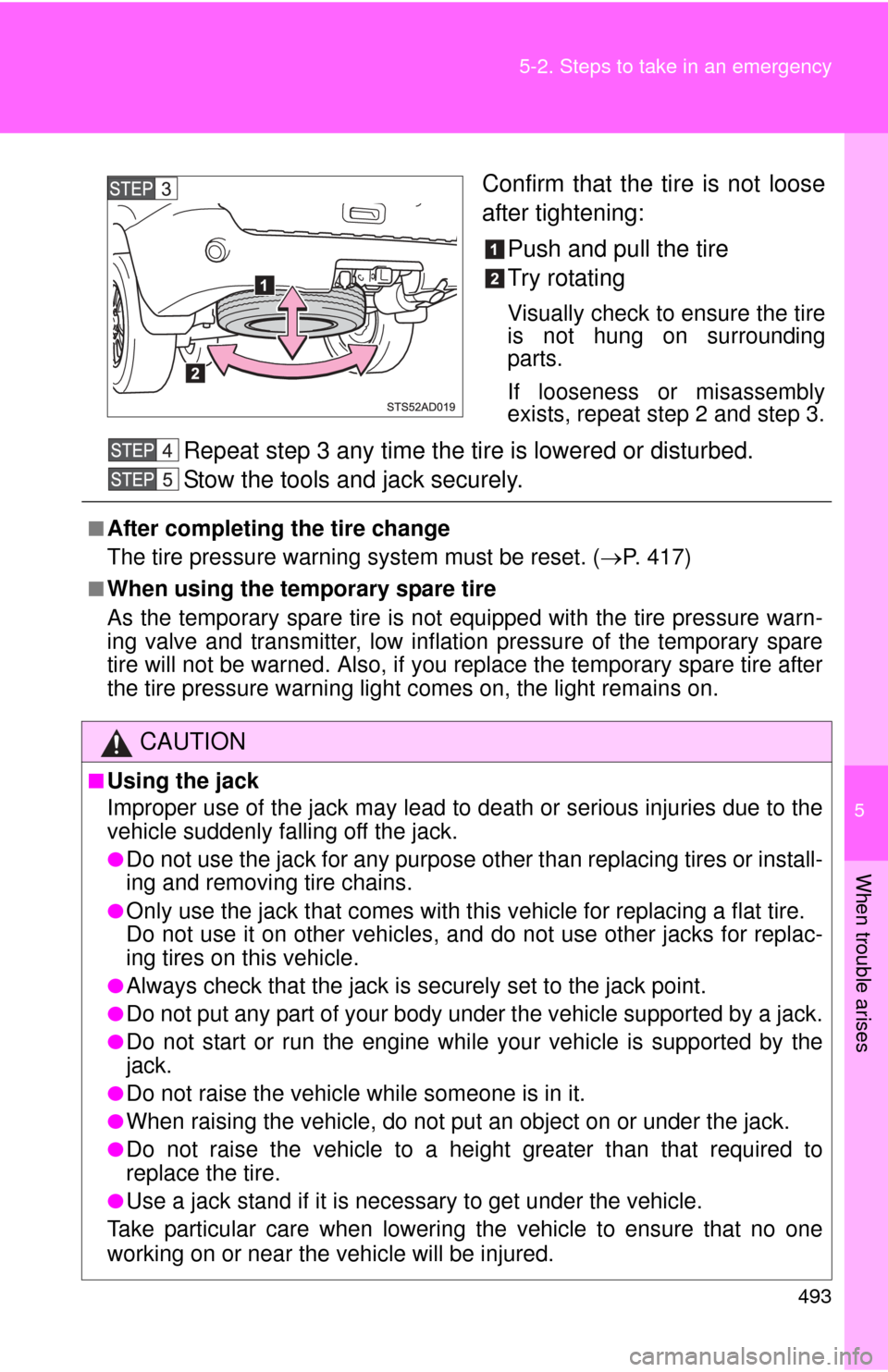
Confirm that the tire is not loose
after tightening:
Push and pull the tire
Try rotating
Visually check to ensure the tire
is not hung on surrounding
parts.
If looseness or misassembly
exists, repeat step 2 and step 3.
Repeat step 3 any time the ti re is lowered or disturbed.
Stow the tools and jack securely.
■After completing the tire change
The tire pressure warning system must be reset. (P. 417)
■When using the temporary spare tire
As the temporary spare tire is not equipped with the tire pressure warn-
ing valve and transmitter, low inflation pressure of the temporary spare
tire will not be warned. Also, if you re place the temporary spare tire after
the tire pressure warning light comes on, the light remains on.
CAUTION
■Using the jack
Improper use of the jack may lead to death or serious injuries due to the
vehicle suddenly falling off the jack.
●Do not use the jack for any purpose other than replacing tires or install-
ing and removing tire chains.
●Only use the jack that comes with this vehicle for replacing a flat tire.
Do not use it on other vehicles, an d do not use other jacks for replac-
ing tires on this vehicle.
●Always check that the jack is securely set to the jack point.
●Do not put any part of your body under the vehicle supported by a jack.
●Do not start or run the engine while your vehicle is supported by the
jack.
●Do not raise the vehicle while someone is in it.
●When raising the vehicle, do not put an object on or under the jack.
●Do not raise the vehicle to a hei ght greater than that required to
replace the tire.
●Use a jack stand if it is necessary to get under the vehicle.
Take particular care when lowering the vehicle to ensure that no one
working on or near the vehicle will be injured.
Page 497 of 576
5
When trouble arises
497
5-2. Steps to take in an emergency
If the engine will not star t
If the engine still does not start after following the correct starting
procedure ( P. 158) or releasing the steering lock (P. 159), confirm
the following points.
■ The engine will not start even when the starter motor oper-
ates normally.
One of the following may be the cause of the problem.
●There may not be sufficient fuel in the vehicle’s tank.
Refuel the vehicle. ( P. 100)
Flex-fuel vehicles: The type of fuel may be different. When
refueling, add the same type of fuel, if available.
After adding a different type of fuel, the engine may run
roughly and driving performance may be reduced for a while
when the engine is first started. In this case, wait until the
engine runs normally.
● The engine may be flooded.
Try to restart the engine once more following correct starting
procedures.
● There may be a malfunction in the engine immobilizer system.
( P. 105)
■ The starter motor turns over slowly, the interior lights and
headlights are dim, or the horn does not sound or sounds at
a low volume.
One of the following may be the cause of the problem.
●The battery may be discharged. ( P. 501)
● The battery terminal connec tions may be loose or corroded.