lock TOYOTA SEQUOIA 2017 2.G Workshop Manual
[x] Cancel search | Manufacturer: TOYOTA, Model Year: 2017, Model line: SEQUOIA, Model: TOYOTA SEQUOIA 2017 2.GPages: 576, PDF Size: 12.76 MB
Page 107 of 576
107
1
1-6. Theft deterrent system
Before driving
Alarm
The system sounds the alarm and flashes lights when forcible entry
is detected.
■ Triggering of the alarm
The alarm is triggered in the fo llowing situations when the alarm
is set.
● A locked door is unlocked or opened in any way other than
using the wireless remote control door lock function or key.
The doors will lock again automatically.
● The hood is opened.
● Vehicles with the glass breakage sensor (if equipped): The
side windows are tapped or broken.
● The battery is reconnected.
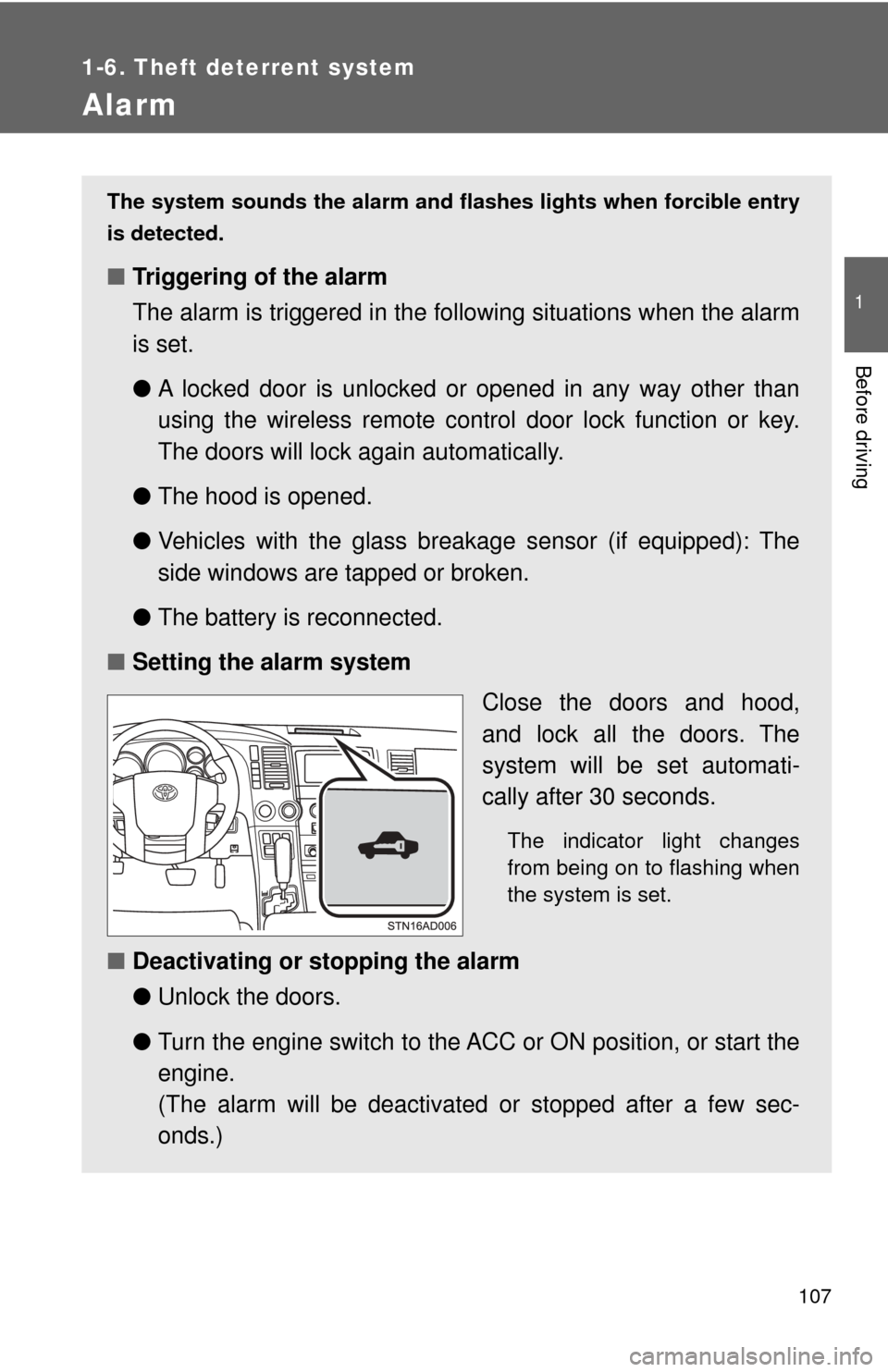
■ Setting the alarm system
Close the doors and hood,
and lock all the doors. The
system will be set automati-
cally after 30 seconds.
The indicator light changes
from being on to flashing when
the system is set.
■Deactivating or stopping the alarm
●Unlock the doors.
● Turn the engine switch to the ACC or ON position, or start the
engine.
(The alarm will be deactivated or stopped after a few sec-
onds.)
Page 108 of 576
108 1-6. Theft deterrent system
■System maintenance
The vehicle has a maintenance-free type alarm system.
■ Items to check before locking the vehicle
To prevent unexpected triggering of the alarm and vehicle theft, make sure
of the following.
●Nobody is in the vehicle.
● The windows and moon roof are closed before the alarm is set.
● No valuables or other personal items are left in the vehicle.
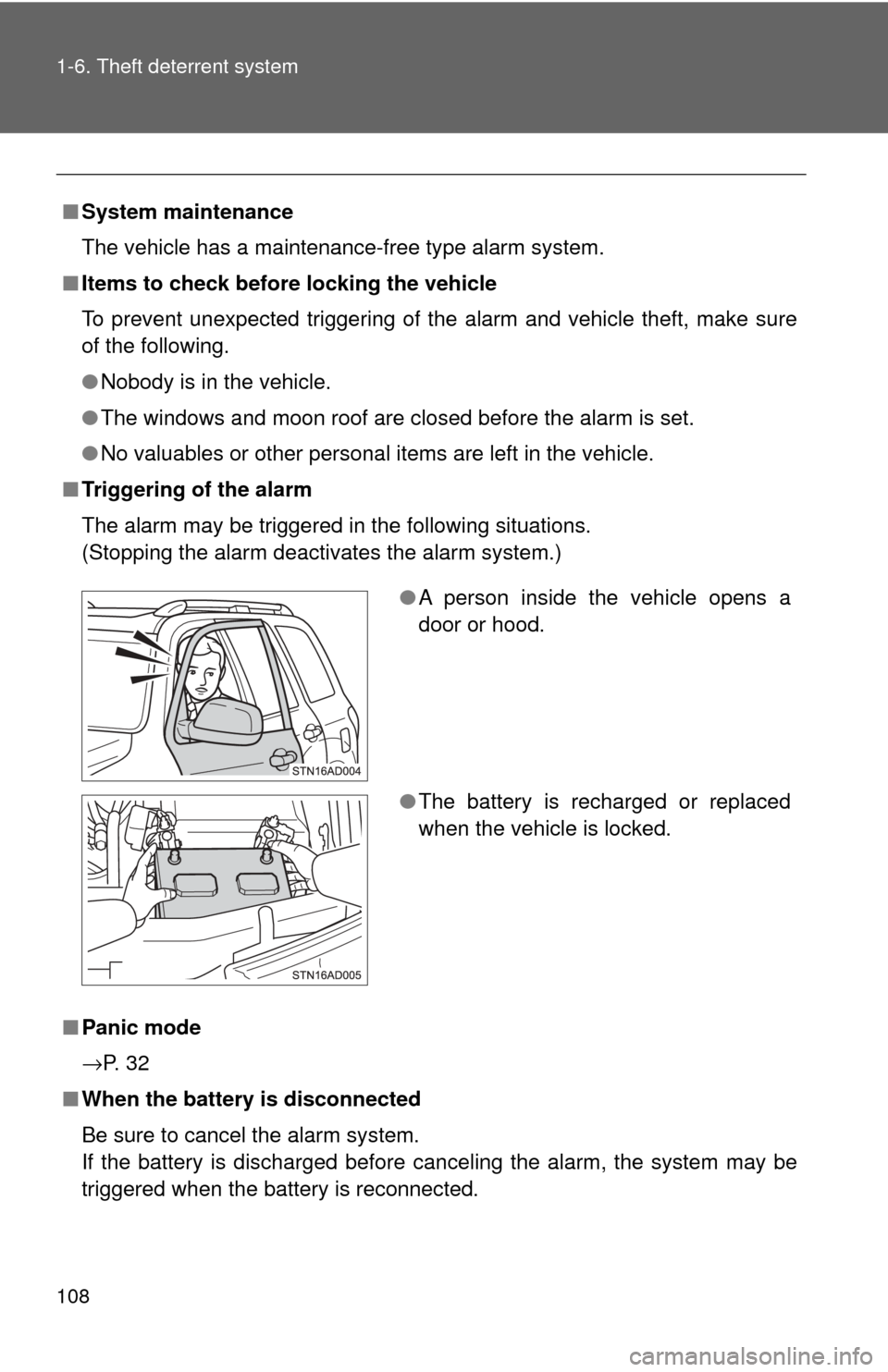
■ Triggering of the alarm
The alarm may be triggered in the following situations.
(Stopping the alarm deactivates the alarm system.)
■ Panic mode
→P. 3 2
■ When the battery is disconnected
Be sure to cancel the alarm system.
If the battery is discharged before canceling the alarm, the system may be
triggered when the battery is reconnected.
●A person inside the vehicle opens a
door or hood.
● The battery is recharged or replaced
when the vehicle is locked.
Page 109 of 576
109
1-6. Theft deterrent system
1
Before driving
■
Alarm-operated door lock
In the following cases, depending on the situation, the door may automati-
cally lock to prevent improper entry into the vehicle:
●When a person remaining in the vehicle locks the door and the alarm is
activated.
● While the alarm is activated, a person remaining in the vehicle unlocks
the door.
● When recharging or replacing the battery.
NOTICE
■To ensure the system operates correctly
Do not modify or remove the system. If modified or removed, the proper
operation of the system cannot be guaranteed.
Page 110 of 576
110
1-7. Safety information
Correct driving posture
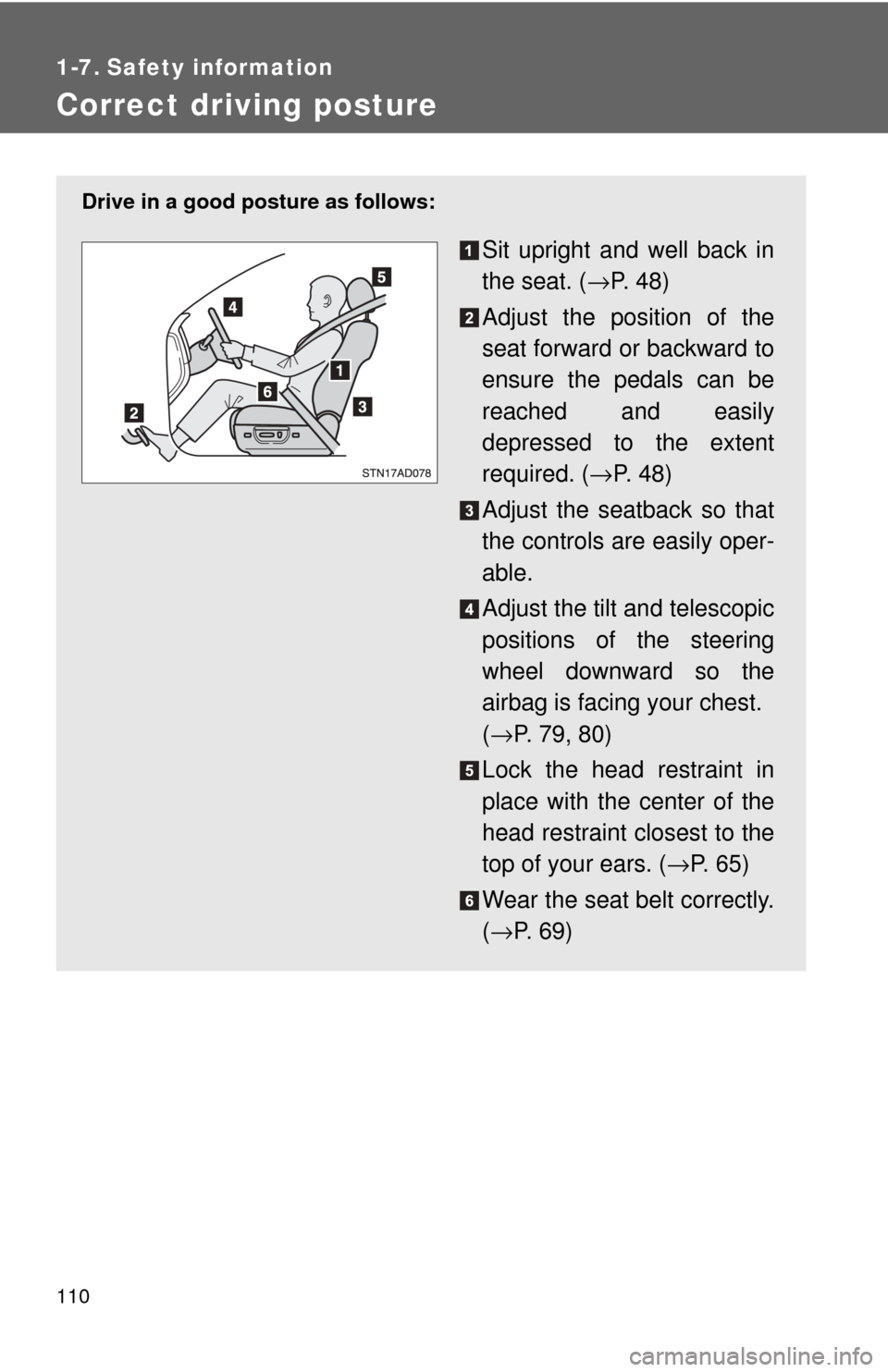
Drive in a good posture as follows:
Sit upright and well back in
the seat. (→P. 4 8 )
Adjust the position of the
seat forward or backward to
ensure the pedals can be
reached and easily
depressed to the extent
required. ( →P. 48)
Adjust the seatback so that
the controls are easily oper-
able.
Adjust the tilt and telescopic
positions of the steering
wheel downward so the
airbag is facing your chest.
( → P. 79, 80)
Lock the head restraint in
place with the center of the
head restraint closest to the
top of your ears. ( →P. 65)
Wear the seat belt correctly.
( → P. 69)
Page 111 of 576
111
1-7. Safety information
1
Before driving
CAUTION
■
While driving
●Do not adjust the position of the driver’s seat while driving.
Doing so could cause the driver to lose control of the vehicle.
● Do not place a cushion between the driver or passenger and the seatback.
A cushion may prevent correct posture from being achieved, and reduce
the effectiveness of the seat belt and head restraint, increasing the risk of
death or serious injury to the driver or passenger.
● Do not place anything under the front seats except for putting them in the
auxiliary box.
Objects placed under the front seats may become jammed in the seat
tracks and stop the seat from locking in place. This may lead to an acci-
dent. The adjustment mechanism may also be damaged.
■ Adjusting the seat position
●Do not recline the seat more than necessary when the vehicle is in motion,
to reduce the risk of sliding under the lap belt.
If the seat is too reclined during an accident, the lap belt may slide past the
hips and apply restraint forces directly to the abdomen or your neck may
contact the shoulder belt, increasing the risk of death or serious injury.
● Take care when adjusting the seat position to ensure that other passen-
gers are not injured by the moving seat.
● Do not put your hands under the seat or near the moving parts to avoid
injury.
Fingers or hands may become jammed in the seat mechanism.
Page 134 of 576
134 1-7. Safety information
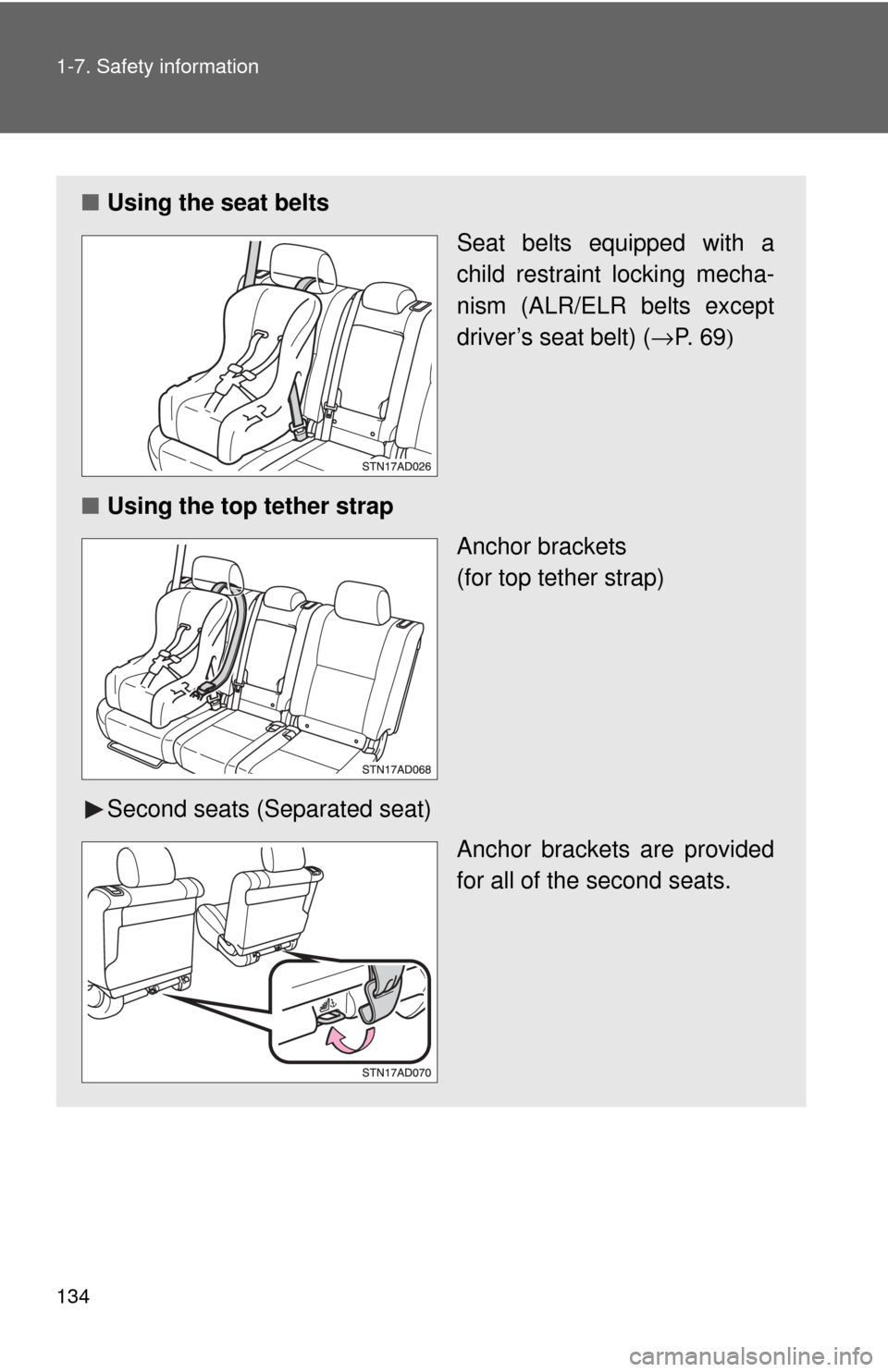
■Using the seat belts
Seat belts equipped with a
child restraint locking mecha-
nism (ALR/ELR belts except
driver’s seat belt) (→P. 6 9 )
■ Using the top tether strap
Anchor brackets
(for top tether strap)
Second seats (Separated seat) Anchor brackets are provided
for all of the second seats.
Page 135 of 576
135
1-7. Safety information
1
Before driving
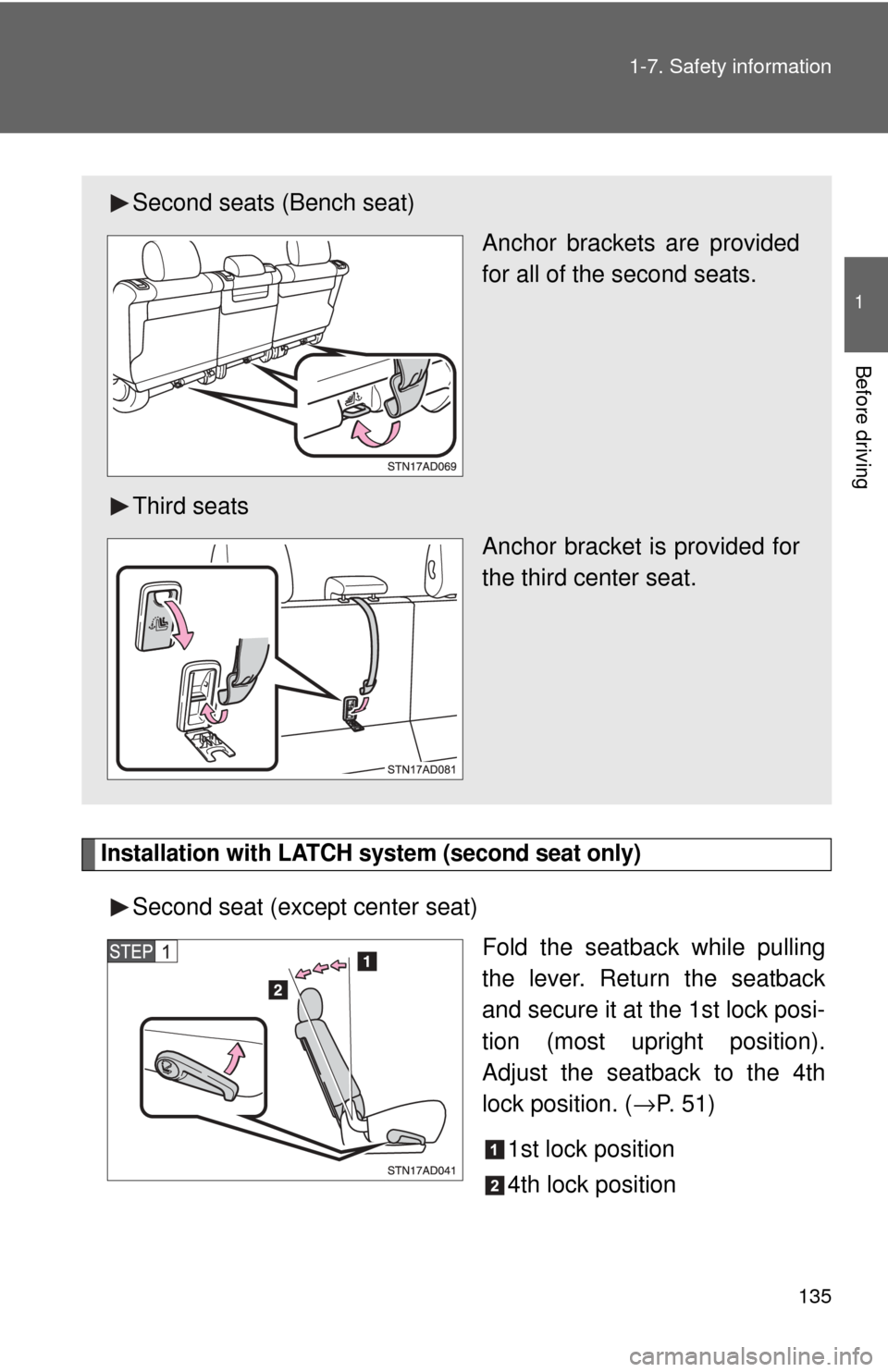
Installation with LATCH
system (second seat only)
Second seat (except center seat)
Fold the seatback while pulling
the lever. Return the seatback
and secure it at the 1st lock posi-
tion (most upright position).
Adjust the seatback to the 4th
lock position. (→P. 51)
1st lock position
4th lock position
Second seats (Bench seat) Anchor brackets are provided
for all of the second seats.
Third seats Anchor bracket is provided for
the third center seat.
Page 136 of 576
136 1-7. Safety information
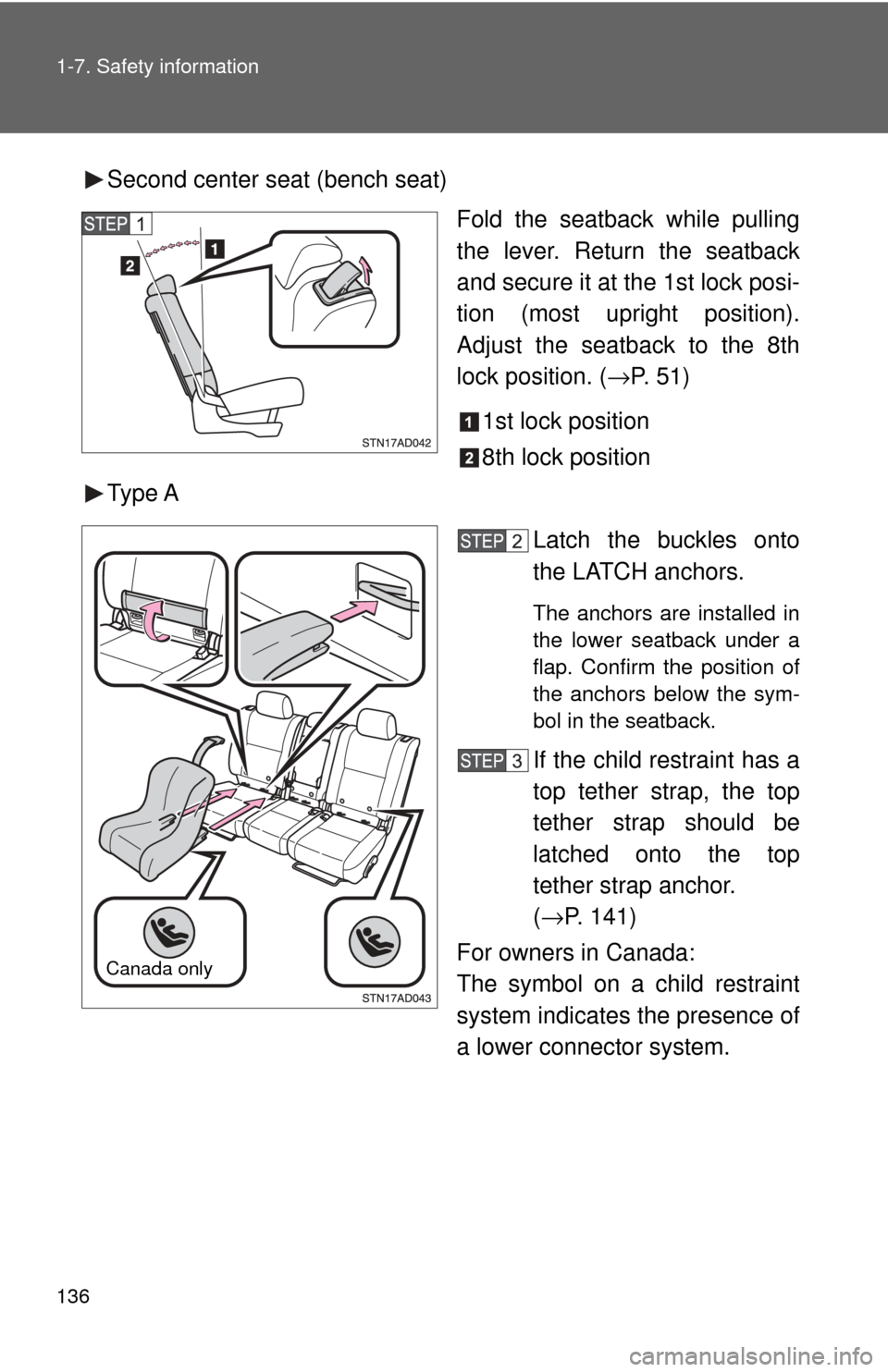
Second center seat (bench seat)Fold the seatback while pulling
the lever. Return the seatback
and secure it at the 1st lock posi-
tion (most upright position).
Adjust the seatback to the 8th
lock position. (→P. 51)
1st lock position
8th lock position
Type A
Latch the buckles onto
the LATCH anchors.
The anchors are installed in
the lower seatback under a
flap. Confirm the position of
the anchors below the sym-
bol in the seatback.
If the child restraint has a
top tether strap, the top
tether strap should be
latched onto the top
tether strap anchor.
(→ P. 141)
For owners in Canada:
The symbol on a child restraint
system indicates the presence of
a lower connector system.
Canada only
Page 138 of 576
138 1-7. Safety information
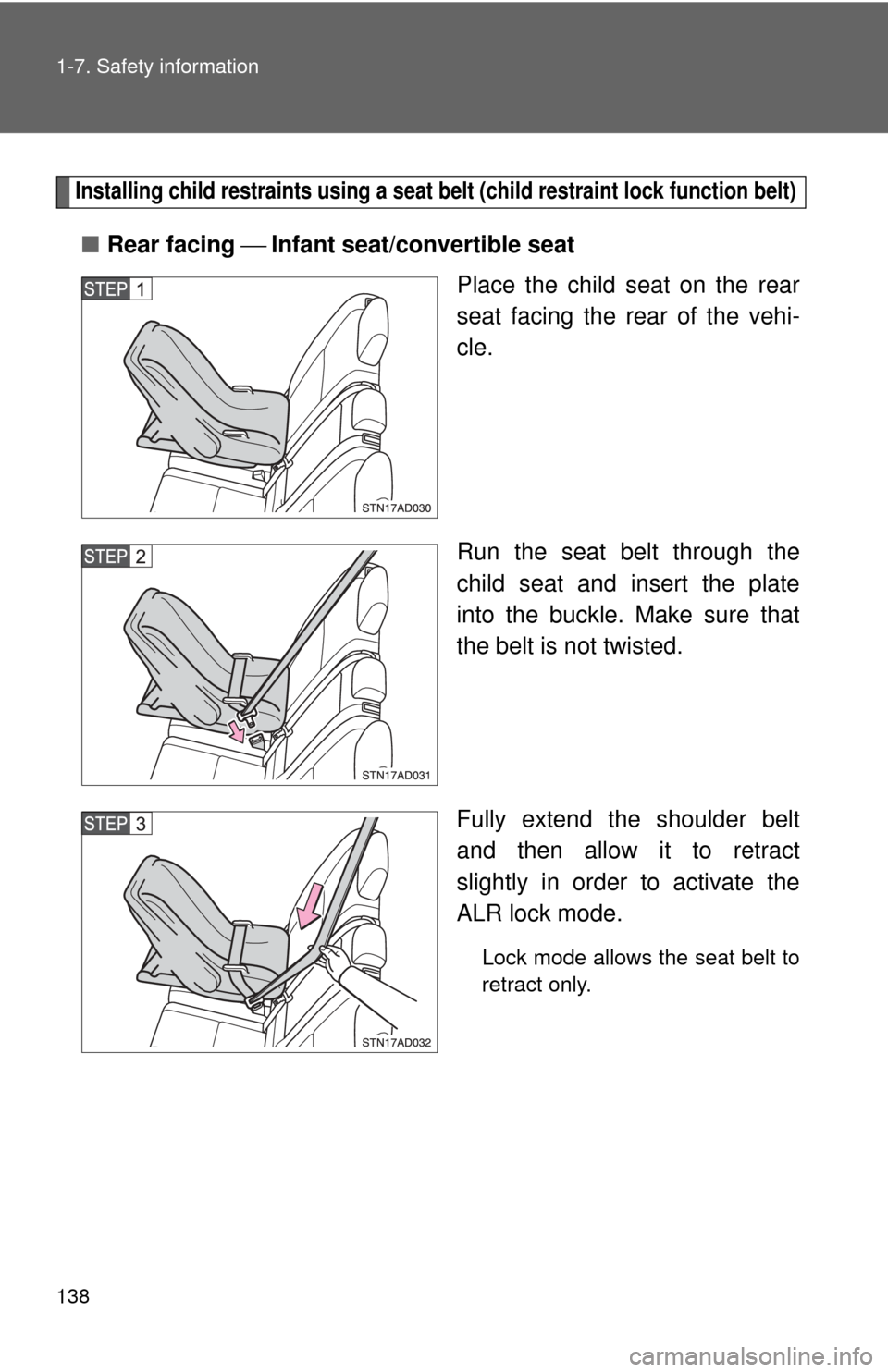
Installing child restraints using a seat belt (child restraint lock function belt)
■Rear facing ⎯ Infant seat/convertible seat
Place the child seat on the rear
seat facing the rear of the vehi-
cle.
Run the seat belt through the
child seat and insert the plate
into the buckle. Make sure that
the belt is not twisted.
Fully extend the shoulder belt
and then allow it to retract
slightly in order to activate the
ALR lock mode.
Lock mode allows the seat belt to
retract only.
Page 139 of 576
139
1-7. Safety information
1
Before driving
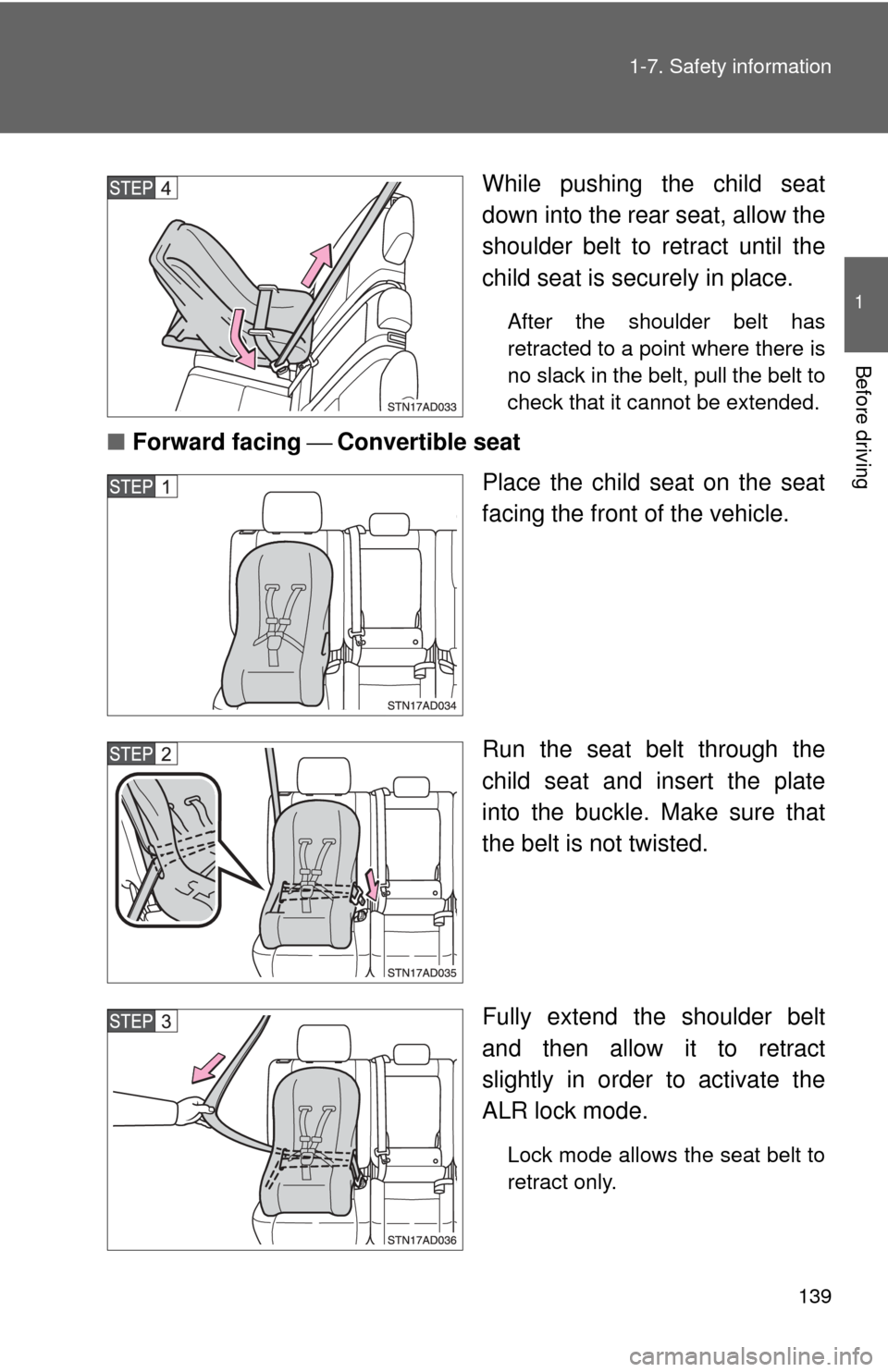
While pushing the child seat
down into the rear seat, allow the
shoulder belt to retract until the
child seat is securely in place.
After the shoulder belt has
retracted to a point where there is
no slack in the belt, pull the belt to
check that it cannot be extended.
■
Forward facing ⎯ Convertible seat
Place the child seat on the seat
facing the front of the vehicle.
Run the seat belt through the
child seat and insert the plate
into the buckle. Make sure that
the belt is not twisted.
Fully extend the shoulder belt
and then allow it to retract
slightly in order to activate the
ALR lock mode.
Lock mode allows the seat belt to
retract only.