brake TOYOTA SEQUOIA 2020 Warranties & Maintenance Guides (in English)
[x] Cancel search | Manufacturer: TOYOTA, Model Year: 2020, Model line: SEQUOIA, Model: TOYOTA SEQUOIA 2020Pages: 260, PDF Size: 8.54 MB
Page 149 of 260
NITTO TIRE
147
WHAT IS NOT COVERED?
This Limited Warranty does not cover the following categories
of claims:
Rapid Treadwear: Original equipment tires are not guaranteed to last a
specified number of miles.
Damage from road hazards (not limited to cuts, snags, bruises, impact
breaks, bulges, punctures, stone drills, chips, and scales), fire, theft,
or collision.
Conditions arising from improper tire/vehicle maintenance or use, not
limited to:
•
Irregular or excessive treadwear due to: Incorrect inflation;
overloading; vehicle misalignment; failure to rotate tires; and poor
or defective mechanical condition of brakes, shocks, and wheels;
or other factors attributable to the vehicle or wheel.
•
Any tire which has been run with low air pressure or while flat.
•
Damage due to abuse; vandalism; tire alteration; tire spinning;
racing; or other competitive activities.
•
Damage, corrosion, or deterioration from using oil-based
chemicals, water-based sealers, balancing substances, or
flammable gases.
•
Damage from improper use of tire chains.
Tires with the DOT identification number removed or rendered illegible.
Improper mounting, balancing or repair, not limited to: •
Improper tire mounting, or tire/wheel assembly imbalance.
•
Damage from incorrect mounting or dismounting of the tire,
incorrect wheel size, water or other material trapped inside the tire
during mounting, or failure to keep the tires balanced.
•
Damage resulting from improper repair materials or procedures.
Page 171 of 260
NITTO TIRE
169
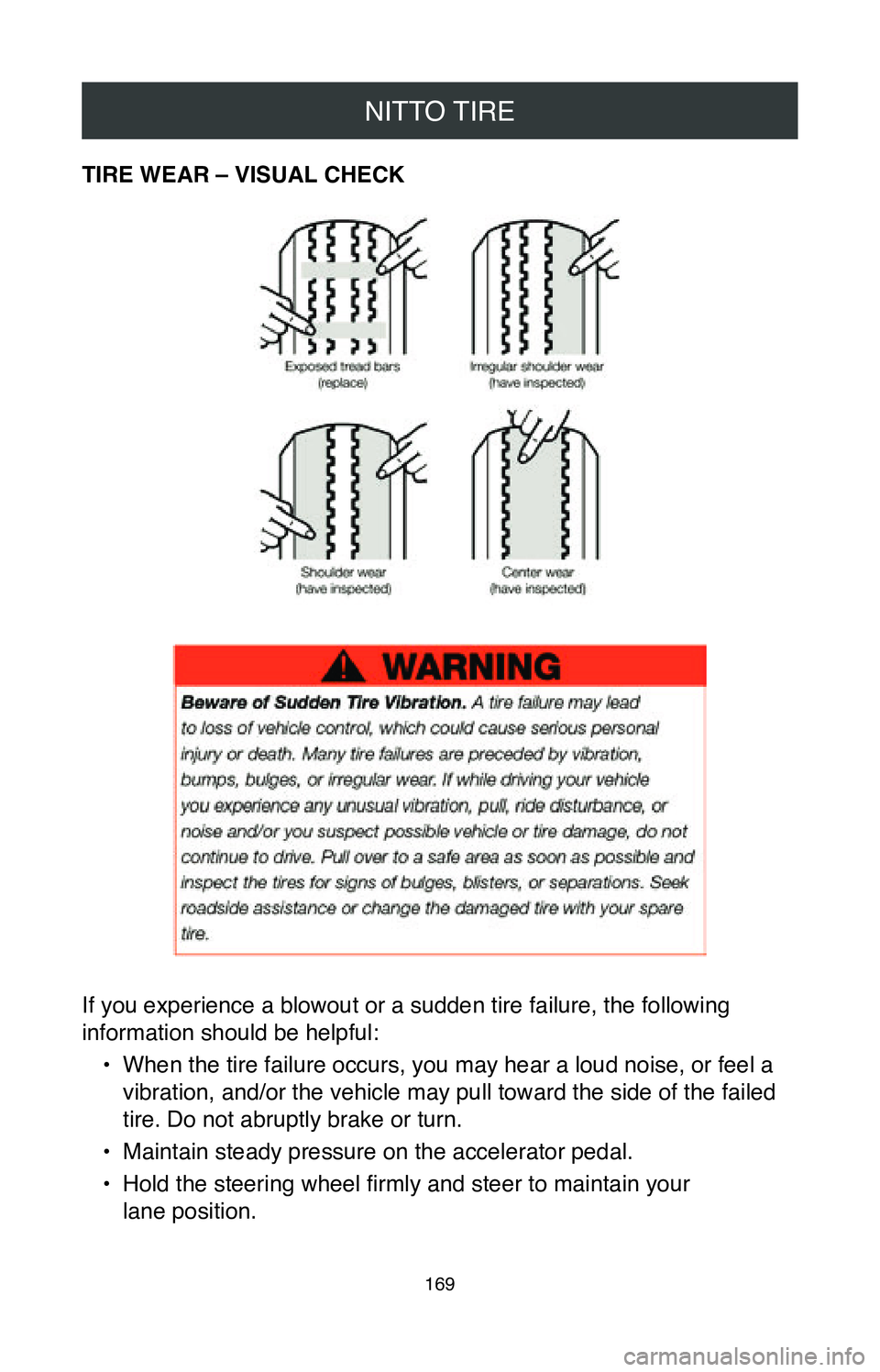
TIRE WEAR – VISUAL CHECK
If you experience a blowout or a sudden tire failure, the following
information should be helpful:•
When the tire failure occurs, you may hear a loud noise, or feel a
vibration, and/or the vehicle may pull toward the side of the failed
tire. Do not abruptly brake or turn.
•
Maintain steady pressure on the accelerator pedal.
•
Hold the steering wheel firmly and steer to maintain your
lane position.
Page 195 of 260
PIRELLI
193
-mechanical irregularities in the vehicle including, without
limitation, misalignment, defective brakes, defective shock
absorbers or struts, or improper rims;
- fire, chemical corrosion, vandalism, wrecks, theft, running while
flat, underinflated or overinflated or abuse during servicing;
- road hazard injuries (including, without limitation, due to nails, glass, metal objects) or other penetrations or snags, bruises
or impact damage (other than for Run Flat and PNCS tires
specifically covered under the Road Hazard policy);
-running on a dynamometer.
Additional Exclusions: •
Tires on any vehicle registered or operated outside the United
States of America or Canada;
•
Tires transferred from the vehicle on which they were originally
installed by a vehicle manufacturer or authorized Pirelli dealer;
•
Additional tires that are not independently subject to a
warranty claim;
•
Tires which have been inflated with anything other than air or
nitrogen;
•
Tires which have been injected with liquid balancer or sealant, or
any other balancing material;
•
Passenger tires (Euro-metric/P-metric) used on commercial
vehicles or used in commercial applications;
•
Tires used in any form of racing or any high performance driving
event including high performance driving schools/instruction and
track day events.
Owner’s Responsibilities
The owner is responsible for proper tire care and maintenance.
Maintain the recommended tire pressure by checking the tire pressure
monthly and before long trips with an accurate pressure gauge. Using
vehicle manufacturer suggestions based on load will improve tire life
and your satisfaction with the tires.
Page 207 of 260
PIRELLI
205
Storage
Should you need to store tires they should be stored indoors in a
cool, dry place. Tire storage areas should be cool (45° F ~ 75° F),
dry, non-dusty, and moderately well ventilated. To protect your tires
from damage related to heat, water, ozone and direct sunlight, it is
suggested you place them in opaque, waterproof containers (e.g.,
plastic trash bags). It is vital that the tires do not come in contact \
with
sources of heat and/or ozone i.e. radiators, electric generators/motors,\
hot pipes, etc., and tires should never be allowed to stand or come into\
contact with water, grease, fuels, brake fluid or any other chemicals.
If you need to transport your tires, please follow the above guidelines.\
WARNING: Driving on an improperly stored tire is dangerous,
as the tire can suddenly fail, which can lead to an accident and
serious personal injury or death.
Tubes in Tubeless Tires
Under no circumstances are tubes to be used in Pirelli tires marked
“Tubeless”. This includes tires that have been repaired. If the tire’s
pressure retention ability has been affected, so as to necessitate a
tube being installed, the tire must be replaced instead.
Tire Valves
Whenever new tires are installed on your wheels, new tire valves of the \
correct type must be installed. During your routine tire inspection, ver\
ify
that all your valves have proper valve caps. Replace as necessary,
since the valve cap is also a seal against pressure loss.
Tire Dismounting and Mounting
Tire fitting should be left to professionals who have the equipment
and training to perform the task properly and safely using U.S. Tire
Manufacturers Association procedures or the vehicle manufacturer’s
recommendations. To maximize the performance of your tires, they
must be installed following the tire sidewall markings with respect to
Page 210 of 260
TOYO TIRE
208
WHAT IS NOT COVERED?
This Limited Warranty does not cover the following categories
of claims:
Rapid Treadwear: Original equipment tires are not guaranteed to last a
specified number of miles.
Damage from road hazards (not limited to cuts, snags, bruises, impact
breaks, bulges, punctures, stone drills, chips, and scales), fire, theft,
or collision.
Conditions arising from improper tire/vehicle maintenance or use, not
limited to:
•
Irregular or excessive treadwear due to: Incorrect inflation;
overloading; vehicle misalignment; failure to rotate tires; and poor
or defective mechanical condition of brakes, shocks, and wheels;
or other factors attributable to the vehicle or wheel.
•
Any tire which has been run with low air pressure or while flat.
•
Damage due to abuse; vandalism; tire alteration; tire spinning;
racing; or other competitive activities.
•
Damage, corrosion, or deterioration from using oil-based
chemicals, water-based sealers, balancing substances, or
flammable gases.
•
Damage from improper use of tire chains.
Tires with the DOT identification number removed or rendered illegible.
Improper mounting, balancing or repair, not limited to: •
Improper tire mounting, or tire/wheel assembly imbalance.
•
Damage from incorrect mounting or dismounting of the tire,
incorrect wheel size, water or other material trapped inside the tire
during mounting, or failure to keep the tires balanced.
•
Damage resulting from improper repair materials or procedures.
Page 231 of 260
TOYO TIRE
229
If you experience a blowout or a sudden tire failure, the following
information should be helpful:•
When the tire failure occurs, you may hear a loud noise, or feel a
vibration, and/or the vehicle may pull toward the side of the failed
tire. Do not abruptly brake or turn.
•
Maintain steady pressure on the accelerator pedal.
•
Hold the steering wheel firmly and steer to maintain your
lane position.
•
Find a safe place to pull off the road and allow the vehicle to
gradually decelerate. Apply light braking as required to stop safely.
•
Gradually pull over to the shoulder and come to a stop. Look for a
damaged tire on your vehicle.
•
Seek roadside assistance or change the damaged tire with your
spare tire.
•
Have all of your tires and the vehicle thoroughly inspected by a
tire professional.
TIRE ROTATION
The purpose for rotating tires is to achieve more uniform wear for all
tires on a vehicle. Your tires should be thoroughly examined on a lift by
a tire dealer for any abnormalities. If tires show uneven treadwear, ask
the service person to check and/or correct any vehicle wheel alignment
or other mechanical problem before rotation.
The following rotation patterns are acceptable. Please refer to your
vehicle Owner’s Manual for rotation advice.