flat tire TOYOTA SEQUOIA HYBRID 2023 Service Manual
[x] Cancel search | Manufacturer: TOYOTA, Model Year: 2023, Model line: SEQUOIA HYBRID, Model: TOYOTA SEQUOIA HYBRID 2023Pages: 628, PDF Size: 14.27 MB
Page 527 of 628
5277-2. Steps to take in an emergency
Owners Manual_USA_M0C043_en
7
When trouble arises
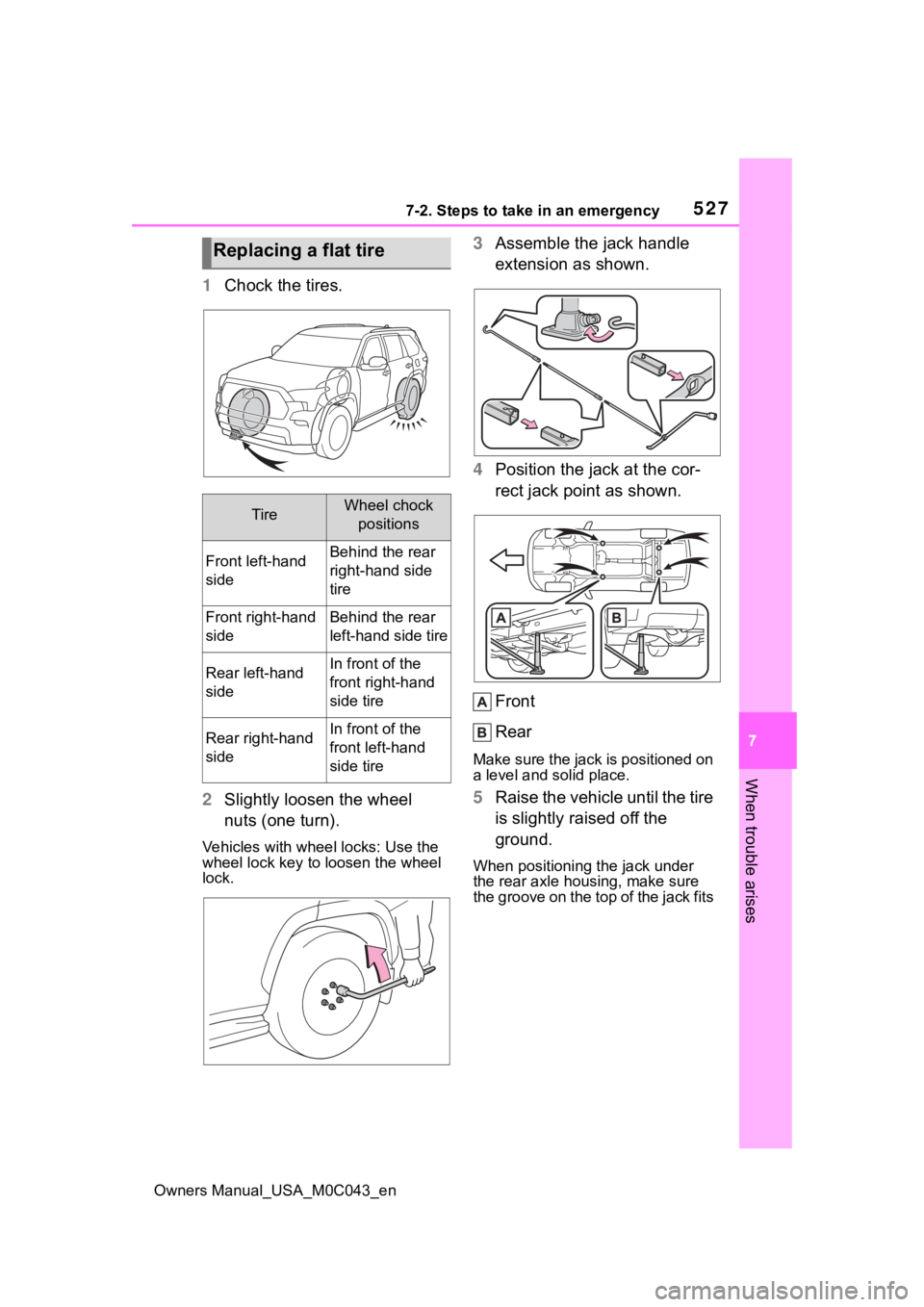
1 Chock the tires.
2 Slightly loosen the wheel
nuts (one turn).
Vehicles with wheel locks: Use the
wheel lock key to loosen the wheel
lock.
3Assemble the jack handle
extension as shown.
4 Position the jack at the cor-
rect jack point as shown.
Front
Rear
Make sure the jack is positioned on
a level and solid place.
5Raise the vehicle until the tire
is slightly raised off the
ground.
When positioning the jack under
the rear axle housing, make sure
the groove on the top of the jack fits
Replacing a flat tire
TireWheel chock
positions
Front left-hand
sideBehind the rear
right-hand side
tire
Front right-hand
sideBehind the rear
left-hand side tire
Rear left-hand
sideIn front of the
front right-hand
side tire
Rear right-hand
sideIn front of the
front left-hand
side tire
Page 528 of 628
5287-2. Steps to take in an emergency
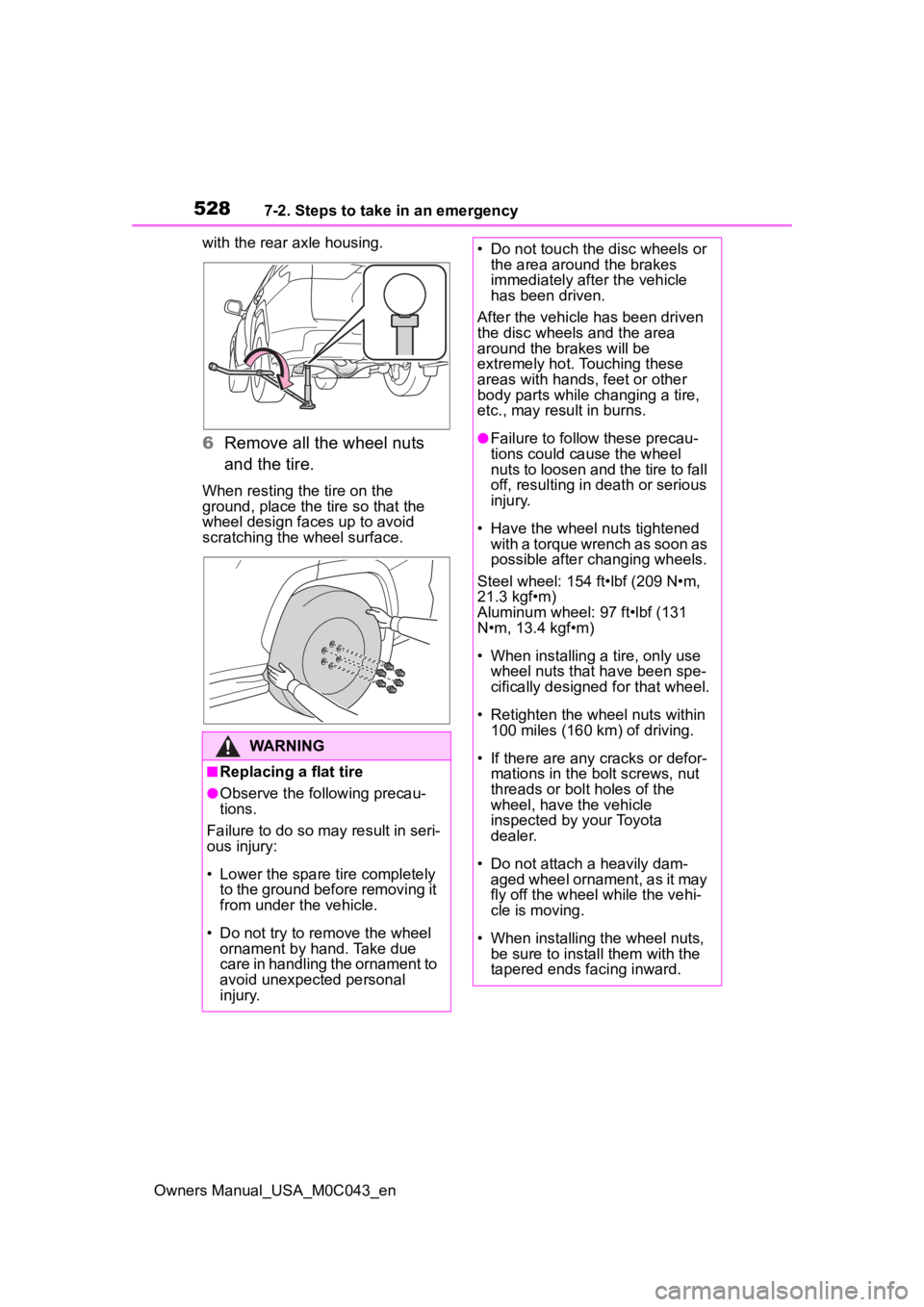
Owners Manual_USA_M0C043_enwith the rear axle housing.
6
Remove all the wheel nuts
and the tire.
When resting the tire on the
ground, place the tire so that the
wheel design faces up to avoid
scratching the wheel surface.
WARNING
■Replacing a flat tire
●Observe the following precau-
tions.
Failure to do so may result in seri-
ous injury:
• Lower the spare tire completely to the ground before removing it
from under the vehicle.
• Do not try to rem ove the wheel
ornament by hand. Take due
care in handling the ornament to
avoid unexpected personal
injury.
• Do not touch the disc wheels or the area around the brakes
immediately after the vehicle
has been driven.
After the vehicle has been driven
the disc wheels and the area
around the br akes will be
extremely hot. Touching these
areas with hands, feet or other
body parts while changing a tire,
etc., may result in burns.
●Failure to follow these precau-
tions could cause the wheel
nuts to loosen and the tire to fall
off, resulting in death or serious
injury.
• Have the wheel nuts tightened
with a torque wrench as soon as
possible after changing wheels.
Steel wheel: 154 ft•lbf (209 N•m,
21.3 kgf•m)
Aluminum wheel: 97 ft•lbf (131
N•m, 13.4 kgf•m)
• When installing a tire, only use wheel nuts that have been spe-
cifically designed for that wheel.
• Retighten the wheel nuts within 100 miles (160 km) of driving.
• If there are any cracks or defor- mations in the bolt screws, nut
threads or bolt holes of the
wheel, have the vehicle
inspected by your Toyota
dealer.
• Do not attach a heavily dam- aged wheel ornament, as it may
fly off the wheel while the vehi-
cle is moving.
• When installing the wheel nuts, be sure to install them with the
tapered ends facing inward.
Page 529 of 628
5297-2. Steps to take in an emergency
Owners Manual_USA_M0C043_en
7
When trouble arises
1 Remove any dirt or foreign
matter from the wheel con-
tact surface.
If foreign matter is on the wheel
contact surface, the wheel nuts
may loosen while the vehicle is in
motion, causing the tire to come off.
2Install the spare tire and
loosely tighten each wheel
nut by hand by approximately
the same amount.
Tighten the whee l nuts until the
tapered portion comes into
loose contact with the disc wheel
seat .
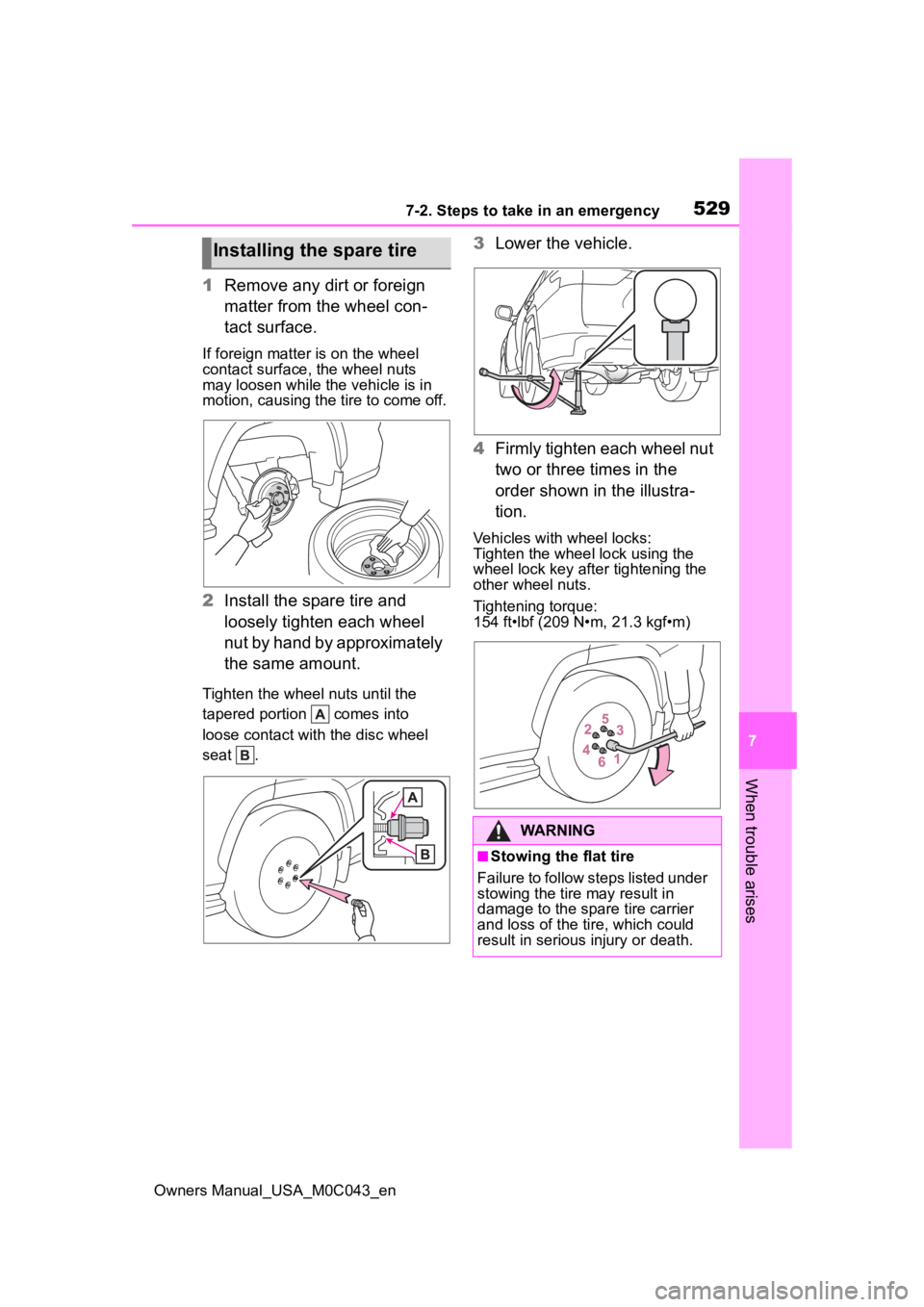
3 Lower the vehicle.
4 Firmly tighten each wheel nut
two or three times in the
order shown in the illustra-
tion.
Vehicles with wheel locks:
Tighten the wheel lock using the
wheel lock key after tightening the
other wheel nuts.
Tightening torque:
154 ft•lbf (209 N•m, 21.3 kgf•m)
Installing the spare tire
WARNING
■Stowing the flat tire
Failure to follow steps listed under
stowing the tire may result in
damage to the spare tire carrier
and loss of the tire, which could
result in serious injury or death.
Page 530 of 628
5307-2. Steps to take in an emergency
Owners Manual_USA_M0C043_en
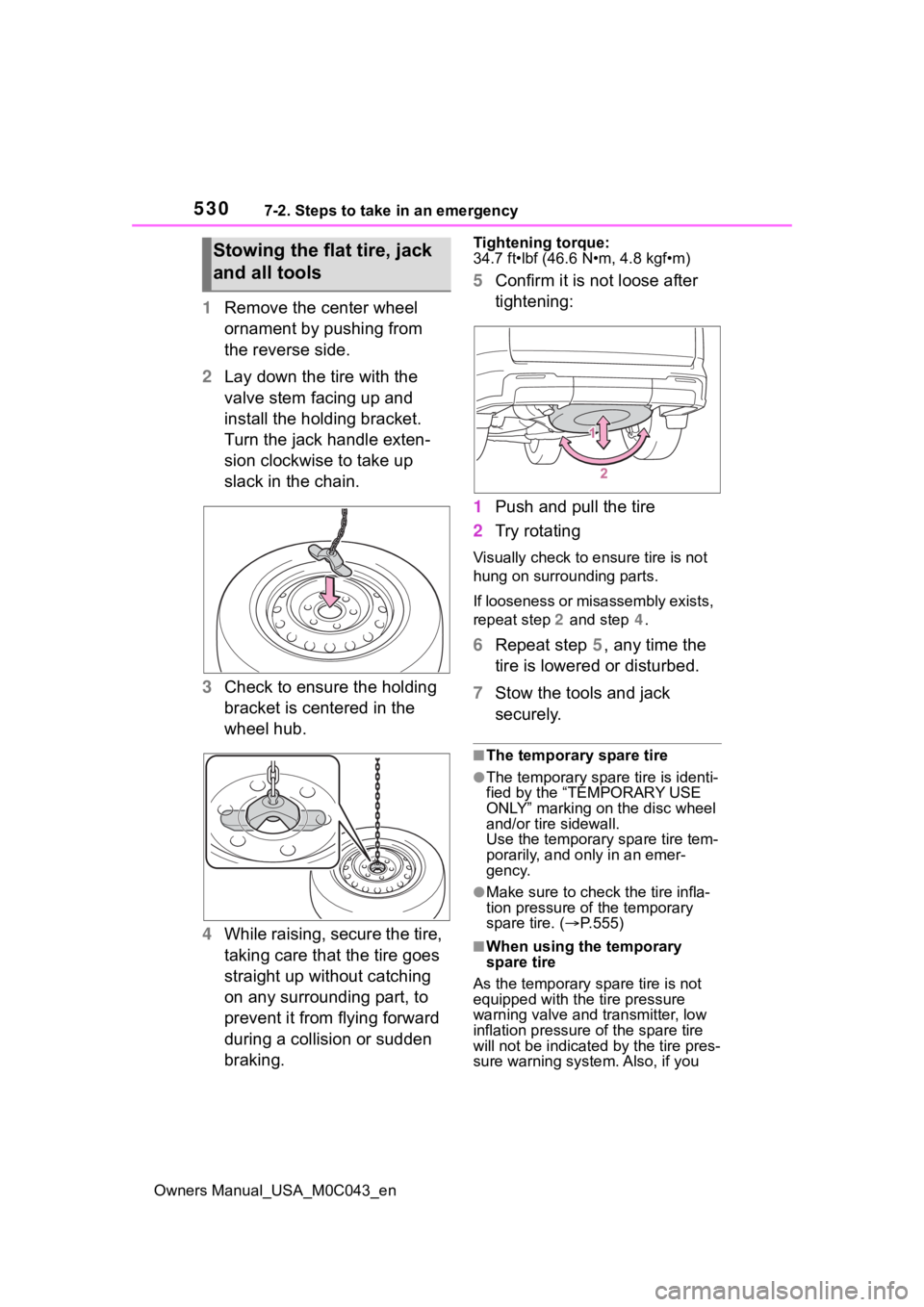
1Remove the center wheel
ornament by pushing from
the reverse side.
2 Lay down the tire with the
valve stem facing up and
install the holding bracket.
Turn the jack handle exten-
sion clockwise to take up
slack in the chain.
3 Check to ensure the holding
bracket is centered in the
wheel hub.
4 While raising, secure the tire,
taking care that the tire goes
straight up without catching
on any surrounding part, to
prevent it from flying forward
during a collision or sudden
braking.
Tightening torque:
34.7 ft•lbf (46.6 N•m, 4.8 kgf•m)
5Confirm it is not loose after
tightening:
1 Push and pull the tire
2 Try rotating
Visually check to e nsure tire is not
hung on surrounding parts.
If looseness or misassembly exists,
repeat step 2 and step 4.
6 Repeat step 5, any time the
tire is lowered or disturbed.
7 Stow the tools and jack
securely.
■The temporary spare tire
●The temporary spare tire is identi-
fied by the “TEMPORARY USE
ONLY” marking on the disc wheel
and/or tire sidewall.
Use the temporary spare tire tem-
porarily, and only in an emer-
gency.
●Make sure to check the tire infla-
tion pressure of the temporary
spare tire. ( P.555)
■When using the temporary
spare tire
As the temporary spare tire is not
equipped with the tire pressure
warning valve and transmitter, low
inflation pressure of the spare tire
will not be indicated by the tire pres-
sure warning system. Also, if you
Stowing the flat tire, jack
and all tools
Page 531 of 628
5317-2. Steps to take in an emergency
Owners Manual_USA_M0C043_en
7
When trouble arises
replace the temporary spare tire
after the tire press ure warning light
comes on, the light remains on.
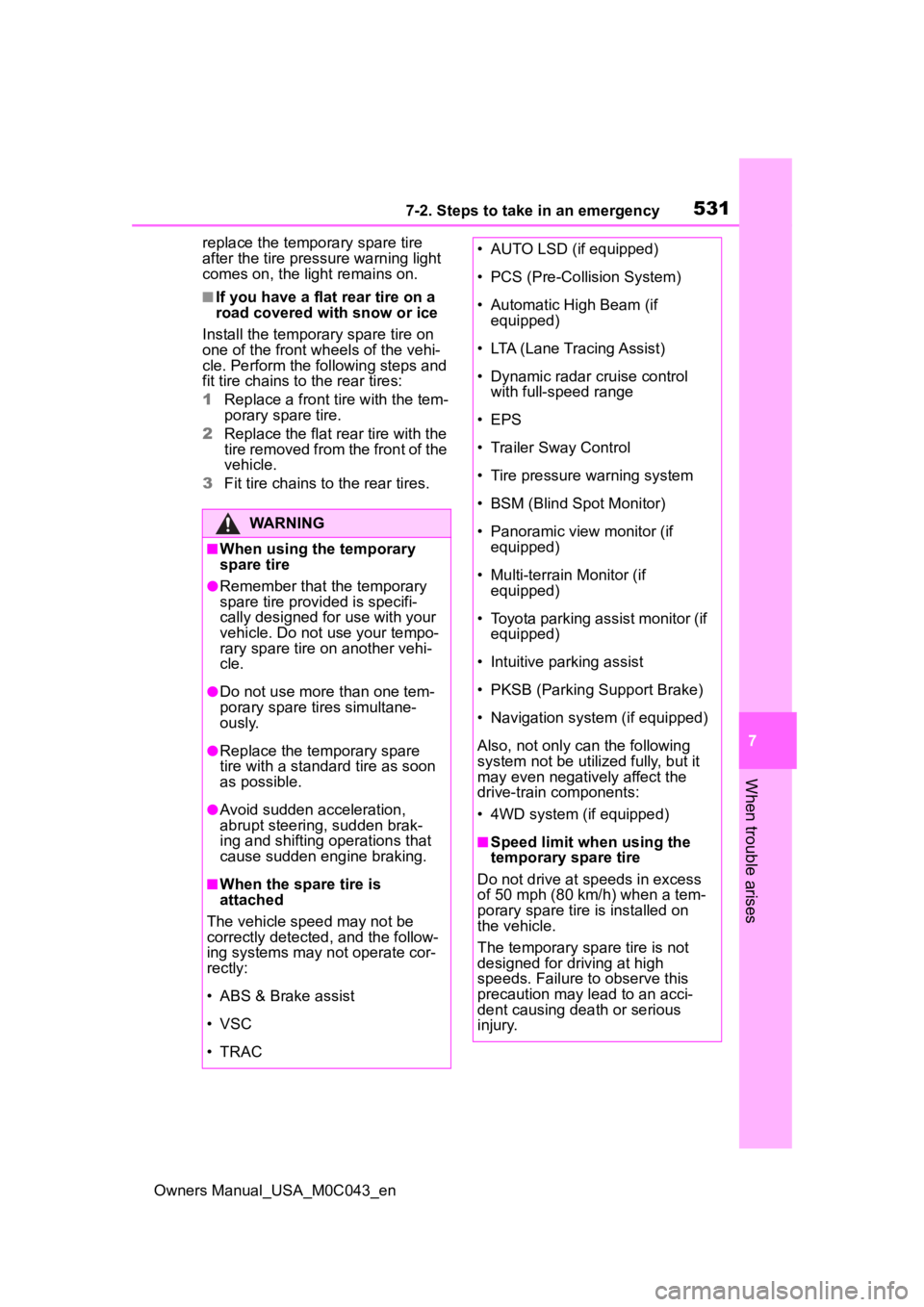
■If you have a flat rear tire on a
road covered with snow or ice
Install the temporary spare tire on
one of the front whe els of the vehi-
cle. Perform the following steps and
fit tire chains to the rear tires:
1 Replace a front ti re with the tem-
porary spare tire.
2 Replace the flat rear tire with the
tire removed from the front of the
vehicle.
3 Fit tire chains to the rear tires.
WARNING
■When using the temporary
spare tire
●Remember that the temporary
spare tire provided is specifi-
cally designed for use with your
vehicle. Do not use your tempo-
rary spare tire on another vehi-
cle.
●Do not use more than one tem-
porary spare tires simultane-
ously.
●Replace the temporary spare
tire with a standard tire as soon
as possible.
●Avoid sudden acceleration,
abrupt steering, sudden brak-
ing and shifting operations that
cause sudden engine braking.
■When the spare tire is
attached
The vehicle speed may not be
correctly detecte d, and the follow-
ing systems may not operate cor-
rectly:
• ABS & Brake assist
• VSC
• TRAC
• AUTO LSD (if equipped)
• PCS (Pre-Collision System)
• Automatic High Beam (if equipped)
• LTA (Lane Tracing Assist)
• Dynamic radar cruise control with full-speed range
• EPS
• Trailer Sway Control
• Tire pressure warning system
• BSM (Blind Spot Monitor)
• Panoramic view monitor (if equipped)
• Multi-terrain Monitor (if equipped)
• Toyota parking assist monitor (if equipped)
• Intuitive parking assist
• PKSB (Parking Support Brake)
• Navigation system (if equipped)
Also, not only c an the following
system not be utilized fully, but it
may even negatively affect the
drive-train components:
• 4WD system (if equipped)
■Speed limit when using the
temporary spare tire
Do not drive at speeds in excess
of 50 mph (80 km/h) when a tem-
porary spare tire is installed on
the vehicle.
The temporary spare tire is not
designed for driving at high
speeds. Failure to observe this
precaution may lead to an acci-
dent causing death or serious
injury.
Page 532 of 628
5327-2. Steps to take in an emergency
Owners Manual_USA_M0C043_en
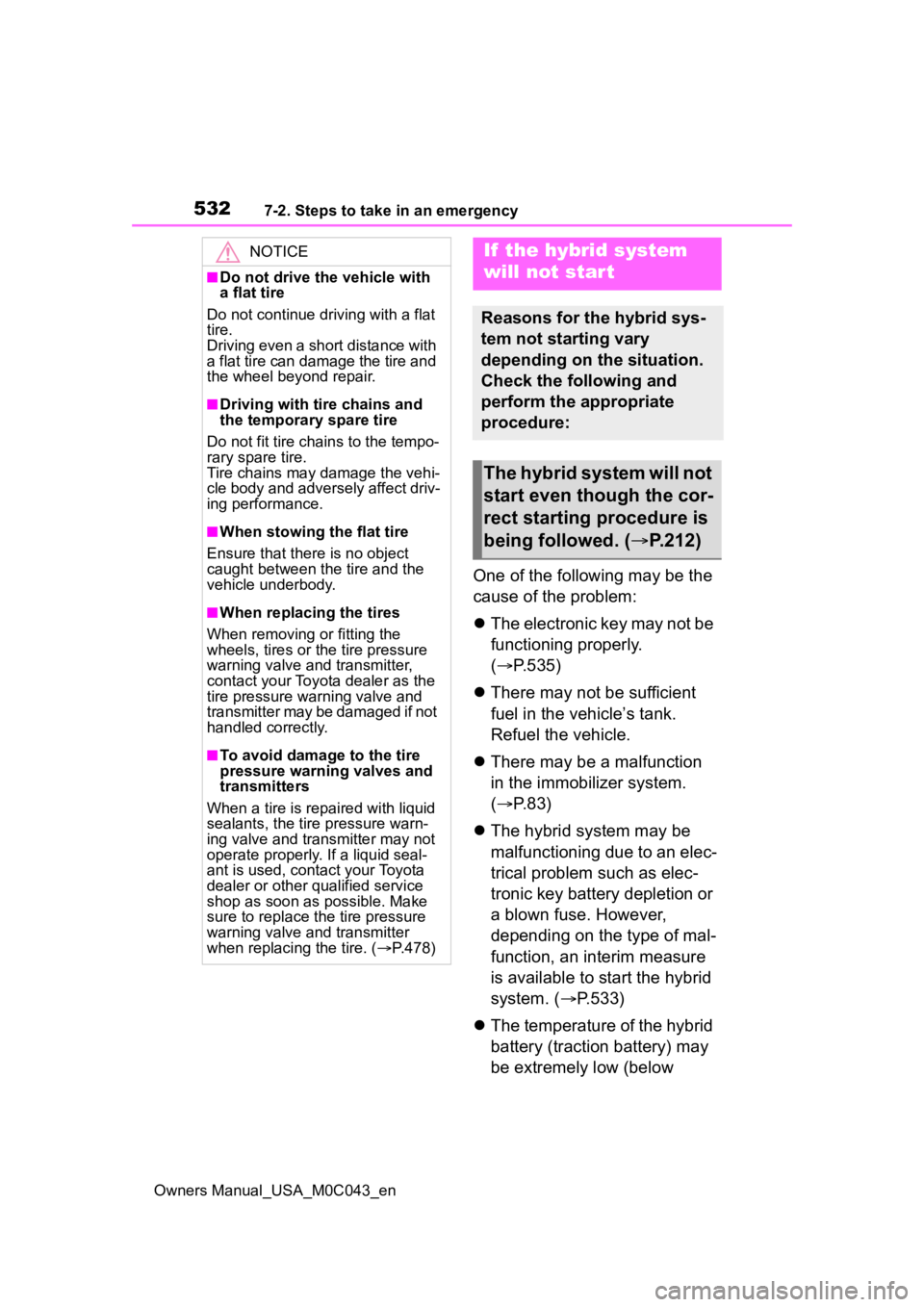
One of the following may be the
cause of the problem:
The electronic key may not be
functioning properly.
( P.535)
There may not be sufficient
fuel in the vehicle’s tank.
Refuel the vehicle.
There may be a malfunction
in the immobilizer system.
( P.83)
The hybrid system may be
malfunctioning due to an elec-
trical problem such as elec-
tronic key battery depletion or
a blown fuse. However,
depending on the type of mal-
function, an interim measure
is available to start the hybrid
system. ( P.533)
The temperature of the hybrid
battery (traction battery) may
be extremely low (below
NOTICE
■Do not drive the vehicle with
a flat tire
Do not continue driving with a flat
tire.
Driving even a short distance with
a flat tire can damage the tire and
the wheel beyond repair.
■Driving with tire chains and
the temporary spare tire
Do not fit tire chains to the tempo-
rary spare tire.
Tire chains may damage the vehi-
cle body and adversely affect driv-
ing performance.
■When stowing the flat tire
Ensure that there is no object
caught between the tire and the
vehicle underbody.
■When replacing the tires
When removing or fitting the
wheels, tires or the tire pressure
warning valve and transmitter,
contact your Toyota dealer as the
tire pressure warning valve and
transmitter may be damaged if not
handled correctly.
■To avoid damage to the tire
pressure warning valves and
transmitters
When a tire is repaired with liquid
sealants, the tire pressure warn-
ing valve and transmitter may not
operate properly. If a liquid seal-
ant is used, contact your Toyota
dealer or other qualified service
shop as soon as possible. Make
sure to replace the tire pressure
warning valve and transmitter
when replaci ng the tire. (P.478)
If the hybrid system
will not star t
Reasons for the hybrid sys-
tem not starting vary
depending on the situation.
Check the following and
perform the appropriate
procedure:
The hybrid system will not
start even though the cor-
rect starting procedure is
being followed. ( P.212)
Page 555 of 628
5558-1. Specifications
Owners Manual_USA_M0C043_en
8
Vehicle specifications
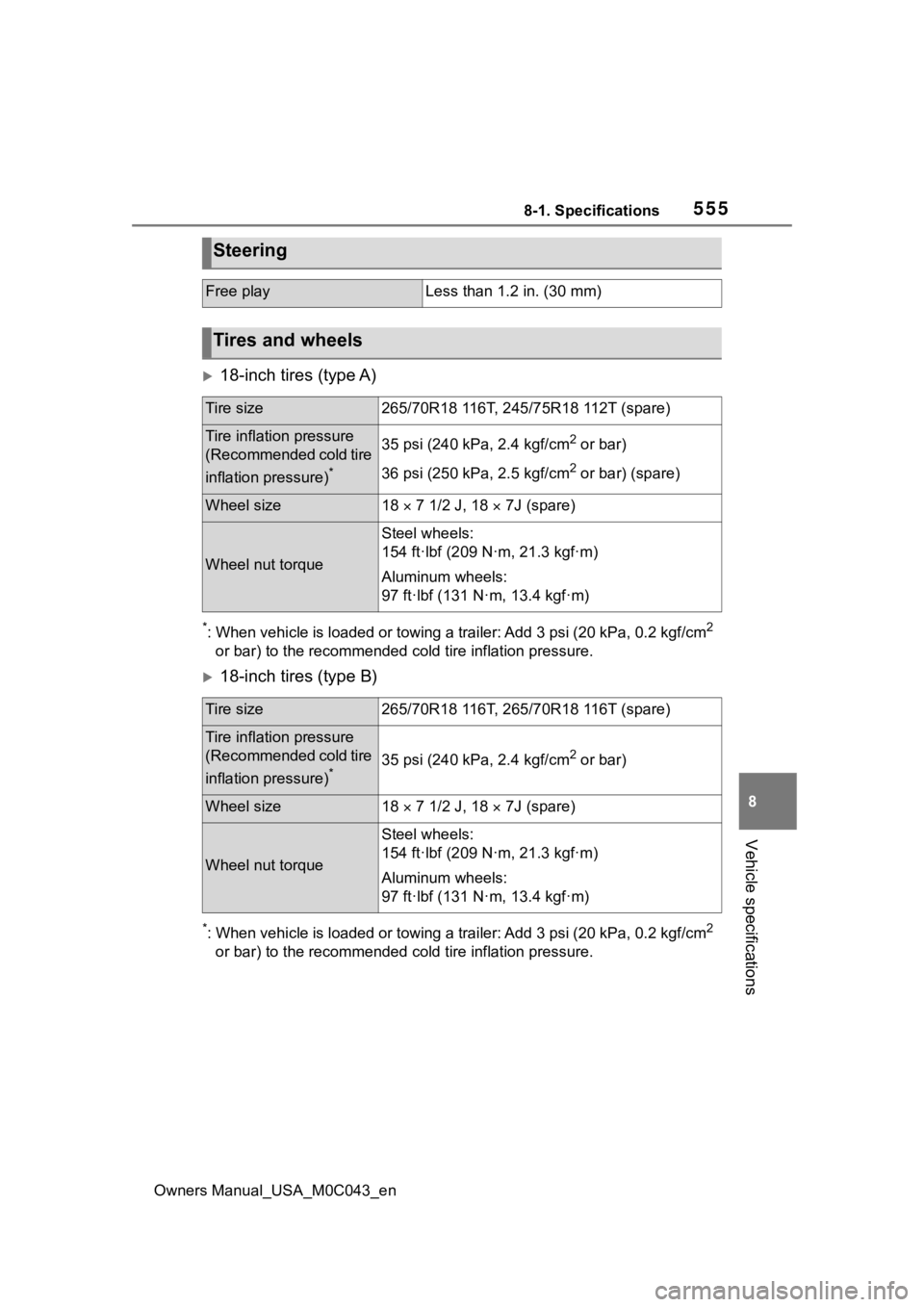
18-inch tires (type A)
*: When vehicle is loaded or towing a trailer: Add 3 psi (20 kPa, 0.2 kgf/cm2
or bar) to the recommended cold tire inflation pressure.
18-inch tires (type B)
*: When vehicle is loaded or towing a trailer: Add 3 psi (20 kPa, 0.2 kgf/cm2
or bar) to the recommended cold tire inflation pressure.
Steering
Free playLess than 1.2 in. (30 mm)
Tires and wheels
Tire size265/70R18 116T, 245/75R18 112T (spare)
Tire inflation pressure
(Recommended cold tire
inflation pressure)
*
35 psi (240 kPa, 2.4 kgf/cm2 or bar)
36 psi (250 kPa, 2.5 kgf/cm
2 or bar) (spare)
Wheel size18 7 1/2 J, 18 7J (spare)
Wheel nut torque
Steel wheels:
154 ft·lbf (209 N·m, 21.3 kgf·m)
Aluminum wheels:
97 ft·lbf (131 N·m, 13.4 kgf·m)
Tire size265/70R18 116T, 265/70R18 116T (spare)
Tire inflation pressure
(Recommended cold tire
inflation pressure)
*35 psi (240 kPa, 2.4 kgf/cm2 or bar)
Wheel size18 7 1/2 J, 18 7J (spare)
Wheel nut torque
Steel wheels:
154 ft·lbf (209 N·m, 21.3 kgf·m)
Aluminum wheels:
97 ft·lbf (131 N·m, 13.4 kgf·m)
Page 556 of 628
5568-1. Specifications
Owners Manual_USA_M0C043_en
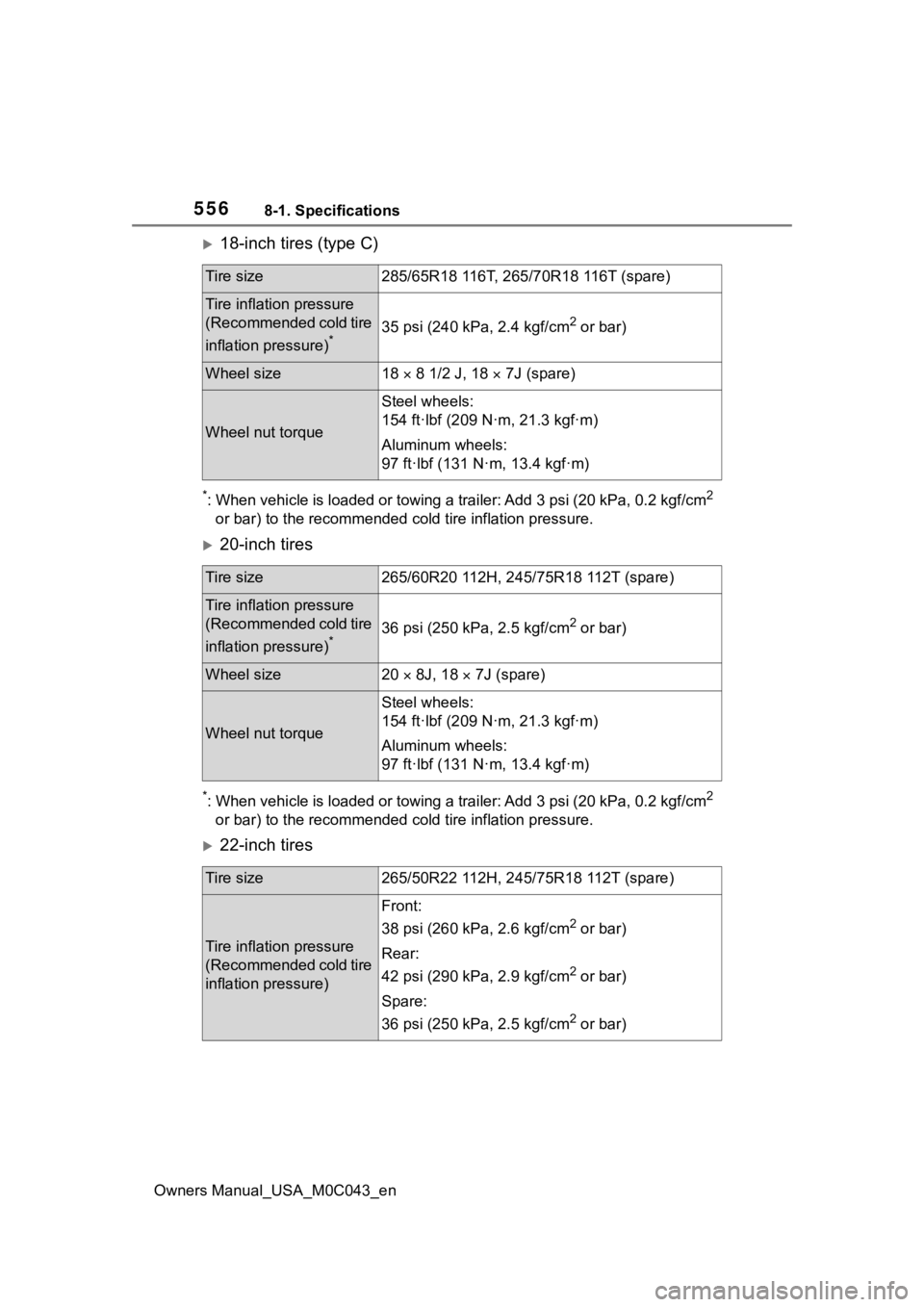
18-inch tires (type C)
*: When vehicle is loaded or towing a trailer: Add 3 psi (20 kPa, 0.2 kgf/cm2
or bar) to the recommended cold tire inflation pressure.
20-inch tires
*: When vehicle is loaded or towing a trailer: Add 3 psi (20 kPa, 0.2 kgf/cm2
or bar) to the recommended cold tire inflation pressure.
22-inch tires
Tire size285/65R18 116T, 265/70R18 116T (spare)
Tire inflation pressure
(Recommended cold tire
inflation pressure)
*35 psi (240 kPa, 2.4 kgf/cm2 or bar)
Wheel size18 8 1/2 J, 18 7J (spare)
Wheel nut torque
Steel wheels:
154 ft·lbf (209 N·m, 21.3 kgf·m)
Aluminum wheels:
97 ft·lbf (131 N·m, 13.4 kgf·m)
Tire size265/60R20 112H, 245/75R18 112T (spare)
Tire inflation pressure
(Recommended cold tire
inflation pressure)
*36 psi (250 kPa, 2.5 kgf/cm2 or bar)
Wheel size20 8J, 18 7J (spare)
Wheel nut torque
Steel wheels:
154 ft·lbf (209 N·m, 21.3 kgf·m)
Aluminum wheels:
97 ft·lbf (131 N·m, 13.4 kgf·m)
Tire size265/50R22 112H, 245/75R18 112T (spare)
Tire inflation pressure
(Recommended cold tire
inflation pressure)
Front:
38 psi (260 kPa, 2.6 kgf/cm
2 or bar)
Rear:
42 psi (290 kPa, 2.9 kgf/cm
2 or bar)
Spare:
36 psi (250 kPa, 2.5 kgf/cm
2 or bar)
Page 560 of 628
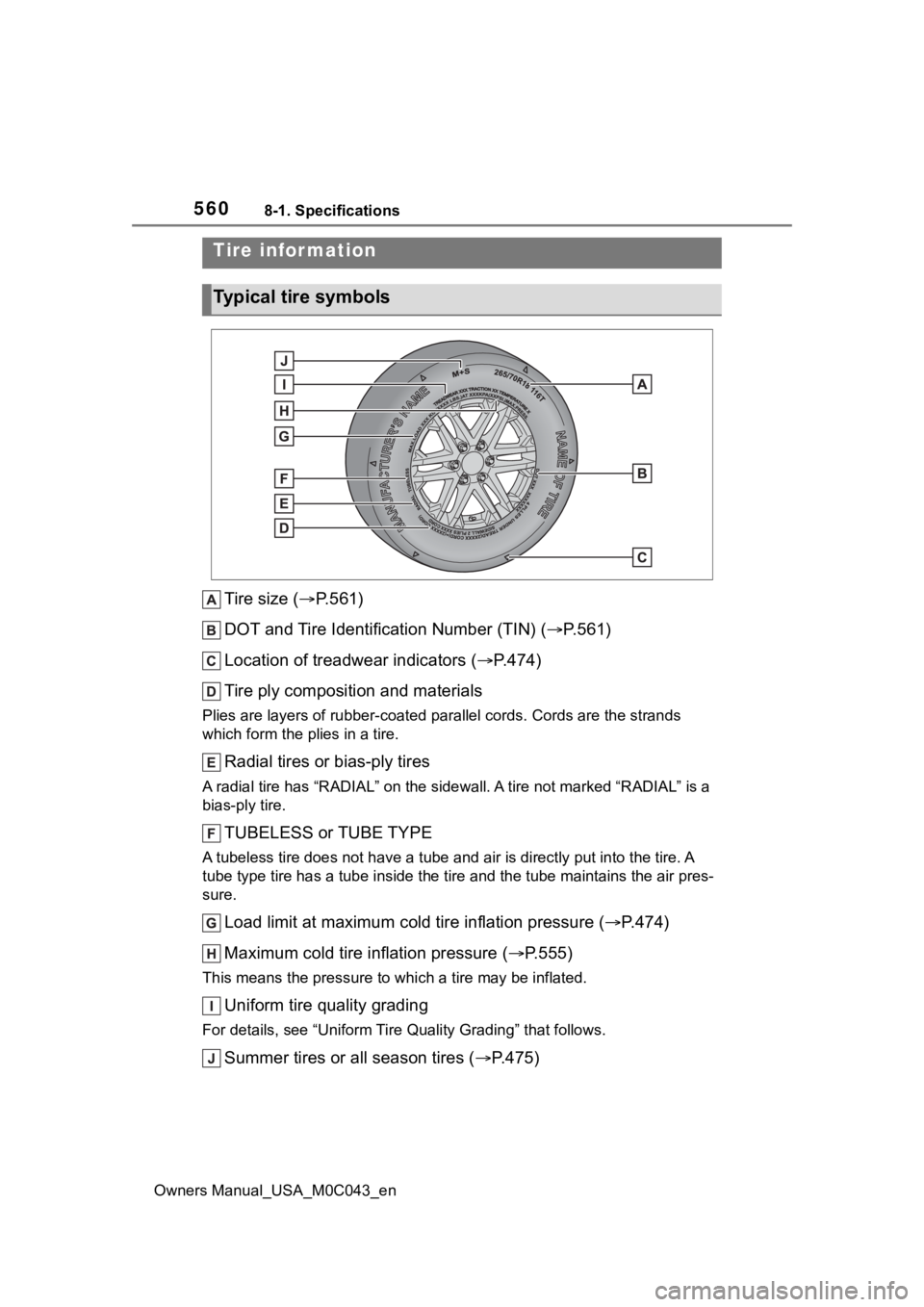
5608-1. Specifications
Owners Manual_USA_M0C043_en
Tire size (P.561)
DOT and Tire Identification Number (TIN) ( P.561)
Location of treadwear indicators ( P.474)
Tire ply composition and materials
Plies are layers of rubber-coat ed parallel cords. Cords are the strands
which form the pl ies in a tire.
Radial tires or bias-ply tires
A radial tire has “RADIAL” on the sidewall. A tire not marked “ RADIAL” is a
bias-ply tire.
TUBELESS or TUBE TYPE
A tubeless tire does not have a tube and air is directly put into the tire. A
tube type tire has a tube inside t he tire and the tube maintains the air pres-
sure.
Load limit at maximum cold tire inflation pressure (P.474)
Maximum cold tire inflation pressure ( P.555)
This means the pressure to w hich a tire may be inflated.
Uniform tire quality grading
For details, see “Uniform Tire Quality Grading” that follows.
Summer tires or all season tires ( P.475)
Tire information
Typical tire symbols
Page 563 of 628

5638-1. Specifications
Owners Manual_USA_M0C043_en
8
Vehicle specifications
tion on uniform tire quality grad-
ing.
Your Toyota dealer will help answer
any questions you may have as you
read this information.
■DOT quality grades
All passenger vehicle tires must
conform to Federal Safety
Requirements in addition to
these grades. Quality grades
can be found where applicable
on the tire sidewall between
tread shoulder and maximum
section width.
For example: Treadwear 200 Trac-
tion AA Temperature A
■Treadwear
The treadwear grade is a com-
parative rating based on the
wear rate of the tire when tested
under controlled conditions on a
specified government test
course.
For example, a tire graded 150
would wear one and a half (1 - 1/2)
times as well on the government
course as a tire graded 100.
The relative perfo rmance of tires
depends upon the actual conditions
of their use. Performance may differ
significantly from the norm due to
variations in driving habits, service
practices and differences in road
characteristics and climate.
■Traction AA, A, B, C
The traction grades, from high-
est to lowest, are AA, A, B and
C, and they represent the tire’s
ability to stop on wet pavement as measured under controlled
conditions on specified govern-
ment test surfaces of asphalt
and concrete.
A tire marked C may have poor
traction performance.
Warning: The traction grade
assigned to this tire is based on
braking (straight ahead) traction
tests and does not include corner-
ing (turning) traction.
■Temperature A, B, C
The temperature grades are A
(the highest), B, and C, repre-
senting the tire’s resistance to
the generation of heat and its
ability to dissipate heat when
tested under controlled condi-
tions on a specified indoor labo-
ratory test wheel.
Sustained high temperature can
cause the material of the tire to
degenerate and reduce tire life, and
excessive temperature can lead to
sudden tire failure.
Grade C corresponds to a level of
performance which all passenger
car tires must meet under the Fed-
eral Motor Vehicle Safety Standard
No. 109.
Grades B and A represent higher
levels of performance on the labo-
ratory test wheel than the minimum
required by law.
Warning: The temperature grades
of a tire assume tha t it is properly
inflated and not overloaded.
Excessive speed, underinflation, or
excessive loading, either sepa-
rately or in combination, can cause
heat buildup and possible tire fail-
ure.