navigation system TOYOTA SIENNA 2007 Service User Guide
[x] Cancel search | Manufacturer: TOYOTA, Model Year: 2007, Model line: SIENNA, Model: TOYOTA SIENNA 2007Pages: 3000, PDF Size: 52.26 MB
Page 267 of 3000

NS–6NAVIGATION – NAVIGATION SYSTEM
NS
HINT:
The combination of autonomous and GPS
navigation makes it possible to display the vehicle
position even when the vehicle is in places where
the GPS radio wave cannot receive a signal. When
only autonomous navigation is used, however, the
mapping accuracy may slightly decline.
(b) Autonomous navigation
This method determines the relative vehicle position
based on the running track determined by the gyro
and vehicle speed sensors located in the radio and
navigation assembly.
(1) Gyro sensor
Calculates the direction by detecting angular
velocity. It is located in the radio and navigation
assembly.
(2) Vehicle speed sensor
Used to calculate the vehicle running distance.
Page 268 of 3000
NAVIGATION – NAVIGATION SYSTEMNS–7
NS
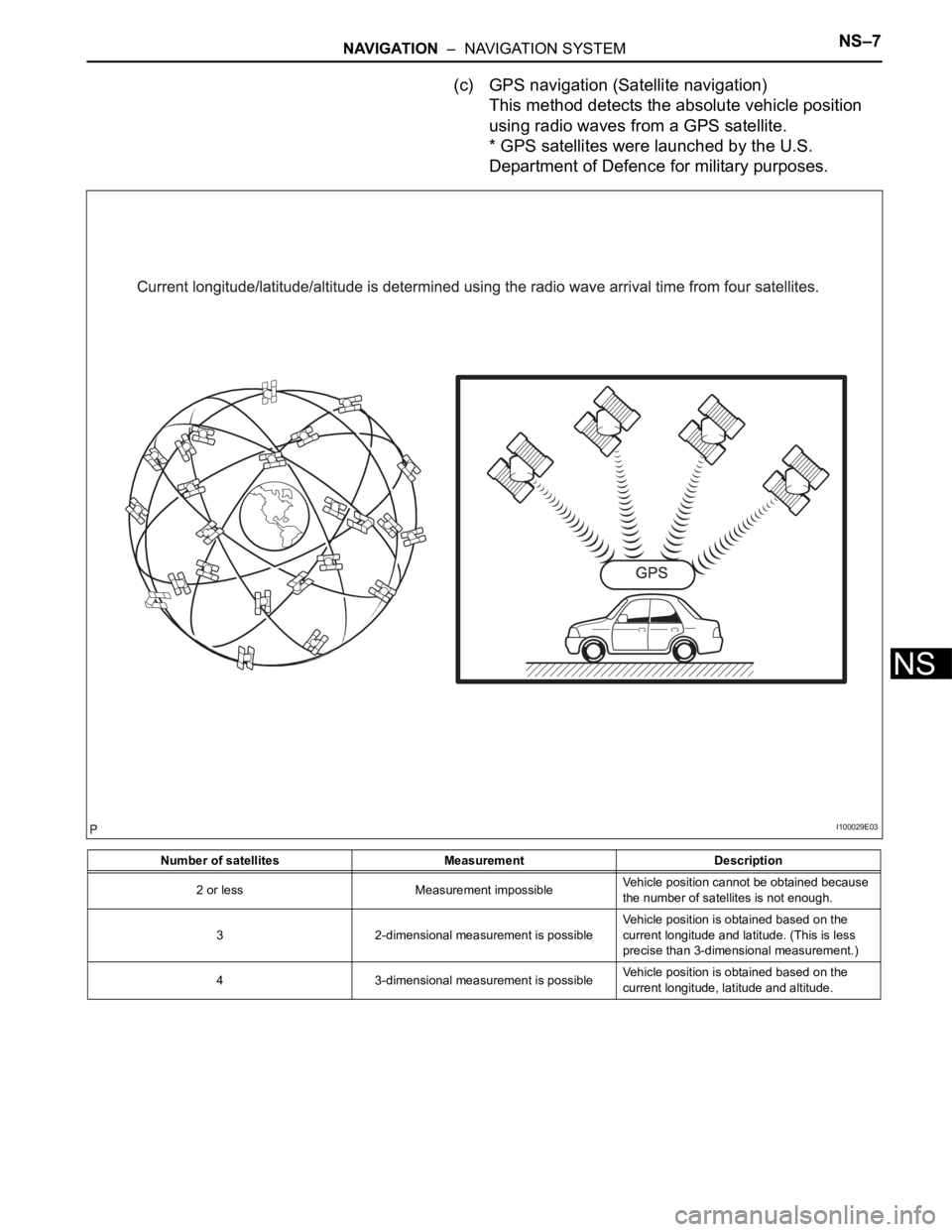
(c) GPS navigation (Satellite navigation)
This method detects the absolute vehicle position
using radio waves from a GPS satellite.
* GPS satellites were launched by the U.S.
Department of Defence for military purposes.
Number of satellites Measurement Description
2 or less Measurement impossibleVehicle position cannot be obtained because
the number of satellites is not enough.
3 2-dimensional measurement is possibleVehicle position is obtained based on the
current longitude and latitude. (This is less
precise than 3-dimensional measurement.)
4 3-dimensional measurement is possibleVehicle position is obtained based on the
current longitude, latitude and altitude.
I100029E03
Page 269 of 3000
NS–8NAVIGATION – NAVIGATION SYSTEM
NS
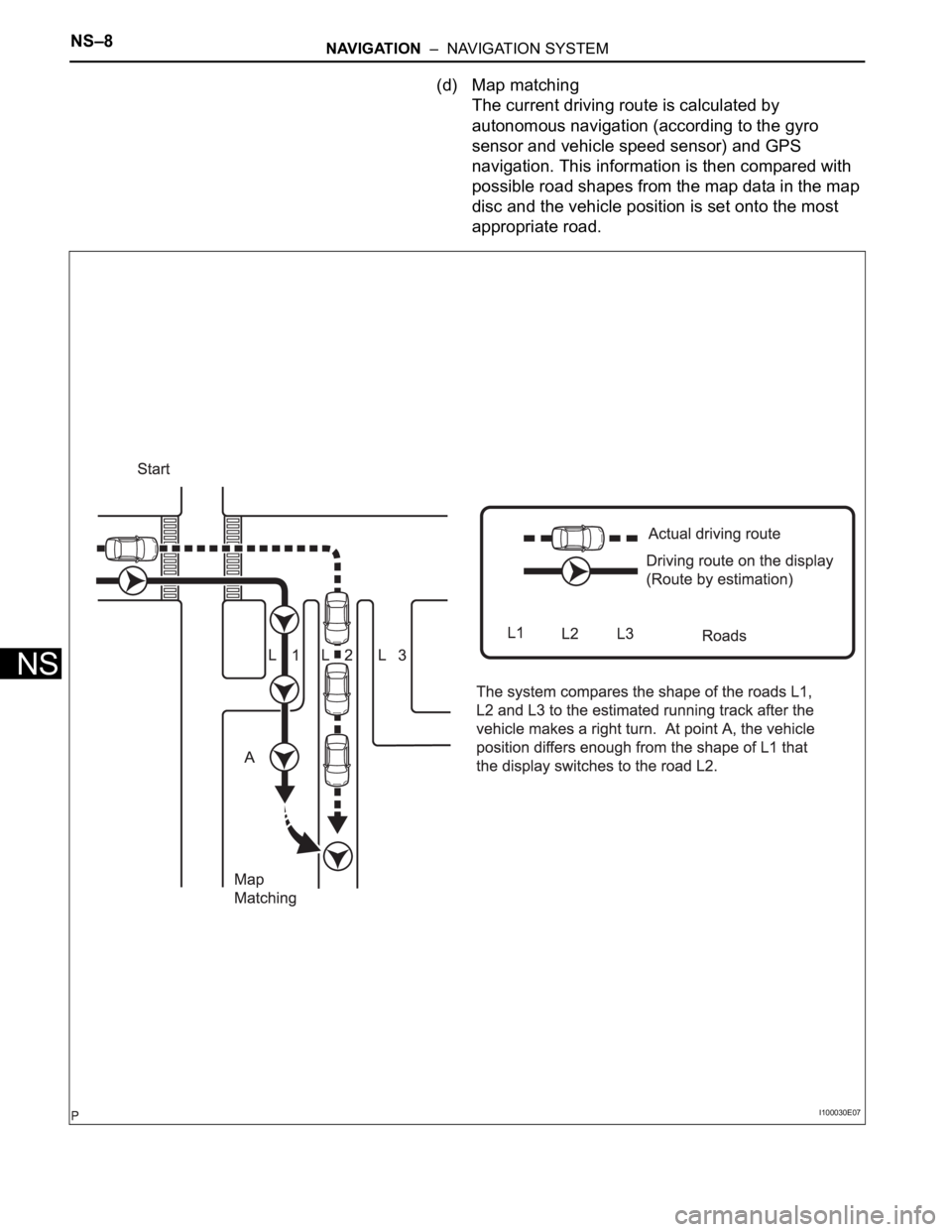
(d) Map matching
The current driving route is calculated by
autonomous navigation (according to the gyro
sensor and vehicle speed sensor) and GPS
navigation. This information is then compared with
possible road shapes from the map data in the map
disc and the vehicle position is set onto the most
appropriate road.
I100030E07
Page 270 of 3000
NAVIGATION – NAVIGATION SYSTEMNS–9
NS
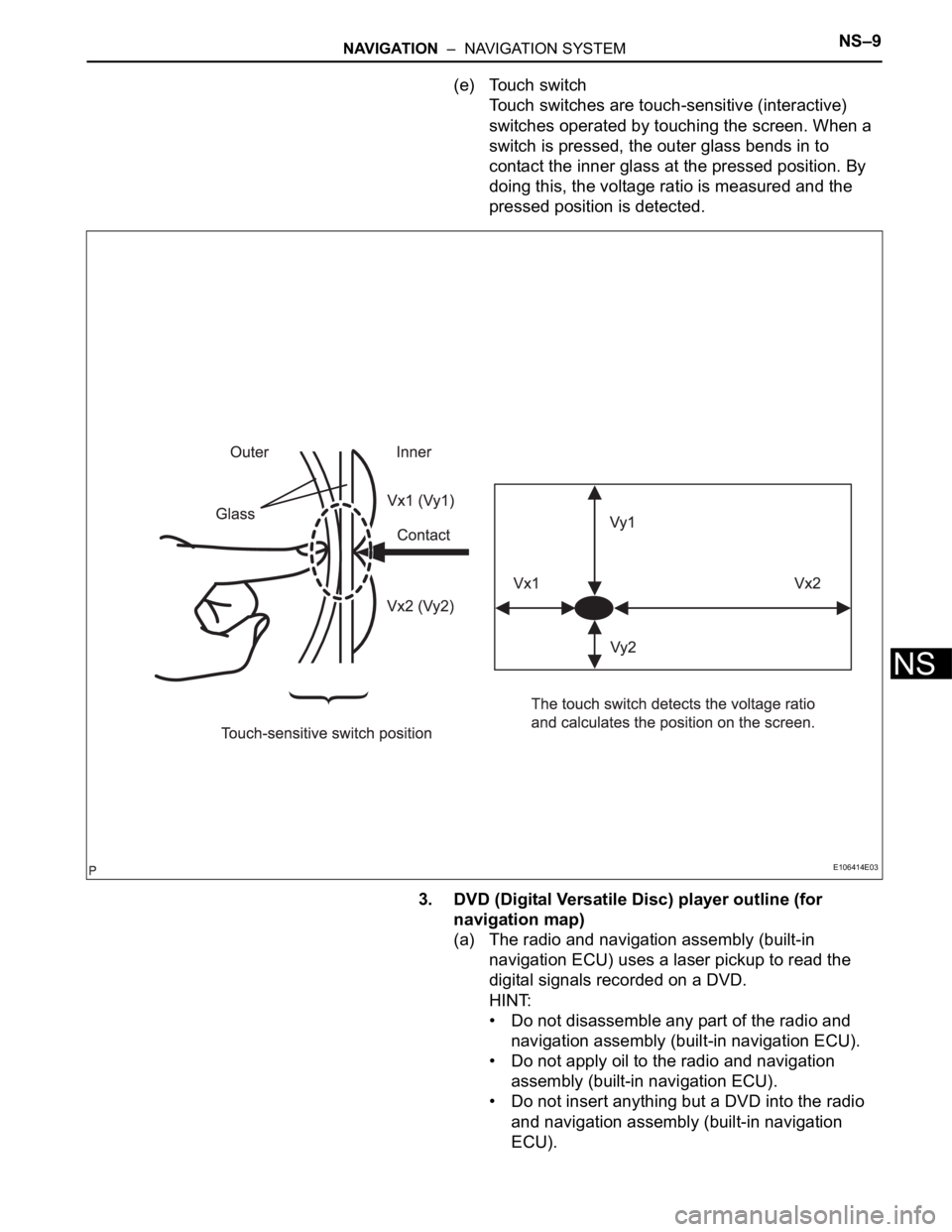
(e) Touch switch
Touch switches are touch-sensitive (interactive)
switches operated by touching the screen. When a
switch is pressed, the outer glass bends in to
contact the inner glass at the pressed position. By
doing this, the voltage ratio is measured and the
pressed position is detected.
3. DVD (Digital Versatile Disc) player outline (for
navigation map)
(a) The radio and navigation assembly (built-in
navigation ECU) uses a laser pickup to read the
digital signals recorded on a DVD.
HINT:
• Do not disassemble any part of the radio and
navigation assembly (built-in navigation ECU).
• Do not apply oil to the radio and navigation
assembly (built-in navigation ECU).
• Do not insert anything but a DVD into the radio
and navigation assembly (built-in navigation
ECU).
E106414E03
Page 271 of 3000
NS–10NAVIGATION – NAVIGATION SYSTEM
NS
CAUTION:
Do not look directly at the laser pickup because
the radio and navigation assembly (built-in
navigation ECU) uses an invisible laser beam.
Be sure to only operate the navigation system
as instructed.
4. CD (Compact Disc) player outline
(a) A compact disc player uses a laser pickup to read
digital signals recorded on a compact disc (CD). By
converting the digital signals to analog, it can play
music and other things.
NOTICE:
• Do not disassemble any part of the CD player.
• Do not apply oil to the CD player.
• Do not insert anything but a CD into the CD
player.
CAUTION:
Do not look directly at the laser pickup because
the CD player uses an invisible laser beam. Be
sure to only operate the player as instructed.
(b) Usable discs
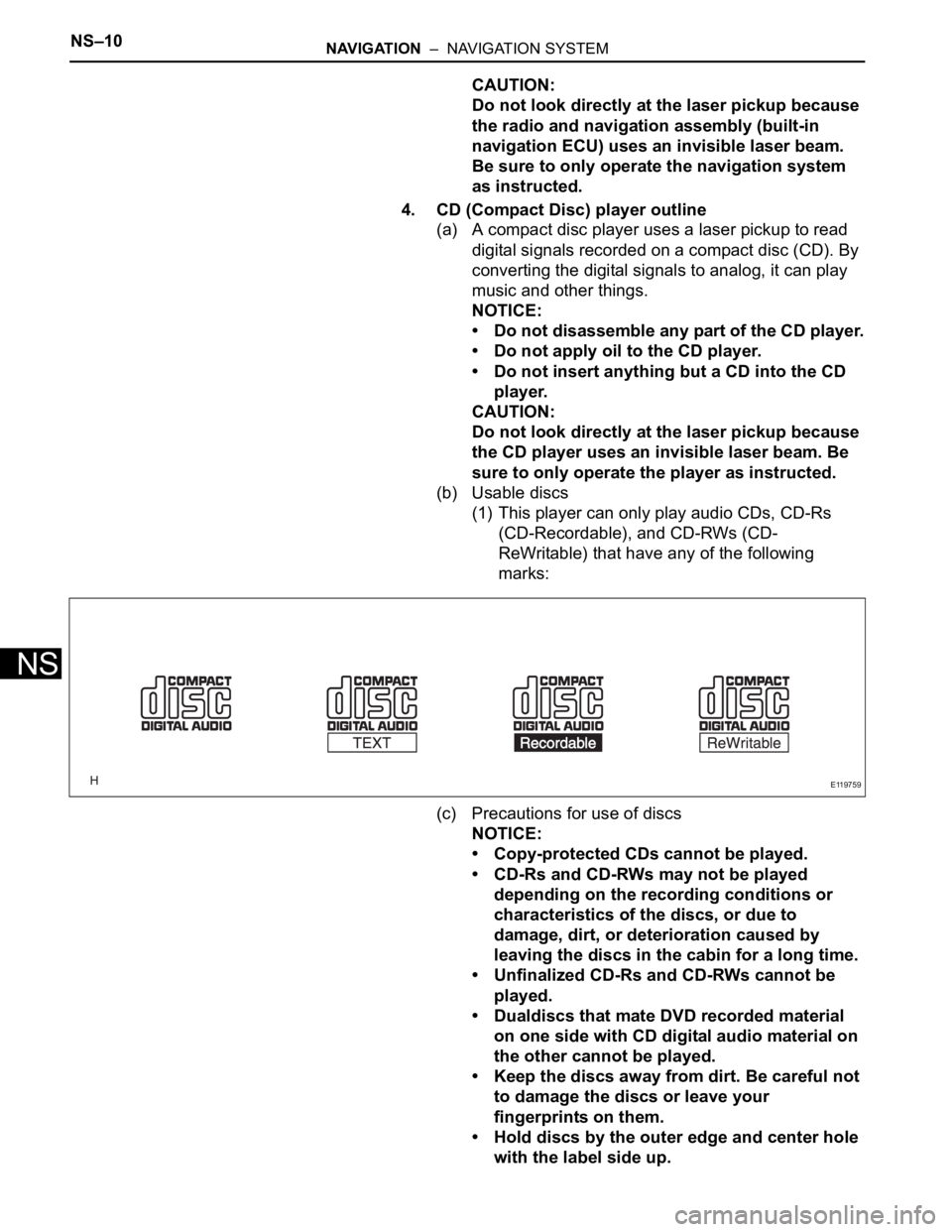
(1) This player can only play audio CDs, CD-Rs
(CD-Recordable), and CD-RWs (CD-
ReWritable) that have any of the following
marks:
(c) Precautions for use of discs
NOTICE:
• Copy-protected CDs cannot be played.
• CD-Rs and CD-RWs may not be played
depending on the recording conditions or
characteristics of the discs, or due to
damage, dirt, or deterioration caused by
leaving the discs in the cabin for a long time.
• Unfinalized CD-Rs and CD-RWs cannot be
played.
• Dualdiscs that mate DVD recorded material
on one side with CD digital audio material on
the other cannot be played.
• Keep the discs away from dirt. Be careful not
to damage the discs or leave your
fingerprints on them.
• Hold discs by the outer edge and center hole
with the label side up.
E119759
Page 272 of 3000
NAVIGATION – NAVIGATION SYSTEMNS–11
NS
• Leaving the disc exposed halfway out of the
slot for a long time after pressing the disc
eject button may cause deformation of the
disc, making the disc unusable.
• If discs have adhesive tape, stickers, CDR
labels, or any traces of such labels attached,
the discs may not be ejected or player
malfunctions may result.
• Keep the discs away from direct sunlight.
(Exposure to direct sunlight may cause
deformation of the disc, making the disc
unusable.)
• Do not use odd-shaped CDs because these
may cause player malfunctions.
• Do not use discs whose recording portion is
transparent or translucent because they may
not be inserted, ejected, or played normally.
HINT:
• When it is cold or it is raining, if the windows mist
up, mist and also dew may form in the player. In
such a case, the CD may skip or the CD may
stop in the middle of play. Ventilate or dehumidify
the cabin for a while before using the player.
• The CD may skip if the player experiences strong
vibrations when the vehicle is driven on rough
road or similar uneven surface(s).
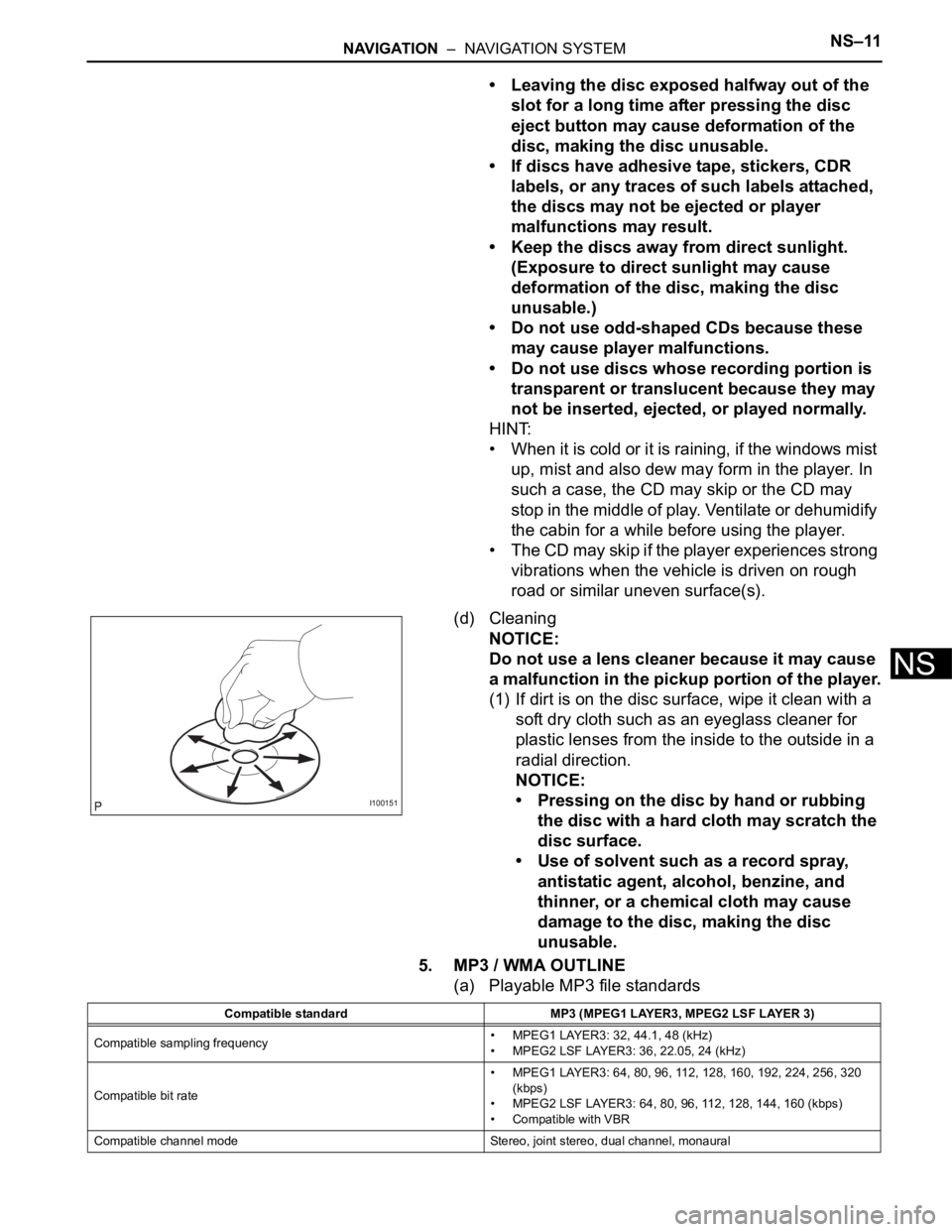
(d) Cleaning
NOTICE:
Do not use a lens cleaner because it may cause
a malfunction in the pickup portion of the player.
(1) If dirt is on the disc surface, wipe it clean with a
soft dry cloth such as an eyeglass cleaner for
plastic lenses from the inside to the outside in a
radial direction.
NOTICE:
• Pressing on the disc by hand or rubbing
the disc with a hard cloth may scratch the
disc surface.
• Use of solvent such as a record spray,
antistatic agent, alcohol, benzine, and
thinner, or a chemical cloth may cause
damage to the disc, making the disc
unusable.
5. MP3 / WMA OUTLINE
(a) Playable MP3 file standards
I100151
Compatible standard MP3 (MPEG1 LAYER3, MPEG2 LSF LAYER 3)
Compatible sampling frequency• MPEG1 LAYER3: 32, 44.1, 48 (kHz)
• MPEG2 LSF LAYER3: 36, 22.05, 24 (kHz)
Compatible bit rate• MPEG1 LAYER3: 64, 80, 96, 112, 128, 160, 192, 224, 256, 320
(kbps)
• MPEG2 LSF LAYER3: 64, 80, 96, 112, 128, 144, 160 (kbps)
• Compatible with VBR
Compatible channel mode Stereo, joint stereo, dual channel, monaural
Page 273 of 3000

NS–12NAVIGATION – NAVIGATION SYSTEM
NS
(b) Playable WMA file standards
(c) ID3 tag and WMA tag
(1) Additional textual information called ID3 tag can
be input to MP3 files. Information such as song
titles and artist names can be stored.
HINT:
This player is compatible with the ID3 tags of ID3
Ver. 1.0 and 1.1, and ID3 Ver. 2.2 and 2.3.
(Number of characters complies with ID3 Ver.
1.0 and 1.1.)
(2) Additional textual information called WMA tag
can be input to WMA files. Information such as
song titles and artist names can be stored.
(d) Usable media
(1) Only CD-ROMs, CD-Rs (CD-Recordable), and
CD-RWs (CD-ReWritable) only can be used to
play MP3/WMA files.
NOTICE:
• CD-Rs and CD-RWs are more easily
affected by a hot and humid environment
than discs used for normal audio CDs. For
this reason, some CD-Rs and CD-RWs
may not be played.
• If there are fingerprints or scratches on
the disc, the disc may not be played or the
CD may skip.
• Some CD-Rs and CD-RWs deteriorate if
they are left in the cabin for a long time.
• Keep CD-Rs and CD-RWs in a storage
case that is impenetrable to light.
(e) Usable media format
(1) Usable media format
HINT:
• As for MP3/WMA files written in any format
other than those above, the contents of the
files may not be played normally or the file
names or folder names may not be displayed
correctly.
• This player is compatible with multi-session
discs and can play CD-Rs and CD-RWs on
which MP3/WMA files are added. However,
only the first session can be played.
• Discs whose first session includes both music
data and MP3 or WMA format data cannot be
played.
Compatible standard WMA Ver. 7, 8, and 9
Compatible sampling frequency 32, 44.1, 48 (kHz)
Compatible bit rate• Ver. 7, 8: CBR48, 64, 80, 96, 128, 160, 192 (kbps)
• Ver. 9: CBR48, 64, 80, 96, 128, 160, 192, 256, 320 (kbps)
• Compatible with playback of channel 2 only
Disc format CD-ROM Mode 1, CD-ROM XA Mode 2 Form 1
File format ISO9660 Level 1 and Level 2 (joliet)
Page 274 of 3000
NAVIGATION – NAVIGATION SYSTEMNS–13
NS
(2) Standard and restrictions
(f) File names
(1) Only files with an extension of ".mp3" or ".wma"
can be recognized and played as MP3 or WMA
files.
(2) Save MP3 or WMA files with an extension of
".mp3" or ".wma".
NOTICE:
If saving non-MP3 or non-WMA files with an
extension of ".mp3" or ".wma", those files
are wrongly recognized as MP3 orWMA files
and played. A loud noise may occur and
damage to the speaker may result.
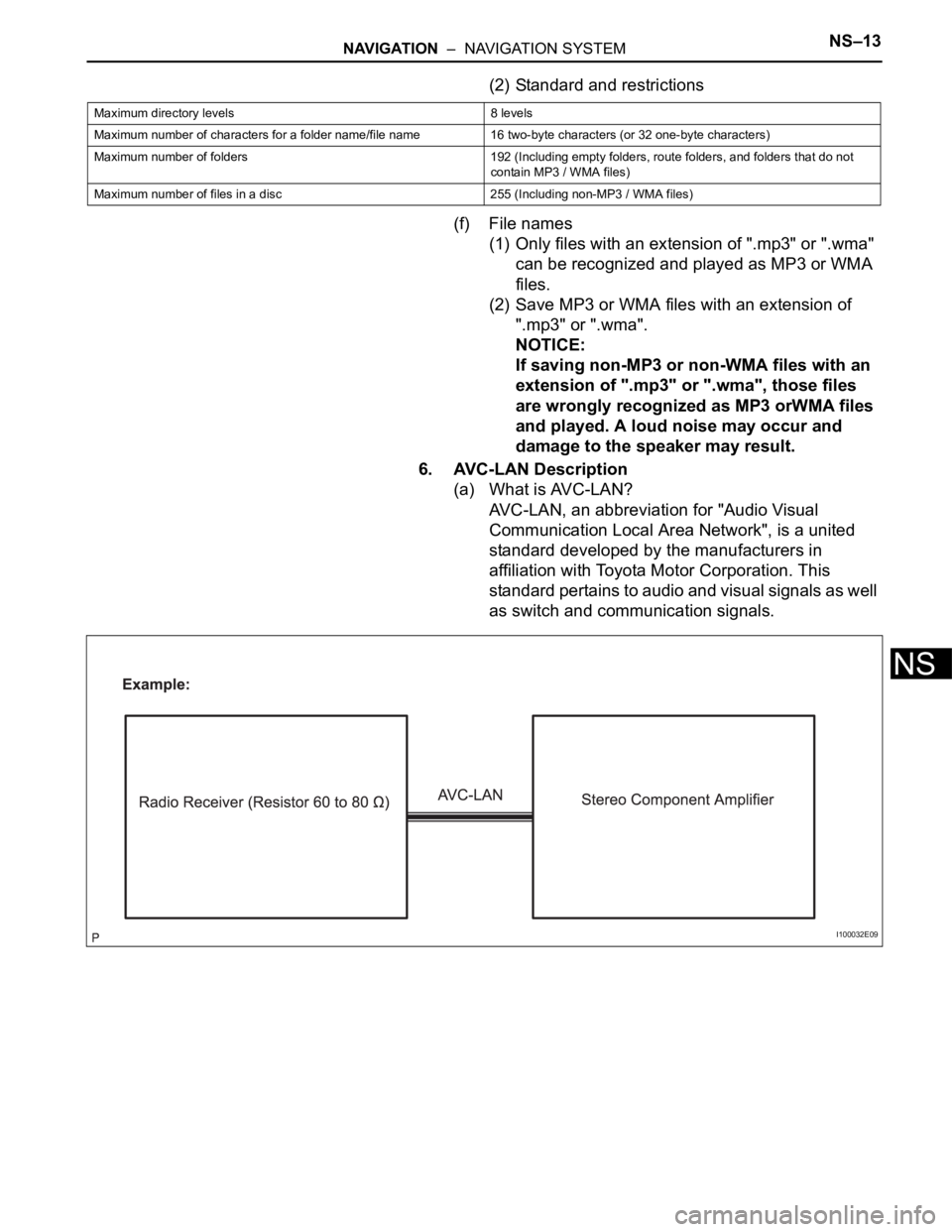
6. AVC-LAN Description
(a) What is AVC-LAN?
AVC-LAN, an abbreviation for "Audio Visual
Communication Local Area Network", is a united
standard developed by the manufacturers in
affiliation with Toyota Motor Corporation. This
standard pertains to audio and visual signals as well
as switch and communication signals.
Maximum directory levels 8 levels
Maximum number of characters for a folder name/file name 16 two-byte characters (or 32 one-byte characters)
Maximum number of folders 192 (Including empty folders, route folders, and folders that do not
contain MP3 / WMA files)
Maximum number of files in a disc 255 (Including non-MP3 / WMA files)
I100032E09
Page 275 of 3000

NS–14NAVIGATION – NAVIGATION SYSTEM
NS
(b) Purpose:
Recently, car audio systems have rapidly developed
and the functions have vastly changed. The
conventional car audio system is being integrated
with multi-media interfaces similar to those in
navigation systems. At the same time, customers
are demanding higher quality from their audio
systems. This is merely an overview of the
standardization background. The specific purposes
are as follows:
(1) To solve sound problems, etc. caused by using
components of different manufacturers through
signal standardization.
(2) To allow each manufacturer to concentrate on
developing products they do best. From this,
reasonably priced products can be produced.
HINT:
• If a short to +B or short to ground is detected
in the AVC-LAN circuit, communication is
interrupted and the audio system will stop
functioning.
• If an audio system is equipped with a
navigation system, the multi-display unit acts
as the master unit.
If the navigation system is not equipped, the
audio head unit acts as the master unit
instead. If the radio and navigation assembly
is equipped, it is the master unit.
• The radio and navigation assembly contains
a resistor that is necessary to enable
communication on the different AVC-LAN
circuits.
• The car audio system with an AVC-LAN
circuit has a diagnostic function.
• Each component has a specified number (3-
digit) called a physical address. Each function
has a number (2-digit) called a logical
address.
7. Communication system outline
(a) Components of the navigation system communicate
with each other via the AVC-LAN.
(b) The radio and navigation assembly has enough
resistance (60 to 80
) necessary for
communication.
(c) If a short circuit or open circuit occurs in the AVC-
LAN circuit, communication is interrupted and the
navigation system will stop functioning.
8. Diagnostic function outline
(a) The audio system has a diagnostic function (the
result is indicated on the master unit).
(b) A 3-digit hexadecimal component code (physical
address) is allocated to each component on the
AVC-LAN. Using this code, the component in the
diagnostic function can be displayed.
Page 276 of 3000
NAVIGATION – NAVIGATION SYSTEMNS–15
NS
9. Bluetooth outline
(a) Bluethooth is a trademark owned by Bluetooth SIG.
Inc.
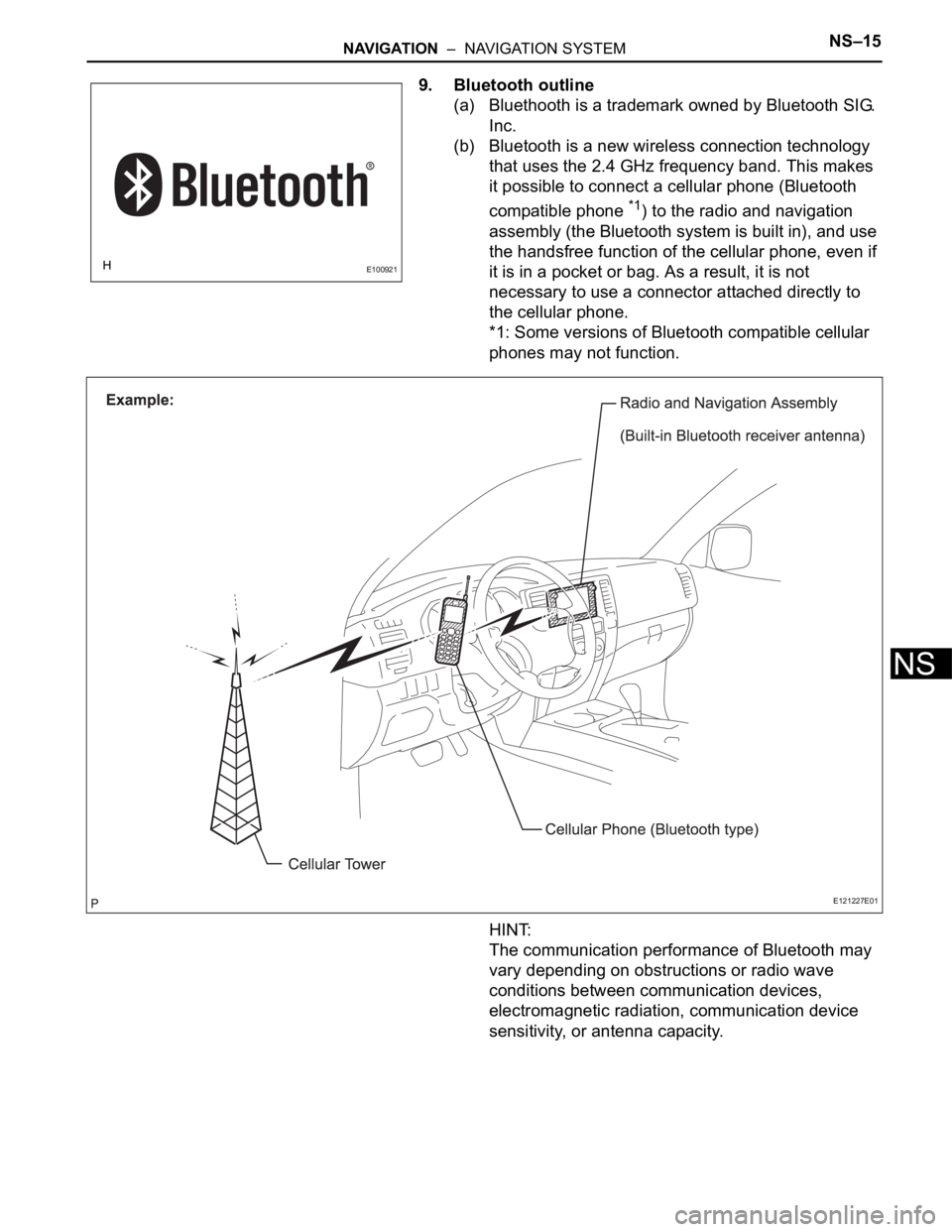
(b) Bluetooth is a new wireless connection technology
that uses the 2.4 GHz frequency band. This makes
it possible to connect a cellular phone (Bluetooth
compatible phone
*1) to the radio and navigation
assembly (the Bluetooth system is built in), and use
the handsfree function of the cellular phone, even if
it is in a pocket or bag. As a result, it is not
necessary to use a connector attached directly to
the cellular phone.
*1: Some versions of Bluetooth compatible cellular
phones may not function.
HINT:
The communication performance of Bluetooth may
vary depending on obstructions or radio wave
conditions between communication devices,
electromagnetic radiation, communication device
sensitivity, or antenna capacity.
E100921
E121227E01