engine TOYOTA SIENNA 2007 Service Repair Manual
[x] Cancel search | Manufacturer: TOYOTA, Model Year: 2007, Model line: SIENNA, Model: TOYOTA SIENNA 2007Pages: 3000, PDF Size: 52.26 MB
Page 1347 of 3000
2GR-FE CHARGING – CHARGING SYSTEMCH–7
CH
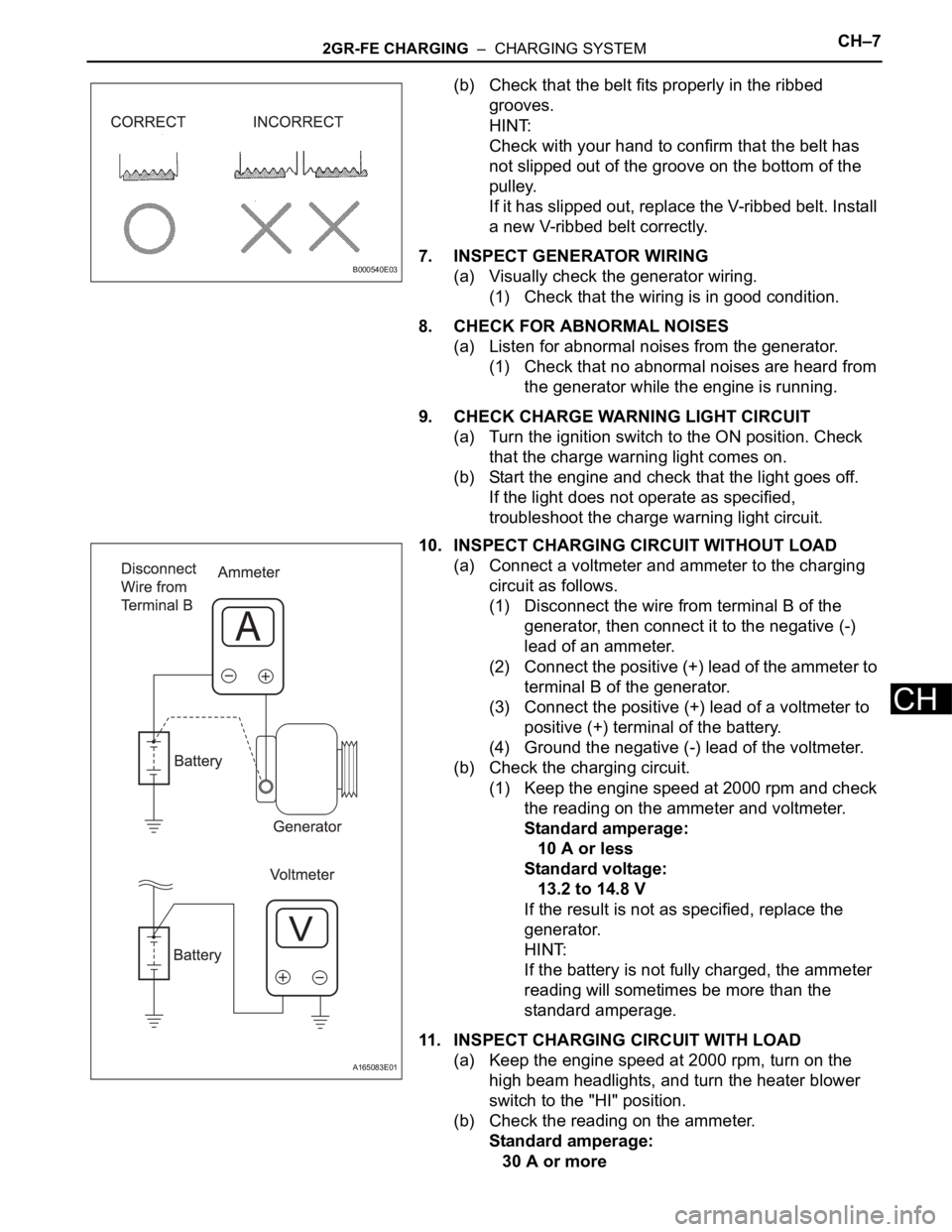
(b) Check that the belt fits properly in the ribbed
grooves.
HINT:
Check with your hand to confirm that the belt has
not slipped out of the groove on the bottom of the
pulley.
If it has slipped out, replace the V-ribbed belt. Install
a new V-ribbed belt correctly.
7. INSPECT GENERATOR WIRING
(a) Visually check the generator wiring.
(1) Check that the wiring is in good condition.
8. CHECK FOR ABNORMAL NOISES
(a) Listen for abnormal noises from the generator.
(1) Check that no abnormal noises are heard from
the generator while the engine is running.
9. CHECK CHARGE WARNING LIGHT CIRCUIT
(a) Turn the ignition switch to the ON position. Check
that the charge warning light comes on.
(b) Start the engine and check that the light goes off.
If the light does not operate as specified,
troubleshoot the charge warning light circuit.
10. INSPECT CHARGING CIRCUIT WITHOUT LOAD
(a) Connect a voltmeter and ammeter to the charging
circuit as follows.
(1) Disconnect the wire from terminal B of the
generator, then connect it to the negative (-)
lead of an ammeter.
(2) Connect the positive (+) lead of the ammeter to
terminal B of the generator.
(3) Connect the positive (+) lead of a voltmeter to
positive (+) terminal of the battery.
(4) Ground the negative (-) lead of the voltmeter.
(b) Check the charging circuit.
(1) Keep the engine speed at 2000 rpm and check
the reading on the ammeter and voltmeter.
Standard amperage:
10 A or less
Standard voltage:
13.2 to 14.8 V
If the result is not as specified, replace the
generator.
HINT:
If the battery is not fully charged, the ammeter
reading will sometimes be more than the
standard amperage.
11. INSPECT CHARGING CIRCUIT WITH LOAD
(a) Keep the engine speed at 2000 rpm, turn on the
high beam headlights, and turn the heater blower
switch to the "HI" position.
(b) Check the reading on the ammeter.
Standard amperage:
30 A or more
B000540E03
A165083E01
Page 1349 of 3000
2GR-FE CHARGING – CHARGING SYSTEMCH–9
CH
INSPECTION PROCEDURE
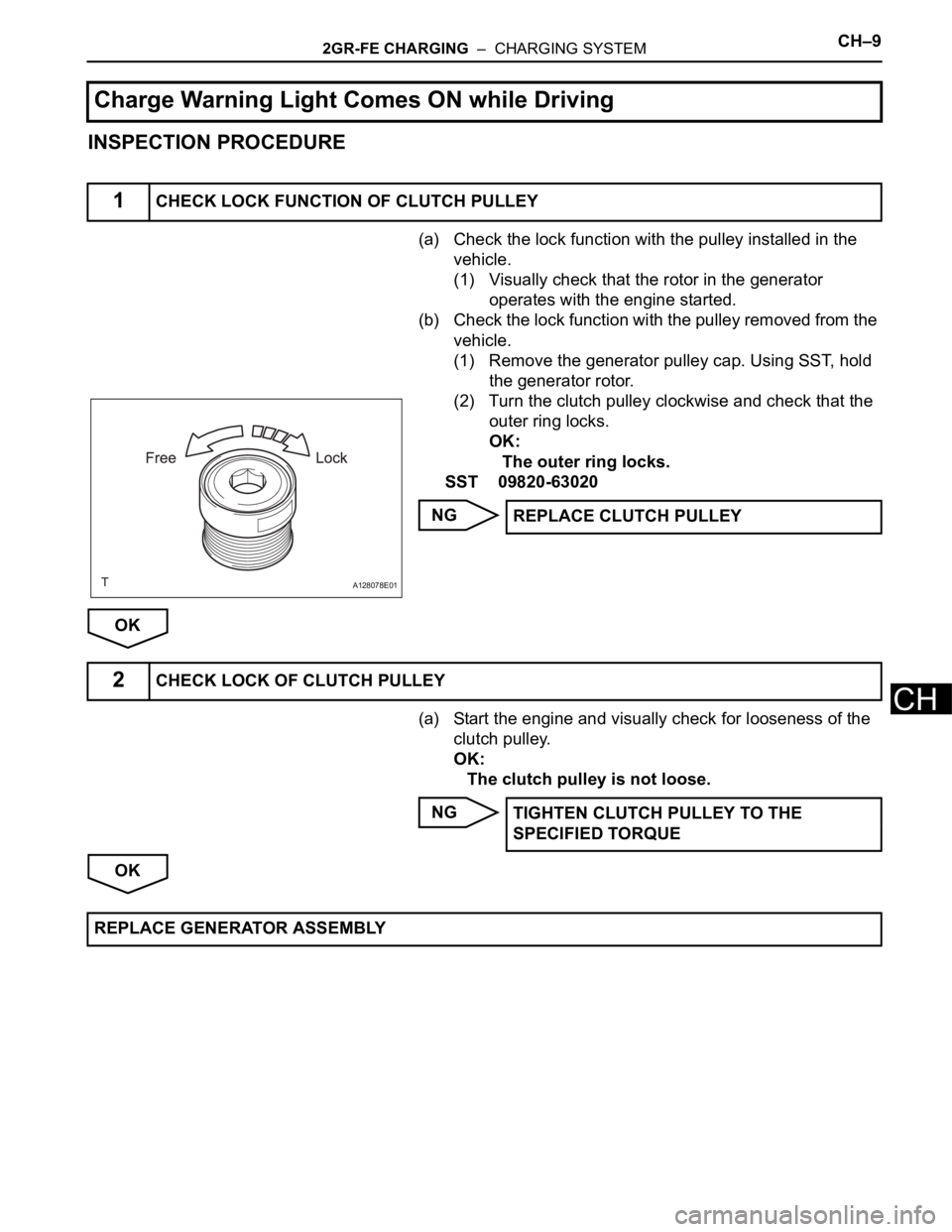
(a) Check the lock function with the pulley installed in the
vehicle.
(1) Visually check that the rotor in the generator
operates with the engine started.
(b) Check the lock function with the pulley removed from the
vehicle.
(1) Remove the generator pulley cap. Using SST, hold
the generator rotor.
(2) Turn the clutch pulley clockwise and check that the
outer ring locks.
OK:
The outer ring locks.
SST 09820-63020
NG
OK
(a) Start the engine and visually check for looseness of the
clutch pulley.
OK:
The clutch pulley is not loose.
NG
OK
Charge Warning Light Comes ON while Driving
1CHECK LOCK FUNCTION OF CLUTCH PULLEY
A128078E01
REPLACE CLUTCH PULLEY
2CHECK LOCK OF CLUTCH PULLEY
TIGHTEN CLUTCH PULLEY TO THE
SPECIFIED TORQUE
REPLACE GENERATOR ASSEMBLY
Page 1350 of 3000
CH–102GR-FE CHARGING – CHARGING SYSTEM
CH
INSPECTION PROCEDURE
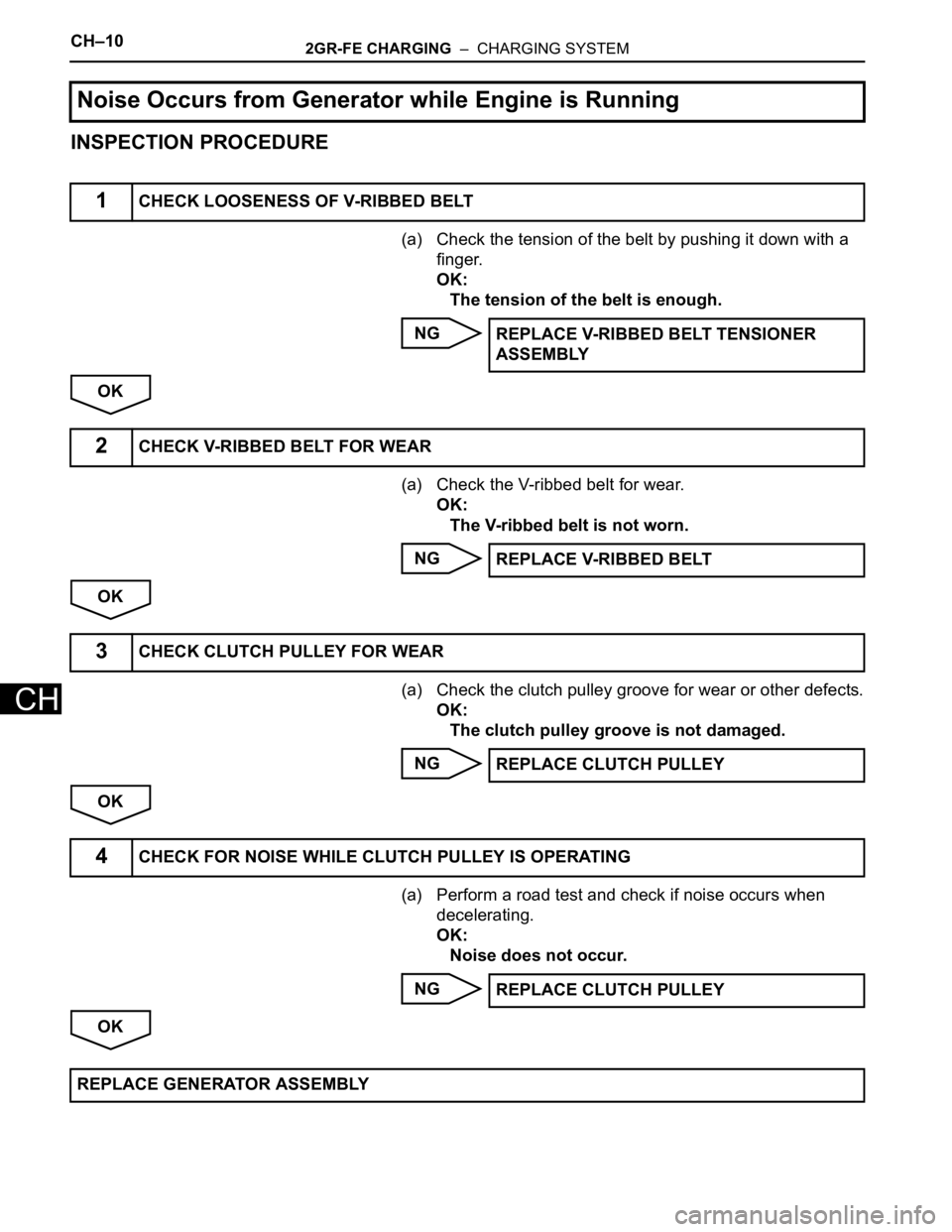
(a) Check the tension of the belt by pushing it down with a
finger.
OK:
The tension of the belt is enough.
NG
OK
(a) Check the V-ribbed belt for wear.
OK:
The V-ribbed belt is not worn.
NG
OK
(a) Check the clutch pulley groove for wear or other defects.
OK:
The clutch pulley groove is not damaged.
NG
OK
(a) Perform a road test and check if noise occurs when
decelerating.
OK:
Noise does not occur.
NG
OK
Noise Occurs from Generator while Engine is Running
1CHECK LOOSENESS OF V-RIBBED BELT
REPLACE V-RIBBED BELT TENSIONER
ASSEMBLY
2CHECK V-RIBBED BELT FOR WEAR
REPLACE V-RIBBED BELT
3CHECK CLUTCH PULLEY FOR WEAR
REPLACE CLUTCH PULLEY
4CHECK FOR NOISE WHILE CLUTCH PULLEY IS OPERATING
REPLACE CLUTCH PULLEY
REPLACE GENERATOR ASSEMBLY
Page 1351 of 3000
CH–162GR-FE CHARGING – GENERATOR
CH
REMOVAL
1. REMOVE V-BANK COVER SUB-ASSEMBLY (See
page EM-28)
2. REMOVE FRONT WHEEL RH
3. REMOVE NO. 1 ENGINE UNDER COVER (See page
EM-26)
4. REMOVE FRONT FENDER APRON SEAL RH (See
page EM-26)
5. DRAIN ENGINE COOLANT (See page CO-6)
6. REMOVE NO. 2 AIR CLEANER INLET (See page EM-
28)
7. REMOVE BATTERY (See page EM-26)
8. REMOVE FRONT BUMPER ASSEMBLY (See page
ET-3)
9. REMOVE FRONT BUMPER ENERGY ABSORBER
10. REMOVE NO. 1 AIR CLEANER INLET (See page EM-
28)
11. DISCONNECT RADIATOR RESERVE TANK HOSE OR
PIPE (See page CO-28)
12. DISCONNECT NO. 1 RADIATOR HOSE (See page CO-
28)
13. DISCONNECT NO. 2 RADIATOR HOSE (See page CO-
29)
14. REMOVE HOOD LOCK RELEASE LEVER
PROTECTOR (See page CO-29)
15. REMOVE HOOD LOCK ASSEMBLY (See page CO-29)
16. REMOVE HOOD LOCK SUPPORT SUB-ASSEMBLY
(See page CO-29)
17. DISCONNECT COOLING FAN ECU CONNECTOR
(See page CO-30)
18. REMOVE RADIATOR UPPER SUPPORT SUB-
ASSEMBLY (See page CO-30)
19. DISCONNECT NO. 2 OIL COOLER OUTLET TUBE
SUB-ASSEMBLY (See page CO-31)
20. REMOVE HEADLIGHT ASSEMBLY RH (See page LI-
69)
21. REMOVE RADIATOR SIDE DEFLECTOR RH (See
page CO-31)
22. REMOVE HEADLIGHT BRACKET RH (See page CO-
32)
23. REMOVE PRESSURE FEED TUBE ASSEMBLY (See
page CO-32)
Page 1356 of 3000
CH–162GR-FE CHARGING – GENERATOR
CH
REMOVAL
1. REMOVE V-BANK COVER SUB-ASSEMBLY (See
page EM-28)
2. REMOVE FRONT WHEEL RH
3. REMOVE NO. 1 ENGINE UNDER COVER (See page
EM-26)
4. REMOVE FRONT FENDER APRON SEAL RH (See
page EM-26)
5. DRAIN ENGINE COOLANT (See page CO-6)
6. REMOVE NO. 2 AIR CLEANER INLET (See page EM-
28)
7. REMOVE BATTERY (See page EM-26)
8. REMOVE FRONT BUMPER ASSEMBLY (See page
ET-3)
9. REMOVE FRONT BUMPER ENERGY ABSORBER
10. REMOVE NO. 1 AIR CLEANER INLET (See page EM-
28)
11. DISCONNECT RADIATOR RESERVE TANK HOSE OR
PIPE (See page CO-28)
12. DISCONNECT NO. 1 RADIATOR HOSE (See page CO-
28)
13. DISCONNECT NO. 2 RADIATOR HOSE (See page CO-
29)
14. REMOVE HOOD LOCK RELEASE LEVER
PROTECTOR (See page CO-29)
15. REMOVE HOOD LOCK ASSEMBLY (See page CO-29)
16. REMOVE HOOD LOCK SUPPORT SUB-ASSEMBLY
(See page CO-29)
17. DISCONNECT COOLING FAN ECU CONNECTOR
(See page CO-30)
18. REMOVE RADIATOR UPPER SUPPORT SUB-
ASSEMBLY (See page CO-30)
19. DISCONNECT NO. 2 OIL COOLER OUTLET TUBE
SUB-ASSEMBLY (See page CO-31)
20. REMOVE HEADLIGHT ASSEMBLY RH (See page LI-
69)
21. REMOVE RADIATOR SIDE DEFLECTOR RH (See
page CO-31)
22. REMOVE HEADLIGHT BRACKET RH (See page CO-
32)
23. REMOVE PRESSURE FEED TUBE ASSEMBLY (See
page CO-32)
Page 1369 of 3000
2GR-FE CHARGING – GENERATORCH–29
CH
18. CONNECT RADIATOR RESERVE TANK HOSE OR
PIPE (See page CO-44)
19. INSTALL NO. 1 AIR CLEANER INLET (See page EM-
59)
20. INSTALL FRONT BUMPER ENERGY ABSORBER
21. INSTALL FRONT BUMPER ASSEMBLY (See page ET-
9)
22. INSTALL BATTERY (See page EM-59)
23. INSTALL NO. 2 AIR CLEANER INLET (See page EM-
60)
24. ADD ENGINE COOLANT (See page CO-7)
25. INSPECT FOR COOLANT LEAK (See page CO-1)
26. ADD AUTOMATIC TRANSAXLE FLUID
27. CHECK AUTOMATIC TRANSAXLE FLUID (See page
AX-123)
28. INSTALL FRONT FENDER APRON SEAL RH (See
page EM-62)
29. INSTALL NO. 1 ENGINE UNDER COVER (See page
EM-63)
30. INSTALL FRONT WHEEL RH
Torque: 103 N*m (1050 kgf*cm, 76 ft.*lbf)
31. INSTALL V-BANK COVER SUB-ASSEMBLY (See
page EM-63)
32. VEHICLE PREPARATION FOR HEADLIGHT AIM
ADJUSTMENT (See page LI-71)
33. PREPARATION FOR HEADLIGHT AIMING (Using a
tester) (See page LI-71)
34. PREPARATION FOR HEADLIGHT AIMING (Using a
Screen) (See page LI-72)
35. HEADLIGHT AIMING INSPECTION (See page LI-74)
36. HEADLIGHT AIMING ADJUSTMENT (See page LI-75)
37. VEHICLE PREPARATION FOR FOG LIGHT AIM
ADJUSTMENT (w/ Fog Light) (See page LI-82)
38. PREPARATION FOR FOG LIGHT AIMING (Using a
Screen) (w/ Fog Light) (See page LI-83)
39. FOG LIGHT AIMING INSPECTION (w/ Fog Light) (See
page LI-74)
40. FOG LIGHT AIMING ADJUSTMENT (w/ Fog Light)
(See page LI-85)
Page 1378 of 3000
2GR-FE CHARGING – GENERATORCH–29
CH
18. CONNECT RADIATOR RESERVE TANK HOSE OR
PIPE (See page CO-44)
19. INSTALL NO. 1 AIR CLEANER INLET (See page EM-
59)
20. INSTALL FRONT BUMPER ENERGY ABSORBER
21. INSTALL FRONT BUMPER ASSEMBLY (See page ET-
9)
22. INSTALL BATTERY (See page EM-59)
23. INSTALL NO. 2 AIR CLEANER INLET (See page EM-
60)
24. ADD ENGINE COOLANT (See page CO-7)
25. INSPECT FOR COOLANT LEAK (See page CO-1)
26. ADD AUTOMATIC TRANSAXLE FLUID
27. CHECK AUTOMATIC TRANSAXLE FLUID (See page
AX-123)
28. INSTALL FRONT FENDER APRON SEAL RH (See
page EM-62)
29. INSTALL NO. 1 ENGINE UNDER COVER (See page
EM-63)
30. INSTALL FRONT WHEEL RH
Torque: 103 N*m (1050 kgf*cm, 76 ft.*lbf)
31. INSTALL V-BANK COVER SUB-ASSEMBLY (See
page EM-63)
32. VEHICLE PREPARATION FOR HEADLIGHT AIM
ADJUSTMENT (See page LI-71)
33. PREPARATION FOR HEADLIGHT AIMING (Using a
tester) (See page LI-71)
34. PREPARATION FOR HEADLIGHT AIMING (Using a
Screen) (See page LI-72)
35. HEADLIGHT AIMING INSPECTION (See page LI-74)
36. HEADLIGHT AIMING ADJUSTMENT (See page LI-75)
37. VEHICLE PREPARATION FOR FOG LIGHT AIM
ADJUSTMENT (w/ Fog Light) (See page LI-82)
38. PREPARATION FOR FOG LIGHT AIMING (Using a
Screen) (w/ Fog Light) (See page LI-83)
39. FOG LIGHT AIMING INSPECTION (w/ Fog Light) (See
page LI-74)
40. FOG LIGHT AIMING ADJUSTMENT (w/ Fog Light)
(See page LI-85)
Page 1380 of 3000

AX–6U151E AUTOMATIC TRANSAXLE – AUTOMATIC TRANSAXLE SYSTEM
AX
SYSTEM DESCRIPTION
1. SYSTEM DESCRIPTION
(a) The ECT (Electronic controlled automatic
transmission/transaxle) is an automatic
transmission/transaxle that electronically controls
shift timing using the ECM. The ECM detects
electrical signals that indicate engine and driving
conditions, and controls the shift point, based on
driver habits and road conditions. As a result, fuel
efficiency and power transmission performance are
improved.
Shift shock has been reduced by controlling the
engine and transmission simultaneously.
In addition, the ECT has features such as follows:
• Diagnostic function.
• Fail-safe function when a malfunction occurs.
Page 1387 of 3000
AX–10U151E AUTOMATIC TRANSAXLE – AUTOMATIC TRANSAXLE SYSTEM
AX
ROAD TEST
1. PROBLEM SYMPTOM CONFIRMATION
(a) Based on the result of the customer problem
analysis, try to reproduce the symptoms. If the
problem is that the transaxle does not shift up, shift
down, or the shift point is too high or too low,
conduct the following road test referring to the
automatic shift schedule and simulate the problem
symptoms.
2. ROAD TEST
NOTICE:
Perform the test at the ATF temperature 50 to 80
C
(122 to 176
F) in the normal operation.
(a) D position test:
Shift into the D position and fully depress the
accelerator pedal and check the following points.
(1) Check up-shift operation.
Check that 1
2, 2 3, 3 4 and 4 5th up-
shifts take place, and that the shift points
conform to the automatic shift schedule (See
page SS-24).
HINT:
5th Gear Up-shift Prohibition Control
• Engine coolant temperature is 55
C (131F)
or less and vehicle speed is at 80 km/h (176
mph) or less.
• ATF temperature is -2
C (28F) or less.
4th Gear Up-shift Prohibition Control
• Coolant temperature is 47
C (117F) or less
and vehicle speed is at 55 km/h (34 mph) or
less.
5th and 4th Gear Lock-up Prohibition Control
• Brake pedal is depressed.
• Accelerator pedal is released.
• Coolant temperature is 60
C (140F) or less.
(2) Check for shift shock and slip.
Check for shock and slip at the 1
2, 2 3, 3
4 and 4 5th up-shifts.
(3) Check for abnormal noise and vibration.
Drive in the D position lock-up or 5th gear, and
check for abnormal noises and vibration.
HINT:
The check for the cause of abnormal noise and
vibration must be done very thoroughly as it
could also be due to loss of balance in the
differential, torque converter clutch, etc.
(4) Check kick-down operation.
Check that the possible kick-down vehicle speed
limits for 2nd to 1st, 3rd to 2nd, 4th to 3rd, 5th to
4th kick-downs conform to those indicated on
the automatic shift schedule while driving
through all gears with the shift lever in the D
position (See page SS-24).
(5) Check abnormal shock and slip at kick-down.
Page 1388 of 3000
U151E AUTOMATIC TRANSAXLE – AUTOMATIC TRANSAXLE SYSTEMAX–11
AX
(6) Check the lock-up mechanism.
• Drive in D position (5th gear), at a steady
speed (lock-up ON).
• Lightly depress the accelerator pedal and
check that the engine speed does not change
abruptly.
HINT:
• There is no lock-up in the 1st and 2nd gear.
• 4th lock-up operates while uphill-downhill
control is active in D position.
• 3rd lock-up operates while uphill-downhill
control is active in D position.
• ATF temperature is 120
C (248F) or more.
• If there is a big jump in engine speed, there is
no lock-up.
(b) 4 (O/D OFF) position test:
Shift into the 4 position and fully depress the
accelerator pedal and check the following points.
(1) Check up-shift operation.
Check that the 1
2, 2 3 and 3 4 up-shift
take place and that the shift point conforms to
the automatic shift schedule (See page SS-24).
HINT:
There is no 5th up-shift in the 4 position.
(2) Check engine braking.
While driving in the 4 position and 4th gear,
release the accelerator pedal and check the
engine braking effect.
(3) Check for abnormal noise during acceleration
and deceleration, and for shock at up-shift and
down-shift.
(c) 3 position test:
Shift into the 3 position and fully depress the
accelerator pedal and check the following points.
(1) Check up-shift operation.
Check that the 1
2 and 2 3 up-shift take
place and that the shift point conforms to the
automatic shift schedule (See page SS-24).
HINT:
There is no 4th up-shift and lock-up in the 3
position.
(2) Check engine braking.
While running in the 3 position and 3rd gear,
release the accelerator pedal and check the
engine braking effect.
(3) Check for abnormal noise during acceleration
and deceleration, and for shock at up-shift and
down-shift.