engine TOYOTA SIENNA 2007 Service Repair Manual
[x] Cancel search | Manufacturer: TOYOTA, Model Year: 2007, Model line: SIENNA, Model: TOYOTA SIENNA 2007Pages: 3000, PDF Size: 52.26 MB
Page 1404 of 3000
AX–34U151E AUTOMATIC TRANSAXLE – AUTOMATIC TRANSAXLE SYSTEM
AX
CHECK MODE PROCEDURE
HINT:
Check mode has a higher sensitivity to malfunctions and can
detect malfunction that normal mode cannot detect. Check
mode can also detect all the malfunctions that normal mode
can detect. In check mode, DTCs are detected with 1-trip
detection logic.
1. DTC CHECK (CHECK MODE)
HINT:
Intelligent tester only: Compared to the normal mode, the
check mode is more sensitive for detecting malfunctions.
Furthermore, the same diagnostic items which are
detected in the normal mode can also be detected in the
check mode.
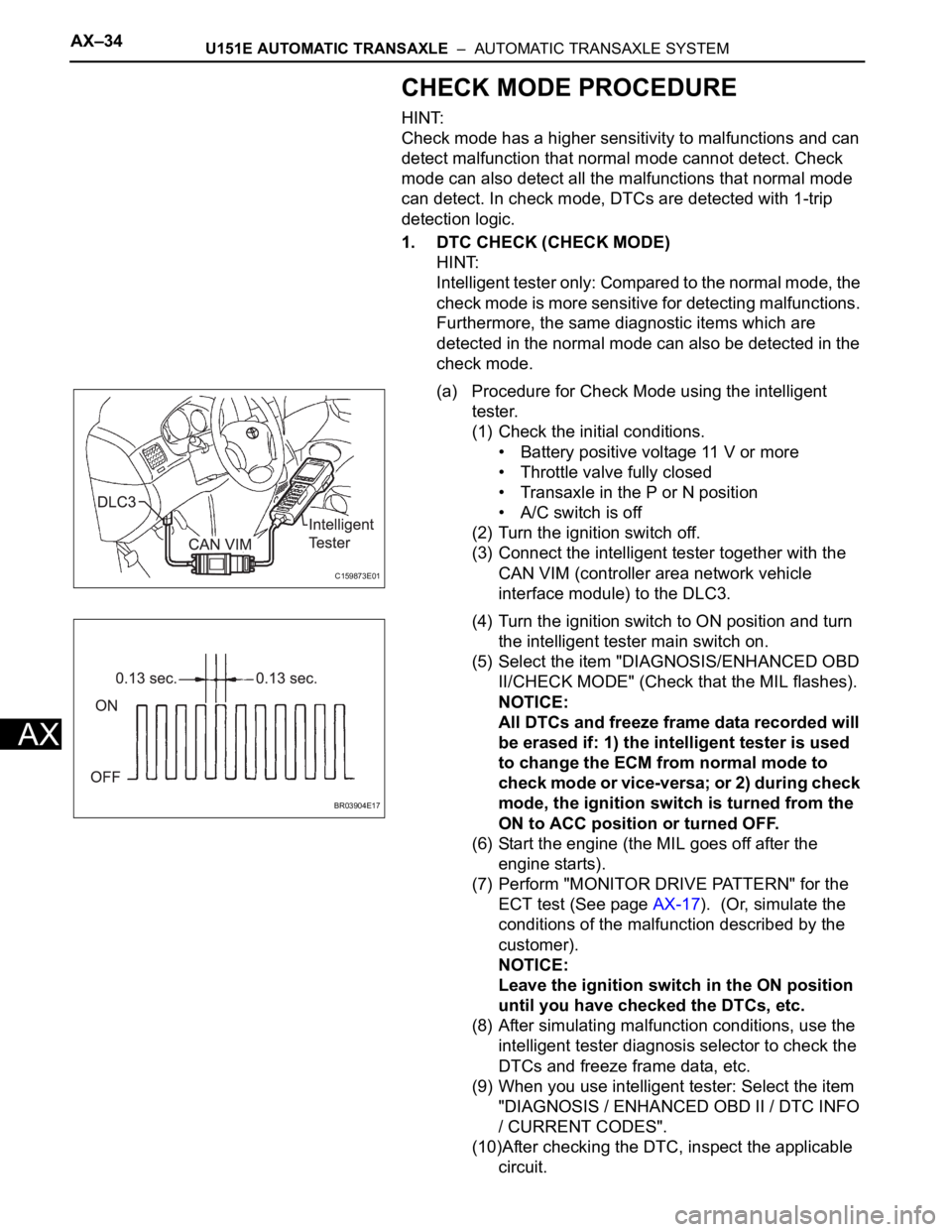
(a) Procedure for Check Mode using the intelligent
tester.
(1) Check the initial conditions.
• Battery positive voltage 11 V or more
• Throttle valve fully closed
• Transaxle in the P or N position
• A/C switch is off
(2) Turn the ignition switch off.
(3) Connect the intelligent tester together with the
CAN VIM (controller area network vehicle
interface module) to the DLC3.
(4) Turn the ignition switch to ON position and turn
the intelligent tester main switch on.
(5) Select the item "DIAGNOSIS/ENHANCED OBD
II/CHECK MODE" (Check that the MIL flashes).
NOTICE:
All DTCs and freeze frame data recorded will
be erased if: 1) the intelligent tester is used
to change the ECM from normal mode to
check mode or vice-versa; or 2) during check
mode, the ignition switch is turned from the
ON to ACC position or turned OFF.
(6) Start the engine (the MIL goes off after the
engine starts).
(7) Perform "MONITOR DRIVE PATTERN" for the
ECT test (See page AX-17). (Or, simulate the
conditions of the malfunction described by the
customer).
NOTICE:
Leave the ignition switch in the ON position
until you have checked the DTCs, etc.
(8) After simulating malfunction conditions, use the
intelligent tester diagnosis selector to check the
DTCs and freeze frame data, etc.
(9) When you use intelligent tester: Select the item
"DIAGNOSIS / ENHANCED OBD II / DTC INFO
/ CURRENT CODES".
(10)After checking the DTC, inspect the applicable
circuit.
C159873E01
BR03904E17
Page 1405 of 3000

U151E AUTOMATIC TRANSAXLE – AUTOMATIC TRANSAXLE SYSTEMAX–35
AX
(11)(See page AX-35) to confirm the details of the
DTCs.
2. DTC CLEAR
(a) When using the OBD II scan tool or intelligent
tester: Clearing the DTCs.
(1) Connect the intelligent tester together with the
CAN VIM (controller area network vehicle
interface module) to the DLC3.
(2) Turn the ignition switch to the ON position and
turn the OBD II scan tool or the intelligent tester
main switch on.
(3) When you use intelligent tester: Select the item
"DIAGNOSIS/ENHANCED OBD II/DTC INFO/
CLEAR CODES [YES] button".
HINT:
When operating the OBD II scan tool (complying
with SAE J1978) or intelligent tester to erase the
codes, the DTCs and freeze frame data will be
erased. (See the OBD II scan tool's instruction
book for operating instructions.)
(b) When not using the OBD II scan tool or intelligent
tester: Clearing the DTCs.
(1) Disconnect the battery cable or remove the EFI
and ETCS fuses from the engine room J/B for 60
seconds or more. However, if you disconnect the
battery cable, perform do the "INITIALIZE"
procedure.
Page 1406 of 3000

AX–36U151E AUTOMATIC TRANSAXLE – AUTOMATIC TRANSAXLE SYSTEM
AX
FAIL-SAFE CHART
1. FAIL-SAFE
This function minimizes the loss of the ECT functions
when any malfunction occurs in a sensor or solenoid.
(a) ATF (Automatic Transmission Fluid) temperature
sensor:
When the ATF temperature sensor has a
malfunction, 5th upshift is prohibited.
(b) Counter gear speed sensor NC (Speed sensor NC):
When the counter gear speed sensor has a
malfunction, 5th upshift is prohibited.
(c) Shift solenoid valve DSL:
When the solenoid valve DSL has a malfunction, the
current to the solenoid valve is stopped.
This stops lock-up control, then fuel economy
decreases.
(d) Shift solenoid valve SL1, SL2, SL3 and S4:
Fail safe function:
If either of the shift solenoid valve circuits develops
an open or short, the ECM turns the other shift
solenoid "ON" and "OFF" in order to shift into the
gear positions shown in the table below.
Manual shifting as shown in the following table must
be done (In case of a short circuit, the ECM stops
sending the current to the short circuited solenoid).
Even if starting the engine in the fail-safe mode, the
gear position remains in the same position.
HINT:
FL: Flex Lock-up
NormalSolenoid ValveSL1 ON OFF ON OFF OFF
SL2 ON ON OFF FL FL
SL3 OFF OFF OFF ON ON
S4 OFF OFF OFF OFF ON
Gear Position 1st 2nd 3rd 4th 5th
SL1
Malfunction
(During driving
at 1st or 2nd)Solenoid ValveSL1 OFF
SL2 ON ON OFF to ON FL to ON FL to ON
SL3 OFF OFF OFF ON to OFF ON to OFF
S4 OFF OFF OFF OFF ON to OFF
Gear Position 1st to 2nd 2nd 3rd to 2nd 4th to 2nd 5th to 2nd
SL1
Malfunction
(During driving
at 3rd)Solenoid ValveSL1 OFF
SL2 ON to FL ON to FL OFF to FL FL FL
SL3 OFF OFF OFF ON to OFF ON to OFF
S4 OFF to ON OFF to ON OFF to ON OFF to ON ON
Gear Position 1st to 4th 2nd to 4th 3rd to 4th 4th 5th to 4th
SL1
Malfunction
(During driving
at 4th or 5th)Solenoid ValveSL1 OFF
SL2 ON to FL ON to FL OFF to FL FL FL
SL3 OFF to ON OFF to ON OFF to ON ON ON
S4 OFF OFF OFF OFF ON
Gear Position 1st to 4th 2nd to 4th 3rd to 4th 4th 5th to 4th
Page 1411 of 3000

U151E AUTOMATIC TRANSAXLE – AUTOMATIC TRANSAXLE SYSTEMAX–45
AX
DESCRIPTION
The park/neutral position switch detects the shift lever position and sends signals to the ECM.
MONITOR DESCRIPTION
These DTCs indicate a problem with the park/neutral position switch and the wire harness in the park/
neutral position switch circuit.
The park/neutral position switch detects the shift lever position and sends a signal to the ECM.
For security, the park/neutral position switch detects the shift lever position so that engine can be started
only when the shift lever is in the P or N position
The park/neutral position switch sends a signal to the ECM according to the shift position (P, R, N or D).
The ECM determines that there is a problem with the switch or related parts if in receives more than 1
position signal simultaneously. The ECM will turn on the MIL and store the DTC.
MONITOR STRATEGY
DTC P0705Transmission Range Sensor Circuit Malfunc-
tion (PRNDL Input)
DTC No. DTC Detection Condition Trouble Area
P0705(A) Any 2 or more signals of the following are ON
simultaneously (2-trip detection logic)
• P input signal is ON.
• N input signal is ON.
• R input signal is ON.
• D input signal is ON.
• 3 input signal is ON.
• 2 input signal is ON.
(B) Any 2 or more signals of the following are ON
simultaneously (2-trip detection logic)
• NSW (STAR) input signal is ON.
• R input signal is ON.
• D input signal is ON.
• 3 input signal is ON.
• 2 input signal is ON.
(C) All switches are OFF simultaneously for NSW
(STAR), P, R, N, D, 3, 2 positions (2-trip detection
logic).
(D) Both 1 and 2 conditions are met (2-trip detection
logic)
1. One of the following conditions are met
(a) NSW (STAR) input signal is ON.
(b) P input signal is ON.
(c) N input signal is ON.
(d) R input signal is ON.
2. One of the following conditions are met
(a) 4 input signal is ON.
(b) L input signal is ON.• Short in park/neutral position switch circuit
• Park/neutral position switch
•ECM
Related DTCs P0705: Park/neutral position switch/Verify switch input
Required sensors/Components Park/neutral position switch
Frequency of operation Continuous
DurationCondition (A), (B), (D)
2 sec.
Condition (C)
60 sec.
MIL operation 2 driving cycles
Sequence of operation None
Page 1417 of 3000

U151E AUTOMATIC TRANSAXLE – AUTOMATIC TRANSAXLE SYSTEMAX–51
AX
MONITOR DESCRIPTION
These DTCs indicate an open or short in the automatic transmission fluid (ATF) temperature sensor (TFT
sensor) circuit. The automatic transmission fluid (ATF) temperature sensor converts ATF temperature to
an electrical resistance value. Based on the resistance, the ECM determines the ATF temperature, and
the ECM detects an opens or shorts in the ATF temperature circuit. If the resistance value of the ATF
temperature is less than 79
*1or more than 156 k *2, the ECM interprets this as a fault in the ATF
sensor or wiring. The ECM will turn on the MIL and store the DTC.
*1: 150
C (302F) or more is indicated regardless of the actual ATF temperature.
*2: -40
C (-40F) is indicated regardless of the actual ATF temperature.
HINT:
The ATF temperature can be checked on the OBD II scan tool or intelligent tester display.
MONITOR STRATEGY
TYPICAL ENABLING CONDITIONS
P0710: Range check (Chattering)
P0712: Range check (Low resistance)
P0713: Range check (High resistance)
TYPICAL MALFUNCTION THRESHOLDS
P0710: Range check (Chattering)
P0712: Range check (Low resistance)
P0713: Range check (High resistance)
P0712ATF temperature sensor resistance is less than 79
for 0.5 sec. or more (1-trip detection logic)• Short in ATF temperature sensor circuit
• Transmission wire (ATF temperature sensor)
•ECM
P0713ATF temperature sensor resistance is more than 156
k
when 15 minutes or more have elapsed after the
engine start
DTC is detected for 0.5 sec. or more (1-trip detection
logic)• Open in ATF temperature sensor circuit
• Transmission wire (ATF temperature sensor)
•ECM
Related DTCsP0710: ATF temperature sensor/Range check (Chattering)
P0712: ATF temperature sensor/Range check (Low resistance)
P0713: ATF temperature sensor/Range check (High resistance)
Required sensors/Components ATF temperature sensor (TFT sensor)
Frequency of operation Continuous
Duration 0.5 sec.
MIL operation Immediate
Sequence of operation None
The monitor will run whenever these DTCs are not present. None
The typical enabling condition is not available. -
The monitor will run whenever this DTC is not present. None
Time after engine start 15 min. or more
TFT (Transmission fluid temperature) sensor resistanceLess than 79
or
More than 156 k
TFT sensor resistanceLess than 79
TFT sensor resistance More than 156 k
DTC No. DTC Detection Condition Trouble Area
Page 1418 of 3000

AX–52U151E AUTOMATIC TRANSAXLE – AUTOMATIC TRANSAXLE SYSTEM
AX
COMPONENT OPERATING RANGE
WIRING DIAGRAM
INSPECTION PROCEDURE
HINT:
Using the intelligent tester to read the DATA LIST allows the values or states of switches, sensors,
actuators and other items to be read without removing any parts. This non-intrusive inspection can be
very useful because intermittent conditions or signals may be discovered before parts or wiring is
disturbed. Reading the DATA LIST information early in troubleshooting is one way to save diagnostic time.
NOTICE:
In the table below, the value listed under "Normal Condition" are reference values. Do not depend
solely on these reference values when deciding whether apart is faulty or not.
1. READ DATA LIST
(a) Warm up the engine.
(b) Turn the ignition switch off.
(c) Connect the intelligent tester together with the CAN VIM (controller area network vehicle
interface module) to the DLC3.
(d) Turn the ignition switch to the ON position.
(e) Turn on the tester.
(f) Select the item "DIAGNOSIS / ENHANCED OBD II / DATA LIST".
(g) According to the display on the tester, read the "DATA LIST".
HINT:
When DTC P0712 is output and OBD II scan tool or intelligent tester output is 150
C (302F),
there is a short circuit.
When DTC P0713 is output and OBD II scan tool or intelligent tester output is -40
C (-40F),
there is an open circuit.
TFT sensor. Atmospheric temperature to approx. 130C (266F)
Tester Display Measurement Item/Range Normal Condition Diagnostic Note
A/T OIL TEMP 1AT F Te m p . S e n s o r Va l u e /
min.: -40
C (-40F)
max.: 215
C (419F)• After Stall Test;
Approx. 80
C (176F)
• Equal to ambient temperature
when cold soakIf the value is "-40
C (-40F)" or
"215
C (419F)", ATF temp.
sensor circuit is opened or
shorted.
G039665E07
Page 1421 of 3000

U151E AUTOMATIC TRANSAXLE – AUTOMATIC TRANSAXLE SYSTEMAX–55
AX
DESCRIPTION
The ATF (Automatic Transmission Fluid) temperature sensor converts the fluid temperature into a
resistance value which is input into the ECM.
MONITOR DESCRIPTION
The ATF temperature sensor converts the ATF temperature to an electrical resistance value. Based on
the resistance, the ECM determines the ATF temperature and detects an open or short in the ATF
temperature circuit or a fault in the ATF temperature sensor.
After running the vehicle for a certain period, the ATF temperature should increase. If the ATF
temperature is below 20
C (68F) after running the vehicle for a certain period, the ECM interprets this as
a fault, and turns on the MIL.
When the ATF temperature is 110
C (230F) or more after 17 minutes of engine cold start, the ECM also
determines this as a fault, turns on the MIL, and stores the DTC.
MONITOR STRATEGY
TYPICAL ENABLING CONDITIONS
All:
Condition (A):
Condition (B):
DTC P0711Transmission Fluid Temperature Sensor "A"
Performance
DTC No. DTC Detection Condition Trouble Area
P0711(A) Both (a) and (b) are detected: (2-trip detection logic)
(a) Intake air and engine coolant temperatures are
more than -10
C (14F) at engine start
(b) After normal driving for over 19 min. and 9 km (6
mile) or more, ATF temp. is less than 20
C (68F)
(B) When engine coolant temp. is less than 35
C (95F)
at engine start, the ATF temp. is 110C (230F) or more
after 17 min. of engine start (2-trip detection logic).Transmission wire (ATF temperature sensor)
Related DTCs P0711: ATF temperature sensor/Rationality check
Required sensors/Components ATF temperature sensor (TFT sensor)
Frequency of operation Continuous
Duration3 sec.: Condition (A), (B), (C)
Continuous.: Condition (D)
MIL operation 2 driving cycles
Sequence of operation None
The monitor will run whenever this DTC is not present. None
TFT sensor circuitNot circuit malfunction
ECT sensor circuitNot circuit malfunction
IAT sensor circuitNot circuit malfunction
ETCSNot circuit malfunction
Time after engine start 18 min. and 20 sec.
Driving distance after engine start 9 km (5.6 mile) or more
IAT (Intake air temperature) (12 sec. after starting engine) -10
C (14F) or more
ECT (12 sec. after starting engine) -10
C (14F) or more
Time after engine start 30 min.
Driving distance after engine start 15 km (9.3 mile) or more
Page 1422 of 3000
AX–56U151E AUTOMATIC TRANSAXLE – AUTOMATIC TRANSAXLE SYSTEM
AX
Condition (C):
Condition (D):
TYPICAL MALFUNCTION THRESHOLDS
Condition (A), (B), (C):
Condition (D):
COMPONENT OPERATING RANGE
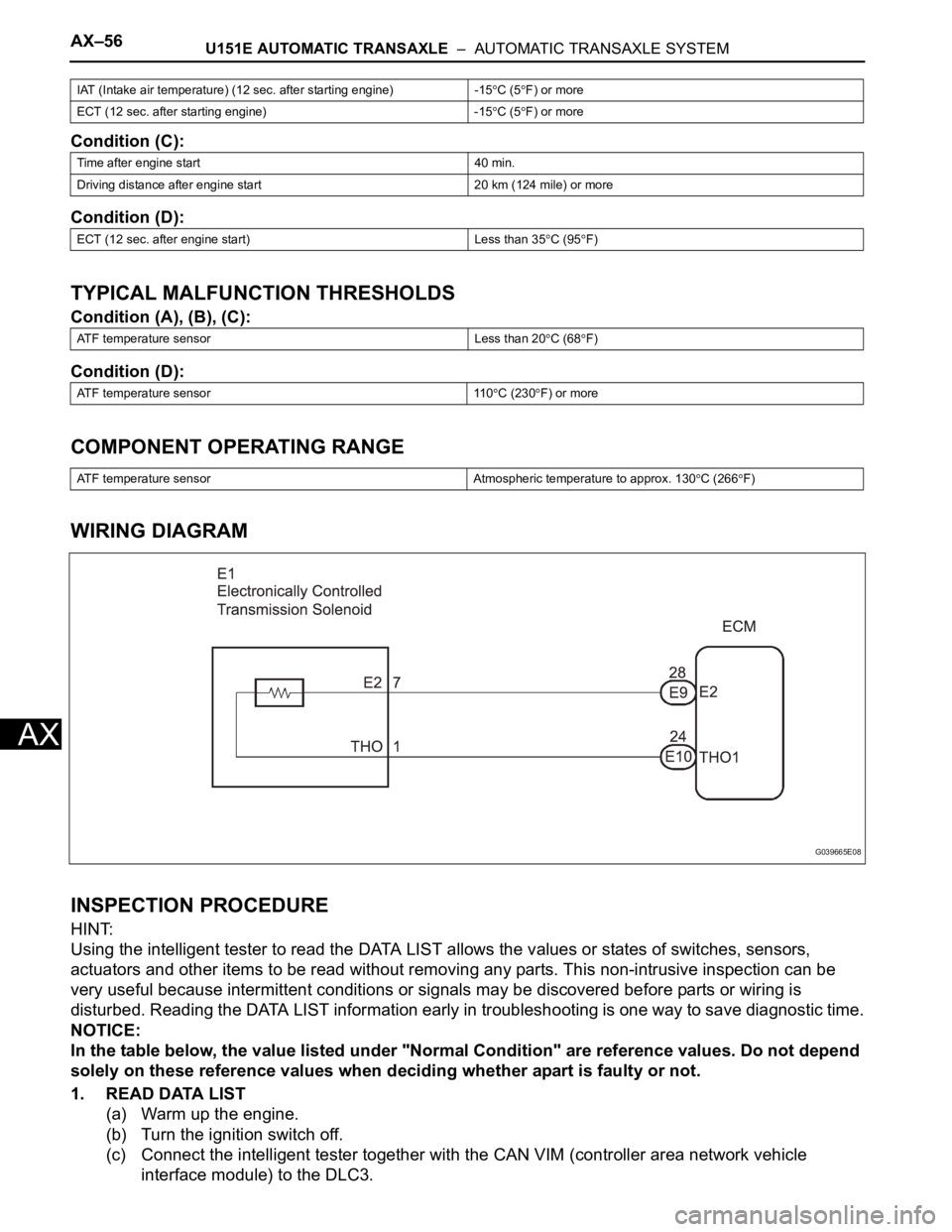
WIRING DIAGRAM
INSPECTION PROCEDURE
HINT:
Using the intelligent tester to read the DATA LIST allows the values or states of switches, sensors,
actuators and other items to be read without removing any parts. This non-intrusive inspection can be
very useful because intermittent conditions or signals may be discovered before parts or wiring is
disturbed. Reading the DATA LIST information early in troubleshooting is one way to save diagnostic time.
NOTICE:
In the table below, the value listed under "Normal Condition" are reference values. Do not depend
solely on these reference values when deciding whether apart is faulty or not.
1. READ DATA LIST
(a) Warm up the engine.
(b) Turn the ignition switch off.
(c) Connect the intelligent tester together with the CAN VIM (controller area network vehicle
interface module) to the DLC3.
IAT (Intake air temperature) (12 sec. after starting engine) -15C (5F) or more
ECT (12 sec. after starting engine) -15
C (5F) or more
Time after engine start 40 min.
Driving distance after engine start 20 km (124 mile) or more
ECT (12 sec. after engine start) Less than 35
C (95F)
ATF temperature sensor Less than 20
C (68F)
ATF temperature sensor 110
C (230F) or more
ATF temperature sensor Atmospheric temperature to approx. 130
C (266F)
G039665E08
Page 1425 of 3000
U151E AUTOMATIC TRANSAXLE – AUTOMATIC TRANSAXLE SYSTEMAX–59
AX
DESCRIPTION
This sensor detects the rotation speed of the input turbine. By comparing the input turbine speed signal
(NT) with the counter gear speed sensor signal (NC), the ECM detects the shift timing of the gears and
appropriately controls the engine torque and hydraulic pressure according to various conditions. Thus,
providing smooth gear shift.
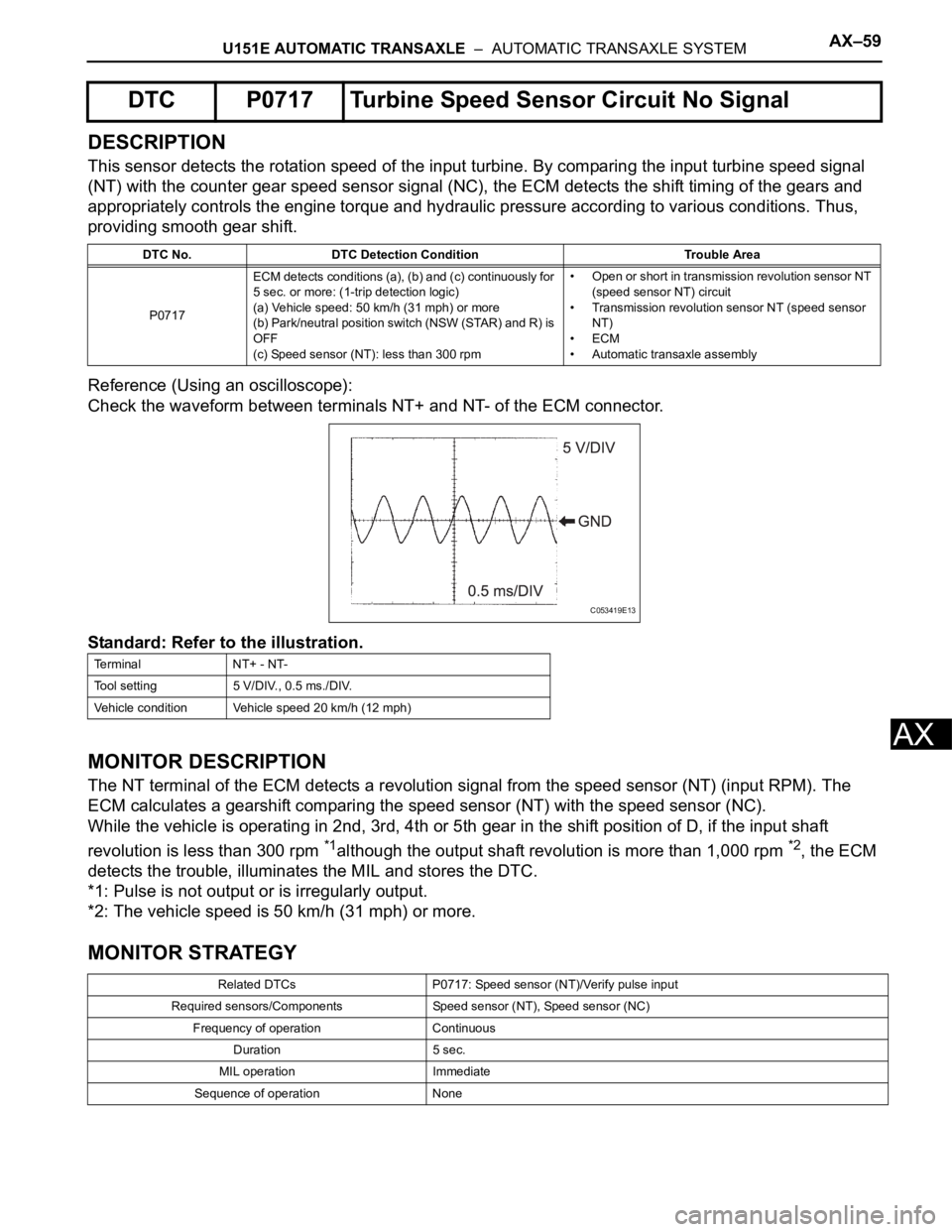
Reference (Using an oscilloscope):
Check the waveform between terminals NT+ and NT- of the ECM connector.
Standard: Refer to the illustration.
MONITOR DESCRIPTION
The NT terminal of the ECM detects a revolution signal from the speed sensor (NT) (input RPM). The
ECM calculates a gearshift comparing the speed sensor (NT) with the speed sensor (NC).
While the vehicle is operating in 2nd, 3rd, 4th or 5th gear in the shift position of D, if the input shaft
revolution is less than 300 rpm
*1although the output shaft revolution is more than 1,000 rpm *2, the ECM
detects the trouble, illuminates the MIL and stores the DTC.
*1: Pulse is not output or is irregularly output.
*2: The vehicle speed is 50 km/h (31 mph) or more.
MONITOR STRATEGY
DTC P0717 Turbine Speed Sensor Circuit No Signal
DTC No. DTC Detection Condition Trouble Area
P0717ECM detects conditions (a), (b) and (c) continuously for
5 sec. or more: (1-trip detection logic)
(a) Vehicle speed: 50 km/h (31 mph) or more
(b) Park/neutral position switch (NSW (STAR) and R) is
OFF
(c) Speed sensor (NT): less than 300 rpm• Open or short in transmission revolution sensor NT
(speed sensor NT) circuit
• Transmission revolution sensor NT (speed sensor
NT)
•ECM
• Automatic transaxle assembly
Te r m i n a l N T + - N T -
Tool setting 5 V/DIV., 0.5 ms./DIV.
Vehicle condition Vehicle speed 20 km/h (12 mph)
Related DTCs P0717: Speed sensor (NT)/Verify pulse input
Required sensors/Components Speed sensor (NT), Speed sensor (NC)
Frequency of operation Continuous
Duration 5 sec.
MIL operation Immediate
Sequence of operation None
C053419E13
Page 1426 of 3000
AX–60U151E AUTOMATIC TRANSAXLE – AUTOMATIC TRANSAXLE SYSTEM
AX
TYPICAL ENABLING CONDITIONS
TYPICAL MALFUNCTION THRESHOLDS
COMPONENT OPERATING RANGE
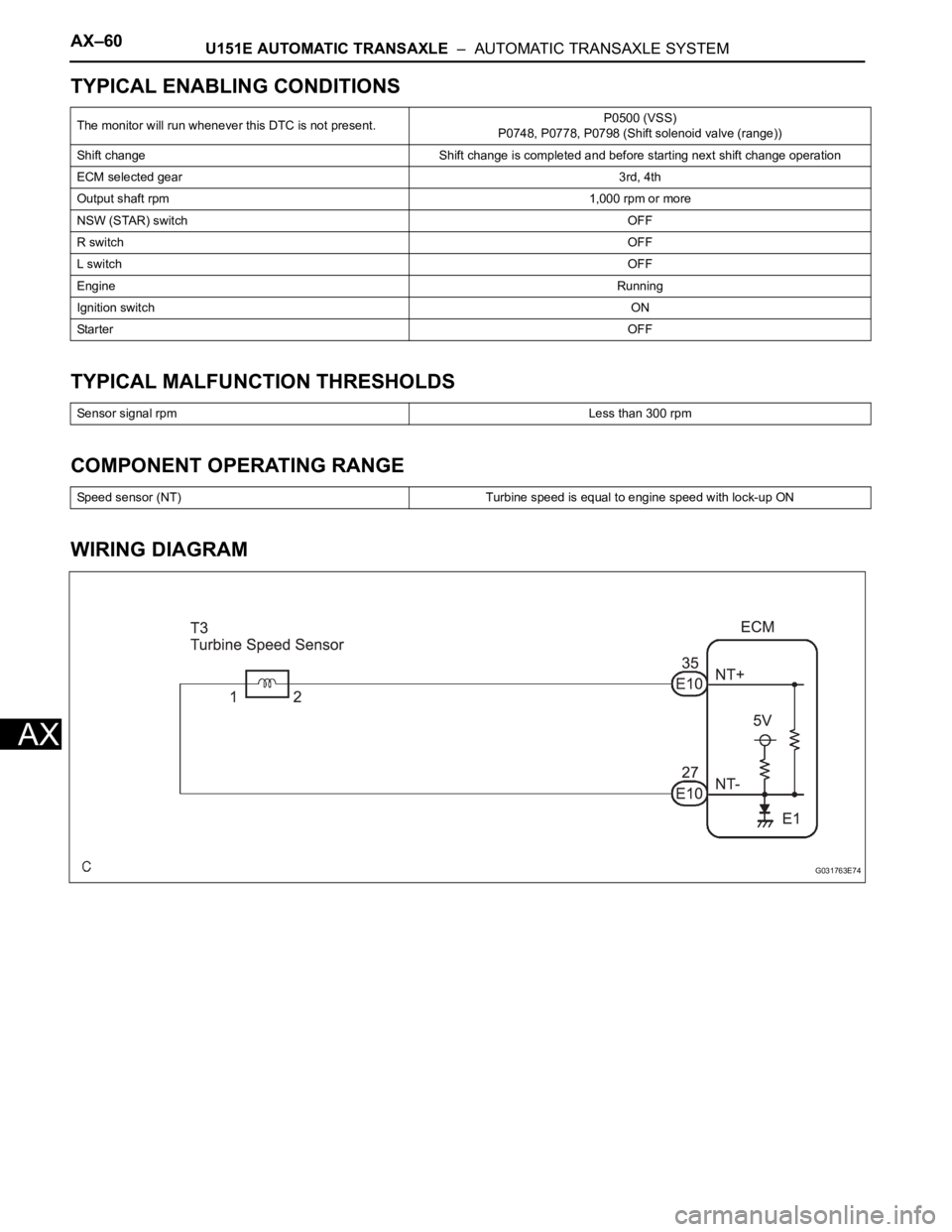
WIRING DIAGRAM
The monitor will run whenever this DTC is not present.P0500 (VSS)
P0748, P0778, P0798 (Shift solenoid valve (range))
Shift change Shift change is completed and before starting next shift change operation
ECM selected gear3rd, 4th
Output shaft rpm1,000 rpm or more
NSW (STAR) switchOFF
R switchOFF
L switchOFF
EngineRunning
Ignition switchON
StarterOFF
Sensor signal rpmLess than 300 rpm
Speed sensor (NT) Turbine speed is equal to engine speed with lock-up ON
G031763E74