height TOYOTA SIENNA 2018 Owners Manual (in English)
[x] Cancel search | Manufacturer: TOYOTA, Model Year: 2018, Model line: SIENNA, Model: TOYOTA SIENNA 2018Pages: 584, PDF Size: 14.47 MB
Page 33 of 584
331-1. For safe use
SIENNA_OM_OM08019U_(U)
1
For safety and security
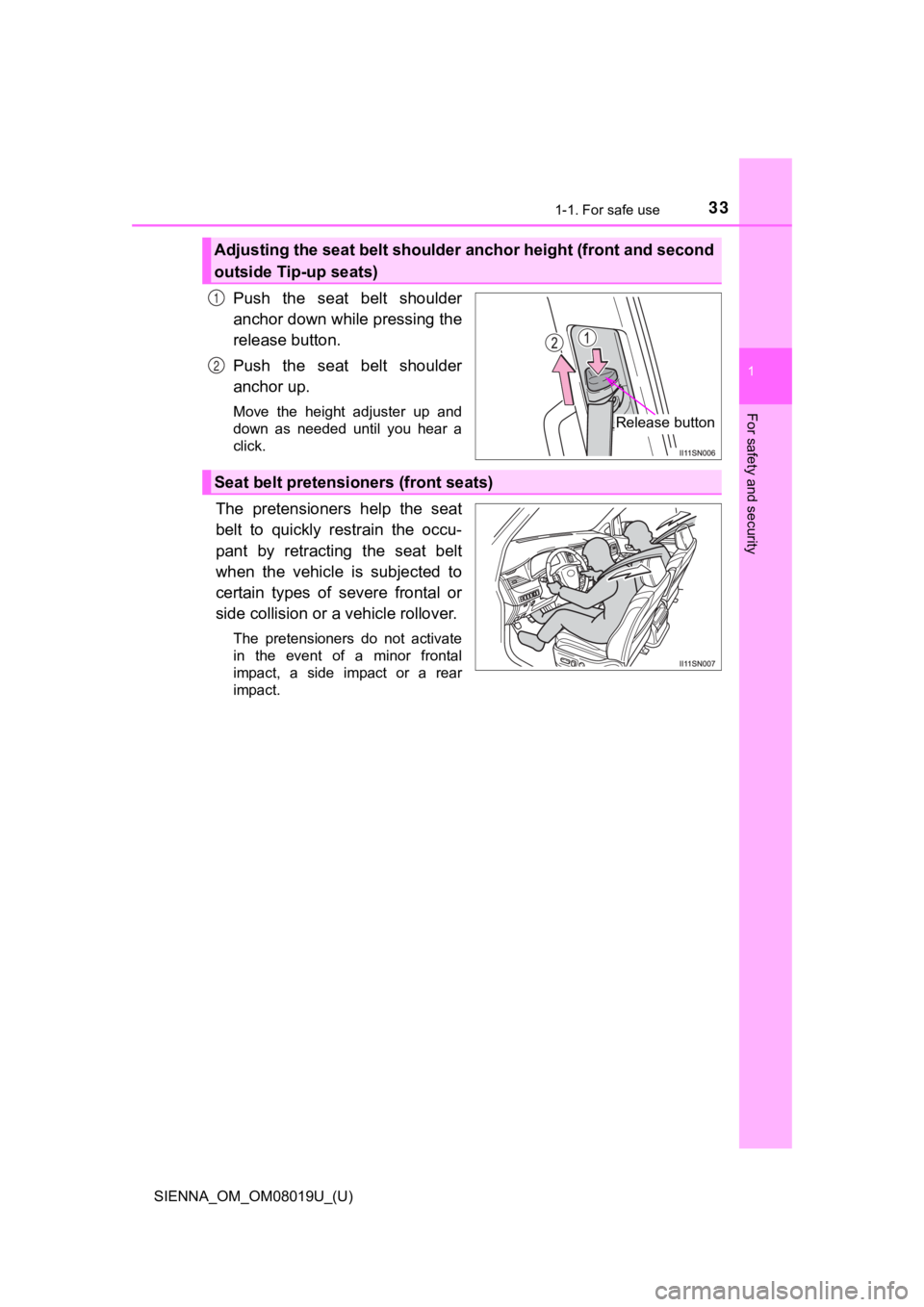
Push the seat belt shoulder
anchor down while pressing the
release button.
Push the seat belt shoulder
anchor up.
Move the height adjuster up and
down as needed until you hear a
click.
The pretensioners help the seat
belt to quickly restrain the occu-
pant by retracting the seat belt
when the vehicle is subjected to
certain types of severe frontal or
side collision or a vehicle rollover.
The pretensioners do not activate
in the event of a minor frontal
impact, a side impact or a rear
impact.
Adjusting the seat belt shoulder anchor height (front and second
outside Tip-up seats)
Release button
1
2
Seat belt pretensioners (front seats)
Page 149 of 584
149
SIENNA_OM_OM08019U_(U)
3-3. Adjusting the seats
3
Operation of each component
Front seats
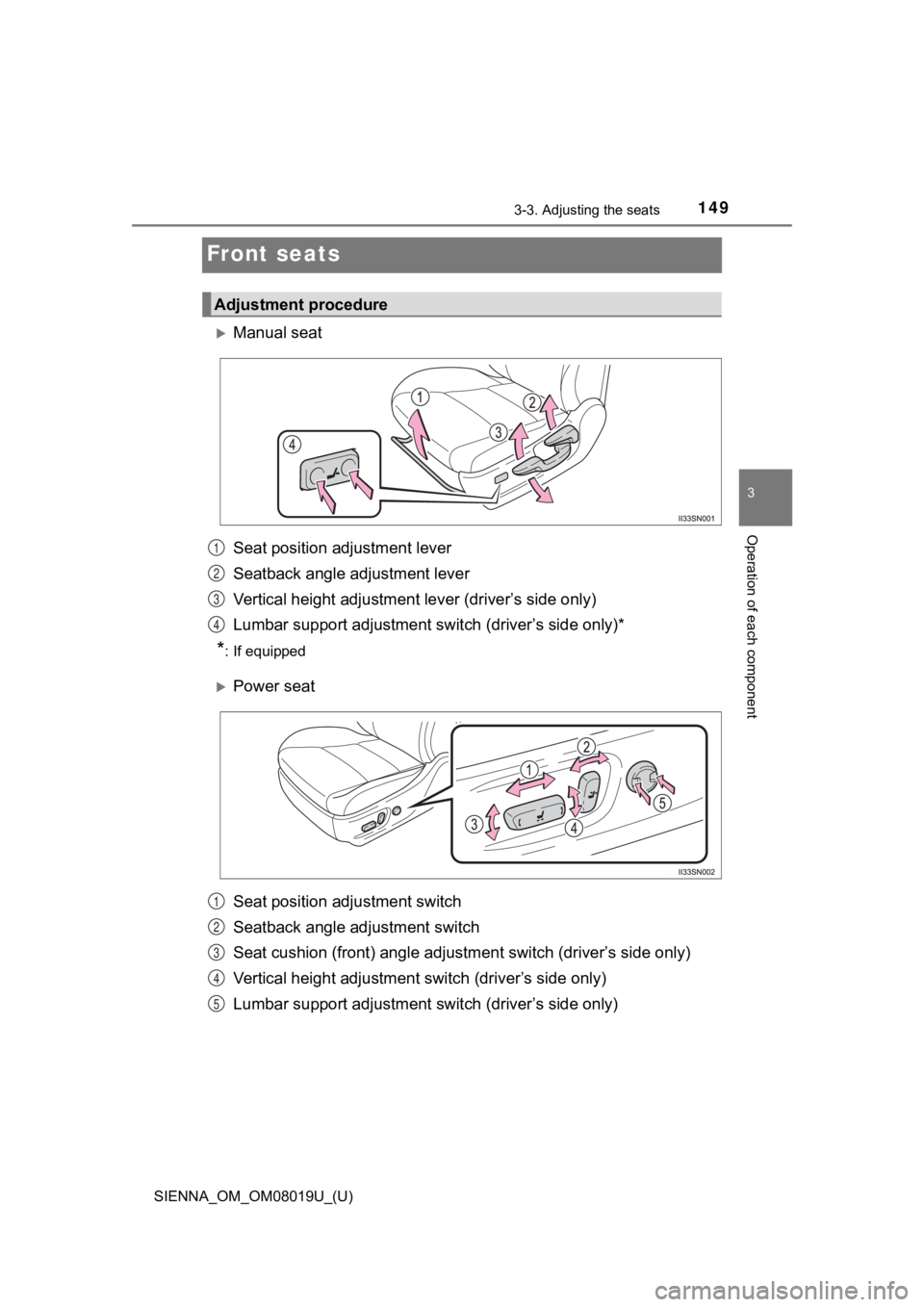
Manual seat
Seat position adjustment lever
Seatback angle adjustment lever
Vertical height adjustment lever (driver’s side only)
Lumbar support adjustment swi tch (driver’s side only)*
*: If equipped
Power seat
Seat position adjustment switch
Seatback angle adj ustment switch
Seat cushion (front) angle adjus tment switch (driver’s side only)
Vertical height adjustment sw itch (driver’s side only)
Lumbar support adjustment s witch (driver’s side only)
Adjustment procedure
1
2
3
4
1
2
3
4
5
Page 175 of 584
SIENNA_OM_OM08019U_(U)
1753-3. Adjusting the seats
3
Operation of each component
■Installing the head restraints
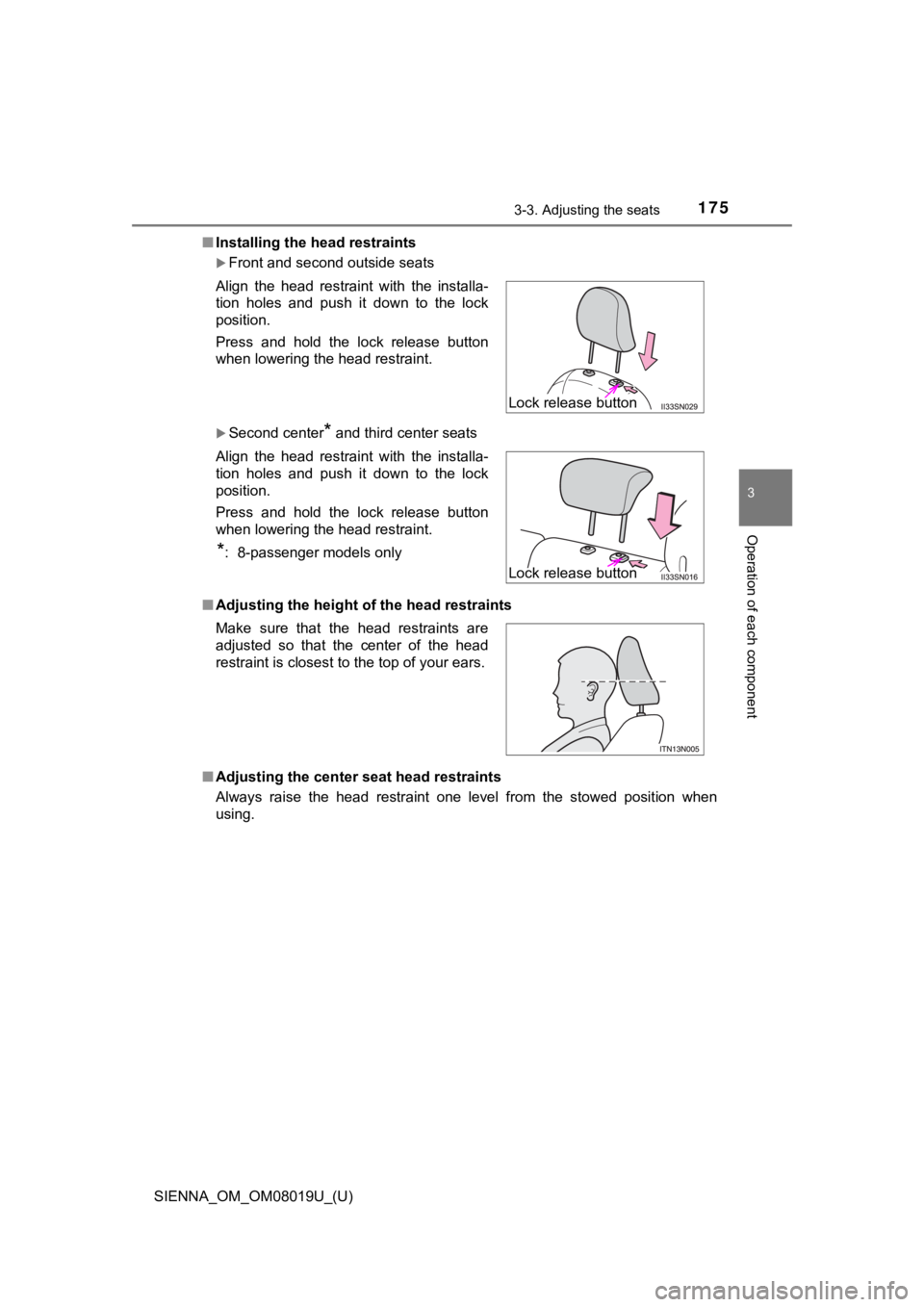
Front and second outside seats
Second center* and third center seats
■ Adjusting the height o f the head restraints
■ Adjusting the center seat head restraints
Always raise the head restraint one level from the stowed posit ion when
using. Align the head restraint with the installa-
tion holes and push it down to the lock
position.
Press and hold the lock release button
when lowering the head restraint.
Align the head restraint with the installa-
tion holes and push it down to the lock
position.
Press and hold the lock release button
when lowering the head restraint.
*: 8-passenger models only
Make sure that the head restraints are
adjusted so that the center of the head
restraint is closest to the top of your ears.
Lock release button
Lock release button
Page 179 of 584
1793-4. Adjusting the steering wheel and mirrors
3
Operation of each component
SIENNA_OM_OM08019U_(U)
Inside rear view mirror
The height of the rear view mirror can be adjusted to suit your driving
posture.
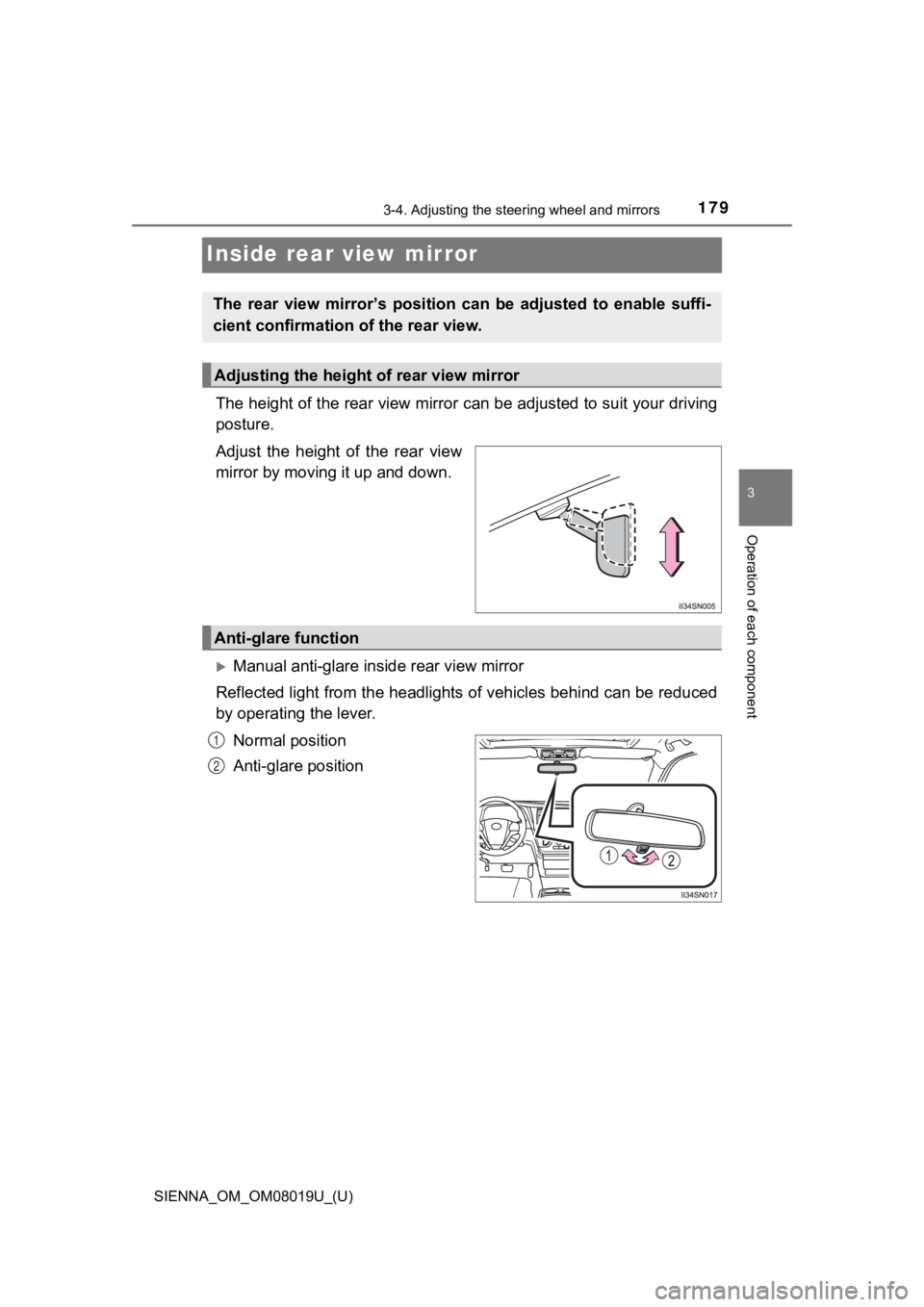
Adjust the height of the rear view
mirror by moving it up and down.
Manual anti-glare inside rear view mirror
Reflected light from the headlights of vehicles behind can be r educed
by operating the lever.
Normal position
Anti-glare position
The rear view mirror’s position ca n be adjusted to enable suffi-
cient confirmation of the rear view.
Adjusting the height of rear view mirror
Anti-glare function
1
2
Page 220 of 584
220
SIENNA_OM_OM08019U_(U)
4-1. Before driving
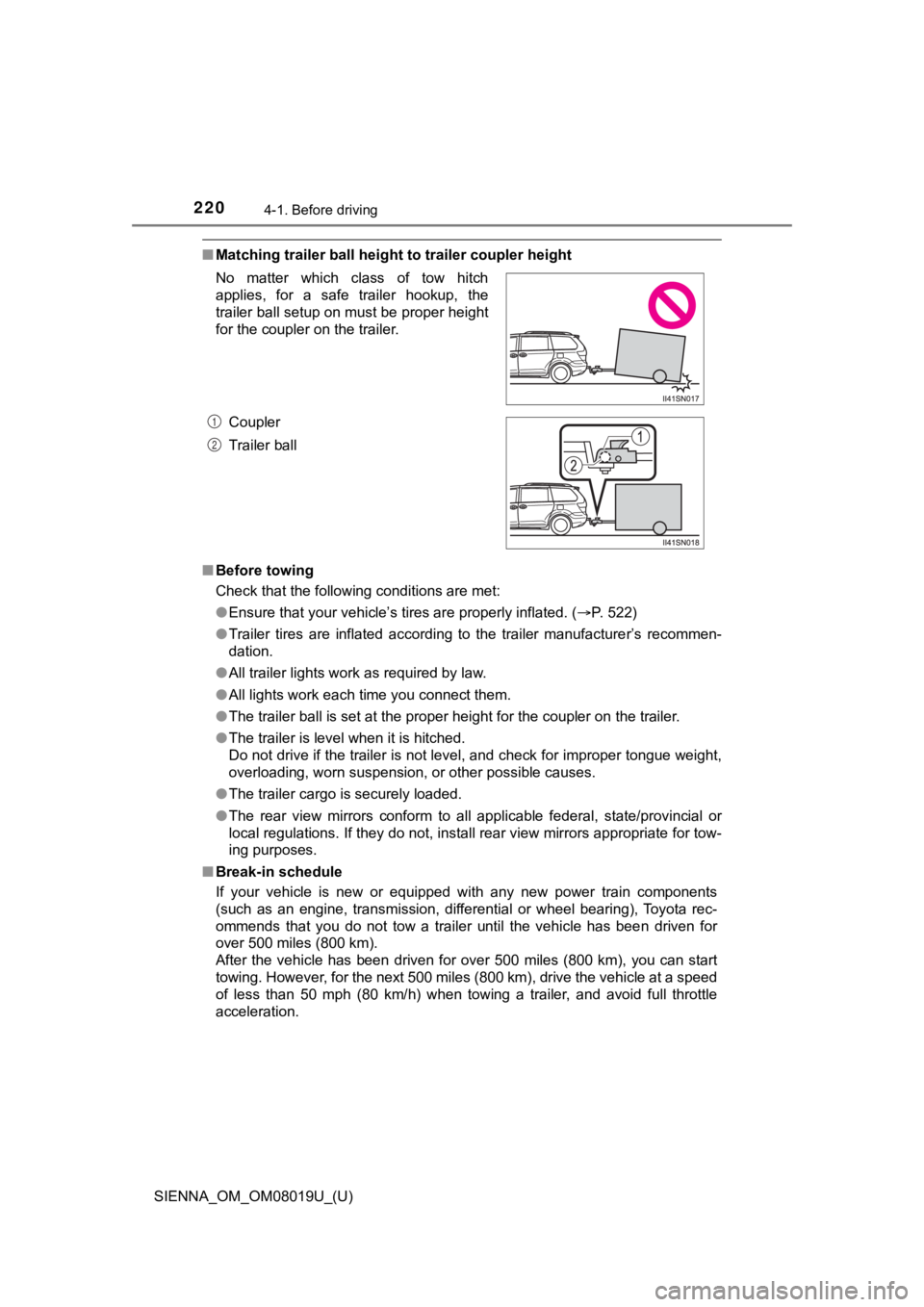
■Matching trailer ball height to trailer coupler height
■ Before towing
Check that the following conditions are met:
●Ensure that your vehicle’s tires are properly inflated. ( P. 522)
● Trailer tires are inflated according to the trailer manufacture r’s recommen-
dation.
● All trailer lights work as required by law.
● All lights work each time you connect them.
● The trailer ball is set at the proper height for the coupler on the trailer.
● The trailer is level when it is hitched.
Do not drive if the trailer is not level, and check for imprope r tongue weight,
overloading, worn suspension, or other possible causes.
● The trailer cargo is securely loaded.
● The rear view mirrors conform to all applicable federal, state/provincial or
local regulations. If they do not, install rear view mirrors ap propriate for tow-
ing purposes.
■ Break-in schedule
If your vehicle is new or equipped with any new power train com ponents
(such as an engine, transmission, differential or wheel bearing ), Toyota rec-
ommends that you do not tow a trailer until the vehicle has bee n driven for
over 500 miles (800 km).
After the vehicle has been driven for over 500 miles (800 km), you can start
towing. However, for the next 500 miles (800 km), drive the veh icle at a speed
of less than 50 mph (80 km/h) when towing a trailer, and avoid full throttle
acceleration. No matter which class of tow hitch
applies, for a safe trailer hookup, the
trailer ball setup on must be proper height
for the coupler on the trailer.
Coupler
Trailer ball
1
2
Page 308 of 584

308
SIENNA_OM_OM08019U_(U)
4-5. Using the driving support systems
■Conditions under which the BSM function may not function correc tly
● The BSM function may not detect vehicles correctly in the following condi-
tions:
• When the sensor is misaligned due to a strong impact to the se nsor or its
surrounding area
• When mud, snow, ice, a sticker, etc. is covering the sensor or surround-
ing area on the rear bumper
• When driving on a road surface that is wet with standing water during bad
weather, such as heavy rain, snow, or fog
• When multiple vehicles approach with only a small gap between each vehicle
• When there is a significant difference in speed between your v ehicle and
the vehicle that enters the detection area
• When a vehicle is in the detection area from a stop and remains in the detection area as your vehicle accelerates
• When towing a trailer
• When the vehicle that enters the detection area is traveling a t about the
same speed as your vehicle
• When driving up or down consecutive steep inclines, such as hills, a dip in the road etc.
• When driving on roads with sharp bends, consecutive curves, or uneven
surfaces
• When vehicle lanes are wide, and the vehicle in the next lane is too far
away from your vehicle
• When there is a significant difference in height between your vehicle and
the vehicle that enters the detection area
• Directly after the BSM function is turned on
• When items such as a bicycle carrier are installed on the rear of the vehi-
cle
Page 487 of 584
4877-2. Steps to take in an emergency
SIENNA_OM_OM08019U_(U)
7
When trouble arises
WARNING
■Using the tire jack
Observe the following precautions.
Improper use of the tire jack may cause the vehicle to suddenly fall off
the jack, leading to death or serious injury.
●Do not use the tire jack for any purpose other than replacing t ires or
installing and removing tire chains.
●Only use the tire jack that comes with this vehicle for replacing a flat
tire. Do not use it on other vehicles, and do not use other tir e jacks for
replacing tires on this vehicle.
●Put the jack properl y in its jack point.
●Do not put any part of your body under the vehicle while it is supported
by the jack.
●Do not start or run the engine while your vehicle is supported by the
jack.
●Do not raise the vehicle w hile someone is inside.
●When raising the vehicle, do not put an object on or under the jack.
●Do not raise the vehicle to a height greater than that required to
replace the tire.
●Use a jack stand if it is nece ssary to get under the vehicle.
●When lowering the vehicle, make sure that there is no-one near the
vehicle. If there are people nearb y, warn them vocally before lowering.
Page 500 of 584
5007-2. Steps to take in an emergency
SIENNA_OM_OM08019U_(U)
NOTICE
■When replacing the tires
When removing or fitting the wheels, tires or the tire pressure warning
valve and transmitter, contact your Toyota dealer as the tire p ressure
warning valve and transmitter may be damaged if not handled cor rectly.
■When driving over bumps
If a vehicle has a flat tire, the vehicle height will be lower than usual.
Ensure that nothing strikes the bottom of the vehicle.
■To avoid damaging the tire pressure warning valves and transmit -
ters
When a tire is repaired with liqui d sealants, the tire pressure warning
valve and transmitter may not operate properly. If a liquid sea lant is
used, contact your Toyota dealer or other qualified service shop as soon
as possible. Make sure to replac e the tire pressure warning valve and
transmitter when replacing the tire. ( P. 4 2 1 )
Page 516 of 584
516
SIENNA_OM_OM08019U_(U)
8-1. Specifications
Maintenance data (fuel, oil level, etc.)
*1: Unladen vehicle
*2: The model code is indicated on the Certification Label. For details, see“Vehicle identification” below.
*3: The towing package is required.Toyota does not recommend towing with this vehicle without the towing
package.
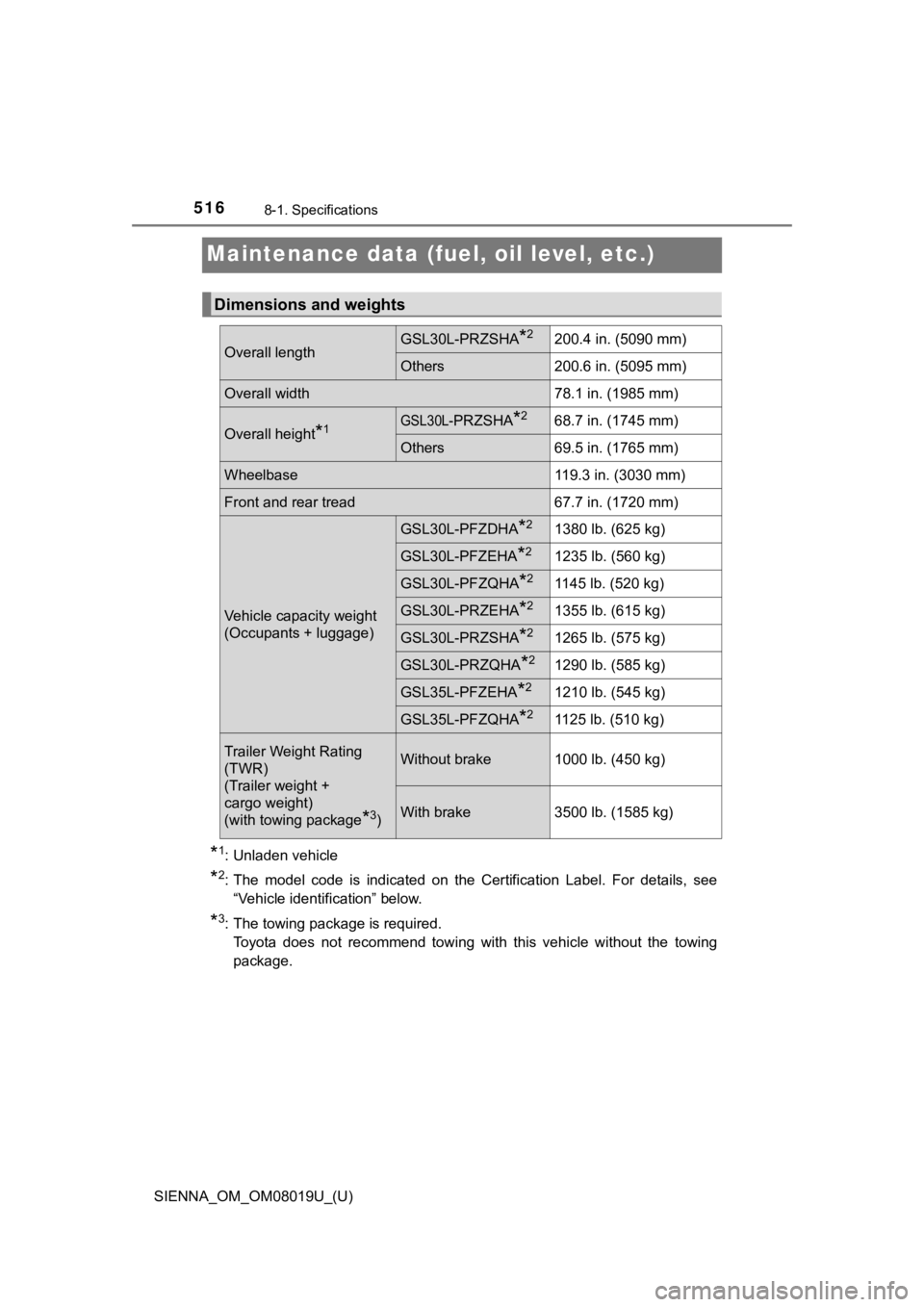
Dimensions and weights
Overall lengthGSL30L-PRZSHA*2200.4 in. (5090 mm)
Others 200.6 in. (5095 mm)
Overall width 78.1 in. (1985 mm)
Overall height*1GSL30L-PRZSHA*268.7 in. (1745 mm)
Others69.5 in. (1765 mm)
Wheelbase 119.3 in. (3030 mm)
Front and rear tread 67.7 in. (1720 mm)
Vehicle capacity weight
(Occupants + luggage)
GSL30L-PFZDHA*21380 lb. (625 kg)
GSL30L-PFZEHA*21235 lb. (560 kg)
GSL30L-PFZQHA*21145 lb. (520 kg)
GSL30L-PRZEHA*21355 lb. (615 kg)
GSL30L-PRZSHA*21265 lb. (575 kg)
GSL30L-PRZQHA*21290 lb. (585 kg)
GSL35L-PFZEHA*21210 lb. (545 kg)
GSL35L-PFZQHA*21125 lb. (510 kg)
Trailer Weight Rating
(TWR)
(Trailer weight +
cargo weight)
(with towing package
*3)
Without brake 1000 lb. (450 kg)
With brake3500 lb. (1585 kg)
Page 532 of 584
532
SIENNA_OM_OM08019U_(U)
8-1. Specifications
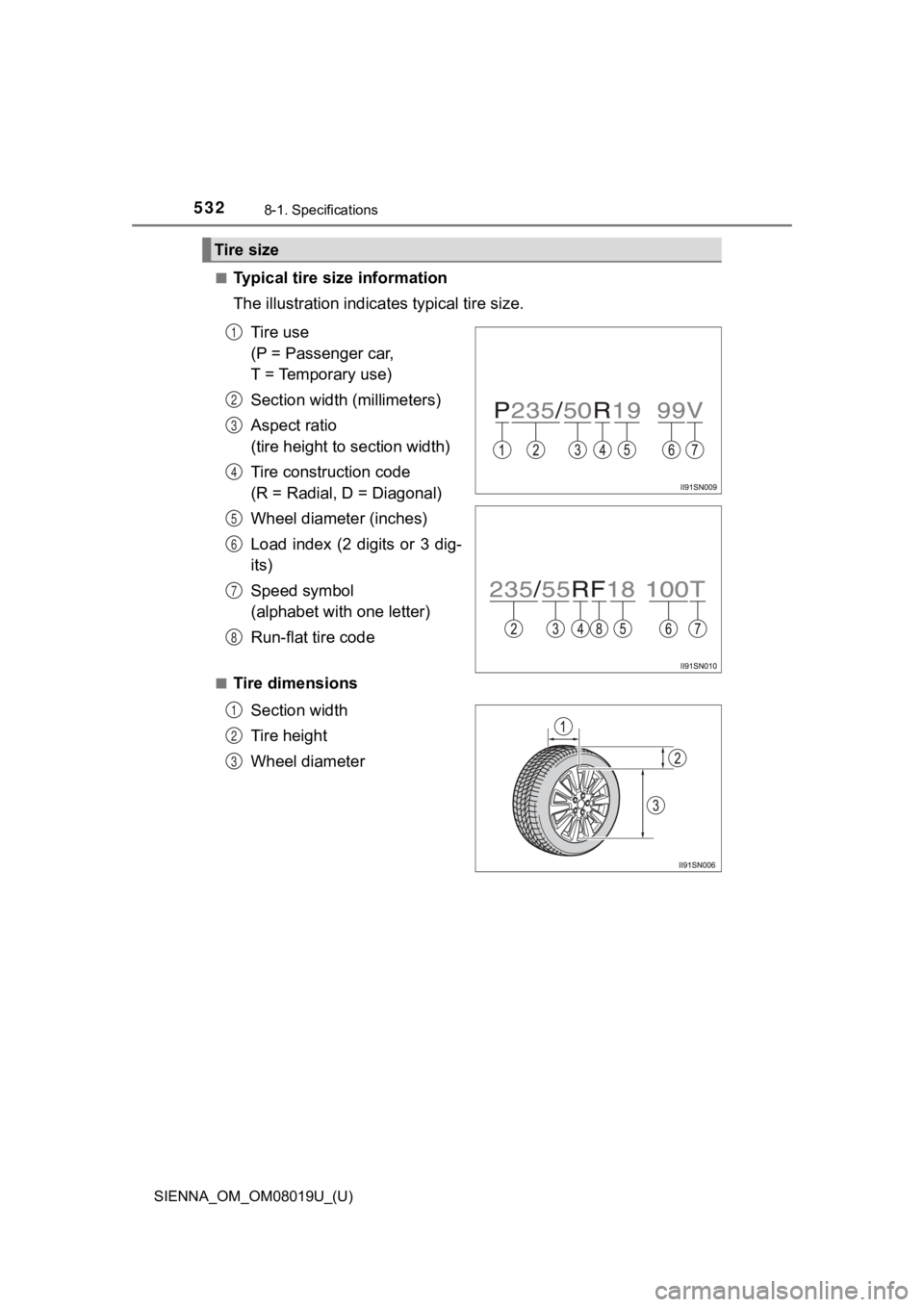
■Typical tire size information
The illustration indicates typical tire size.
■Tire dimensions
Section width
Tire height
Wheel diameter
Tire size
Tire use
(P = Passenger car,
T = Temporary use)
Section widt h (millimeters)
Aspect ratio
(tire height to section width)
Tire construction code
(R = Radial, D = Diagonal)
Wheel diameter (inches)
Load index (2 digits or 3 dig-
its)
Speed symbol
(alphabet with one letter)
Run-flat tire code1
2
3
4
5
6
7
8
1
2
3