fuel pressure TOYOTA SIENNA HYBRID 2021 (in English) User Guide
[x] Cancel search | Manufacturer: TOYOTA, Model Year: 2021, Model line: SIENNA HYBRID, Model: TOYOTA SIENNA HYBRID 2021Pages: 601, PDF Size: 32.07 MB
Page 440 of 601

4396-3. Do-it-yourself maintenance
6
Maintenance and care
Do not forget to check the spare.
■Effects of incorrect tire inflation
pressure
Driving with incorrect tire inflation
pressure may result in the following:
●Reduced fuel economy
●Reduced driving comfort and poor
handling
●Reduced tire life due to wear
●Reduced safety
●Damage to the drive train
If a tire needs frequent inflating,
have it checked b y your Toyota
dealer.
■Instructions for checking tire
inflation pressure
When checking tire inflation pres-
sure, observe the following:
●Check only when the tires are
cold.
If your vehicle has been parked
for at least 3 hours or has not
been driven for more than 1 mile
or 1.5 km, you will get an accurate
cold tire inflation pressure reading.
●Always use a tire pressure gauge.
It is difficult to judge if a tire is
properly inflated based only on its
appearance.
●It is normal for the tire inflation
pressure to be higher after driving
as heat is generated in the tire. Do
not reduce tire inflation pressure
after driving.
●Never exceed the vehicle capacity
weight. Passengers and luggage
weight should be placed so that
the vehicle is balanced.
WARNING
■Proper inflation is critical to
save tire performance
Keep your tires properly inflated.
If the tires are not properly
inflated, the following conditions
may occur which could lead to an
accident resulting in death or seri-
ous injury:
●Excessive wear
●Uneven wear
●Poor handling
●Possibility of blowouts resulting
from overheated tires
●Air leaking from between tire
and wheel
●Wheel deformation and/or tire
damage
●Greater possibi lity of tire dam-
age while driving (due to road
hazards, expansion joints,
sharp edges in the road, etc.)
NOTICE
■When inspecting and adjust-
ing tire inflation pressure
Be sure to put the tire valve caps
back on.
If a valve cap is no t installed, dirt
or moisture may get into the valve
and cause an air leak, resulting in
decreased tire inflation pressure.
Page 473 of 601
4727-2. Steps to take in an emergency
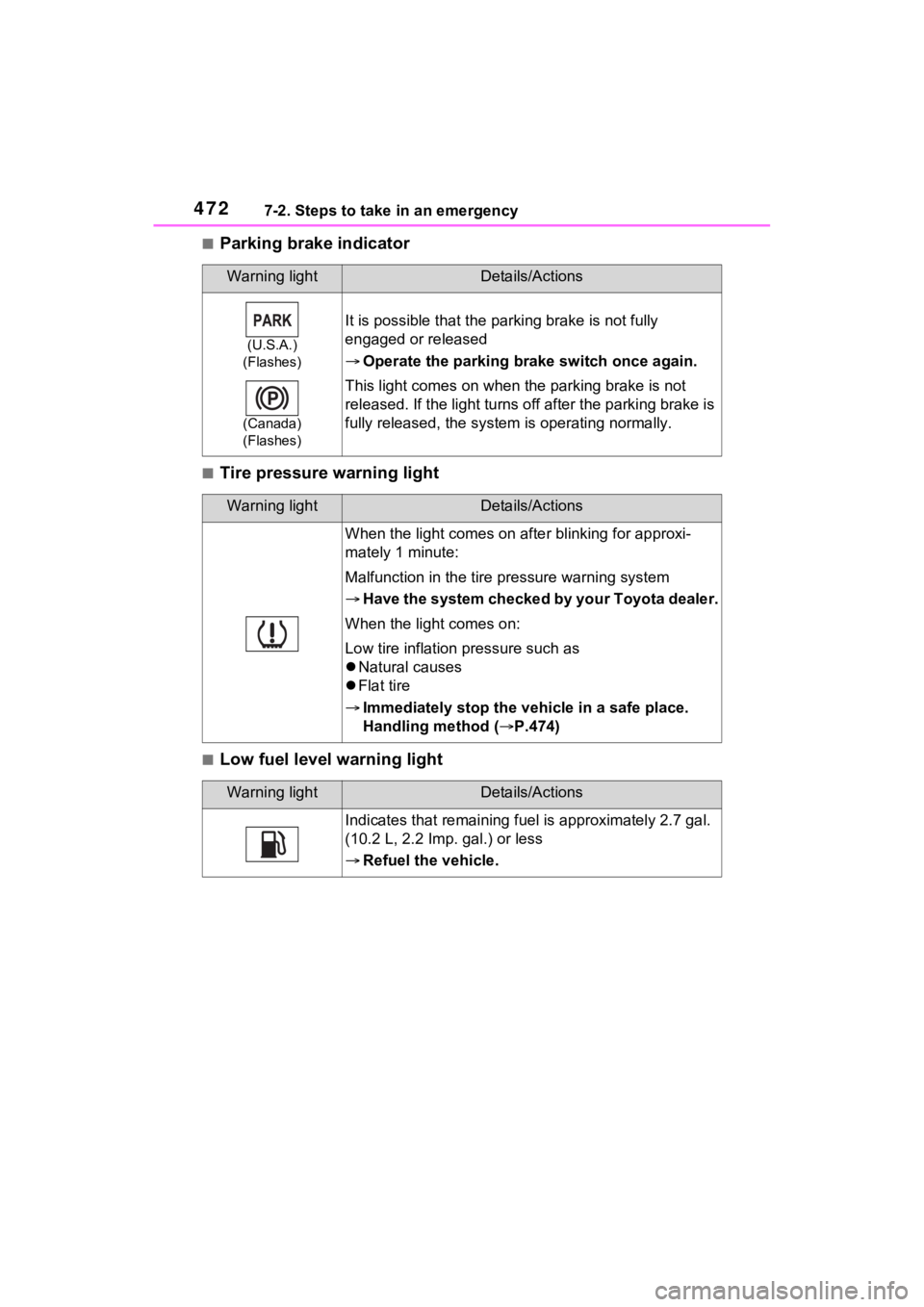
■Parking brake indicator
■Tire pressure warning light
■Low fuel level warning light
Warning lightDetails/Actions
(U.S.A.)
(Flashes)
(Canada)
(Flashes)
It is possible that the parking brake is not fully
engaged or released
Operate the parking br ake switch once again.
This light comes on when the parking brake is not
released. If the light turns off after the parking brake is
fully released, the system is operating normally.
Warning lightDetails/Actions
When the light comes on afte r blinking for approxi-
mately 1 minute:
Malfunction in the tire pressure warning system
Have the system checked by your Toyota dealer.
When the light comes on:
Low tire inflation pressure such as
Natural causes
Flat tire
Immediately stop the v ehicle in a safe place.
Handling method ( P.474)
Warning lightDetails/Actions
Indicates that remaining fuel is approximately 2.7 gal.
(10.2 L, 2.2 Imp. gal.) or less
Refuel the vehicle.
Page 475 of 601

4747-2. Steps to take in an emergency
seat.
●If a cushion is placed on the seat,
the sensor may not detect a pas-
senger, and the warning light may
not operate properly.
■SRS warning light
This warning light system monitors
the airbag sensor assembly, front
impact sensors, side impact sensors
(front door), side impact sensors
(front), side impact sensors (rear),
driver’s seat position sensor,
driver’s seat belt buckle switch, front
passenger occupant classification
sensors, “AIR BAG ON” indicator
light, “AIR BAG OFF” indicator light,
front passenger’s seat belt buckle
switch, seat belt pretensioners and
force limiters, airbags, interconnect-
ing wiring and power sources.
( P.42)
■If the malfunction indicator
lamp comes on while driving
First check the following:
●Is the fuel t ank empty?
If it is, fill the fuel tank immediately.
●Is the fuel tank cap loose?
If it is, tighten it securely.
The light will go o ff after several
driving trips.
If the light does not go off even after
several trips, contact your Toyota
dealer as soon as possible.
■Electric power steering system
warning light (warning buzzer)
When the 12-volt battery charge
becomes insufficien t or the voltage
temporarily drops, the electric power
steering system warning light may
come on and the warning buzzer
may sound.
■When the tire pressure warning
light comes on
Inspect the tires to check if a tire is
punctured.
If a tire is punctured: P.491 If none of the tires are punctured:
Turn the power switch to OFF then
turn it to ON.
Check if the tire pressure warning
light comes on or blinks.
If the tire pressur
e warning light
blinks for approximately 1 minute
then stays on
There may be a malfunction in the
tire pressure warning system. Have
the vehicle inspected by your
Toyota dealer immediately.
If the tire pressur e warning light
comes on
1 After the temperature of the tires
has lowered sufficiently, check
the inflation pressure of each tire
and adjust them to the specified
level.
2 If the warning light does not turn
off even after several minutes
have elapsed, check that the
inflation pressure of each tire is
at the specified level and perform
initialization. ( P.430)
■The tire pressure warning light
may come on due to natural
causes
The tire pressure warning light may
come on due to natural causes such
as natural air leaks and tire inflation
pressure changes caused by tem-
perature. In this ca se, adjusting the
tire inflation pressure will turn off the
warning ligh t (after a few minutes).
■When a tire is replaced with a
compact spare tire (vehicles
with compact spare tire)
The compact spare tire is not
equipped with a tire pressure warn-
ing valve and tran smitter. If a tire
goes flat, the tire pressure warning
light will not turn off even though the
flat tire has been replaced with the
spare tire. Replac e the spare tire
with the standard tire and adjust the
tire inflation pressure. The tire pres-
sure warning light will go off after a
few minutes.
Page 477 of 601
4767-2. Steps to take in an emergency
WARNING
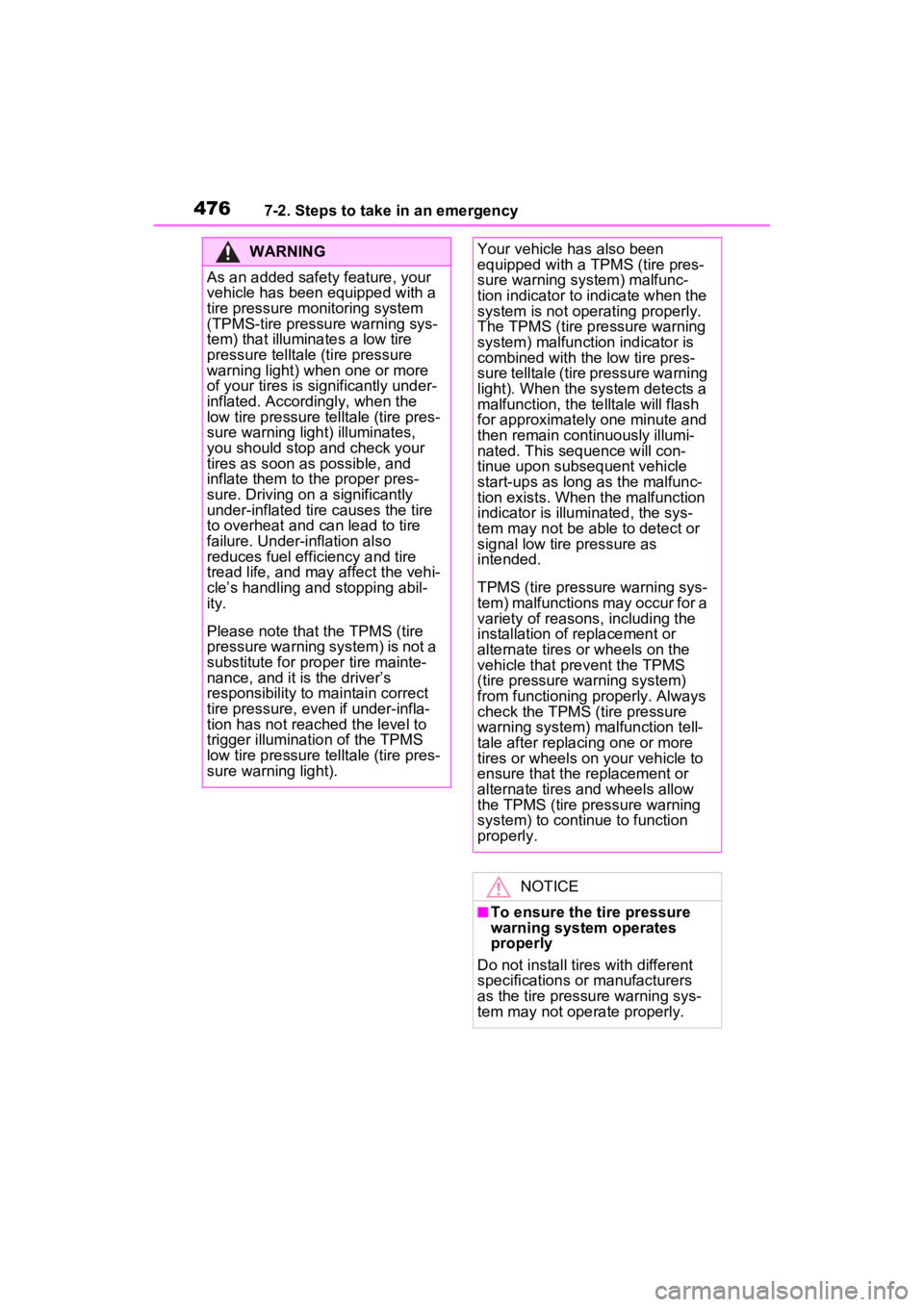
As an added safety feature, your
vehicle has been equipped with a
tire pressure m onitoring system
(TPMS-tire pressure warning sys-
tem) that illuminates a low tire
pressure telltale (tire pressure
warning light) when one or more
of your tires is significantly under-
inflated. Accordingly, when the
low tire pressure telltale (tire pres-
sure warning light) illuminates,
you should stop and check your
tires as soon as possible, and
inflate them to the proper pres-
sure. Driving on a significantly
under-inflated tire causes the tire
to overheat and can lead to tire
failure. Under-inflation also
reduces fuel efficiency and tire
tread life, and may affect the vehi-
cle’s handling and stopping abil-
ity.
Please note that the TPMS (tire
pressure warning system) is not a
substitute for pro per tire mainte-
nance, and it is the driver’s
responsibility to maintain correct
tire pressure, even if under-infla-
tion has not reach ed the level to
trigger illumination of the TPMS
low tire pressure telltale (tire pres-
sure warning light).
Your vehicle has also been
equipped with a TPMS (tire pres-
sure warning system) malfunc-
tion indicator to indicate when the
system is not operating properly.
The TPMS (tire pressure warning
system) malfunction indicator is
combined with the low tire pres-
sure telltale (tire pressure warning
light). When the system detects a
malfunction, the te lltale will flash
for approximately one minute and
then remain continuously illumi-
nated. This sequence will con-
tinue upon subsequent vehicle
start-ups as long as the malfunc-
tion exists. When the malfunction
indicator is illuminated, the sys-
tem may not be ab le to detect or
signal low tire pressure as
intended.
TPMS (tire pressure warning sys-
tem) malfunctions may occur for a
variety of reasons, including the
installation of replacement or
alternate tires or wheels on the
vehicle that prevent the TPMS
(tire pressure warning system)
from functioning properly. Always
check the TPMS (tire pressure
warning system) malfunction tell-
tale after replacing one or more
tires or wheels on your vehicle to
ensure that the replacement or
alternate tires and wheels allow
the TPMS (tire pressure warning
system) to continue to function
properly.
NOTICE
■To ensure the tire pressure
warning system operates
properly
Do not install tires with different
specifications or manufacturers
as the tire pressure warning sys-
tem may not operate properly.
Page 480 of 601

4797-2. Steps to take in an emergency
7
When trouble arises
tion display, it may indicate a mal-
function. Immediately stop the
vehicle and contact your Toyota
dealer.
•“Braking Power Low”
• “12-Volt Battery Charging System
Malfunction”
• “Oil Pressure Low”
●If any of the following messages
are shown on the multi-informa-
tion display, the vehicle may have
run out of fuel. Stop the vehicle in
a safe place and, if the fuel level is
low, refuel the vehicle.
• “Hybrid System Stopped”
• “Engine Stopped”
●If “Low Auxiliary Battery See
Owner’s Manual” is shown
• When the display goes off after
several seconds
*:
Maintain the hybri d system opera-
tion for more than 15 minutes and
charge the 12- volt battery.
• When the display does not go off:
Start up the hybrid system using the
procedures for “If the 12-volt battery
is discharged” ( P.506)
*: Displays for about 6 seconds
●If “Maintenance Required for Trac-
tion Battery Cooling Parts See
Owner’s Manual” is shown, the fil-
ter may be clogged, the air intake
vent may be blocked, or there may
be a gap in the duct. Therefore,
perform the following correction
procedure.
• If the air intake vent or filter of the hybrid battery (traction battery)
are dirty, perform the procedures
on P.443to clean them.
• If the warning message is shown when the air intake vent and filter
of the hybrid battery (traction bat-
tery) are not dirty, have the vehicle
inspected at your Toyota dealer.
■If “Engine Oil Level Low Add or
Replace” is displayed
The engine oil level may be low.
Check the level of the engine oil, and add engine oil if necessary.
This message may be displayed if
the vehicle is stopped on a slope.
Move the vehicle to a level surface
and check if the message disap-
pears.
■If “Hybrid System Stopped
Steering Power Low” is dis-
played
This message is displayed if the
hybrid system is stopped while driv-
ing.
When steering wheel operations are
heavier than usual, grip the steering
wheel firmly and operate it using
more force than usual.
■If “Hybrid System Overheated
Output Power Reduced” is
shown
The message may be shown when
driving under severe operating con-
ditions. (For example, when driving
up a long steep hill or driving up a
steep hill in reverse.)
Coping method: P.514
■If “Traction Battery Needs to be
Protected Refrain from the Use
of N Position” is shown
This message may be displayed
when the shift lever is in N.
As the hybrid battery (traction bat-
tery) can not be charged when the
shift lever is in N, shift the shift lever
to P when the vehicle is stopped.
■If “Traction Battery Needs to be
Protected Shift into P to
Restart” is shown
This message is displayed when the
hybrid battery (traction battery)
charge has becom e extremely low
because the shift lever has been left
in N for a certain amount of time.
When operating the vehicle, shift to
P and restart the hybrid system.
■If “Shift to P Before Exiting
Vehicle” is shown
Message is displayed when the
driver’s door is opened without turn-
Page 491 of 601
4907-2. Steps to take in an emergency
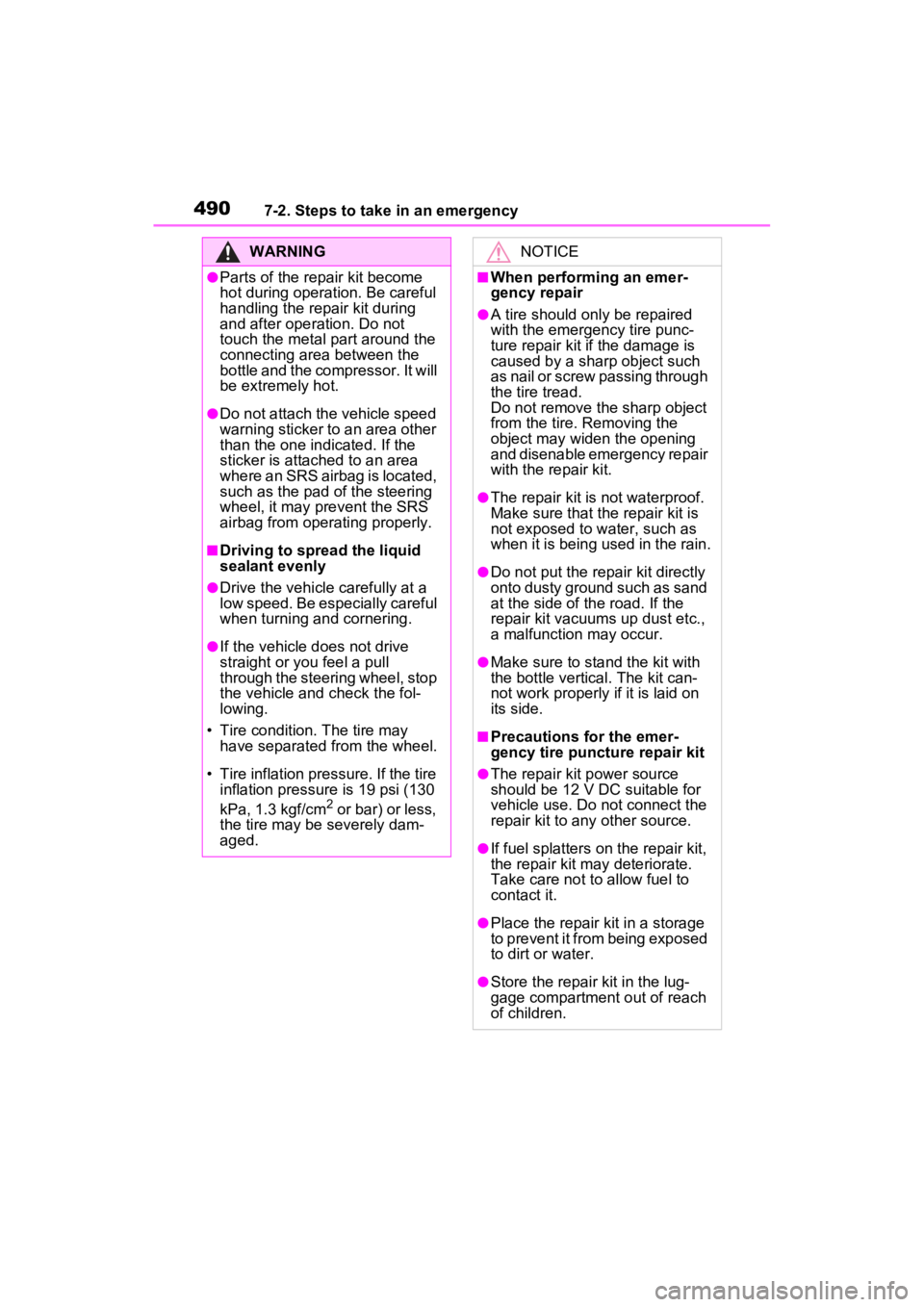
WARNING
●Parts of the repair kit become
hot during operation. Be careful
handling the repair kit during
and after operation. Do not
touch the metal part around the
connecting area between the
bottle and the compressor. It will
be extremely hot.
●Do not attach the vehicle speed
warning sticker to an area other
than the one indicated. If the
sticker is attached to an area
where an SRS airbag is located,
such as the pad of the steering
wheel, it may prevent the SRS
airbag from operating properly.
■Driving to spread the liquid
sealant evenly
●Drive the vehicle carefully at a
low speed. Be especially careful
when turning and cornering.
●If the vehicle does not drive
straight or you feel a pull
through the steering wheel, stop
the vehicle and check the fol-
lowing.
• Tire condition. The tire may have separated from the wheel.
• Tire inflation pressure. If the tire inflation pressure is 19 psi (130
kPa, 1.3 kgf/cm
2 or bar) or less,
the tire may be severely dam-
aged.
NOTICE
■When performing an emer-
gency repair
●A tire should only be repaired
with the emergency tire punc-
ture repair kit if the damage is
caused by a sharp object such
as nail or screw passing through
the tire tread.
Do not remove th e sharp object
from the tire. Removing the
object may widen the opening
and disenable emergency repair
with the repair kit.
●The repair kit is not waterproof.
Make sure that the repair kit is
not exposed to water, such as
when it is being used in the rain.
●Do not put the repair kit directly
onto dusty ground such as sand
at the side of the road. If the
repair kit vacuums up dust etc.,
a malfunction may occur.
●Make sure to stand the kit with
the bottle vertical. The kit can-
not work properly if it is laid on
its side.
■Precautions for the emer-
gency tire puncture repair kit
●The repair kit power source
should be 12 V DC suitable for
vehicle use. Do not connect the
repair kit to any other source.
●If fuel splatters on the repair kit,
the repair kit may deteriorate.
Take care not to allow fuel to
contact it.
●Place the repair kit in a storage
to prevent it from being exposed
to dirt or water.
●Store the repair kit in the lug-
gage compartment out of reach
of children.
Page 535 of 601
5348-1. Specifications
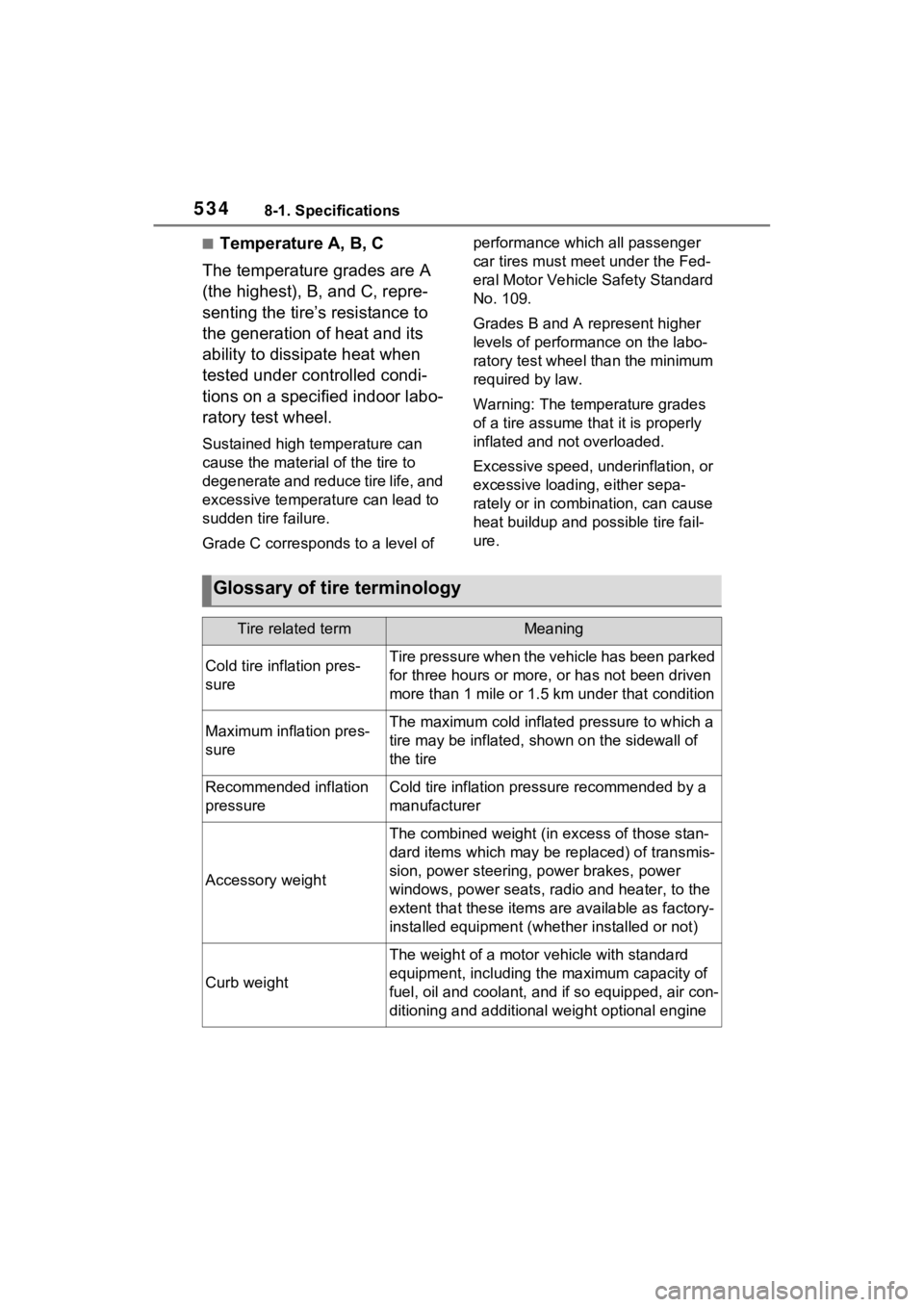
■Temperature A, B, C
The temperature grades are A
(the highest), B, and C, repre-
senting the tire’s resistance to
the generation of heat and its
ability to dissipate heat when
tested under controlled condi-
tions on a specified indoor labo-
ratory test wheel.
Sustained high temperature can
cause the material of the tire to
degenerate and reduce tire life, and
excessive temperature can lead to
sudden tire failure.
Grade C corresponds to a level of performance which all passenger
car tires must meet under the Fed-
eral Motor Vehicle Safety Standard
No. 109.
Grades B and A represent higher
levels of performance on the labo-
ratory test wheel than the minimum
required by law.
Warning: The temperature grades
of a tire assume tha
t it is properly
inflated and not overloaded.
Excessive speed, underinflation, or
excessive loading, either sepa-
rately or in combination, can cause
heat buildup and possible tire fail-
ure.
Glossary of tire terminology
Tire related termMeaning
Cold tire inflation pres-
sureTire pressure when the vehicle has been parked
for three hours or more, or has not been driven
more than 1 mile or 1.5 km under that condition
Maximum inflation pres-
sureThe maximum cold inflated pressure to which a
tire may be inflated, shown on the sidewall of
the tire
Recommended inflation
pressureCold tire inflation pressure recommended by a
manufacturer
Accessory weight
The combined weight (in excess of those stan-
dard items which may be replaced) of transmis-
sion, power steering, power brakes, power
windows, power seats, radio and heater, to the
extent that these items are available as factory-
installed equipment (whether installed or not)
Curb weight
The weight of a motor vehicle with standard
equipment, including th e maximum capacity of
fuel, oil and coolant, and if so equipped, air con-
ditioning and additional weight optional engine
Page 576 of 601

Alphabetical Index575
F
Flat tire ............................ 481, 491Tire pressure warning system........................................... 427
Floor mats ................................. 32
Fluid Brake ............................ 420, 524
Hybrid transmission.............. 523
Rear differential .................... 523
Washer ................................. 421
Fog lights Replacing light bulbs ............ 451
Switch................................... 254
Footwell lights ..... ................... 363
Front door courtesy lights Wattage ................................ 526
Front doors .......... ................... 132
Front passenger’s seat belt reminder light ....................... 473
Front passenger occupant clas- sification system .................... 51
Front seat heaters .................. 361
Front seats .............................. 169 Adjustment ........................... 169
Cleaning ............................... 403
Correct driving posture ........... 33
Driving position memory....... 178
Head restraints ..................... 182
Memory recall function ......... 180
Power easy access system .. 178
Seat heaters ......................... 361
Seat position memory .......... 178
Seat ventilators .................... 361
Front side marker lights ........ 248 Light switch .......................... 248
Replacing light bulbs ............ 451
Front turn signal lights Replacing light bulbs ............ 451
Turn signal lever................... 242
Fuel Capacity ............................... 520 Fuel gauge .....................97, 101
Information .........
..................528
Refueling ..............................259
Type .............................520, 528
Warning light ........................472
Fuel consumption information Average fuel consumption ....125
Current fuel consumption .....125
Fuel filler door.........................260 If the fuel filler door cannot be opened ...............................503
Refueling ..............................259
Fuel gauge.........................97, 101
Fuses .......................................449
G
Garage door opene r ...............392
Gauges ..............................97, 101
Glove box ................................367
Grocery bag hooks .................387
H
Headlights ...............................248 Automatic High Beam system...........................................250
Light switch...........................248
Replacing light bulbs ............451
Wattage ................................526
Head restraints .......................182
Head-up display ......................118 Driving information display area...........................................118
Driving support system display area ....................................120
Head-up display switch ........119
Hybrid System Indicator .......121
Navigation system-linked display ...........................................118
Pop-up display......................120
Settings ................................119
Head-up display switch..........119
Page 585 of 601

584Alphabetical Index
Pre-collision warning ............ 267
RCD OFF indicator............... 470
RCTA (Rear Cross Traffic Alert)........................................... 300
RCTA OFF indicator............. 470
Seat belt reminder ................ 473
Vehicle sway warning........... 279
Warning lights ABS ...................................... 468
Brake hold operated indicator........................................... 471
Brake Override System ........ 471
Brake system ....................... 466
Charging system .................. 466
Drive-Start Control ............... 471
Electric power steering ......... 468
Engine .................................. 467
High coolant temperature ..... 467
Hybrid system overheat ....... 467
Intuitive parking assist OFF indi- cator ................................... 469
Low engine oil pressure ....... 467
Low fuel level ....................... 472
LTA indicator ........................ 469
Malfunction indicator lamp ... 467
Parking brake indicator ........ 472
PCS warning light................. 469
PKSB (Parking Support Brake) ........................................... 471
PKSB OFF indicato r ............. 470
RCD OFF indicator............... 470
RCTA OFF indicator............. 470
Seat belt reminder light ........ 473
Slip indicator......................... 471
SRS ...................................... 468
Tire pressure ........................ 472
Warning messages ................ 477
Washer Checking .............................. 421
Low washer fluid warning mes-sage ........................... 421, 477
Preparing and c hecking before winter ..................................343
Switch ...........................254, 257
Washing and waxing ..............400
Weights Cargo capacity .............215, 218
Load limits ............................218
Wheels .....................................440 Replacing wheels .................440
Size ......................................525
Window glasses Power windows ....................201
Window lock switch ...............203
Windows Power windows ....................201
Rear window defogger .........350
Washer .........................254, 257
Windshield defogge r ..............349
Windshield wiper d e-icer .......353
Windshield wipers Intermittent windshield wipers...........................................254
Position.........................254, 257
Rain-sensing windshield wipers ...........................................254
Winter driving tips ..................343
Wireless charger.....................381
Wireless remote control.........130 Battery-saving function .........165
Locking/Unlocking ................130
Panic mode ..........................130
Replacing the battery ...........447
For vehicles with Entune Audio, Entune Audio Plus
or Entune Premium Audio,
refer to the “NAVIGA-
TION AND MULTIMEDIA
SYSTEM OWNER’S MAN-
UAL” for information
Page 601 of 601
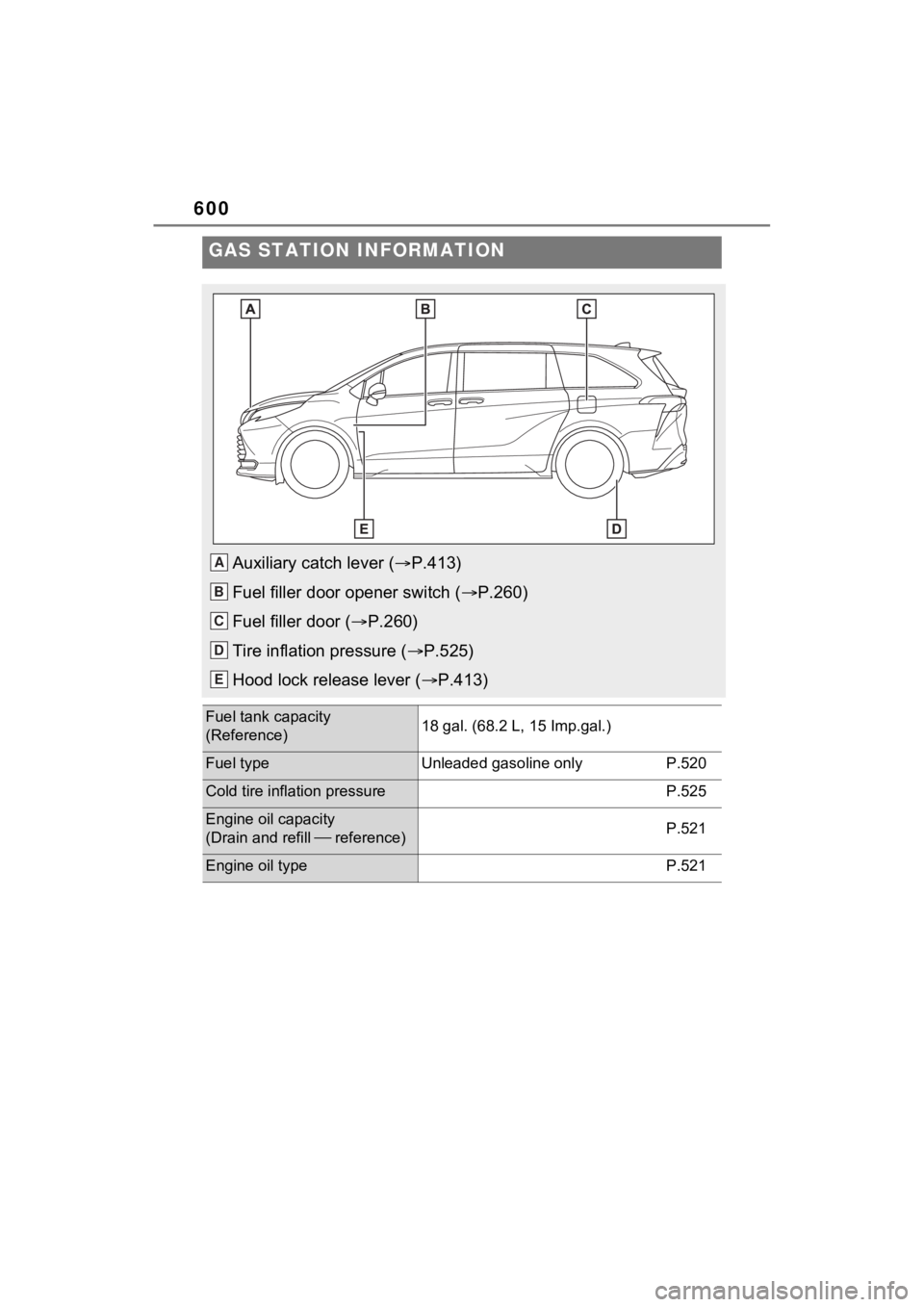
600
GAS STATION INFORMATION
Auxiliary catch lever (P.413)
Fuel filler door opener switch ( P.260)
Fuel filler door ( P.260)
Tire inflation pressure ( P.525)
Hood lock release lever ( P.413)
Fuel tank capacity
(Reference)18 gal. (68.2 L, 15 Imp.gal.)
Fuel typeUnleaded gasoline onlyP.520
Cold tire infl ation pressureP.525
Engine oil capacity
(Drain and refill reference)P.521
Engine oil typeP.521
A
B
C
D
E