AUX TOYOTA SIENNA HYBRID 2021 Owners Manual (in English)
[x] Cancel search | Manufacturer: TOYOTA, Model Year: 2021, Model line: SIENNA HYBRID, Model: TOYOTA SIENNA HYBRID 2021Pages: 601, PDF Size: 32.07 MB
Page 216 of 601

2154-1. Before driving
4
DrivingCargo capacity depends on the
total weight of the occupants.
(Cargo capacity) = (Total load
capacity) - (Total weight of occu-
pants)
Steps for Determining Correct
Load Limit
(1) Locate the statement “The
combined weight of occupants
and cargo should never exceed
XXX kg or XXX lbs.” on your
vehicle’s placard.
(2) Determine the combined
weight of the driver and passen-
gers that will be riding in your
vehicle.
(3) Subtract the combined
weight of the driver and passen-
gers from XXX kg or XXX lbs.
(4) The resulting figure equals
the available amount of cargo
and luggage load capacity.
Cargo and luggage
Take notice of the following
information about storage
precautions, cargo capacity
and load.
WARNING
■Things that must not be car-
ried in the luggage compart-
ment
The following things may cause a
fire if loaded in the luggage com-
partment:
●Receptacles co ntaining gaso-
line
●Aerosol cans
■Storage precautions
Observe the following precau-
tions. Failure to do so may pre-
vent the pedals from being
depressed properly, may block
the driver’s vision, or may result in
items hitting the d river or passen-
gers, possibly causing an acci-
dent.
●Stow cargo and luggage in the
luggage compartment when-
ever possible.
●Do not stack anything in the lug-
gage compartment higher than
the seatbacks.
●Do not place cargo or luggage
in or on the following locations.
• At the feet of the driver
• On the front passenger or rear seats (when stacking items)
• On the instrument panel
• On the dashboard
• On the auxiliary box or tray that has no lid
●Secure all items in the occupant
compartment.
●When you fold down the rear
seats, long items should not be
placed directly behind the front
seats.
●Never allow anyon e to ride in
the luggage compartment. It is
not designed for passengers.
They should ride in their seats
with their seat belts properly
fastened. Otherw ise, they are
much more likely to suffer death
or serious bodily injury, in the
event of sudden braking, sud-
den swerving or an accident.
Capacity and distribution
Page 367 of 601
3665-3. Using the storage features
5-3.Using the storage features
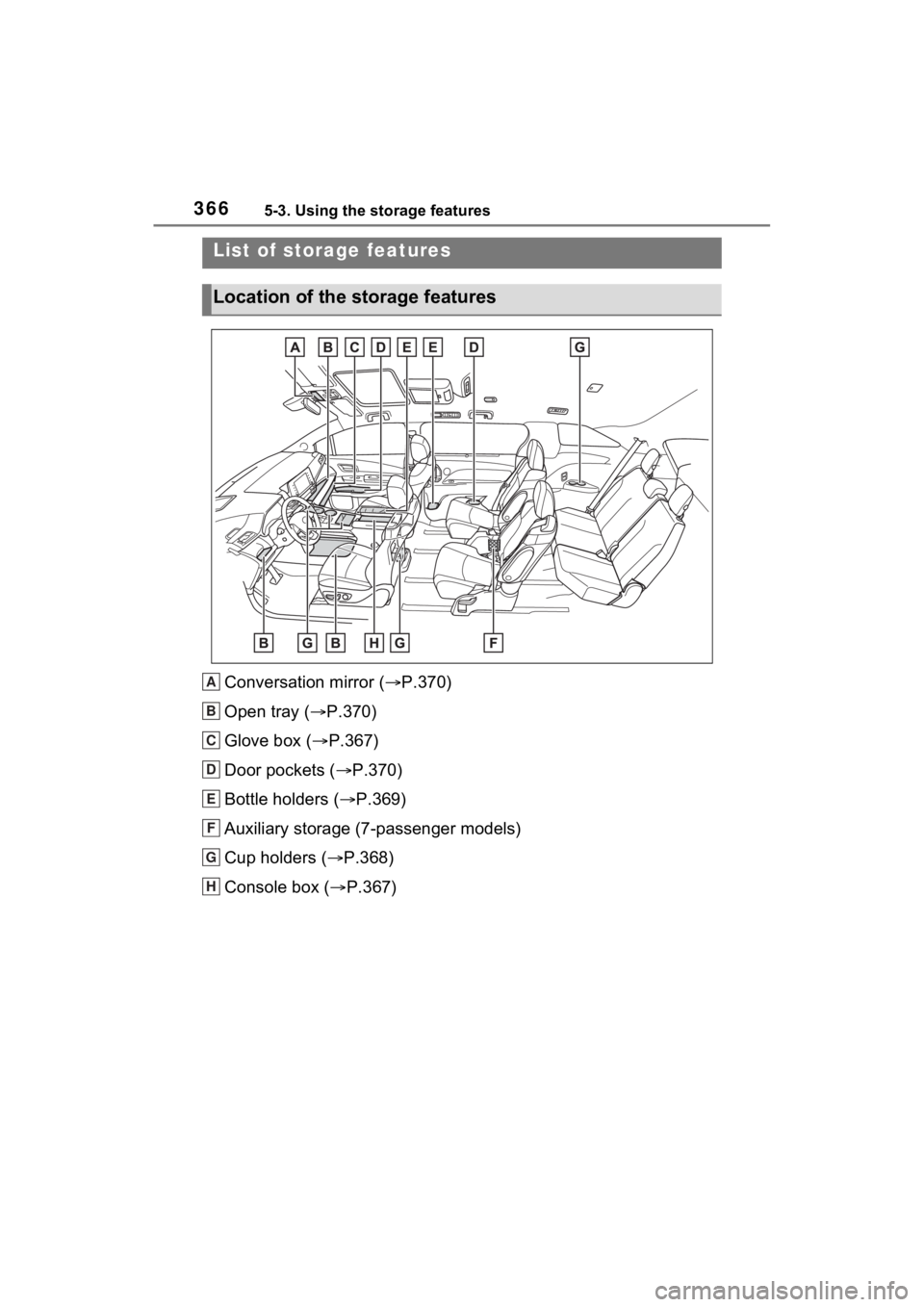
Conversation mirror (P.370)
Open tray ( P.370)
Glove box ( P.367)
Door pockets ( P.370)
Bottle holders ( P.369)
Auxiliary storage (7-passenger models)
Cup holders ( P.368)
Console box ( P.367)
List of storage features
Location of the storage features
A
B
C
D
E
F
G
H
Page 373 of 601
3725-3. Using the storage features
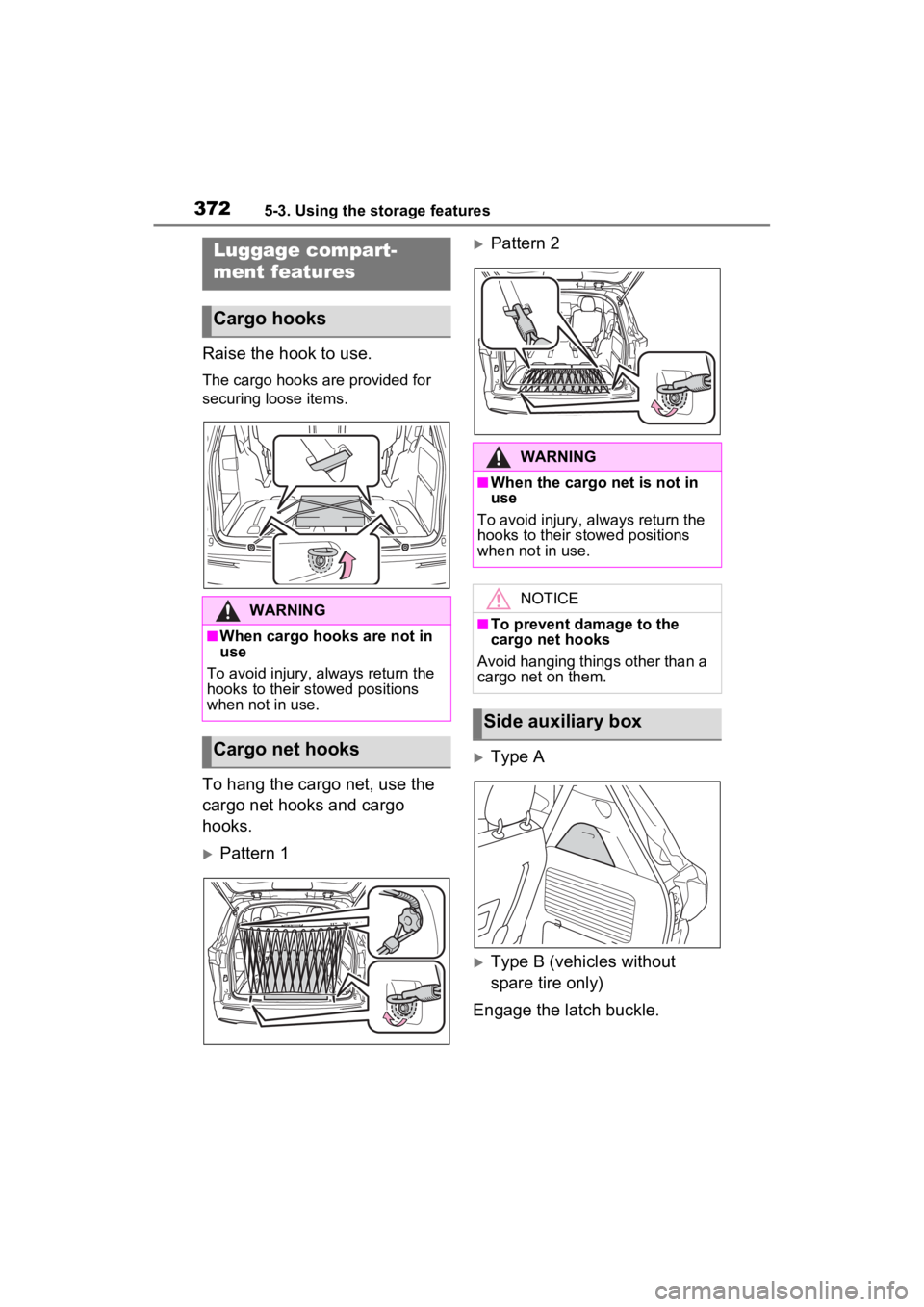
Raise the hook to use.
The cargo hooks are provided for
securing loose items.
To hang the cargo net, use the
cargo net hooks and cargo
hooks.
Pattern 1
Pattern 2
Type A
Type B (vehicles without
spare tire only)
Engage the latch buckle.
Luggage compart-
ment features
Cargo hooks
WARNING
■When cargo hooks are not in
use
To avoid injury, always return the
hooks to their stowed positions
when not in use.
Cargo net hooks
WARNING
■When the cargo net is not in
use
To avoid injury, always return the
hooks to their stowed positions
when not in use.
NOTICE
■To prevent damage to the
cargo net hooks
Avoid hanging things other than a
cargo net on them.
Side auxiliary box
Page 414 of 601
4136-3. Do-it-yourself maintenance
6
Maintenance and care
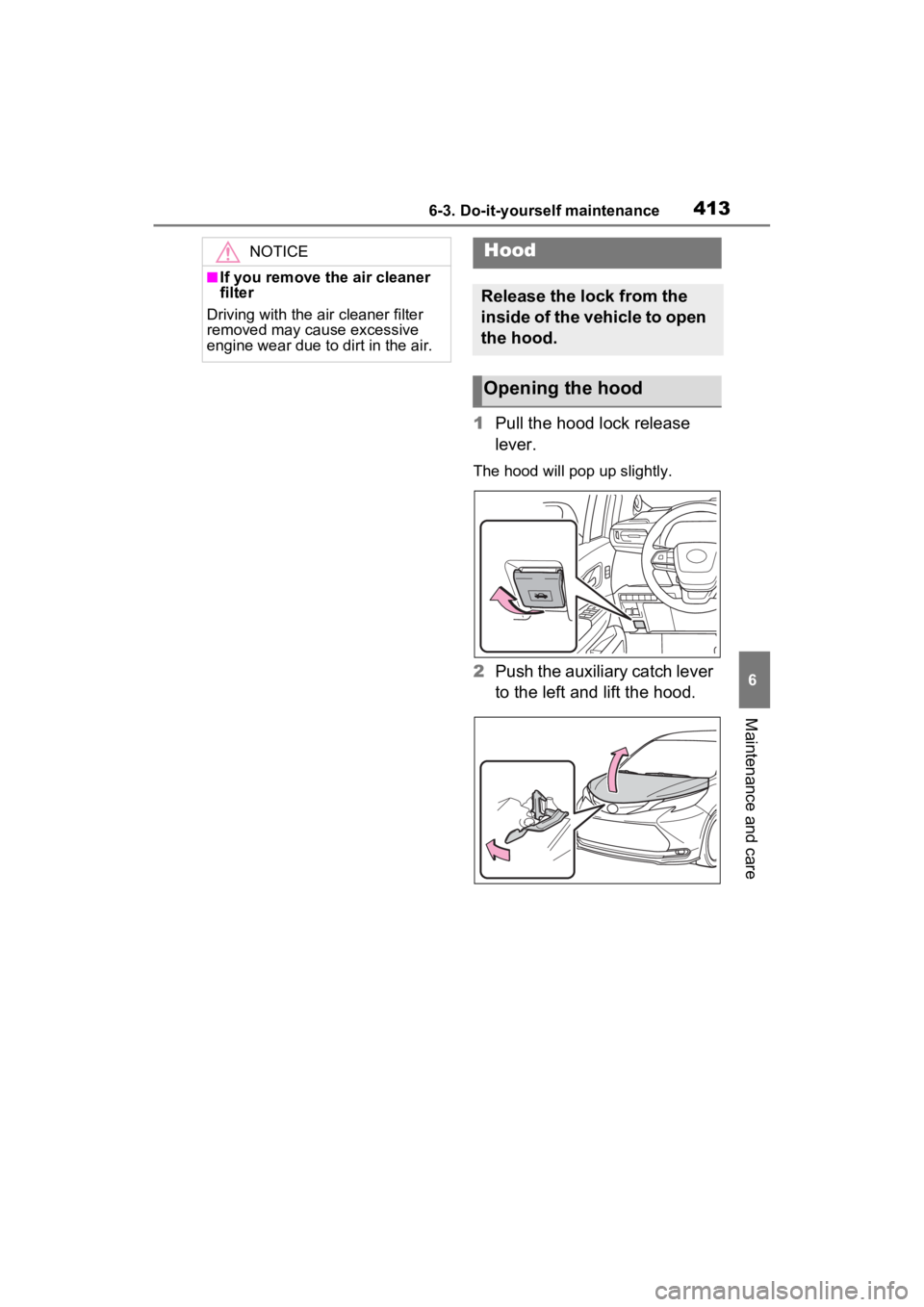
1Pull the hood lock release
lever.
The hood will pop up slightly.
2Push the auxiliary catch lever
to the left and lift the hood.
NOTICE
■If you remove th e air cleaner
filter
Driving with the air cleaner filter
removed may cause excessive
engine wear due to dirt in the air.
Hood
Release the lock from the
inside of the vehicle to open
the hood.
Opening the hood
Page 429 of 601
4286-3. Do-it-yourself maintenance
“TPWS Setting”, and then
press “OK”.
6 Press or to select
“Setting UNIT”.
7 Press or to select the
desired unit and then press
“OK”.
With 7-inch display
1 Park the vehicle in a safe
place and turn the power
switch off.
Changing the unit cannot be per-
formed while the vehicle is moving.
2Turn the power switch to ON.
3 Press or of the meter
control switches on the steer-
ing wheel and select .
4 Press or of the meter
control switches and select
, and then press and hold
“OK”.
5 Press or of the meter
control switches and select
“TPWS Setting”, and then
press “OK”.
6 Press or to select
“Setting UNIT”.
7 Press or to select the
desired unit and then press
“OK”.
■Routine tire inflation pressure
checks
The tire pressure warning system
does not replace routine tire inflation
pressure checks. Make sure to check tire inflation pressure as part
of your routine o
f daily vehicle
checks.
■Tire inflation pressure
●It may take a few minutes to dis-
play the tire inflation pressure
after the power switch is turned to
ON. It may also take a few min-
utes to display the tire inflation
pressure after infl ation pressure
has been adjusted.
●Tire inflation pressure changes
with temperature.
The displayed values may also be
different from the values mea-
sured using a tire pressure gauge.
■Situations in which the tire
pressure warning system may
not operate properly
●In the following cases, the tire
pressure warning system may not
operate properly.
• If non-genuine Toyota wheels are
used.
• A tire has been replaced with a tire that is not an OE (Original
Equipment) tire.
• A tire has been replaced with a tire that is not of the specified size.
• Tire chains, etc. are equipped.
• An auxiliary-support ed run-flat tire
is equipped.
• If a window tint that affects the radio wave signals is installed.
• If there is a lot of snow or ice on
the vehicle, particularly around the
wheels or wheel housings.
• If the tire inflation pressure is
extremely higher than the speci-
fied level.
• If wheel withou t tire pressure
warning valves and transmitters
are used.
• If the ID code on the tire pressure warning valves and transmitters is
not registered in the tire pressure
warning computer.
●Performance may be affected in
the following situations.
• Near a TV tower, electric power
plant, gas station, radio station,
Page 480 of 601

4797-2. Steps to take in an emergency
7
When trouble arises
tion display, it may indicate a mal-
function. Immediately stop the
vehicle and contact your Toyota
dealer.
•“Braking Power Low”
• “12-Volt Battery Charging System
Malfunction”
• “Oil Pressure Low”
●If any of the following messages
are shown on the multi-informa-
tion display, the vehicle may have
run out of fuel. Stop the vehicle in
a safe place and, if the fuel level is
low, refuel the vehicle.
• “Hybrid System Stopped”
• “Engine Stopped”
●If “Low Auxiliary Battery See
Owner’s Manual” is shown
• When the display goes off after
several seconds
*:
Maintain the hybri d system opera-
tion for more than 15 minutes and
charge the 12- volt battery.
• When the display does not go off:
Start up the hybrid system using the
procedures for “If the 12-volt battery
is discharged” ( P.506)
*: Displays for about 6 seconds
●If “Maintenance Required for Trac-
tion Battery Cooling Parts See
Owner’s Manual” is shown, the fil-
ter may be clogged, the air intake
vent may be blocked, or there may
be a gap in the duct. Therefore,
perform the following correction
procedure.
• If the air intake vent or filter of the hybrid battery (traction battery)
are dirty, perform the procedures
on P.443to clean them.
• If the warning message is shown when the air intake vent and filter
of the hybrid battery (traction bat-
tery) are not dirty, have the vehicle
inspected at your Toyota dealer.
■If “Engine Oil Level Low Add or
Replace” is displayed
The engine oil level may be low.
Check the level of the engine oil, and add engine oil if necessary.
This message may be displayed if
the vehicle is stopped on a slope.
Move the vehicle to a level surface
and check if the message disap-
pears.
■If “Hybrid System Stopped
Steering Power Low” is dis-
played
This message is displayed if the
hybrid system is stopped while driv-
ing.
When steering wheel operations are
heavier than usual, grip the steering
wheel firmly and operate it using
more force than usual.
■If “Hybrid System Overheated
Output Power Reduced” is
shown
The message may be shown when
driving under severe operating con-
ditions. (For example, when driving
up a long steep hill or driving up a
steep hill in reverse.)
Coping method: P.514
■If “Traction Battery Needs to be
Protected Refrain from the Use
of N Position” is shown
This message may be displayed
when the shift lever is in N.
As the hybrid battery (traction bat-
tery) can not be charged when the
shift lever is in N, shift the shift lever
to P when the vehicle is stopped.
■If “Traction Battery Needs to be
Protected Shift into P to
Restart” is shown
This message is displayed when the
hybrid battery (traction battery)
charge has becom e extremely low
because the shift lever has been left
in N for a certain amount of time.
When operating the vehicle, shift to
P and restart the hybrid system.
■If “Shift to P Before Exiting
Vehicle” is shown
Message is displayed when the
driver’s door is opened without turn-
Page 482 of 601
4817-2. Steps to take in an emergency
7
When trouble arises
■Warning buzzer
P.473
NOTICE
■“High Power Consumption
Power to Climate Temporar-
ily Limited” is frequently
shown
There is a possible malfunction
relating to the charging system or
the 12-volt battery may be deteri-
orating. Have the vehicle
inspected by your Toyota dealer.
■If “Low Auxiliary Battery See
Owner’s Manual” is displayed
frequently
The 12-volt battery may have
deteriorated.
As the battery m ay discharge in
this state when left unattended,
have the battery inspected by
your Toyota dealer.
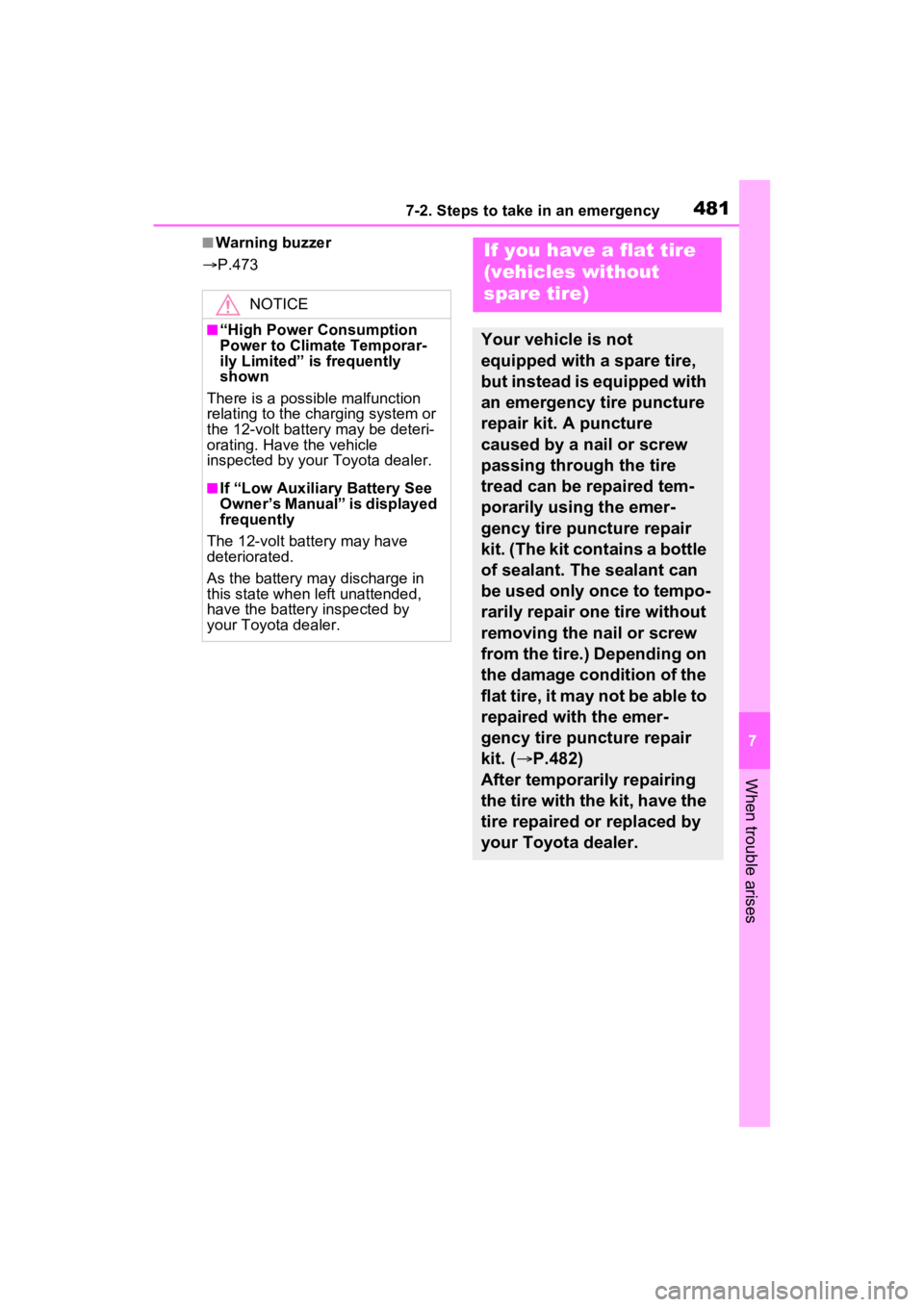
If you have a flat tire
(vehicles without
spare tire)
Your vehicle is not
equipped with a spare tire,
but instead is equipped with
an emergency tire puncture
repair kit. A puncture
caused by a nail or screw
passing through the tire
tread can be repaired tem-
porarily using the emer-
gency tire puncture repair
kit. (The kit contains a bottle
of sealant. The sealant can
be used only once to tempo-
rarily repair one tire without
removing the nail or screw
from the tire.) Depending on
the damage condition of the
flat tire, it may not be able to
repaired with the emer-
gency tire puncture repair
kit. ( P.482)
After temporarily repairing
the tire with the kit, have the
tire repaired or replaced by
your Toyota dealer.
Page 561 of 601
5609-1. For owners
Coussins gonflables SRS latéraux et en rideauCoussins gonflables SRS latéraux avant
Peuvent aider à protéger le torse des occupants des sièges avan t
Coussins gonflables SRS en rideau
• Peuvent aider à protéger principalement la tête des occupants des sièges
latéraux
• Peuvent aider à empêcher les occu pants d’être éjectés du véhicule en
cas de tonneaux
Coussins gonflables SRS de la deuxième rangée de sièges
Peuvent aider à protéger le torse des occupants des sièges laté raux de la
deuxième rangée de sièges
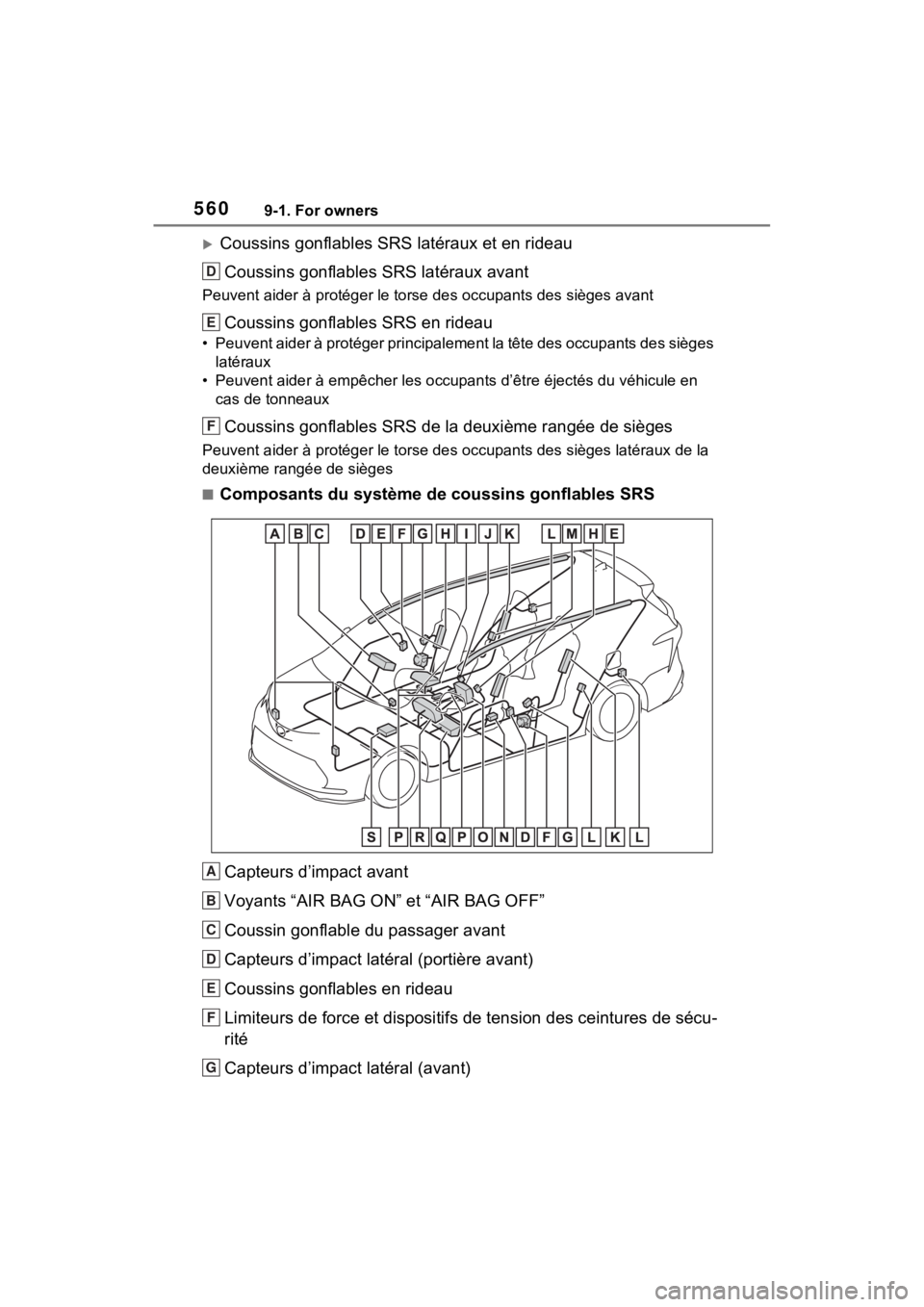
■Composants du système de coussins gonflables SRS
Capteurs d’impact avant
Voyants “AIR BAG ON” et “AIR BAG OFF”
Coussin gonflable du passager avant
Capteurs d’impact latéral (portière avant)
Coussins gonflables en rideau
Limiteurs de force et dispositif s de tension des ceintures de s écu-
rité
Capteurs d’impact latéral (avant)
D
E
F
A
B
C
D
E
F
G
Page 562 of 601

5619-1. For owners
9
For owners
Coussins gonflables latéraux (sièges avant)
Coussin gonflable du coussin de siège du passager avant
Contacteur de boucle de ceinture de sécurité du passager avant
Coussins gonflables latéraux (sièges latéraux de la deuxième
rangée de sièges)
Capteurs d’impact latéral (arrière)
Contacteur de boucle de ceinture de sécurité du conducteur
Capteur de position du siège du conducteur
Coussin gonflable du conducteur
Capteurs du système de classif ication de l’occupant du siège du
passager avant
Coussin gonflable de protec tion des genoux du conducteur
Lampe témoin SRS
Module de capteur de coussin gonflable
Votre véhicule est doté de COUSSINS GONFLABLES ÉVOLUÉS
dont la conception s’appuie sur les normes de sécurité des véhi cules
à moteur américains (FMVSS208). Le module de capteur de coussin
gonflable (ECU) contrôle le déplo iement des coussins gonflables en
fonction des informations obtenues des capteurs et d’autres élé-
ments affichés dans le diagramme des composants du système ci-
dessus. Ces informations comprennent des données relatives à la
gravité de l’accident et aux occ upants. Au moment du déploiemen t
des coussins gonflables, une réaction chimique se produit dans les
gonfleurs de coussin gonflable et les coussins gonflables se remplis-
sent rapidement d’un gaz non toxique pour aider à limiter le mo uve-
ment des occupants.H
I
J
K
L
M
N
O
P
Q
R
S
Page 563 of 601
5629-1. For owners
AVERTISSEMENT
■Précautions relatives aux
coussins gonflables SRS
Observez les pré cautions suiva-
ntes en ce qui concerne les cous-
sins gonflables SRS.
Négliger de le faire pourrait occa-
sionner des blessures graves,
voire mortelles.
●Le conducteur et tous les pas-
sagers du véhicule doivent por-
ter leur ceinture de sécurité de
la manière appropriée.
Les coussins gonflables SRS
sont des disposit ifs supplémen-
taires qui doivent être utilisés
avec les ceintures de sécurité.
●Le coussin gonflable SRS du
conducteur se déploie avec une
force considérable et peut occa-
sionner des blessures graves,
voire mortelles, notamment lor-
sque le conducteur se trouve
très près du coussin gonflable.
La National Highway Traffic
Safety Administration (NHTSA),
aux États-Unis, fait les recom-
mandations suivantes : La zone
à risque du coussin gonflable du
conducteur couvre 2 à 3 in.
(50 à 75 mm) de la zone de
déploiement du coussin gon-
flable. Pour assur er une marge
de sécurité suffisante, restez à
10 in. (250 mm) du coussin
gonflable. Cette distance est
mesurée du centre du volant à
votre sternum. Si maintenant
vous vous tenez assis à moins
de 10 in. (250 mm), vous pou-
vez changer votre position de
conduite de plusieurs
manières :
• Reculez votre siège à la posi- tion maximale vous permettant
d’atteindre encore aisément les
pédales.
• Inclinez légèrement le dossier du siège.
Bien que les véhicules soient
conçus différemment, la plupart
des conducteurs peuvent main-
tenir une distance de 10 in.
(250 mm), même si leur siège
se trouve complètement vers
l’avant, simplement en inclinant
un peu le dossier du siège vers
l’arrière. Si la visibilité avant est
moindre après avoir incliné le
dossier de votre siège, utilisez
un coussin ferme et non glissant
pour être assis plus haut ou
relevez le siège s i cette option
est disponible sur votre
véhicule.
• Si votre volant est réglable en hauteur, inclinez-l e vers le bas.
Cela vous permet d’orienter le
coussin gonflable vers votre
buste plutôt que v ers votre tête
et vers votre cou.
Le siège doit être réglé de la
manière recommandée ci-dessus
par la NHTSA, tout en gardant le
contrôle des pédales et du volant,
ainsi que la vue sur les com-
mandes du tableau de bord.