flat tire TOYOTA SIENNA HYBRID 2023 Owners Manual
[x] Cancel search | Manufacturer: TOYOTA, Model Year: 2023, Model line: SIENNA HYBRID, Model: TOYOTA SIENNA HYBRID 2023Pages: 602, PDF Size: 14.9 MB
Page 1 of 602

SIENNA_OM_OM08050U_(U)
1
2
3
4
5
6
7
8
9
Pictorial indexSearch by illustration
For safety
and securityMake sure to read through them
(Main topics: Child seat, theft deterrent system)
Vehicle status
information and
indicatorsReading driving-related information
(Main topics: Meters, multi-information display)
Before driving
Opening and closing the doors and windows,
adjustment before driving
(Main topics: Keys, doors, seats, power windows)
Driving
Operations and advice which are necessary for
driving
(Main topics: Starting hybrid system, refueling)
Interior featuresUsage of the interior features
(Main topics: Air conditioner, storage features)
Maintenance
and careCaring for your vehicle and maintenance
procedures
(Main topics: Interior and exterior, light bulbs)
When trouble
arisesWhat to do in case of malfunction and emergency
(Main topics: 12-volt battery discharge, flat tire)
Vehicle
specificationsVehicle specifications, customizable features
(Main topics: Fuel, oil, tire inflation pressure)
For ownersReporting safety defects for U.S. owners, and seat
belt and SRS airbag instructions for Canadian
owners
IndexSearch by symptom
Search alphabetically
Page 4 of 602
4TABLE OF CONTENTS
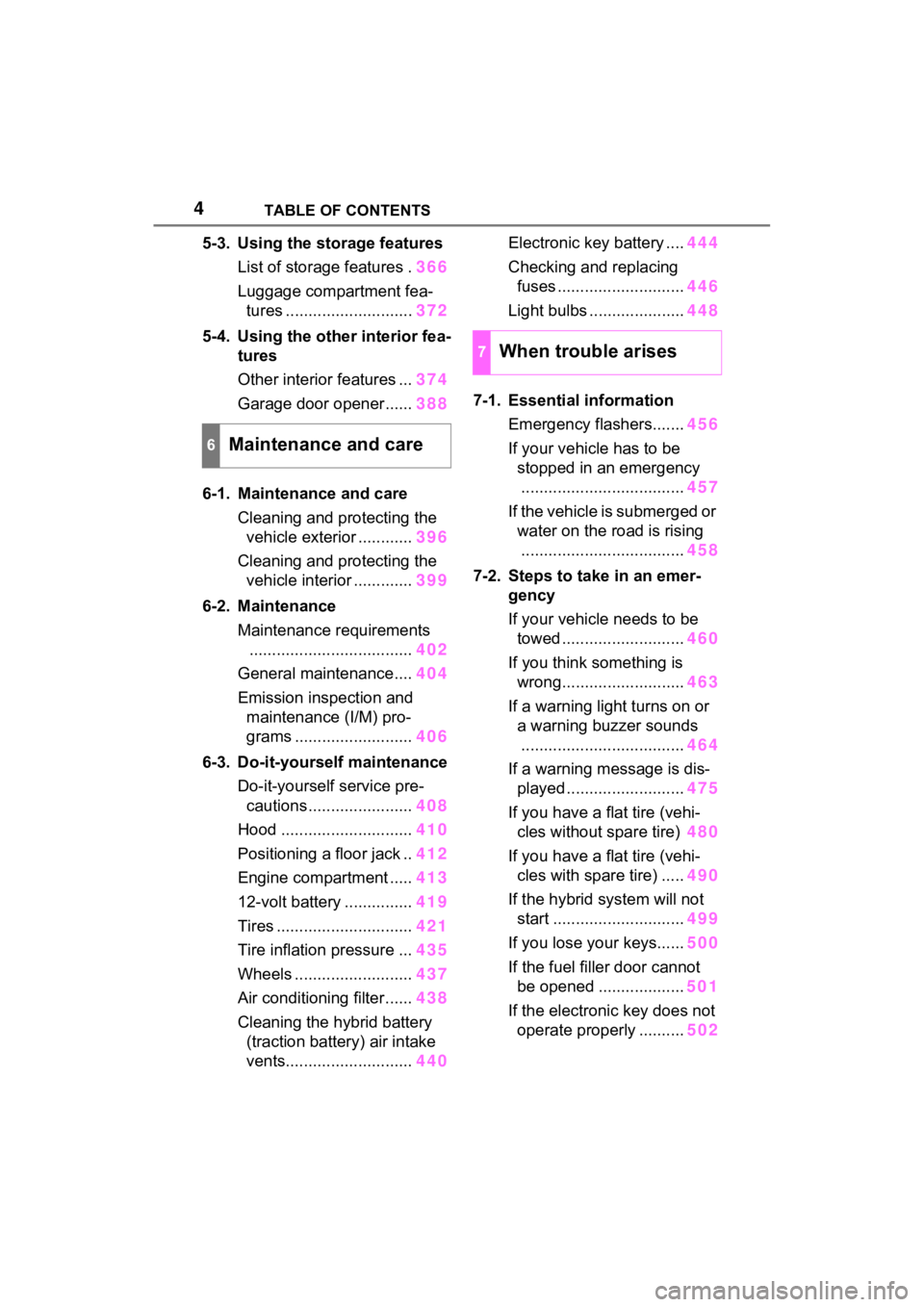
5-3. Using the storage featuresList of storage features . 366
Luggage compartment fea- tures ............................ 372
5-4. Using the other interior fea- tures
Other interior features ... 374
Garage door opener...... 388
6-1. Maintenance and care Cleaning and protecting the vehicle exterior ............ 396
Cleaning and protecting the vehicle interior ............. 399
6-2. Maintenance Maintenance requirements.................................... 402
General maintenance.... 404
Emission inspection and maintenance (I/M) pro-
grams .......................... 406
6-3. Do-it-yourself maintenance Do-it-yourself service pre-cautions ....................... 408
Hood ............................. 410
Positioning a floor jack .. 412
Engine compartment ..... 413
12-volt battery ............... 419
Tires .............................. 421
Tire inflation pressure ... 435
Wheels ......... .................437
Air conditioning filter ...... 438
Cleaning the hybrid battery (traction battery) air intake
vents............................ 440Electronic key battery ....
444
Checking and replacing fuses ............................ 446
Light bulbs ..................... 448
7-1. Essential information Emergency flashers....... 456
If your vehicle has to be stopped in an emergency.................................... 457
If the vehicle is submerged or water on the road is rising.................................... 458
7-2. Steps to take in an emer- gency
If your vehicle needs to be towed ........................... 460
If you think something is wrong........................... 463
If a warning light turns on or a warning buzzer sounds
.................................... 464
If a warning message is dis- played .......................... 475
If you have a flat tire (vehi- cles without spare tire)480
If you have a flat tire (vehi- cles with spare tire) ..... 490
If the hybrid system will not start ............................. 499
If you lose your keys...... 500
If the fuel fille r door cannot
be opened ................... 50
1
I f th
e electronic key does not
operate properly .......... 502
6Maintenance and care
7When trouble arises
Page 15 of 602
15Pictorial index
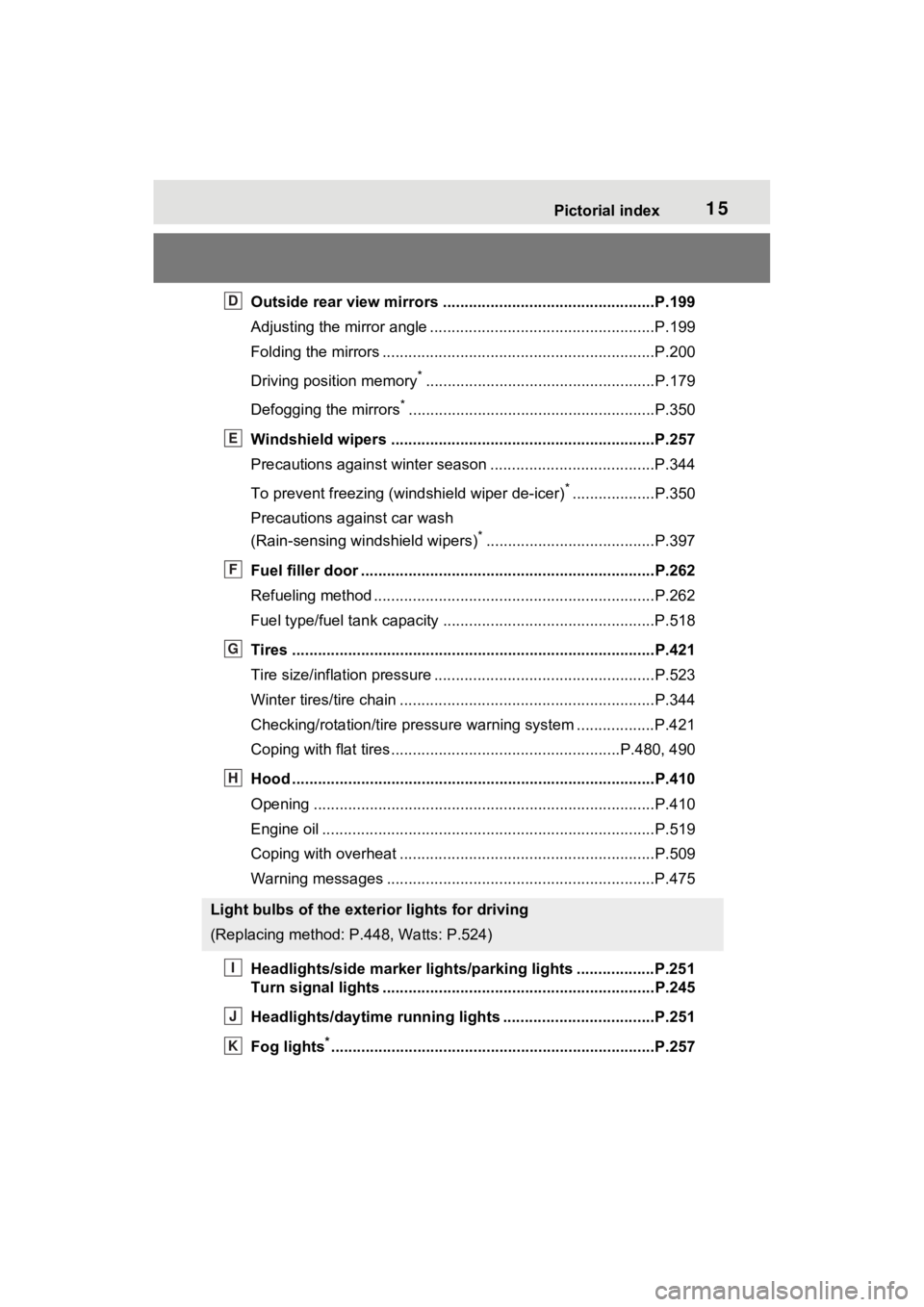
Outside rear view mirrors .................................................P.199
Adjusting the mirror angle ....................................................P.199
Folding the mirrors ...............................................................P.200
Driving position memory
*.....................................................P.179
Defogging the mirrors
*.........................................................P.350
Windshield wipers .............................................. ...............P.257
Precautions against winter season .............................. ........P.344
To prevent freezing (windshield wiper de-icer)
*...................P.350
Precautions against car wash
(Rain-sensing windshield wipers)
*.......................................P.397
Fuel filler door ............................................... .....................P.262
Refueling method ............................................... ..................P.262
Fuel type/fuel tan k capacity .................................................P.518
Tires ....................................................................................P.421
Tire size/inflation pressure ................................... ................P.523
Winter tires/tire chain ........................................ ...................P.344
Checking/rotation/tire pressur e warning system ..................P.421
Coping with flat tires......................................... ............P.480, 490
Hood ....................................................................................P.410
Opening ........................................................ .......................P.410
Engine oil ..................................................... ........................P.519
Coping with overheat ........................................... ................P.509
Warning messages ..............................................................P.475
Headlights/side marke r lights/parking lights ..................P.251
Turn signal lights ...............................................................P.245
Headlights/daytime running lights .............................. .....P.251
Fog lights
*............................................................... ............P.257
Light bulbs of the exterior lights for driving
(Replacing method: P.448, Watts: P.524)
D
E
F
G
H
I
J
K
Page 17 of 602
17Pictorial index
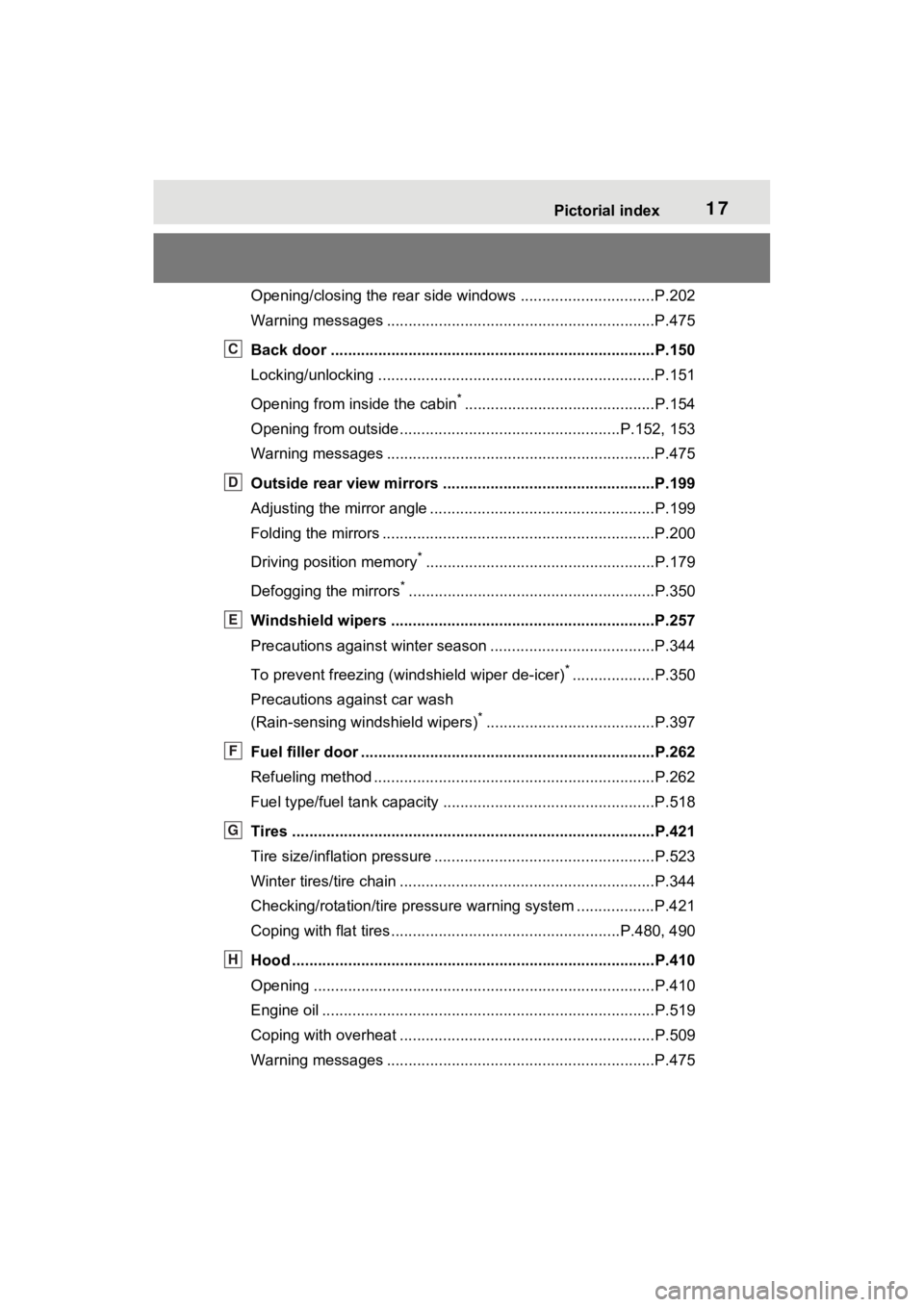
Opening/closing the rear side windows ...............................P.202
Warning messages ..............................................................P.475
Back door ...................................................... .....................P.150
Locking/unlocking ................................................................P.151
Opening from inside the cabin
*............................................P.154
Opening from outside........................................... ........P.152, 153
Warning messages ..............................................................P.475
Outside rear view mirrors .................................................P.199
Adjusting the mirror angle ..................................... ...............P.199
Folding the mirrors ...............................................................P.200
Driving position memory
*.....................................................P.179
Defogging the mirrors
*.........................................................P.350
Windshield wipers .............................................. ...............P.257
Precautions against winter season .............................. ........P.344
To prevent freezing (windshield wiper de-icer)
*...................P.350
Precautions against car wash
(Rain-sensing windshield wipers)
*.......................................P.397
Fuel filler door ............................................... .....................P.262
Refueling method ............................................... ..................P.262
Fuel type/fuel tan k capacity .................................................P.518
Tires ....................................................................................P.421
Tire size/inflation pressure ................................... ................P.523
Winter tires/tire chain ........................................ ...................P.344
Checking/rotation/tire pressur e warning system ..................P.421
Coping with flat tires......................................... ............P.480, 490
Hood ....................................................................................P.410
Opening ........................................................ .......................P.410
Engine oil ..................................................... ........................P.519
Coping with overheat ........................................... ................P.509
Warning messages ..............................................................P.475
C
D
E
F
G
H
Page 19 of 602

19Pictorial index
Opening/closing the front side windows...............................P.202
Locking/unlocking by using the mechanical key ..........P.133, 502
Warning messages ..............................................................P.475
Sliding doors .................................................. ....................P.137
Locking/unlocking ................................................................P.138
Opening/closing the sliding door ............................... ...........P.139
Opening/closing the rear si de windows ...............................P.202
Warning messages ..............................................................P.475
Back door ...................................................... .....................P.150
Locking/unlocking ................................................................P.151
Opening from inside the cabin
*............................................P.154
Opening from outside........................................... ........P.152, 153
Warning messages ..............................................................P.475
Outside rear view mirrors .................................................P.199
Adjusting the mirror angle ..................................... ...............P.199
Folding the mirrors ...............................................................P.200
Driving position memory
*.....................................................P.179
Defogging the mirrors
*.........................................................P.350
Windshield wipers .............................................. ...............P.257
Precautions against winter season .............................. ........P.344
To prevent freezing (windshield wiper de-icer)
*...................P.350
Precautions against car wash
(Rain-sensing windshield wipers)
*.......................................P.397
Fuel filler door ............................................... .....................P.262
Refueling method ............................................... ..................P.262
Fuel type/fuel tan k capacity .................................................P.518
Tires ....................................................................................P.421
Tire size/inflation pressure ................................... ................P.523
Winter tires/tire chain ........................................ ...................P.344
Checking/rotation/tire pressur e warning system ..................P.421
B
C
D
E
F
G
Page 20 of 602
20Pictorial index
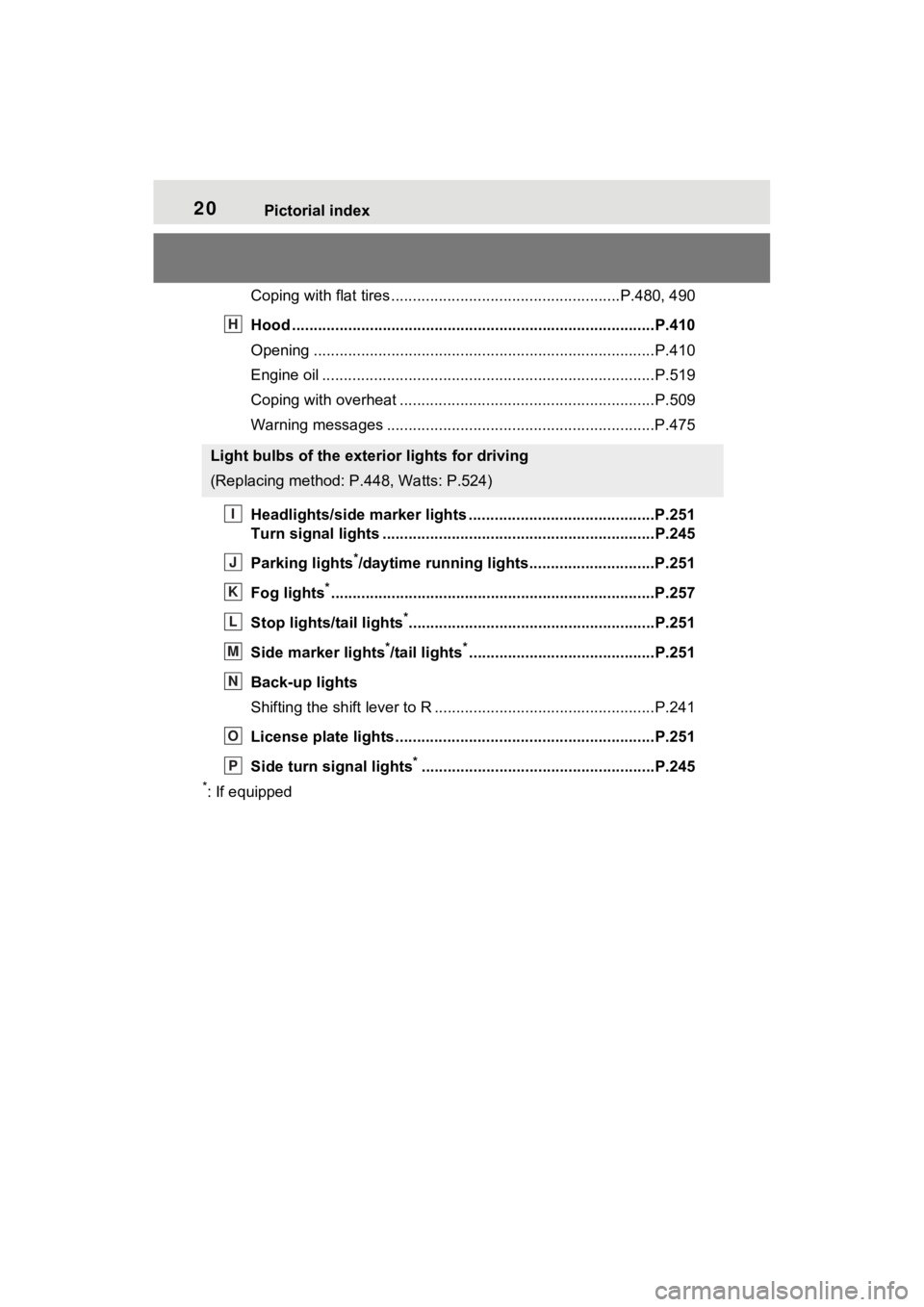
Coping with flat tires.....................................................P.480, 490
Hood ....................................................................................P.410
Opening ........................................................ .......................P.410
Engine oil ..................................................... ........................P.519
Coping with overheat ........................................... ................P.509
Warning messages ..............................................................P.475
Headlights/side marker lights .................................. .........P.251
Turn signal lights ...............................................................P.245
Parking lights
*/daytime running lights.............................P.251
Fog lights
*............................................................... ............P.257
Stop lights/tail lights
*.........................................................P.251
Side marker lights
*/tail lights*...........................................P.251
Back-up lights
Shifting the shift lever to R ...................................................P.241
License plate lights........................................... .................P.251
Side turn signal lights
*......................................................P.245
*: If equipped
Light bulbs of the exterior lights for driving
(Replacing method: P .448, Watts: P.524)
H
I
J
K
L
M
N
O
P
Page 78 of 602

781-3. Emergency assistance
■Enhanced Roadside Assis-
tance
Enhanced Roadside Assistance
adds GPS data to the already
included warranty-based Toyota
roadside service.
Subscribers can press the
“SOS” button to reach a Safety
Connect response-center agent,
who can help with a wide range
of needs, such as: towing, flat
tire, fuel delivery, etc. For a
description of the Enhanced
Roadside Assistance services
and their limitations, please see
the Safety Connect Terms and
Conditions, which are available
at Toyota.com in the United
States, Toyotapr.com in Puerto
Rico and Toyota.ca in Canada.
Important! Read this informa-
tion before using Safety Con-
nect.
■Exposure to radio fre-
quency signals
The Safety Connect system
installed in your vehicle is a low-
power radio transmitter and
receiver. It receives and also
sends out radio frequency (RF)
signals.
In August 1996, the Federal
Communications Commission
(FCC) adopted RF exposure
guidelines with safety levels for mobile wireless phones. Those
guidelines are consistent with
the safety standards previously
set by the following U.S. and
international standards bodies.
ANSI (American National
Standards Institute) C95.1
[1992]
NCRP (National Council on
Radiation Protection and
Measurement) Report 86
[1986]
ICNIRP (International Com-
mission on Non-Ionizing Radi-
ation Protection) [1996]
Those standards were based on
comprehensive and periodic
evaluations of the relevant sci-
entific literature. Over 120 scien-
tists, engineers, and physicians
from universities, and govern-
ment health agencies and
industries reviewed the avail-
able body of research to
develop the ANSI Standard
(C95.1).
The design of Safety Connect
complies with the FCC guide-
lines in addition to those stan-
dards.
Safety information for
Safety Connect
Page 218 of 602

2164-1. Before driving
NOTICE
■Avoiding damage to vehicle
parts
●Do not turn the steering wheel
fully in either direction and hold
it there for an extended period
of time.
Doing so may damage the
power steering motor.
●When driving over bumps in the
road, drive as slowly as possible
to avoid damaging the wheels,
underside of the vehicle, etc.
■If you get a flat tire while driv-
ing
A flat or damaged tire may cause
the following situations.
●It may be difficult to control your
vehicle.
●The vehicle will make abnormal
sounds or vibrations.
●The vehicle will lean abnor-
mally.
Hold the steering wheel firmly and
gradually depress the brake pedal
to slow down the vehicle.
Information on what to do in case
of a flat tire ( P.480, 490)
■When encountering flooded
roads
Do not drive on a road that has
flooded after heavy rain, etc.
Doing so may cause the following
serious damage to the vehicle:
●Engine stalling
●Short in electrical components
●Engine damage caused by
water immersion
In the event that you drive on a
flooded road and the vehicle is
flooded, be sure to have your
Toyota dealer c heck the following:
●Brake function
●Changes in quantity and quality
of oil and fluid used for the
engine, hybrid transmission
(front and rear), etc.
●Lubricant condition for the bear-
ings and suspension joints
(where possible), and the func-
tion of all joints, bearings, etc.
■When parking the vehicle
Always set the parking brake, and
shift the shift lever to P. Failure to
do so may cause the vehicle to
move or the vehicle may acceler-
ate suddenly if t he accelerator
pedal is accidentally depressed.
Page 224 of 602

2224-1. Before driving
■Before towing
Check that the fo llowing conditions
are met:
●Ensure that your vehicle’s tires
are properly inflated. ( P.523)
●Trailer tires are inflated according
to the trailer manufacturer’s rec-
ommendation.
●All trailer lights work as required
by law.
●All lights work each time you con-
nect them.
●The trailer ball is set at the proper
height for the coupler on the
trailer.
●The trailer is level when it is
hitched.
Do not drive if th e trailer is not
level, and check for improper
tongue weight, overloading, worn
suspension, or other possible
causes.
●The trailer cargo is securely
loaded.
●The rear view mirr ors conform to
all applicable fede ral, state/provin-
cial or local regulations. If they do
not, install rear view mirrors
appropriate for towing purposes.
■When towing a trailer
Disable the following systems, as
the systems may no t operate prop-
erly.
●LTA (Lane Tracing Assist)
( P.278)
Trailer towing (with
towing package)
Your vehicle is designed
primarily as a passenger-
and-load-carrying vehicle.
Towing a trailer can have an
adverse impact on handling,
performance, braking, dura-
bility, and fuel consump-
tion. For your safety and the
safety of others, you must
not overload your vehicle or
trailer. You must also
ensure that you are using
appropriate towing equip-
ment, that the towing equip-
ment has been installed
correctly and used properly,
and that you employ the
requisite driving habits.
Vehicle-trailer stability and
braking performance are
affected by trailer stability,
brake performance and set-
ting, trailer brakes, the hitch
and hitch systems (if
equipped).
To tow a trailer safely, use
extreme care and drive the
vehicle in accordance with
your trailer’s characteris-
tics and operating condi-
tions.
Toyota warranties do not
apply to damage or mal-
function caused by towing a
trailer for commercial pur-
poses.
Contact your Toyota dealer for
further information about addi-
tional requirements such as a
towing kit, etc.
Page 257 of 602
2554-3. Operating the lights and wipers
4
Driving
fog, mist, ice, dirt, etc.
• The windshield is cracked or dam- aged
• The front camera is deformed or
dirty
• When the temperature of the front
camera is extremely high
• Surrounding brightness levels are equal to those of h eadlights, tail
lights or fog lights
• When headlights or tail lights of vehicles ahead are turned off,
dirty, changing color, or not aimed
properly
• When the vehicle is hit by water,
snow, dust, etc. fr om a preceding
vehicle
• When driving thr ough an area of
intermittently changing brightness
and darkness
• When frequently and repeatedly
driving ascending/descending
roads, or roads with rough, bumpy
or uneven surfaces (such as
stone-paved roads, gravel roads,
etc.)
• When frequently and repeatedly
taking curves or driving on a wind-
ing road
• There is a highly reflective object
ahead of the vehicle, such as a
sign or mirror
• The back of a vehicle ahead is
highly reflective, such as a con-
tainer on a truck
• The vehicle’s headlights are dam-
aged or dirty, or are not aimed
properly
• The vehicle is listing or tilting due
to a flat tire, a trailer being towed,
etc.
• The high beam and low beam are
repeatedly being switched
between in an abnormal manner
• The driver believes that the high
beam may be causing problems
or distress to other drivers or
pedestrians nearby
■Temporarily lowering sensor
sensitivity
The sensitivity of the sensor can be
temporarily lowered. 1
Turn the power s witch off while
the following conditions are met.
●The headlight switch is in or
position.
●The headlight switch lever is in the
original position.
●Automatic High Beam switch is
on.
2 Turn the power switch to ON.
3 Within 60 seconds after step 2,
repeat pushing the headlight
switch lever to the high beam
position then pulling it to the orig-
inal position quickly 10 times,
then leave the lever in the origi-
nal position.
4 If the sensitivity is changed, the
Automatic High Beam indicator
turns on and off 3 times.
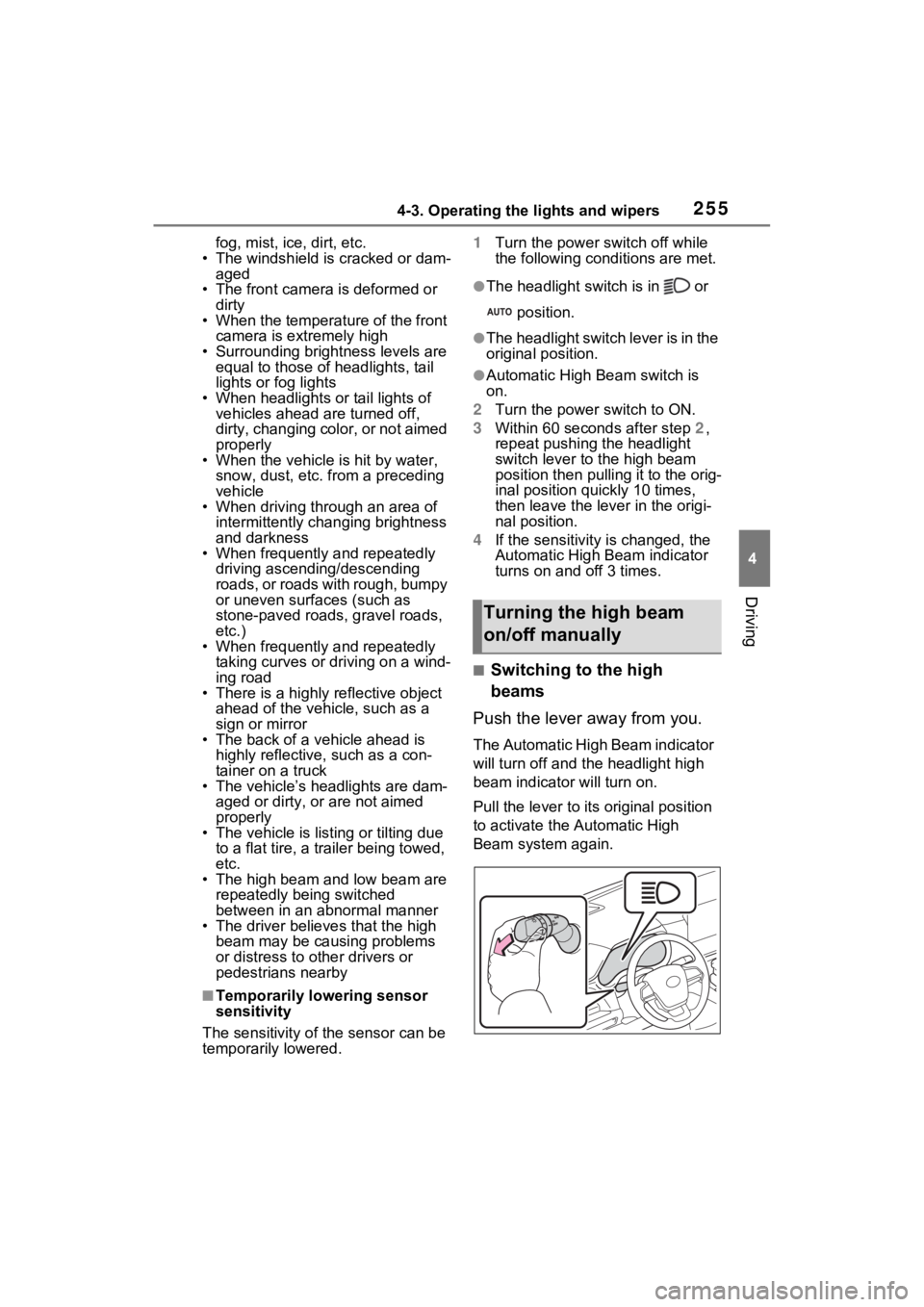
■Switching to the high
beams
Push the lever away from you.
The Automatic High Beam indicator
will turn off and the headlight high
beam indicator will turn on.
Pull the lever to its original position
to activate the Automatic High
Beam system again.
Turning the high beam
on/off manually