light TOYOTA SOLARA 1999 Manual PDF
[x] Cancel search | Manufacturer: TOYOTA, Model Year: 1999, Model line: SOLARA, Model: TOYOTA SOLARA 1999Pages: 244, PDF Size: 2.27 MB
Page 179 of 244
SOLARA_U179
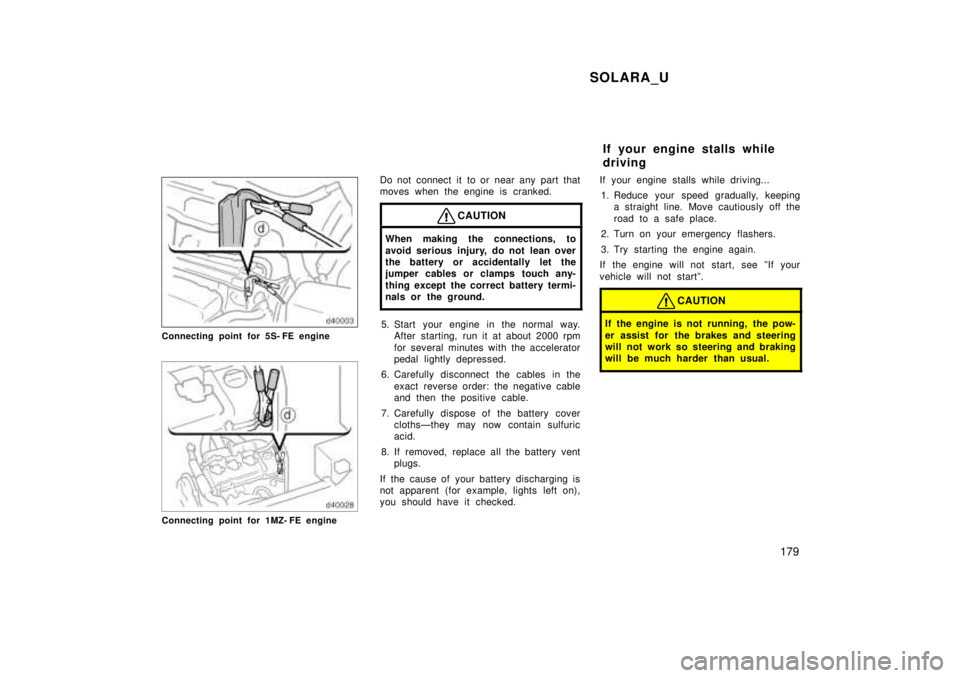
Connecting point for 5S- FE engine
Connecting point for 1MZ- FE engine Do not connect it to or near any part that
moves when the engine is cranked.
CAUTION
When making the connections, to
avoid serious injury, do not lean over
the battery or accidentally let the
jumper cables or clamps touch any-
thing except the correct battery termi-
nals or the ground.
5. Start your engine in the normal way.After starting, run it at about 2000 rpm
for several minutes with the accelerator
pedal lightly depressed.
6. Carefully disconnect the cables in the exact reverse order: the negative cable
and then the positive cable.
7. Carefully dispose of the battery cover clothsÐthey may now contain sulfuric
acid.
8. If removed, replace all the battery vent plugs.
If the cause of your battery discharging is
not apparent (for example, lights left on),
you should have it checked. If your engine stalls while driving...
1. Reduce your speed gradually, keeping a straight line. Move cautiously off the
road to a safe place.
2. Turn on your emergency flashers.
3. Try starting the engine again.
If the engine will not start, see ºIf your
vehicle will not startº.
CAUTION
If the engine is not running, the pow-
er assist for the brakes and steering
will not work so steering and braking
will be much harder than usual.
If your engine stalls while
driving
Page 196 of 244
SOLARA_U
196
Air conditioning control panel, car au-
dio, instrument panel,
c onsole panel,
and switches
Use a soft damp cloth for cleaning.
Soak a clean soft cloth in water or luke-
warm water then lightly
w ipe off dirt.
NOTICE
Do not use organic substances (sol-
vents, kerosene, alcohol,
g asoline,
etc.) or alkaline or acidic solutions. These chemicals can cause discol-
oring, staining or peeling of thesurface.
If you use cleaners or polishing
agents, make sure their ingredientsdo not include the substances men- tioned above.
If you use a liquid car freshener, donot spill the liquid onto the ve-
hicle's interior surfaces. It may con-tain the ingredients mentioned
a-
bove. Immediately clean any spill
using the method mentioned above.
Leather Interior
The leather upholstery may be cleaned
with neutral detergent for wool.
Remove dirt using a soft cloth dampened
with 5% solution of neutral detergent for
wool. Then thoroughly wipe off all traces
of detergent with a clean damp cloth.
After cleaning or whenever any part of the
leather gets wet, dry with a soft clean
cloth. Allow the leather to dry in a venti-
lated shaded area.
NOTICE
If a stain should fail to come outwith a neutral detergent, apply acleaner that does not contain an
organic solvent.
Never use organic substances such as benzine, alcohol or gasoline,
or
alkaline or acid solutions for clean-
ing the leather as thesecould
c ause discoloring.
Use of a nylon brush or synthetic
fiber cloth, etc. may scratch thefine grained surface of the leather.
Mildew may develop on soiled leath-
er upholstery. Be especially carefulto avoid oil spots. Try to keep yourupholstery always clean.
Long exposure to direct sunlight may cause the leather surface toharden and shrink. Keep your ve-
hicle in a shaded area, especially inthe summer.
The interior of your vehicle is aptto heat up on hot summer days,
so
avoid placing on the upholstery
items made of vinyl or plastic orcontaining wax as these tend tostick to leather when warm.
Improper cleaning of the leather up-
holstery could result in discolor-
ation or staining.
If you have any questions about the
cleaning of your Toyota, your local
Toyota dealer will be pleased to answer
them.
Page 200 of 244

SOLARA_U
200
Tire surface and wheel nuts
Check the tires carefully for cuts, damage
or excessive wear. See Chapter 7- 2 for
additional information. When checking the
tires, make sure no nuts are missing, and
check the nuts for looseness. Tighten
them if necessary.
Tire rotation
Rotate the tires every 12000 km (7500
miles). See Chapter 7- 2 for additional in-
formation.
Fluid leaks
Check underneath for leaking fuel, oil, wa-
ter or other fluid after the vehicle has
been parked for a while. If you smell fuel
fumes or notice any leak, have the cause
found and corrected immediately.
Doors and engine hood
Check that all doors including trunk lid
operate smoothly and all latches lock se-
curely. Make sure the engine hood sec-
ondary latch secures the hood from open-
ing when the primary latch is released.
INSIDE THE VEHICLE
Items listed below should be checked
regularly, e.g. while performing periodic
services, cleaning the vehicle, etc.
Lights
Make sure the headlights, stop lights, tail
lights, turn signal lights, and other lights
are all working. Check headlight aim.
Service reminder indicators and warning
buzzers
Check that all service reminder indicators
and warning buzzers function properly.
Steering wheel
Be alert for changes in steering condition,
such as hard steering or strange noise.
Seats
Check that all front seat controls such as
seat adjusters, seatback recliner, etc. op-
erate smoothly and that all latches lock
securely in any position. Check that the
head restraints move up and down
smoothly and that the locks hold securely
in any latched position. For folding- down
rear seatbacks, check that the latches
lock securely.
Seat belts
Check that the seat belt system such as
buckles, retractors and anchors operate
properly and smoothly. Make sure that the
belt webbings not cut, frayed, worn or
damaged.
Accelerator pedal
Check the pedal for smooth operation and
uneven pedal effort or catching.
Clutch pedal
Check the pedal for smooth operation.
Brake pedal
Check the pedal for smooth operation and
that the pedal has the proper clearance.
Check the brake booster function.
Brakes
At a safe place, check that the brakes do
not pull to one side when applied.
Parking brake
Check that the lever has the proper travel
and that, on a safe incline, your vehicle
is held securely with only the parking
brake applied.
Automatic transmission ºParkº mecha-
nism
Check the lock release button of the se-
lector lever for proper and smooth opera-
tion. On a safe incline, check that your
vehicle is held securely with the selector
lever in ºPº position and all brakes re-
leased.
Page 207 of 244
SOLARA_U207
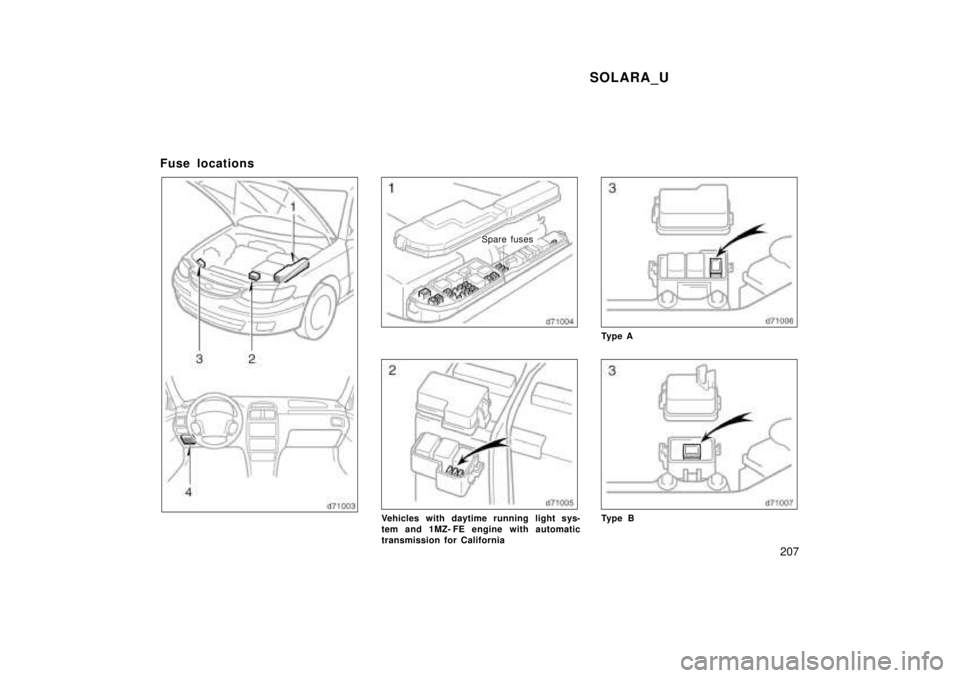
Fuse locations
Spare fuses
Vehicles with daytime running light sys-
tem and 1MZ- FE engine with automatic
transmission for California
Ty p e A
Ty p e B
Page 210 of 244

SOLARA_U
210
Parts and tools
Here is a list of parts and tools you will
need on performing do- it- yourself mainte-
nance. Remember all Toyota parts are de-
signed in metric sizes, so your tools must
be metric.
Checking the engine oil level
Parts (if level is low):
Engine oil API grade SJ,
ºEnergy- Conservingº or ILSAC
multigrade having viscosity proper for
your climate
Tools: Rag or paper towel
Funnel (only for adding oil)
Checking the engine coolant level
Parts (if level is low): ºToyota Long Life Coolantº or equiva-
lent
See Chapter 7- 2 for details about cool-
ant type selection.
Demineralized or distilled water
Tools: Funnel (only for adding coolant)
Checking brake fluid
Parts (if level is low): SAE J1703 or FMVSS No. 116 DOT 3
brake fluid Tools:
Rag or paper towel
Funnel (only for adding fluid)
Checking power steering fluid
Parts (if level is low): Automatic transmission fluid DEXRON )
II or III
Tools: Rag or paper towel
Funnel (only for adding fluid)
Checking battery condition
Tools: Warm water
Baking soda
Grease
Conventional wrench (for terminal
clamp bolts)
Checking and replacing fuses
Parts (if replacement is necessary): Genuine Toyota fuse or equivalent with
same amperage rating as original
Adding washer fluid
Parts: Water
Washer fluid containing antifreeze (for
winter use)
Tools: Funnel Replacing light bulbs
Parts:
Bulb with same number and wattage
rating as original (See charts in ºRe-
placing light bulbsº in Chapter 7- 3.)
Tools: Screwdriver
Flat- bladed screwdriver
Page 212 of 244
SOLARA_U
212
Part 7
DO- IT- YOURSELF
MAINTENANCEÐ
Chapter 7- 2
Engine and Chassis
Checking the engine oil level
Checking the engine coolant
level
Checking brake fluid
Checking power steering fluid
Checking tire pressure
Checking and replacing tires
Rotating tires
Installing snow tires and chains
Replacing wheels
Aluminum wheel precautions
Checking the engine oil level
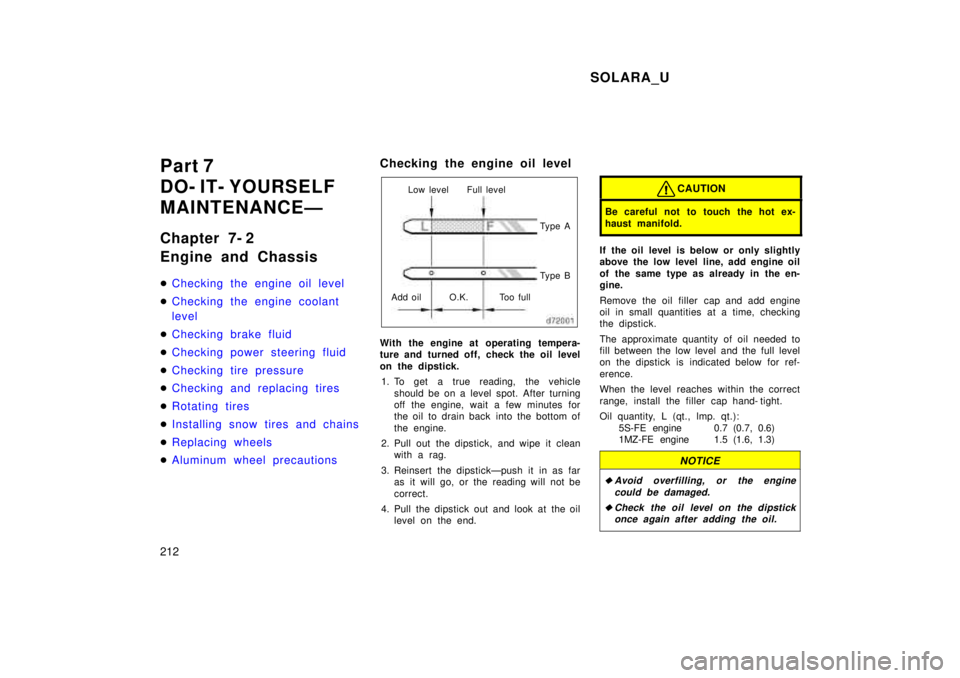
Add oil
Low level Full level
O.K. Too full Ty p e A
Ty p e B
With the engine at operating tempera-
ture and turned off, check the oil level
on the dipstick. 1. To get a true reading, the vehicle should be on a level spot. After turning
off the engine, wait a few minutes for
the oil to drain back into the bottom of
the engine.
2. Pull out the dipstick, and wipe it clean with a rag.
3. Reinsert the dipstickÐpush it in as far as it will go, or the reading will not be
correct.
4. Pull the dipstick out and look at the oil level on the end.
CAUTION
Be careful not to touch the hot ex-
haust manifold.
If the oil level is below or only slightly
above the low level line, add engine oil
of the same type as already in the en-
gine.
Remove the oil filler cap and add engine
oil in small quantities at a time, checking
the dipstick.
The approximate quantity of oil needed to
fill between the low level and the full level
on the dipstick is indicated below for ref-
erence.
When the level reaches within the correct
range, install the f iller cap hand- tight.
Oil quantity, L (qt., lmp. qt.): 5S-FE engine 0.7 (0.7, 0.6)
1MZ-FE engine 1.5 (1.6, 1.3)
NOTICE
Avoid overfilling, or the engine
could be damaged.
Check the oil level on the dipstickonce again after adding the oil.
Page 215 of 244
SOLARA_U215
Checking brake fluid
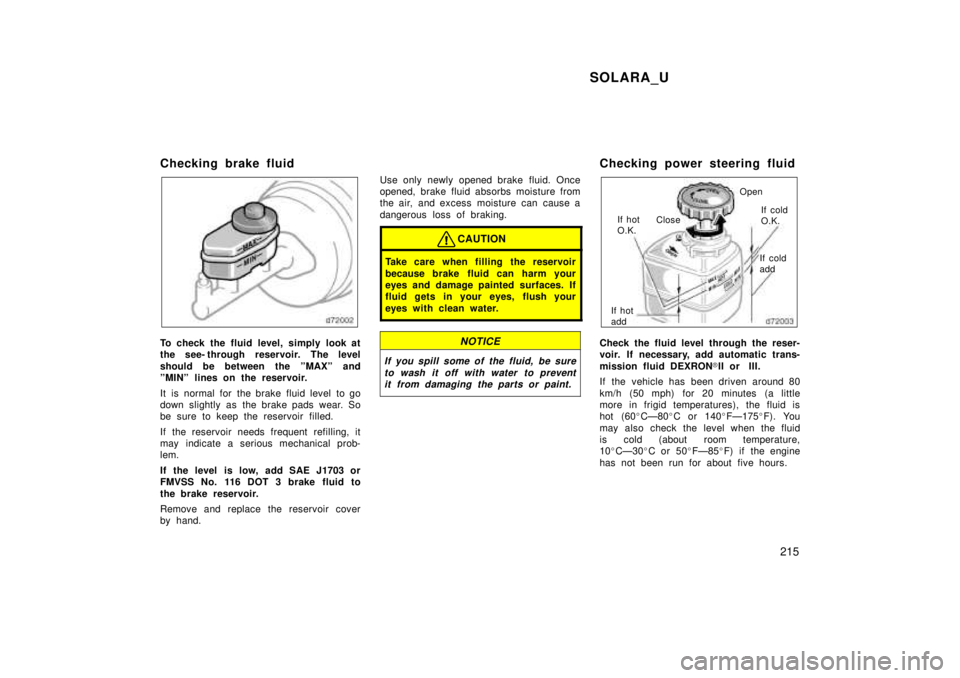
To check the fluid level, simply look at
the see- through reservoir. The level
should be between the ºMAXº and
ºMINº lines on the reservoir.
It is normal for the brake fluid level to go
down slightly as the brake pads wear. So
be sure to keep the reservoir filled.
If the reservoir needs frequent ref
illing, it
may indicate a serious mechanical prob-
lem.
If the level is low, add SAE J1703 or
FMVSS No. 116 DOT 3 brake fluid to
the brake reservoir.
Remove and replace the reservoir cover
by hand. Use only newly opened brake fluid. Once
opened, brake fluid absorbs moisture from
the air, and excess moisture can cause a
dangerous loss of braking.
CAUTION
Take care when filling the r
eservoir
because brake fluid can harm your
eyes and damage painted surfaces. If
fluid gets in your eyes, flush your
eyes with clean water.
NOTICE
If you spill some of the fluid, be sure
to wash it off with water to preventit from damaging the parts or paint.
Checking power steering fluid
If cold addIf cold
O.K.
If hotadd If hot
O.K.
Open
Close
Check the fluid level through the reser-
voir. If necessary, add automatic trans-
mission fluid DEXRON II or III.
If the vehicle has been driven around 80
km/h (50 mph) for 20 minutes (a little
more in frigid temperatures), the fluid is
hot (60 CÐ80 C or 140 FÐ175 F). You
may also check the level when the fluid
is cold (about room temperature,10 CÐ30 C or 50 FÐ85 F) if the engine
has not been run for about five hours.
Page 219 of 244
SOLARA_U219
CAUTION
Do not drive with the snow tires
incorrectly inflated.
Never drive over 120 km/h (75 mph)
with any type of snow tires.
TIRE CHAIN SELECTION
Use tire chains of the correct size.
Use only genuine Toyota tire chains or equiv-
alent for use on the SOLARA.
NOTICE
If the wrong combination of tire and
chain is used, the chains could dam-age the vehicle body.
* SOLARA genuine tire chains
(Part No. 08329- 33801)
Laws about using tire chains vary ac-
cording to locality and type of road, so
always check your local laws before
you install tire chains. CHAIN INSTALLATION
Install the chains on the front tires as
tightly as possible. Do not use tire
chains on the rear tires. Retighten
chains after driving 0.5Ð1.0 km
(1/4Ð1/2 mile).
When installing chains on your tires, care-
fully follow the instructions of the chain
manufacturer.
If wheel covers are used, they will be
scratched by the chain band,so remove
the covers before putting on the chains.
CAUTION
Do not exceed 50 km/h (30 mph) or
the chain manufacturer 's recom-
mended speed limit, whichever is
lower.
Drive carefully avoiding bumps,
holes, and sharp turns, which may
cause the vehicle to bounce.
Avoid sharp turns or locked- wheel
braking, as use of chains may ad-
versely affect vehicle handling.
Replacing wheels
WHEN TO REPLACE YOUR WHEELS
If you have wheel damage such as
bending, cracks or heavy corrosion, the
wheel should be replaced.
If you fail to replace damaged wheels, the
tire may slip off the wheel or they may
cause loss of handling control.
WHEEL SELECTION
When replacing wheels, care should be
taken to ensure that the wheels are re-
placed by ones with the same load ca-
pacity, diameter, rim width, and offset.
This must be observed on compact spare
tires, too.
Correct replacement wheels are available
at your Toyota dealer.
A wheel of a different size or type may
adversely affect handling, wheel and bear-
ing life, brake cooling, speedometer/odom-
eter calibration, stopping ab ility, headlight
aim, bumper height, vehicle ground clear-
ance, and tire or snow chain clearance to
the body and chassis.
Page 222 of 244
SOLARA_U
222
Part 7
DO- IT- YOURSELF
MAINTENANCEÐ
Chapter 7- 3
Electrical components
Checking battery condition
Battery recharging precautions
Checking and replacing fuses
Adding washer fluid
Replacing light bulbs
CAUTION
BATTERY PRECAUTIONS
The battery produces flammable and
explosive hydrogen gas.
Do not cause a spark from the bat-
tery with tools.
Do not smoke or light a match near
the battery.
The electrolyte contains poisonous
and corrosive sulfuric acid. Avoid contact with eyes, skin or
clothes.
Never ingest electrolyte.
Wear protective safety glasses when
working near the battery.
Keep children away from the bat-
tery.
EMERGENCY MEASURES If electrolyte gets in your eyes,
flush your eyes with clean water
immediately and get immediate
medical attention. If possible, con-
tinue to apply water with a sponge
or cloth while en route to the medi-
cal office.
If electrolyte gets on your skin,
thoroughly wash the contact area. If
you feel pain or burning, get medi-
cal attention immediately.
If electrolyte gets on your clothes,
there is a possibility of its soaking
through to your skin, so immediate-
ly take off the exposed clothing and
follow the procedure above, if nec-
essary.
If you happen to swallow electro-
lyte, drink a large quantity of water
or milk. Follow with milk of magne-
sia, beaten raw egg or vegetable
oil. Then go immediately for emer-
gency help.
Checking battery c onditionÐ
ÐPrecautions
Page 223 of 244
SOLARA_U223
ÐChecking battery exterior
TerminalsGround cable
Hold- down clamp
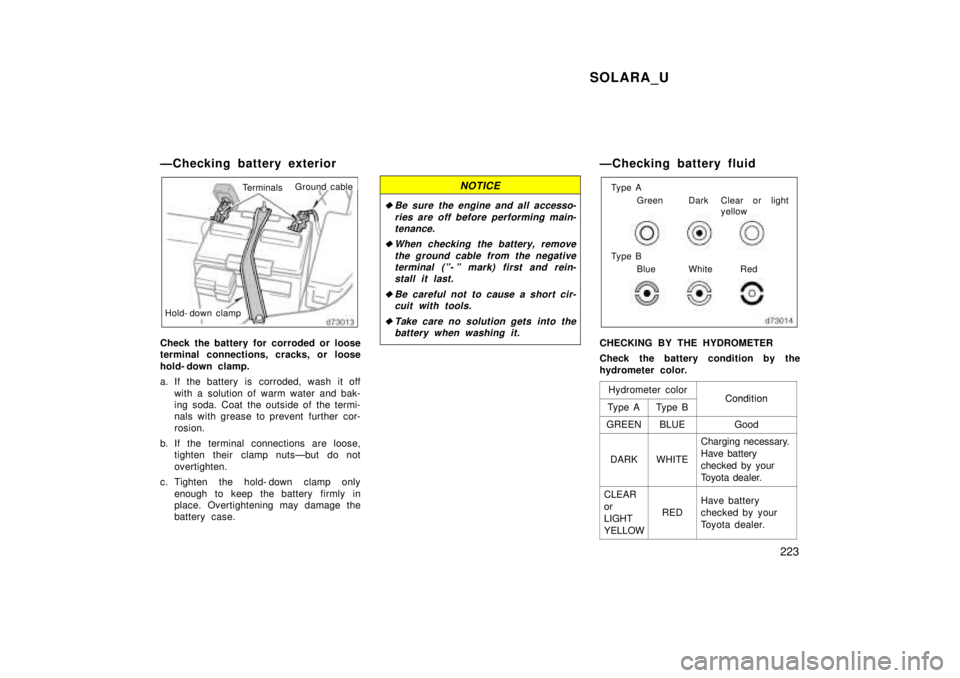
Check the battery for corroded or loose
terminal connections, cracks, or loose
hold- down clamp.
a. If the battery is corroded, wash it off with a solution of warm water and bak-
ing soda. Coat the outside of the termi-
nals with grease to prevent further cor-
rosion.
b. If the terminal connections are loose, tighten their clamp nutsÐbut do not
overtighten.
c. Tighten the hold- down clamp only enough to keep the battery firmly in
place. Overtightening may damage the
battery case.
NOTICE
Be sure the engine and all accesso-
ries are off before performing main-tenance.
When checking the battery, remove
the ground cable from the negativeterminal (º- º mark) first and rein-stall it last.
Be careful not to cause a short cir- cuit with tools.
Take care no solution gets into thebattery when washing it.
ÐChecking battery fluid
Ty p e A
Ty p e B Green Dark Clear or light
yellow
Blue White Red
CHECKING BY THE HYDROMETER
Check the battery condition by the
hydrometer color. Hydrometer color
ConditionTy p e ATy p e BCondition
GREENBLUEGood
DARKWHITE
Charging necessary. Have batterychecked by your
Toyota dealer.
CLEAR orLIGHTYELLOW
RED
Have battery
checked by your
Toyota dealer.