light TOYOTA SUPRA 1996 Repair Manual
[x] Cancel search | Manufacturer: TOYOTA, Model Year: 1996, Model line: SUPRA, Model: TOYOTA SUPRA 1996Pages: 188, PDF Size: 3.84 MB
Page 128 of 188
126Do not connect the cable to or near any
part that moves when the engine is cranked.
NOTICE
When making the connections, do not lean over the battery or
accidentally let the jumper cables or clamps touch anything exceptthe correct battery terminals or the ground.
5. Start your engine in the normal way.
After starting, run it at about 2000 rpm for several minutes with the accelerator ped-
al lightly depressed.
6. Carefully disconnect the cables in the
exact reverse order: the negative cable
and then the positive cable.
7. Carefully dispose of the battery cover
clothsÐthey may now contain sulfuricacid.
8. If removed, replace all the battery vent plugs.
If the cause of your battery discharging is
not apparent (for example, lights left on), you should have it checked. If your engine stalls while driving
0
1. Reduce your speed gradually, keeping
a straight line. Move cautiously off the
road to a safe place.
2. Turn on your emergency flashers.
3. Try starting the engine again.
If the engine will not start, see If your ve-
hicle will not startº.If the engine is not running, the
power assist for the brakes and
steering will not work so steering
and braking will be much harder
than usual. CAUTION
! If your engine coolant temperature
gauge indicates overheating, if you
experience a loss of power, or if you
hear a
loud knocking or pinging noise,
the engine has probably overheated.
You should follow this procedure 0
1. Pull safely off the road, stop the vehicle
and turn on your emergency flashers. Put
the transmission in Pº (automatic) or neu-
tral ( manual) and apply the parking brake.
Turn off the air conditioning if it is beingused.
2. If coolant or steam is boiling out of the
radiator or reservoir, stop the engine. Wait
until the steam subsides before opening
the hood. If there is no coolant boiling over or steam, leave the engine running.
To help avoid personal injury, keep
the hood closed until there is no steam. Escaping steam or coolant
is a sign of very high pressure. CAUTION
!
3. Visually check to see if the engine drive
belt (fan belt) is broken or loose. Look for
obvious coolant leaks from the radiator,
hoses, and under the vehicle. However, note that water draining from the air condi-
tioning is normal if it has been used.
If your vehicle overheats
If your engine stalls while driving
Page 129 of 188
127
When the engine is running, keep
hands and clothing away from the
moving fan and engine drive belts.CAUTION
!
4. If the engine drive belt is broken or the
coolant is leaking, stop the engine immedi-
ately. Call a Toyota dealer for assistance.
5. If the engine drive belt is O.K. and there are no obvious leaks, you may help the en-
gine cool down more quickly by running it
at about 1500 rpm for a few minutes with the accelerator pedal lightly depressed.
6. Check the coolant reservoir. If it is dry,
add coolant to the reservoir while the en- gine is running. Fill it about half full.
Do not attempt to remove the radia-
tor cap when the engine and radia-
tor are hot. Serious injury could re-
sult from scalding hot fluid and
steam blown out under pressure. CAUTION
!
7. After the engine coolant temperature
has cooled to normal, again check the
coolant level in the reservoir. If necessary,
bring it up to half full again. Serious cool-ant loss indicates a leak in the system.
You should have it checked as soon as
possible at your Toyota dealer. 1. Reduce
your speed gradually, keeping
a straight line. Move cautiously off the
road to a safe place well away from the
traffic. Avoid stopping on the center divid-
er of a highway. Park on a level spot with firm ground.
2. Stop the engine and turn on your emer-
gency flashers.
3. Firmly set the parking brake and put the transmission in Pº (automatic) or re- verse (manual).
4. Have everyone get out of the vehicle
on the side away from traffic.
5. Read the following instructions thor-
oughly.When jacking, be sure to observe
the following to reduce the possi-
bility of personal injury: Follow jacking instructions.
Use a jack only for lifting your ve-
hicle during wheel changing.
Never get beneath the vehicle
when supported by a jack.
Do not start or run the engine
while your vehicle is supported
by a jack. CAUTION
!
NOTICE
Do not continue driving with a deflated tire. Driving even a short
distance can damage a tire beyond repair.
If you have a flat tireÐ
Page 130 of 188
128
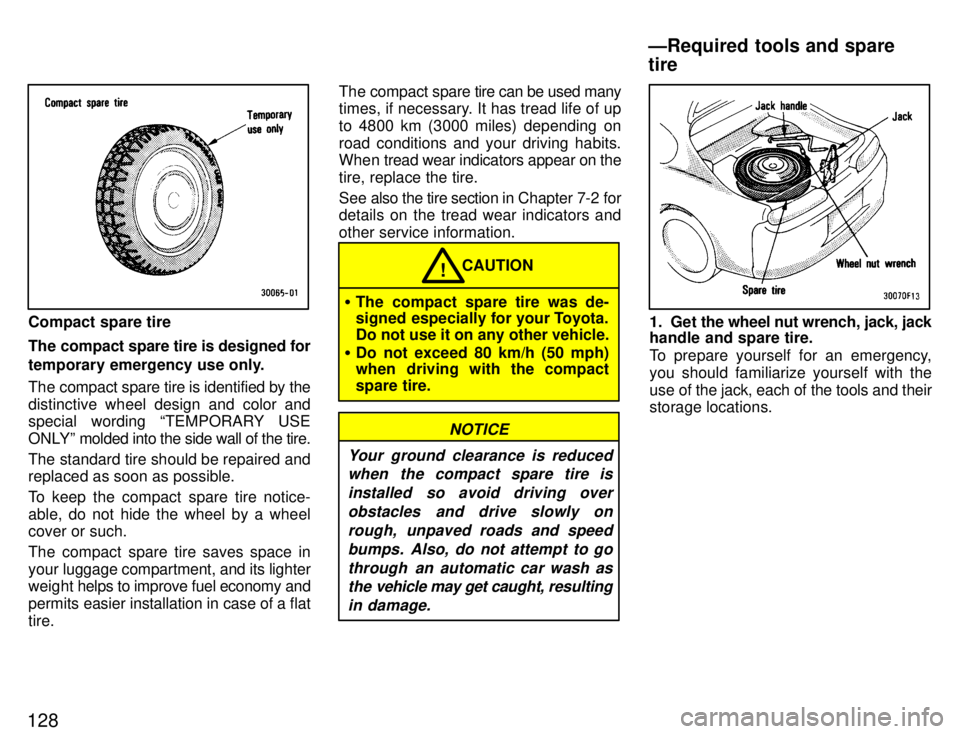
Compact spare tire
The compact spare tire is designed for
temporary emergency use only.
The compact spare tire is identified by the
distinctive wheel design and color and
special wording TEMPORARY USE
ONLYº molded into the side wall of the tire.
The standard tire should be repaired and replaced as soon as possible.
To keep the compact spare tire notice-
able, do not hide the wheel by a wheel cover or such.
The compact spare tire saves space in your luggage compartment, and its lighter
weight helps to i mprove fuel economy and
permits easier installation in case of a flattire. The compact spare
tire can be used many
times, if necessary. It has tread life of up
to 4800 km (3000 miles) depending on
road conditions and your driving habits.
When tread wear indicators appear on the
tire, replace the tire.
See also the tire section in Chapter 7-2 for
details on the tread wear indicators and other service information.
The compact spare tire was de-
signed especially for your Toyota. Do not use it on any other vehicle.
Do not exceed 80 km/h (50 mph)
when driving with the compact spare tire. CAUTION
!
NOTICE
Your ground clearance is reduced when the compact spare tire is
installed so avoid driving overobstacles and drive slowly on rough, unpaved roads and speedbumps. Also, do not attempt to go through an automatic car wash asthe vehicle may get caught, resulting
in damage.
1. Get the wheel nut wrench, jack, jack
handle and spare tire.
To prepare yourself for an emergency, you should familiarize yourself with the
use of the jack, each of the tools and their storage locations.
ÐRequired tools and spare tire
Page 142 of 188
140Begin by vacuuming thoroughly to re-
move as much dirt as possible. Several
types of foam cleaners are available;some are in aerosol cans and others are
powders or
liquids which you mix with wa-
ter to produce a foam. To shampoo the
carpets, use a sponge or brush to apply the foam. Rub in overlapping circles. Do not apply waterÐthe best results are obtained by keeping the carpet as dry as possible. Read the shampoo instructions
and follow them closely. Seat belts
The seat belts may be cleaned with mild
soap and water or with lukewarm water. Use a cloth or sponge. As you are clean-
ing, check the belts for excessive wear,
fraying, or cuts.
Do not use dye or bleach on the
beltsÐit may weaken them.
NOTICE
Windows
The windows may be cleaned with any
household window cleaner.
When cleaning the inside of the win-
dows, be careful not to scratch or
damage the heater wires on the rear window.
NOTICE
Air conditioning control panel, car au-
dio, instrument panel, console panel,
and switches Use a soft damp cloth for cleaning.
Soak a clean soft cloth in water or luke-
warm water then lightly wipe off any dirt.
Do not use organic substances(solvents, kerosene, alcohol, gas-
oline, etc.) or alkaline or acidic
solutions. These chemicals cancause discoloring, staining or
peeling of the surface.
If you use cleaners or polishingagents, make sure their ingredi-
ents do not include the sub-
stances mentioned above.
If you use a liquid car freshener,do not spill the liquid onto the ve-
hicle's interior surfaces. It maycontain the ingredients men-
tioned above. Immediately clean
any spill using the method men-tioned above.
NOTICE
Leather Interior
The leather upholstery may be cleaned
with neutral detergent for wool. Remove dirt using a soft cloth dampened with 5% solution of neutral detergent for
wool. Then thoroughly wipe off all traces
of detergent with a clean damp cloth. After
cleaning or whenever any part of the
leather gets wet, dry with a soft clean
cloth. Allow the leather to dry in a venti-
lated shaded area.
If a stain should fail to come outwith a neutral detergent, apply a
cleaner that does not contain anorganic solvent.
Never use organic substances
such as benzine, alcohol or gaso-line, or alkaline or acid solutionsfor cleaning the leather as these
could cause discoloring.
Use of a nylon brush or syntheticfiber cloth, etc. may scratch the
fine grained surface of the leather.
Mildew may develop on soiled
leather upholstery. Be especially
careful to avoid oil spots. Try tokeep your upholstery alwaysclean.
Long exposure to direct sunlight
may cause the leather surface toharden and shrink. Keep your ve-
hicle in a shaded area, especiallyin the summer.
NOTICE
Page 146 of 188
144You can be confident that your Toyota
dealer's service department performs the
best
job to meet the maintenance require-
ments on your vehicleÐreliably and eco-
nomically.
Your copy of the repair order is proof that
all required maintenance has been per-
formed for warranty coverage. And if any
problems should arise with your vehicle
while under warranty, your Toyota dealer
will promptly take care of it. Again, be sure
to keep a copy of the repair order for any
service performed on your Toyota.
What about do-it-yourself mainte- nance?
Many of the maintenance items are easy
to do yourself if you have a little mechani-
cal ability and a few basic automotive
tools. Simple instructions for how to per-
form them are presented in Part 7.
If you are a skilled do-it-yourself me-
chanic, the Toyota service manuals are recommended. Please be aware that do-
it-yourself maintenance can affect your
warranty coverage. See Owner's Guide,
Owner 's Manual Supplement or W arranty
Booklet for the details. Listed
below are the general maintenance
items that should be performed as fre- quently as specified. In addition to check-
ing the items listed, if you notice any un-
usual noise, smell or vibration, you should
investigate the cause or take your vehicle
to your T oyota dealer or a qualified service
shop immediately. It is recommended thatany problem you notice be brought to theattention of your dealer or the qualified service shop for their advice.
Make these checks only where
adequate ventilation can be ob-
tained if you run the engine. CAUTION
!
OUTSIDE THE VEHICLE
Items listed below should be per-
formed from time to time, unless other-
wise specified.
Tire pressure Check the pressure with a gauge every
two weeks, or at least once a month. See Chapter 7-2 for additional information. Tire surface and wheel nuts Check the tires carefully
for cuts, damage
or excessive wear. See Chapter 7-2 for
additional information. When checking the tires, make sure no nuts are missing,
and check the nuts for looseness. T ighten
them if necessary. Fluid leaks Check underneath for leaking fuel, oil, wa-
ter or other fluid after the vehicle has been
parked for a while. If you smell fuel fumes
or notice any leak, have the cause found
and corrected immediately. Doors and engine hood
Check that all doors including back door
operate smoothly and all latches lock se-
curely. M ake sure the engine hood secon-
dary latch secures the hood from opening
when the primary latch is released. INSIDE THE VEHICLE Items listed below should be checked
regularly, e.g. while performing period-
ic services, cleaning the vehicle, etc. Lights Make sure the headlights, stop lights, tail lights, turn signal lights, and other lights are all working. Check headlight aim.
General maintenance
Page 154 of 188

152Here is a list of parts and tools you will
need on performing do-it-yourself main-
tenance. Remember all Toyota parts are
designed in metric sizes, so your tools
must be metric. Checking the engine oil level Parts (if level is low):
Engine oil API SH, Energy-Conserv-
ing IIº multigrade or ILSAC multigrade
having viscosity proper for your cli-mate
Tools: Rag or paper towel
Funnel (only for adding oil)
Checking the engine coolant level Parts (if level is low): Ethylene-glycol antifreeze
Demineralized or distilled water
Tools: Funnel (only for adding coolant)
Checking brake fluid Parts (if level is low): SAE J1703 or FMVSS No. 116 DOT 3 brake fluid
Tools: Rag or paper towel
Funnel (only for adding fluid) Checking power steering fluid Parts (if level is low):
Automatic transmission fluid DEXRON )
-II or -III
Tools: Rag or paper towel
Funnel (only for adding fluid)
Checking battery condition Non-maintenance batteriesÐ
Tools: Warm water
Baking soda
Grease
Conventional wrench (for terminal clamp bolts)
Maintenance type batteriesÐ Parts (if level is low): Distilled water
Tools: Warm water
Baking soda
Grease
Conventional wrench (for terminal clamp bolts)
Coin (for vent plugs)
Funnel (only for adding distilled water) Checking and replacing fuses Parts (if replacement is necessary):
Fuse with same amperage rating as original
Adding washer fluid Parts: Water
Washer fluid containing antifreeze (for winter use)
Tools: Funnel
Replacing light bulbs Parts: Bulb with same number and wattage rating as original (See charts in Re-
placing light bulbsº in Chapter 7-3.)
Tools: Screwdriver
Parts and tools
Page 155 of 188
Part 7Checking the engine oil level
153
DO-IT-YOURSELF MAINTENANCEÐ
Chapter 7-2 Engine and Chassis
Checking the engine oil level
Checking the engine coolant level
Checking brake fluid
Checking power steering fluid
Checking tire pressure
Checking and replacing tires
Rotating tires
Installing snow tires and chains
Replacing wheels
Aluminum wheel precautions
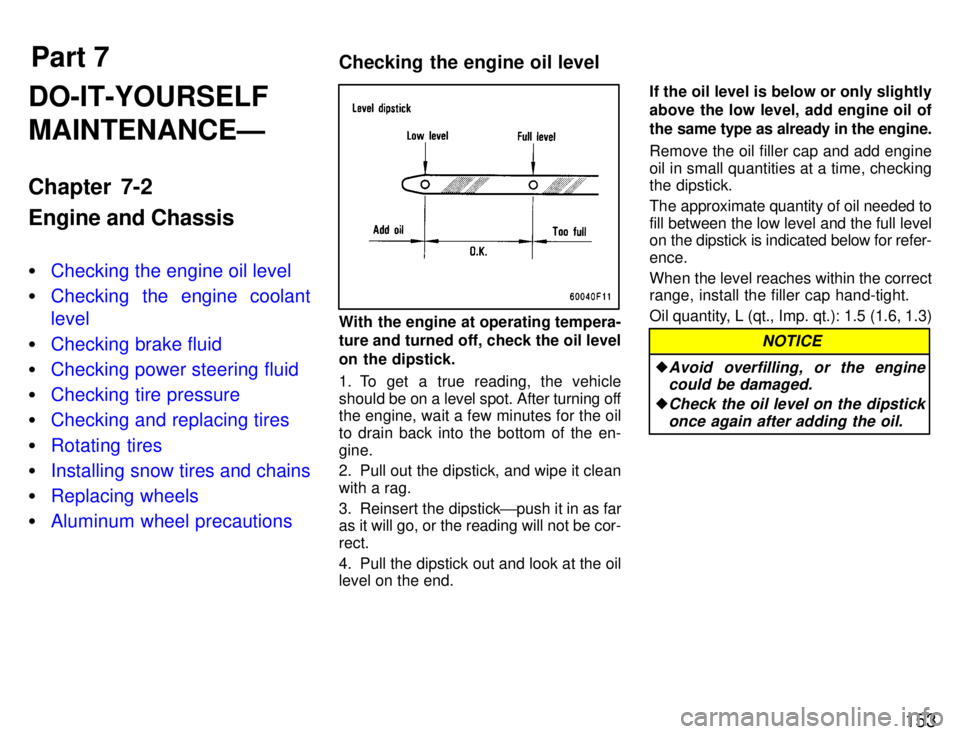
With the engine at operating tempera- ture and turned off, check the oil level
on the dipstick.
1. To get a true reading, the vehicle
should be on a
level spot. After turning off
the engine, wait a few minutes for the oil
to drain back into the bottom of the en-gine.
2. Pull out the dipstick, and wipe it clean with a rag.
3. Reinsert the dipstick 'push it in as far
as it will go, or the reading will not be cor- rect.
4. Pull the dipstick out and look at the oil level on the end. If the oil level is below or only slightly
above the low level, add engine oil of
the same type as already in the engine. Remove the oil filler cap and add engine
oil in small quantities at a time, checking the dipstick.
The approximate quantity of oil needed to fill between the low level and the full level
on the dipstick is indicated below for refer- ence.
When the level reaches within the correct range, install the filler cap hand-tight.
Oil quantity, L (qt., Imp. qt.): 1.5 (1.6, 1.3)
Avoid overfilling, or the enginecould be damaged.
Check the oil level on the dipstick
once again after adding the oil.
NOTICE
Page 158 of 188
156
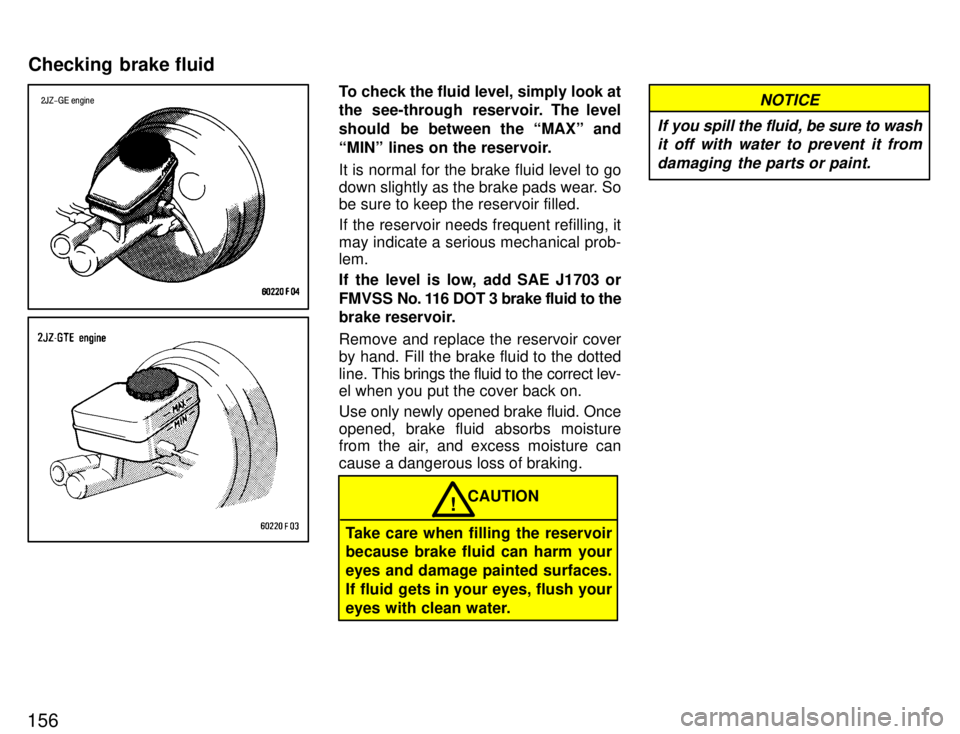
2JZGE engineTo check the fluid level, simply look at
the see-through reservoir. The level
should be between the MAXº and
MINº lines on the reservoir. It is normal for the brake fluid level to go
down slightly as the brake pads wear. So be sure to keep the reservoir filled.
If the reservoir needs frequent refilling, it may indicate a serious mechanical prob- lem.
If the level is low, add SAE J1703 or
FMVSS No. 116 DOT 3 brake fluid to the
brake reservoir. Remove and replace the reservoir cover
by hand. Fill the brake fluid to the dotted
line. This brings the fluid to the correct lev-
el when you put the cover back on. Use only newly opened brake fluid. Once
opened, brake fluid absorbs moisture
from the air, and excess moisture can cause a dangerous loss of braking.
CAUTION
Take care when filling the reservoir
because brake fluid can harm your
eyes and damage painted surfaces.
If fluid gets in your eyes, flush your
eyes with clean water.!
NOTICE
If you spill the fluid, be sure to wash it off with water to prevent it from
damaging the parts or paint.
Checking brake fluid
Page 163 of 188

161
WHEN TO REPLACE YOUR WHEELS
If you have wheel damage such as
bending, cracks or heavy corrosion,
the wheel should be replaced.
If you fail to replace damaged wheels, the
tire may slip off the wheel or they may cause loss of handling control. WHEEL SELECTION
When replacing wheels,
care should be
taken to ensure that the wheels are re- placed by ones with the same load ca-
pacity, diameter, rim width, and offset. This must be observed on compact spare
tires, too.
Correct replacement wheels are available
at your Toyota dealer.
A wheel of a different size or type may ad-
versely affect handling, wheel and bear-
ing life, brake cooling, speedometer/
odometer calibration, stopping ability,
headlight aim, bumper height, vehicle
ground clearance, and tire or snow chainclearance to the body and chassis. Replacement
with used wheels is not rec-
ommended as they may have been sub-jected to rough treatment or high mileageand could fail without warning. Also, bent
wheels which have been straightened
may have structural damage and there-
fore should not be used. Never use an in-
ner tube in a leaking wheel which is de-
signed for a tubeless tire.
After driving your vehicle the first 1600
km (1000 miles), check that the wheel
nuts are tight.
If you have repaired or changed your
tires, check that the wheel nuts are still
tight after driving 1600 km (1000miles).
When using tire chains, be careful not
to damage the aluminum wheels.
Use only the Toyota wheel nuts and
wrench designed for your aluminumwheels.
When balancing your wheels, use only
Toyota balance weights or equivalent
and a plastic or rubber hammer.
As with any wheel, periodically checkyour aluminum wheels for damage. If
damaged, replace immediately.
Replacing wheels
Aluminum wheel precautions
Page 165 of 188
Part 7Checking battery conditionÐ ÐPrecautions
163
DO-IT-YOURSELF MAINTENANCEÐ
Chapter 7-3 Electrical components
Checking battery condition
Battery recharging precautions
Checking and replacing fuses
Adding washer fluid
Checking the headlight aim
Replacing light bulbs
BATTERY PRECAUTIONS
The battery produces flammable
and explosive hydrogen gas.
Do not cause a spark from the bat-
tery with tools.
Do not smoke or light a match near
the battery.
The electrolyte contains poisonous
and corrosive sulfuric acid. Avoid contact with eyes, skin or clothes.
Never ingest electrolyte.
Wear protective safety glasses
when working near the battery.
Keep children away from the bat-
tery.
EMERGENCY MEASURES If electrolyte gets in your eyes,
flush your eyes with clean water
for at least 15 minutes and get im-
mediate medical attention. If pos-
sible, continue to apply water with
a sponge or cloth while en route to
the medical office.
If electrolyte gets on your skin,
thoroughly wash the contact area.
If you feel pain or burning, get
medical attention immediately. CAUTION
!
If electrolyte gets on your clothes,
there is a possibility of its soaking
through to your skin, so immedi- ately take off the exposed cloth-
ing and follow the procedure
above, if necessary.
If you happen to swallow electro-
lyte, drink a large quantity of wa-
ter or milk. Follow with milk of
magnesia, beaten raw egg or veg-
etable oil. Then go immediately
for emergency help.