wheel TOYOTA SUPRA 1998 User Guide
[x] Cancel search | Manufacturer: TOYOTA, Model Year: 1998, Model line: SUPRA, Model: TOYOTA SUPRA 1998Pages: 191, PDF Size: 3.65 MB
Page 103 of 191

SUPRA (U)103
Auxiliary box
To open the box, pull up the strap.
Luggage coverWhen you open the back door, the lug-
gage cover tilt ups for easy access to
the luggage area.
NOTICE
Make sure the luggage cover is surely
stowed.
Traction control system
AUTOMATIC MODE
The traction control system automatical-
ly help control the spinning of the rear
wheels which may occur when acceler-
ating on slippery road surfaces, thus
assisting driver control the driving pow-
er of the rear wheels. When you turn
the ignition switch on, the traction con-
trol system always turns on automati-
cally, and the slip indicator light and
ºSNOWº indicator light will come on.
The indicator lights will go off after
about 3 seconds.
Page 104 of 191

SUPRA (U)
104
Leave the system on during ordinary
driving so that it can operate when
needed. When traction control is ap-
plied, the slip indicator light blinks. If
your vehicle still skids even though
traction control is applied, more power-
ful traction control is applied and the
ºSNOWº indicator light comes on.
You may hear a slight clicking noise in
the engine compartment when the engine
is started. This means that the traction
control system is in the self- check mode,
and does not indicate malfunction. When
the traction control system is operating,
you may feel vibration of your vehicle,
caused by operation of the brakes. This
indicates the system is functioning proper-
ly.
When getting the vehicle out of mud or
new snow, etc. the traction control system
will help operate to prevent the wheels
from spinning.
MANUAL SNOW OPERATION
You can select the snow mode by push-
ing the ºSNOWº switch. The ºSNOWº
indicator light will come on.
To select the automatic mode, push the
ºOFFº switch. The ºSNOWº indicator
light will go off. If your vehicle still
skids, the system automatically oper-
ates.
MANUAL TRACTION CONTROL OFF OP-
ERATION
You can turn off the traction control
system by pushing the ºOFFº switch.
The ºTRAC OFFº indicator/warning light
will come on. Pushing the ºOFFº switch
a second time turns on the traction
control system and the ºTRAC OFFº
indicator/warning light will go off.
If the ºSNOWº indicator light is on,
pushing the ºOFFº switch once selects
the outomatic mode and pushing it a
second time turns off the traction con-
trol system.
Page 105 of 191
SUPRA (U)105
CAUTION
Under certain slippery road condi-
tions, full traction of the vehicle and
power to the rear wheels cannot be
maintained, even though the traction
control system is in operation. Do not
drive the vehicle under any speed or
maneuvering conditions which will
cause the vehicle to lose traction. In
situations where the road surface is
covered with ice or snow, your ve-
hicle should be fitted with snow tires
or tire chains. Always drive at an ap-
propriate and cautions pace.
Floor mat
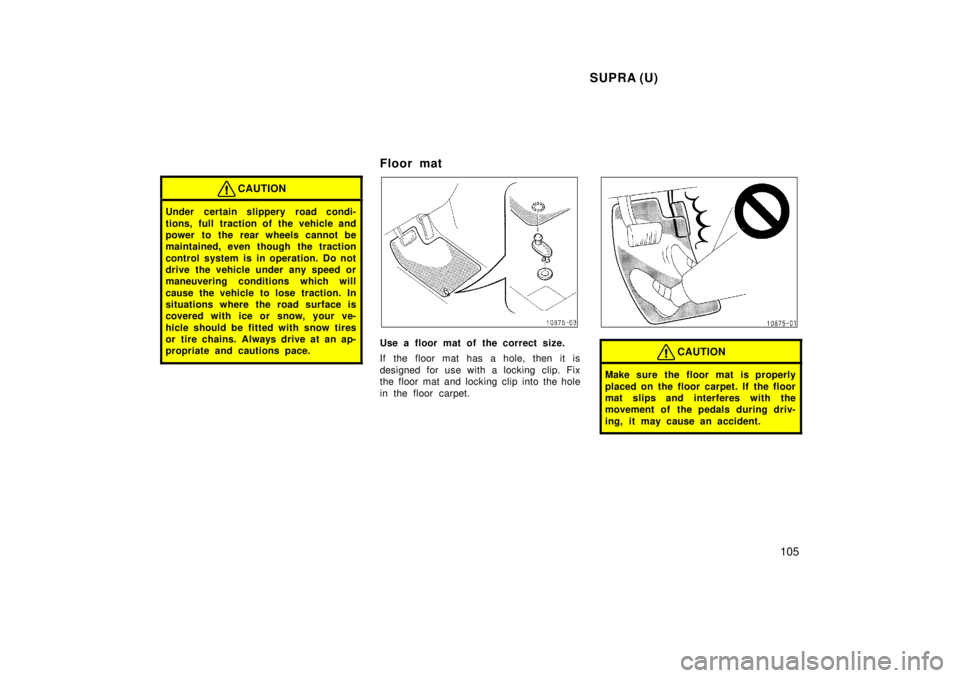
Use a floor mat of the correct size.
If the floor mat has a hole, then it is
designed for use with a locking clip. Fix
the floor mat and locking clip into the hole
in the floor carpet.CAUTION
Make sure the floor mat is properly
placed on the floor carpet. If the floor
mat slips and interferes with the
movement of the pedals during driv-
ing, it may cause an accident.
Page 113 of 191
SUPRA (U)11 3
Brake system
TANDEM MASTER CYLINDER BRAKE SYSTEM
The tandem master cylinder brake system
is a hydraulic system with two separate
sub- systems. If either sub- system s
hould
fail, the other will still work. However, the
pedal will be harder to press, and your
stopping distance will be longer. Also, the
brake system warning light may come on.
CAUTION
Do not drive your vehicle with only a
single brake system. Have your
brakes fixed immediately.
BRAKE BOOSTER
The brake booster uses engine vacuum to
power- assist the brakes. If the engine
should quit while you are driving, you can
bring the vehicle to a stop with normal
pedal pressure. There is enough reserve
vacuum for one or two stops±but no more!
CAUTION
Do not pump the brake pedal if the
engine stalls. Each push on the
pedal uses up your vacuum reserve.
Even if the power assist is com-
pletely lost, the brakes will still
work. But you will have to push the
pedal hard±much harder than nor-
mal. And your braking distance will
be longer.
ANTI- LOCK BRAKE SYSTEM
The anti- lock brake system is designed to
automatically help prevent lock- up of the
wheels during sudden braking or braking
on slippery road surfaces. This assists in
providing directional stab ility and steering
performance of the vehicle under these
circumstances.
The anti- lock brake system becomes op-
erative after the vehicle has accelerated
to a speed in excess of approximately 10
km/h (6 mph). It stops operating when the
vehicle decelerates to a speed below
approximately 5 km/h (3 mph). You may hear a sound in the engine
compartment for a few seconds when the
engine is started or just after the vehicle
is started. This means that the anti- lock
brake system is in the self check mode,
and does not indicate a malfunction.
Effective way to press the ºABSº brake
pedal:
When the anti- lock brake system func-
tion is in action, you may feel the brake
pedal pulsating and hear a noise. In this
situation, to let the anti- lock brake sys-
tem work for you, just hold the brake
pedal down more firmly. Do not pump
the brake. This will result in reduced
braking performance.
The brake pedal pulsation caused by the
anti- lock brake system may indicate haz-
ardous road surface conditions. Although
the anti- lock brake system assists in pro-
viding vehicle control, it is still important
to drive with all due care, because the
anti- lock brake system cannot overcome
the laws of physics that act on your ve-
hicle: Braking capab ility is dependent on tire
friction with the road surface.
Page 114 of 191

SUPRA (U)
11 4
Even though the anti- lock brake sys-
tem is operating, a driver cannot main-
tain full control on certain slippery road
surfaces, when cornering at high
speeds, or in violent maneuvers.
Avoid high speeds on wet roads. The
anti- lock brake system cannot elimi-
nate the risk of hydroplaning and loss
of tire friction.
Always maintain a safe distance from the
vehicle in front of you. Compared with
vehicles not fitted with an anti- lock brake
system, your vehicle may r equire a longer
stopping distance in the following cases:
Driving on rough, gravel or snow- cov-
ered roads.
Driving with tire chains installed.
Driving on roads where the road sur-
face is pitted or has other differences
in surface height.
ºABSº warning light
This light comes on when the ignition key
is turned to the ºONº position. After a few
seconds, the light will go off.
If either of the following conditions occurs,
this indicates a malfunction somewhere in
the parts monitored by the warning light
system. Contact your Toyota dealer as
soon as possible to service the vehicle.
The light does not come on as de-
scribed above, or remains on.
The light comes on while driving. Even if the anti- lock brake system should
fail, the brake system will still operate
conventionally. However, when the ºABSº
warning light is on (and the brake system
warning light is off), the anti- lock brake
system is not assisting brake performance
so that the wheels can lock- up during
sudden braking or braking on slippery
road surfaces. Have your vehicle checked
by your Toyota dealer as soon as pos-
sible.
DRUM- IN- DISC TYPE PARKING BRAKE SYSTEM
Your vehicle has a drum- in- disc type
parking brake system. This type of brake
system n
eeds bedding- down of the brake
shoes periodically or whenever the parking
brake shoes and/or drums are replaced.
Have your Toyota dealer perform the bed-
ding- down.
Page 116 of 191
SUPRA (U)
11 6
Limited- slip differential
Some Toyotas are equipped with a lim-
ited- slip differential. If one rear wheel be-
gins to spin, the limited- slip differential is
designed to aid traction by automatically
transmitting driving force to the other rear
wheel. If you are not sure whether your
vehicle is equipped with one, you can ask
your Toyota dealer.
CAUTION
Do not start or run the engine while
your vehicle is supported by a jack.
The vehicle could be driven off the
jack and could pose a danger or re-
sult in serious injury.
NOTICE
Use only a spare tire of the same
size, construction and load capacityas the original tires on your Toyotabecause damage to the limited- slip
differential could possibly occur withanother tire type.
Your Toyota's identification
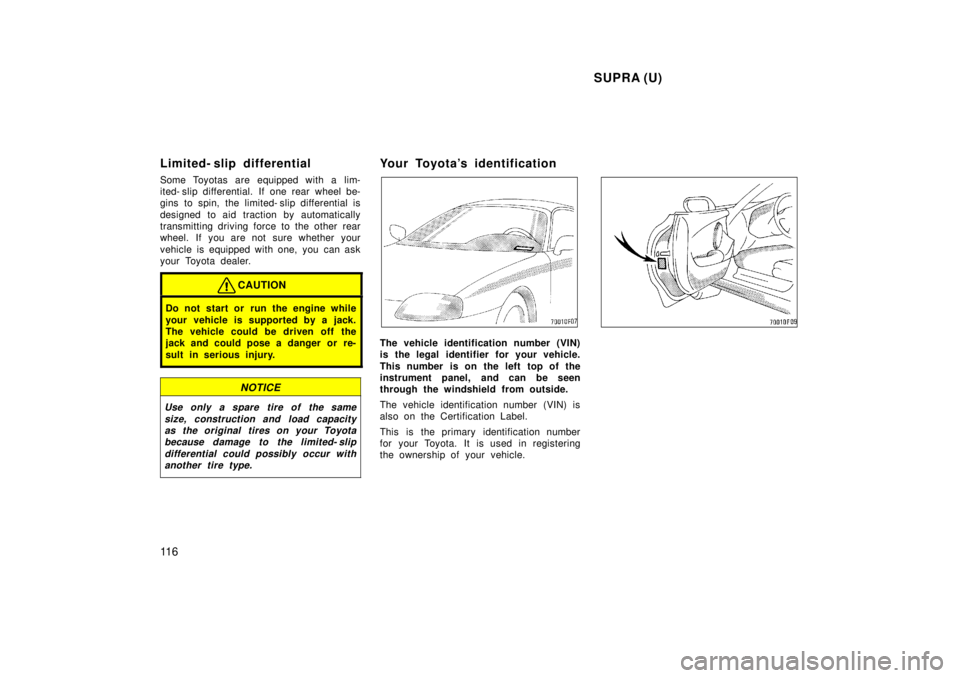
The vehicle identification number (VIN)
is the legal identifier for your vehicle.
This number is on the left top of the
instrument panel, and can be seen
through the windshield from outside.
The vehicle identification number (VIN) is
also on the Certification Label.
This is the primary identification number
for your Toyota. It is used in registering
the ownership of your vehicle.
Page 118 of 191
SUPRA (U)
11 8
Types of tires
Determine what kind of tires your ve-
hicle is originally equipped with.
1. Summer tires
Summer tires are high- speed capab ility
tires best suited to highway driving under
dry conditions.
Since summer tires do not have the same
traction performance as snow tires, sum-
mer tires are inadequate for driving on
snow- covered or icy roads. For driving on
snow- covered or icy roads, we recom-
mend using snow tires. If installing snow
tires, be sure to replace all four tires.
2. All season tires
All season tires are designed to provide
better traction in snow and to be adequate
for driving in most winter conditions, as
well as for use all year round.
All season tires, however, do not have
adequate traction performance compared
with snow tires in heavy or loose snow.
Also, all season tires fall short in accel-
eration and handling performance
compared with summer tires in highway
driving.
CAUTION
Do not mix summer and all season
tires on your vehicle as this can
cause dangerous handling charac-
teristics, resulting in loss of con-
trol.
Do not use tire other than the
manufacturer 's designated tires, and
never mix tires or wheels of the
sizes different from the originals.
Page 119 of 191

SUPRA (U)11 9
Part 3
STARTING AND DRIV-
ING
Before starting the engine
How to start the engine
Precautions for turning off an
engine with turbocharger
Tips for driving in various
conditions
Winter driving tips
Tr ailer towing
How to save fuel and make
your vehicle last longer, too
Before starting the engine
1. Check the area around the vehicle be- fore entering it.
2. Adjust seat position, seatback angle and steering wheel angle.
3. Adjust inside and outside rear view mirrors.
4. Lock all doors.
5. Fasten seat belts. 1. Apply the parking brake firmly.
2. Turn off unnecessary lights and acces-
sories.
3. Manual transmission: Press the clutch
pedal to the floor and shift the trans-
mission into neutral. Hold the clutch
pedal to the floor until the engine is
started. A starter safety device will pre-
vent the starter from operating if the
clutch pedal is not fully depressed.
Automatic transmission: Put the se-
lector lever in ºPº. If you need to re-
start the engine while the vehicle is
moving, put the selector lever in ºNº.
A starter safety device will prevent the
starter from operating if the selector
lever is in any drive position.
4. Automatic transmission only: De-
press the brake pedal and hold it to
the floor until driving off.
How to start the engine±
(a) Before cranking
Page 121 of 191
SUPRA (U)121
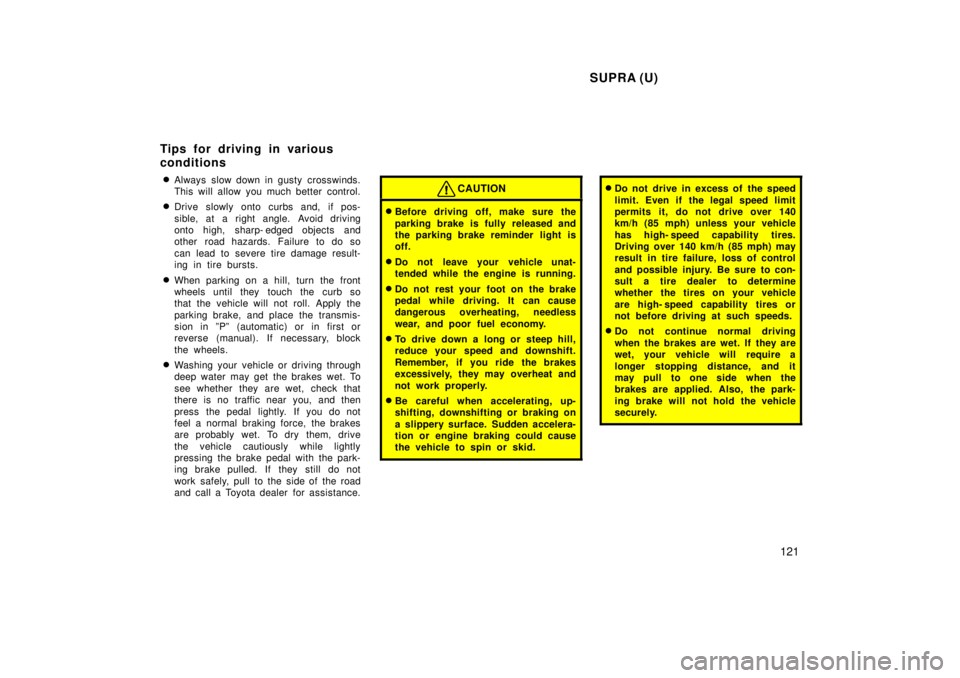
Always slow down in gusty crosswinds.
This will allow you much better control.
Drive slowly onto curbs and, if pos-
sible, at a right angle. Avoid driving
onto high, sharp- edged objects and
other road hazards. Failure to do so
can lead to severe tire damage result-
ing in tire bursts.
When parking on a hill, turn the front
wheels until they touch the curb so
that the vehicle will not roll. Apply the
parking brake, and place the transmis-
sion in ºPº (automatic) or in first or
reverse (manual). If necessary, block
the wheels.
Washing your vehicle or driving through
deep water may get the brakes wet. To
see whether they are wet, check that
there is no traffic near you, and then
press the pedal lightly. If you do not
feel a normal braking force, the brakes
are probably wet. To dry them, drive
the vehicle cautiously while lightly
pressing the brake pedal with the park-
ing brake pulled. If they still do not
work safely, pull to the side of the road
and call a Toyota dealer for assistance.
CAUTION
Before driving off, make sure the
parking brake is fully released and
the parking brake reminder light is
off.
Do not leave your vehicle unat-
tended while the engine is running.
Do not rest your foot on the brake
pedal while driving. It can cause
dangerous overheating, needless
wear, and poor fuel economy.
To drive down a long or steep hill,
reduce your speed and downshift.
Remember, if you ride the brakes
excessively, they may overheat and
not work properly.
Be careful when accelerating, up-
shifting, downshifting or braking on
a slippery surface. Sudden accelera-
tion or engine braking could cause
the vehicle to spin or skid.
Do not drive in excess of the speed
limit. Even if the legal speed limit
permits it, do not drive over 140
km/h (85 mph) unless your vehicle
has high- speed capability tires.
Driving over 140 km/h (85 mph) may
result in tire failure, loss of control
and possible injury. Be sure to con-
sult a tire dealer to determine
whether the tires on your vehicle
are high- speed capability tires or
not before driving at such speeds.
Do not continue normal driving
when the brakes are wet. If they are
wet, your vehicle will require a
longer stopping distance, and it
may pull to one side when the
brakes are applied. Also, the park-
ing brake will not hold the vehicle
securely.
Tips for driving in various
conditions
Page 122 of 191

SUPRA (U)
122
Winter driving tips
Make sure you have ethylene- glycol an-
tifreeze in the radiator.
NOTICE
Do not use alcohol type antifreeze.
Check the condition of the battery and
cables.
Cold temperatures reduce the capacity of
any battery, so it must be in top shape
to provide enough power for winter start-
ing. Chapter 7- 3 tells you how to visually
inspect the battery. Your Toyota dealer
and most service stations will be pleased
to check the level of charge.
Make sure the engine oil viscosity is
suitable for the cold weather.
See Chapter 7- 2 for recommended viscos-
ity. Leaving a heavy summer oil in your
vehicle during winter months may cause
harder starting. If you are not sure about
which oil to use, call your Toyota dealer±
he will be pleased to help.
Keep the door locks from freezing.
Squirt lock de- icer or glycerine into the
locks to keep them from freezing. To open
a frozen lock, try heating the key before
inserting it.
Use a washer fluid containing an anti-
freeze solution.
This product is available at your Toyota
dealer and most auto parts stores. Follow
the manufacturer 's directions for how
much to mix with water.NOTICE
Do not use engine antifreeze or any
other substitute as washer fluid be-cause it may damage your vehicle's paint.
Do not use your parking brake when
there is a possibility it could freeze.
When parking, put the transmission into
ºPº (automatic) or into first or reverse
(manual) and block the front wheels. Do
not use the parking brake, or snow or
water accumulated in and around the
parking brake mechanism may freeze,
making it hard to release.
Keep ice and snow from accumulating
under the fenders.
Ice and snow built up under your fenders
can make steering difficult. During bad
winter driving, stop and check under the
fenders occasionally. Depending on where you are driving,
we recommend you carry some emer-
gency equipment.
Some of the things you might put in the
vehicle are tire chains, window scraper,
bag of sand or salt, flares, small shovel,
jumper cables, etc.