wheel TOYOTA SUPRA 1998 Owner's Manual
[x] Cancel search | Manufacturer: TOYOTA, Model Year: 1998, Model line: SUPRA, Model: TOYOTA SUPRA 1998Pages: 191, PDF Size: 3.65 MB
Page 123 of 191

SUPRA (U)123
Trailer towing
Toyota does not recommend towing a trail-
er with your Supra. It is not designed for
trailer towing.
Getting more kilometers/mileage from a
liter/gallon of fuel is easyÐjust take it
easy. It will help make your vehicle last
longer, too. Here are some specific tips
on how to save money on both fuel and
repairs:
Keep your tires inflated at the cor-
rect pressure. Underinflation causes
tire wear and wastes fuel. See Chapter
7- 2 for instructions.
Do not carry unneeded weight in
your vehicle. Excess weight puts a
heavier load on the engine, causing
greater fuel consumption.
Avoid lengthy warm- up idling. Once
the engine is running smoothly, begin
drivingÐbut gently. Remember, howev-
er, that on cold winter days this may
take a little longer.
Accelerate slowly and smoothly.
Avoid jackrabbit starts. Get into high
gear as quickly as possible.
Avoid long engine idling. If you have
a long wait and you are not in traffic,
it is better to turn off the engine and
start again later.
Avoid engine lug or overrevving. Use
a gear position suitable for the road on
which you are travelling.
Avoid continuous speeding up and
slowing down. Stop- and- go driving
wastes fuel.
Avoid unnecessary stopping and
braking. Maintain a steady pace. Try
to time the traffic signals so you only
need to stop as little as possible or
take advantage of through streets to
avoid traffic lights. Keep a proper dis-
tance from other vehicles to avoid sud-
den braking. This will also reduce wear
on your brakes.
Avoid heavy traffic or traffic jams
whenever possible.
Do not rest your foot on the clutch
or brake pedal. This causes needless
wear, overheating and poor fuel econo-
my.
Maintain a moderate speed on high-ways. The faster you drive, the greater
the fuel consumption. By reducing your
speed, you will cut down on fuel con-
sumption.
Keep the front wheels in proper
alignment. Avoid hitting the curb and
slow down on rough roads. Improper
alignment not only causes faster tire
wear but also puts an extra load on
the engine, which, in turn, wastes fuel.
How to save fuel and make
your vehicle last longer, too
Page 130 of 191
SUPRA (U)
130
If you have a flat tireÐ
1. Reduce your speed gradually, keeping a straight line. Move cautiously off the
road to a safe place well away from
the traffic. Avoid stopping on the center
divider of a highway. Park on a level
spot with firm ground.
2. Stop the engine and turn on your emergency flashers.
3. Firmly set the parking brake and put the transmission in ºPº (automatic) or
reverse (manual).
4. Have everyone get out of the vehicle on the side away from traffic.
5. Read the following instructions thor- oughly.
CAUTION
When jacking, be sure to observe the
following to reduce the possibility of
personal injury: Follow jacking instructions.
Do not start or run the engine while
your vehicle is supported by the
jack.
Stop the vehicle on a level firm
ground, firmly set the parking brake
and put the transmission in Pº
(automatic) or reverse (manual).
Block the wheel diagonally opposite
to the one being changed if neces-
sary.
Make sure to set the jack properly
in the jack point. Raising the ve-
hicle with jack improperly posi-
tioned will damage the vehicle or
may allow the vehicle to fall off the
jack and cause personal injury.
Never get under the vehicle when
the vehicle is supported by the jack
alone.
Use the jack only for lifting your
vehicle during wheel changing.
Do not raise the vehicle with some-
one in the vehicle.
When raising the vehicle, do not
put an object on or under the jack.
Raise the vehicle only high enough
to remove and change the tire.NOTICE
Do not continue driving with a de-
flated tire. Driving even a short dis-tance can damage a tire beyond re- pair.
Page 131 of 191
SUPRA (U)131
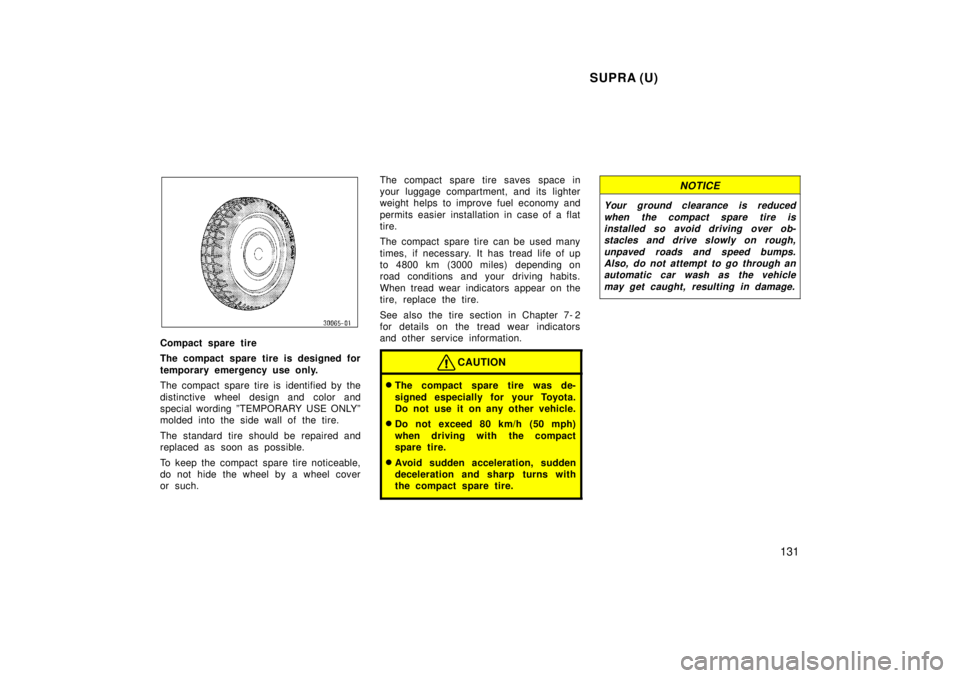
Compact spare tire
The compact spare tire is designed for
temporary emergency use only.
The compact spare tire is identified by the
distinctive wheel design and color and
special wording ºTEMPORARY USE ONLYº
molded into the side wall of the tire.
The standard tire should be repaired and
replaced as soon as possible.
To keep the compact spare tire noticeable,
do not hide the wheel by a wheel cover
or such. The compact spare tire saves space in
your luggage compartment, and its lighter
weight helps to improve fuel economy and
permits easier installation in case of a flat
tire.
The compact spare tire can be used many
times, if necessary. It has tread life of up
to 4800 km (3000 miles) depending on
road conditions and your driving habits.
When tread wear indicators appear on the
tire, replace the tire.
See also the tire section in Chapter 7- 2
for details on the tread wear indicators
and other service information.
CAUTION
The compact spare tire was de-
signed especially for your Toyota.
Do not use it on any other vehicle.
Do not exceed 80 km/h (50 mph)
when driving with the compact
spare tire.
Avoid sudden acceleration, sudden
deceleration and sharp turns with
the compact spare tire.
NOTICE
Your ground clearance is reduced
when the compact spare tire isinstalled so avoid driving over ob- stacles and drive slowly on rough,
unpaved roads and speed bumps.Also, do not attempt to go through anautomatic car wash as the vehicle
may get caught, resulting in damage.
Page 132 of 191

SUPRA (U)
132
ÐRequired tools and spare tire
1. Get the wheel nut wrench, jack, jack
handle and spare tire.
To prepare yourself for an emergency, you
should fam iliarize yourself with the use of
the jack, each of the tools and their stor-
age locations.To remove the jack, loosen the bolt and
remove it.
When storing the jack, secure it by follow-
ing removal step in reverse order to pre-
vent it from flying forward during a colli-
sion or sudden braking.To remove the spare tire:
1. Remove the spare tire cover.
2. Loosen the bolt and remove it.
When storing the spare tire, put it in place
with the outer side of the wheel facing up.
Then secure the tire by repeating the
above removal steps in reverse order to
prevent it from flying forward during a
collision or s udden braking.
Page 133 of 191
SUPRA (U)133
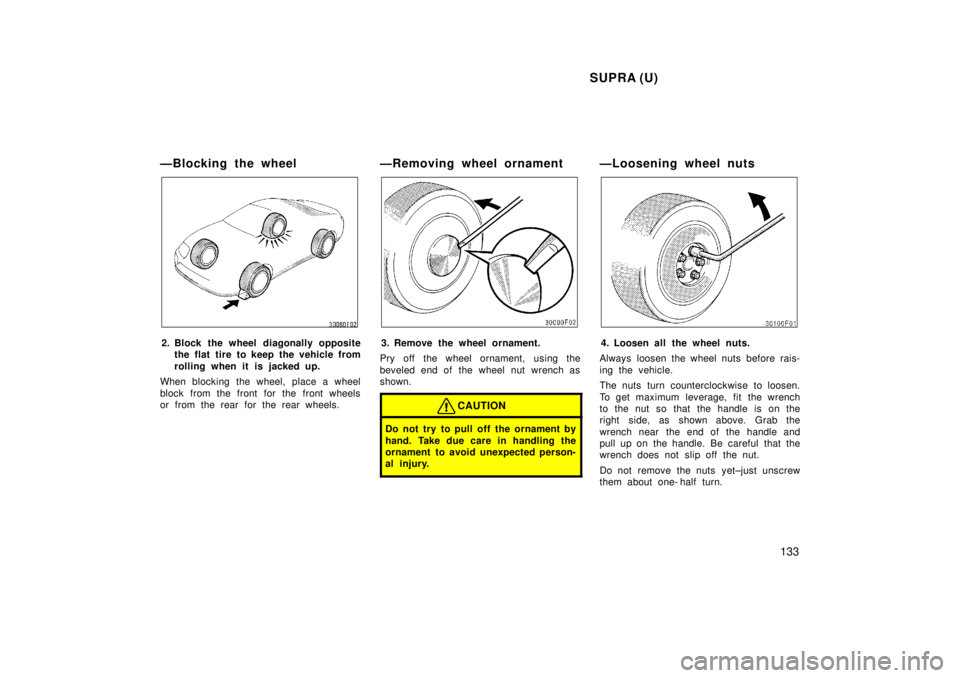
ÐBlocking the wheel
2. Block the wheel diagonally opposite
the flat tire to keep the vehicle from
rolling when it is j acked up.
When blocking the wheel, place a wheel
block from the front for the front wheels
or from the rear for the rear wheels. ÐRemoving wheel ornament3. Remove the wheel ornament.
Pry off the wheel ornament, using the
beveled end of the wheel nut wrench as
shown.
CAUTION
Do not try to pull off the ornament by
hand. Take due care in handling the
ornament to avoid unexpected person-
al injury.
ÐLoosening wheel nuts
4. Loosen all the wheel nuts.
Always loosen the wheel nuts before rais-
ing the vehicle.
The nuts turn counterclockwise to loosen.
To get maximum leverage, fit the wrench
to the nut so that the handle is on the
right side, as shown above. Grab the
wrench near the end of the handle and
pull up on the handle. Be careful that the
wrench does not slip off the nut.
Do not remove the nuts yet±just unscrew
them about one- half turn.
Page 135 of 191

SUPRA (U)135
ÐChanging wheels
7. Remove the wheel nuts and change
tires.
Lift the flat tire straight off and put it
aside.
Roll the spare wheel into position and
align the holes in the wheel with the bolts.
Then lift up the wheel and get at least the
top bolt started through its hole. Wiggle
the tire and press it back over the other
bolts.Before putting on wheels, remove any cor-
rosion on the mounting surfaces with a
wire brush or such. Installation of wheels
without good metal- to- metal contact at the
mounting surface can cause wheel nuts to
loosen and eventually cause a wheel to
come off while driving. Therefore after the
first 1600 km (1000 miles), check to see
that the wheel nuts are tight. ÐReinstalling wheel nuts8. Reinstall all the wheel nuts finger
tight.
Reinstall the wheel nuts and tighten them
as much as you can by hand. Press back
on the tire back and see if you can tight-
en them more.
Page 136 of 191
SUPRA (U)
136
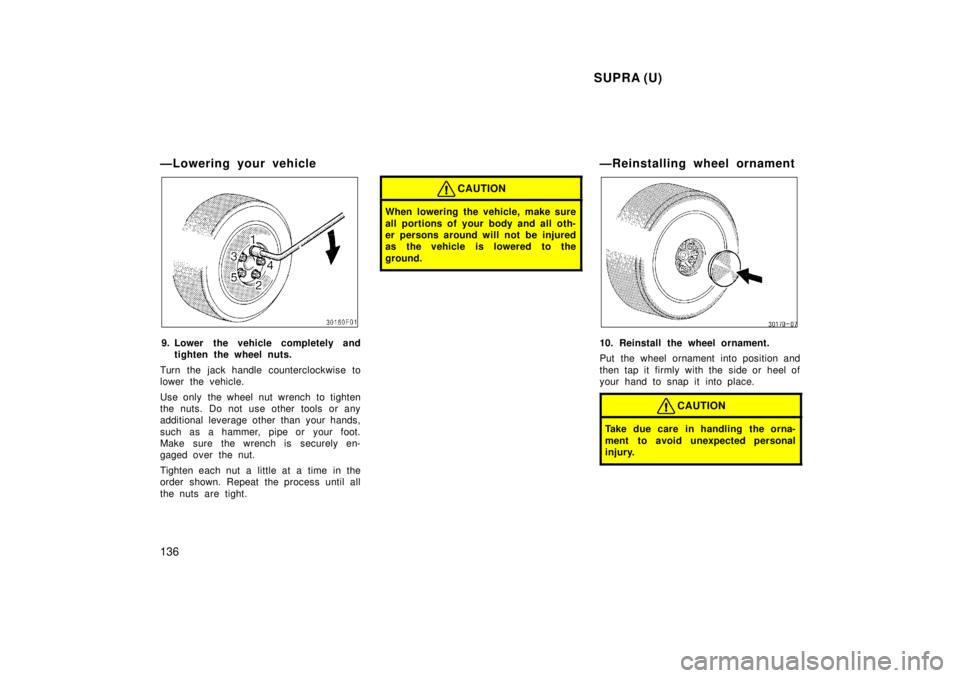
ÐLowering your vehicle
9. Lower the vehicle completely and
tighten the wheel nuts.
Turn the jack handle counterclockwise to
lower the vehicle.
Use only the wheel nut wrench to tighten
the nuts. Do not use other tools or any
additional leverage other than your hands,
such as a hammer, pipe or your foot.
Make sure the wrench is securely en-
gaged over the nut.
Tighten each nut a little at a time in the
order shown. Repeat the process until all
the nuts are tight.
CAUTION
When lowering the vehicle, make sure
all portions of your body and all oth-
er persons around will not be injured
as the vehicle is lowered to the
ground.
ÐReinstalling wheel ornament
10. Reinstall the wheel ornament.
Put the wheel ornament into position and
then tap it firmly with the side or heel of
your hand to snap it into place.
CAUTION
Take due care in handling the orna-
ment to avoid unexpected personal
injury.
Page 137 of 191
SUPRA (U)137
ÐAfter changing wheels
11. Check the air pressure of the re-
placed tire.
Adjust the air pressure to the specification
designated in Part 8. If the pressure is
lower, drive slowly to the nearest service
station and fill to the correct pressure.
Do not forget to reinstall the tire inflation
valve cap as dirt and moisture could get
into the valve core and possibly cause air
leakage. If the cap is missing, have a new
one put on as soon as possible.
12. Restow all the tools, jack and flat
tire securely.
As soon as possible after changing
wheels, tighten the wheel nuts to the
torque specified in Part 8 with a torque
wrench, have a technician repair the flat
tire and replace the spare tire with it.
CAUTION
Before driving, make sure all the
tools, jack and flat tire are securely
in place in their storage location to
reduce the possibility of personal in-
jury during a collision or s
udden
braking.
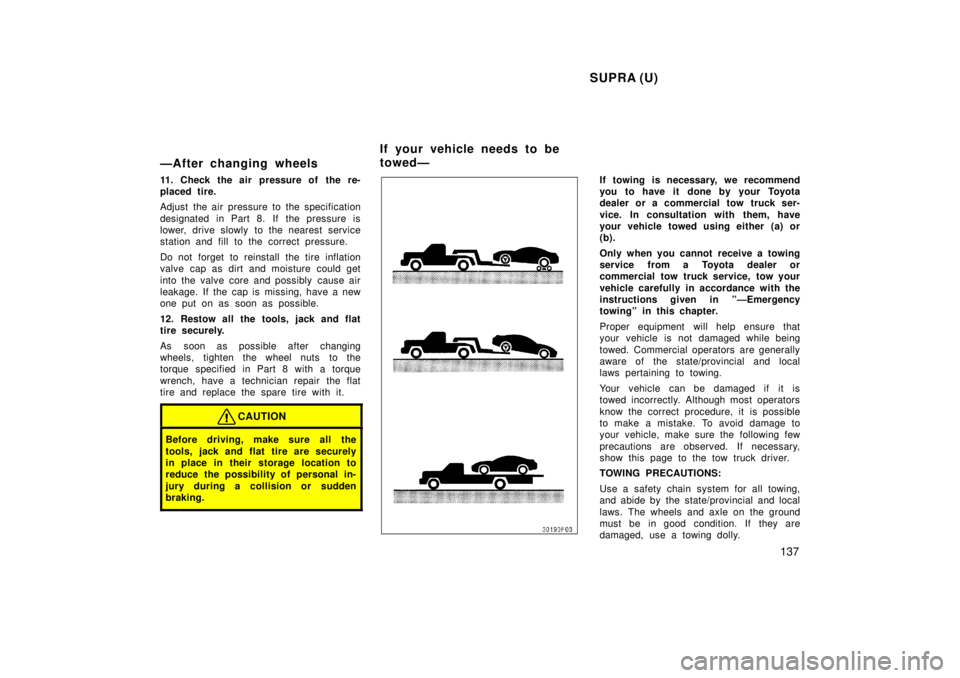
If towing is necessary, we recommend
you to have it done by your Toyota
dealer or a commercial tow truck ser-
vice. In consultation with them, have
your vehicle towed using either (a) or
(b).
Only when you cannot receive a towing
service from a Toyota dealer or
commercial tow truck service, tow your
vehicle carefully in accordance with the
instructions given in ºÐEmergency
towingº in this chapter.
Proper equipment will help ensure that
your vehicle is not damaged while being
towed. Commercial operators are generally
aware of the state/provincial and local
laws pertaining to towing.
Your vehicle can be damaged if it is
towed incorrectly. Although most operators
know the correct procedure, it is possible
to make a mistake. To avoid damage to
your vehicle, make sure the following few
precautions are observed. If necessary,
show this page to the tow truck driver.
TOWING PRECAUTIONS:
Use a safety chain system for all towing,
and abide by the state/provincial and local
laws. The wheels and axle on the ground
must be in good condition. If they are
damaged, use a towing dolly.
If your vehicle needs to be
towedÐ
Page 138 of 191
SUPRA (U)
138
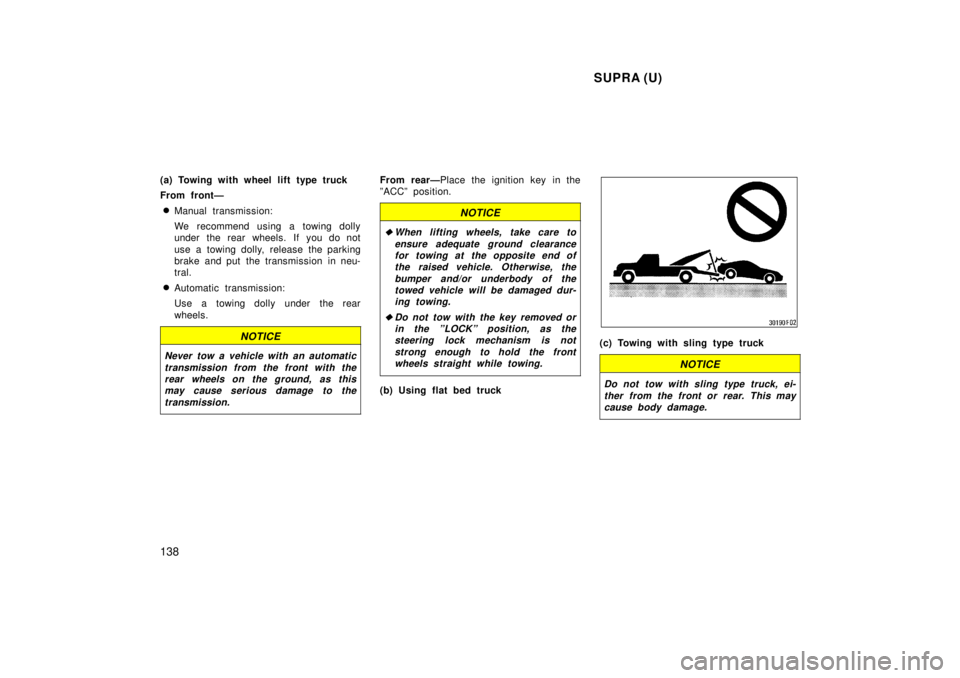
(a) Towing with wheel lift type truck
From frontÐ
Manual transmission:
We recommend using a towing dolly
under the rear wheels. If you do not
use a towing dolly, release the parking
brake and put the transmission in neu-
tral.
Automatic transmission:
Use a towing dolly under the rear
wheels.
NOTICE
Never tow a vehicle with an automatic
transmission from the front with therear wheels on the ground, as thismay cause serious damage to the
transmission.
From rearÐ Place the ignition key in the
ºACCº position.
NOTICE
When lifting wheels, take care to
ensure adequate ground clearancefor towing at the opposite end ofthe raised vehicle. Otherwise, the
bumper and/or underbody of thetowed vehicle will be damaged dur-ing towing.
Do not tow with the key removed orin the ºLOCKº position, as thesteering lock mechanism is not
strong enough to hold the frontwheels straight while towing.
(b) Using flat bed truck
(c) Towing with sling type truck
NOTICE
Do not tow with sling type truck, ei-
ther from the front or rear. This maycause body damage.
Page 139 of 191
SUPRA (U)139
ÐEmergency towing
If towing is necessary, we recommend
you to have it done by your Toyota
dealer or a commercial tow truck ser-
vice.
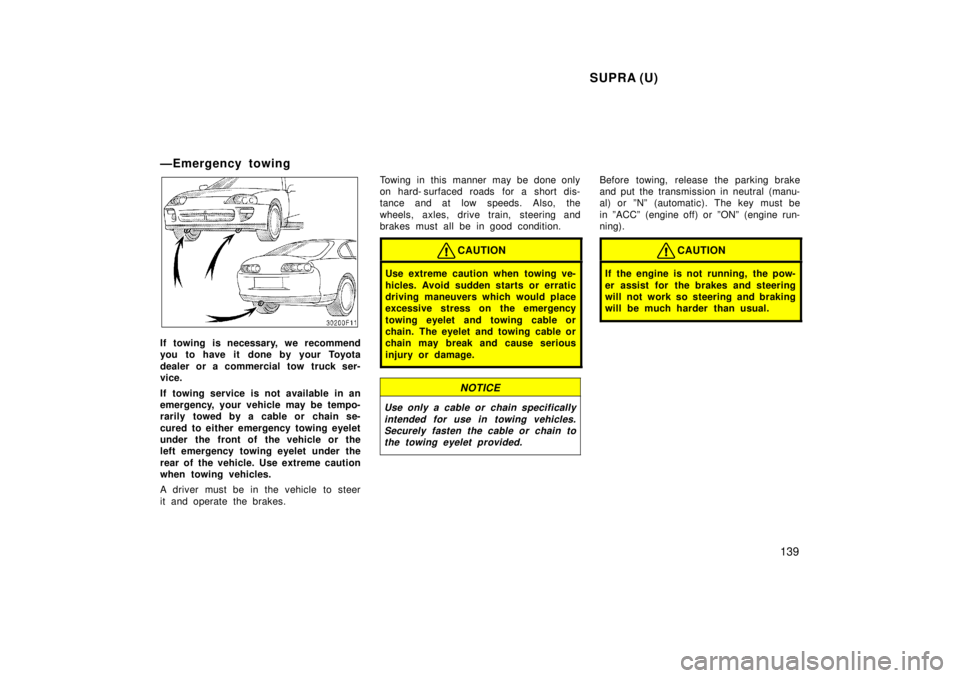
If towing service is not available in an
emergency, your vehicle may be tempo-
rarily towed by a cable or chain se-
cured to either emergency towing eyelet
under the front of the vehicle or the
left emergency towing eyelet under the
rear of the vehicle. Use extreme caution
when towing vehicles.
A driver must be in the vehicle to steer
it and operate the brakes.
Towing in this manner may be done only
on hard- surfaced roads for a short dis-
tance and at low speeds. Also, the
wheels, axles, drive train, steering and
brakes must all be in good condition.
CAUTION
Use extreme caution when towing ve-
hicles. Avoid sudden starts or erratic
driving maneuvers which would place
excessive stress on the emergency
towing eyelet and towing cable or
chain. The eyelet and towing cable or
chain may break and cause serious
injury or damage.
NOTICE
Use only a cable or chain specifically
intended for use in towing vehicles.Securely fasten the cable or chain to the towing eyelet provided.
Before towing, release the parking brake
and put the transmission in neutral (manu-
al) or ºNº (automatic). The key must be
in ºACCº (engine off) or ºONº (engine run-
ning).
CAUTION
If the engine is not running, the pow-
er assist for the brakes and steering
will not work so steering and braking
will be much harder than usual.