Tank TOYOTA T100 1997 User Guide
[x] Cancel search | Manufacturer: TOYOTA, Model Year: 1997, Model line: T100, Model: TOYOTA T100 1997Pages: 212, PDF Size: 3.17 MB
Page 163 of 212

159
Tire surface and wheel nuts Check the tires carefully
for cuts, damage
or excessive wear. See Chapter 7-2 for
additional information. When checking the tires, make sure no nuts are missing,
and check the nuts for looseness. T ighten
them if necessary.
Tire rotation
Rotate the tires every 12000 km (7500
miles). See Chapter 7-2 for additional in- formation.
Fluid leaks Check underneath for leaking fuel, oil, wa-
ter or other fluid after the vehicle has been
parked for a while. If you smell fuel fumes
or notice any leak, have the cause found
and corrected immediately. Doors and engine hood Check that all doors including tailgate op- erate smoothly and all latches lock se-
curely. M ake sure the engine hood secon-
dary latch secures the hood from opening
when the primary latch is released. INSIDE THE VEHICLE Items listed below should be checked
regularly, e.g. while performing peri-
odic services, cleaning the vehicle,etc. LightsMake sure the headlights, stop lights, tail lights, turn signal lights, and other lights are all working. Check headlight aim. Service reminder indicators and
warn-
ing buzzersCheck that all service reminder indicators
and warning buzzers function properly. Steering wheel
Be alert for changes in steering condition, such as hard steering or strange noise. Seats Check that all seat controls such as seat
adjusters, seatback recliner, etc. operate
smoothly and that all latches lock securely
in any position. Check that the head re-
straints move up and down smoothly and
that the locks hold securely in any latched
position. For folding-down seatback
(bench seat), check that the latches lock
securely. Seat belts
Check that the seat belt system such as
buckles, retractors and anchors operate
properly and smoothly. Make sure that the
belt webbing is not cut, frayed, worn ordamaged.
Accelerator pedal Check the pedal for smooth operation and
uneven pedal effort or catching. Clutch pedal Check the pedal for smooth operation. Brake pedal Check
the pedal for smooth operation and
that the pedal has the proper clearance. Check the brake booster function. Brakes
At a safe place, check that the brakes do not pull to one side when applied. Parking brake Check that the lever has the proper travel and that, on a safe incline, your vehicle is
held securely with only the parking brake applied.
Automatic transmission Parkº mech-
anism
On a safe incline, check that your vehicle is held securely with the selector lever in Pº position and all brakes released.
IN THE ENGINE COMPARTMENT Items listed below should be checked
from time to time, e.g. each time when refueling.
Washer fluid
Make sure there is sufficient fluid in the
tank. See Chapter 7-3 for additional infor-
mation.
Page 178 of 212
174
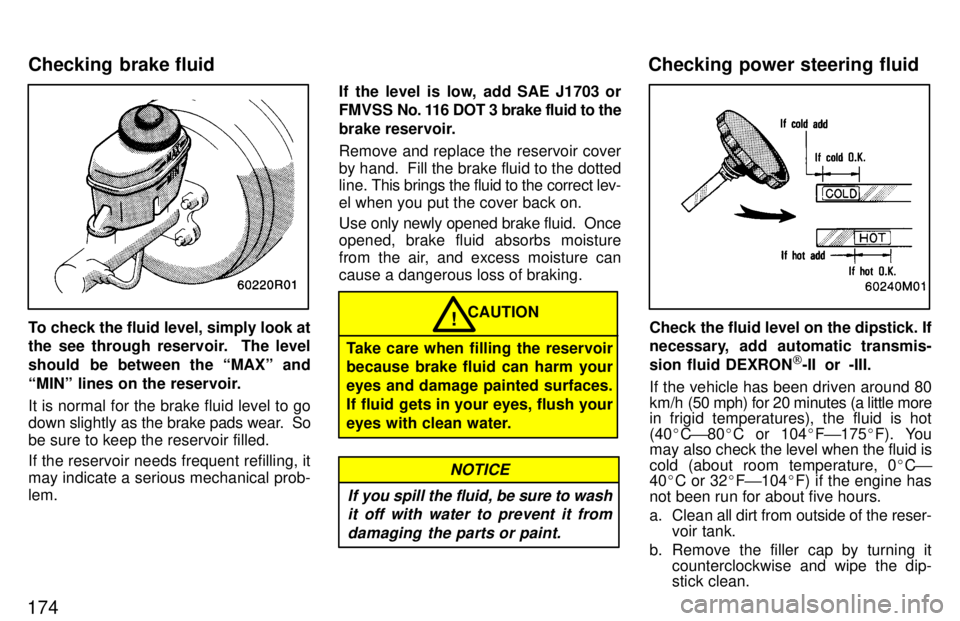
To check the fluid level, simply look at
the see through reservoir. The level
should be between the MAXº and
MINº lines on the reservoir. It is normal for the brake fluid level to go
down slightly as the brake pads wear. So
be sure to keep the reservoir filled. If the reservoir needs frequent refilling, it may indicate a serious mechanical prob- lem. If the level is low, add SAE J1703 or
FMVSS No. 116 DOT 3 brake fluid to the
brake reservoir. Remove and replace the reservoir cover by hand. Fill the brake fluid to the dotted
line.
This brings the fluid to the correct lev-
el when you put the cover back on.
Use only newly opened brake fluid. Once
opened, brake fluid absorbs moisture
from the air, and excess moisture cancause a dangerous loss of braking.CAUTION
Take care when filling the reservoir
because brake fluid can harm your
eyes and damage painted surfaces.
If fluid gets in your eyes, flush your
eyes with clean water.!
If you spill the fluid, be sure to wash it off with water to prevent it from
damaging the parts or paint.
NOTICE
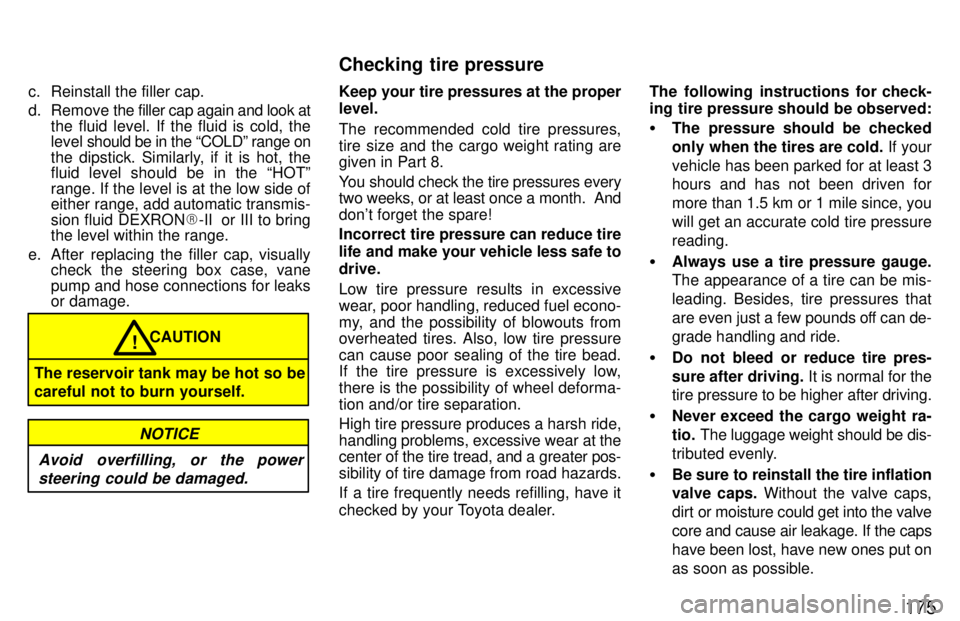
Check the fluid level on the dipstick. If
necessary, add automatic transmis-
sion fluid DEXRON [
-II or -III.
If the vehicle has been driven around 80
km/h (50 mph) for 20 minutes (a little more
in frigid temperatures), the fluid is hot (40 C ' 80 C or 104 F ' 175 F). You
may also check the level when the fluid is
cold (about room temperature, 0 C '
40 C or 32 F ' 104 F) if the engine has
not been run for about five hours.
a. Clean all dirt from outside of the reser-
voir tank.
b. Remove the filler cap by turning it counterclockwise and wipe the dip-
stick clean.
Checking brake fluid
Checking power steering fluid
Page 179 of 212
175
c. Reinstall the filler cap.
d. Remove
the filler cap again and look at
the fluid level. If the fluid is cold, the
level should be in the COLDº range on
the dipstick. Similarly, if it is hot, the
fluid level should be in the HOTº range. If the level is at the low side of either range, add automatic transmis-
sion fluid DEXRON -II or III to bring
the level within the range.
e. After replacing the filler cap, visually check the steering box case, vane
pump and hose connections for leaks or damage.
CAUTION
The reservoir tank may be hot so be careful not to burn yourself.!
Avoid overfilling, or the power steering could be damaged.
NOTICE
Keep your tire pressures at the proper level.
The recommended cold tire pressures,
tire size and the cargo weight rating are
given in Part 8.
You should check the tire pressures every two weeks, or at least once a month. And
don't forget the spare!
Incorrect tire pressure can reduce tire
life and make your vehicle less safe todrive.
Low tire pressure results in excessive
wear, poor handling, reduced fuel econo-
my, and the possibility of blowouts from overheated tires. Also, low tire pressure
can cause poor sealing of the tire bead.
If the tire pressure is excessively low,
there is the possibility of wheel deforma-tion and/or tire separation.
High tire pressure produces a harsh ride,
handling problems, excessive wear at the center of the tire tread, and a greater pos-
sibility of tire damage from road hazards.
If a tire frequently needs refilling, have it
checked by your Toyota dealer. The following instructions for check-
ing tire pressure should be observed:
The pressure should be checked
only when the tires are cold. If your
vehicle has been parked for at least 3 hours and has not been driven for more than 1.5 km or 1 mile since, you
will get an accurate cold tire pressurereading.
Always use a tire pressure gauge.
The appearance of a tire can be mis-
leading. Besides, tire pressures that
are even just a few pounds off can de-
grade handling and ride.
Do not bleed or reduce tire pres-sure after driving. It is normal for the
tire pressure to be higher after driving.
Never exceed the cargo weight ra-tio. The luggage weight should be dis-
tributed evenly.
Be sure to reinstall the tire inflation
valve caps. Without the valve caps,
dirt or moisture could get into the valve
core and cause air leakage. If the caps have been lost, have new ones put onas soon as possible.
Checking tire pressure
Page 190 of 212
186If you are not sure whether the fuse has
blown, try replacing the suspected fuse with one that you know is good.
If the fuse has blown, push a new fuse
into the clip.
Only install a fuse with the amperage rat-
ing designated on the fuse box lid.
If you do not have a spare fuse, in an
emergency you can pull out the CIGº,
RADIOº, DOMEº or A/Cº fuse, whichmay be dispensable for normal driving, and use it if its amperage rating is the same.
If you cannot use one of the same amper-
age, use one that is lower, but as close as
possible to the rating. If the amperage is
lower than that specified, the fuse might
blow out again but this does not indicate
anything
wrong. Be sure to get the correct
fuse as soon as possible and return the
substitute to its original clip.
It is a good idea to purchase a set of spare
fuses and keep them in your vehicle for emergencies.
If the new fuse immediately blows out, there is a problem with the electrical sys-
tem. Have your Toyota dealer correct it as
soon as possible.
Never use a fuse with a higher am-
perage rating, or any other object, in
place of a fuse. This may cause ex-
tensive damage and possibly a fire. CAUTION
!
If any washer does not work, the wash-
er tank may be empty. Add washer fluid.
You may use plain water as washer fluid.
However, in cold areas where tempera-
tures range below freezing point, use
washer fluid containing antifreeze. This
product is available at your Toyota dealer
and most auto parts stores. Follow the
manufacturer 's directions for how much
to mix with water.
NOTICE
Do not use engine antifreeze or any other substitute because it may
damage your vehicle's paint.
Adding washer fluid
Page 199 of 212

195
Model:
3RZ-FE and 5VZ-FE
Type: 3RZ-FE engine4 cylinder in line, 4 cycle, gasoline
5VZ-FE engine 6 cylinder V type, 4 cycle, gasoline
Bore and stroke, mm (in.):
3RZ-FE engine95.0 x 95.0 (3.74 x 3.74)
5VZ-FE engine
93.5 x 82.0 (3.68 x 3.23)
Displacement, cm 3
(cu. in.):
3RZ-FE engine
2694 (164.3)
5VZ-FE engine 3378 (206.1) Fuel type:
Unleaded gasoline, Research Octane Number 91 (Octane Rating 87) orhigher
Fuel tank capacity, L (gal., Imp. gal.):
91 (24.0, 20.0) ENGINE
Valve clearance (engine cold), mm (in.)
3RZ-FE engines
Intake 0.15 '0.25 (0.006 '0.010)
Exhaust 0.25 '0.35 (0.010 '0.014)
5VZ-FE engine
Intake 0.13 '0.23 (0.006 '0.009)
Exhaust 0.27 '0.37 (0.011 '0.014)
Spark plug type: 3RZ-FE engines
NIPPONDENSO K16R-U
NGK BKR5EYA
5VZ-FE engine
NIPPONDENSO K16TR11
NGK BKR5EKB11
Spark plug gap:
3RZ-FE engine 0.8 (0.031)
5VZ-FE engine 1.1 (0.043)
Drive belt tension measured with
Boroughs drive belt tension gauge No.
BT-33-73F (used belt), Ibf:
3RZ-FE engine 115 + 20
5VZ-FE engine 100 + 20
Fuel
Engine Service specifications