ignition TOYOTA TACOMA 1996 Owners Manual
[x] Cancel search | Manufacturer: TOYOTA, Model Year: 1996, Model line: TACOMA, Model: TOYOTA TACOMA 1996Pages: 196, PDF Size: 1.8 MB
Page 4 of 196

3
1. Headlight and turn signal switch
2. Wiper and washer switches
3. Driving pattern selector button
4. Emergency flasher switch
5. Clock
6. Cup holder
7. Air conditioning controls
8. Car audio
9. Ashtray10. Cigarette lighter
11. Parking brake lever 12. Ignition switch13. Cruise control switch 14. Hook lock release lever
15. Rear differential lock button16. Instrument panel light control knob 17. Clutch start cancel switch
Page 11 of 196

10
LOCKING AND UNLOCKING WITH KEY
Insert the key into the keyhole and turn
it.
To lock: Turn the key forward.
To unlock: Turn the key backward.
Vehicles with power door lock sys-
temÐBoth doors lock and unlock simulta-
neously with either door. In the driver's
door l ock, turning the key once will unlock
the driver's door and twice in succession
will unlock the driver's door and passen-
ger's door simultaneously.LOCKING AND UNLOCKING WITH IN-
SIDE LOCK BUTTON Move the lock button.
To lock: Push the button downward.
To unlock: Pull the button upward.
Closing the door with the lock button
pushed in w ill also lock the door. Be care-
ful not to lock your keys in the vehicle.
Vehicles with power door lock systemÐ
The door cannot be locked if you leave thekey in the ignition switch.Driver's side
Passenger 's side
Side doors
Page 12 of 196
11
LOCKING AND UNLOCKING WITH
POWER DOOR LOCK SWITCH Push the switch.
To lock: Push the switch on the front side.
To unlock: Push the switch on the rear side.
Both doors lock or unlock simultaneously.
CAUTION!
Before driving, be sure that the
doors are closed and locked, espe-
cially when small children are in the
vehicle. A long with the proper use of
seat belts, locking the doors helps
prevent the driver and passengers
from being thrown out from the ve-
hicle during an accident. It also
helps prevent the doors from being
opened unintentionally.
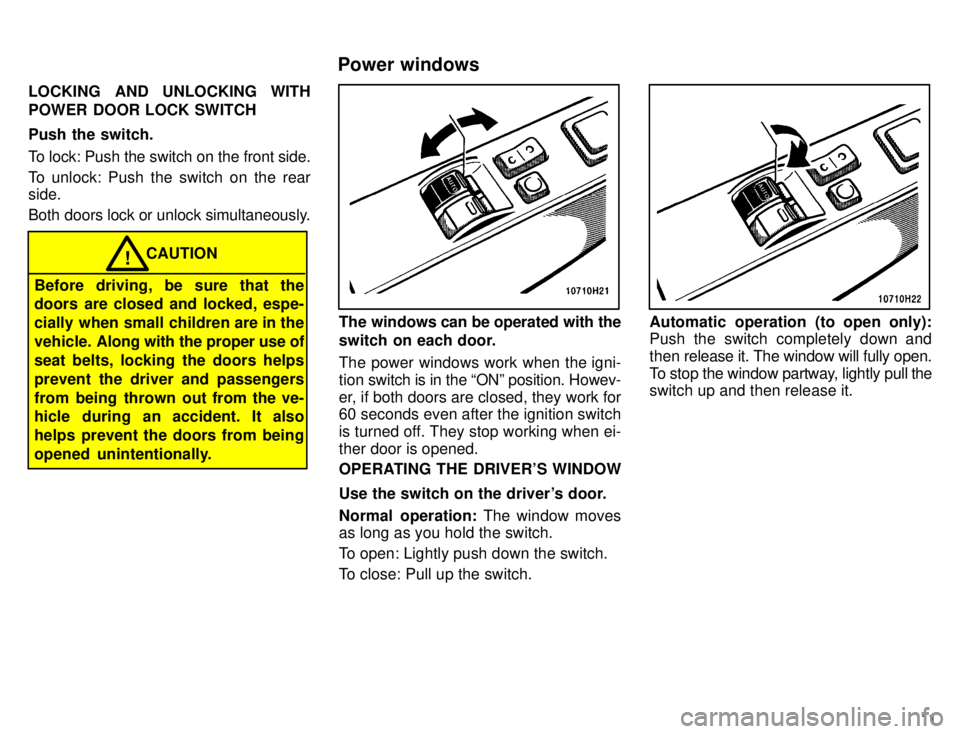
The windows can be operated with the
switch on each door.
The power windows work when the igni- tion switch is in the ONº position. Howev-
er, if both doors are closed, they work for 60 seconds even after the ignition switch
is turned off. They stop working when ei-ther door is opened.
OPERATING THE DRIVER'S WINDOW
Use the switch on the driver's door.
Normal operation: The window moves
as long as you hold the switch.
To open: Lightly push down the switch.
To close: Pull up the switch.Automatic operation (to open only):
Push the switch completely down and
then rel ease it. The window will fully open.
To stop the window partway, lightly pull the
switch up and then release it.
Power windows
Page 31 of 196

29
This indicator comes on when the
ignition key is turned to the ACCº or
ONº position. It goes off after about 6
seconds. This means the SRS airbag
is operating properly.
The SRS airbag warning light system
monitors the airbag sensor assembly,
inflator, warning light, interconnecting wir-
ing and power sources.The SRS airbag system is designed to
activate in response to a severe frontal
impact within the shaded area be-
tween the arrows in the illustration.
The SRS airbags will deploy if the severity
of the impact is above the designed
threshold level, comparable to an approxi-
mate 20 km/h (14 mph) collision when im-
pacting straight into a fixed barrier that
does not move or deform.
If the severity of the impact is below the
above threshold level, the SRS airbag
may not deploy. However, this threshold velocity will be
considerably higher if the vehicle strikes
an object, such as a parked vehicle or sign
pole, which can move or deform on im-
pact, or if it is
involved in an underride col-
lision (a collision in which the nose of the
vehicle underridesº, or goes under, the
bed of a truck).
For your safety, be sure to always wear your seat belt.
Page 34 of 196

32
This SRS airbag system has a service re-
minder indicator to inform the driver of op-
erating problems. If either of the following
conditions occurs, this indicates a mal-
function of the airbag. Contact your Toyo-
ta dealer as soon as possible to servicethe vehicle. The light does not come on when the
ignition key is turned to the ACCº or
ONº position, or remains on.
The light comes on while driving.In the following cases, contact your Toyo-
ta dealer as soon as possible: The SRS airbag has been inflated.
The front part of the vehicle (shaded in the illustration) was involved in an ac-
cident not of the extent to cause the
SRS airbags to inflate.
The pad section of the steering wheel
(shaded in the illustration) is scratched,
cracked, or otherwise damaged. Toyota strongly urges the use of child
restraint systems for children small
enough to use them.
The laws of all fifty states in the U.S.A.
and Canada now require the use of a child
restraint system.
CAUTION!
For effective protection in automo-
bile accidents and sudden stops,
children must be properly re-
strained. Holding a child in your
arms is not a substitute for a child
restraint system. In an accident, the
child can be crushed against the
windshield, or between you and the
vehicle's interior, if you are unre-strained.
Child restraint- ÐChild restraint precautions
Page 35 of 196

32
This SRS airbag system has a service re-
minder indicator to inform the driver of op-
erating problems. If either of the following
conditions occurs, this indicates a mal-
function of the airbag. Contact your Toyo-
ta dealer as soon as possible to servicethe vehicle. The light does not come on when the
ignition key is turned to the ACCº or
ONº position, or remains on.
The light comes on while driving.In the following cases, contact your Toyo-
ta dealer as soon as possible: The SRS airbag has been inflated.
The front part of the vehicle (shaded in the illustration) was involved in an ac-
cident not of the extent to cause the
SRS airbags to inflate.
The pad section of the steering wheel
(shaded in the illustration) is scratched,
cracked, or otherwise damaged. Toyota strongly urges the use of child
restraint systems for children small
enough to use them.
The laws of all fifty states in the U.S.A.
and Canada now require the use of a child
restraint system.
CAUTION!
For effective protection in automo-
bile accidents and sudden stops,
children must be properly re-
strained. Holding a child in your
arms is not a substitute for a child
restraint system. In an accident, the
child can be crushed against the
windshield, or between you and the
vehicle's interior, if you are unre-strained.
Child restraintÐÐChild restraint precautions
Page 45 of 196

Part 1Headlights and turn signals
41
OPERATION OF INSTRUMENTS AND CONTROLSÐ
Chapter 1-4
Lights and Wipers
Headlights and turn signals
Emergency flashers
Instrument panel light control
Interior lights
Personal lights
Ignition switch light
Windshield wipers and washer
HEADLIGHTS
To turn on the following lights: Twist
the headlight/turn signal lever knob. Position 1ÐParking, tail, license plate
and instrument panel lights Position 2ÐHeadlights and all of the above If you turn the ignition switch to the
LOCKº position with the headlights left
on, a buzzer reminds you to turn the lights
off when you open the driver's door.
NOTICE
To prevent the battery from being discharged, do not leave the lights
on for a long period when theengine is not running.
Daytime running light system (Canada only)
The headlights turn on when the parking brake is released with the engine started,
even with the light switch in the OFFº
position. They will not go off until the igni-
tion switch is turned off.
To turn on the other exterior lights and in-
strument panel lights, twist the knob to the
position 1.
Under the daytime running light system,
the headlights turn on at reduced intensi-
ty. Twist the knob to the position 2 to turn
to full intensity for driving at night.
Page 48 of 196

44To turn on the interior light, slide the switch.
The interior light switch has the following positions: ONºÐKeeps the light on all the time.
OFFºÐTurns the light off.
DOORºÐTurns the light on when either
door is opened. The light goes off when both doors are closed.
The personal lights operate separately
with each outer switch.
To turn on the light, push the switch on
your side. To turn the light off, push the
switch once again.
The center switch has the following posi- tions:
Position 1ÐTurns both lights on when ei-
ther
door is opened. The lights go off when
both doors are closed.
Position 2ÐThe lights are off unless you operate either outer switch.For easy access to the ignition switch,
the ignition switch light comes on
when the driver's door is opened.
The light remains on for some time after
the driver's door is closed.
Ignition switch light
Personal lights
Page 51 of 196

Part 1Fuel gauge
47
OPERATION OF INSTRUMENTS AND CONTROLSÐ
Chapter 1-5 Gauges, Meters and Service reminder indicators
Fuel gauge
Engine coolant temperature gauge
Tachometer
Odometer and trip meter
Service reminder indicators and warning buzzers
The gauge works when the ignition
switch is on
and indicates the approxi-
mate quantity of fuel remaining in the tank. Nearly fullÐNeedle at Fº Nearly emptyÐNeedle at Eº
It is a good idea to keep the tank over 1/4 full.
This fuel gauge has a non-return type
needle wh ich remains at the last indicated
position when the ignition switch is turned
off.
If the level approaches Eº or the low fuel
level warning light (on some models)
comes on, fill the fuel tank as soon as pos- sible. If the fuel tank is completely empty, the malfunction indicator lamp comes on. Fill
the fuel tank immediately.
The indicator lamp goes off after driving several times. If the indicator lamp does
not go off, contact your Toyota dealer assoon as possible.
Page 52 of 196

48
The gauge indicates the engine cool-
ant temperature when the ignition
switch is on. The engine operating
temperature will vary with changes inweather and engine load.
If the needle moves into the red zone, your engine is too hot. If your vehicle over-
heats, stop your vehicle and allow the en-
gine to cool.
Your vehicle may overheat during severe operating conditions, such as: Driving up a long hill on a hot day.
Reducing speed or stopping after high
speed driving.
Idling for a long period with the air con-
ditioning on in stop-and-go traffic.
Towing a trailer.
NOTICE
Do not remove the thermostat in
the engine cooling system as this
may cause the engine to overheat. The thermostat is designed tocontrol the flow of coolant to keep
the temperature of the engine within the specified operatingrange.
Do not continue driving with an
overheated engine. See If yourvehicle overheatsº in Part 4.
The tachometer indicates engine speed
in thousands of rpm (revolutions per
minute). Use it while driving to select
correct shift points and to prevent en-
gine lugging and overr evving.
Driving with the engine running too fast
causes excessive engine wear and poor
fuel economy. Remember, in most cases
the slower the engine speed, the greater
the fuel economy.
NOTICE
Do not let the indicator needle get into the red zone. This may cause
severe engine damage.
Tachometer
Engine coolant temperature gauge