sensor TOYOTA TACOMA 1996 Owners Manual
[x] Cancel search | Manufacturer: TOYOTA, Model Year: 1996, Model line: TACOMA, Model: TOYOTA TACOMA 1996Pages: 196, PDF Size: 1.8 MB
Page 31 of 196

29
This indicator comes on when the
ignition key is turned to the ACCº or
ONº position. It goes off after about 6
seconds. This means the SRS airbag
is operating properly.
The SRS airbag warning light system
monitors the airbag sensor assembly,
inflator, warning light, interconnecting wir-
ing and power sources.The SRS airbag system is designed to
activate in response to a severe frontal
impact within the shaded area be-
tween the arrows in the illustration.
The SRS airbags will deploy if the severity
of the impact is above the designed
threshold level, comparable to an approxi-
mate 20 km/h (14 mph) collision when im-
pacting straight into a fixed barrier that
does not move or deform.
If the severity of the impact is below the
above threshold level, the SRS airbag
may not deploy. However, this threshold velocity will be
considerably higher if the vehicle strikes
an object, such as a parked vehicle or sign
pole, which can move or deform on im-
pact, or if it is
involved in an underride col-
lision (a collision in which the nose of the
vehicle underridesº, or goes under, the
bed of a truck).
For your safety, be sure to always wear your seat belt.
Page 32 of 196

30
The SRS airbag is not designed to in-
flate if the vehicle is subjected to a side
or rear impact, if it rolls over, or if it is in-
volved in a low- speed frontal collision.The SRS airbag system mainly consists
of the following components and their
locations are shown in the illustration.
1. SRS airbag warning light
2. Steering wheel pad (airbag and inflator)
3. Airbag sensor assembly
The airbag sensor assembly consists of a
safing sensor and airbag sensor.In a severe frontal impact, sensor detects
deceleration and the system triggers the
airbag inflator. Then a chemical reaction
in the inflator momentarily fills the airbag
with non-toxic nitrogen gas to help re-
strain the forward motion of the driver. When the airbag inflates, it produces a fairly loud noise and releases some
smoke along with the nitrogen gas. This isnot harmful and does not indicate a fire.
Be sure to wash off any residue as soon
as possible to prevent minor skin irritation.
Deployment of the airbag happens in a
fraction of a
second, so the airbag must in-
flate with considerable force. While the
system is designed to reduce serious inju-
ries, it may also cause minor burns or
abrasions and swellings.
The steering wheel hub may be hot for
several m inutes, but the airbag will not be
hot. The airbag is designed to inflate only once.
Page 33 of 196
31
CAUTION!
The SRS airbag system is designed
only as a supplement to the primary protection of the seat belt system of
the driver. The driver is particularlysusceptible to injury if he/she does
not wear his/her seat belt; when
sudden braking or a collision oc-
curs, he/she may be thrown for-
ward. To obtain further protection in
an accident, the driver and all pas-
sengers in the vehicle should al-ways wear their seat belts when
driving. For instructions and pre-
cautions concerning the seat belt
systems, see Seat beltsº in this
chapter.
CAUTION!
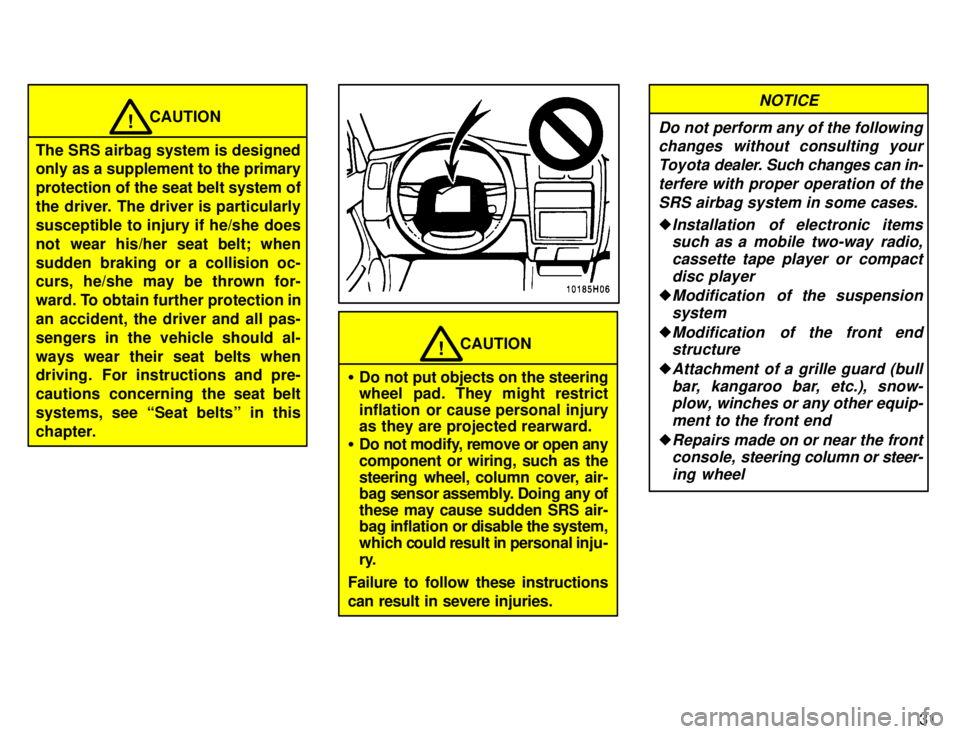
Do not put objects on the steering
wheel pad. They might restrict
inflation or cause personal injury as they are projected rearward.
Do not modify, remove or open any
component or wiring, such as the
steering wheel, column cover, air-
bag sensor assembly. Doing any of
these may cause sudden SRS air-
bag inflation or disable the system,
which could result in personal inju-
ry.
Failure to follow these instructions
can result in severe injuries.
NOTICE
Do not perform any of the following changes without consulting your
Toyota dealer. Such changes can in-
terfere with proper operation of the SRS airbag system in some cases.
Installation of electronic itemssuch as a mobile two-way radio,
cassette tape player or compactdisc player
Modification of the suspension system
Modification of the front endstructure
Attachment of a grille guard (bull
bar, kangaroo bar, etc.), snow-plow, winches or any other equip-
ment to the front end
Repairs made on or near the frontconsole, steering column or steer-
ing wheel
Page 55 of 196

51
(d) Low Oil Pressure Warning Light
This light warns that the engine oil pres-
sure is too low.
If it flickers or stays on while you are driving,
pull off the road to a safe place and stop the
engine immediately. Call a Toyota dealer or
qualified repair shop for assistance.
The light may occasionally flicker when
the engine is idling or it may come on brief-
ly after a hard stop. There is no cause for concern if it then goes out when the en-
gine is accelerated slightly.
The light may come on when the oil level
is extremely low. It is not designed to indi- cate low oil level, and the oil level must bechecked using the level dipstick.
NOTICE
Do not drive the vehicle with the warning light onÐeven for one
block. It may ruin the engine.
(e) Low Fuel Level Warning Light
This light comes on when the fuel level in
the tank becomes nearly empty. Fill up the
tank as soon as possible. (f) Malfunction Indicator Lamp
This lamp comes on in the following cases.
a. The fuel tank is completely empty. (See Fuel gaugeº in Chapter 1-5 for instruc- tions.)
b. The fuel tank cap is not tightened se-
curely. (See Fuel tank capº in Chapter
1-2 for instructions.)
c. There is a problem somewhere in your
engine or automatic transmission electri- cal system.
If it comes on while you are driving in case
c, have your vehicle checked/repaired by
your Toyota dealer as soon as possible.
(g) ABSº Warning Light
This light warns that there is a problem
somewhere in your anti-lock brake sys-tem.
If the light comes on while you are driving,
have your vehicle checked by your T
oyota
dealer as soon as possible.
The light will come on when the ignition key is turned to the ONº position. After
about 3 seconds, the light will go off. When the ABSº warning light is on (and
the brake system warning light is off), thebrake system operates conventionally but
without anti-lock function. Vehicles with rear differential lock systemÐ
The anti-lock brake system does not op-
erate when the rear differential is locked.
It is normal operation for the ABSº warn-
ing light to be on at this time.
(h) SRS Airbag Warning Light
This light will come on when the igni-
tion
key is turned to the ACCº or ONº
position. After about 6 seconds, the
light will go off. This means the airbag
system is operating properly.
The warning light system monitors the air-
bag sensor assembly, inflator, warning light, interconnecting wiring and powersources.
If either of the following conditions occurs, this indicates a malfunction somewhere inthe parts monitored by the warning light
system. Contact your Toyota dealer as
soon as possible to service the vehicle. The light does not come on when the
ignition key is turned to the ACCº or
ONº position or remains on.
The light comes on while driving.
(i) Light Reminder Buzzer
This buzzer will sound if the driver's door is opened while the ignition switch is turned to the LOCKº position with the
headlight switch on. Removing the key will
not stop the buzzer as long as the head-light switch is on.