snow chains TOYOTA TACOMA 1996 Owners Manual
[x] Cancel search | Manufacturer: TOYOTA, Model Year: 1996, Model line: TACOMA, Model: TOYOTA TACOMA 1996Pages: 196, PDF Size: 1.8 MB
Page 107 of 196
103
TANDEM MASTER CYLINDER BRAKE SYSTEM
The tandem master cylinder brake sys-
tem is a hydraulic system with two sepa-
rate sub-systems. If either sub-system
should fa
il, the other will still work. Howev-
er, the pedal will be harder to press, and
your stopping distance will be longer.
Also, the brake system warning light may come on.
CAUTION!
Do not drive your vehicle with only
a single brake system. Have your
brakes fixed immediately.
BRAKE BOOSTER
The brake booster uses engine vacuum to
power-assist the brakes. If the engine
should quit while you are driving, you can
bring the vehicle to a stop with normal
pedal pressure. There is enough reserve vacuum for one or two stopsÐbut no more!
CAUTION!
Do not pump the brake pedal if the
engine stalls. Each push on the
pedal uses up your vacuum re- serve.
Even if the power assist is com-
pletely lost, the brakes will still
work. But you will have to push the
pedal hardÐmuch harder than
normal. And your braking distance
will be longer.
ANTI-LOCK BRAKE SYSTEM (with ABSº warning light)
The anti-lock brake system is designed to prevent lock-up of the wheels during sud-
den braking or braking on slippery road surfaces. This assists the driver in con-
trolling the vehicle under these circum-stances.
The anti-lock brake system becomes op- erative after the vehicle has accelerated
to a speed in excess of approximately 10
km/h (6 mph). It stops operating when the
vehicle decelerates to a speed below
approximately 5 km/h (3 mph).
You may hear a sound in the engine
compartment for a few seconds when the
engine is started or just after the vehicleis started. This means that the anti-lock
brake system is in the self check mode,
and does not indicate a malfunction.
When the anti-lock brake system function is in action, you may feel the brake pedal
pulsating and hear a noise. In this situa-
tion, to let the anti-lock brake systemwork for you, just hold the brake pedal
down more firmly. Do not pump the brake. The brake pedal pulsation caused by the
anti-lock brake system may indicate haz- ardous road surface conditions. Althoughthe anti-lock brake system assists in pro-
viding
vehicle control, it is still important to
drive with all due care, because the anti-
lock brake system cannot overcome the
laws of physics that act on your vehicle: Braking capab ility is dependent on tire
friction with the road surface.
Even though the anti-lock brake sys-
tem is operating, a driver cannot main- tain full control on certain slippery road
surfaces, when cornering at highspeeds, or in violent maneuvers.
Avoid high speeds on wet roads. The
anti-lock brake system cannot elimi-
nate the risk of hydroplaning and lossof tire friction.
Always maintain a safe distance from the
vehicle in front of you. Compared with ve-
hicles not fitted with an anti-lock brake
system, your vehicle may require a longer
stopping distance in the following cases: Driving on rough, gravel or snow-cov-
ered roads.
Driving with tire chains installed.
Driving on roads where the road sur-
face is pitted or has other differences in surface height.
Brake system
Page 117 of 196

11 3
Use a washer fluid containing an anti-
freeze solution.
This product is available at your Toyota
dealer and most auto parts stores. Follow
the manufacturer's directions for how
much to mix with water.
Do not use engine antifreeze or any
other substitute because it may
damage your vehicle's paint.
NOTICE
Do not use your parking brake when there is a possibility it could freeze. When parking, put the transmission into
Pº (automatic) or into first or reverse
(manual) and block the front wheels. Do
not use the parking brake, or snow or wa-
ter accumulated in and around the parkingbrake mechanism may freeze, making it
hard to release. Keep ice and snow from accumulating
under the fenders.
Ice and snow built up under your fenders
can make steering difficult. During bad winter driving, stop and check under the
fenders occasionally. Depending on where you are driving,
we recommend you carry some emer- gency equipment.
Some of the things you might put in the ve-
hicle are tire chains, window scraper, bag of sand or salt, flares, small shovel, jump- er cables, etc.
Your vehicle is designed primarily as a pas-
senger- and- load- carrying vehicle. Towing
a trailer will have an adverse effect on han-
dling, performance, braking, durability and
driving economy (fuel consumption, etc.).
Your safety and satisfaction depend on the
proper use of correct equipment and cau-
tious driving habits. For your safety and the
safety of others, you must not overload your
vehicle or trailer. Ask your local Toyota deal-
er for further details before towing. WEIGHT LIMITS
Before towing, make sure the total
trailer weight, gross combination
weight, gross vehicle weight, gross axle weight and trailer tongue load are
all within the limits.
The total trailer weight and tongue load
can be measured with platform scales
found at a highway weighing station,
building supply company, trucking com-
pany, junk yard, etc.
Trailer towing
Page 159 of 196
Part 7Checking the engine oil level
155
DO-IT-YOURSELF MAINTENANCEÐ
Chapter 7-2 Engine and Chassis
Checking the engine oil level
Checking the engine coolant level
Checking brake fluid
Checking power steering fluid
Checking tire pressure
Checking and replacing tires
Rotating tires
Installing snow tires and chains
Replacing wheels
Aluminum wheel precautions
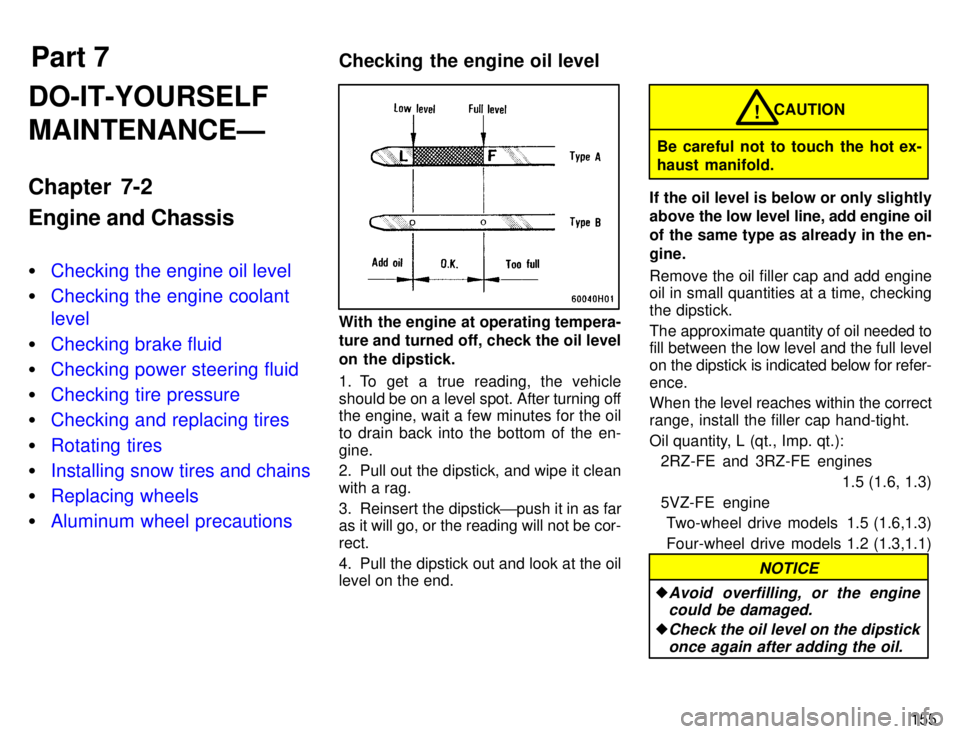
With the engine at operating tempera- ture and turned off, check the oil level
on the dipstick.
1. To get a true reading, the vehicle
should be on a
level spot. After turning off
the engine, wait a few minutes for the oil
to drain back into the bottom of the en-gine.
2. Pull out the dipstick, and wipe it clean with a rag.
3. Reinsert the dipstick 'push it in as far
as it will go, or the reading will not be cor- rect.
4. Pull the dipstick out and look at the oil level on the end.
CAUTION
Be careful not to touch the hot ex-
haust manifold.!
If the oil level is below or only slightly
above the low level line, add engine oil
of the same type as already in the en- gine. Remove the oil filler cap and add engine oil in small quantities at a time, checking the dipstick.
The approximate quantity of oil needed to fill between the low level and the full level
on the dipstick is indicated below for refer-ence.
When the level reaches within the correct range, install the filler cap hand-tight.
Oil quantity, L (qt., Imp. qt.):
2RZ-FE and 3RZ-FE engines
1.5 (1.6, 1.3)
5VZ-FE engine Two-wheel drive models 1.5 (1.6,1.3)
Four-wheel drive models 1.2 (1.3,1.1)
Avoid overfilling, or the engine could be damaged.
Check the oil level on the dipstick
once again after adding the oil.
NOTICE
Page 164 of 196
160
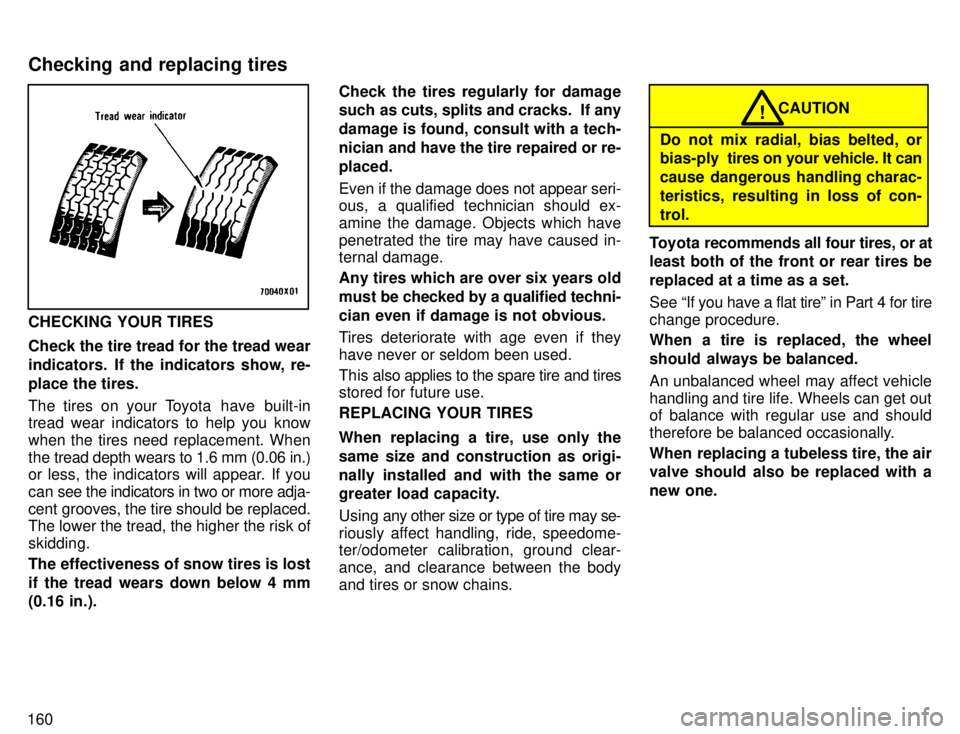
CHECKING YOUR TIRES Check the tire tread for the tread wear
indicators. If the indicators show, re-
place the tires.
The tires on your Toyota have built-in tread wear indicators to help you know
when the tires need replacement. When
the tread depth wears to 1.6 mm (0.06 in.)
or less, the indicators will appear. If you
can see the indicators in two or more adja-
cent grooves, the tire should be replaced.
The lower the tread, the higher the risk of skidding. The effectiveness of snow tires is lost
if the tread wears down below 4 mm (0.16 in.).Check the tires regularly for damage
such as cuts, splits and cracks. If any
damage is found, consult with a tech-
nician and have the tire repaired or re-placed. Even if the damage does not appear seri-
ous, a qualified technician should ex-
amine the damage. Objects which havepenetrated the tire may have caused in- ternal damage.
Any tires which are over six years old
must be checked by a qualified techni-
cian even if damage is not obvious.
Tires deteriorate with age even if they
have never or seldom been used.
This
also applies to the spare tire and tires
stored for future use.REPLACING YOUR TIRES
When replacing a tire, use only the
same size and construction as origi-
nally installed and with the same or
greater load capacity.
Using any other size or type of tire may se-
riously affect handling, ride, speedome-
ter/odometer calibration, ground clear-
ance, and clearance between the body
and tires or snow chains.
CAUTION
Do not mix radial, bias belted, or
bias-ply tires on your vehicle. It can
cause dangerous handling charac-
teristics, resulting in loss of con-trol.!
Toyota recommends all four tires, or at
least both of the front or rear tires be
replaced at a time as a set.
See If you have a flat tireº in Part 4 for tire
change procedure.
When a tire is replaced, the wheel
should always be balanced.
An unbalanced wheel may affect vehicle
handling and tire life. Wheels can get out
of balance with regular use and should
therefore be balanced occasionally.
When replacing a tubeless tire, the air
valve should also be replaced with a
new one.
Checking and replacing tires
Page 165 of 196

161
Two-wheel drive models with steel wheels
Two-wheel drive models with alumi-
num wheels and four-wheel drivemodelsTo equalize tire wear and help extend
tire life, Toyota recommends that you
rotate your tires approximately every
12000 km (7500 miles). However, the
most appropriate timing for tire rota-
tion may vary according to your driv-
ing habits and road surface condi- tions.
See If you have a flat tireº in Part 4 for tire
change procedure. When rotating tires, check for uneven
wear
and damage. Abnormal wear is usu-
ally caused by incorrect tire pressure, im-
proper wheel alignment, out-of-balance
wheels, or severe braking. WHEN TO USE SNOW TIRES OR CHAINS
Snow tires or chains are recom-
mended when driving on snow or ice.
On wet or dry roads, conventional tires
provide better traction than snow tires. SNOW TIRE SELECTION
If you need snow tires, select the same
size, construction and load capacity
as the original tires on your Toyota.
Do not use tires other than those men-
tioned above. Do not install studded tires
without first checking local regulations for
possible restrictions.
SNOW TIRE INSTALLATION
Snow tires should be installed on all wheels. Installing snow tires on the front wheels
only can lead to an excessive difference
in road grip capability between the front
and rear tires which could cause loss of
vehicle control.
When storing removed tires, you should
store them in a cool dry place.
Mark the direction of rotation and be sure to install them in the same direction whenreplacing.
Installing snow tires and chains
Rotating tires
Page 166 of 196
162
CAUTION
Do not drive with the snow tires in- correctly inflated.
Never drive over 120 km/h (75
mph) with any type of snow tires.!
TIRE CHAIN SELECTION Use the tire chains of correct size.
Regulations regarding the use of tire
chains vary according to location or
type of r oad, so always check them be-
fore installing chains.
CHAIN INSTALLATION Install the chains on the front tires as
tightly as possible. Do not use tire
chains on the rear tires. Retighten
chains after driving 0.5 '1.0 km
(1/4 '1/2 mile).
When installing chains on your tires, care- fully follow the instructions of the chain
manufacturer.
If wheel covers are used, they will be
scratched by the chain band, so removethe covers before putting on the chains.
Do not exceed 50 km/h (30 mph) or
the chain manufacturer's recom-
mended speed limit, whichever is
lower.
Drive carefully avoiding bumps,
holes, and sharp turns, which may
cause the vehicle to bounce.
Avoid sharp turns or locked-
wheel braking, as use of chains
may adversely affect vehicle han- dling.
CAUTION! WHEN TO REPLACE YOUR WHEELS
If you have wheel damage such as
bending, cracks or heavy corrosion,
the wheel should be replaced.
If you fail to replace damaged wheels, the
tire may slip off the wheel or they may cause loss of handling control. WHEEL SELECTION
When replacing wheels, care should be
taken to ensure that the wheels are re-
placed by ones with the same load ca-
pacity, diameter, rim width, and offset.
Correct
replacement wheels are available
at your Toyota dealer.
A wheel of a different size or type may ad-
versely affect handling, wheel and bear-
ing life, brake cooling, speedometer/
odometer calibration, stopping ability,
headlight aim, bumper height, vehicle
ground clearance, and tire or snow chain clearance to the body and chassis.
Replacement with used wheels is not rec-
ommended as they may have been sub- jected to rough treatment or high mileage and could fail without warning. Also, bent
wheels which have been straightened
may have structural damage and there-
fore should not be used. Never use an in-
ner tube in a leaking wheel which is de-
signed for a tubeless tire.
Replacing wheels