stop start TOYOTA TACOMA 1996 Owners Manual
[x] Cancel search | Manufacturer: TOYOTA, Model Year: 1996, Model line: TACOMA, Model: TOYOTA TACOMA 1996Pages: 196, PDF Size: 1.8 MB
Page 54 of 196
50
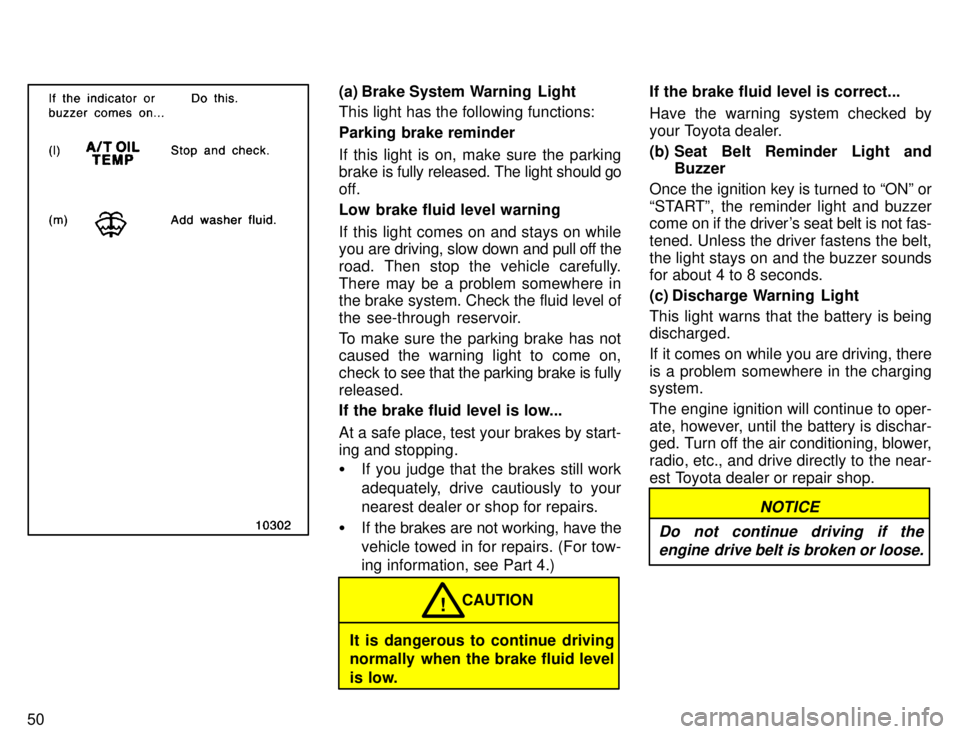
(a) Brake System Warning Light This light has the following functions: Parking brake reminder
If this light is on, make sure the parking
brake is fully released. The light should go
off.
Low brake fluid level warning
If this light comes on and stays on while
you are driving, slow down and pull off the
road. Then stop the vehicle carefully.There may be a problem somewhere in
the brake system. Check the fluid level of
the see-through reservoir.
To make sure the parking brake has not
caused the warning light to come on,
check to see that the parking brake is fully
released.
If the brake fluid level is low...
At a safe place, test your brakes by start-
ing and stopping. If you judge that the brakes still work
adequately, drive cautiously to yournearest dealer or shop for repairs.
If the brakes are not working, have the
vehicle towed in for repairs. (For tow- ing information, see Part 4.)
It is dangerous to continue driving
normally when the brake fluid level
is low. CAUTION
! If the brake fluid level is correct...
Have the warning system checked by
your Toyota dealer.
(b) Seat Belt Reminder Light and
Buzzer
Once the ignition key is turned to ONº or
STARTº, the reminder light and buzzer
come on if the driver's seat belt is not fas-
tened. Unless the driver fastens the belt, the light stays on and the buzzer sounds for about 4 to 8 seconds.
(c) Discharge Warning Light
This light warns that the battery is being discharged.
If it comes on while you are driving, there
is a problem somewhere in the charging system.
The engine ignition will continue to oper-
ate, however, until the battery is dischar-
ged. Turn off the air conditioning, blower,
radio, etc., and drive directly to the near-
est Toyota dealer or repair shop.
NOTICE
Do not continue driving if the engine drive belt is broken or loose.
Page 56 of 196
52(j) Key Reminder Buzzer
This buzzer reminds you to remove the
key when you open the driver's door withthe ignition key in the ACCº or LOCKº position.
(k) Unengaged Parkº Warning Light
(vehicles with automatic transmis-sion)
This light warns that the transmission
Parkº mechanism is not engaged. If the
front drive control lever is in the Nº posi-
tion while the selector lever is in the Pº
position, the transmission will disengage
and the wheels will not lock.
To restore the park function, shift
the front drive control lever out of Nº.
CAUTION
!
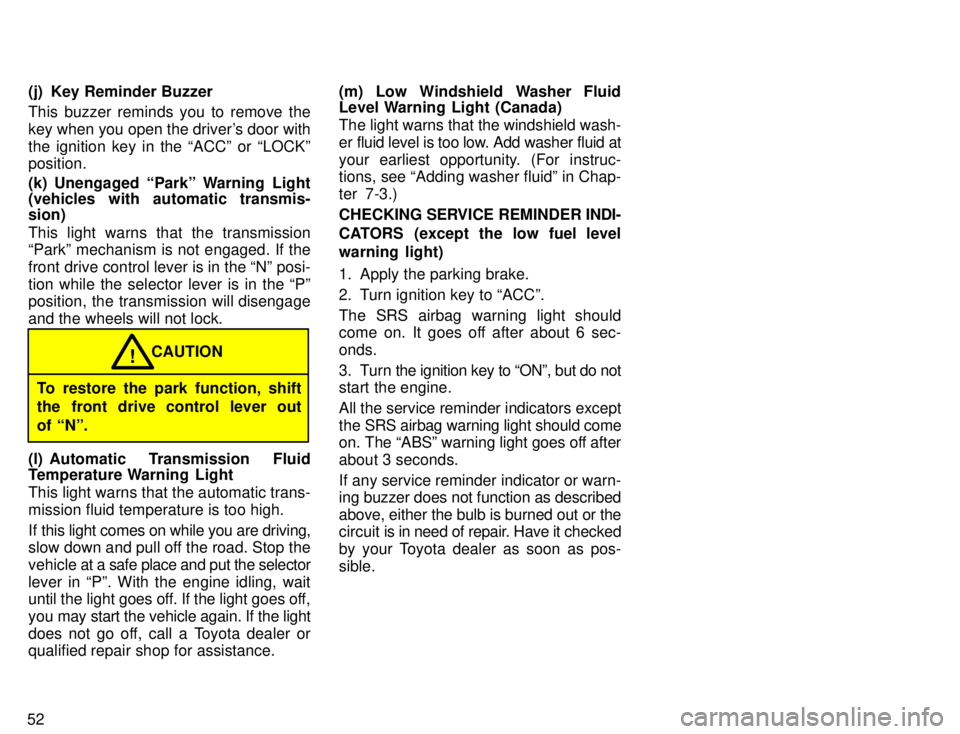
(l) Automatic Transmission Fluid
Temperature Warning Light
This light warns that the automatic trans- mission fluid temperature is too high.
If this light comes on while you are driving,
slow down and pull off the road. Stop the
vehicle at a safe place and put the selector
lever in Pº. With the engine idling, wait
until the light goes off. If the light goes off,
you may start the vehicle again. If the light
does not go off, call a Toyota dealer or
qualified repair shop for assistance. (m) Low Windshield Washer Fluid
Level Warning Light (Canada)
The light warns that the windshield wash-
er fluid level is too low. Add washer fluid at
your earliest opportunity. (For instruc-
tions, see Adding washer fluidº in Chap- ter 7-3.)
CHECKING SERVICE REMINDER
INDI-
CATORS (except the low fuel level
warning light)
1. Apply the parking brake.
2. Turn ignition key to ACCº.
The SRS airbag warning light should
come on. It goes off after about 6 sec- onds.
3. Turn the ignition key to ONº, but do not
start the engine.
All the service reminder indicators except
the SRS airbag warning light should come
on. The ABSº warning light goes off after
about 3 seconds.
If any service reminder indicator or warn-
ing buzzer does not function as described above, either the bulb is burned out or the
circuit is in need of repair. Have it checked
by your Toyota dealer as soon as pos- sible.
Page 62 of 196
58Your automatic transmission has a shift
lock system to minimize the possibility of
incorrect operation. This means you can
only shift out of Pº position when the brake
pedal is depressed (with the ignition
switch in ONº position and the selector le- ver pulled toward you).
(a) Normal driving
1. Start the engine as instructed in How
to start the engineº in Part 3. The trans- mission must be in Pº or Nº.
2. With your foot holding down the brake
pedal, shift the selector lever to Dº.
In Dº position, the automatic transmis-
sion system will select the most suitable
gear for running conditions such as nor-
mal cruising, hill climbing, hard towing, etc.
Always turn the overdrive switch on for
better fuel economy and quieter driving. If
the engine coolant temperature is low, the transmission will not shift into the over-
drive gear even with the overdrive switch on.
Never put your foot on the accelera-
tor pedal while shifting. CAUTION
!
3. Release the parking brake and brake
pedal. Depress the accelerator pedal
slowly for smooth starting. (b) Using engine braking
To use engine braking, you can downshift the transmission as follows:
Turn off the overdrive switch. The O/D
OFFº indicator light will come on and the transmission will downshift to the
third gear.
Shift into the 2º position. The trans-
mission will downshift to the second
gear when the vehicle speed drops
down to or lower than the maximum al-
lowable speed for second gear, andmore powerful engine braking will beobtained.
Shift into the Lº position. The trans- mission will downshift to the first gear
when the vehicle speed drops down to
or lower than the maximum allowable
speed for Lº position and maximum
engine braking will be applied.
Vehicles with cruise controlÐWhen the
cruise control is being used, even if you
downshift the transmission by turning off the overdrive switch, engine braking will
not be applied because the cruise control
is not cancelled. For ways to decrease the
vehicle speed, see Cruise controlº in this
chapter.
MAXIMUM ALLOWABLE SPEEDS
2º 136 km/h (85 mph) . . . . . . . . . . . .
Lº 74 km/h (46 mph) . . . . . . . . . . . . .
Be careful when downshifting on a
slippery surface. Abrupt shifting
could cause the vehicle to spin orskid. CAUTION
!
NOTICE
Be careful not to overrev the en-
gine. Watch the tachometer to
keep engine rpm from going into
the red zone. The maximum allow-able speed (approximate) for each
position is given above for yourreference.
Do not continue hill climbing for along time in the 2º or Lº posi-
tion. This may cause severe auto-matic transmission damage from
overheating. To prevent such damage, use Dº position for hillclimbing or hard towing.
(c) Backing up
1. Bring the vehicle to a complete stop.
2. With the brake pedal held down with your foot, shift the selector lever to the Rº
position.
NOTICE
Never shift into reverse while the vehicle is moving.
Page 76 of 196
72
Do not lock the differential until
the wheels have stopped spin-
ning. Otherwise, the vehicle may
move in an unexpected direction
when the differential lock is en-
gaged, resulting in an accident.
This may also lead to possible
damage to differential lock com-
ponent parts.
Do not drive over 8 km/h (5 mph)
when the differential is locked. CAUTION
!
To unlock the differential, push the
switch once again.
Unlock the differential as soon as the ve- hicle moves out.
For easy unlocking, slightly turn the steer-
ing wheel in either direction while the ve- hicle is in motion.
When the differential lock is disengaged, the indicator light will go out.
The differential will also unlock if you shift
the front drive control lever out of L4º. Never f orget to turn off the switch after us-
ing this feature. To check the indicator bulb, turn the igni-
tion key to the ONº position, but do not
start the engine.
Do not keep driving with the differ- ential lock switch on.
CAUTION
!
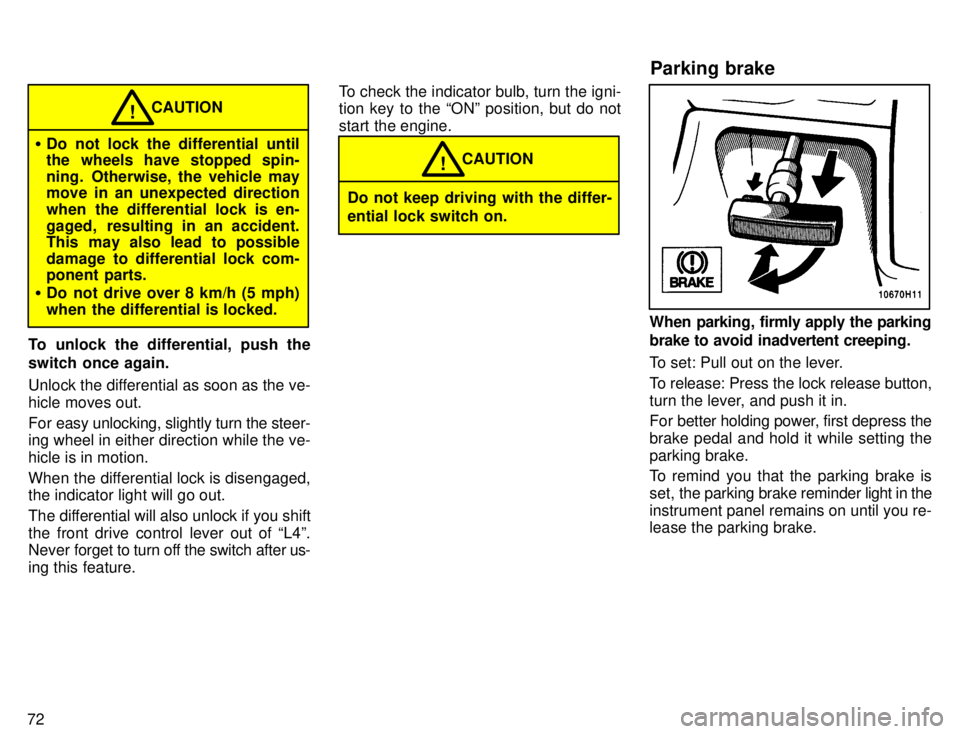
When parking, firmly apply the parking
brake to avoid inadvertent creeping.
To set: Pull out on the lever.
To release: Press the lock release button,
turn the lever, and push it in.
For better holding power, first depress the brake pedal and hold it while setting the
parking brake.
To remind you that the parking brake is
set,
the parking brake reminder light in the
instrument panel remains on until you re- lease the parking brake. Parking brake
Page 102 of 196
98
When driving off-road or in
rugged terrain, do not drive at ex- cessive speeds, jump the vehicle,
or strike objects, etc. This may cause loss of control or vehicle rol-
lover. You are also risking expen-
sive damage to your vehicle's sus-
pension and chassis. Drive gently and avoid high speeds.
Your vehicle does not need an elaborate
break-in. But following a few simple tips
for the first 1600 km (1000 miles) can add
to the future economy and long life of your vehicle:
Do not drive over 88 km/h (55 mph).
Run the engine at moderate speed be- tween 2000 and 4000 rpm.
Avoid full-throttle starts.
Try to avoid hard stops during the first
300 km (200 miles).
Do not drive slowly with the manual
transmission in a high gear.
Do not drive for a long time at any
single speed, either fast or slow.
Do not tow a trailer during the first 800
km (500 miles)
Four-wheel drive models with free-
wheeling hubs onlyÐ For the first 500 km (300 miles):
We recommend that you use high range,
two-wheel drive, with both free-wheeling
hubs engaged. For information on thefour-wheel drive system and the front hubs, see Four-wheel drive systemº in Chapter 1-6. FUEL TYPE
Your new vehicle must use only un-
leaded gasoline.
To help prevent gas station mixups, your
Toyota has a new smaller fuel tank open- ing.
The special nozzle on pumps with un-
leaded fuel will fit it, but the larger stan-
dard nozzle on pumps with leaded gas will
not.
Do not use leaded gasoline. Use of
leaded gasoline will cause the
three-way catalytic converter to lose its effectiveness and theemission control system to func- tion improperly. Also, this can in-crease maintenance costs.
NOTICE
OCTANE NUMBER
Select Research Octane Number 91
(Octane Rating 87) or higher.
Use of unleaded fuel with an octane num- ber or rating lower than stated above will
cause persistent heavy knocking. If se-
vere, this will lead to engine damage.
Fuel
Break-in period
Page 107 of 196
103
TANDEM MASTER CYLINDER BRAKE SYSTEM
The tandem master cylinder brake sys-
tem is a hydraulic system with two sepa-
rate sub-systems. If either sub-system
should fa
il, the other will still work. Howev-
er, the pedal will be harder to press, and
your stopping distance will be longer.
Also, the brake system warning light may come on.
CAUTION!
Do not drive your vehicle with only
a single brake system. Have your
brakes fixed immediately.
BRAKE BOOSTER
The brake booster uses engine vacuum to
power-assist the brakes. If the engine
should quit while you are driving, you can
bring the vehicle to a stop with normal
pedal pressure. There is enough reserve vacuum for one or two stopsÐbut no more!
CAUTION!
Do not pump the brake pedal if the
engine stalls. Each push on the
pedal uses up your vacuum re- serve.
Even if the power assist is com-
pletely lost, the brakes will still
work. But you will have to push the
pedal hardÐmuch harder than
normal. And your braking distance
will be longer.
ANTI-LOCK BRAKE SYSTEM (with ABSº warning light)
The anti-lock brake system is designed to prevent lock-up of the wheels during sud-
den braking or braking on slippery road surfaces. This assists the driver in con-
trolling the vehicle under these circum-stances.
The anti-lock brake system becomes op- erative after the vehicle has accelerated
to a speed in excess of approximately 10
km/h (6 mph). It stops operating when the
vehicle decelerates to a speed below
approximately 5 km/h (3 mph).
You may hear a sound in the engine
compartment for a few seconds when the
engine is started or just after the vehicleis started. This means that the anti-lock
brake system is in the self check mode,
and does not indicate a malfunction.
When the anti-lock brake system function is in action, you may feel the brake pedal
pulsating and hear a noise. In this situa-
tion, to let the anti-lock brake systemwork for you, just hold the brake pedal
down more firmly. Do not pump the brake. The brake pedal pulsation caused by the
anti-lock brake system may indicate haz- ardous road surface conditions. Althoughthe anti-lock brake system assists in pro-
viding
vehicle control, it is still important to
drive with all due care, because the anti-
lock brake system cannot overcome the
laws of physics that act on your vehicle: Braking capab ility is dependent on tire
friction with the road surface.
Even though the anti-lock brake sys-
tem is operating, a driver cannot main- tain full control on certain slippery road
surfaces, when cornering at highspeeds, or in violent maneuvers.
Avoid high speeds on wet roads. The
anti-lock brake system cannot elimi-
nate the risk of hydroplaning and lossof tire friction.
Always maintain a safe distance from the
vehicle in front of you. Compared with ve-
hicles not fitted with an anti-lock brake
system, your vehicle may require a longer
stopping distance in the following cases: Driving on rough, gravel or snow-cov-
ered roads.
Driving with tire chains installed.
Driving on roads where the road sur-
face is pitted or has other differences in surface height.
Brake system
Page 120 of 196

11 6MAINTENANCE
If you tow a trailer, your vehicle will re-
quire more frequent maintenance due
to the additional load. For this informa-
tion, please refer to the scheduled
maintenance information in the Own-
er 's Manual Supplement/Maintenance Scheduleº.
Retighten all fixing bolts of the towing
ball and bracket after approximately
1000 km (600 miles) of trailer driving.
PRE-T OWING SAFETY CHECK Check that your vehicle remains level
when a loaded or unloaded trailer is
hitched. Do not drive if the vehicle has
an abnormal nose-up or nose-down
condition, and check for improper
tongue load, overload, worn suspen-
sion or other possible causes.
Make sure the trailer cargo is securely
loaded so that it cannot shift.
Check that your rear view mirrors con-
form to any applicable federal, state/
provincial or local regulation. If not,
install the rear view mirrors required
for towing purpose. TRAILER TOWING TIPS
When towing a trailer, your vehicle will
handle differently than when not tow-
ing. The three main causes of vehicle
trailer accidents are driver error, exces-
sive speed and improper trailer loading.
Keep these in mind when towing:
Before starting out, check operation of
the lights and all vehicle-trailer con-
nections. After driving a short dis-
tance, stop and recheck the lights and
connections. Before actually towing a
trailer, practice turning, stopping and
backing with a trailer in an area away
from traffic until you learn the feel.
Backing w ith a trailer is difficult and re-
quires practice. Grip the bottom of the steering wheel and move your hand to
the left to move the trailer to the left. Move your hand to the right to move
the trailer to the right. (This procedureis generally opposite to that when
backing without a trailer). Also, just
turn the steering wheel a little at a time,
avoiding sharp or prolonged turning. Have someone guide you when back-
ing to reduce the risk of an accident.
Because stopping distance may be in-
creased, vehicle-to-vehicle distance
should be increased when towing a
trailer. For each 16 km/h (10 mph) ofspeed, allow at least one vehicle and
trailer length between you and the ve-
hicle ahead. Avoid sudden braking as you may skid, resulting in jackknifing
and loss of control. This is especially
true on wet or slippery surfaces.
Avoid jerky starts or sudden accelera-tion. If your vehicle has manual trans-
mission, prevent excessive clutch slip-
page by keeping engine rpm low and
not racing the engine. Always start out
in first gear.
Avoid jerky steering and sharp turns.
The trailer could hit your vehicle in a
tight turn. Slow down before making a
turn to avoid the necessity of suddenbraking.
Remember that when making a turn,the trailer wheels will be closer than the vehicle wheels to the inside of the
turn. Therefore, compensate for this
by making a larger than normal turning
radius with your vehicle.
Page 121 of 196
11 7
Crosswinds and rough roads will ad-
versely affect handling of your vehicle
and trailer, causing sway. Pay attention
to the rear from time to time to prepare
yourself for being passed by large
trucks or buses, which may cause your
vehicle and trailer to sway. If swaying
happens, firmly grip the steering wheel
and reduce speed immediately but
gradually. Never increase speed. Steer
straight ahead. If you make no extreme
correction with the steering or brakes,
the vehicle and trailer will stabilize.
Be careful when passing other ve- hicles. Passing requires considerable
distance. After passing a vehicle, do
not forget the length of your trailer and
be sure you have plenty of room be-
fore changing lanes.
In order to maintain engine braking ef-
ficiency, do not use fifth gear (manual
transmission) or overdrive (automatictransmission).
Because of the added load of the trail-
er, your vehicle's engine may overheat
on hot days (at temperatures over30 5C [85 5F]) when going up a long or
steep grade with a trailer. If the engine
coolant temperature gauge indicates
overheating, immediately turn off the
air conditioning (if in use), pull off the
road and stop in a safe spot. Refer to
If your vehicle overheatsº in Part 4 ofthis manual.
Always place wheel blocks under both
the vehicle and trailer wheels whenparking. Apply the parking brake firm-
ly. Put the transmission in Pº (auto-
matic) or in first or reverse (manual).
Avoid parking on a slope with a trailer, but if it cannot be avoided, do so only after performing the following:
1. Apply the brakes and hold.
2. Have someone place wheel blocks un-
der both the vehicle and trailer wheels.
3. When the wheel blocks are in place,
release your brakes slowly until the blocks
absorb the load.
4. Apply the parking brake firmly.
5. Shift into first or reverse (manual) or
Pº (automatic) and turn off the engine. When restarting out after parking on a slope: 1. With the transmission in Pº position
(automatic) or
the clutch pedal depressed
(manual), start the engine. (With an auto-
matic transmission, be sure to keep thebrake pedal depressed.)
2. Shift into gear.
3. Release the parking brake (also foot
brake on automatic transmission ve-
hicles) and slowly pull or back away from
the wheel blocks. Stop and apply your brakes.
4. Have someone retrieve the blocks.
Do not exceed 72 km/h (45 mph) or
the posted towing speed limit,
whichever is lower. Because insta-
bility (swaying) of a towing
vehicle-trailer combination usual-
ly increases as the speed in-
creases, exceeding 72 km/h (45
mph) may cause loss of control.
Slow down and downshift before
descending steep or long down-
hill grades. Do not make suddendownshifts.
Avoid holding the pedal down too
long or too frequently. This could
cause the brakes to overheat and
result in reduced braking efficiency.
CAUTION!
Page 122 of 196
11 8Getting
more kilometers/mileage from a li-
ter/gallon of fuel is easyÐjust take it easy.
It will help make your vehicle last longer,
too. Here are some specific tips on how to
save money on both fuel and repairs: Keep your tires inflated at the cor- rect pressure. Underinflation causes
tire wear and wastes fuel. See Chapter
7-2 for instructions.
Do not carry unneeded weight in
your vehicle. Excess weight puts a
heavier load on the engine, causinggreater fuel consumption.
Avoid lengthy warm-up idling.
Once the engine is running smoothly,
begin drivingÐbut gently. Remember,
however, that on cold winter days this
may take a little longer.
Accelerate slowly and smoothly.
Avoid jackrabbit starts. Get into high
gear as quickly as possible.
Avoid long engine idling. If you have
a long wait and you are not in traffic, it
is better to turn off the engine and start
again later.
Avoid engine lug or overrevving.
Use a gear position suitable for the
road on which you are travelling.
Avoid continuous speeding up and
slowing down. Stop-and-go driving
wastes fuel.
Avoid unnecessary stopping and braking. Maintain a steady pace. Try
to time the traffic signals so you only
need to stop as little as possible or take
advantage of through streets to avoid
traffic lights. Keep a proper distance
from other vehicles to avoid suddenbraking. This will also reduce wear onyour brakes.
Avoid heavy traffic or traffic jams
whenever possible.
Do not rest your foot on the clutch
or brake pedal. This causes needless
wear, overheating and poor fuel econ-
omy.
Maintain a moderate speed on highways. The faster you drive, the
greater the fuel consumption. By re-
ducing your speed, you will cut down
on fuel consumption.
Keep the front wheels in properalignment. Avoid hitting the curb and
slow down on rough roads. Improper
alignment not only causes faster tire
wear but also puts an extra load on the
engine, which, in turn, wastes fuel.
Keep the bottom of your vehicle
free from mud, etc. This not only
lessens weight but also helps prevent corrosion.
Keep your vehicle tuned-up and in
top shape. A dirty air cleaner, improp-
er valve clearance, dirty plugs, dirty oil
and grease, brakes not adjusted, etc.
all lower engine performance and con-
tribute to poor fuel economy. For lon-
ger life of all parts and lower operating
costs, keep all maintenance work on
schedule, and if you often drive under severe conditions, see that your ve-
hicle receives more frequent mainte-nance. (For scheduled maintenance
information, please refer to the sepa-
rate Owner's Manual Supplement/
Maintenance Scheduleº).
CAUTION
Never turn off the engine to coast
down hills. Your power steering and
brake booster will not function with-
out the engine running. Also, the
emission control system operates
properly only when the engine is
running.!
How to save fuel and make your
vehicle last longer, too
Page 126 of 196
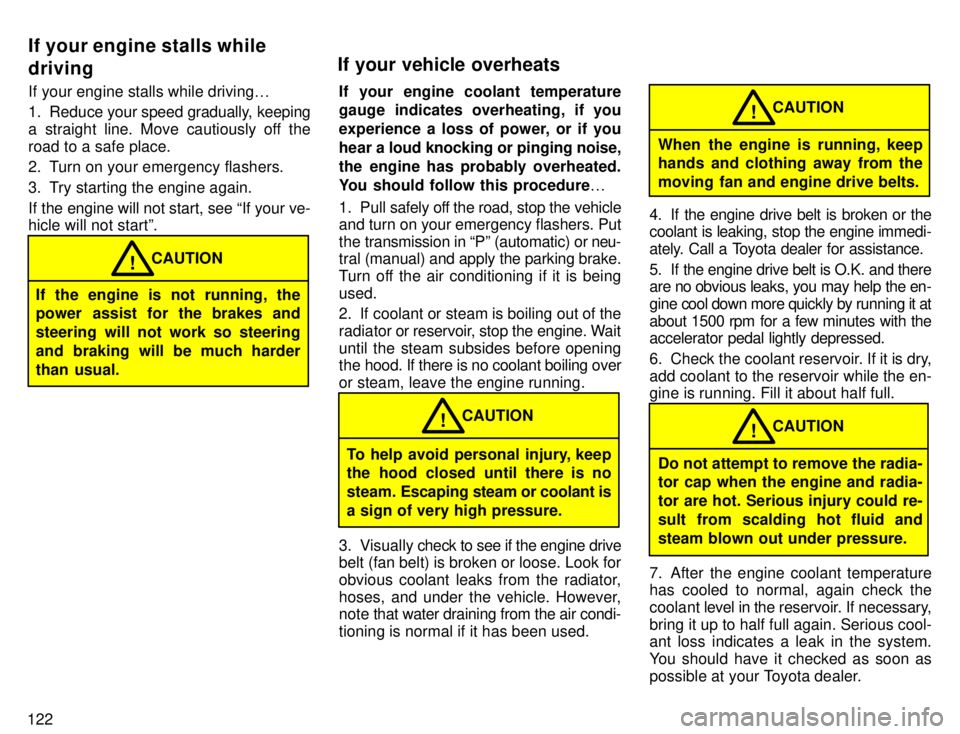
122If your engine stalls while driving
0
1. Reduce your speed gradually, keeping
a straight line. Move cautiously off the
road to a safe place.
2. Turn on your emergency flashers.
3. Try starting the engine again.
If the engine will not start, see If your ve-
hicle will not startº.
If the engine is not running, the
power assist for the brakes and
steering will not work so steering
and braking will be much harder
than usual. CAUTION
! If your engine coolant temperature
gauge indicates overheating, if you
experience a loss of power, or if you
hear a
loud knocking or pinging noise,
the engine has probably overheated.
You should follow this procedure 0
1. Pull safely off the road, stop the vehicle
and turn on your emergency flashers. Put
the transmission in Pº (automatic) or neu-
tral ( manual) and apply the parking brake.
Turn off the air conditioning if it is beingused.
2. If coolant or steam is boiling out of the
radiator or reservoir, stop the engine. Wait
until the steam subsides before opening
the hood. If there is no coolant boiling over or steam, leave the engine running.
To help avoid personal injury, keep
the hood closed until there is no steam. Escaping steam or coolant is
a sign of very high pressure. CAUTION
!
3. Visually check to see if the engine drive
belt (fan belt) is broken or loose. Look for
obvious coolant leaks from the radiator,
hoses, and under the vehicle. However, note that water draining from the air condi-
tioning is normal if it has been used.
When the engine is running, keep
hands and clothing away from the
moving fan and engine drive belts. CAUTION
!
4. If the engine drive belt is broken or the
coolant is leaking, stop the engine immedi-
ately. Call a Toyota dealer for assistance.
5. If the engine drive belt is O.K. and there
are no obvious leaks, you may help the en-
gine cool down more quickly by running it at
about 1500 rpm for a few minutes with the
accelerator pedal lightly depressed.
6. Check the coolant reservoir. If it is dry,
add coolant to the reservoir while the en- gine is running. Fill it about half full.
Do not attempt to remove the radia-
tor cap when the engine and radia-
tor are hot. Serious injury could re-
sult from scalding hot fluid and
steam blown out under pressure. CAUTION
!
7. After the engine coolant temperature
has cooled to normal, again check the
coolant level in the reservoir. If necessary,
bring it up to half full again. Serious cool- ant loss indicates a leak in the system.
You should have it checked as soon as
possible at your Toyota dealer.
If your engine stalls while
driving
If your vehicle overheats