light TOYOTA TACOMA 1997 User Guide
[x] Cancel search | Manufacturer: TOYOTA, Model Year: 1997, Model line: TACOMA, Model: TOYOTA TACOMA 1997Pages: 221, PDF Size: 2.02 MB
Page 21 of 221
21
4. SEAT LUMBAR SUPPORT AD-
JUSTING LEVER
Pull the lever forward or backward.
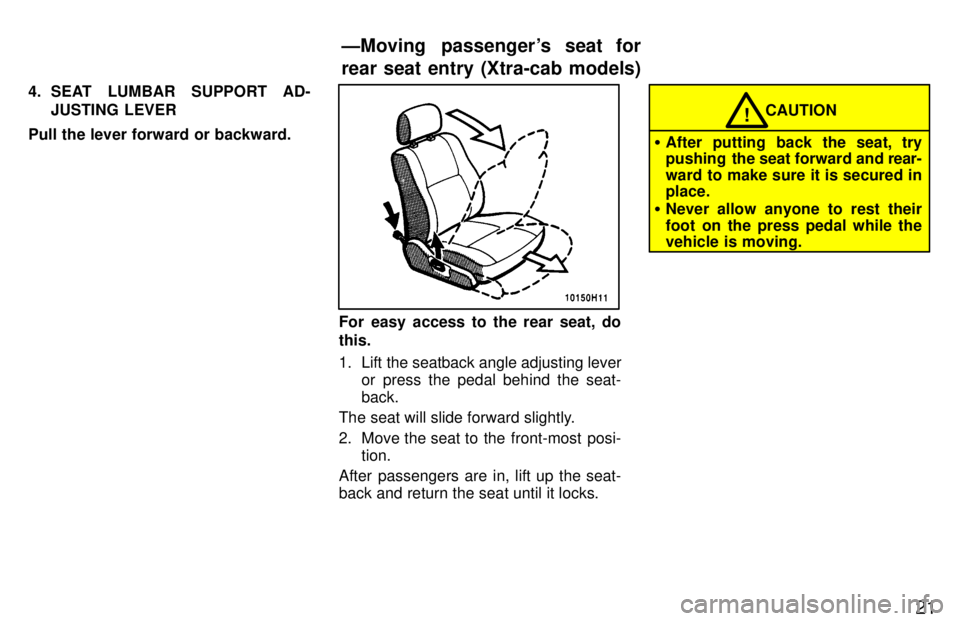
For easy access to the rear seat, do this.
1. Lift the seatback angle adjusting lever or press the pedal behind the seat- back.
The seat will slide forward slightly.
2. Move the seat to the front-most posi- tion.
After passengers are in, lift up the seat- back and return the seat until it locks.
CAUTION!
After putting back the seat, try
pushing the seat forward and rear-
ward to make sure it is secured inplace.
Never allow anyone to rest their
foot on the press pedal while the
vehicle is moving.
ÐMoving passenger's seat for
rear seat entry (Xtra-cab models)
Page 22 of 221
22
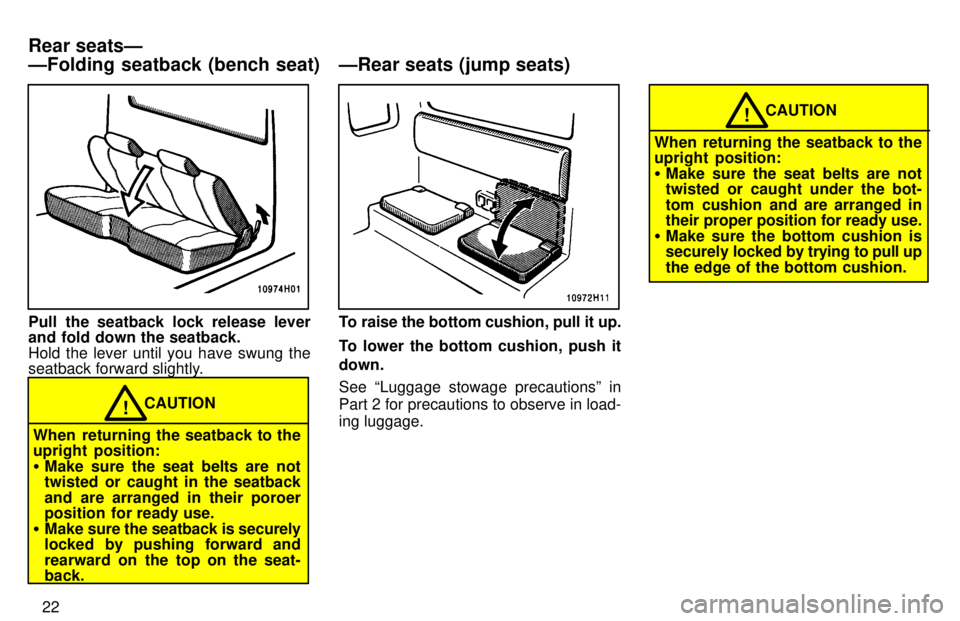
Pull the seatback lock release lever
and fold down the seatback.
Hold the lever until you have swung the
seatback forward slightly.
CAUTION!
When returning the seatback to the
upright position: Make sure the seat belts are not
twisted or caught in the seatback
and are arranged in their poroer
position for ready use.
Make sure the seatback is securely
locked by pushing forward and
rearward on the top on the seat- back.
To raise the bottom cushion, pull it up.
To lower the bottom cushion, push it down. See Luggage stowage precautionsº in
Part 2 for precautions to observe in load- ing luggage.
CAUTION!
When returning the seatback to the
upright position: Make sure the seat belts are not twisted or caught under the bot-
tom cushion and are arranged in
their proper position for ready use.
Make sure the bottom cushion is
securely locked by trying to pull up
the edge of the bottom cushion.
Rear seatsÐ
ÐFolding seatback (bench seat) ÐRear seats (jump seats)
Page 24 of 221
24
Toyota strongly urges that the driver and passengers in the vehicle be properly re- strained at all times with the seat belts
provided. Failure to do so could increase
the chance of injury and/or the severity of
injury in accidents. Child.
Use a child restraint system ap-
propriate for the child until the child be-
comes large enough to properly wear the
vehicle's seat belts. See Child restraintº
for details. NORMAL-CAB MODELSÐ
If a child is too large for a child restriant
systemn, the child should sit in the seat
and must be restrained using the vehicle's
seat belt. XTRA-CAB MODELSÐ
If a child is too large for a child restraint
system, the child should sit in the rear seat
and must be restrained using the vehicle's
seat belt. According to accident statistics,the child is safer when properly restrained
in the rear seat than in the front seat. If a
child must sit in the front seat, the seat
belts should be worn properly. Do not allow the child to stand up or kneel
on either rear or front seats. An unre-
strained child could suffer serious injury
during emergency braking or a collision.
Also, do not let the child sit on your lap. It
does not provide sufficient restraint.
If the shoulder belt falls across the child's neck or face, move the child to the center
position and use the center lap belt.
Small-framed person or youth in a
3-point type seat belt.
On models with
a bench seat, have a small-framed per-
son or youth sit slightly closer to the center
of the vehicle (so the shoulder belt does
not cross over the neck). On models with separate seats, move the seat fully back- ward.
Pregnant woman. Toyota recommends
the use of a seat belt. Ask your doctor for
specific recommendations. The lap belt
should be worn securely and as low as
possible over the hips and not on thewaist.
Injured person. Toyota recommends the
use of a seat belt. Depending on the injury,
first check with your doctor for specific recommendations.
CAUTION!
Persons should ride in their seats
properly wearing their seat belts whenever the vehicle is moving.
Otherwise, they are much more like-
ly to suffer serious bodily injury in
the event of sudden braking or a col- lision.
When using the seat belts, observe
the following: Use the belt for only one person at
a time. Do not use a single belt for
two or more peopleÐeven chil- dren.
Avoid reclining the seatbacks too
much. The seat belts provide maxi-
mum protection when the seat-backs are in the upright position.
(Refer to the seat adjustment in-structions.)
Be careful not to damage the belt
webbing or hardware. Take care
that they do not get caught or
pinched in the seat or doors.
Inspect the belt system periodical-
ly. Check for cuts, fraying, and
loose parts. Damaged parts should
be replaced. Do not desassemble
or modify the system.
Seat beltsÐ ÐSeat belt precautions
Page 26 of 221
26
If the seat belt cannot be pulled out of the
retractor,
firmly pull the belt and release it.
You will then be able to smoothly pull the
belt out of the retractor.
When a passenger's shoulder belt is com-
pletely extended and is then retracted
even slightly, the belt is locked in that posi-
tion and cannot be extended. This feature
is used to hold the child restraint system
securely. (For details, see Child restraintº
in this chapter.) To free the belt again, fully
retract the belt and then pull the belt out
once more.
CAUTION!
After inserting the tab, make sure
the tab and buckle are locked and that the belt is not twisted.
Do not insert coins, clips, etc. in
the buckle as this may prevent you
from properly latching the tab and buckle.
If the seat belt does not function
normally, immediately contact
your Toyota dealer. Do not use the
seat until the seat belt is fixed. It cannot protect an adult occupant
or your child from injury.
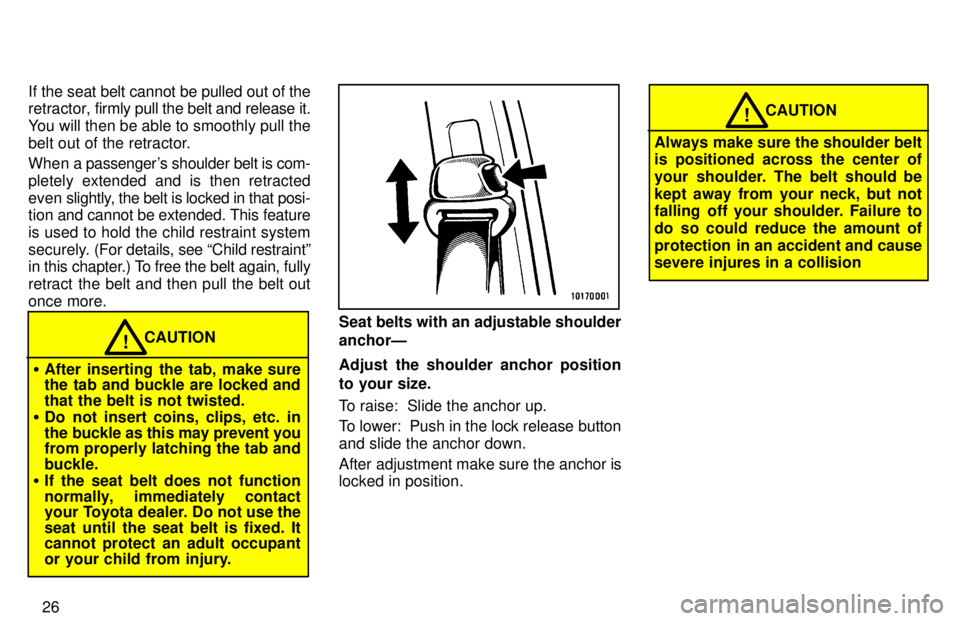
Seat belts with an adjustable shoulder anchorÐ
Adjust the shoulder anchor position
to your size.
To raise: Slide the anchor up.
To lower: Push in the lock release button
and slide the anchor down.
After adjustment make sure the anchor is
locked in position.
CAUTION!
Always make sure the shoulder belt
is positioned across the center of
your shoulder. The belt should be
kept away from your neck, but not
falling off your shoulder. Failure to
do so could reduce the amount of
protection in an accident and cause severe injures in a collision
Page 31 of 221

31
This indicator comes on when the
ignition key is turned to the ACCº or
ONº position. It goes off after about 6
seconds. This means the SRS airbag
is operating properly.
The SRS airbag warning light system
monitors the airbag sensor assembly, in-
flators, warning light, interconnecting wir-
ing and power sourcesThe SRS airbag system is designed to
activate in response to a severe frontal
impact within the shaded area be-
tween the arrows in the illustration.
The SRS airbags will deploy if the severity
of the impact is above the designed
threshold level, comparable to an approxi-
mate 20 km/h (14 mph) collision when im-
pacting straight into a fixed barrier that
does not move or deform.
If the severity of the impact is below the
above threshold level, the SRS airbags
may not deploy. However, this threshold velocity will be
considerably higher if the vehicle strikes
an object, such as a parked vehicle or sign
pole, which can move or deform on im-
pact, or if it is
involved in an underride col-
lision (e.g. a collision in which the noise of
the vehicle underridesº, or goes under, the bed of a truck).
For the safety of all occupants, be sure to
always wear your seat belts.
Page 32 of 221

32
The SRS airbags are not designed to inflate if the vehicle is subjected to a
side or rear impact, if it rolls over, or if
it is involved in a low-speed frontalcollision.The SRS airbag system mainly consists
of the following components and their
locations are shown in the illustration.
1 SRS airbag warning light.
2 Airbag sensor assembly.
3 Steering wheel pad (airbag and inflat-or)
The airbag sensor assembly consists of a
safing sensor and airbag sensor. In a severe frontal impact, sensor detects
deceleration and the system triggers the
airbag inflator. Then a chemical reaction
in the inflator momentarily fills the airbag
with non-toxic nitrogen gas to help re-
strain the forward motion of the driver. When the airbag inflates, it produces a fairly loud noise and releases some
smoke along with the nitrogen gas. This is not harmful and does not indicate a fire.
Be sure to wash off any residue as soon
as possible to prevent minor skin irritation.
Deployment of the airbag happens in a
fraction of a
second, so the airbag must in-
flate with considerable force. While the
system is designed to reduce serious inju-
ries, it may also cause minor burns or
abrasions and swellings.
The steering wheel hub may be hot for
several m inutes, but the airbag will not be
hot. The airbag is designed to inflate onlyonce.
Page 34 of 221
34
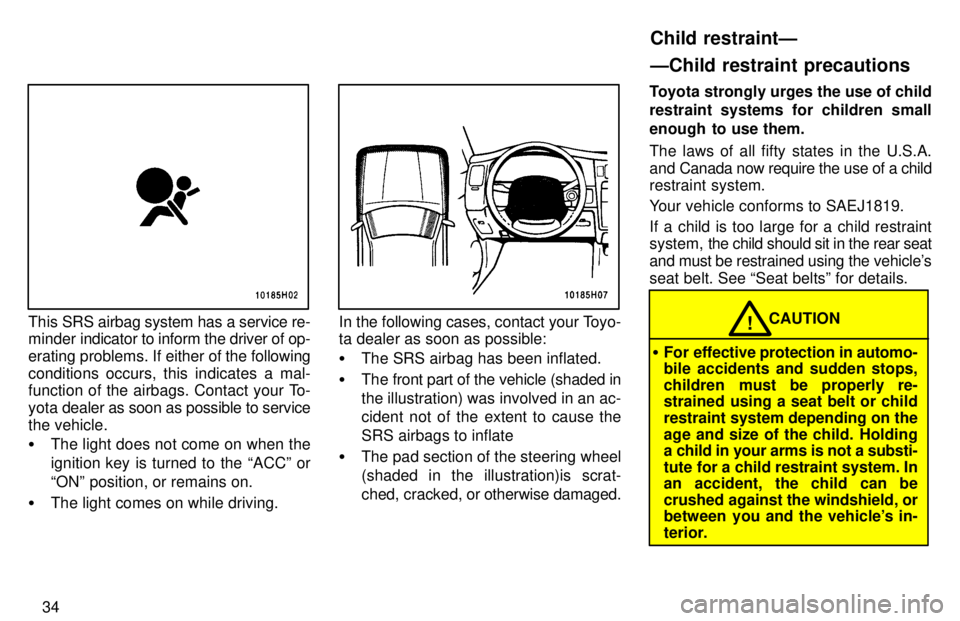
This SRS airbag system has a service re-
minder indicator to inform the driver of op-
erating problems. If either of the following
conditions occurs, this indicates a mal-
function of the airbags. Contact your To-
yota dealer as soon as possible to service
the vehicle. The light does not come on when the
ignition key is turned to the ACCº or
ONº position, or remains on.
The light comes on while driving.In the following cases, contact your Toyo-
ta dealer as soon as possible: The SRS airbag has been inflated.
The front part of the vehicle (shaded in the illustration) was involved in an ac-
cident not of the extent to cause the
SRS airbags to inflate
The pad section of the steering wheel
(shaded in the illustration)is scrat-
ched, cracked, or otherwise damaged. Toyota strongly urges the use of child
restraint systems for children small
enough to use them.
The laws of all fifty states in the U.S.A.
and Canada now require the use of a child
restraint system.
Your vehicle conforms to SAEJ1819.
If a child is too large for a child restraint
system,
the child should sit in the rear seat
and must be restrained using the vehicle's
seat belt. See Seat beltsº for details.CAUTION!
For effective protection in automo-
bile accidents and sudden stops,
children must be properly re-
strained using a seat belt or child
restraint system depending on the
age and size of the child. Holding
a child in your arms is not a substi-
tute for a child restraint system. In
an accident, the child can be
crushed against the windshield, or
between you and the vehicle's in-
terior.
Child restraintÐ ÐChild restraint precautions
Page 35 of 221
34
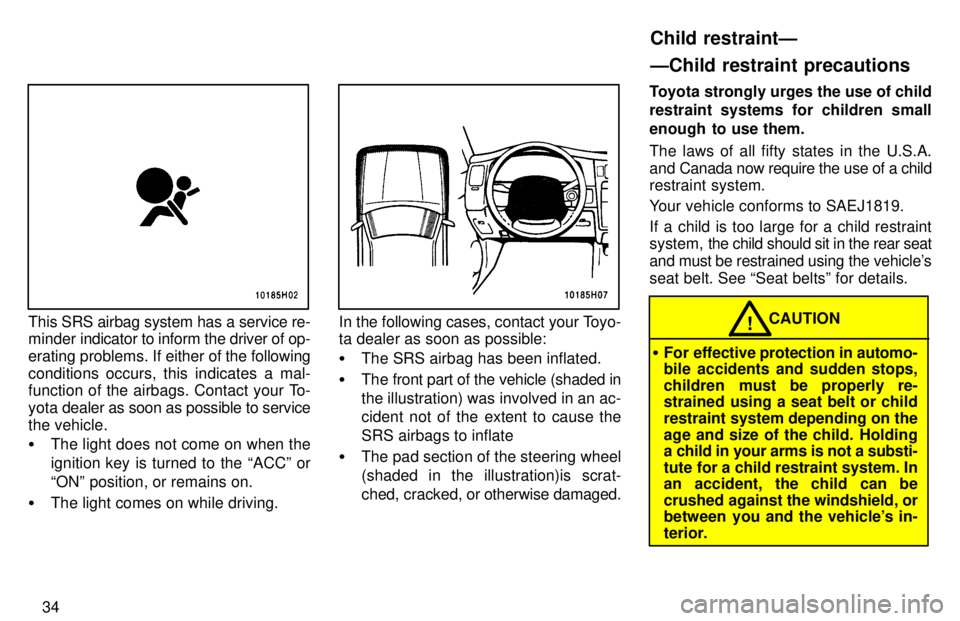
This SRS airbag system has a service re-
minder indicator to inform the driver of op-
erating problems. If either of the following
conditions occurs, this indicates a mal-
function of the airbags. Contact your To-
yota dealer as soon as possible to service
the vehicle. The light does not come on when the
ignition key is turned to the ACCº or
ONº position, or remains on.
The light comes on while driving.In the following cases, contact your Toyo-
ta dealer as soon as possible: The SRS airbag has been inflated.
The front part of the vehicle (shaded in the illustration) was involved in an ac-
cident not of the extent to cause the
SRS airbags to inflate
The pad section of the steering wheel
(shaded in the illustration)is scrat-
ched, cracked, or otherwise damaged. Toyota strongly urges the use of child
restraint systems for children small
enough to use them.
The laws of all fifty states in the U.S.A.
and Canada now require the use of a child
restraint system.
Your vehicle conforms to SAEJ1819.
If a child is too large for a child restraint
system,
the child should sit in the rear seat
and must be restrained using the vehicle's
seat belt. See Seat beltsº for details.CAUTION!
For effective protection in automo-
bile accidents and sudden stops,
children must be properly re-
strained using a seat belt or child
restraint system depending on the
age and size of the child. Holding
a child in your arms is not a substi-
tute for a child restraint system. In
an accident, the child can be
crushed against the windshield, or
between you and the vehicle's in-
terior.
Child restraintÐ ÐChild restraint precautions
Page 44 of 221
43
CAUTION!
After inserting the tab, make sure
the tab and buckle are locked and that the lap belt is not twisted.
Do not insert coins, clips, etc. in
the buckle as this may pervent you
from properly latching the tab and buckle.
If the seat belt does not function
normally, it cannot protect your
child from injury. Contact your To-
yota dealer immediately. Do not
use the seat until the seat belt isfixed.
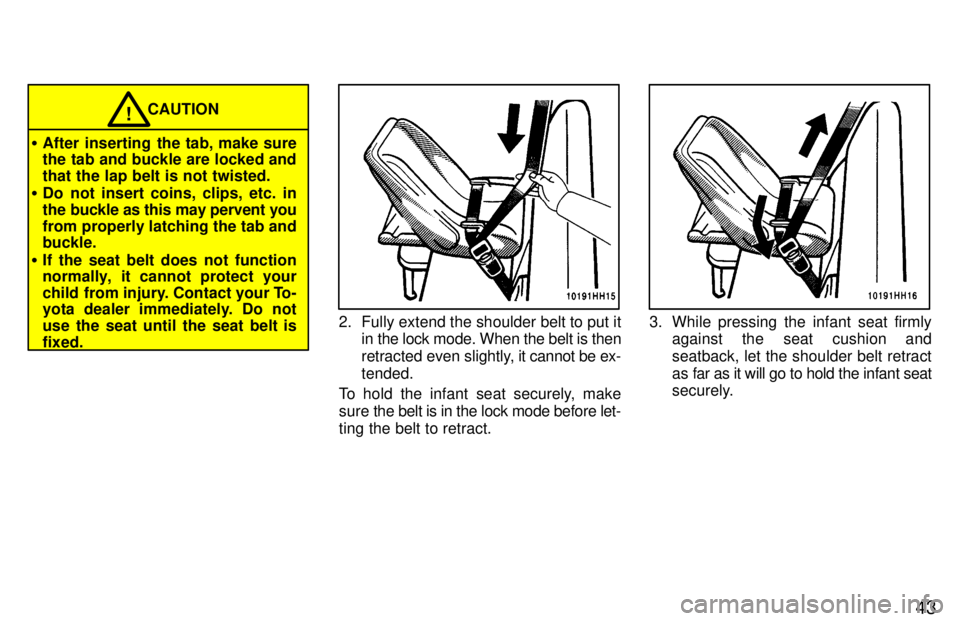
2. Fully extend the shoulder belt to put it
in the lock mode. When the belt is then
retracted even slightly, it cannot be ex-
tended.
To hold the infant seat securely, makesure the belt is in the lock mode before let-
ting the belt to retract.3. While pressing the infant seat firmly against the seat cushion and
seatback, let the shoulder belt retract
as far as it will go to hold the infant seat
securely.
Page 47 of 221
46
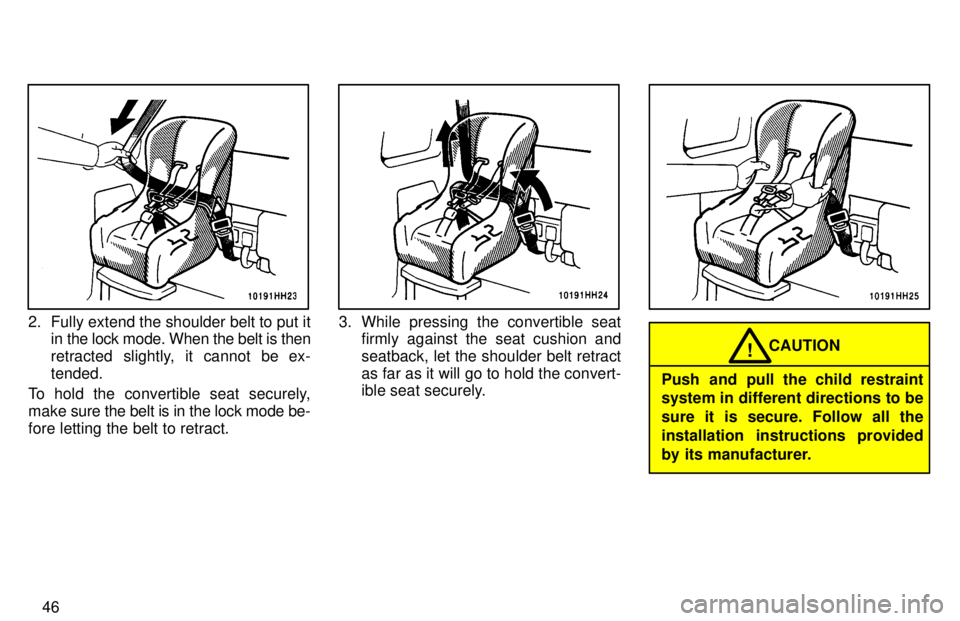
2. Fully extend the shoulder belt to put itin the lock mode. When the belt is then
retracted slightly, it cannot be ex-tended.
To hold the convertible seat securely,
make sure the belt is in the lock mode be-
fore letting the belt to retract.3. While pressing the convertible seat firmly against the seat cushion and
seatback, let the shoulder belt retract
as far as it will go to hold the convert-
ible seat securely.
CAUTION!
Push and pull the child restraint
system in different directions to be sure it is secure. Follow all theinstallation instructions provided
by its manufacturer.