warning TOYOTA TACOMA 1997 User Guide
[x] Cancel search | Manufacturer: TOYOTA, Model Year: 1997, Model line: TACOMA, Model: TOYOTA TACOMA 1997Pages: 221, PDF Size: 2.02 MB
Page 63 of 221
62(h) SRS Airbag Warning Light
This light will come on when the igni-
tion
key is turned to the ACCº or ONº
position. After about 6 seconds, the
light w ill go off. This means the airbag
system is operating properly.
The warning light system monitors the air-
bag sensor assembly, inflator, warning light, interconnecting wiring and power sources.
If either of the following conditions occurs, this indicates a malfunction somewhere in the parts monitored by the warning light
system. Contact your Toyota dealer as
soon as possible to service the vehicle. The light does not come on when the
ignition key is turned to the ACCº or
ONº position or remains on.
The light comes on while driving.
(i) Light Reminder Buzzer
This buzzer will sound if the driver's door is opened while the ignition switch isturned to the LOCKº position with the
headlight switch on. Removing the key will
not stop the buzzer as long as the head- light switch is on. (j) Key Reminder Buzzer
This buzzer reminds you to remove the
key when you open the driver's door withthe ignition key in the ACCº or LOCKº position.
(k) Unengaged Parkº Warning Light
(vehicles with automatic tranmis- sion)
The light warns that the transmission
Parkº mechanism is not engaged. If the
front drive control lever is in the Nº posi-
tion while the selector lever is in the Pº
position, the transmission will disengage
and the wheels will not lock.
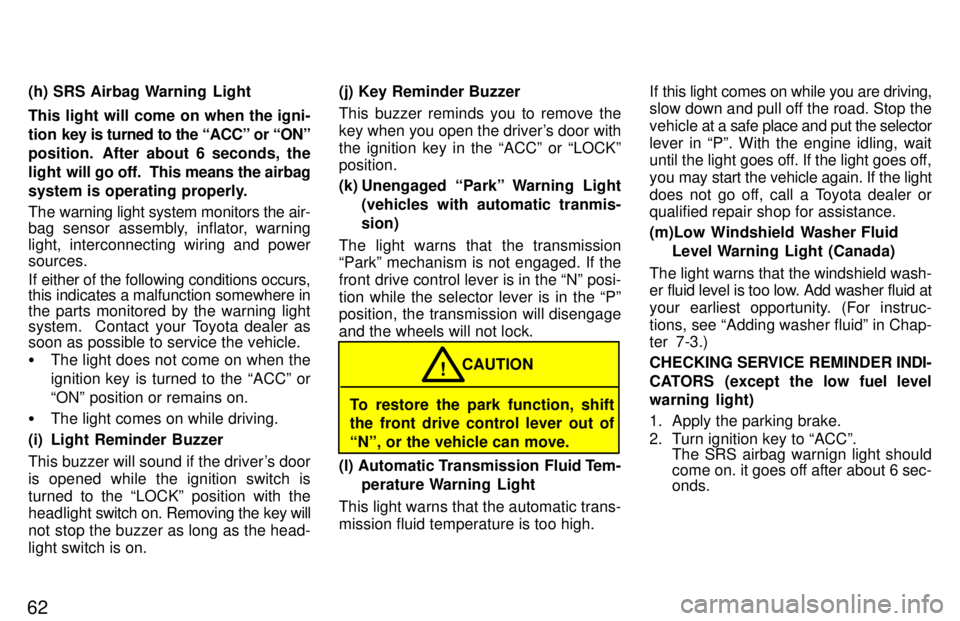
To restore the park function, shift
the front drive control lever out of
Nº, or the vehicle can move. CAUTION
!
(l) Automatic Transmission Fluid Tem- perature Warning Light
This light warns that the automatic trans- mission fluid temperature is too high. If this light comes on while you are driving,
slow down and pull off the road. Stop the
vehicle at a
safe place and put the selector
lever in Pº. With the engine idling, wait
until the light goes off. If the light goes off,
you may start the vehicle again. If the light
does not go off, call a Toyota dealer or
qualified repair shop for assistance.
(m)Low Windshield Washer Fluid
Level Warning Light (Canada)
The light warns that the windshield wash-
er fluid level is too low. Add washer fluid at
your earliest opportunity. (For instruc-
tions, see Adding washer fluidº in Chap- ter 7-3.)
CHECKING SERVICE REMINDER INDI-
CATORS (except the low fuel level
warning light)
1. Apply the parking brake.
2. Turn ignition key to ACCº. The SRS airbag warnign light should
come on. it goes off after about 6 sec- onds.
Page 64 of 221

63
3. Turn the ignition key to ONº, but do
not start the engine.
All the service reminder indicators ex-
cept the SRS airbag warning light
should come on. The ABSº warning
light goes off after about 3 seconds.
If any service reminder indicator or warn-
ing buzzer does not function as describedabove, either the bulb is burned out or the
circuit is in need of repair. Have it checked
by your Toyota dealer as soon as pos- sible.
Page 120 of 221
11 9
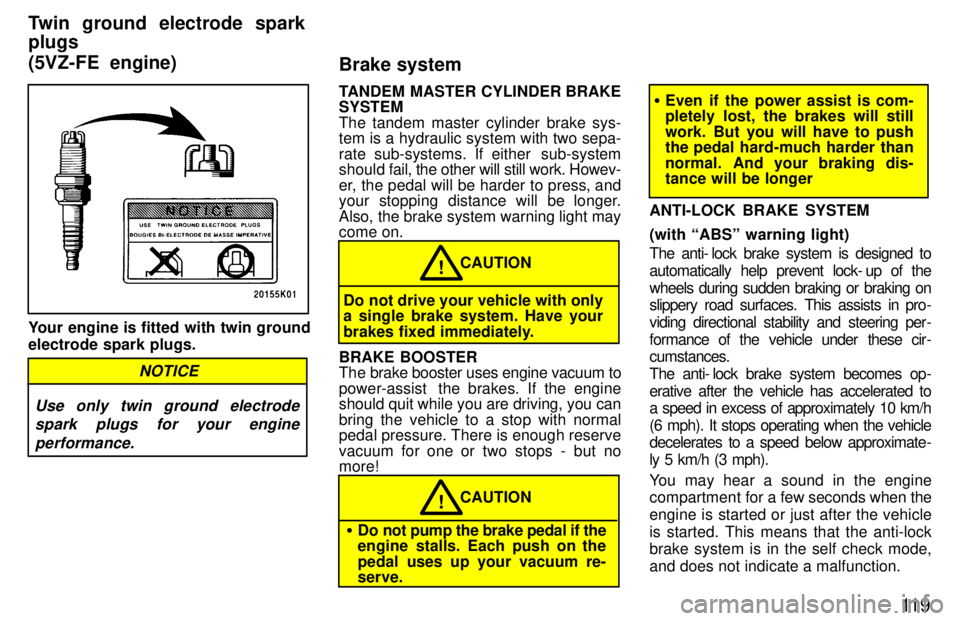
Your engine is fitted with twin ground electrode spark plugs.
Use only twin ground electrodespark plugs for your engine
performance.
NOTICE
TANDEM MASTER CYLINDER BRAKE SYSTEM
The tandem master cylinder brake sys-
tem is a hydraulic system with two sepa-
rate sub-systems. If either sub-system
should fa il, the other will still work. Howev-
er, the pedal will be harder to press, and
your stopping distance will be longer.
Also, the brake system warning light may come on.
CAUTION!
Do not drive your vehicle with only
a single brake system. Have your
brakes fixed immediately.
BRAKE BOOSTER
The brake booster uses engine vacuum to
power-assist the brakes. If the engine
should quit while you are driving, you can
bring the vehicle to a stop with normal
pedal pressure. There is enough reserve
vacuum for one or two stops - but no more!
CAUTION!
Do not pump the brake pedal if the
engine stalls. Each push on the
pedal uses up your vacuum re- serve.
Even if the power assist is com-
pletely lost, the brakes will still
work. But you will have to push
the pedal hard-much harder than
normal. And your braking dis- tance will be longer
ANTI-LOCK BRAKE SYSTEM (with ABSº warning light)
The anti- lock brake system is designed to
automatically help prevent lock- up of the
wheels during sudden braking or braking on
slippery road surfaces. This assists in pro-
viding directional stability and steering per -
formance of the vehicle under these cir -
cumstances.
The anti- lock brake system becomes op-
erative after the vehicle has accelerated to
a speed in excess of approximately 10 km/h
(6 mph). It stops operating when the vehicle
decelerates to a speed below approximate-
ly 5 km/h (3 mph).
You may hear a sound in the engine
compartment for a few seconds when the
engine is started or just after the vehicle is started. This means that the anti-lock
brake system is in the self check mode,
and does not indicate a malfunction.
Twin ground electrode spark plugs
(5VZ-FE engine)
Brake system
Page 122 of 221

121
ABSº warning light
This light comes on when the ignition key is turned to the ONº position. After about
3 seconds, the light will go off.
If any of the following conditions occurs, this
indicates a malfunction somewhere in
the parts monitored by the warning light
system. Contact your Toyota dealer as
soon as possible to service the vehicle. The light does not come on as de-
scribed above, or remains on.
The light comes on while driving.
Vehicles with rear differential lock sys- temÐ The light comes on while driving with
the rear differential unlocked.
The light does not come on with the
rear differential locked.
The system comes into operation with
the rear differential locked. Even if the anti-lock brake system
should
fail, the brake system will still operate con-
ventionally. However, when the `ABS''
warning light is on (and the brake system
warning light is off), the anti-lock brake
system is not assisting brake perfor-mance so that the wheels can lock-up
during sudden braking or braking on slip-
pery road surfaces. Have your vehicle
checked by your Toyota dealer as soon as
possible
The brake pads wear limit indicators
on your disc brakes give a warning
noise w hen the brake pads are worn to
where replacement is required.
If you hear a squealing or scraping noise
while driving, have the brake pads
checked and replaced by your Toyota
dealer as soon as possible. Expensive ro-
tor damage can result if the pads are not
replaced when necessary.
Brake pad wear limit indicators
Page 170 of 221

169
Tire surface and wheel nuts Check the tires carefully
for cuts, damage
or excessive wear. See Chapter 7-2 for
additional information. When checking the tires, make sure no nuts are missing,
and check the nuts for looseness. T ighten
them if necessary.
Tire rotation
Rotate the tires every 12000 km (7500
miles). See Chapter 7-2 for additional in- formation.
Fluid leaks Check underneath for leaking fuel, oil, wa-
ter or other fluid after the vehicle has been
parked for a while. If you smell fuel fumes
or notice any leak, have the cause found
and corrected immediately. Doors and engine hood Check that all doors including tailgate op- erate smoothly and all latches lock se-
curely. M ake sure the engine hood secon-
dary latch secures the hood from opening
when the primary latch is released. INSIDE THE VEHICLE Items listed below should be checked
regularly, e.g. while performing peri-
odic services, cleaning the vehicle,etc. Lights Make sure the headlights, stop lights, tail lights, turn signal lights, and other lights are all working. Check headlight aim. Service reminder indicators and
warn-
ing buzzers Check that all service reminder indicators
and warning buzzers function properly. Steering wheel
Be alert for changes in steering condition, such as hard steering or strange noise. Seats Check that all front seat controls such as
seat adjusters, seatback recliner, etc. op- erate smoothly and that all latches lock
securely in any position. Check that the
head restraints move up and down
smoothly and that the locks hold securely
in any latched position. For folding-down
seatback (bench seat), check that the
latches lock securely. Seat belts
Check that the seat belt system such as
buckles, retractors and anchors operate
properly
and smoothly. Make sure the belt
webbing is not cut, frayed, worn or dam-aged. Accelerator pedal Check the pedal for smooth operation and
uneven pedal effort or catching. Clutch pedal Check the pedal for smooth operation. Brake pedal Check the pedal for smooth operation and
that the pedal has the proper clearance. Check the brake booster function. Brakes
At a safe place, check that the brakes do not pull to one side when applied. Parking brake Check that the lever has the proper travel and that, on a safe incline, your vehicle is
held securely with only the parking brake applied.
Page 190 of 221

189
WHEN TO REPLACE YOUR WHEELS
If you have wheel damage such as
bending, cracks or heavy corrosion,
the wheel should be replaced.
If you fail to replace damaged wheels, the
tire may slip off the wheel or they may cause loss of handling control. WHEEL SELECTION
When replacing wheels, care should
be taken to ensure that the wheels are
replaced by ones with the same load
capacity, diameter, rim width, and off-set.
Correct
replacement wheels are available
at your Toyota dealer.
A wheel of a different size or type may ad-
versely affect handling, wheel and bear-
ing life, brake cooling, speedometer/
odometer calibration, stopping ability,
headlight aim, bumper height, vehicle
ground clearance, and tire or snow chain clearance to the body and chassis. Replacement
with used wheels is not rec-
ommended as they may have been sub-jected to rough treatment or high mileage
and could fail without warning. Also, bent
wheels which have been straightened
may have structural damage and there-
fore should not be used. Never use an in-
ner tube in a leaking wheel which is de-
signed for a tubeless tire.
After driving your vehicle the first 1600
km (1000 miles), check that the wheel
nuts are tight.
If you have rotated, repaired, or
changed your tires, check that the
wheel nuts are still tight after driving
1600 km (1000 miles).
When using tire chains, be careful not
to damage the aluminum wheels.
Use only the Toyota wheel nuts and
wrench designed for your aluminumwheels.
When balancing your wheels, use only
Toyota balance weights or equivalent
and a plastic or rubber hammer.
As with any wheel, periodically checkyour aluminum wheels for damage. If
damaged, replace immediately.
Aluminum wheel precautions
Replacing wheels
Page 213 of 221

212
Engine compartment (Canada)
6. HORN 15 A: Emergency flashers,
horns
7. DOME 15 A: Car audio system, power
antenna, interior light, clock, ignition
switch light, personal ligths, door cour-
tesy lights
8. TAIL 10 A: Tail lights, license plate
lights
9. PANEL 10 A: Emergency flashers,
heater cotnrol system, air conditioning
cooling system, gauges and meters,
clock, car audio system overdrive indi-
cator light, glovebox light, cigarette
lighter, instrument panel lightsInstrument panel
10. A/C 10 A: Air conditionin cooling sys-
tem
11. HEAD (RH) 10 A: Right-hand head-
light
12. HEAD (LH) 10 A: Left-hand headlight
13. HEAD (HI RH) 10 A: Right-hand
headlight (high beam), hi-beam indi-
cator light
14. HEAD (HI LH) 10 A: Left-hand head-
light (high beam)
15. HEAD (LO RH) 10 A: Right-hand
headlight (low beam)
16. HEAD (LO LH) 10 A: Left-hand head-
light (low beam) 17. DRL 7.5 A:
Daytime running light sys-
tem
18. 4WD 15 A: A.D.D. control system,
four-wheel drive control system, rear
differential lock system
19. GAUGE 10 A: Gauges and meters,
back-up lights, cruise control system,
power antenna, power door lock con- trol system, electronically controlled
automatic transmission system, start-
ing system, charging system, heater control system
20. TURN 10 A: Turn signal lights
21. ECU-IG 15 A: Cruise control system,
anti-lock brake system, shift lock sys-tem
22. WIPER 20 A: Windshield wipers and
washer
23. IGN 7.5 A: Discharge warning light,
SRS airbag system
24. RADIO 7.5 A: Car audio system, pow-
er antenna
25. CIG 15 A: Cigarette lighter, clock,
power rear view mirrors, back-up lights, shift lock system
26. ECU-B 15 A: SRS airbag warning
light, daytime running light system, cruise control syste, anti-lock brake system
Page 217 of 221

216Traction A, B, C
ÐThe traction grades,
from highest to lowest, are A, B, and C,
and they represent the tire's ability to stop
on wet pavement as measured under
controlled conditions on specified govern-
ment test surfaces of asphalt and con-
crete. A tire marked C may have poor trac-
tion performance.
Warning: The traction grade assigned to this tire is based on braking (straight
ahead) traction tests and does not include
cornering (turning) traction.
Temperature A, B, C ÐThe temperature
grades are A (the highest), B, and C, rep-
resenting the tire's resistance to the gen-
eration of heat and its ability to dissipate heat when tested under controlled condi-tions on a specific indoor laboratory test
wheel. Sustained high temperature can cause the material of the tire life, and ex- cessive temperature can lead to sudden
tire failure. The grade C corresponds to alevel of performance which all passenger
car tires must meet under the Federal Mo-
tor Vehicle Safety Standard No. 109.
Grades B and A represent higher levels of
performance on the laboratory test wheel
than the minimum required by law. Warning: The temperature grades for thistire
are established for a tire that is proper-
ly inflated and not overloaded. Excessivespeed, underinflation, or excessive load- ing, wither separately or in combination,can cause heat buildup and possible tire failure. This
information has been prepared in ac-
cordance with regulation issued by the
National Highway Traffic Safety Adminis-
tration of the U.S. Department of Trans-
portation Highway Traffic Safety Adminis-
tration of the U.S. Department of
Transportation. It provides the purchas-
ers and/or prospective purchasers of Toy- toa vehicles with information on truck-
camper loading. Your Toyota dealer will
help answer any auestions you may have
as you read this information.
Camper informationÐ