engine TOYOTA TACOMA 1997 Manual PDF
[x] Cancel search | Manufacturer: TOYOTA, Model Year: 1997, Model line: TACOMA, Model: TOYOTA TACOMA 1997Pages: 221, PDF Size: 2.02 MB
Page 186 of 221
185
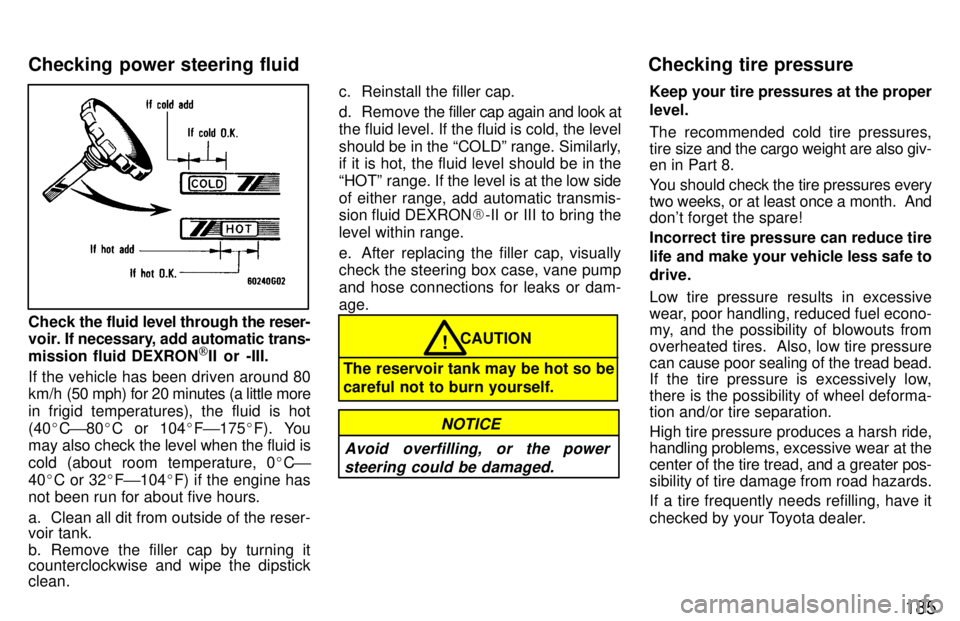
Check the fluid level through the reser-
voir. If necessary, add automatic trans-
mission fluid DEXRON [
II or -III.
If the vehicle has been driven around 80
km/h (50 mph) for 20 minutes (a little more
in frigid temperatures), the fluid is hot (40 C ' 80 C or 104 F ' 175 F). You
may also check the level when the fluid is
cold (about room temperature, 0 C '
40 C or 32 F ' 104 F) if the engine has
not been run for about five hours.
a. Clean all dit from outside of the reser- voir tank.
b. Remove the filler cap by turning it
counterclockwise and wipe the dipstick clean. c. Reinstall the filler cap.
d. Remove the filler cap again and look at the fluid level. If the fluid is cold, the level
should be in the COLDº range. Similarly, if it is hot, the fluid level should be in the
HOTº range. If the level is at
the low side
of either range, add automatic transmis-
sion fluid DEXRON -II or III to bring the
level within range.
e. After replacing the filler cap, visually check the steering box case, vane pump
and hose connections for leaks or dam-age.
CAUTION
The reservoir tank may be hot so be careful not to burn yourself.!
Avoid overfilling, or the power steering could be damaged.
NOTICE
Keep your tire pressures at the proper level.
The recommended cold tire pressures, tire size and the cargo weight are also giv-
en in Part 8.
You should check the tire pressures every two weeks, or at least once a month. And
don't forget the spare!
Incorrect tire pressure can reduce tire
life and make your vehicle less safe to drive.
Low tire pressure results in excessive
wear, poor handling, reduced fuel econo-
my, and the possibility of blowouts from
overheated tires. Also, low tire pressure
can cause poor sealing of the tread bead.
If the tire pressure is excessively low,
there is the possibility of wheel deforma- tion and/or tire separation.
High tire pressure produces a harsh ride,
handling problems, excessive wear at the center of the tire tread, and a greater pos-
sibility of tire damage from road hazards.
If a tire frequently needs refilling, have it
checked by your Toyota dealer.
Checking power steering fluid
Checking tire pressure
Page 193 of 221
192
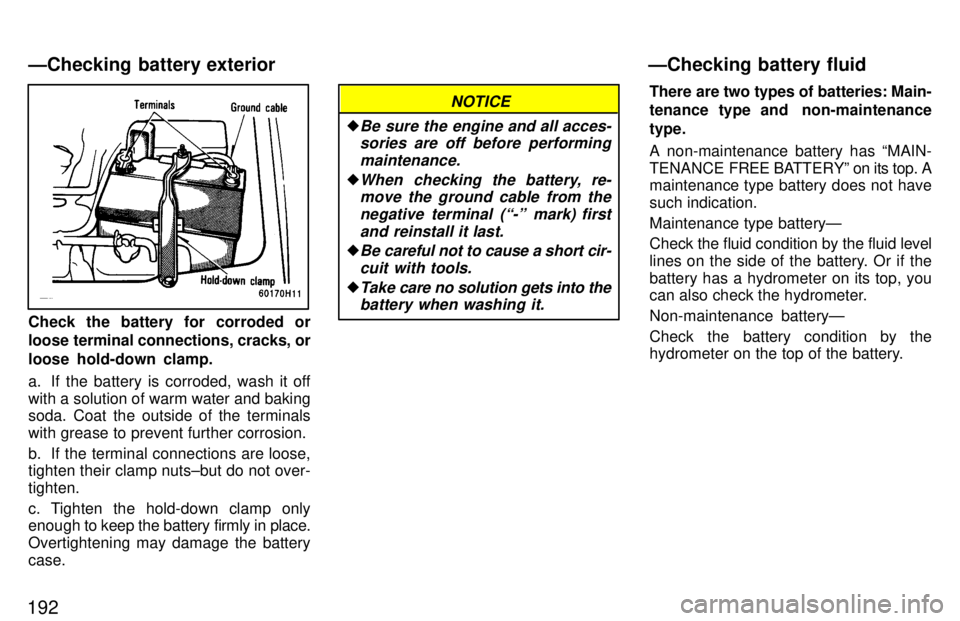
Check the battery for corroded or
loose terminal connections, cracks, or
loose hold-down clamp.
a. If the battery is corroded, wash it off with a solution of warm water and baking
soda. Coat the outside of the terminals with grease to prevent further corrosion.
b. If the terminal connections are loose, tighten their clamp nuts±but do not over- tighten.
c. Tighten the hold-down clamp only
enough to keep the battery firmly in place.
Overtightening may damage the battery case.
NOTICE
Be sure the engine and all acces-
sories are off before performing
maintenance.
When checking the battery, re-move the ground cable from the
negative terminal (-º mark) first
and reinstall it last.
Be careful not to cause a short cir-cuit with tools.
Take care no solution gets into thebattery when washing it.
There are two types of batteries: Main-
tenance type and non-maintenance type. A non-maintenance battery has MAIN-
TENANCE FREE BATTERYº on its top. A
maintenance type battery does not havesuch indication. Maintenance type batteryÐ Check the fluid condition by the fluid level
lines on the side of the battery. Or if the
battery has a hydrometer on its top, you
can also check the hydrometer. Non-maintenance batteryÐ
Check the battery condition by the
hydrometer on the top of the battery.
ÐChecking battery exterior
ÐChecking battery fluid
Page 195 of 221
194
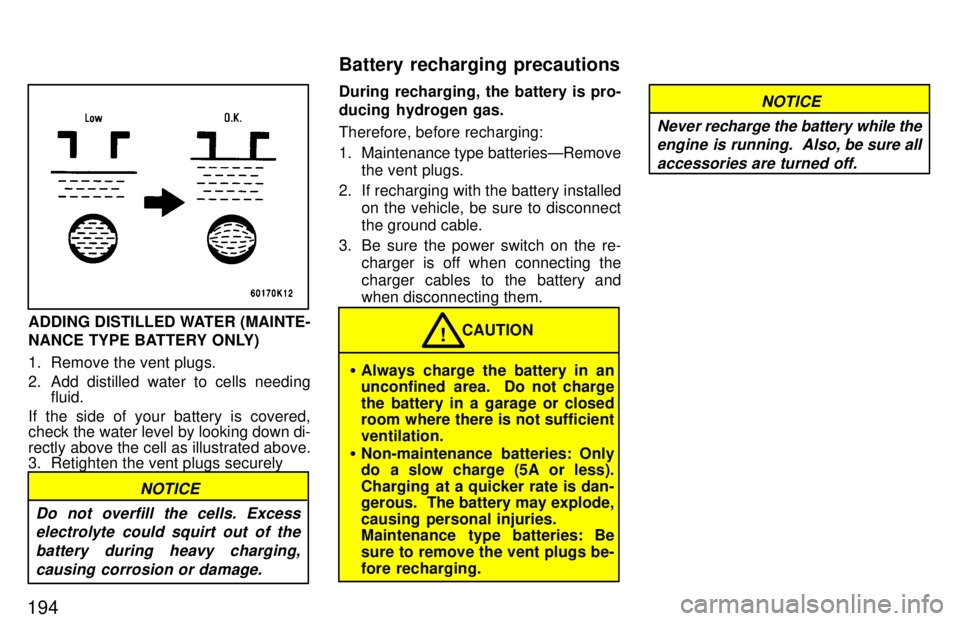
ADDING DISTILLED WATER (MAINTE-
NANCE TYPE BATTERY ONLY)
1. Remove the vent plugs.
2. Add distilled water to cells needingfluid.
If the side of your battery is covered,
check the water level by looking down di-
rectly above the cell as illustrated above.
3. Retighten the vent plugs securely
NOTICE
Do not overfill the cells. Excess electrolyte could squirt out of the
battery during heavy charging,causing corrosion or damage.
During recharging, the battery is pro-
ducing hydrogen gas. Therefore, before recharging:
1. Maintenance type batteriesÐRemove the vent plugs.
2. If recharging with the battery installed on the vehicle, be sure to disconnect the ground cable.
3. Be sure the power switch on the re- charger is off when connecting the
charger cables to the battery and
when disconnecting them.
Always charge the battery in an
unconfined area. Do not charge
the battery in a garage or closed
room where there is not sufficient ventilation.
Non-maintenance batteries: Only
do a slow charge (5A or less).
Charging at a quicker rate is dan-
gerous. The battery may explode,
causing personal injuries.
Maintenance type batteries: Be sure to remove the vent plugs be-fore recharging. CAUTION
!
NOTICE
Never recharge the battery while the
engine is running. Also, be sure all
accessories are turned off.
Battery recharging precautions
Page 197 of 221
196If the new fuse immediately blows out, there is a problem with the electrical sys-
tem.
Have your Toyota dealer correct it as
soon as possible.
Never use a fuse with a higher
amperage rating, or any other
object, in place of a fuse. This maycause extensive damage and
possibly a fire. CAUTION
!
If any washer does not work, the wash-
er tank may be empty. Add washer fluid.
You may use plain water as washer fluid.
However, in cold areas where tempera-
tures range below freezing point, use
washer fluid containing antifreeze. This
product is available at your Toyota dealer
and most auto parts stores. Follow the
manufacturer 's directions for how much
to mix with water.
NOTICE
Do not use engine antifreeze or any other substitute because it may
damage your vehicle's paint.
The following illustrations show how to
gain access to the bulbs. When replacing
a bulb, make sure the ignition switch and
light switch are off. Use bulbs with the wattage ratings given in the table.
NOTICE
Only use a bulb or unit of the listed type.
Light Bulbs and
UnitsBulb and Unit No.WType
Headlight unitsH605965/35Ð
Headlight bulbs900360/55D
Parking lights1685B
Front turn signal lights115627A
Rear turn signal lights115627A
Stop and tail lights115727/8A
Back-up lights115627A
License plate lights1943.8B
High mounted stop- light1685B
Adding washer fluid Replacing light bulbs and unitsÐ
Page 206 of 221
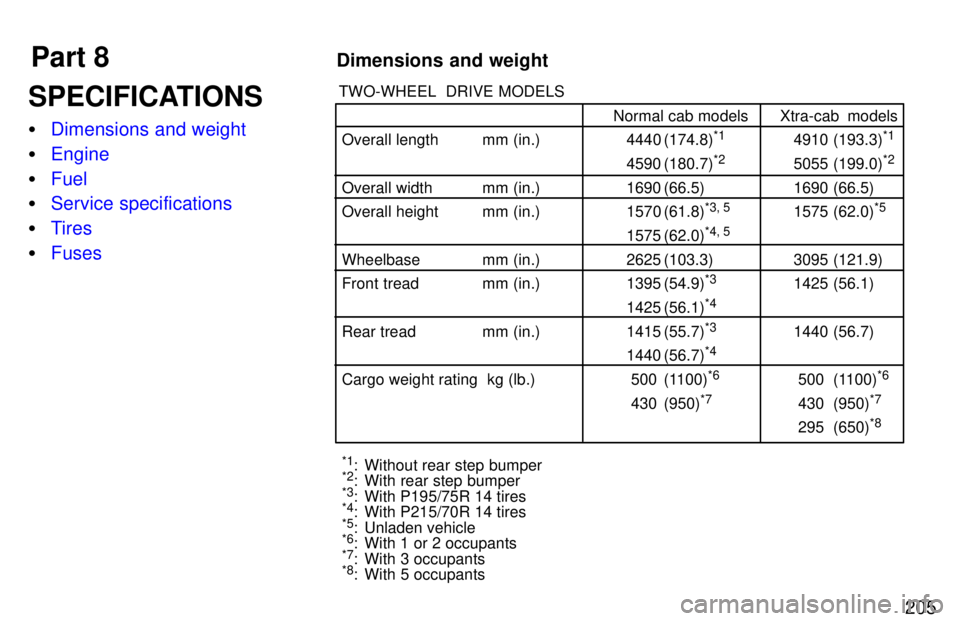
Normal cab models Xtra-cab models
Overall length mm (in.) 4440 (174.8) *1
4910 (193.3) *1
4590 (180.7) *2
5055 (199.0) *2
Overall width mm (in.) 1690 (66.5) 1690 (66.5)
Overall height mm (in.) 1570 (61.8) *3,
5
1575 (62.0) *5
1575 (62.0) *4,
5
Wheelbase mm (in.) 2625 (103.3) 3095 (121.9)
Front tread mm (in.) 1395 (54.9) *3
1425 (56.1)
1425 (56.1) *4
Rear tread mm (in.) 1415 (55.7) *3
1440 (56.7)
1440 (56.7) *4
Cargo weight rating kg (lb.) 500 (1100) *6
500 (1100)*6
430 (950) *7
430 (950)*7
295 (650) *8
*1 : Without rear step bumper
*2 : With rear step bumper
*3 : With P195/75R 14 tires
*4 : With P215/70R 14 tires
*5 : Unladen vehicle
*6 : With 1 or 2 occupants
*7 : With 3 occupants
*8 : With 5 occupants
Part 8 Dimensions and weight
205
SPECIFICATIONS
Dimensions and weight
Engine
Fuel
Service specifications
Tires
Fuses
TWO-WHEEL DRIVE MODELS
Page 207 of 221

206
FOUR-WHEEL DRIVE MODELS
Model:
2RZ-FE, 3RZ-FE and 5VZ-FE
Type: 2RZ-FE and 3RZ-FE engine
4 cylinder in line, 4 cycle, gasoline
5VZ-FE engine 6 cylinder V type, 4 cycle, gasoline
Bore and stroke, mm (in.): 2RZ-FE engine
95.0 x 86.0 (3.74 x 3.39)
3RZ-FE engine
95.0 x 95.0 (3.74 x 3.74)
5VZ-FE engine 93.5 x 82.0 (3.68 x 3.23)
Displacement, cm 3
(cu. in.):
2RZ-FE engine 2438 (148.8)
3RZ-FE engine 2694 (164.3)
5VZ-FE engine
3378 (206.1)
Normal cab models Xtra-cab models
Overall length mm (in.) 4585 (180.5) 5055 (199.0)
Overall width mm (in.) 1690 (66.5) *1
1690 (66.5)
1720 (67.7) *2
1720 (67.7)*2
Overall height mm (in.) 1710 (67.3) *1,3
1700 (66.9)*1,3
1740 (68.5) *2,3
1735 (68.3)*2,3
Wheelbase mm (in.) 2625 (103.3) 3095 (121.9)
Front tread mm (in.) 1395 (54.9) *3
1460 (57.5)*4
1500 (59.1) *5
1500 (59.1)*5
Rear tread mm (in.) 1455 (57.3) *4
1455 (57.3)*4
1495 (58.9) *5
1495 (58.9)*5
Cargo weight rating kg (lb.) 500 (1100) 500 (1100) *6
317 (700) *7
*1 : With P225/75R 15 tires
*2 : With 31 x 10.5R 15 LT tires
*3 : Unladen vehicle
*4 : With steel wheels
*5 : With aluminum wheels
*6 : With 3 occupants
*7 : With 5 occupants
Engine
Page 208 of 221

207
Fuel type:
Unleaded gasoline, Research Octane Number 91 (Octane Rating 87) orhigher
Fuel tank capacity, L (gal., Imp. gal.):
Two-wheel drive models
57 (15.1, 12.5) Four-wheel drive models
68 (18.0, 15.0) ENGINE
Valve clearance (engine cold), mm (in.) 2RZ-FE and 3RZ-FE engines
Intake 0.15 '0.25 (0.006 '0.010)
Exhaust 0.25 '0.35 (0.010 '0.014)
5VZ-FE engine
Intake 0.13 '0.23 (0.006 '0.009)
Exhaust 0.27 '0.37 (0.011 '0.014)
Spark plug type: 2RZ-FE and 3RZ-FE engines NIPPONDENSO K16R-U
NGK BKR5EYA
5VZ-FE engine
NIPPONDENSO K16TR11
NGK BKR5EKB11
Spark plug type: 2RZ-FE and 3RZ-FE engines
0.8 (0.031)
5VZ-FE engine
1.1 (0.043) Drive belt tension measured with Bor-
oughs drive belt tension gauge No.
BT-33-73F (used belt), Ibf: 2RZ-FE and 3RZ-FE engines
Generator belt 115 + 20
Air conditioning
compressor belt 100 + 20
Power steering pump belt 100 -15+20
5VZ-FE engine Generator belt 100 + 20
Air conditioning
compressor belt 100 + 20
Power steering pump belt 100 -15+20
Fuel
Service specifications
Page 209 of 221

208
ENGINE LUBRICATION Oil capacity (drain and refill), L (qt., Imp. qt.):
Two-wheel drive models 2RZ-FE engine
With filter 5.5 (5.8, 4.8)
Without filter 4.8 (5.0, 4.2)
5VZ-FE engine
With filter 5.4 (5.7, 4.8)
Without filter 5.1 (5.4, 4.5)
Four-wheel drive models 3RZ-FE engine
With filter 5.4 (5.7, 4.8)
Without filter 4.7 (5.0, 4.1)
5VZ-FE engine With filter 5.2 (5.5, 4.6)
Without filter 4.9 (5.2, 4.3)
Oil grade:
API SH, Energy-Conserving IIº multi-
grade engine oil or ILSAC multigrade en-
gine oil is recommended. Recommended oil viscosity (SAE):
COOLING SYSTEM
Total capacity, L (qt., Imp. qt.):
Two-wheel drive models With manual transmission
2RZ-FE engine
8.0 (8.5, 7.0)
5VZ-FE engine 9.7 (10.3, 8.5)
With automatic transmission
2RZ-FE engine 7.8 (8.2, 6.9)
5VZ-FE engine 9.5 (10.0, 8.4) Four-wheel drive models With manual transmission
3RZ-FE engine
8.3 (8.8, 7.3)
5VZ-FE engine 10.1 (10.7, 8.9)
With automatic transmission
3RZ-FE engine 8.2 (8.7, 7.2)
5VZ-FE engine 10.0 (10.5, 8.8)
Coolant type: With ethylene-glycol antifreeze (Do not use alcohol type.)
BATTERY Open voltage* at 20 C (68 F):
12.7 V Fully charged 12.3 V Half charged
11.9 V Discharged
*Voltage that is checked 20 minutes after
the key is removed with all the lights
turned off Charging rates: 5 A max.
Page 210 of 221

209
CLUTCH
Pedal freeplay, mm (in.):
5' 15 (0.2 '0.6)
Fluid type: SAE J1703 or FMVSS No. 116 DOT 3
MANUAL TRANSAXLE
Oil capacity, L (qt., Imp. qt.):
2RZ-FE engine 2.6 (2.7, 2.3)
3RZ-FE engine 2.5 (2.6, 2.2)
5VZ-FE engine
Two-wheel drive models 2.6 (2.7, 2.3)
Four-wheel drive models 2.2 (2.3, 1.9)
Oil type:
Multipurpose gear oil API GL-4 or GL-5
Recommended oil viscosity:
SAE 75W-90 AUTOMATIC TRANSMISSION Fluid capacity (drain and refill), L (qt., Imp. qt.):
Two-wheel drive models 2RZ-FE engine
Up to 2.4 (2.5 2.1)
5VZ-FE engine Up to 1.6 (1.7, 1.4)
Four-wheel drive models Up to 2.0 (2.1, 1.8)
Fluid type:
Automatic transmission fluid D-II or DEXRON [
III (DEXRON [
II)
TRANSFER
Oil capacity, L (qt., lmp. qt.): 1.0 (1.1, 0.9)
Oil type: Multipurpose gear oil API GL-4 or
GL-5 Recommended oil viscosity: SAE 75W-90 DIFFERENTIAL
Oil capacity, L (qt., lmp. qt.):
Two-wheel drive models
2RZ-FE engine 1.35 (1.4, 1.2)
5VZ-FE engine 2.55 (2.7, 2.2)
Four-wheel drive models Front A.D.D. 1.15 (1.2, 1.0)
Except A.D.D. 1.1 (1.2, 1.0)
Rear Short wheel base
With rear differential lock system 2.65 (2.8, 2.3)
Without rear differential lock system 2.55 (2.7, 2.2)
Extra long wheel base
With rear differential lock system 2.95 (3.1, 2.6)
Without rear differential lock system 2.05 (2.2, 1.8)
Oil type: Hypoid gear oil API GL-5
Page 211 of 221

210
Recommended oil viscosity:
Front A.D.D.
SAE 75W-90
Except A.D.D. Above -18 C (0 F)
SAE 90
Below -18 C (0 F)
SAE 80W or 80W-90
Rear Above -18 C (0 F)
SAE 90
Below -18 C (0 F)
SAE 80W or 80W-90 CHASSIS LUBRICATION Wheel bearings:
Lithium base wheel bearing grease, NLGI No. 2
Front drive shaft thrust bushings:
Synthetic oil and lithium soap basechassis grease, NLGI No. 1
Propeller shafts:
SpidersLithium base chassis grease, NLGI No. 2
Slide youke and double cardan joint
Molybdenum-disulfide lithiumbase chassis grease, NLGI No. 2
BRAKES Minimum pedal clearance when de- pressed with the pressure of 490 N (50
kgf, 110 lbf) with the engine running, mm(in.): 72 (2.8)
Pedal freeplay, mm (in.):
3' 6 (0.12 '0.24)
Pad wear limit, mm (in.):
1.0 (0.04)
Lining wear limit, mm (in.):
1.0 (0.04)
Parking brake adjustment when pulled with the force of 196 N (20 kgf, 44 lbf):
12'18 clicks
Fluid type:
SAE J1703 or FMVSS No. 116 DOT 3 STEERING Wheel freeplay:
Less than 30 mm (1.2 in.)
Power steering fluid type: Automatic transmission fluid DEXRON [
II or III