ESP TOYOTA TACOMA 1997 Owners Manual
[x] Cancel search | Manufacturer: TOYOTA, Model Year: 1997, Model line: TACOMA, Model: TOYOTA TACOMA 1997Pages: 221, PDF Size: 2.02 MB
Page 11 of 221

11
LOCKING AND UNLOCKING WITH
POWER DOOR LOCK SWITCH Push the switch.
To lock: Push the switch on the front side.
To unlock: Push the switch on the rear side
Both doors lock or unlock simultaneously.
CAUTION!
Before driving, be sure that the
doors are closed and locked, espe-
cially when small children are in the
vehicle. A long with the proper use of
seat belts, locking the doors helps
prevent the driver and passengers
from being thrown out from the ve-
hicle during an accident. It also
helps prevent the doors from being
opened unintentionally.
The windows can be operated with the
switch on each door.
The power windows work when the igni- tion switch is in the ONº position. Howev-
er, if both doors are closed, they work for 60 seconds even after the ignition switch
is turned off. They stop working when ei-ther door is opened.
OPERATING THE DRIVER'S WINDOW
Use the switch on the driver's door.
Normal operation: The window moves
as long as you hold the switch.
To open: Lightly push down the switch.
To close: Pull up the switch.Automatic operation (to open only):
Push the switch completely down and
then rel ease it. The window will fully open.
To stop the window partway, lightly pull the
switch up and then release it.
Power windows
Page 12 of 221

12
OPERATING THE PASSENGERS' WIN-
DOW
Use the switch on the passenger's
door or the switch on the driver's door
that controls the passenger's window.
The windows moves as long as you hold the switch.
To open: Push down the switch.
To close: Pull up the switch.
If you push in the WINDOWS LOCKº
button on the driver's door, the passen-
ger's windows cannot be operated.
CAUTION!
To avoid serious personal injury, you
must do the following. Always make sure the head, hands
and other parts of the body of all oc-
cupants are kept completely inside
the vehicle before you close the
power windows. If someone's
neck, head or hands gets caught in
a closing window, it could result in
a serious injury. When anyone
closes the power windows, be sure
that they operate the windows safe-
ly.
When small children are in the ve-
hicle, never let them use the power
window switches without supervi-
sion. Use the WINDOW LOCKº
button to prevent them from mak-
ing unexpected use of the switches.
Never leave small children alone in
the vehicle, especially with the igni-
tion key still inserted. They could
use the power window switches
and get trapped in a window. Unat-
tended children can become in-
volved in serious accidents.
Page 30 of 221
30
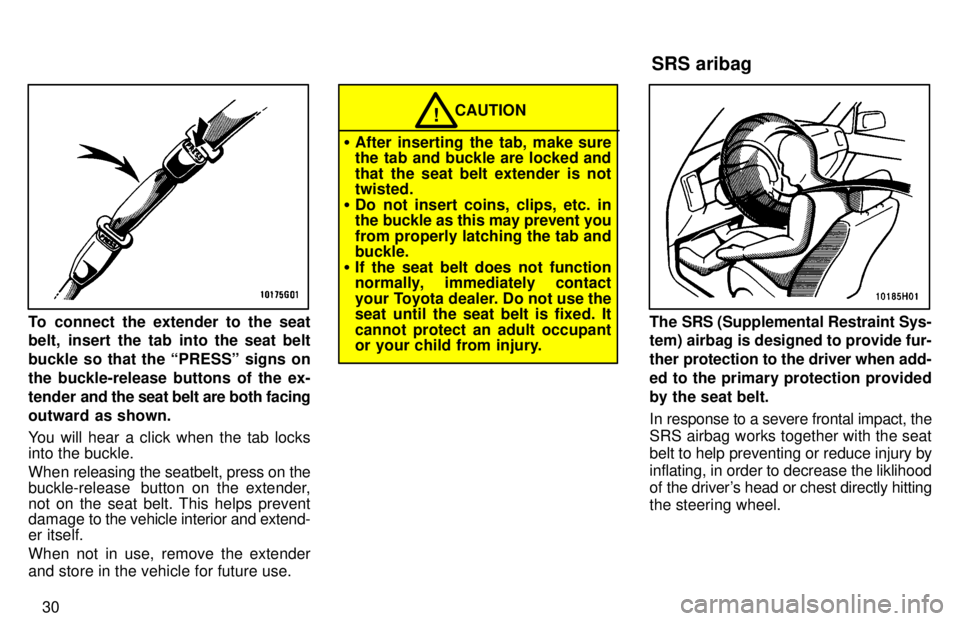
To connect the extender to the seat
belt, insert the tab into the seat belt
buckle so that the PRESSº signs onthe buckle-release buttons of the ex-
tender and the seat belt are both facing
outward as shown.
You will hear a click when the tab locks into the buckle.
When releasing the seatbelt, press on the
buckle-release button on the extender,not on the seat belt. This helps prevent
damage to the vehicle interior and extend- er itself.
When not in use, remove the extender
and store in the vehicle for future use.
CAUTION!
After inserting the tab, make sure
the tab and buckle are locked and
that the seat belt extender is not twisted.
Do not insert coins, clips, etc. in
the buckle as this may prevent you
from properly latching the tab and buckle.
If the seat belt does not function
normally, immediately contact
your Toyota dealer. Do not use the
seat until the seat belt is fixed. It cannot protect an adult occupant
or your child from injury.
The SRS (Supplemental Restraint Sys-
tem) airbag is designed to provide fur-
ther protection to the driver when add-
ed to the primary protection providedby the seat belt.
In response to a severe frontal impact, the
SRS airbag works together with the seat
belt to help preventing or reduce injury byinflating, in order to decrease the liklihood
of the driver's head or chest directly hitting the steering wheel. SRS aribag
Page 31 of 221

31
This indicator comes on when the
ignition key is turned to the ACCº or
ONº position. It goes off after about 6
seconds. This means the SRS airbag
is operating properly.
The SRS airbag warning light system
monitors the airbag sensor assembly, in-
flators, warning light, interconnecting wir-
ing and power sourcesThe SRS airbag system is designed to
activate in response to a severe frontal
impact within the shaded area be-
tween the arrows in the illustration.
The SRS airbags will deploy if the severity
of the impact is above the designed
threshold level, comparable to an approxi-
mate 20 km/h (14 mph) collision when im-
pacting straight into a fixed barrier that
does not move or deform.
If the severity of the impact is below the
above threshold level, the SRS airbags
may not deploy. However, this threshold velocity will be
considerably higher if the vehicle strikes
an object, such as a parked vehicle or sign
pole, which can move or deform on im-
pact, or if it is
involved in an underride col-
lision (e.g. a collision in which the noise of
the vehicle underridesº, or goes under, the bed of a truck).
For the safety of all occupants, be sure to
always wear your seat belts.
Page 102 of 221

101
AM
FadingÐAM broadcasts are reflected by the upper atmosphere-especially atnight. These reflected signals can inter-
fere with those received directly from the radio station, causing the radio station tosound alternately strong and weak.
Station interferenceÐWhen a reflected
signal and a signal received directly from a radio station are very nearly the same
frequency, they can interfere with each
other,
making it difficult to hear the broad-
cast.
StaticÐAM is easily affected by external sources of electrical noise, such as high
tension power lines, lightening, or electri-cal motors. This results in static.
CARING FOR YOUR CASSETTE PLAY-
ER AND TAPES
For high performance from your cassette
player and tapes:
Clean the tape head and other parts regu-
larly. A dirty tape head or tape path can de-
crease sound quality and tangle your
cassette tapes. The easiest way to
clean them is by using a cleaning tape.
(A wet type is recommended.) Use high-quality cassettes.
Low-quality cassette tapes can cause
many problems, including poor sound, inconsistent playing speed, and
constant auto-reversing. They can
also get stuck or tangled in the cas-
sette player.
Do not use a cassette if it has been
damaged or tangled or if its label is
peeling off.
Do not leave a cassette in the player if
you are not listening to it, especially if it is hot outside.
Store cassettes in their cases and out
of direct sunlight.
Avoid using cassettes with a total play-
ing time longer than 100 minutes (50
minutes per side). The tape used in
these cassettes is thin and could get
stuck or tangled in the cassette player.
Page 120 of 221
11 9
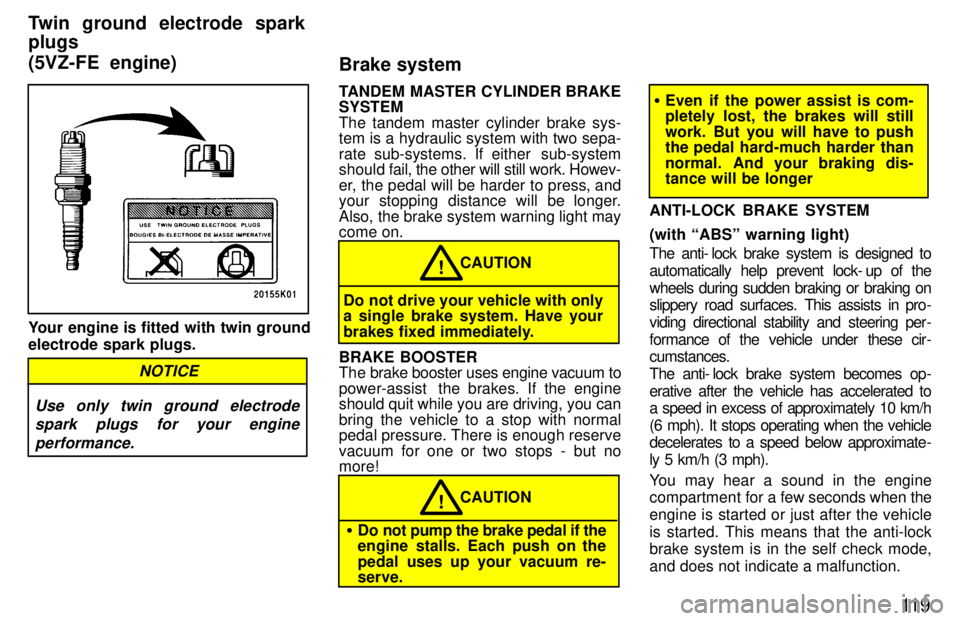
Your engine is fitted with twin ground electrode spark plugs.
Use only twin ground electrodespark plugs for your engine
performance.
NOTICE
TANDEM MASTER CYLINDER BRAKE SYSTEM
The tandem master cylinder brake sys-
tem is a hydraulic system with two sepa-
rate sub-systems. If either sub-system
should fa il, the other will still work. Howev-
er, the pedal will be harder to press, and
your stopping distance will be longer.
Also, the brake system warning light may come on.
CAUTION!
Do not drive your vehicle with only
a single brake system. Have your
brakes fixed immediately.
BRAKE BOOSTER
The brake booster uses engine vacuum to
power-assist the brakes. If the engine
should quit while you are driving, you can
bring the vehicle to a stop with normal
pedal pressure. There is enough reserve
vacuum for one or two stops - but no more!
CAUTION!
Do not pump the brake pedal if the
engine stalls. Each push on the
pedal uses up your vacuum re- serve.
Even if the power assist is com-
pletely lost, the brakes will still
work. But you will have to push
the pedal hard-much harder than
normal. And your braking dis- tance will be longer
ANTI-LOCK BRAKE SYSTEM (with ABSº warning light)
The anti- lock brake system is designed to
automatically help prevent lock- up of the
wheels during sudden braking or braking on
slippery road surfaces. This assists in pro-
viding directional stability and steering per -
formance of the vehicle under these cir -
cumstances.
The anti- lock brake system becomes op-
erative after the vehicle has accelerated to
a speed in excess of approximately 10 km/h
(6 mph). It stops operating when the vehicle
decelerates to a speed below approximate-
ly 5 km/h (3 mph).
You may hear a sound in the engine
compartment for a few seconds when the
engine is started or just after the vehicle is started. This means that the anti-lock
brake system is in the self check mode,
and does not indicate a malfunction.
Twin ground electrode spark plugs
(5VZ-FE engine)
Brake system
Page 130 of 221

129
Four-wheel drive modelsÐToyota
recommends not using four-wheel
drive on dry hard-surfaced roads, be-
cause four-wheel driving will cause unnecessary noise and wear, and poor
fuel economy.
Four-wheel drive modelsÐIn cold
temperatures, noise may occur when
driving in two-wheel drive before the
transfer is warmed up. Therefore, first
drive in four-wheel drive until the
transfer is warmed up.
CAUTION
Before driving off, make sure that the parking brake if fully released
and the parking brake reminder
light is off.
Do not leave your vehicle unat-
tended while the engine is running.
Do not rest your foot on the brake
pedal while driving. It can cause
dangerous overheating, needless
wear, and poor fuel economy.
Be careful when accelerating, up-
shifting, down shifting or braking
on a slippery surface. Sudden ac-
celeration or engine braking, could cause the vehicle to spin or skid.!
To drive down a long or steep hill, reduce your speed and downshift.
Remember, if you ride the brakes
excessively, they may overheat and
not work properly.
Do not drive in excess of the speed
limit. Even if the legal speed limit
permits it, do not drive over 140
km/h (85 mph) unless your vehicle
has high-speed capability tires.
Driving over 140 km/h (85 mph) may
result in tire failure, loss of control
and possible injury. Be sure to con-
sult a tire dealer to determine
whether the tires on your vehicle
are high-speed capability tires or
not before driving at such speeds.
Do not continue normal driving
when the brakes are wet. If they are
wet, your vehicle will require a lon-ger stopping distance, and it may
pull to one side when the brakes are
applied. Also, the parking brake
will not hold the vehicle securely. When driving your vehicle off-road,
please observe the following precautions
to ensure your driving enjoyment and to
help prevent the closure of areas to off-
road vehicles.
a. Drive your vehicle only in areas where
off-road vehicles are permitted to travel.
b. Respect private property. Get owner's
permission before entering private prop-
erty.
c. Do not enter areas that are closed.
Hon-
or gates, barriers and signs that restrict travel.
d. Stay on established roads. When con-
ditions are wet, driving techniques should
be changed or travel delayed to prevent
damage to roads.
For owners in U.S. mainland, Hawaii and Puerto Rico:
To obtain additional information pertaining
to driving your vehicle off-road, consult the following organizations. State and Local Parks and Recreation Departments
State Motor Vehicle Bureau
Recreational Vehicle Clubs
U.S. Forest Service and Bureau of
Land Management
Off-road driving precautions (four-wheel drive models only)
Page 131 of 221
130
CAUTION
Always observe the following
precautions to minimize the risk of
serious per sonal injury or damage to
your vehicle: Drive carefully when off the road.
Do not take unnecessary risks by
driving in dangerous places.
Do not grip the steering wheel
spokes when driving off-road. A
bad bump could jerk the wheel and
injure your hands. Keep both
hands and especially your thumbson the outside of the rim.
Always check your brakes for effec-
tiveness immediately after driving
in sand, mud, water or snow.
After driving through tall grass,
mud, rock, sand, rivers, etc., check
that there is no grass, bush, paper,
rags, stone, sand etc. adhering or
trapped on the underbody. Clear off
any such matter from the under-
body. If the vehicle is used with these materials trapped or adher-
ing to the underbody, a breakdown
or fire could occur.! The driver and all passengers
should fasten their seat belts
whenever the vehicle is moving.
If driving through water, such as when crossing shallow streams,
first check the depth of the waterand the bottom of the river bed for
firmness. Drive slowly and avoiddeep water.
Take all necessary safety mea-sures to ensure that damage to the
engine or other components does not occur.
Water entering the engine air in-take will cause severe engine dam-
age. Water can wash the grease from
wheel bearings, causing rustingand premature failure, and may
also enter the differential, trans-mission and transfer case, reduc-
ing the gear oil's lubricating quali-ties.
Sand and mud that has accumu-lated in brake drums and around
brake discs may affect braking ef-ficiency and may damage brake
system components.
NOTICE
Always perform a maintenance in-spection after each day of off-
road driving that has taken youthrough rough terrain, sand, mud,
or water. For scheduled mainte- nance information, refer to the
separate Owner's Manual Sup-plement/Maintenance Scheduleº.
Page 135 of 221

134
Never tow a trailer without using a
safety chain securely attached to
both the trailer and the vehicle. If
damage occurs to the coupling
unit or hitch ball, there is danger of
the trailer wandering over into
another lane.
TIRES Ensure that your vehicle's tires are
properly inflated.
The trailer tires should be inflated to
the pressure recommended by the
trailer manufacturer in respect to the
total trailer weight.
TRAILER LIGHTS Trailer lights must comply with federal,
state/provincial and local regulations. See your local recreational vehicle
dealer or rental agency for the correct type of wiring and relays for your trail-
er. Check for correct operation of the
turn signals and stop lights each time
you hitch up. Direct splicing may dam-
age your vehicle's electrical system
and cause a malfunction of your lights. BREAK-IN SCHEDULE
Toyota recommends that you do not
tow a trailer with a new vehicle or a ve-
hicle with any new power train compo-
nent (engine, transmission, differen- tial, wheel bearing, etc.) for the first
800 km (500 miles) of driving.
MAINTENANCE If you tow a trailer, your vehicle will re-
quire more frequent maintenance due
to the additional load. For this informa-
tion, please refer to the scheduled
maintenance information in the Own-
er 's Manual Supplement/Maintenance Scheduleº.
Retighten all fixing bolts of the towing
ball and bracket after approximately
1000 km (600 miles) of trailer driving.
PRE-T OWING SAFETY CHECK Check that your vehicle remains level
when a loaded or unloaded trailer is
hitched. Do not drive if the vehicle has
an abnormal nose-up or nose-down
condition, and check for improper
tongue load, overload, worn suspen-
sion or other possible causes.
Make sure the trailer cargo is securely
loaded so that it cannot shift.
Check that your rear view mirrors con-
form to any applicable federal, state/
provincial or local regulation. If not,
install the rear view mirrors required
for towing purpose.
TRAILER TOWING TIPS
When towing a trailer, your vehicle will
handle differently than when not tow- ing. The three main causes of vehicle
trailer accidents are driver error, ex-
cessive speed and improper trailer
loading. Keep these in mind when tow-
ing: Before starting out, check operation of
the lights and all vehicle-trailer con-
nections. After driving a short dis-
tance, stop and recheck the lights and
connections. Before actually towing a
trailer, practice turning, stopping and
backing with a trailer in an area away
from traffic until you learn the feel.
Page 136 of 221

135
Backing w ith a trailer is difficult and re-
quires practice. Grip the bottom of the steering wheel and move your hand to
the left to move the trailer to the left. Move your hand to the right to move
the trailer to the right. (This procedureis generally opposite to that when
backing without a trailer). Also, just
turn the steering wheel a little at a time,
avoiding sharp or prolonged turning. Have someone guide you when back-
ing to reduce the risk of an accident.
Because stopping distance may be in-
creased, vehicle-to-vehicle distance
should be increased when towing a
trailer. For each 16 km/h (10 mph) of speed, allow at least one vehicle and
trailer length between you and the ve-
hicle ahead. Avoid sudden braking as you may skid, resulting in jackknifing and loss of control This is especially
true on wet or slippery surfaces.
Avoid jerky starts or sudden accelera-tion. If your vehicle has manual trans-
mission, prevent excessive clutch slip-
page by keeping engine rpm low and
not racing the engine. Always start out
in first gear.
Avoid jerky steering and sharp turns.
The trailer could hit your vehicle in a
tight turn. Slow down before making a
turn to avoid the necessity of sudden braking.
Remember that when making a turn,the trailer wheels will be closer than the vehicle wheels to the inside of the
turn. Therefore, compensate for this
by making a larger than normal turning
radius with your vehicle.
Crosswinds and rough roads will ad-
versely affect handling of your vehicle
and trailer, causing sway. Pay atten-
tion to the rear from time to time to pre-
pare yourself for being passed by largetrucks or buses, which may cause your
vehicle and trailer to sway. If swaying
happens, firmly grip the steering wheel
and reduce speed immediately but
gradually. Never increase speed.
Steer straight ahead. If you make no
extreme correction with the steering or
brakes, the vehicle and trailer will sta-bilize.
Be careful when passing other ve-hicles. Passing requires considerable
distance. After passing a vehicle, do
not forget the length of your trailer and
be sure you have plenty of room be-
fore changing lanes.
In order to maintain engine braking ef-
ficiency, do not use fifth gear (manual
transmission) or overdrive (automatic transmission).
Because of the added load of the trail-
er, your vehicle's engine may overheat
on hot days (at temperatures over 30 5C [85 5F]) when going up a long or
steep grade with a trailer. If the engine
coolant temperature gauge indicates
overheating, immediately turn off the
air conditioning (if in use), pull off the
road and stop in a safe spot. Refer to
If your vehicle overheatsº in Part 4 of this manual.
Always place wheel blocks under both
the vehicle and trailer wheels whenparking. Apply the parking brake firm-
ly. Put the transmission in Pº (auto-
matic) or in first or reverse (manual).
Avoid parking on a slope with a trailer, but if it cannot be avoided, do so onlyafter performing the following:
1. Apply the brakes and hold.
2. Have someone place wheel blocks un-
der both the vehicle and trailer wheels.
3. When the wheel blocks are in place, release your brakes slowly until the blocks absorb the load.