engine TOYOTA TACOMA 2009 (in English) Service Manual
[x] Cancel search | Manufacturer: TOYOTA, Model Year: 2009, Model line: TACOMA, Model: TOYOTA TACOMA 2009Pages: 520, PDF Size: 10.75 MB
Page 167 of 520
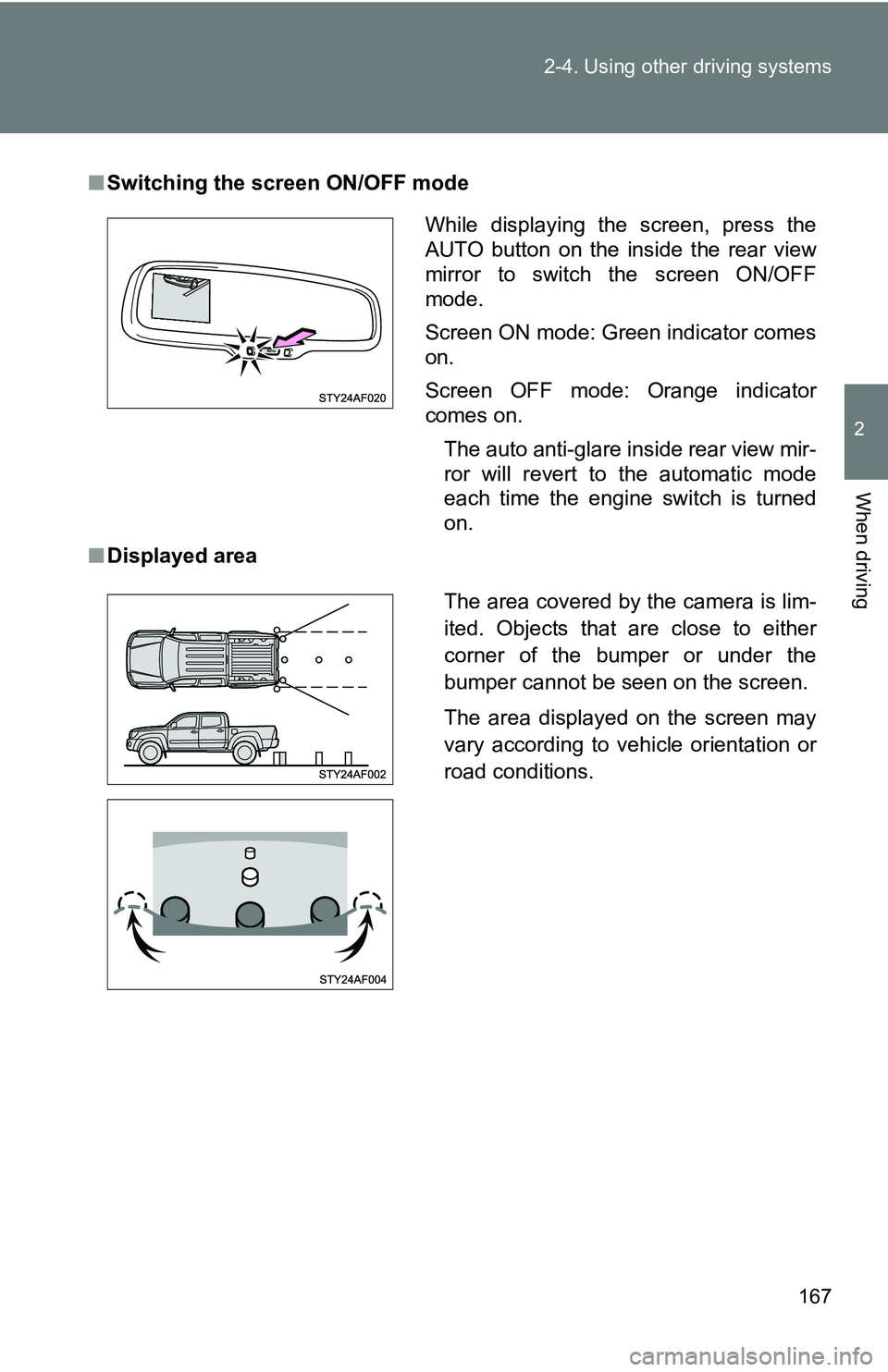
167
2-4. Using other
driving systems
2
When driving
■Switching the screen ON/OFF mode
■ Displayed area
While displaying the screen, press the
AUTO button on the inside the rear view
mirror to switch the screen ON/OFF
mode.
Screen ON mode: Green indicator comes
on.
Screen OFF mode: Orange indicator
comes on.
The auto anti-glare inside rear view mir-
ror will revert to the automatic mode
each time the engine switch is turned
on.
The area covered by the camera is lim-
ited. Objects that are close to either
corner of the bumper or under the
bumper cannot be seen on the screen.
The area displayed on the screen may
vary according to vehicle orientation or
road conditions.
Page 175 of 520
175
2-4. Using other
driving systems
2
When driving
■When the rear differential is locked (vehicles with the rear differential
lock system)
The active traction control system is activated only when the vehicle speed
is less than 3 mph (6 km/h).
■ Sounds and vibrations caused by the active traction control system
●A sound may be heard from the engine compartment when the engine is
started or just after the vehicle begins to move. This sound does not indi-
cate that a malfunction has occurred in the system.
● Vibrations may be felt through the vehicle body and steering. It may
occur when the system is operating.
■ If the brake system overheats
The system will cease operation, a buz zer will sound and A-TRAC indicator
blink to alert the driver. Stop the vehicle in a safe place. (There is no problem
with continuing normal driving.)
The system will be automatically restored after a short time.
CAUTION
■ The active traction control system m ay not operate effectively when
Directional control and power may not be achievable while driving on slip-
pery road surfaces, even if the active traction control system is operating.
Do not drive the vehicle in conditions where stability and power may be lost.
Page 176 of 520
176
2-4. Using other driving systems
AUTO LSD system
When the AUTO LSD system is operatingIf the rear wheels spin, the slip
indicator flashes to indicate that
the AUTO LSD system has been
controlled the spinning of the
rear wheels.
The AUTO LSD system aids traction by using the traction control
system to control engine performance and braking when one of the
rear wheels begins to spin.
The system should be used only wh en one of the rear wheels spin-
ning occurs in a ditch or rough surface.
■ System operation
The system can be used on 2W D models and in 2WD mode on
4WD models.
Press the VSC OFF switch to
turn on the system.
At this time, the AUTO LSD
and VSC OFF indicators will
come on simultaneously.
To turn off the system, push
the switch again.
If the engine is turned off while
the AUTO LSD indicator is on
and then restarted, the indica-
tor will turn off automatically.
Page 180 of 520
180 2-4. Using other driving systems
■After unlocking the rear differential
To check that the indicator goes off, turn the engine switch to the ON posi-
tion, but do not start the engine.
CAUTION
■To avoid an accident
●Do not use the rear differential lock system except when wheel spinning
occurs in a ditch or on a slippery or ragged surface. Large steering effort
and careful cornering control will be required.
● Do not lock the rear differential until the wheels have stopped spinning.
Otherwise, the vehicle may move in an unexpected direction when the dif-
ferential lock is engaged, resulting in an accident. This may also lead to
possible damage to differential lock component parts.
● Do not drive over 5 mph (8 km/h) when the differential is locked.
● Do not keep driving with the RR DIFF LOCK switch on.
Page 182 of 520
182 2-4. Using other driving systems
■Operating tips
The system will operate when the shift lever is in a position other than P.
However, to make effective use of the system it is recommended that the
shift lever be shifted to 2 or L.
■ The system will not operate when
●The front-wheel drive control switch is in the H2 or H4 position.
● The rear differential is locked.
■ The downhill assist control system indicator light flashes when
● The selector lever is in the N position.
● The front-wheel drive control switch is in the H2 or H4 position.
● The rear differential is locked.
■ If the brake system overheats
The system will cease operation and a buzzer will sound to alert the driver.
Stop the vehicle in a safe place. (There is no problem with continuing normal
driving.)
■ System malfunction
●The downhill assist control system indicator does not come on when the
engine switch is turned to the ON position.
● The downhill assist control system indicator does not come on when the
DAC switch is pressed.
In the above cases have your vehicle checked by your Toyota dealer.
CAUTION
■Do not rely excessively on the downhill assist control system.
It may not be able to maintain a low speed over road surfaces on which slid-
ing can easily occur, such as extremely steep slopes or icy or muddy roads.
Page 183 of 520
183
2-4. Using other driving systems
2
When driving
Clutch star t cancel switch (if equipped)
■Clutch start system
The system is designed to keep the starter motor from operating if the clutch
pedal is not depressed all the way down.
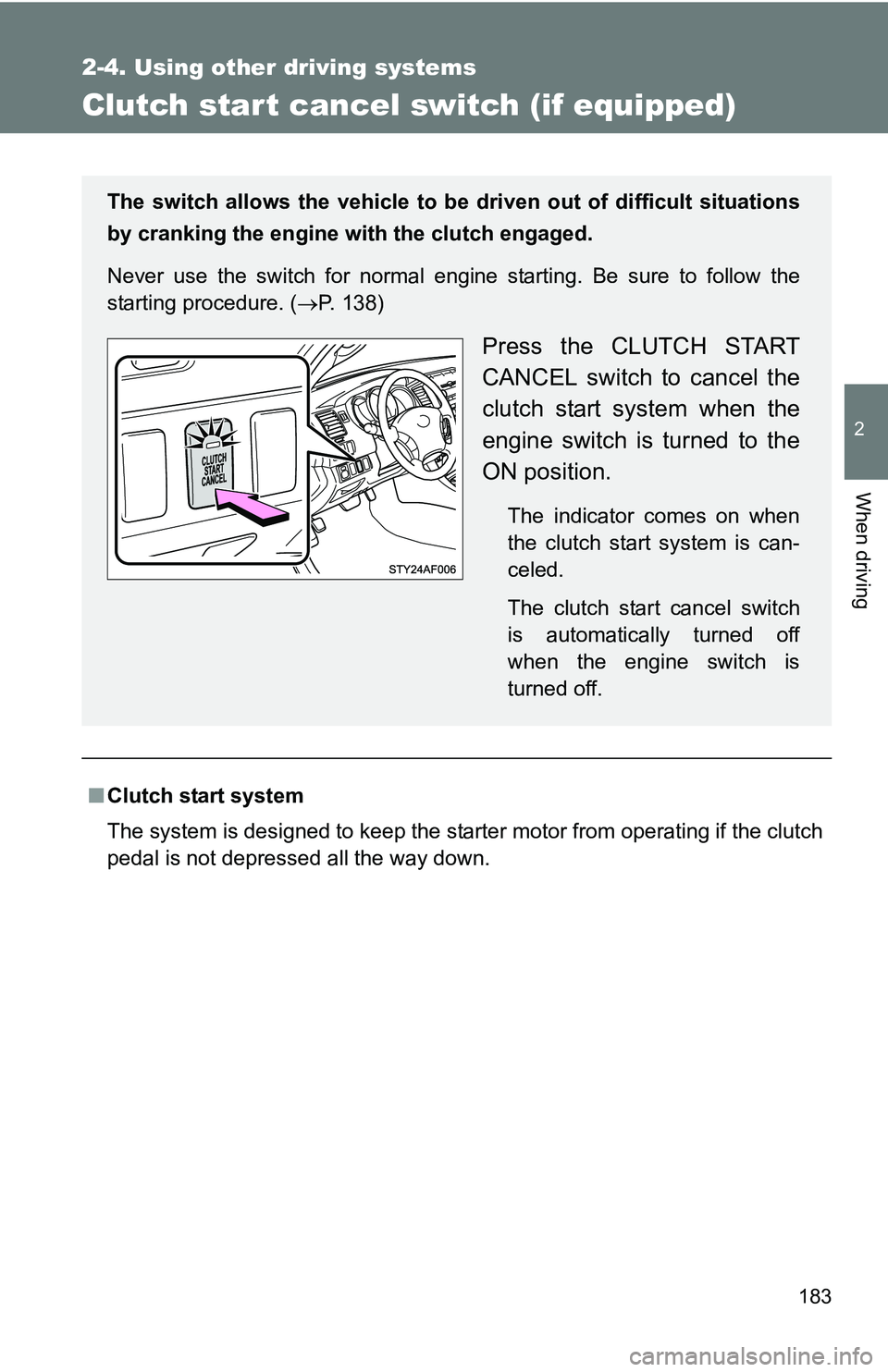
The switch allows the vehicle to be driven out of difficult situations
by cranking the engine with the clutch engaged.
Never use the switch for normal engine starting. Be sure to follow the
starting procedure. ( P. 138)
Press the CLUTCH START
CANCEL switch to cancel the
clutch start system when the
engine switch is turned to the
ON position.
The indicator comes on when
the clutch start system is can-
celed.
The clutch start cancel switch
is automatically turned off
when the engine switch is
turned off.
Page 185 of 520
185
2-4. Using other
driving systems
2
When driving
When the VSC/TRAC/hill-start assist control systems are operating
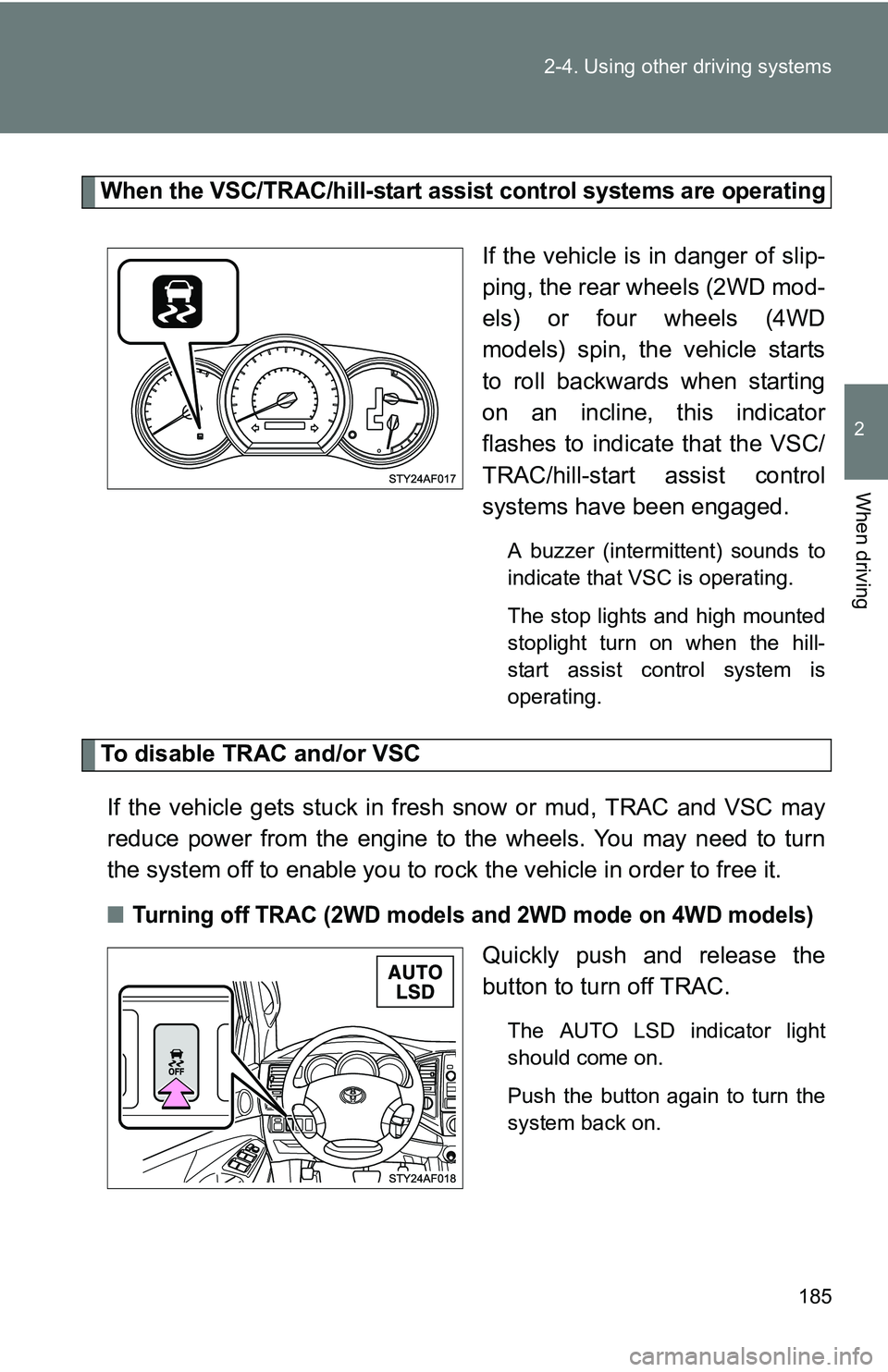
If the vehicle is in danger of slip-
ping, the rear wheels (2WD mod-
els) or four wheels (4WD
models) spin, the vehicle starts
to roll backwards when starting
on an incline, this indicator
flashes to indicate that the VSC/
TRAC/hill-start assist control
systems have been engaged.
A buzzer (intermittent) sounds to
indicate that VSC is operating.
The stop lights and high mounted
stoplight turn on when the hill-
start assist control system is
operating.
To disable TRAC and/or VSC
If the vehicle gets stuck in fresh snow or mud, TRAC and VSC may
reduce power from the engine to the wheels. You may need to turn
the system off to enable you to rock the vehicle in order to free it.
■Turning off TRAC (2WD models and 2WD mode on 4WD models)
Quickly push and release the
button to turn off TRAC.
The AUTO LSD indicator light
should come on.
Push the button again to turn the
system back on.
Page 186 of 520
186 2-4. Using other driving systems
■Turning off TRAC and VSC
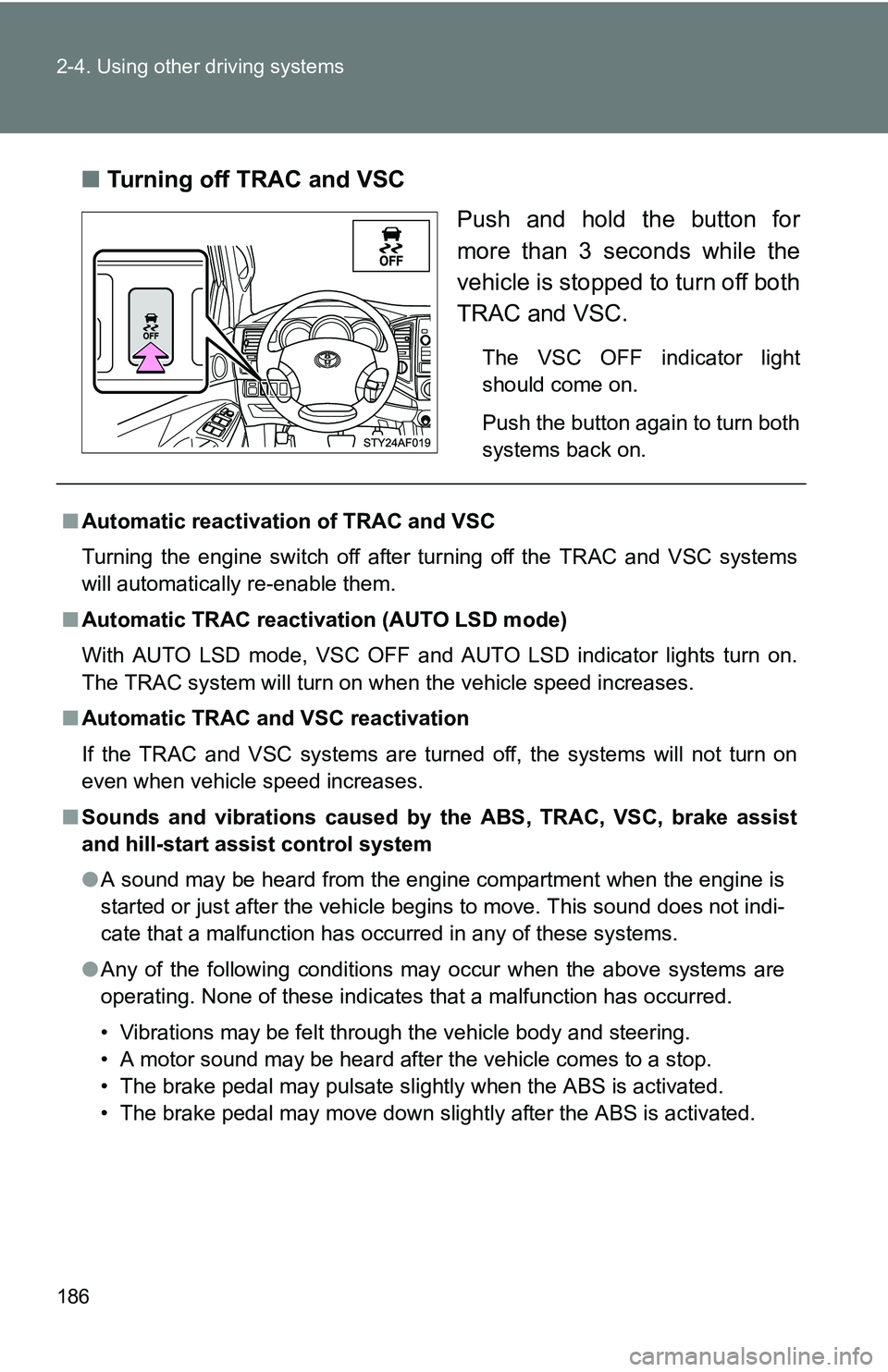
Push and hold the button for
more than 3 seconds while the
vehicle is stopped to turn off both
TRAC and VSC.
The VSC OFF indicator light
should come on.
Push the button again to turn both
systems back on.
■Automatic reactivation of TRAC and VSC
Turning the engine switch off after turning off the TRAC and VSC systems
will automatically re-enable them.
■ Automatic TRAC reactivation (AUTO LSD mode)
With AUTO LSD mode, VSC OFF and AUTO LSD indicator lights turn on.
The TRAC system will turn on when the vehicle speed increases.
■ Automatic TRAC and VSC reactivation
If the TRAC and VSC systems are turned off, the systems will not turn on
even when vehicle speed increases.
■ Sounds and vibrations caused by the ABS, TRAC, VSC, brake assist
and hill-start assist control system
● A sound may be heard from the engine compartment when the engine is
started or just after the vehicle begins to move. This sound does not indi-
cate that a malfunction has occurred in any of these systems.
● Any of the following conditions may occur when the above systems are
operating. None of these indicates that a malfunction has occurred.
• Vibrations may be felt through the vehicle body and steering.
• A motor sound may be heard after the vehicle comes to a stop.
• The brake pedal may pulsate slightly when the ABS is activated.
• The brake pedal may move down slightly after the ABS is activated.
Page 194 of 520
194 2-5. Driving information
NOTICE
■To prevent the water damage
●Take all necessary safety measures to ensure that water damage to the
engine or other components does not occur.
● Water entering the engine air intake will cause severe engine damage.
● Water entering the automatic transmission will cause deterioration in shift
quality, locking up of your transmission accompanied by vibration, and ulti-
mately damage.
● Water can wash the grease from wheel bearings, causing rusting and pre-
mature failure, and may also enter the differentials, transmission and
transfer case, reducing the gear oil’s lubricating qualities.
■ When you drive through water
If driving through water, such as when crossing shallow streams, first check
the depth of the water and the bottom of the river bed for firmness. Drive
slowly and avoid deep water.
■ Inspection after off-road driving
●Sand and mud that has accumulate d in brake drums and around brake
discs may affect braking efficiency and may damage brake system compo-
nents.
● Always perform a maintenance inspection after each day of off-road driv-
ing that has taken you through rough terrain, sand, mud, or water. For
scheduled maintenance information, refer to the “Scheduled Maintenance
Guide” or “Owner’s Manual Supplement”.
Page 201 of 520
201
2-5. Driving information
2
When driving
Winter driving tips
Carry out the necessary preparations and inspections before driving
the vehicle in winter. Always drive the vehicle in a manner appropri-
ate to the prevailing weather conditions.
■ Pre-winter preparations
●Use fluids that are appropriate to the prevailing outside tem-
peratures.
• Engine oil
• Engine coolant
• Washer fluid
● Have a service technician inspect the level and specific grav-
ity of battery electrolyte.
● Have the vehicle fitted with four snow tires or purchase a set
of tire chains for the rear tires.
Ensure that all tires are the same size and brand, and that chains
match the size of the tires.
■Before driving the vehicle
Perform the following according to the driving conditions.
●Do not try to forcibly open a window, scrape an outside rear
view mirror surface or move a wiper or outside rear view mir-
ror that is frozen. Pour warm water over the frozen area to
melt the ice. Wipe away the water immediately to prevent it
from freezing.
● To ensure proper operation of th e climate control system fan,
remove any snow that has accumulated on the air inlet vents
in front of the windshield.
● Remove any ice that has accumu lated on the vehicle chassis.
● Periodically check for and remove any excess ice or snow
that may have accumulated in the wheel well or on the
brakes.