brake light TOYOTA TACOMA 2009 Owners Manual (in English)
[x] Cancel search | Manufacturer: TOYOTA, Model Year: 2009, Model line: TACOMA, Model: TOYOTA TACOMA 2009Pages: 520, PDF Size: 10.75 MB
Page 2 of 520
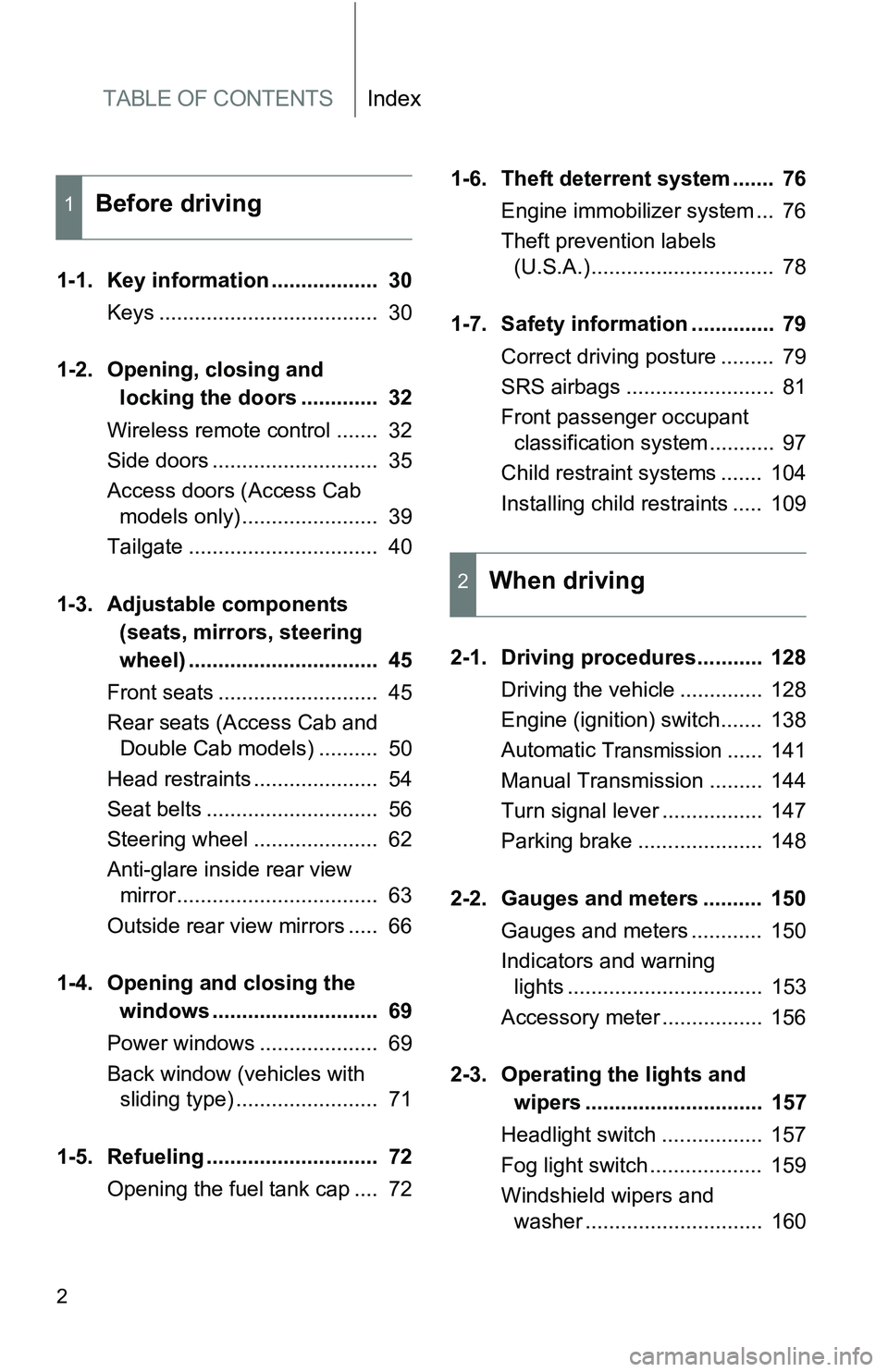
TABLE OF CONTENTSIndex
2
1-1. Key information .................. 30Keys ..................................... 30
1-2. Opening, closing and
locking the doors ............. 32
Wireless remote control ....... 32
Side doors ............................ 35
Access doors (Access Cab models only) ....................... 39
Tailgate ................................ 40
1-3. Adjustable components
(seats, mirrors, steering
wheel) ................................ 45
Front seats ........................... 45
Rear seats (Access Cab and Double Cab models) .......... 50
Head restraints ..................... 54
Seat belts ............................. 56
Steering wheel ..................... 62
Anti-glare inside rear view mirror .................................. 63
Outside rear view mirrors ..... 66
1-4. Opening a nd closing the
window s ............................ 69
Power windows .................... 69
Back window (vehicles with sliding type) ........................ 71
1-5. Refueling ............................. 72 Opening the fuel tank cap .... 72 1-6. Theft deterrent system ....... 76
Engine immobilizer system ... 76
Theft prevention labels (U.S.A.)............................... 78
1-7. Safety information .............. 79 Correct driving posture ......... 79
SRS airbags ......................... 81
Front passenger occupant classification system ........... 97
Child restraint systems ....... 104
Installing child restraints ..... 109
2-1. Driving procedures........... 128 Driving the vehicle .............. 128
Engine (ignition) switch....... 138
Automatic
Transmission...... 141
Manual Transmission ......... 144
Turn signal lever ................. 147
Parking brake ..................... 148
2-2. Gauges and meters .......... 150 Gauges and meters ............ 150
Indicators and warning lights ................................. 153
Accessory meter ................. 156
2-3. Operating the lights and wipers .............................. 157
Headlight switch ................. 157
Fog light switch ................... 159
Windshield wipers and washer .............................. 160
1Before driving
2When driving
Page 127 of 520
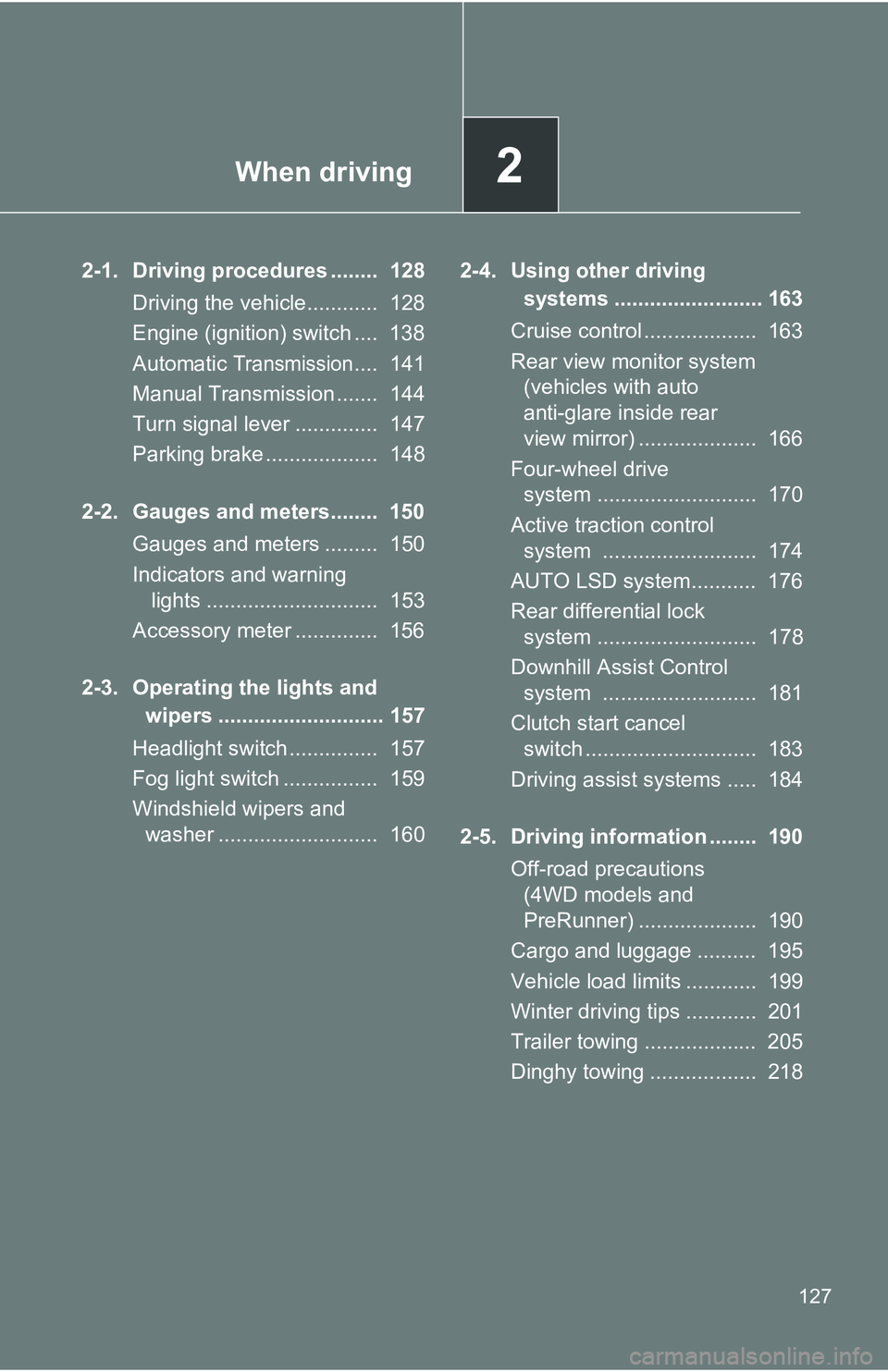
When driving2
127
2-1. Driving procedures ........ 128Driving the vehicle............ 128
Engine (ignition) switch .... 138
Automatic
Transmission.... 141
Manual Transmission ....... 144
Turn signal lever .............. 147
Parking brake ................... 148
2-2. Gauges and meters........ 150 Gauges and meters ......... 150
Indicators and warning lights ............................. 153
Accessory meter .............. 156
2-3. Operating the lights and wipers ............................ 157
Headlight switch ............... 157
Fog light switch ................ 159
Windshield wipers and washer ........................... 160 2-4. Using other driving
systems ......................... 163
Cruise control ................... 163
Rear view monitor system (vehicles with auto
anti-glare inside rear
view mirror) .................... 166
Four-wheel drive system ........................... 170
Active traction control system .......................... 174
AUTO LSD system........... 176
Rear differential lock system ........................... 178
Downhill Assist Control system .......................... 181
Clutch start cancel switch ............................. 183
Driving assist systems ..... 184
2-5. Driving information ........ 190 Off-road precautions (4WD models and
PreRunner) .................... 190
Cargo and luggage .......... 195
Vehicle load limits ............ 199
Winter driving tips ............ 201
Trailer towing ................... 205
Dinghy towing .................. 218
Page 130 of 520
130 2-1. Driving procedures
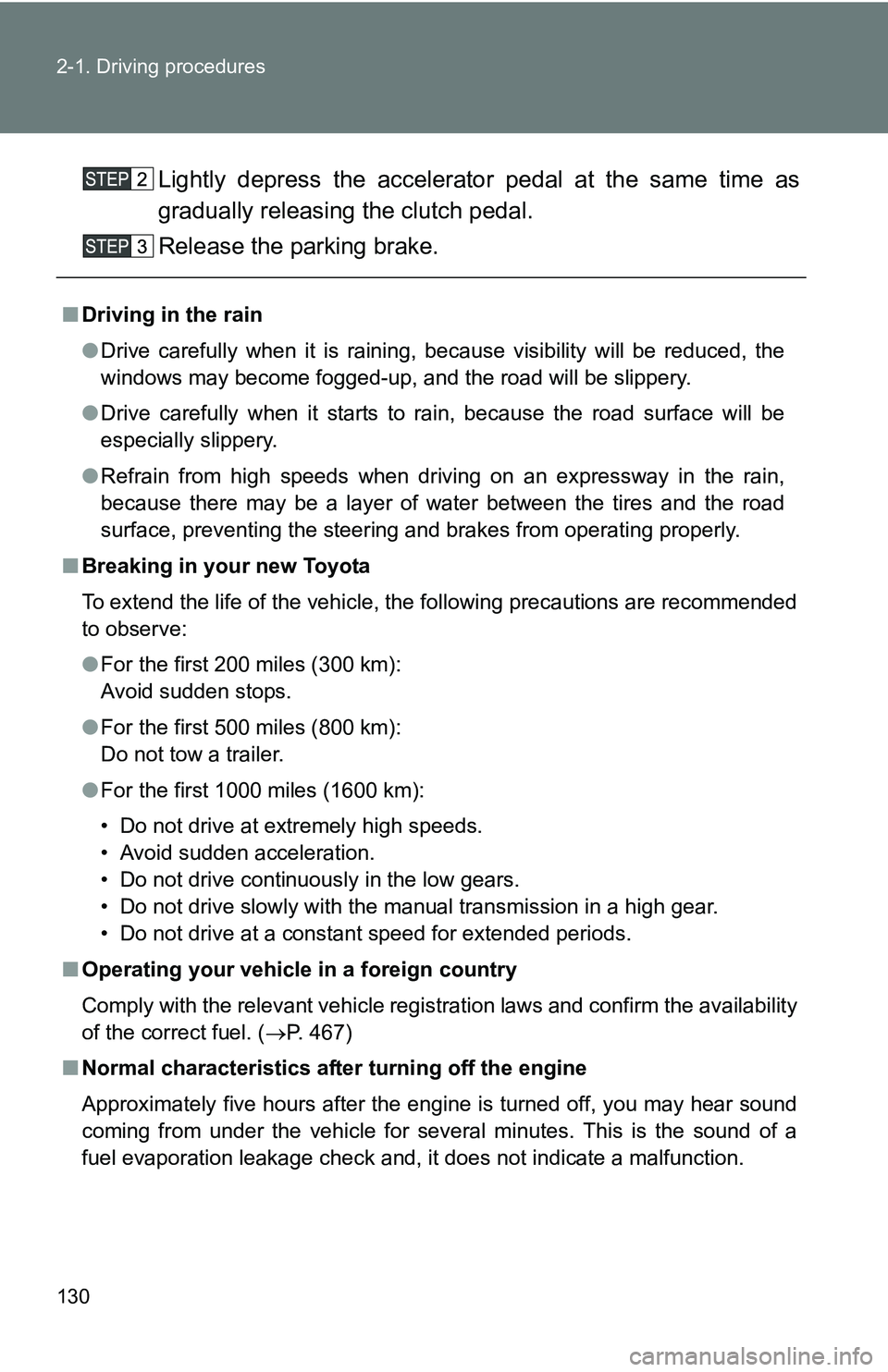
Lightly depress the accelerator pedal at the same time as
gradually releasing the clutch pedal.
Release the parking brake.
■Driving in the rain
●Drive carefully when it is raining, because visibility will be reduced, the
windows may become fogged-up, and the road will be slippery.
● Drive carefully when it starts to rain, because the road surface will be
especially slippery.
● Refrain from high speeds when driving on an expressway in the rain,
because there may be a layer of water between the tires and the road
surface, preventing the steering and brakes from operating properly.
■ Breaking in your new Toyota
To extend the life of the vehicle, the following precautions are recommended
to observe:
●For the first 200 miles (300 km):
Avoid sudden stops.
● For the first 500 miles (800 km):
Do not tow a trailer.
● For the first 1000 miles (1600 km):
• Do not drive at extremely high speeds.
• Avoid sudden acceleration.
• Do not drive continuously in the low gears.
• Do not drive slowly with the manual transmission in a high gear.
• Do not drive at a constant speed for extended periods.
■ Operating your vehicle in a foreign country
Comply with the relevant vehicle registration laws and confirm the availability
of the correct fuel. ( P. 467)
■ Normal characteristics afte r turning off the engine
Approximately five hours after the engine is turned off, you may hear sound
coming from under the vehicle for several minutes. This is the sound of a
fuel evaporation leakage check and, it does not indicate a malfunction.
Page 131 of 520
131
2-1. Driving procedures
2
When driving
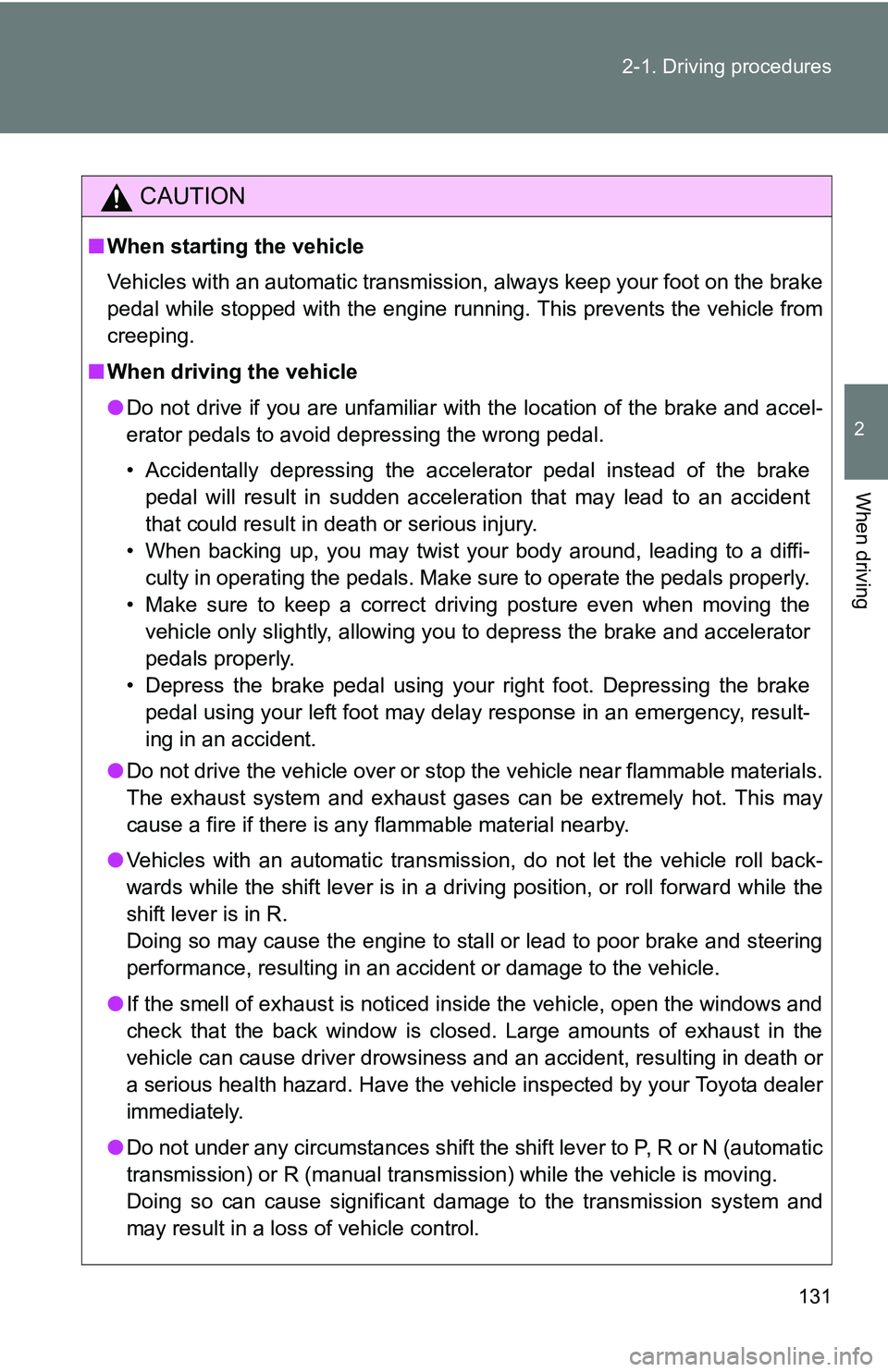
CAUTION
■
When starting the vehicle
Vehicles with an automatic transmission, always keep your foot on the brake
pedal while stopped with the engine running. This prevents the vehicle from
creeping.
■ When driving the vehicle
●Do not drive if you are unfamiliar with the location of the brake and accel-
erator pedals to avoid depressing the wrong pedal.
• Accidentally depressing the accelerator pedal instead of the brake
pedal will result in sudden acceleration that may lead to an accident
that could result in death or serious injury.
• When backing up, you may twist your body around, leading to a diffi- culty in operating the pedals. Make sure to operate the pedals properly.
• Make sure to keep a correct driving posture even when moving the vehicle only slightly, allowing you to depress the brake and accelerator
pedals properly.
• Depress the brake pedal using your right foot. Depressing the brake pedal using your left foot may delay response in an emergency, result-
ing in an accident.
● Do not drive the vehicle over or st op the vehicle near flammable materials.
The exhaust system and exhaust gases can be extremely hot. This may
cause a fire if there is any flammable material nearby.
● Vehicles with an automatic transmission, do not let the vehicle roll back-
wards while the shift lever is in a driving position, or roll forward while the
shift lever is in R.
Doing so may cause the engine to stall or lead to poor brake and steering
performance, resulting in an accident or damage to the vehicle.
● If the smell of exhaust is noticed inside the vehicle, open the windows and
check that the back window is closed. Large amounts of exhaust in the
vehicle can cause driver drowsiness and an accident, resulting in death or
a serious health hazard. Have the vehicle inspected by your Toyota dealer
immediately.
● Do not under any circumstances shift the shift lever to P, R or N (automatic
transmission) or R (manual transmission) while the vehicle is moving.
Doing so can cause significant damage to the transmission system and
may result in a loss of vehicle control.
Page 133 of 520
133
2-1. Driving procedures
2
When driving
CAUTION
■
When driving on slippery road surfaces
●After driving through a puddle, lightly depress the brake pedal to make
sure that the brakes are functioning properly. Wet brake pads may prevent
the brakes from functioning properly. If the brakes on only one side are wet
and not functioning properly, steering control may be affected, resulting in
an accident.
■ When shifting the shift lever
●Vehicles with an automatic transmission, be careful not to shift the shift
lever with the accelerator pedal depressed.
This may lead to unexpected rapid acceleration of the vehicle that may
cause an accident and result in death or serious injury.
■ When the vehicle is stopped
●Do not race the engine.
If the vehicle is in any gear other than P (automatic transmission only) or
N, the vehicle may accelerate suddenly and unexpectedly, and may cause
an accident.
● Do not leave the vehicle with the engine running for a long time.
If such a situation cannot be avoided, park the vehicle in an open space
and check that exhaust fumes do not enter the vehicle interior.
● Vehicles with an automatic transmission, always keep a foot on the brake
pedal while the engine is running to prevent an accident caused by the
vehicle moving.
■ When the vehicle is parked
●Do not leave glasses, cigarette lighters, spray cans, or soft drink cans in
the vehicle when it is in the sun.
Doing so may result in the following.
• Gas may leak from a cigarette lighter or spray can, and may lead to a
fire.
• The temperature inside the vehicle may cause the plastic lenses and plastic material of eye glasses to deform or crack.
• Soft drink cans may fracture, causing the contents to spray over the interior of the vehicle, and may also cause a short circuit in the vehi-
cle’s electrical components.
Page 158 of 520
158 2-3. Operating the lights and wipers
■Daytime running light system (if equipped)
To make your vehicle more visible to other drivers, the front turn signal lights
turn on automatically whenever the engine is started and the parking brake
is released. Daytime running lights are not designed for use at night.
■ Automatic light off system
Opening the driver’s door with the engine switch in the ACC or LOCK posi-
tion will turn the headlights and tail lights off.
To turn the lights on again, turn the engine switch to the ON position, or turn
the headlight switch off once and then back to the or position.
NOTICE
■To prevent battery discharge
Do not leave the lights on longer than necessary when the engine is not run-
ning.
Page 164 of 520
164 2-4. Using other driving systems
■Cruise control can be set when
●The shift lever is in D, 4 (vehicles with 5-speed automatic transmission)
or 3 (vehicles with 4-speed automatic transmission).
● Vehicle speed is more than approximately 25 mph (40 km/h).
■ Accelerating
The vehicle can be accelerated normally.
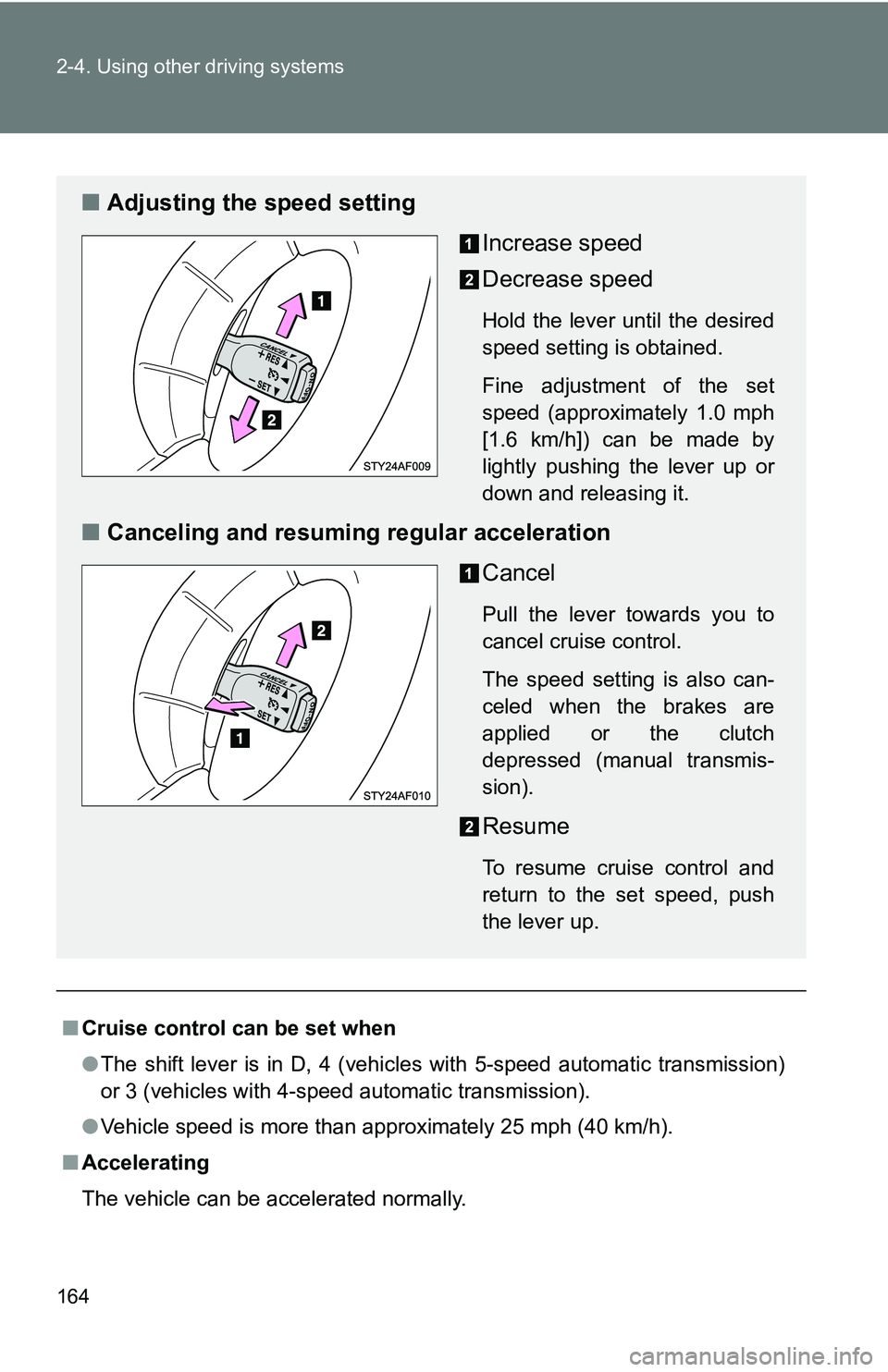
■ Adjusting the speed setting
Increase speed
Decrease speed
Hold the lever until the desired
speed setting is obtained.
Fine adjustment of the set
speed (approximately 1.0 mph
[1.6 km/h]) can be made by
lightly pushing the lever up or
down and releasing it.
■Canceling and resuming regular acceleration
Cancel
Pull the lever towards you to
cancel cruise control.
The speed setting is also can-
celed when the brakes are
applied or the clutch
depressed (manual transmis-
sion).
Resume
To resume cruise control and
return to the set speed, push
the lever up.
Page 179 of 520
179
2-4. Using other
driving systems
2
When driving
Manual transmission
4WD models: Before using the rear differential lock system.
Stop the vehicle or reduce your speed to less than 2 mph (3
km/h). Depress the clutch pedal and put the front-wheel drive
control switch in the L4 position to see if this is sufficient. If
this has no effect, additionally use the rear differential lock
system.
Be sure to stop the wheels.
Depress the clutch pedal.
Press the RR DIFF LOCK switch.
After the rear differential is locked, the indicator will come on.
Slowly release the clutch pedal.
Unlock the rear differential as soon as the vehicle moves.
To unlock the rear differential, push the switch again.
■ Locking the rear differential
●When the rear differential is locked, VSC is automatically turned off.
(The rear differential lock and VSC OFF indicators come on.)
● The following systems do not operate when the rear differential is locked.
It is normal operation for the ABS warning light and VSC OFF indicator to
be on at this time. If the DAC switch turns on, the downhill assist cont\
rol
system indicator light flashes.
•ABS
• Brake assist system
•VSC
•TRAC
• Downhill assist control system
• Hill-start assist control system
■ The rear differential lock is disengaged when
●Shift the front-wheel drive control switch to H2 or H4 position. (4WD mod-
els)
Never forget to turn off the switch after using this feature.
Page 181 of 520
181
2-4. Using other driving systems
2
When driving
Downhill Assist Control system (if equipped)
The downhill assist control system helps to prevent excessive speed
on steep downhill descents.
■System operation
The system will operate when the vehicle is traveling under 15
mph (25 km/h) and the front-wheel drive control switch is in the
L4 position.
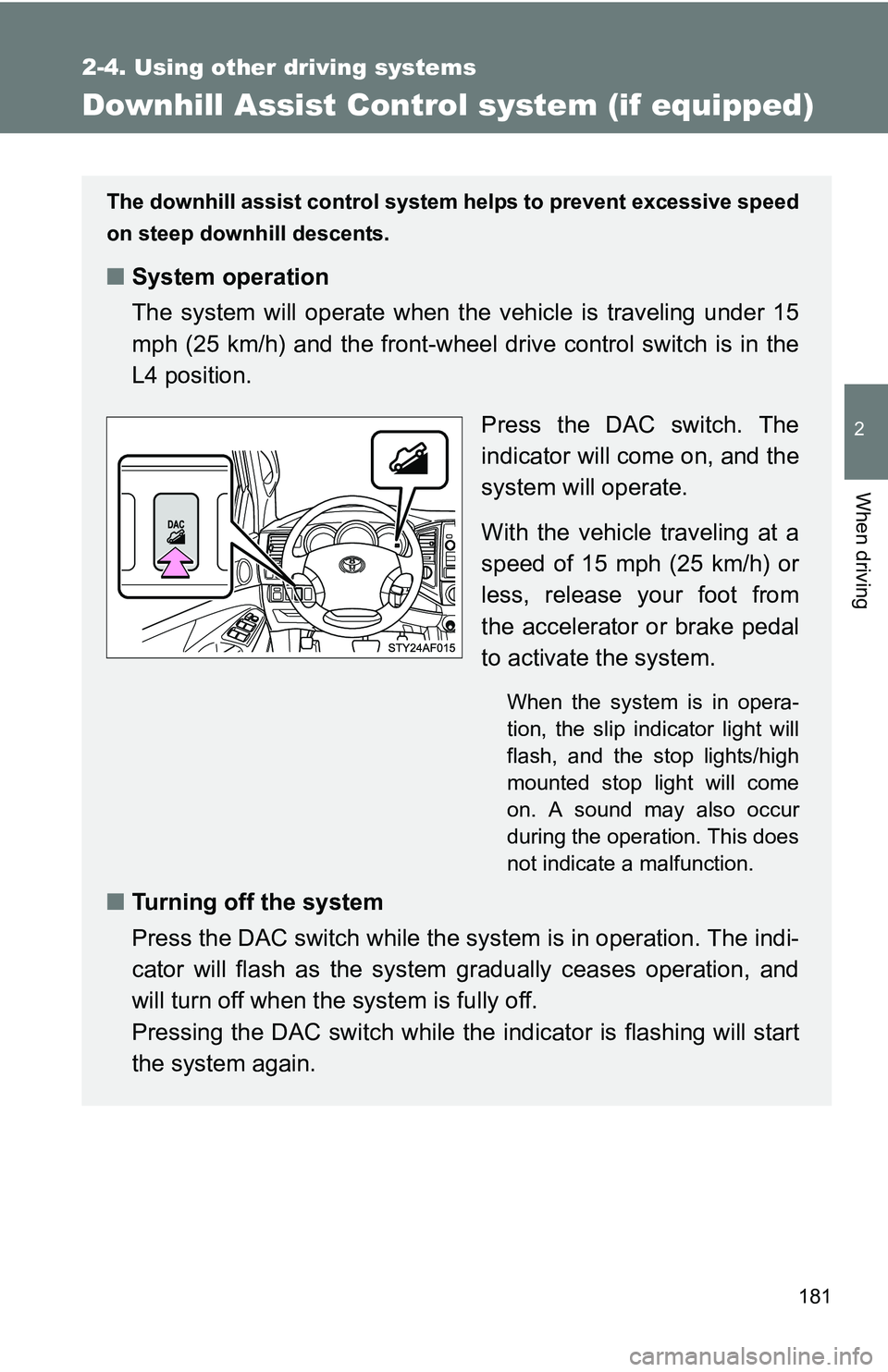
Press the DAC switch. The
indicator will come on, and the
system will operate.
With the vehicle traveling at a
speed of 15 mph (25 km/h) or
less, release your foot from
the accelerator or brake pedal
to activate the system.
When the system is in opera-
tion, the slip indicator light will
flash, and the stop lights/high
mounted stop light will come
on. A sound may also occur
during the operation. This does
not indicate a malfunction.
■Turning off the system
Press the DAC switch while the syst em is in operation. The indi-
cator will flash as the system gradually ceases operation, and
will turn off when the system is fully off.
Pressing the DAC switch while the indicator is flashing will start
the system again.
Page 182 of 520
182 2-4. Using other driving systems
■Operating tips
The system will operate when the shift lever is in a position other than P.
However, to make effective use of the system it is recommended that the
shift lever be shifted to 2 or L.
■ The system will not operate when
●The front-wheel drive control switch is in the H2 or H4 position.
● The rear differential is locked.
■ The downhill assist control system indicator light flashes when
● The selector lever is in the N position.
● The front-wheel drive control switch is in the H2 or H4 position.
● The rear differential is locked.
■ If the brake system overheats
The system will cease operation and a buzzer will sound to alert the driver.
Stop the vehicle in a safe place. (There is no problem with continuing normal
driving.)
■ System malfunction
●The downhill assist control system indicator does not come on when the
engine switch is turned to the ON position.
● The downhill assist control system indicator does not come on when the
DAC switch is pressed.
In the above cases have your vehicle checked by your Toyota dealer.
CAUTION
■Do not rely excessively on the downhill assist control system.
It may not be able to maintain a low speed over road surfaces on which slid-
ing can easily occur, such as extremely steep slopes or icy or muddy roads.