flat tire TOYOTA TACOMA 2009 Owners Manual (in English)
[x] Cancel search | Manufacturer: TOYOTA, Model Year: 2009, Model line: TACOMA, Model: TOYOTA TACOMA 2009Pages: 520, PDF Size: 10.75 MB
Page 1 of 520
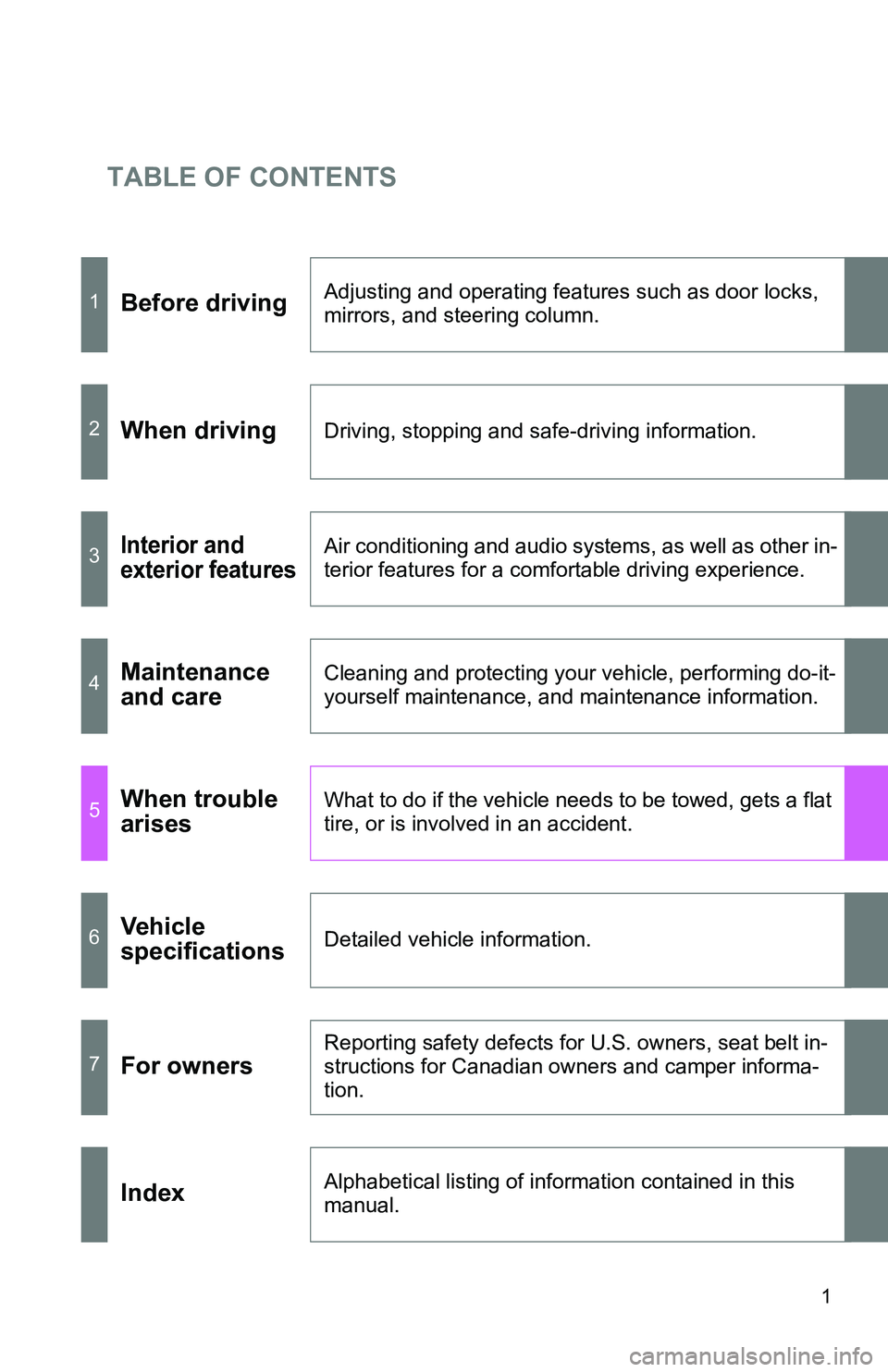
TABLE OF CONTENTS
1
1Before drivingAdjusting and operating features such as door locks,
mirrors, and steering column.
2When drivingDriving, stopping and safe-driving information.
3Interior and
exterior featuresAir conditioning and audio systems, as well as other in-
terior features for a comfortable driving experience.
4Maintenance
and careCleaning and protecting your vehicle, performing do-it-
yourself maintenance, and maintenance information.
5When trouble
arisesWhat to do if the vehicle needs to be towed, gets a flat
tire, or is involved in an accident.
6Vehicle
specificationsDetailed vehicle information.
7For owners
Reporting safety defects for U.S. owners, seat belt in-
structions for Canadian owners and camper informa-
tion.
IndexAlphabetical listing of information contained in this
manual.
Page 4 of 520
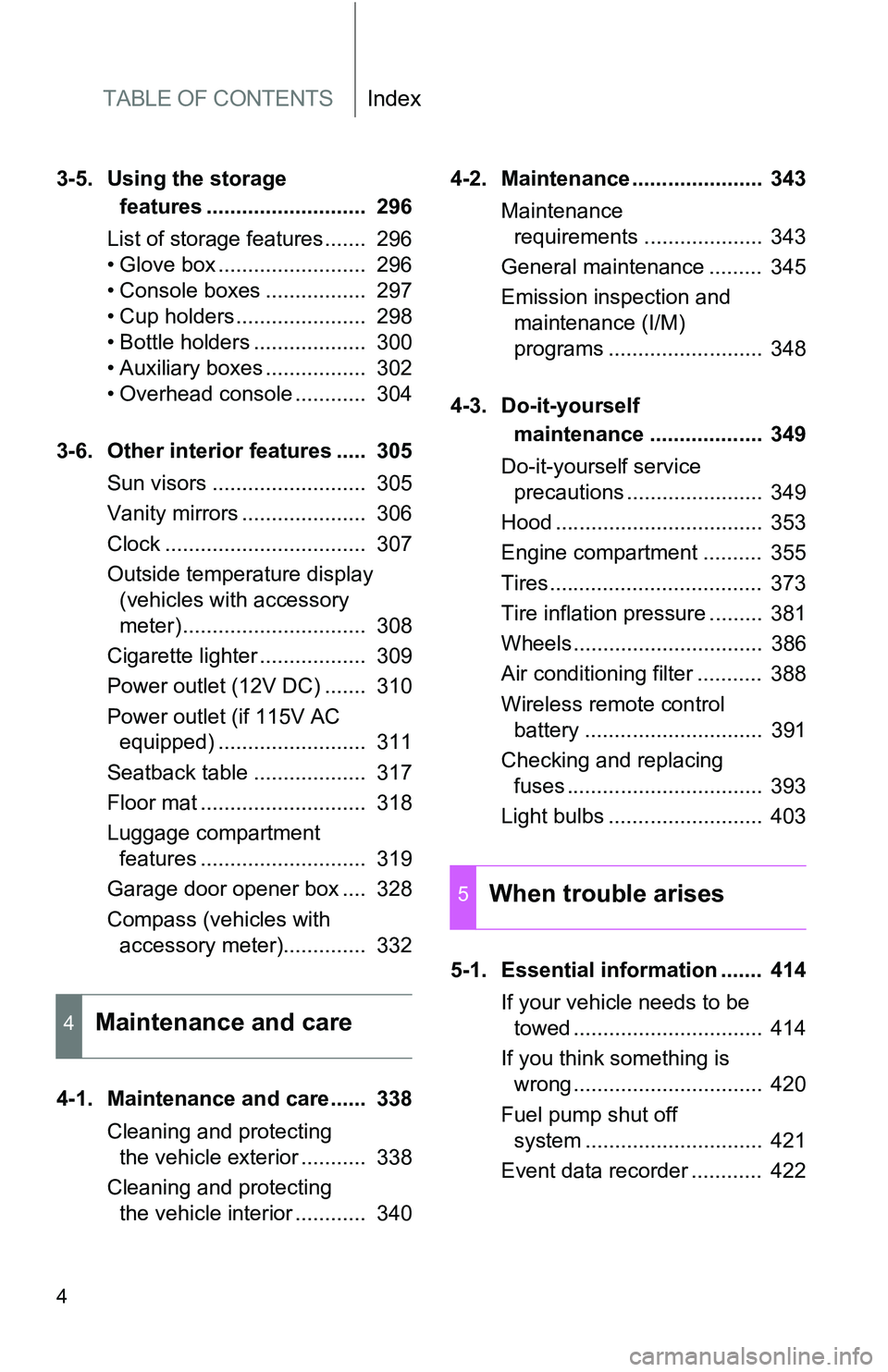
TABLE OF CONTENTSIndex
4
3-5. Using the storage features ........................... 296
List of storage features....... 296
• Glove box ......................... 296
• Console boxes ................. 297
• Cup holders ...................... 298
• Bottle holders ................... 300
• Auxiliary boxes ................. 302
• Overhead console ............ 304
3-6. Other interior features ..... 305 Sun visors .......................... 305
Vanity mirrors ..................... 306
Clock .................................. 307
Outside temperature display (vehicles with accessory
meter) ............................... 308
Cigarette lighter .................. 309
Power outlet (12V DC) ....... 310
Power outlet (if 115V AC equipped) ......................... 311
Seatback table ................... 317
Floor mat ............................ 318
Luggage compartment features ............................ 319
Garage door opener box .... 328
Compass (vehicles with accessory meter).............. 332
4-1. Maintenance and care...... 338 Cleaning and protecting the vehicle exterior ........... 338
Cleaning and protecting the vehicle interior ............ 340 4-2. Maintenance ...................... 343
Maintenance requirements .................... 343
General maintenance ......... 345
Emission inspection and maintenance (I/M)
programs .......................... 348
4-3. Do-it-yourself maintenance ................... 349
Do-it-yourself service precautions ....................... 349
Hood ................................... 353
Engine compartment .......... 355
Tires.................................... 373
Tire inflation pressure ......... 381
Wheels................................ 386
Air conditioning filter ........... 388
Wireless remote control battery .............................. 391
Checking and replacing fuses ................................. 393
Light bulbs .......................... 403
5-1. Essential information ....... 414 If your vehicle needs to be towed ................................ 414
If you think something is wrong ................................ 420
Fuel pump shut off system .............................. 421
Event data recorder ............ 422
4Maintenance and care
5When trouble arises
Page 5 of 520
1
2
3
4
5
6
7
5
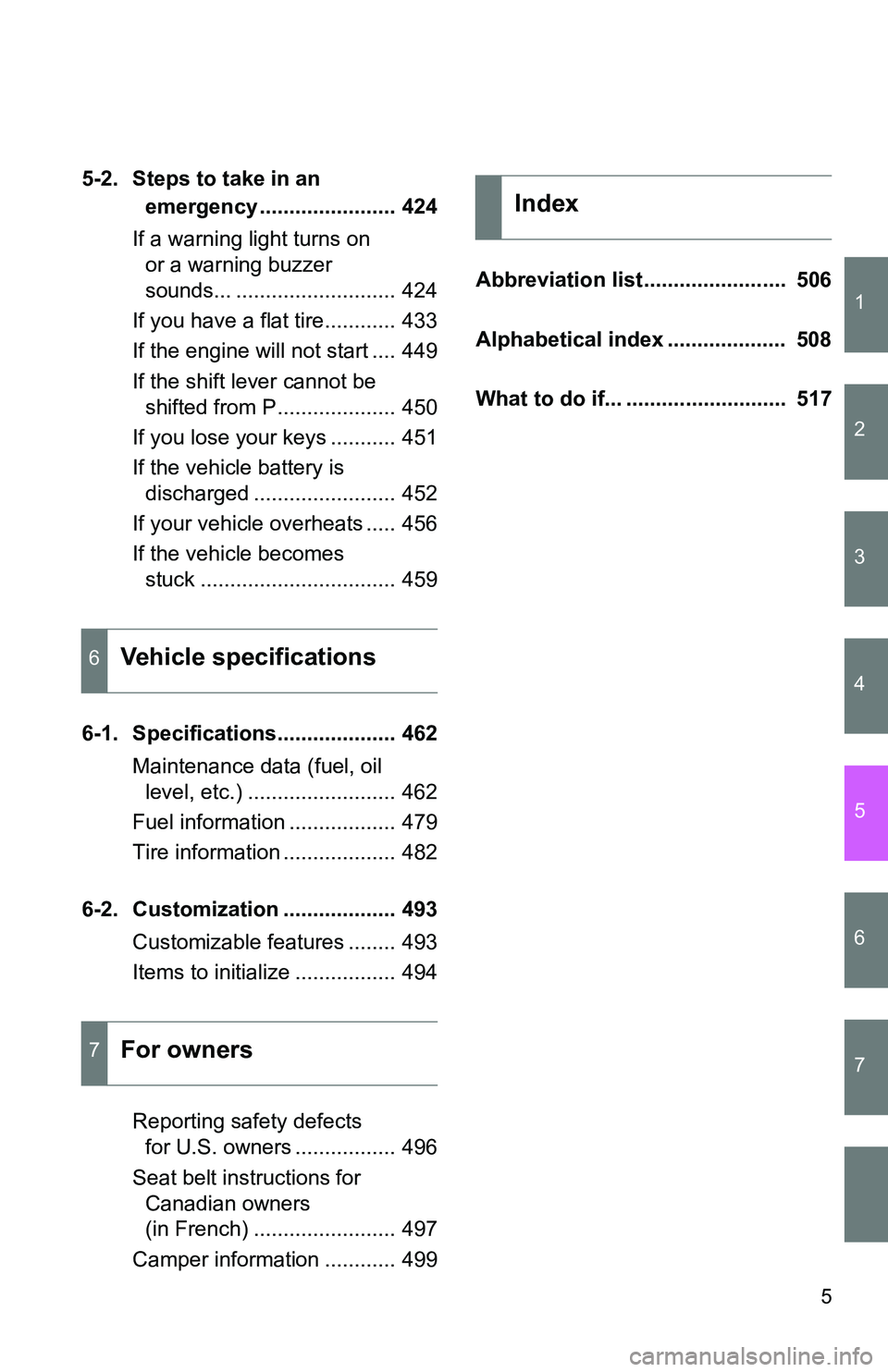
5-2. Steps to take in an emergency ....................... 424
If a warning light turns on or a warning buzzer
sounds... ........................... 424
If you have a flat tire............ 433
If the engine will not start .... 449
If the shift lever cannot be shifted from P.................... 450
If you lose your keys ........... 451
If the vehicle battery is discharged ........................ 452
If your vehicle overheats ..... 456
If the vehicle becomes stuck ................................. 459
6-1. Specifications.................... 462 Maintenance data (fuel, oil level, etc.) ......................... 462
Fuel information .................. 479
Tire information ................... 482
6-2. Customization ................... 493 Customizable features ........ 493
Items to initialize ................. 494
Reporting safety defects for U.S. owners ................. 496
Seat belt instructions for Canadian owners
(in French) ........................ 497
Camper information ............ 499 Abbreviation list ........................ 506
Alphabetical index .................... 508
What to do if... ........................... 517
6Vehicle specifications
7For owners
Index
Page 7 of 520
7
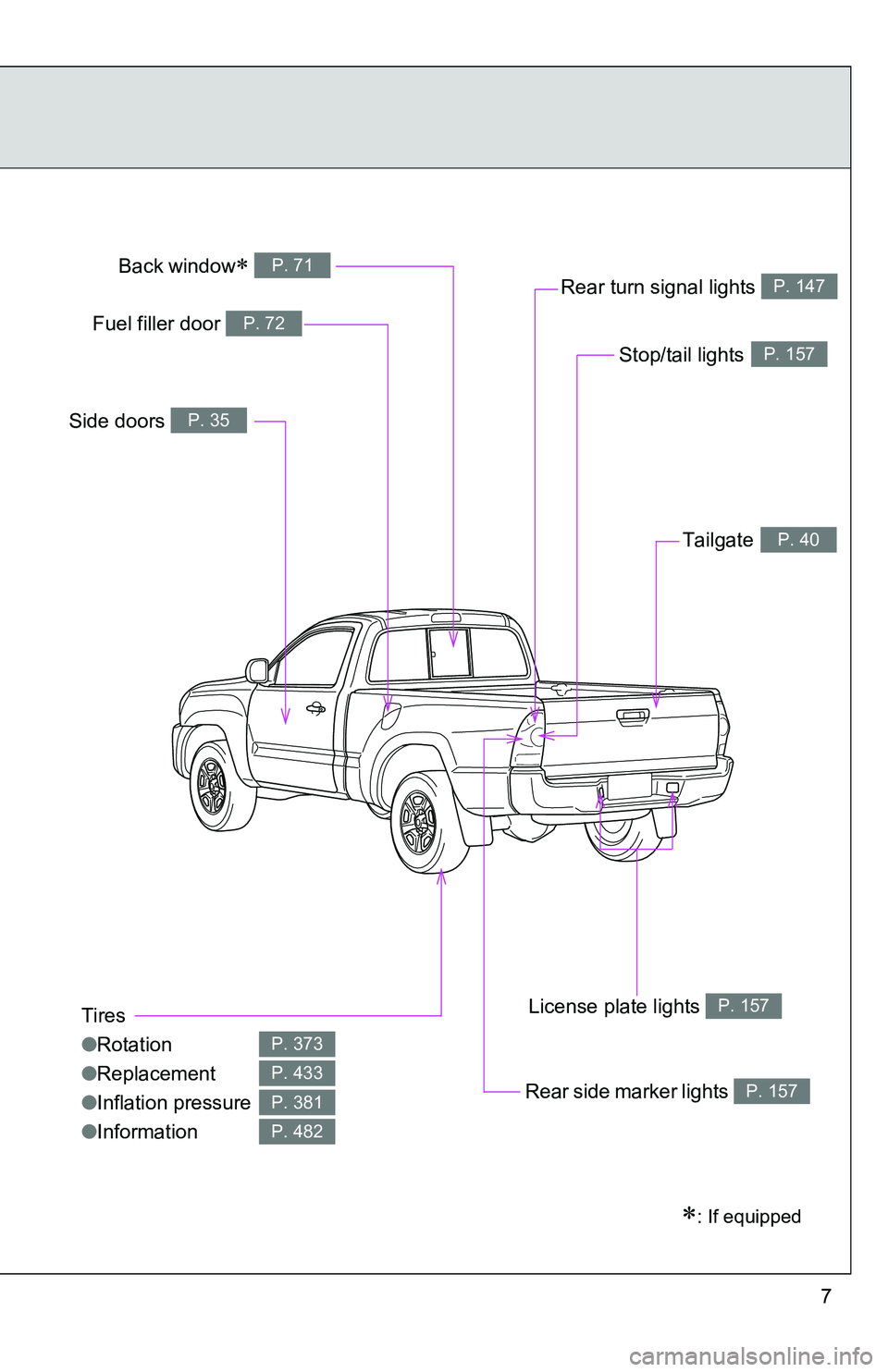
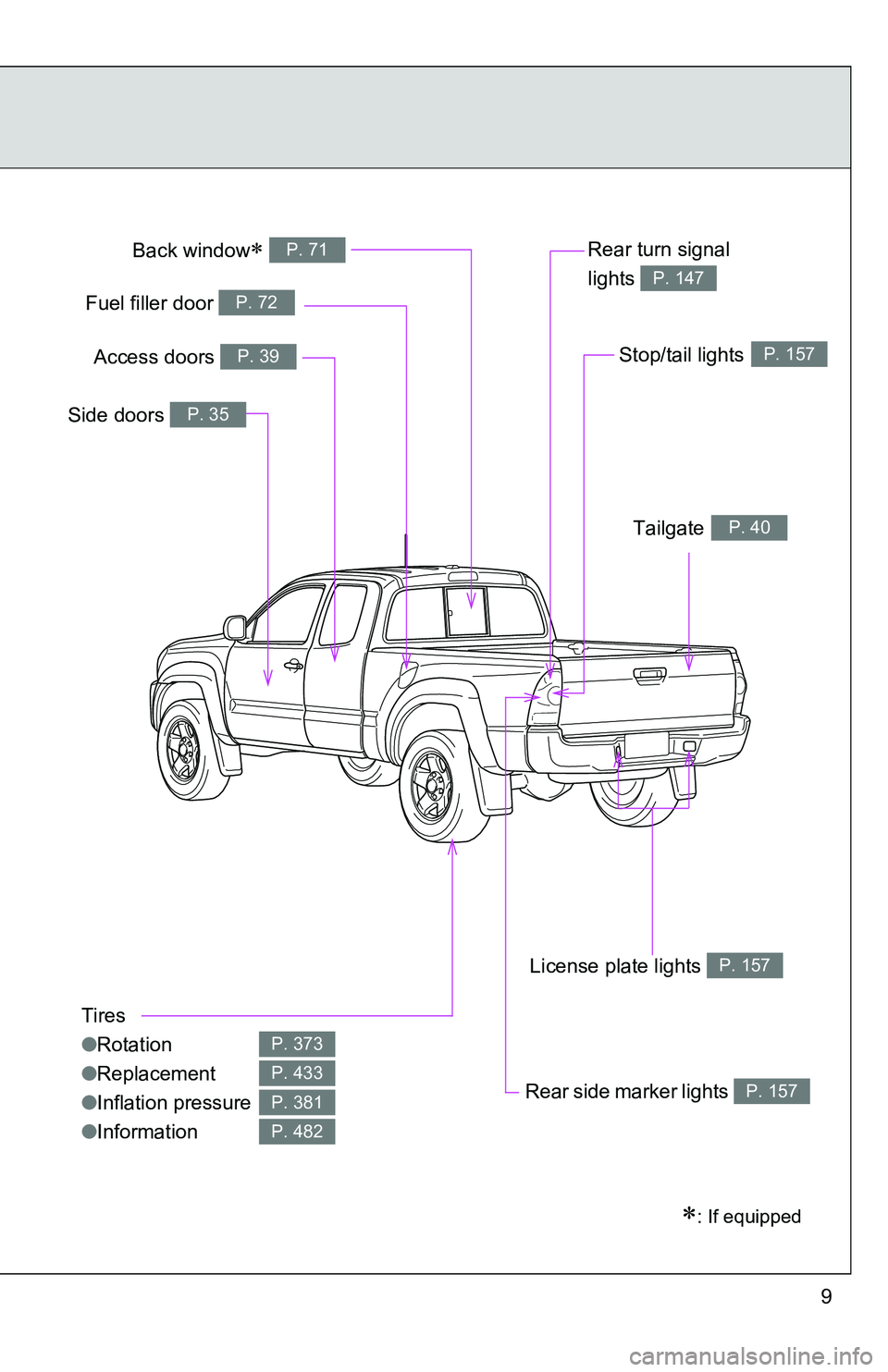
Tires
●Rotation
● Replacement
● Inflation pressure
● Information
P. 373
P. 433
P. 381
P. 482
Fuel filler door P. 72
Rear turn signal lights P. 147
Rear side marker lightsP. 157
Side doors P. 35
Stop/tail lightsP. 157
TailgateP. 40
License plate lights P. 157
Back window P. 71
: If equipped
Page 9 of 520
9
Tires
●Rotation
● Replacement
● Inflation pressure
● Information
P. 373
P. 433
P. 381
P. 482
Fuel filler door P. 72
Rear turn signal
lights
P. 147
Rear side marker lightsP. 157
Side doors P. 35
: If equipped
Stop/tail lightsP. 157
TailgateP. 40
License plate lights P. 157
Access doors P. 39
Back window P. 71
Page 11 of 520

11
Tires
●Rotation
● Replacement
● Inflation pressure
● Information
P. 373
P. 433
P. 381
P. 482
Fuel filler door P. 72Rear turn signal
lights
P. 147
Rear side marker lightsP. 157
Side doors P. 35
: If equipped
Stop/tail lightsP. 157
TailgateP. 40
License plate lights P. 157
Back window P. 71
Page 92 of 520
92 1-7. Safety information
CAUTION
■Modification and disposal of SRS airbag system components
Do not dispose of your vehicle or perform any of the following modifications
without consulting your Toyota dealer.
The SRS airbags may malfunction or deploy (inflate) accidentally, causing
death or serious injury.
● Installation, removal, disassembly and repair of the SRS airbags.
● Repairs, modifications, removal or replacement of the steering wheel,
instrument panel, dashboard, seats or seat upholstery, front, side and rear
pillars or roof side rails.
● Repairs or modifications of the front fender, front bumper, or side of the
occupant compartment.
● Installation of snow plows, winches, etc. to the front grille (bull bars, kan-
garoo bar etc.).
● Modifications to the vehicle’s suspension system.
● Do not use tires or wheels other than the manufacturer’s recommended
size. ( P. 373, 475)
● Installation of electronic devices such as mobile two-way radios or CD
players.
● Modifications to your vehicle for a person with a physical disability.
Page 137 of 520
137
2-1. Driving procedures
2
When driving
NOTICE
■
If you get a flat tire while driving
A flat or damaged tire may cause the following situations. Hold the steering
wheel firmly and gradually press the brake pedal to slow down the vehicle.
●It may be difficult to control your vehicle.
● The vehicle will make abnormal sounds.
● The vehicle will behave abnormally.
Replace a flat tire with a new one. ( P. 439)
■ When encountering flooded roads
Do not drive on a road that has flooded after heavy rain etc. Doing so may
cause the following serious damage to the vehicle.
●Engine stalling
● Short in electrical components
● Engine damage caused by water immersion
In the event that you drive on a flooded road and the vehicle is flooded, be
sure to have your Toyota dealer check the following.
● Brake function
● Changes in quantity and quality of oil and fluid used for the engine, trans-
mission, transfer (4WD vehicles), differentials, etc.
● Lubricant condition for the propeller shaft, bearings and suspension joints
(where possible) and the function of all joints, bearings, etc.
Page 188 of 520
188 2-4. Using other driving systems
CAUTION
■The ABS does not operate effectively when
●The limits of the gripping performance have been exceeded.
● The vehicle hydroplanes while driving at high speed on the wet or slick
road.
■ Stopping distance when the ABS is operating will exceed that of nor-
mal conditions
The ABS is not designed to shorten the vehicle’s stopping distance. Always
maintain a safe distance from the vehicle in front of you in the following situ-
ations.
● When driving on dirt, gravel or snow-covered roads
● When driving with tire chains
● When driving over bumps in the road
● When driving over roads with pothol es or roads with uneven roads
■ When VSC is activated
The slip indicator flashes and a warning buzzer sounds. Always drive care-
fully. Reckless driving may cause an accident. Exercise particular care when
the indicator flashes and a buzzer sounds.
■ TRAC may not operate effectively when
Directional control and power may not be achievable while driving on slip-
pery road surfaces, even if TRAC is operating.
Do not drive the vehicle in conditions where stability and power may be lost.
■ If the hill-start assist contro l does not operate effectively
The hill start assist control may not operate effectively on steep inclines and
roads covered in ice.
■ Replacing tires
Make sure that all tires are of the same size, brand, tread pattern and total
load capacity. In addition, make sure that the tires are inflated to the appro-
priate tire pressure level.
The ABS and VSC will not function correctly if different tires are fitted on the
vehicle.
Contact your Toyota dealer for further information when replacing tires or
wheels.
Page 211 of 520
211
2-5. Driving information
2
When driving
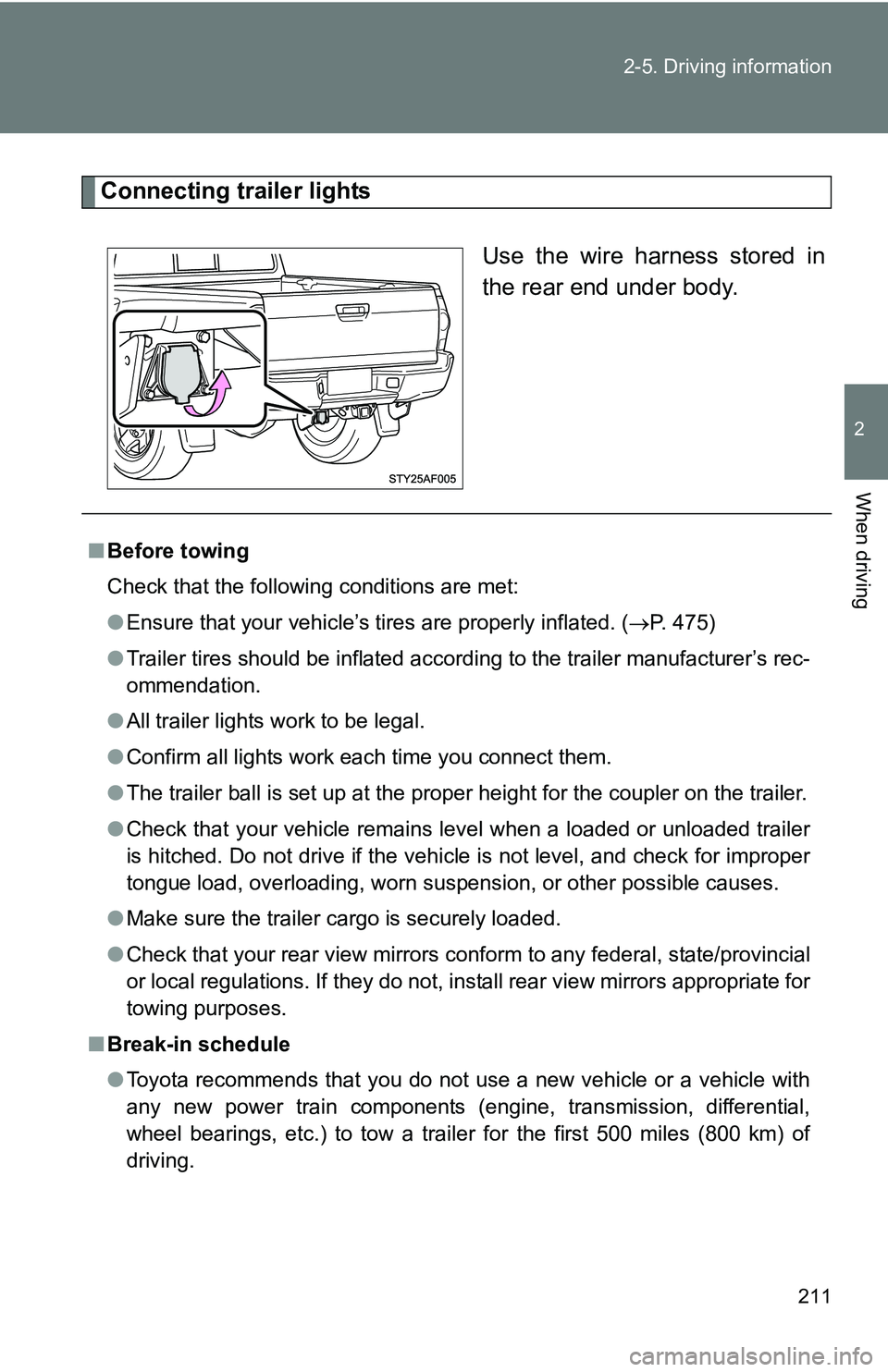
Connecting trailer lights
Use the wire harness stored in
the rear end under body.
■Before towing
Check that the following conditions are met:
●Ensure that your vehicle’s tires are properly inflated. ( P. 475)
● Trailer tires should be inflated according to the trailer manufacturer’s rec-
ommendation.
● All trailer lights work to be legal.
● Confirm all lights work each time you connect them.
● The trailer ball is set up at the proper height for the coupler on the t\
railer.
● Check that your vehicle remains level when a loaded or unloaded trailer
is hitched. Do not drive if the vehicle is not level, and check for improper
tongue load, overloading, worn suspension, or other possible causes.
● Make sure the trailer cargo is securely loaded.
● Check that your rear view mirrors c onform to any federal, state/provincial
or local regulations. If they do not, inst all rear view mirrors appropriate for
towing purposes.
■ Break-in schedule
●Toyota recommends that you do not use a new vehicle or a vehicle with
any new power train components (engine, transmission, differential,
wheel bearings, etc.) to tow a trailer for the first 500 miles (800 km) of
driving.