seats TOYOTA TACOMA 2009 Owners Manual (in English)
[x] Cancel search | Manufacturer: TOYOTA, Model Year: 2009, Model line: TACOMA, Model: TOYOTA TACOMA 2009Pages: 520, PDF Size: 10.75 MB
Page 2 of 520
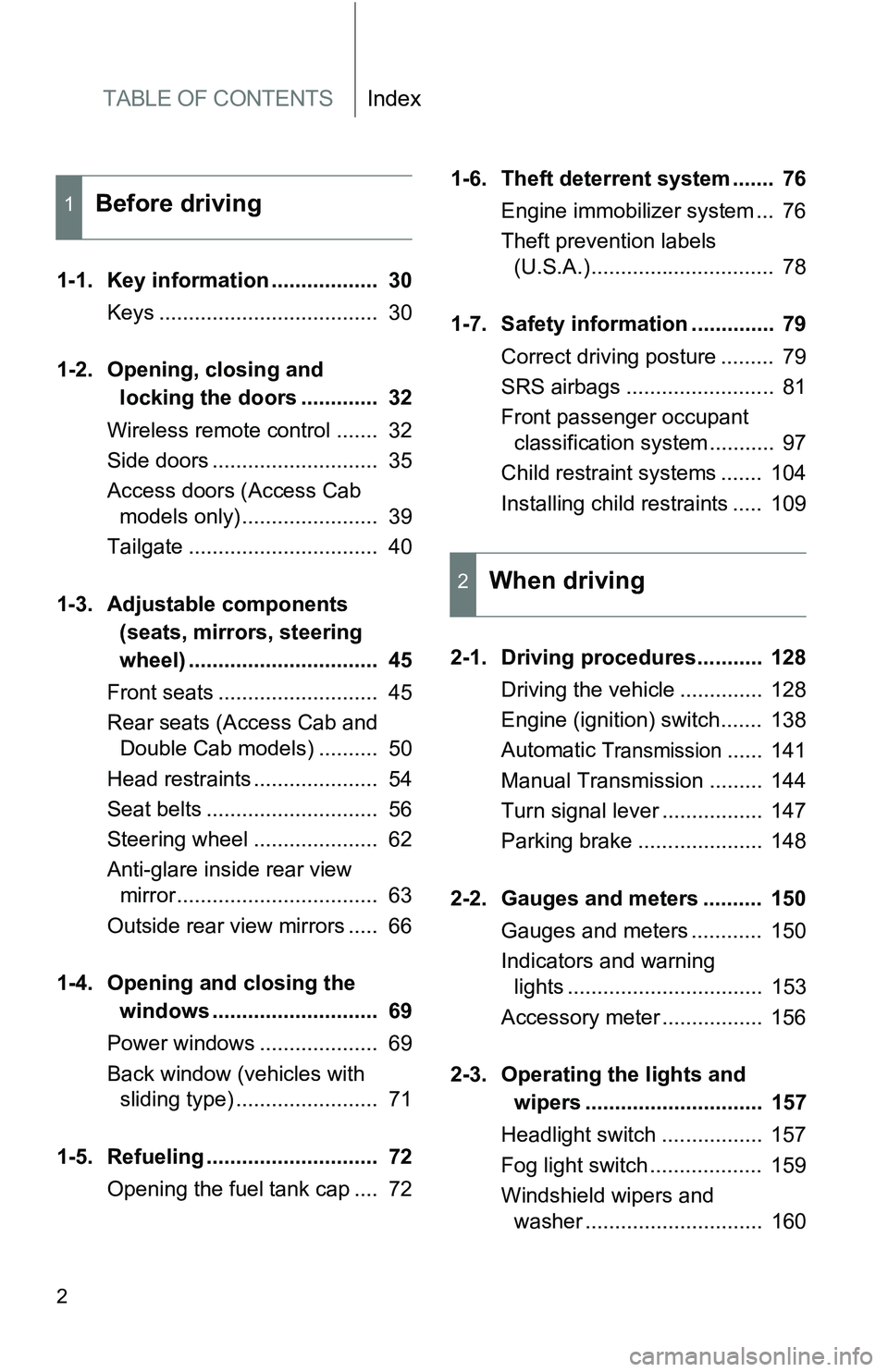
TABLE OF CONTENTSIndex
2
1-1. Key information .................. 30Keys ..................................... 30
1-2. Opening, closing and
locking the doors ............. 32
Wireless remote control ....... 32
Side doors ............................ 35
Access doors (Access Cab models only) ....................... 39
Tailgate ................................ 40
1-3. Adjustable components
(seats, mirrors, steering
wheel) ................................ 45
Front seats ........................... 45
Rear seats (Access Cab and Double Cab models) .......... 50
Head restraints ..................... 54
Seat belts ............................. 56
Steering wheel ..................... 62
Anti-glare inside rear view mirror .................................. 63
Outside rear view mirrors ..... 66
1-4. Opening a nd closing the
window s ............................ 69
Power windows .................... 69
Back window (vehicles with sliding type) ........................ 71
1-5. Refueling ............................. 72 Opening the fuel tank cap .... 72 1-6. Theft deterrent system ....... 76
Engine immobilizer system ... 76
Theft prevention labels (U.S.A.)............................... 78
1-7. Safety information .............. 79 Correct driving posture ......... 79
SRS airbags ......................... 81
Front passenger occupant classification system ........... 97
Child restraint systems ....... 104
Installing child restraints ..... 109
2-1. Driving procedures........... 128 Driving the vehicle .............. 128
Engine (ignition) switch....... 138
Automatic
Transmission...... 141
Manual Transmission ......... 144
Turn signal lever ................. 147
Parking brake ..................... 148
2-2. Gauges and meters .......... 150 Gauges and meters ............ 150
Indicators and warning lights ................................. 153
Accessory meter ................. 156
2-3. Operating the lights and wipers .............................. 157
Headlight switch ................. 157
Fog light switch ................... 159
Windshield wipers and washer .............................. 160
1Before driving
2When driving
Page 12 of 520

12
Pictorial indexInterior
Seat belts P. 56
SRS driver airbag P. 81
Head restraints P. 54
Bottle holders2 P. 300
Seatback table1 P. 317
SRS side airbags P. 81
Floor mats P. 318
SRS front
passenger
airbag
P. 81
Rear seats2 P. 50
Front seats P. 45
Glove box P. 296
Front console box2 P. 297
Page 15 of 520
15
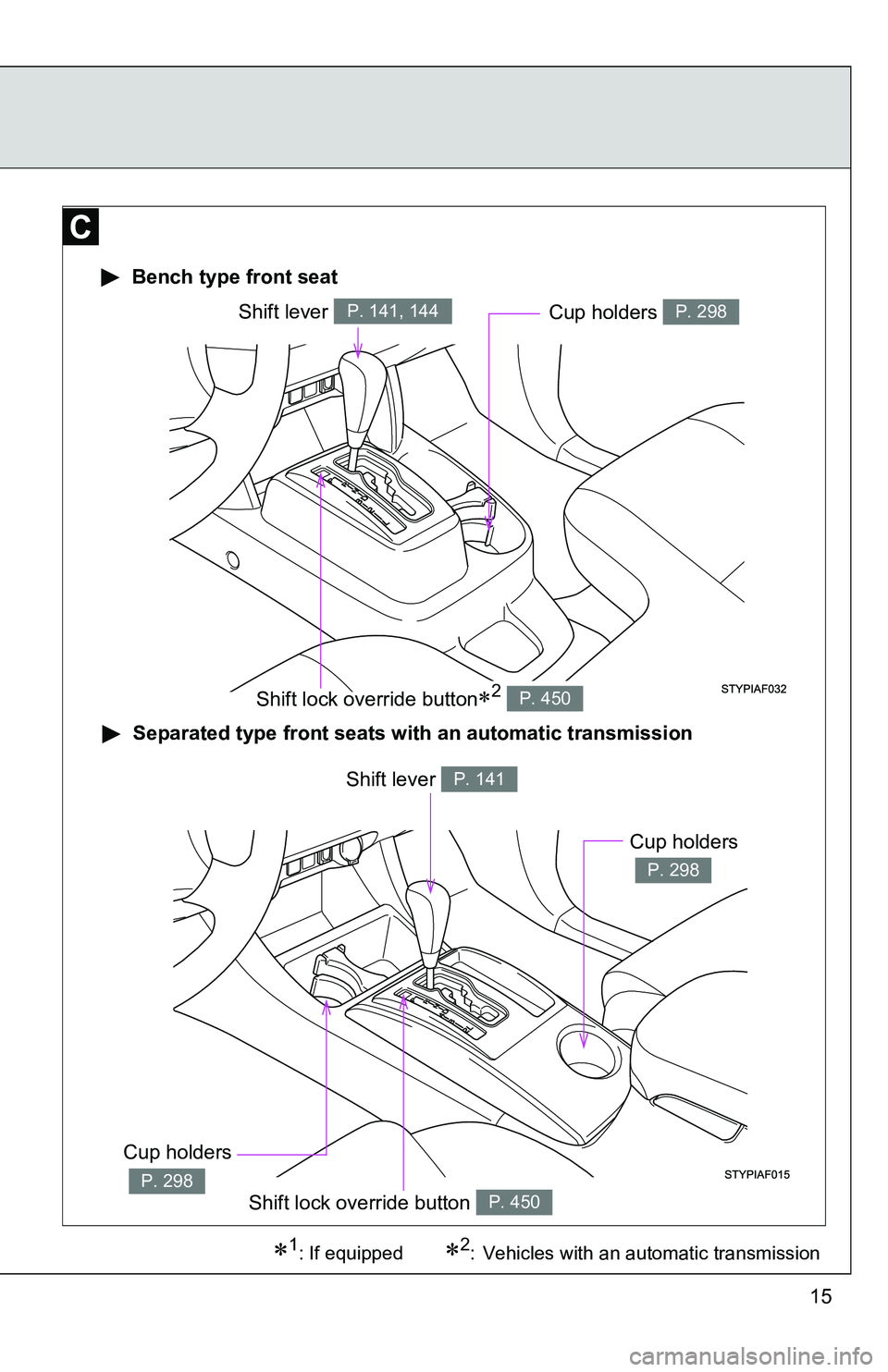
Bench type front seat
Separated type front seats with an automatic transmission
Shift lever P. 141, 144Cup holders P. 298
Shift lever P. 141
Cup holders
P. 298
1: If equipped
Shift lock override button P. 450
Cup holders
P. 298
Shift lock override button2 P. 450
2: Vehicles with an automatic transmission
Page 16 of 520
16
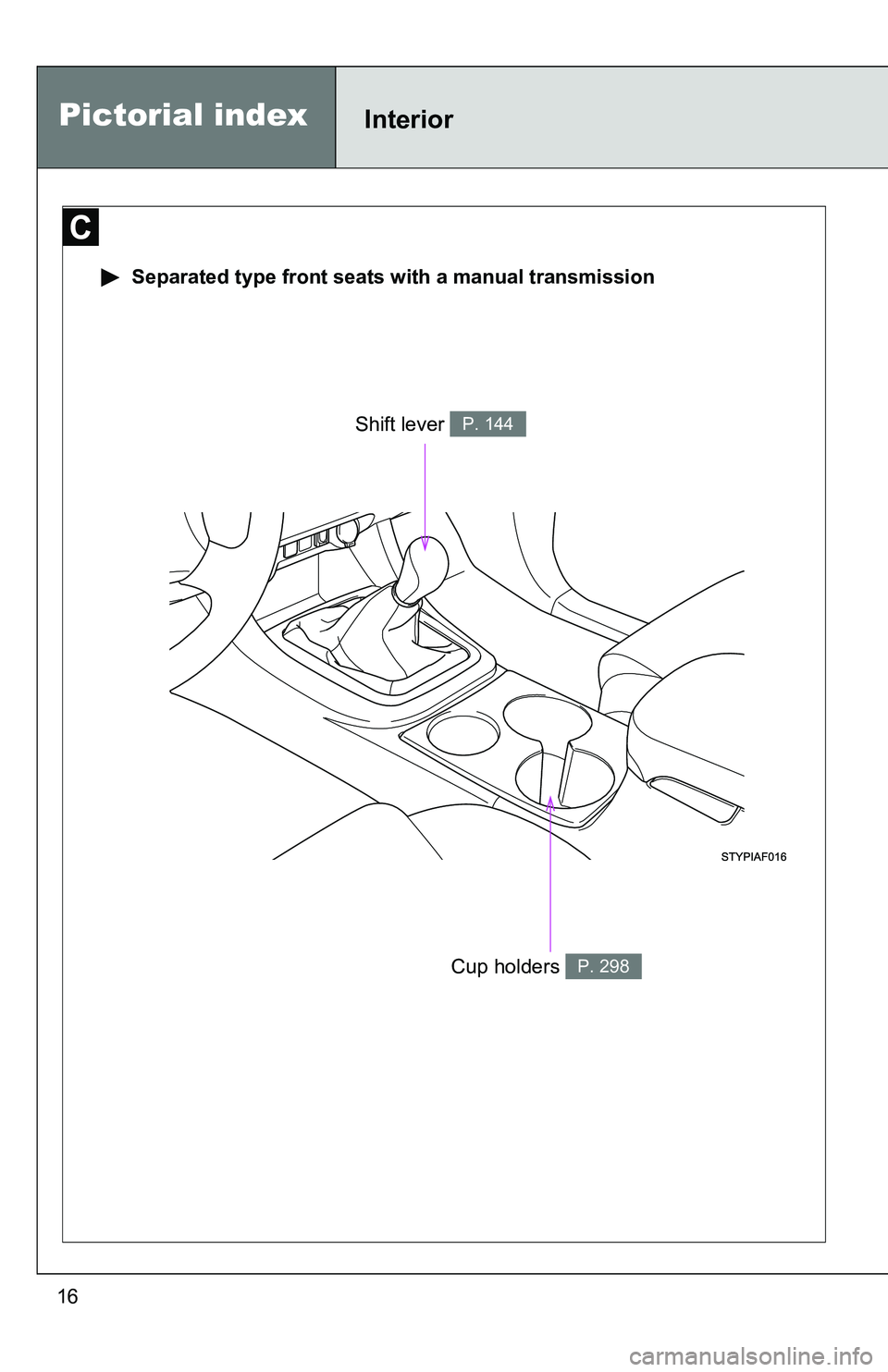
Separated type front seats with a manual transmission
Shift lever P. 144
Cup holders P. 298
Pictorial indexInterior
Page 29 of 520
Before driving1
29
1-1. Key information................ 30Keys ................................... 30
1-2. Opening, closing and locking the doors ........... 32
Wireless remote control ..... 32
Side doors .......................... 35
Access doors (Access Cab models only) .................... 39
Tailgate .............................. 40
1-3. Adjustable components (seats, mirrors, steering
wheel).............................. 45
Front seats ......................... 45
Rear seats (Access Cab and Double Cab models) ........ 50
Head restraints................... 54
Seat belts ........................... 56
Steering wheel ................... 62
Anti-glare inside rear view mirror ............................... 63
Outside rear view mirrors ... 66
1-4. Opening and closing the windows.......................... 69
Power windows .................. 69
Back window (vehicles with sliding type)...................... 71 1-5. Refueling........................... 72
Opening the fuel tank cap ................................... 72
1-6. Theft deterrent system .... 76 Engine immobilizer system ............................. 76
Theft prevention labels (U.S.A.) ............................ 78
1-7. Safety information ........... 79 Correct driving posture....... 79
SRS airbags ....................... 81
Front passenger occupant classification system ........ 97
Child restraint systems..... 104
Installing child restraints ........................ 109
Page 45 of 520
45
1
Before driving
1-3. Adjustable components (seats, mirrors, steering wheel)
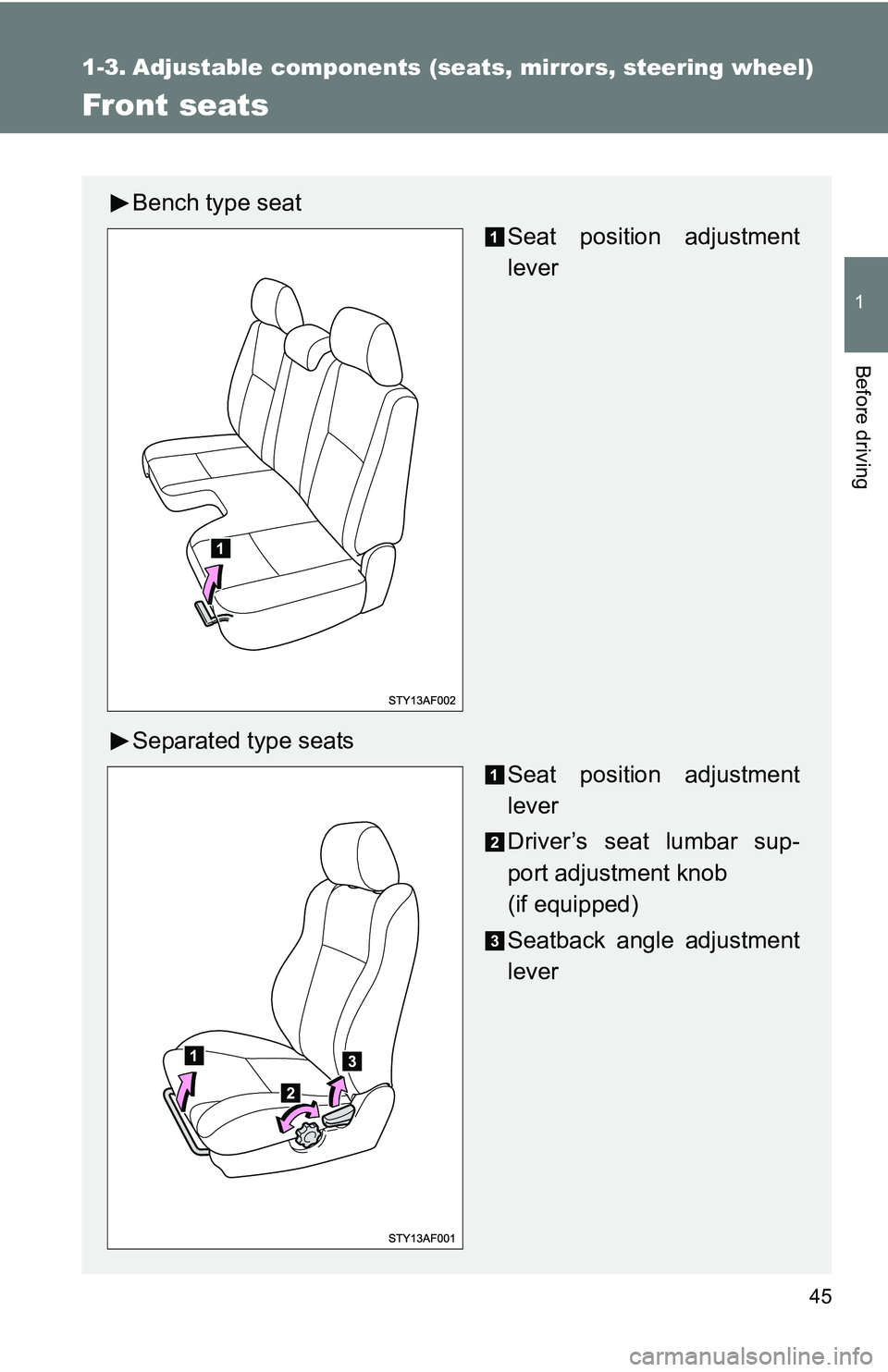
Front seats
Bench type seat
Seat position adjustment
lever
Separated type seats Seat position adjustment
lever
Driver’s seat lumbar sup-
port adjustment knob
(if equipped)
Seatback angle adjustment
lever
Page 46 of 520
46 1-3. Adjustable components (seats, mirrors, steering wheel)
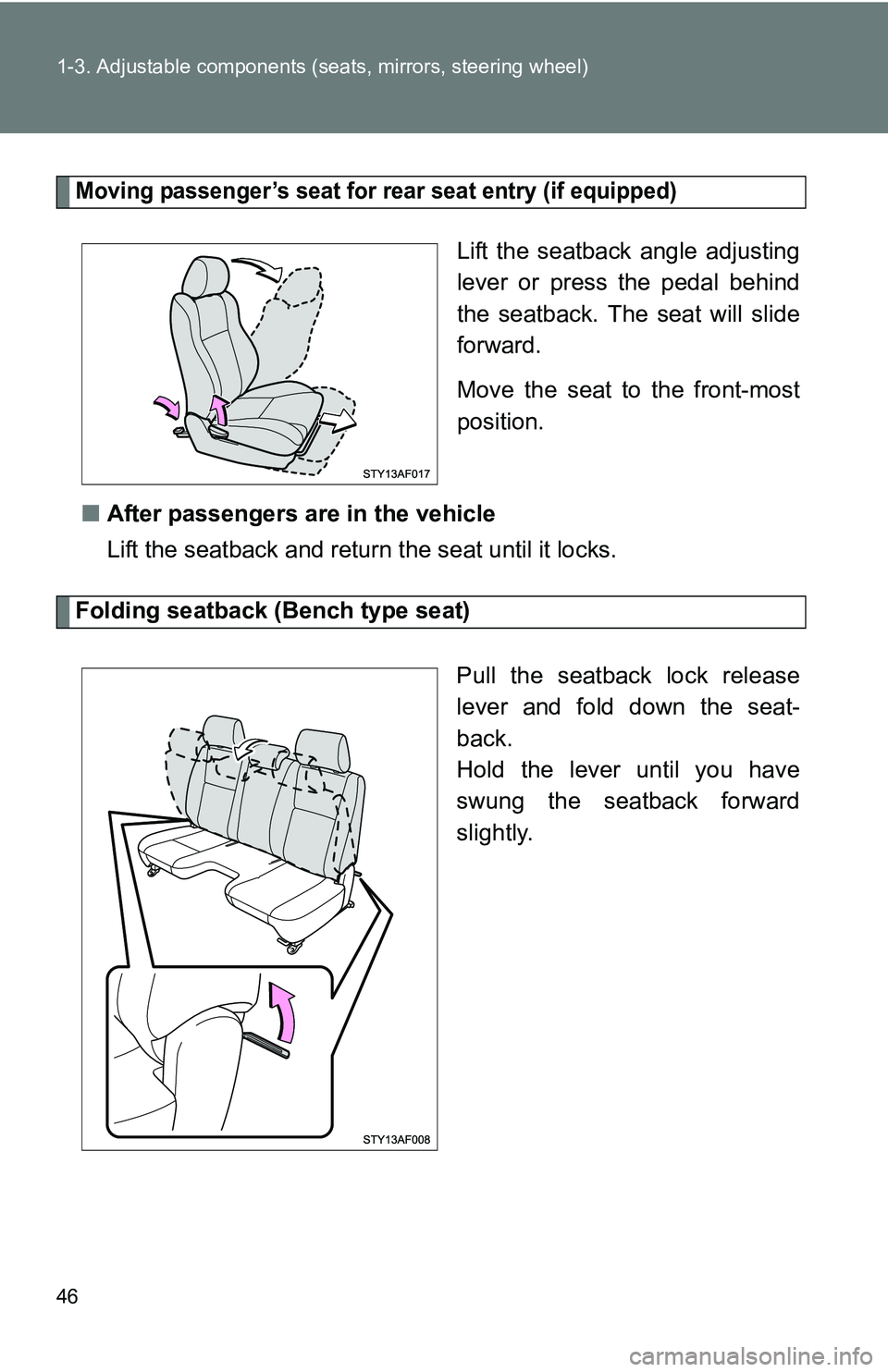
Moving passenger’s seat for rear seat entry (if equipped)
Lift the seatback angle adjusting
lever or press the pedal behind
the seatback. The seat will slide
forward.
Move the seat to the front-most
position.
■ After passengers are in the vehicle
Lift the seatback and retu rn the seat until it locks.
Folding seatback (Bench type seat)
Pull the seatback lock release
lever and fold down the seat-
back.
Hold the lever until you have
swung the seatback forward
slightly.
Page 48 of 520
48 1-3. Adjustable components (seats, mirrors, steering wheel)
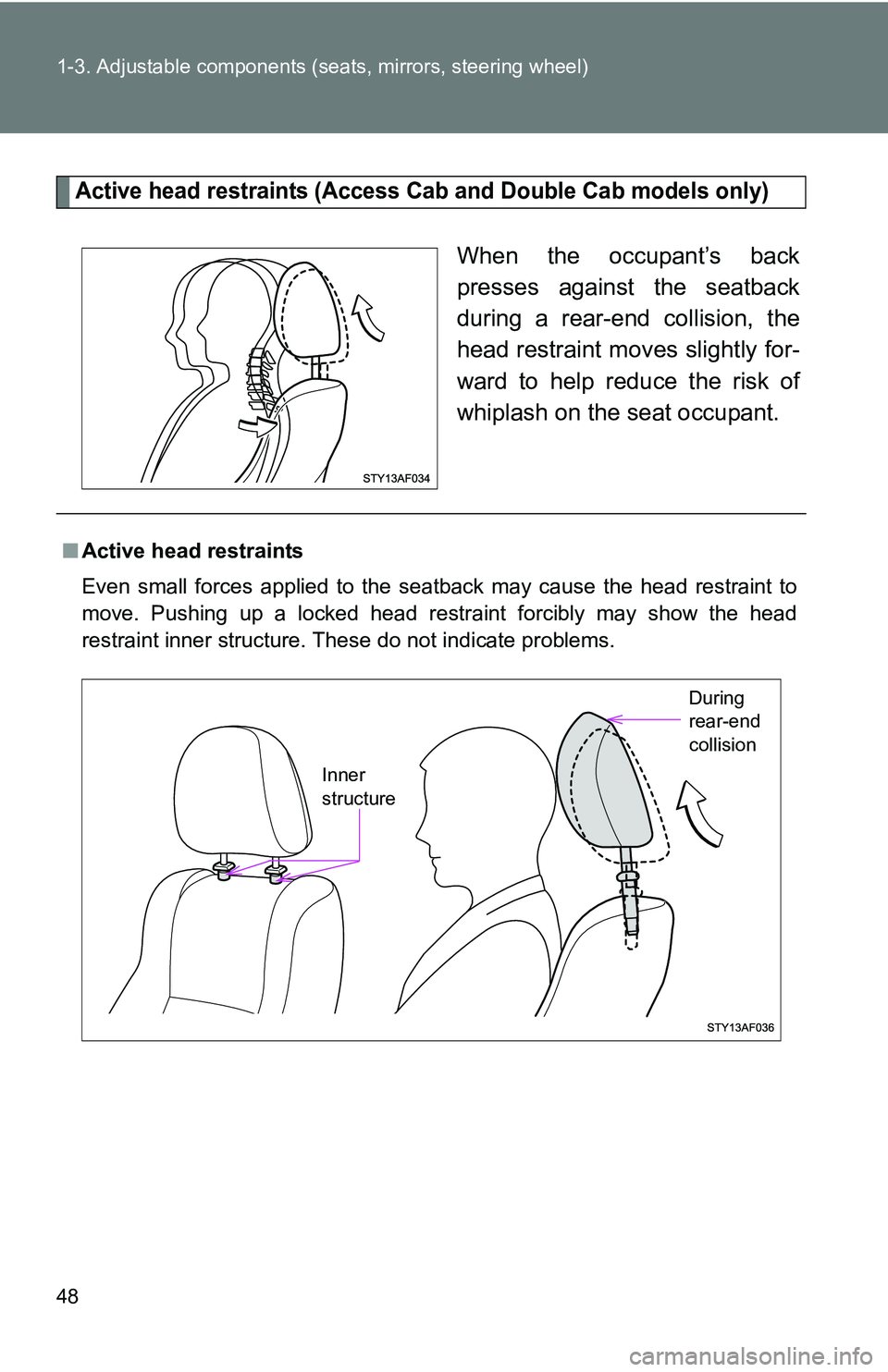
Active head restraints (Access Ca b and Double Cab models only)
When the occupant’s back
presses against the seatback
during a rear-end collision, the
head restraint moves slightly for-
ward to help reduce the risk of
whiplash on the seat occupant.
■Active head restraints
Even small forces applied to the seatback may cause the head restraint to
move. Pushing up a locked head restraint forcibly may show the head
restraint inner structure. These do not indicate problems.
Inner
structure
During
rear-end
collision
Page 50 of 520
50
1-3. Adjustable components (seats, mirrors, steering wheel)
Rear seats (Access Cab and Double Cab models)
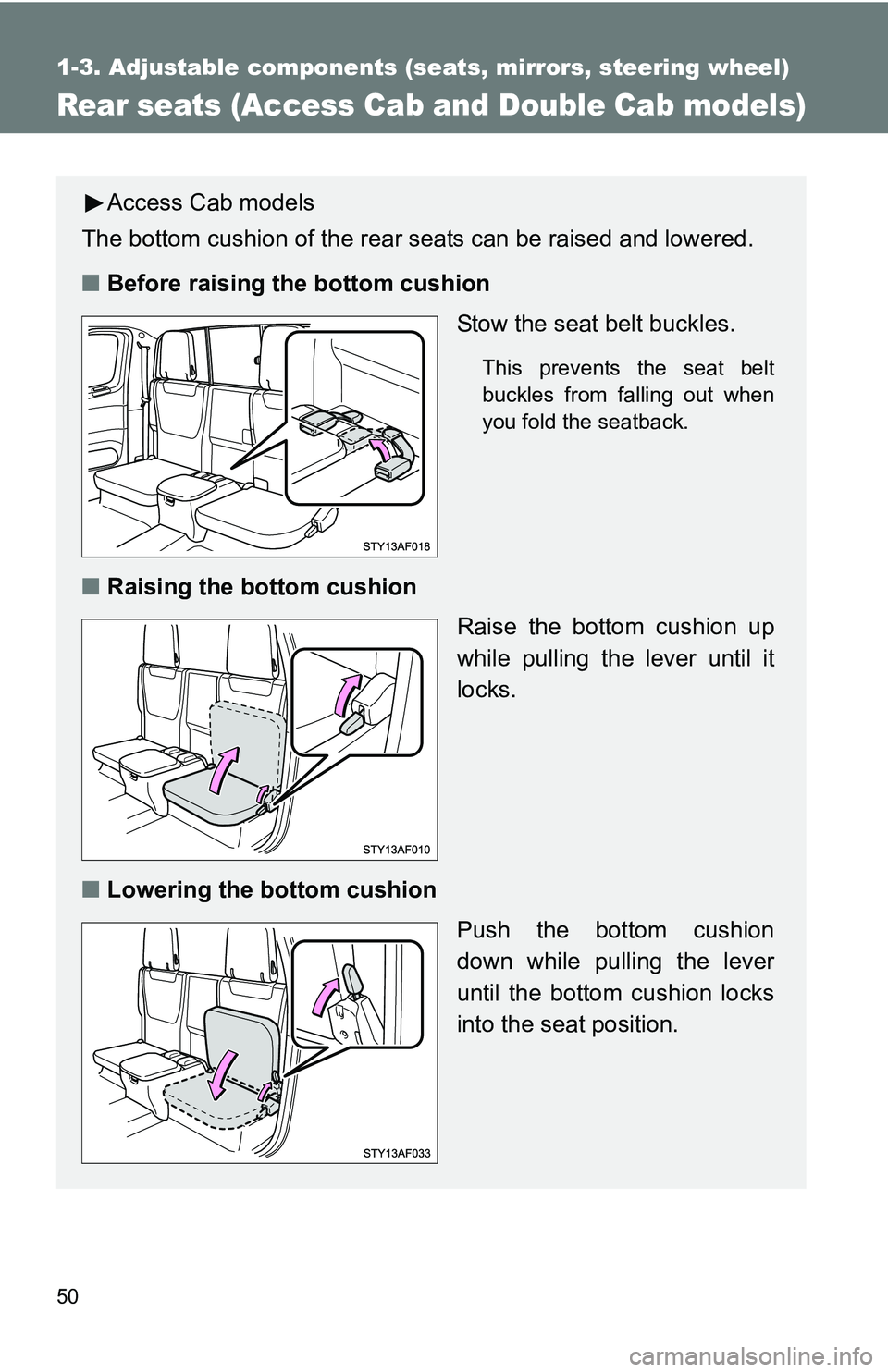
Access Cab models
The bottom cushion of the rear seats can be raised and lowered.
■ Before raising the bottom cushion
Stow the seat belt buckles.
This prevents the seat belt
buckles from falling out when
you fold the seatback.
■Raising the bottom cushion
Raise the bottom cushion up
while pulling the lever until it
locks.
■ Lowering the bottom cushion
Push the bottom cushion
down while pulling the lever
until the bottom cushion locks
into the seat position.
Page 51 of 520
51
1-3. Adjustable components (s
eats, mirrors, steering wheel)
1
Before driving
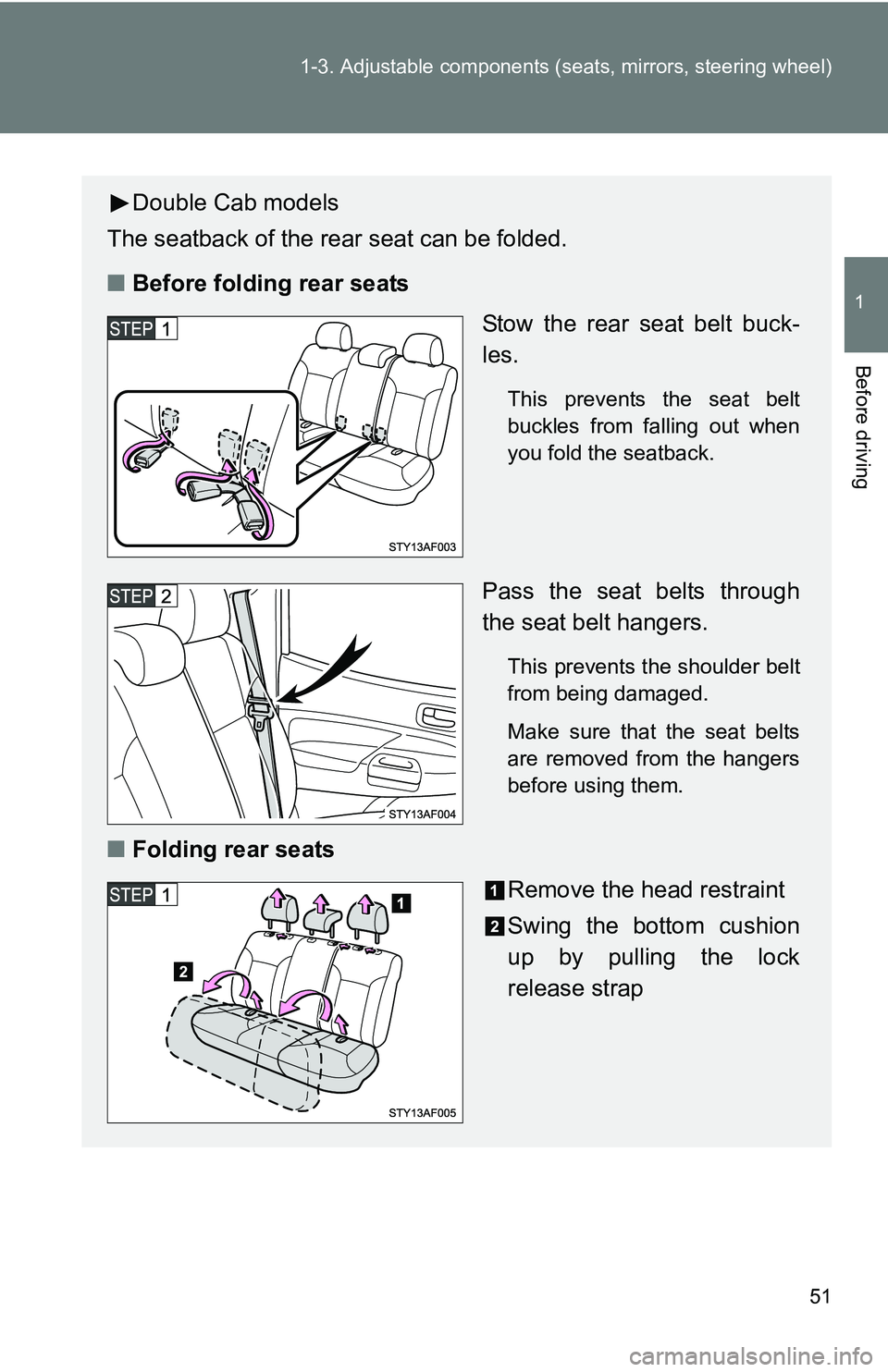
Double Cab models
The seatback of the rear seat can be folded.
■ Before folding rear seats
Stow the rear seat belt buck-
les.
This prevents the seat belt
buckles from falling out when
you fold the seatback.
Pass the seat belts through
the seat belt hangers.
This prevents the shoulder belt
from being damaged.
Make sure that the seat belts
are removed from the hangers
before using them.
■Folding rear seats
Remove the head restraint
Swing the bottom cushion
up by pulling the lock
release strap