weight TOYOTA TACOMA 2009 Owners Manual (in English)
[x] Cancel search | Manufacturer: TOYOTA, Model Year: 2009, Model line: TACOMA, Model: TOYOTA TACOMA 2009Pages: 520, PDF Size: 10.75 MB
Page 60 of 520
60 1-3. Adjustable components (seats, mirrors, steering wheel)
CAUTION
■Seat belt pretensioners
●Do not place anything, such as a cushion, on the front passenger’s seat.
Doing so will disperse the passenger’s weight, which prevents the sensor
from detecting the passenger’s weight properly. As a result, the seat belt
pretensioner for the front passenger’s seat may not activate in the event of
a collision.
● If the pretensioner has activated, the seat belt becomes locked: it cannot
be further extended, nor will it return to the stowed position. The seat belt
cannot be used again and must be replaced at your Toyota dealer.
■ Seat belt damage and wear
●Do not damage the seat belts by allowing the belt, plate, or buckle to be
jammed in the door.
● Inspect the seat belt system periodically. Check for cuts, fraying, and loose
parts. Do not use a damaged seat belt until it is replaced. Damaged seat
belts cannot protect an occupant from death or serious injury.
● Ensure that the belt and tab are locked and the belt is not twisted.
If the seat belt does not function correctly, immediately contact your Toyota
dealer.
● Replace the seat assembly, including the belts, if your vehicle has been
involved in a serious accident, even if there is no obvious damage.
● Do not attempt to install, remove, modify, disassemble or dispose of the
seat belts. Have any necessary repairs carried out by your Toyota dealer.
Inappropriate handling of the pretensioner may prevent it from operating
properly resulting in death or serious injury.
■ Using a seat belt extender
●Do not wear the seat belt extender, if you can fasten the seat belt without
the extender.
● Do not use the seat belt extender when installing a child restraint system,
because the belt will not securely hold the child restraint system, increas-
ing the risk of death or serious injury in the event of a collision.
● The personalized extender may not be safe on another vehicle, when
used by another person, or at a different seating position other than the
one originally intended.
Page 195 of 520
195
2-5. Driving information
2
When driving
Cargo and luggage
CAUTION
■When you secure cargo with the deck rails
Be sure to follow the instructions below in order to avoid the cargo com-
ing loose.
●Do not install accessories (tie-down cleats, storage boxes, etc.) at
more than the following number of locations per deck rail.
• Side rail:Short deck—Max. 3 locations
Long deck—Max. 4 locations
• Headboard rail: Max 3 locations
Take notice of the following information about storage precau-
tions, cargo capacity and load.
● Stow cargo and luggage in the rear deck whenever possible.
● Be sure all items are secured in place.
● Be careful to keep the vehicle level. Placing the weight as far for-
ward as possible helps maintain vehicle balance.
● For better fuel economy, do no t carry unnecessary weight.
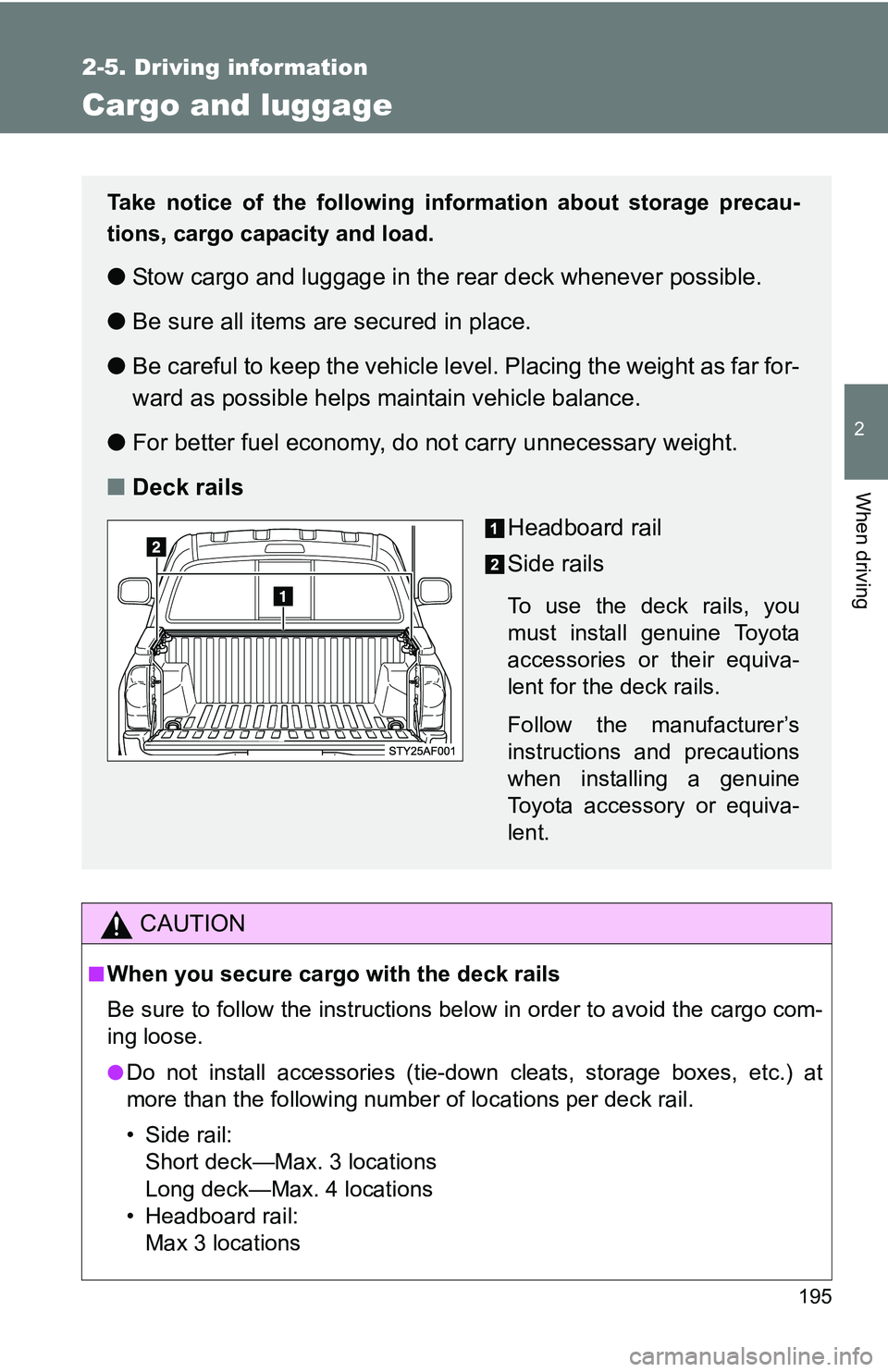
■ Deck rails
Headboard rail
Side rails
To use the deck rails, you
must install genuine Toyota
accessories or their equiva-
lent for the deck rails.
Follow the manufacturer’s
instructions and precautions
when installing a genuine
Toyota accessory or equiva-
lent.
Page 196 of 520
196 2-5. Driving information
Capacity and distributionCargo capacity depends on the total weight of the occupants.
(Cargo capacity) = (Total load capacity) (Total weight of occupants)
Steps for Determining Correct Load Limit—
(1) Locate the statement “The co mbined weight of occupants and
cargo should never exceed XXX kg or XXX lbs.” on your vehicle’s
placard.
(2) Determine the combined weight of the driver and passengers that
will be riding in your vehicle.
(3)Subtract the combined weight of the driver and passengers from XXX kg or XXX lbs.
(4) The resulting figure equals the av ailable amount of cargo and lug-
gage load capacity.
For example, if the “XXX” amount equals 1400 lbs. and there will
be five 150 lb passengers in your vehicle, the amount of available
cargo and luggage load capacity is 650 lbs. (1400 750 (5 150)
= 650 lbs.)
(5) Determine the combined weight of luggage and cargo being loaded on the vehicle. That weight may not safely exceed the
available cargo and luggage load capacity calculated in Step 4.
CAUTION
■When you secure cargo with the deck rails
●Spread out tie-down/support location s evenly along the length of the
rails.
●Do not exceed a total tensile load of 440 lb. (200 kg) per deck rail.
●To prevent luggage or cargo from sliding forward during braking, make
sure the deck rail accessories su ch as storage box are securely
attached on the deck rails.
Page 197 of 520
197
2-5. Driving information
2
When driving
(6) If your vehicle will be towing a tr
ailer, load from your trailer will be
transferred to your vehicle. Consult this manual to determine how
this reduces the available cargo and luggage load capacity of your
vehicle.
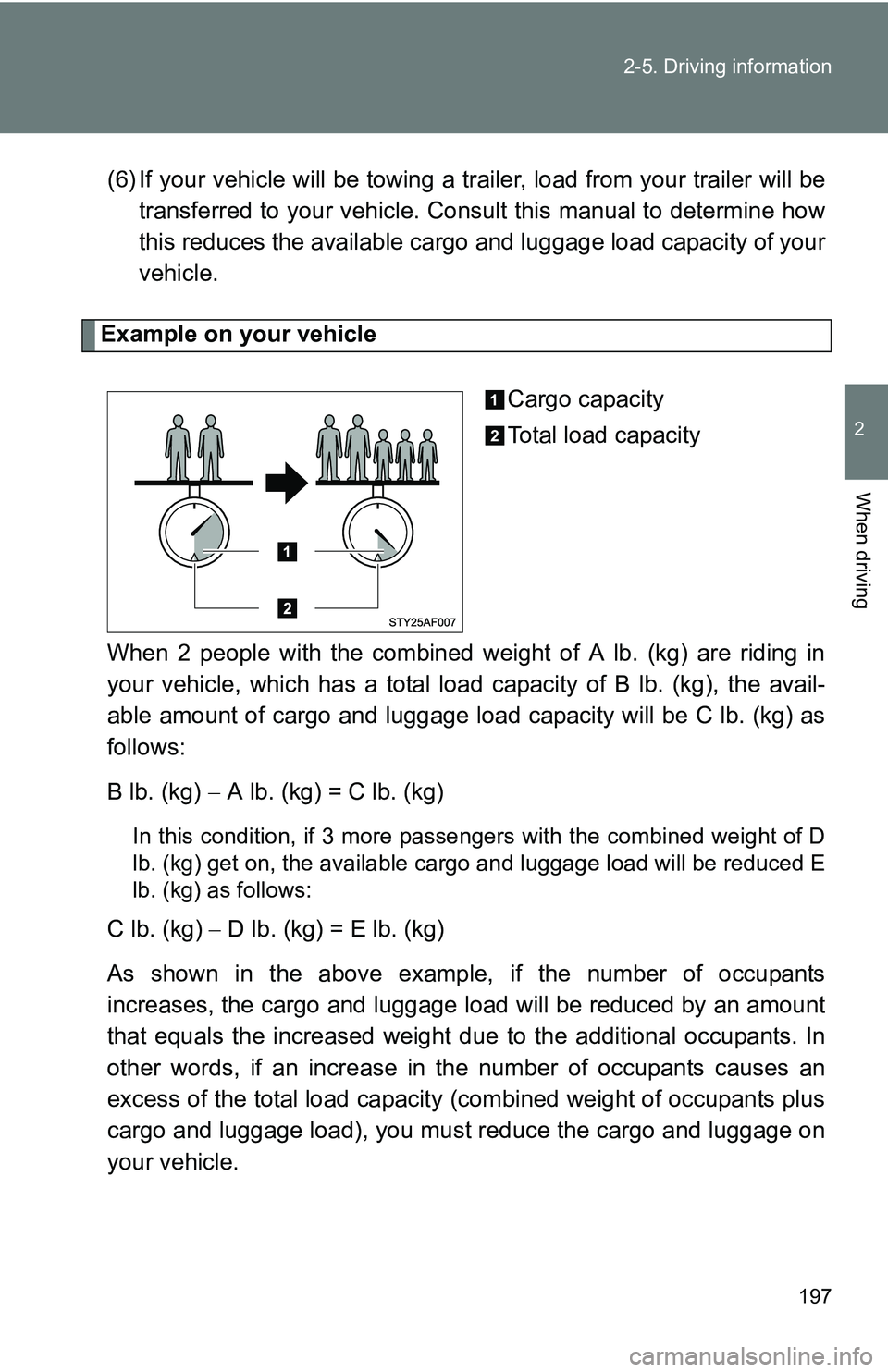
Example on your vehicle
Cargo capacity
Total load capacity
When 2 people with the combined weight of A lb. (kg) are riding in
your vehicle, which has a total load capacity of B lb. (kg), the avail-
able amount of cargo and luggage load capacity will be C lb. (kg) as
follows:
B lb. (kg) A lb. (kg) = C lb. (kg)
In this condition, if 3 more passengers with the combined weight of D
lb. (kg) get on, the available carg o and luggage load will be reduced E
lb. (kg) as follows:
C lb. (kg) D lb. (kg) = E lb. (kg)
As shown in the above example, if the number of occupants
increases, the cargo and luggage load will be reduced by an amount
that equals the increased weight du e to the additional occupants. In
other words, if an increase in th e number of occupants causes an
excess of the total load capacity (combined weight of occupants plus
cargo and luggage load), you must reduce the cargo and luggage on
your vehicle.
Page 198 of 520
198 2-5. Driving information
CAUTION
■Things that must not be carried in the luggage compartment
The following things may cause a fire if loaded in the luggage compart-
ment.
●Receptacles containing gasoline
●Aerosol cans
■Storage precautions
●Do not stack anything in the luggage compartment higher than the
seatbacks.
Such items may be thrown about and possibly injure people in the
vehicle during sudden braking or in an accident.
●Do not drive with objects on top of the instrument panel.
They may interfere with the driver’s field of view or move during sharp
acceleration or turning, thus impairing the driver’s control of the vehi-
cle. In an accident they may injure the vehicle occupants.
●Secure all items in the occupant compartment, as they may shift and
injure someone during an accident or sudden braking.
●Never allow anyone to ride in the rear deck. It is not designed for pas-
sengers. They should ride in their seats with their seat belts properly
fastened. Otherwise, they are much more likely to suffer death or seri-
ous bodily injury, in the event of sudden braking or a collision.
■Capacity and distribution
●Do not exceed the maximum axle weight rating or the total vehicle
weight rating.
●Even if the total load of occupant’s weight and the cargo load is less
than the total load capacity, do not apply the load unevenly. Improper
loading may cause deterioration of steering or braking control which
may cause death or serious injury.
Page 199 of 520
199
2-5. Driving information
2
When driving
Vehicle load limits
Vehicle load limits include total load capacity, seating capacity,
towing capacity and cargo capacity.
■Total load capacity: ( P. 463)
Total load capacity means the combined weight of occupants,
cargo and luggage.
■ Seating capacity:
Regular Cab models
3 occupants
Access Cab models 4 occupants (Front 2, Rear 2)
Double Cab models 5 occupants (Front 2, Rear 3)
Seating capacity means the ma ximum number of occupants
whose estimated average weight is 150 lb. (68 kg) per person.
Even if the number of occupants are within the seating capacity,
do not exceed the total load capacity.
■ Towing capacity:
Without towing package
3500 lb. (1587 kg)
With towing package 6500 lb. (2948 kg)
Towing capacity means the maximum gross trailer weight (trailer
weight plus its cargo weight) that your vehicle is able to tow.
■ Cargo capacity
Cargo capacity may increase or decrease depending on the
weight and the number of occupants.
Page 205 of 520
205
2-5. Driving information
2
When driving
Trailer towing
Your vehicle is designed primarily as a passenger-and-load carrying
vehicle, and thus towing a trailer will have an adverse effect on han-
dling, performance, braking, durability, and fuel consumption. For
your safety and the safety of others, do not overload the vehicle or
trailer.
We recommend you use a weight distributing hitch when towing to
keep your vehicle level with the ground.
■ Weight limits
Confirm that the total trailer we ight, gross combination weight,
gross vehicle weight, gross axle weight, and trailer tongue load
are all within the limits.
■ Gross vehicle weight
The gross vehicle weight must not exceed the Gross Vehicle
Weight Rating (GVWR) indicated on the Certification Label. The
gross vehicle weight is the sum of the weights of the unloaded
vehicle, driver, passengers, luggage, hitch, and the trailer
tongue load. It also includes t he weight of any special equipment
installed on your vehicle.
Page 206 of 520
206 2-5. Driving information
■Gross axle weight
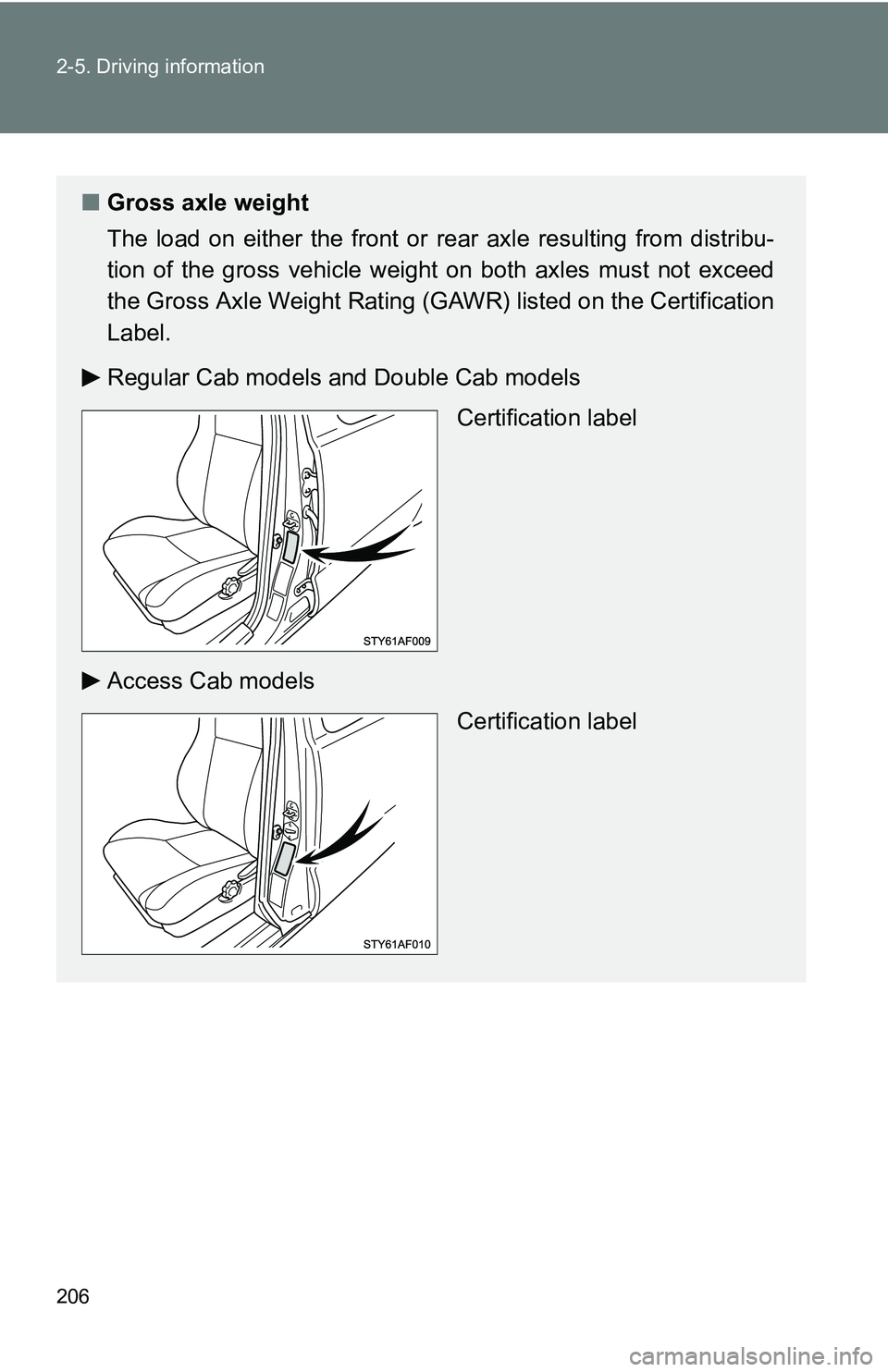
The load on either the front or rear axle resulting from distribu-
tion of the gross vehicle weight on both axles must not exceed
the Gross Axle Weight Rating (GAWR) listed on the Certification
Label.
Regular Cab models and Double Cab models
Certification label
Access Cab models Certification label
Page 207 of 520
207
2-5. Driving information
2
When driving
■
Trailer tongue load
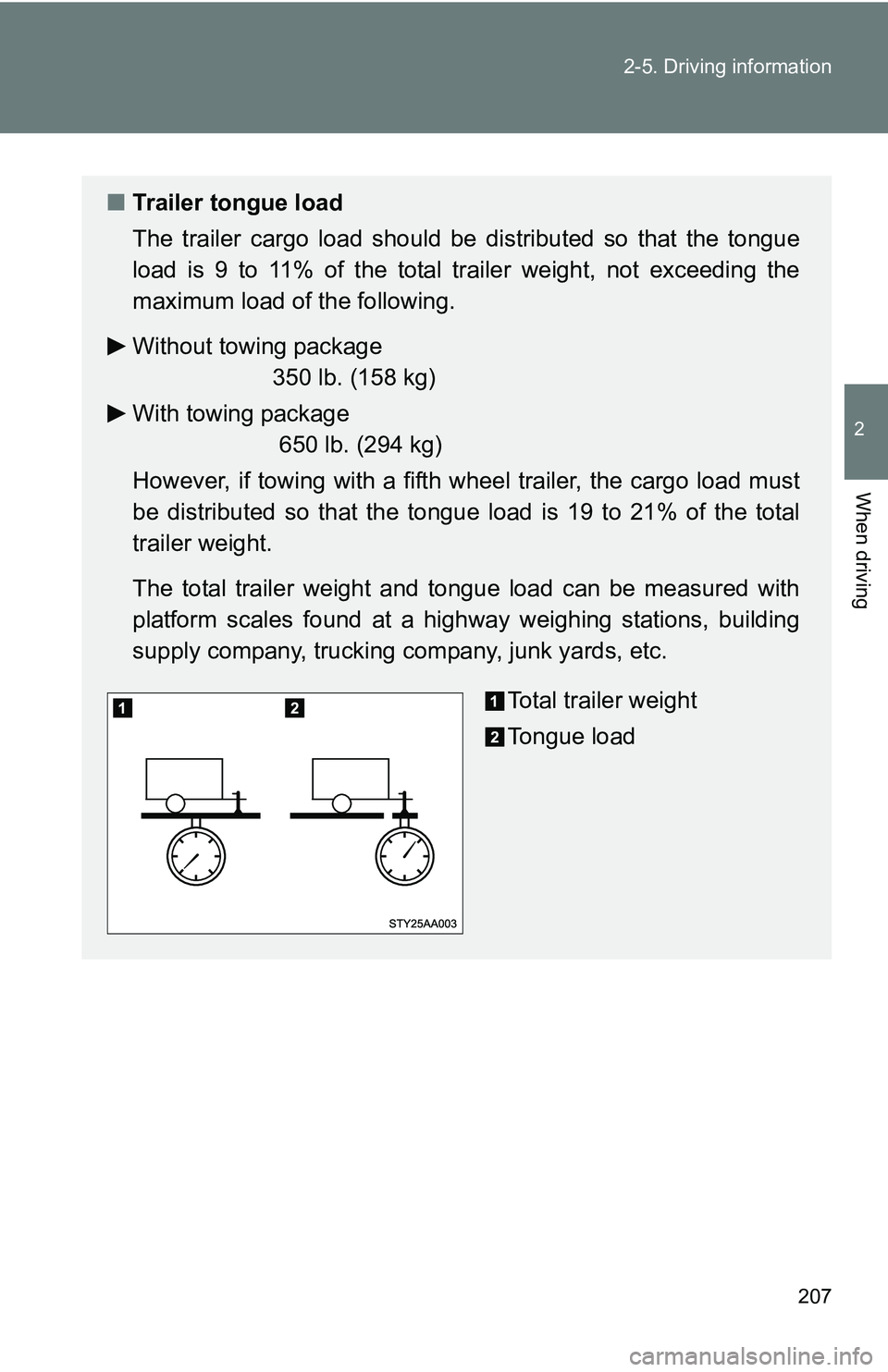
The trailer cargo load should be distributed so that the tongue
load is 9 to 11% of the total trailer weight, not exceeding the
maximum load of the following.
Without towing package 350 lb. (158 kg)
With towing package 650 lb. (294 kg)
However, if towing with a fifth wheel trailer, the cargo load must
be distributed so that the tongue load is 19 to 21% of the total
trailer weight.
The total trailer weight and tongue load can be measured with
platform scales found at a highway weighing stations, building
supply company, trucking company, junk yards, etc.
Total trailer weight
Tongue load
Page 208 of 520
208 2-5. Driving information
Towing a trailerConsult your Toyota dealer for further information about additional
requirements such as a towing kits, etc.
Hitch and tow hitch receiver■ Hitch
Trailer hitch assemblies have different weight capacities estab-
lished by the hitch manufacturer . Even though the vehicle may be
rated for towing a higher weight, the operator must never exceed
the maximum weight rating specified for the trailer hitch.