belt TOYOTA TACOMA 2010 Owners Manual (in English)
[x] Cancel search | Manufacturer: TOYOTA, Model Year: 2010, Model line: TACOMA, Model: TOYOTA TACOMA 2010Pages: 532, PDF Size: 15.03 MB
Page 1 of 532
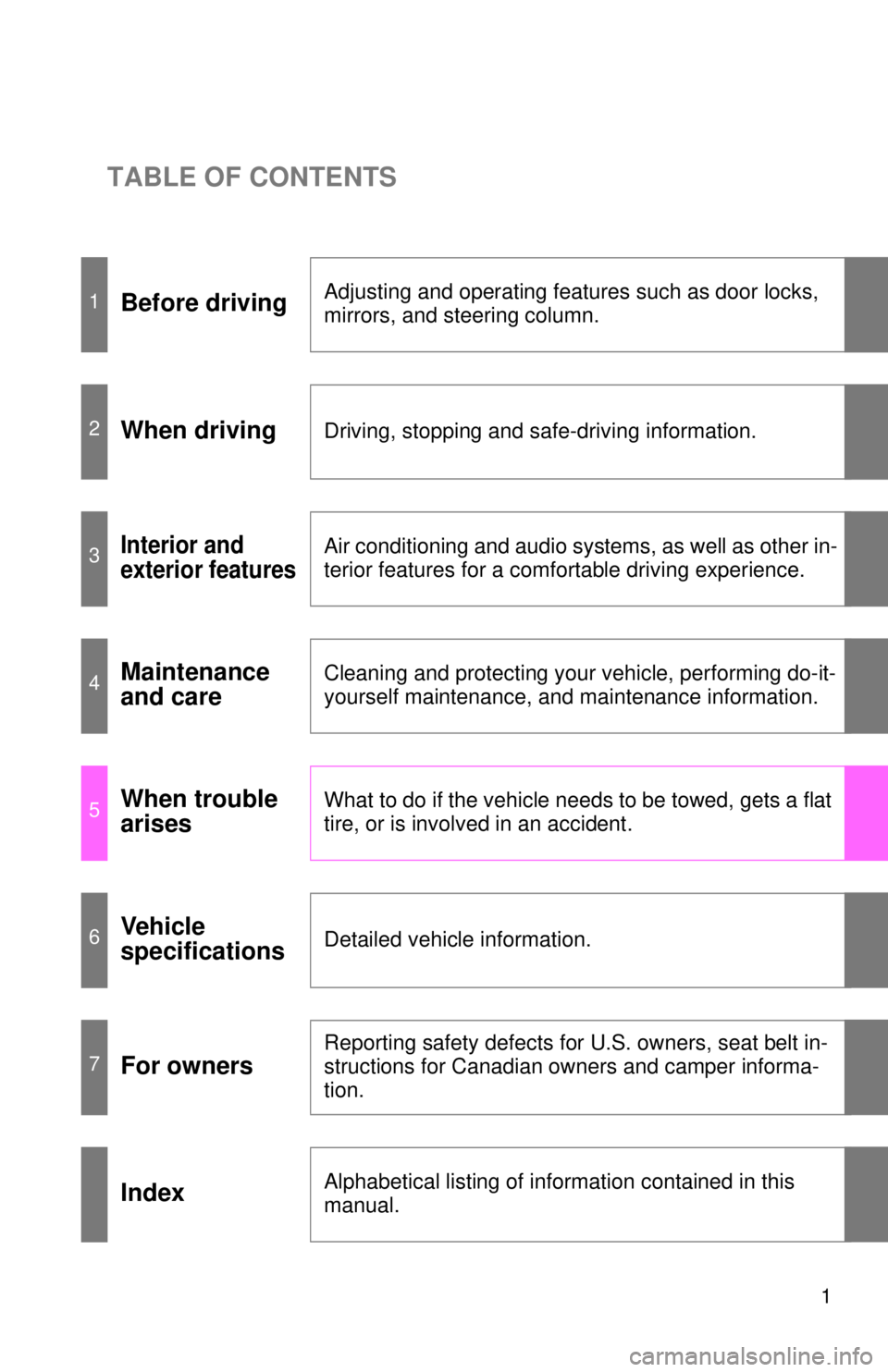
TABLE OF CONTENTS
1
1Before drivingAdjusting and operating features such as door locks,
mirrors, and steering column.
2When drivingDriving, stopping and safe-driving information.
3Interior and
exterior featuresAir conditioning and audio systems, as well as other in-
terior features for a comfortable driving experience.
4Maintenance
and careCleaning and protecting your vehicle, performing do-it-
yourself maintenance, and maintenance information.
5When trouble
arisesWhat to do if the vehicle needs to be towed, gets a flat
tire, or is involved in an accident.
6Vehicle
specificationsDetailed vehicle information.
7For owners
Reporting safety defects for U.S. owners, seat belt in-
structions for Canadian owners and camper informa-
tion.
IndexAlphabetical listing of information contained in this
manual.
Page 2 of 532

TABLE OF CONTENTSIndex
2
1-1. Key information
Keys ..................................... 30
1-2. Opening, closing and locking
the doors
Wireless remote control ....... 32
Side doors ............................ 35
Access doors (Access Cab
models only) ....................... 39
Tailgate ................................ 40
1-3. Adjustable components
(seats, mirrors, steering
wheel)
Front seats ........................... 45
Rear seats (Access Cab
and Double Cab models) ... 50
Head restraints ..................... 54
Seat belts ............................. 58
Steering wheel ..................... 64
Anti-glare inside rear view
mirror .................................. 65
Outside rear view mirrors ..... 68
1-4. Opening and closing the
windows
Power windows .................... 71
Back window (vehicles
with sliding type)................. 73
1-5. Refueling
Opening the fuel tank cap .... 741-6. Theft deterrent system
Engine immobilizer system ... 78
1-7. Safety information
Correct driving posture ......... 81
SRS airbags ......................... 83
Front passenger occupant
classification system ......... 100
Child restraint systems ....... 107
Installing child restraints ..... 112
2-1. Driving procedures
Driving the vehicle .............. 134
Engine (ignition) switch....... 144
Automatic
Transmission...... 147
Manual Transmission ......... 150
Turn signal lever ................. 153
Parking brake ..................... 154
Horn .................................... 156
2-2. Gauges and meters
Gauges and meters ............ 157
Indicators and warning
lights ................................. 160
Accessory meter ................. 163
2-3. Operating the lights and
wipers
Headlight switch ................. 164
Fog light switch ................... 166
Windshield wipers and
washer .............................. 167
1Before driving
2When driving
Page 5 of 532

1
2
3
4
5
6
7
5
5-2. Steps to take in an emergency
If a warning light turns on
or a warning buzzer
sounds... ........................... 431
If you have a flat tire............ 440
If the engine will not start .... 456
If the shift lever cannot be
shifted from P.................... 457
If you lose your keys ........... 458
If the vehicle battery is
discharged ........................ 459
If your vehicle overheats ..... 463
If the vehicle becomes
stuck ................................. 466
If your vehicle has to be
stopped in an
emergency ........................ 468
6-1. Specifications
Maintenance data
(fuel, oil level, etc.) ............ 470
Fuel information .................. 488
Tire information ................... 491
6-2. Customization
Customizable features ........ 502
Items to initialize ................. 503Reporting safety defects
for U.S. owners ................ 506
Seat belt instructions for
Canadian owners
(in French) ........................ 507
Camper information ............ 509
Abbreviation list ........................ 516
Alphabetical index .................... 518
What to do if... ........................... 527
6Vehicle specifications
7For owners
Index
Page 12 of 532
12
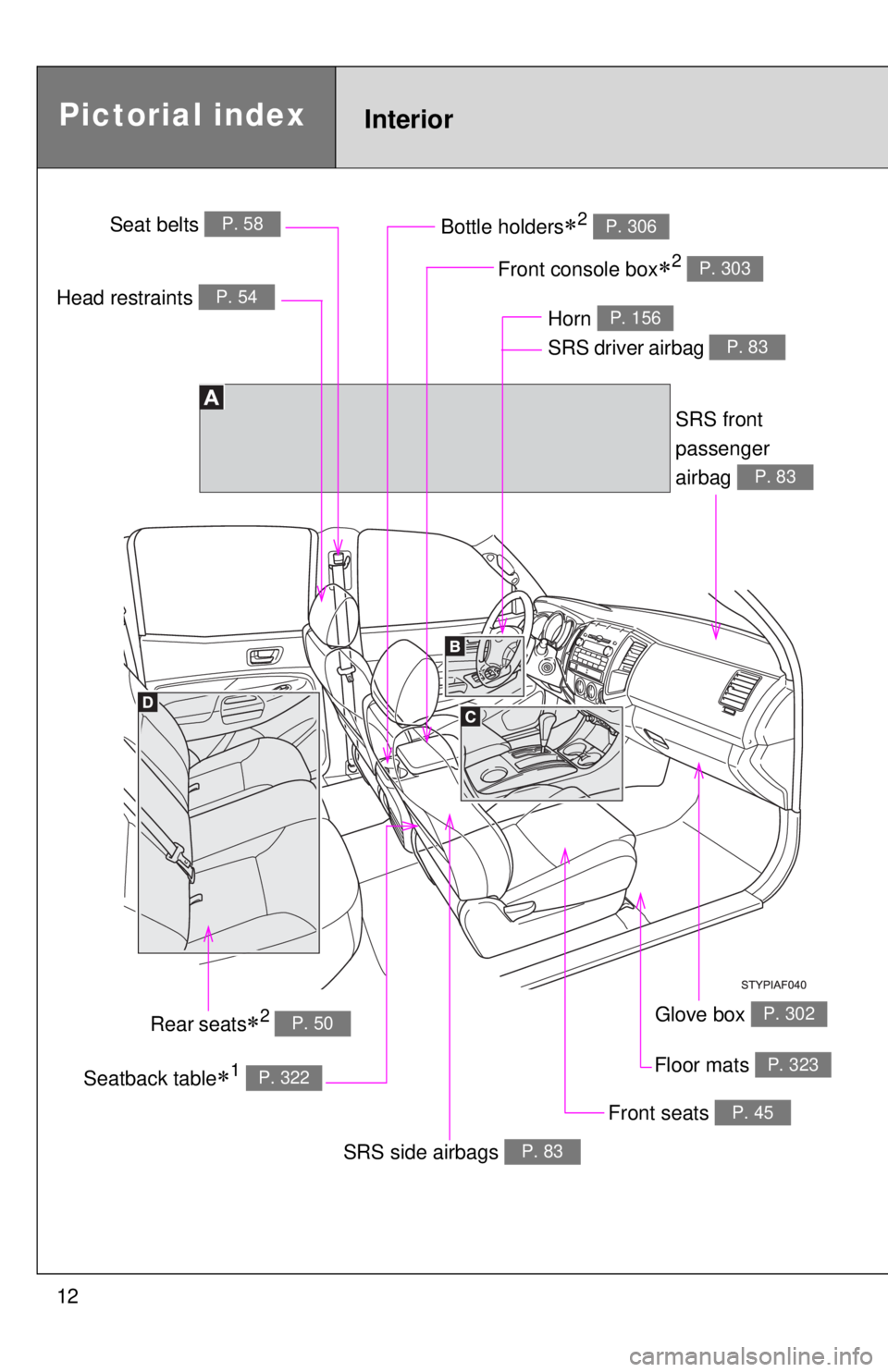
Pictorial indexInterior
Seat belts P. 58
Head restraints P. 54
Bottle holders2 P. 306
Seatback table1 P. 322
SRS side airbags P. 83
Floor mats P. 323
SRS front
passenger
airbag
P. 83
Rear seats2 P. 50
Front seats P. 45
Glove box P. 302
Front console box2 P. 303
Horn
SRS driver airbag P. 156
P. 83
Page 25 of 532

25
Installation of a mobile two-way radio system
As the installation of a mobile two-way radio system in your vehicle could
affect electronic systems such as the multiport fuel injection system/sequen-
tial multiport fuel injection system, cruise control system, anti-lock brake sys-
tem, SRS airbag system and seat belt pretensioner system, be sure to check
with your Toyota dealer for precautionary measures or special instructions
regarding installation.
Scrapping your Toyota
The SRS airbag and seat belt pretensioner devices in your Toyota contain
explosive chemicals. If the vehicle is scrapped with the airbags and seat belt
pretensioners left as they are, this may cause an accident such as fire. Be
sure to have the systems of the SRS airbag and seat belt pretensioner
removed and disposed of by a qualified service shop or by your Toyota
dealer before you scrap your vehicle.
Perchlorate Material
Special handling may apply,
See www.dtsc.ca.gov/hazardouswaste/perchlorate.
Your vehicle has components that may contain perchlorate. These compo-
nents may include airbag, seat belt pretensioners, and wireless remote con-
trol batteries.
Page 29 of 532
Before driving1
29
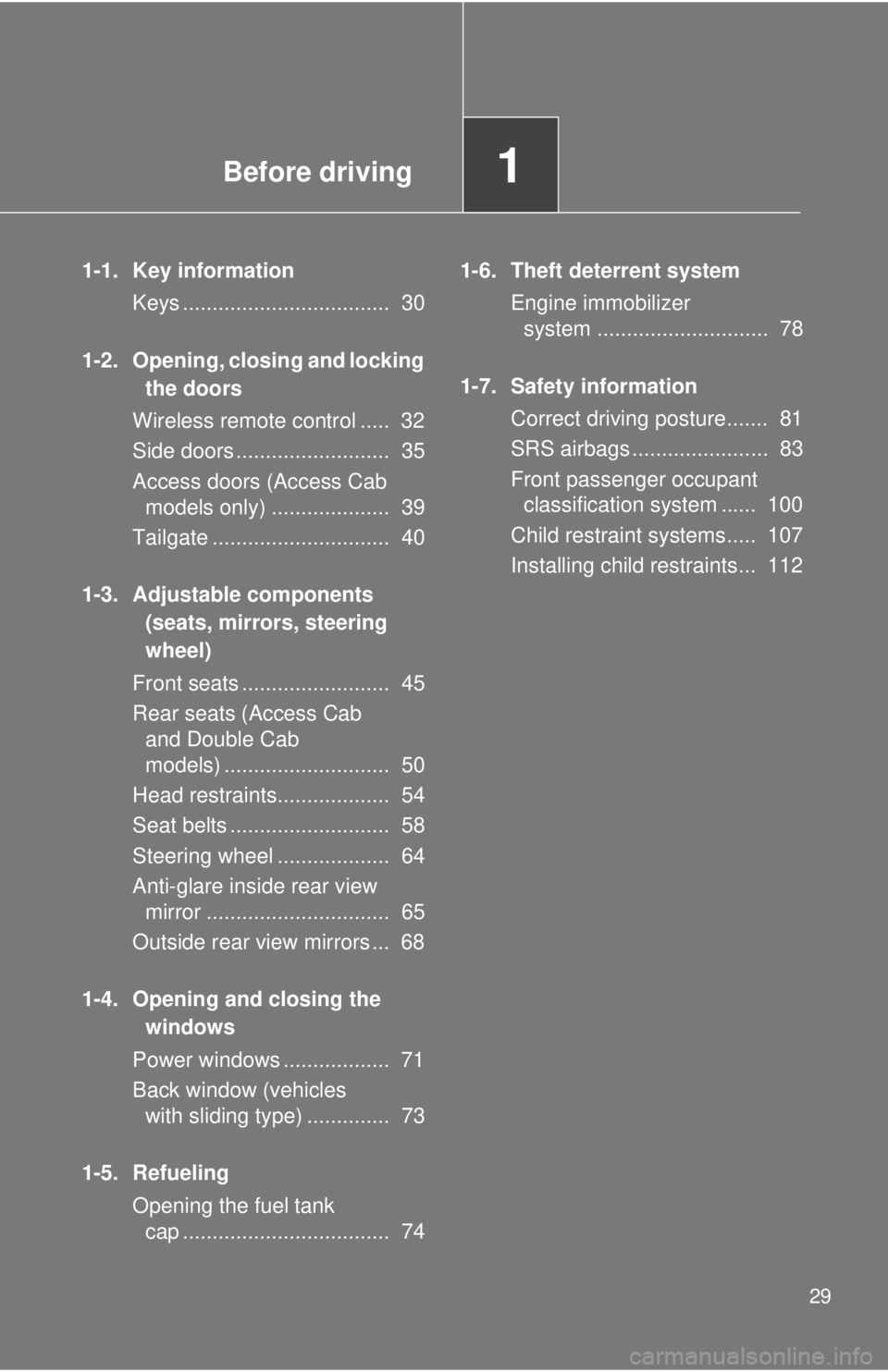
1-1. Key information
Keys ................................... 30
1-2. Opening, closing and locking
the doors
Wireless remote control ..... 32
Side doors .......................... 35
Access doors (Access Cab
models only) .................... 39
Tailgate .............................. 40
1-3. Adjustable components
(seats, mirrors, steering
wheel)
Front seats ......................... 45
Rear seats (Access Cab
and Double Cab
models) ............................ 50
Head restraints................... 54
Seat belts ........................... 58
Steering wheel ................... 64
Anti-glare inside rear view
mirror ............................... 65
Outside rear view mirrors ... 68
1-4. Opening and closing the
windows
Power windows .................. 71
Back window (vehicles
with sliding type) .............. 73
1-5. Refueling
Opening the fuel tank
cap ................................... 741-6. Theft deterrent system
Engine immobilizer
system ............................. 78
1-7. Safety information
Correct driving posture....... 81
SRS airbags ....................... 83
Front passenger occupant
classification system ...... 100
Child restraint systems..... 107
Installing child restraints... 112
Page 38 of 532
38 1-2. Opening, closing and locking the doors
CAUTION
■To prevent an accident
Observe the following precautions while driving the vehicle.
Failing to do so may result in a door opening and an occupant falling out,
resulting in death or serious injury.
●Always use a seat belt.
●Always lock all doors.
●Ensure that all doors are properly closed.
●Do not pull the inside handle of the doors while driving.
The doors may be opened and the passengers are thrown out of the vehi-
cle and it may result in serious injury or death.
Be especially careful for the front doors, as the doors may be opened even
if the inside lock buttons are in locked position.
●Set the rear door child protector locks when children are seated in the rear
seat.
Page 49 of 532
49 1-3. Adjustable components (seats, mirrors, steering wheel)
1
Before driving
CAUTION
■Seat adjustment
●Be careful that the seat does not hit passengers or luggage.
●Do not recline the seat more than necessary when the vehicle is in motion
to reduce the risk of sliding under the lap belt.
If the seat is too reclined, the lap belt may slide past the hips and apply
restraint forces directly to the abdomen or your neck may contact the
shoulder belt, increasing the risk of death or serious injury in the event of
an accident.
●After adjusting the seat, make sure that the seat is locked in position.
■After returning the seatback to the upright position
Observe the following precautions. Failure to do so may result in death or
serious injury.
●Make sure the seatback is securely locked.
●Check that the seat belts are not twisted or caught in the seatback.
●Arrange the seat belts in the proper positions for ready use.
■Caution while driving
●Vehicles with seatback table: Do not sit on or place anything on the folded
seatback.
●Access Cab models only: Do not rest your foot on the press pedal behind
the passenger seat.
Page 50 of 532
50
1-3. Adjustable components (seats, mirrors, steering wheel)
Rear seats (Access Cab and Double Cab models)
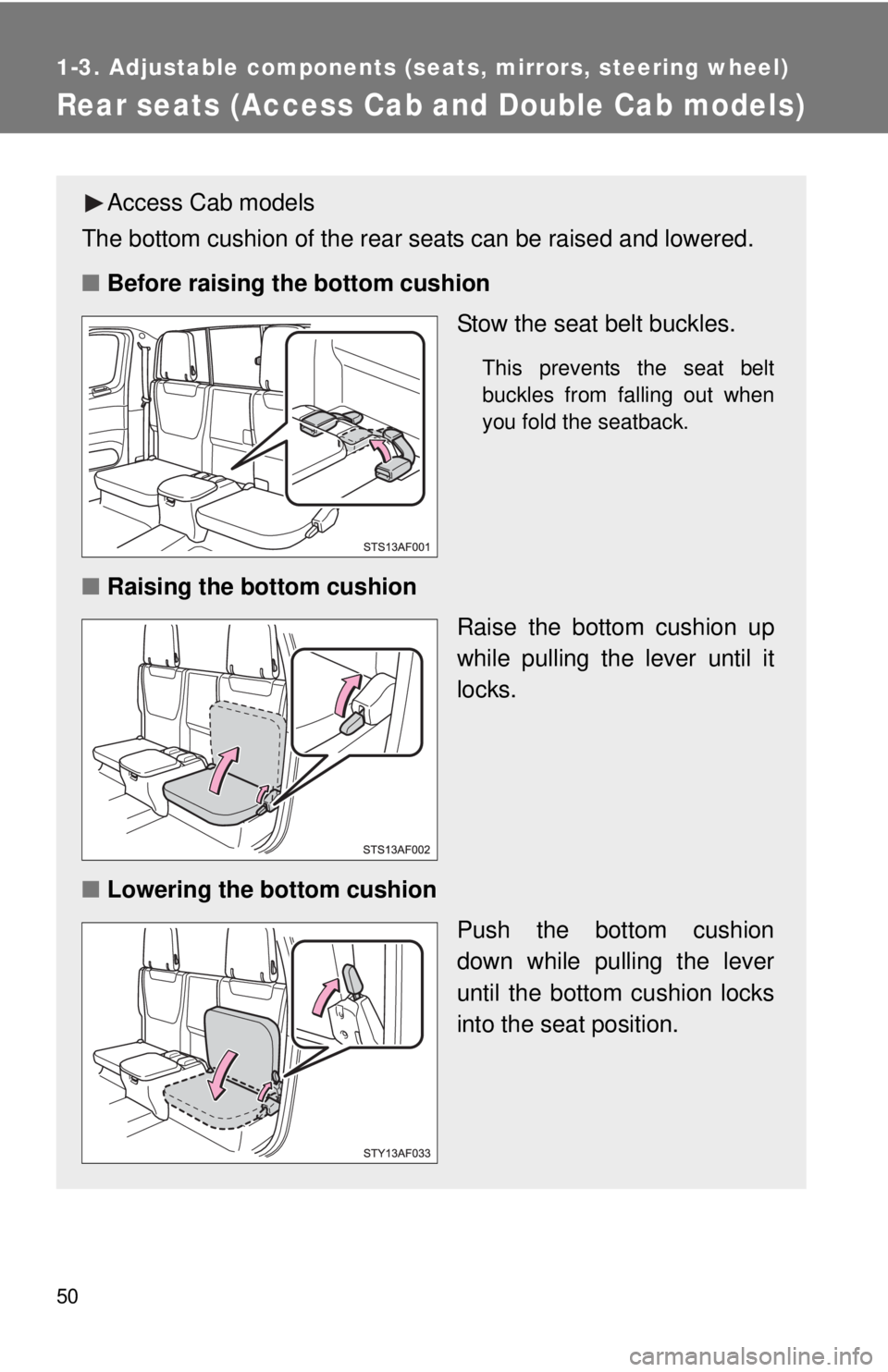
Access Cab models
The bottom cushion of the rear seats can be raised and lowered.
■Before raising the bottom cushion
Stow the seat belt buckles.
This prevents the seat belt
buckles from falling out when
you fold the seatback.
■Raising the bottom cushion
Raise the bottom cushion up
while pulling the lever until it
locks.
■Lowering the bottom cushion
Push the bottom cushion
down while pulling the lever
until the bottom cushion locks
into the seat position.
Page 51 of 532
51 1-3. Adjustable components (seats, mirrors, steering wheel)
1
Before driving
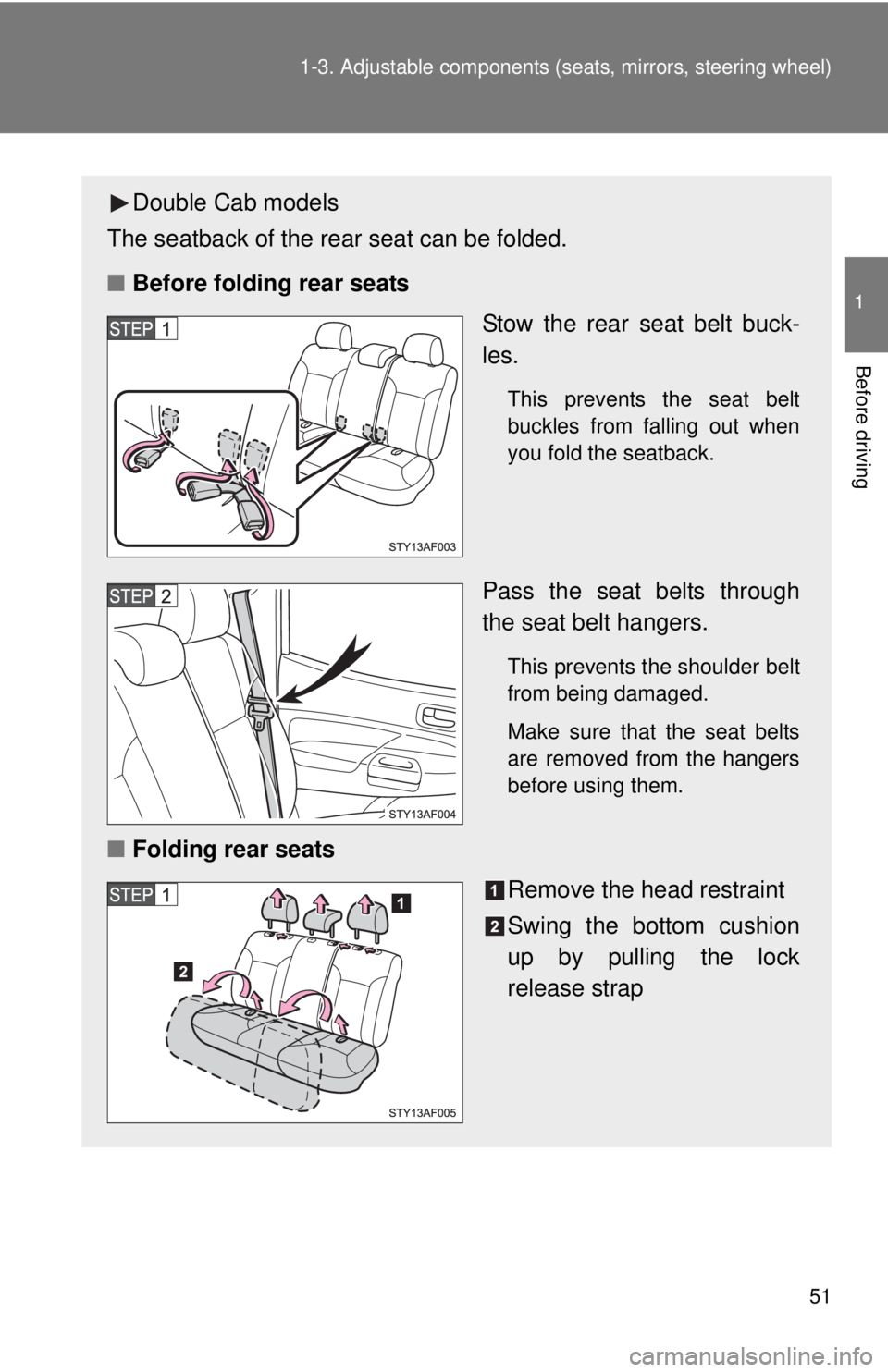
Double Cab models
The seatback of the rear seat can be folded.
■Before folding rear seats
Stow the rear seat belt buck-
les.
This prevents the seat belt
buckles from falling out when
you fold the seatback.
Pass the seat belts through
the seat belt hangers.
This prevents the shoulder belt
from being damaged.
Make sure that the seat belts
are removed from the hangers
before using them.
■Folding rear seats
Remove the head restraint
Swing the bottom cushion
up by pulling the lock
release strap