grease TOYOTA TACOMA 2010 Owners Manual (in English)
[x] Cancel search | Manufacturer: TOYOTA, Model Year: 2010, Model line: TACOMA, Model: TOYOTA TACOMA 2010Pages: 532, PDF Size: 15.03 MB
Page 201 of 532
201 2-5. Driving information
2
When driving
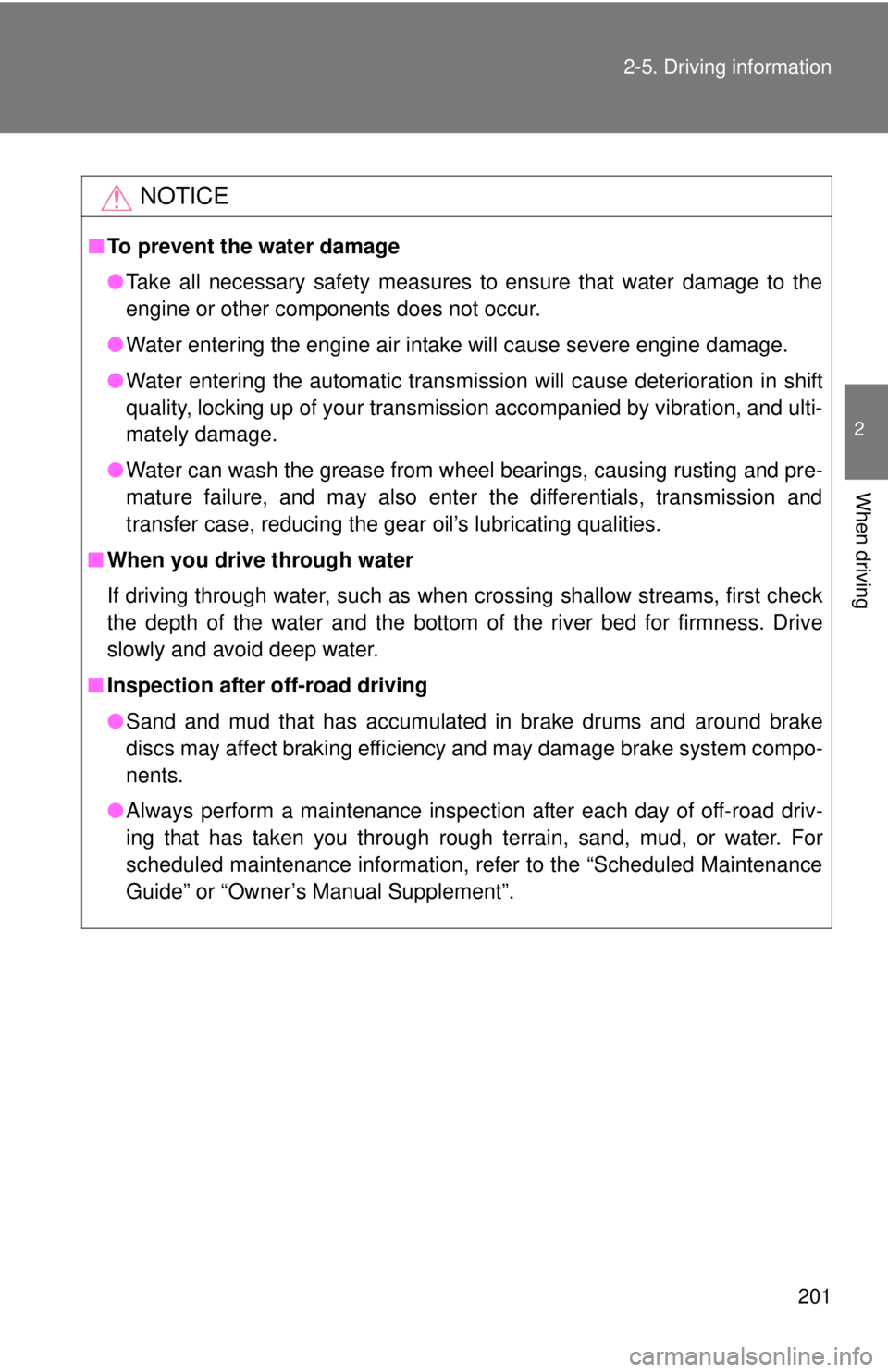
NOTICE
■To prevent the water damage
●Take all necessary safety measures to ensure that water damage to the
engine or other components does not occur.
●Water entering the engine air intake will cause severe engine damage.
●Water entering the automatic transmission will cause deterioration in shift
quality, locking up of your transmission accompanied by vibration, and ulti-
mately damage.
●Water can wash the grease from wheel bearings, causing rusting and pre-
mature failure, and may also enter the differentials, transmission and
transfer case, reducing the gear oil’s lubricating qualities.
■When you drive through water
If driving through water, such as when crossing shallow streams, first check
the depth of the water and the bottom of the river bed for firmness. Drive
slowly and avoid deep water.
■Inspection after off-road driving
●Sand and mud that has accumulated in brake drums and around brake
discs may affect braking efficiency and may damage brake system compo-
nents.
●Always perform a maintenance inspection after each day of off-road driv-
ing that has taken you through rough terrain, sand, mud, or water. For
scheduled maintenance information, refer to the “Scheduled Maintenance
Guide” or “Owner’s Manual Supplement”.
Page 221 of 532
221 2-5. Driving information
2
When driving
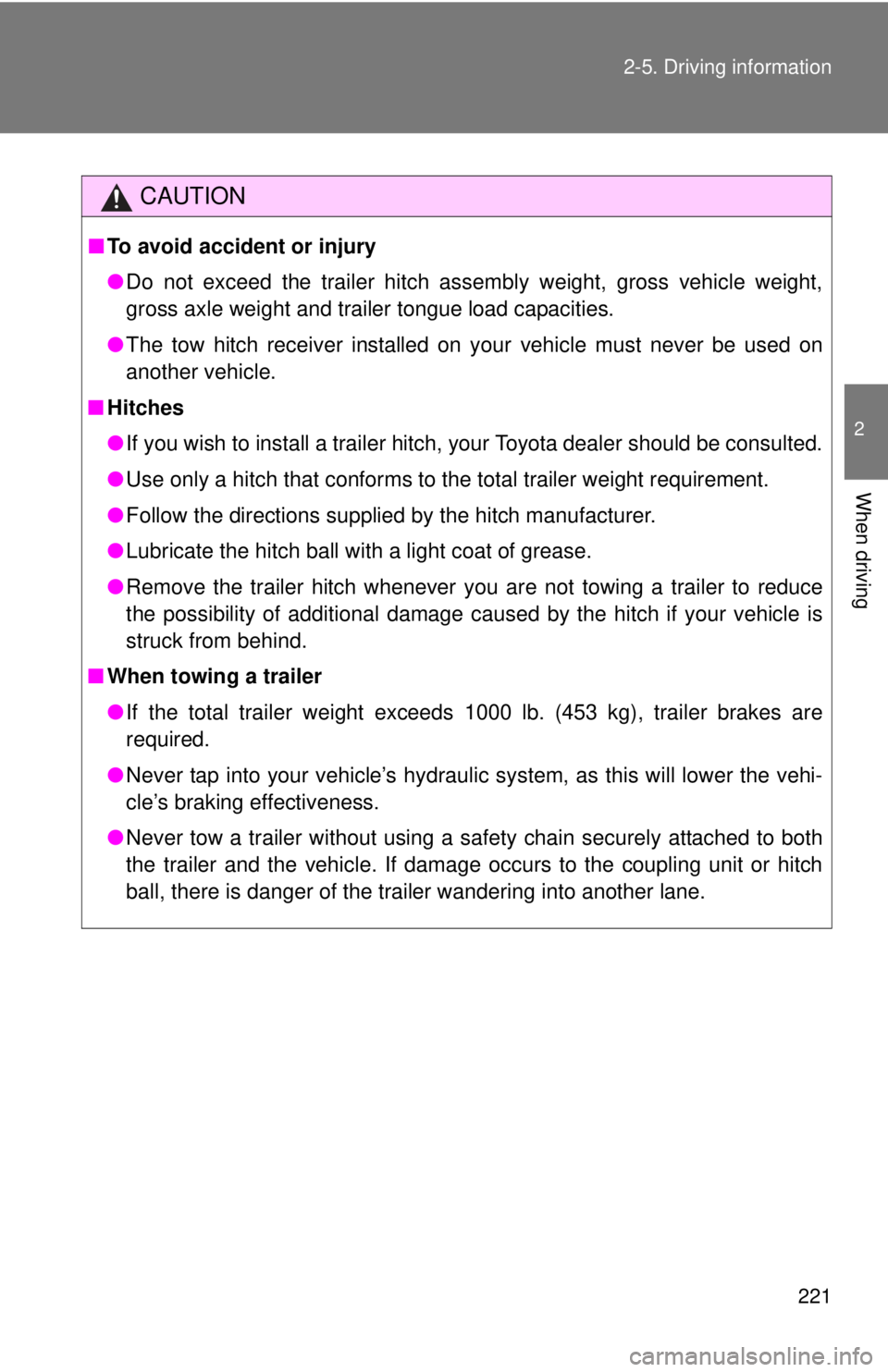
CAUTION
■To avoid accident or injury
●Do not exceed the trailer hitch assembly weight, gross vehicle weight,
gross axle weight and trailer tongue load capacities.
●The tow hitch receiver installed on your vehicle must never be used on
another vehicle.
■Hitches
●If you wish to install a trailer hitch, your Toyota dealer should be consulted.
●Use only a hitch that conforms to the total trailer weight requirement.
●Follow the directions supplied by the hitch manufacturer.
●Lubricate the hitch ball with a light coat of grease.
●Remove the trailer hitch whenever you are not towing a trailer to reduce
the possibility of additional damage caused by the hitch if your vehicle is
struck from behind.
■When towing a trailer
●If the total trailer weight exceeds 1000 lb. (453 kg), trailer brakes are
required.
●Never tap into your vehicle’s hydraulic system, as this will lower the vehi-
cle’s braking effectiveness.
●Never tow a trailer without using a safety chain securely attached to both
the trailer and the vehicle. If damage occurs to the coupling unit or hitch
ball, there is danger of the trailer wandering into another lane.
Page 356 of 532
356
4-3. Do-it-yourself maintenance
Do-it-yourself ser vice precautions
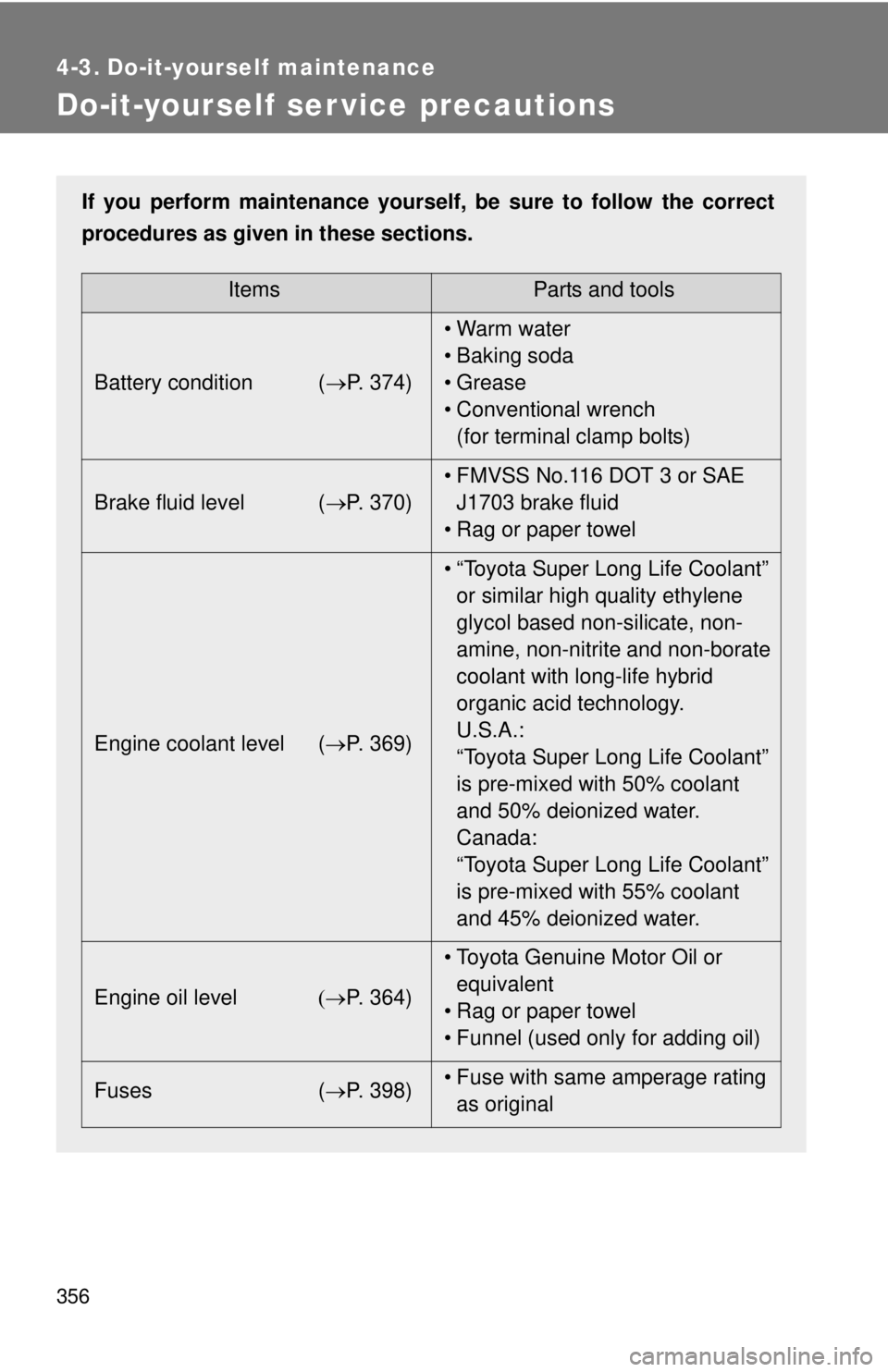
If you perform maintenance yourself, be sure to follow the correct
procedures as given in these sections.
ItemsParts and tools
Battery condition (P. 374)•Warm water
• Baking soda
• Grease
• Conventional wrench
(for terminal clamp bolts)
Brake fluid level (P. 370)• FMVSS No.116 DOT 3 or SAE
J1703 brake fluid
• Rag or paper towel
Engine coolant level (P. 369)• “Toyota Super Long Life Coolant”
or similar high quality ethylene
glycol based non-silicate, non-
amine, non-nitrite and non-borate
coolant with long-life hybrid
organic acid technology.
U.S.A.:
“Toyota Super Long Life Coolant”
is pre-mixed with 50% coolant
and 50% deionized water.
Canada:
“Toyota Super Long Life Coolant”
is pre-mixed with 55% coolant
and 45% deionized water.
Engine oil levelP. 364)• Toyota Genuine Motor Oil or
equivalent
• Rag or paper towel
• Funnel (used only for adding oil)
Fuses (P. 398)• Fuse with same amperage rating
as original
Page 453 of 532
5
When trouble arises
453 5-2. Steps to take in an emergency
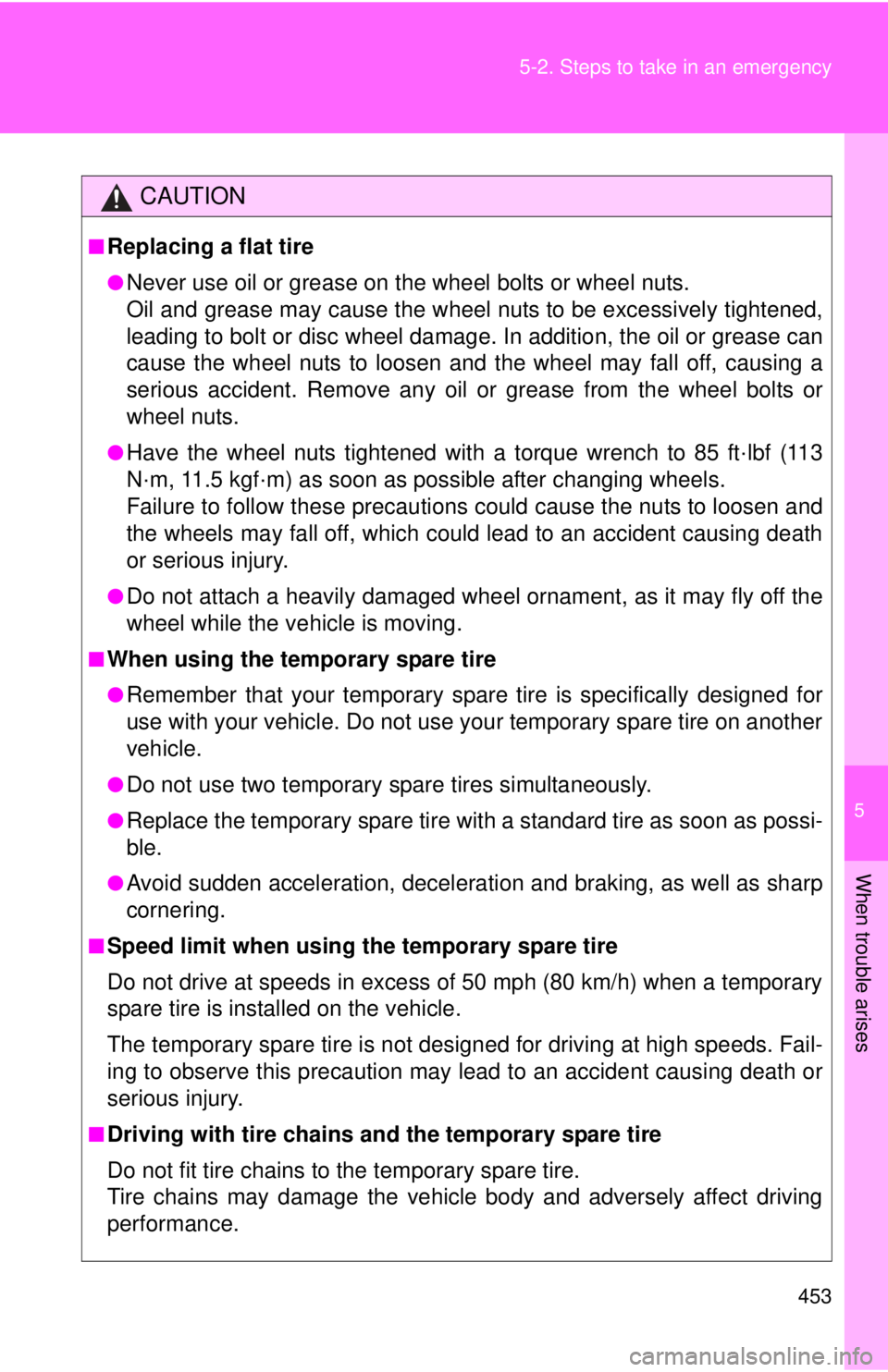
CAUTION
■Replacing a flat tire
●Never use oil or grease on the wheel bolts or wheel nuts.
Oil and grease may cause the wheel nuts to be excessively tightened,
leading to bolt or disc wheel damage. In addition, the oil or grease can
cause the wheel nuts to loosen and the wheel may fall off, causing a
serious accident. Remove any oil or grease from the wheel bolts or
wheel nuts.
●Have the wheel nuts tightened with a torque wrench to 85 ft·lbf (113
N·m, 11.5 kgf·m) as soon as possible after changing wheels.
Failure to follow these precautions could cause the nuts to loosen and
the wheels may fall off, which could lead to an accident causing death
or serious injury.
●Do not attach a heavily damaged wheel ornament, as it may fly off the
wheel while the vehicle is moving.
■When using the temporary spare tire
●Remember that your temporary spare tire is specifically designed for
use with your vehicle. Do not use your temporary spare tire on another
vehicle.
●Do not use two temporary spare tires simultaneously.
●Replace the temporary spare tire with a standard tire as soon as possi-
ble.
●Avoid sudden acceleration, deceleration and braking, as well as sharp
cornering.
■Speed limit when using the temporary spare tire
Do not drive at speeds in excess of 50 mph (80 km/h) when a temporary
spare tire is installed on the vehicle.
The temporary spare tire is not designed for driving at high speeds. Fail-
ing to observe this precaution may lead to an accident causing death or
serious injury.
■Driving with tire chains and the temporary spare tire
Do not fit tire chains to the temporary spare tire.
Tire chains may damage the vehicle body and adversely affect driving
performance.
Page 483 of 532
483 6-1. Specifications
6
Vehicle specifications
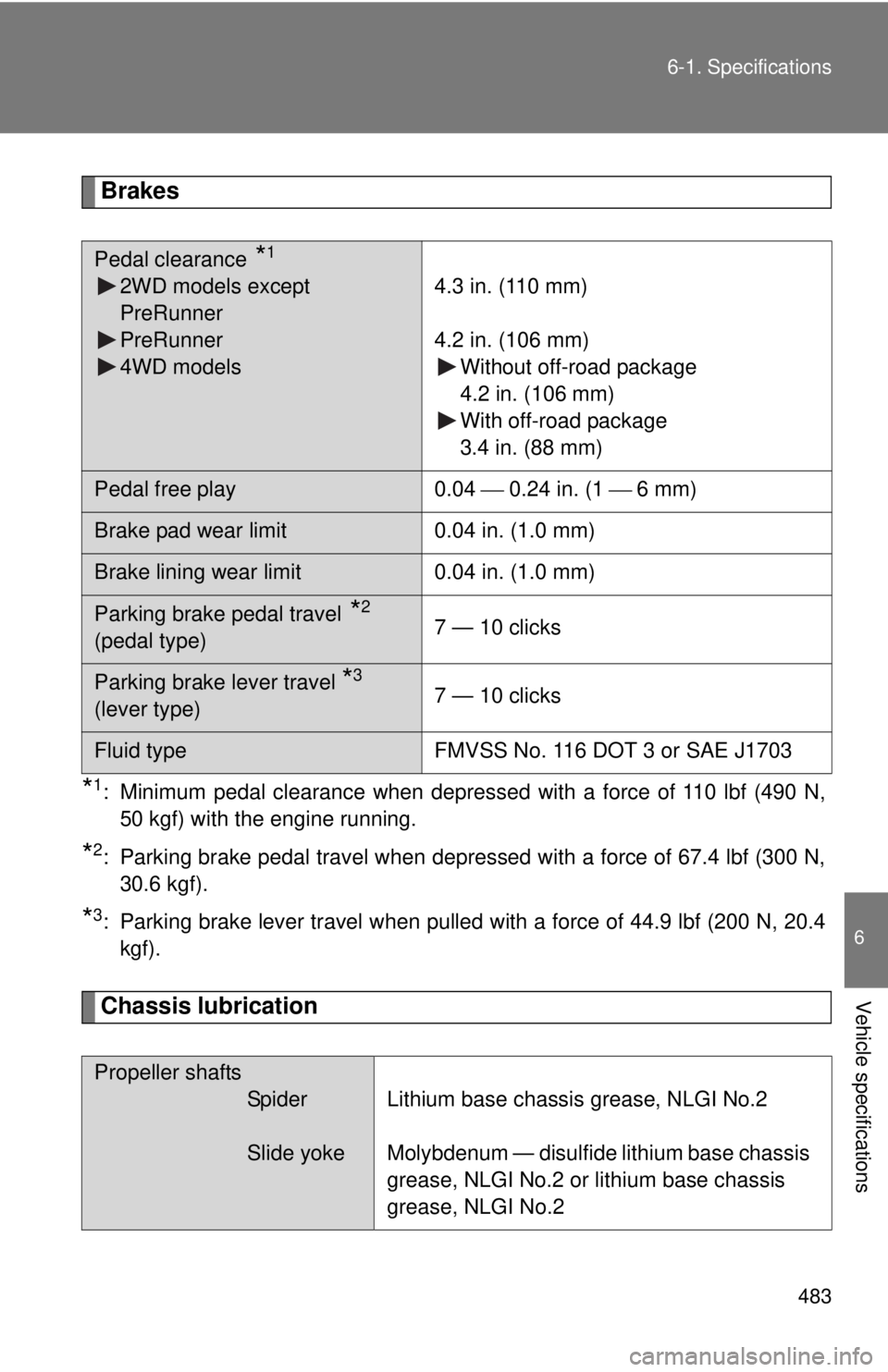
Brakes
*1: Minimum pedal clearance when depressed with a force of 110 lbf (490 N,
50 kgf) with the engine running.
*2: Parking brake pedal travel when depressed with a force of 67.4 lbf (300 N,
30.6 kgf).
*3: Parking brake lever travel when pulled with a force of 44.9 lbf (200 N, 20.4
kgf).
Chassis lubrication
Pedal clearance *1
2WD models except
PreRunner
PreRunner
4WD models4.3 in. (110 mm)
4.2 in. (106 mm)
Without off-road package
4.2 in. (106 mm)
With off-road package
3.4 in. (88 mm)
Pedal free play 0.04 0.24 in. (1 6 mm)
Brake pad wear limit 0.04 in. (1.0 mm)
Brake lining wear limit 0.04 in. (1.0 mm)
Parking brake pedal travel *2
(pedal type)7 — 10 clicks
Parking brake lever travel *3
(lever type)7 — 10 clicks
Fluid type FMVSS No. 116 DOT 3 or SAE J1703
Propeller shafts
Spider
Slide yokeLithium base chassis grease, NLGI No.2
Molybdenum — disulfide lithium base chassis
grease, NLGI No.2 or lithium base chassis
grease, NLGI No.2