warning TOYOTA TACOMA 2011 (in English) Owner's Guide
[x] Cancel search | Manufacturer: TOYOTA, Model Year: 2011, Model line: TACOMA, Model: TOYOTA TACOMA 2011Pages: 548, PDF Size: 9.84 MB
Page 394 of 548
394 4-3. Do-it-yourself maintenance
For vehicles sold in U.S.A.
This device complies with part 15 of the FCC Rules. Operation is subject
to the following two conditions: (1) This device may not cause harmful
interference, and (2) this device must accept any interference received,
including interference that may cause undesired operation.
FCC WARNING:
Changes or modifications not expre ssly approved by the party responsi-
ble for compliance could void the user's authority to operate the equip-
ment.
For vehicles sold in Canada
NOTE:
Operation is subject to the following two conditions: (1) this device may
not cause interference, and (2) this de vice must accept any interference,
including interference that may caus e undesired operation of the device.
CAUTION
■When inspecting or replacing tires
Observe the following precautions to prevent accidents. Failure to do so
may cause damage to parts of the drive train, as well as dangerous han-
dling characteristics, which may lead to an accident resulting in death or
serious injury.
●Do not mix tires of different makes, models or tread patterns.
Also, do not mix tires of remarkably different treadwear.
●Do not use tire sizes other than those recommended by Toyota.
●Do not mix differently constructed ti res (radial, bias-belted or bias-ply
tires).
●Do not mix summer, all season and winter tires.
●Do not use tires that have been used on another vehicle.
●Do not use tires if you do not know how they were used previously.
■When initializing the tire pressure warning system
Do not push the tire pressure warnin g reset switch without first adjusting
the tire inflation pressure to the spec ified level. Otherwise, the tire pres-
sure warning light may not come on ev en if the tire inflation pressure is
low, or it may come on when the tire inflation pressure is actually normal.
Page 395 of 548
395
4-3. Do-it-yourself maintenance
4
Maintenance and care
NOTICE
■Repairing or replacing tires, wheels, tire pressure warning valves,
transmitters and tire valve caps
●When removing or fitting the wheels, tires or the tire pressure warning
valve and transmitter, contact your Toyota dealer as the tire pressure
warning valve and transmitter may be damaged if not handled cor-
rectly.
●When replacing tire valve caps, do not use tire valve caps other than
those specified. The cap may become stuck.
■To avoid damaging the tire pressure warning valves and transmit-
ters
Do not use liquid sealants on flat tires.
■Driving on rough roads
Take particular care when driving
on roads with loose surfaces or pot-
holes.
These conditions may cause losses in tire inflation pressure, reducing
the cushioning ability of the tires. In addition driving on rough roads may
cause damage to the tires themselves, as well as the vehicle’s wheels
and body.
■If tire inflation pressures become low while driving
Do not continue driving, or your tires and/or wheels may be ruined.
Page 402 of 548
402 4-3. Do-it-yourself maintenance
■When replacing wheels
The wheels of your Toyota are equipped with tire pressure warning
valves and transmitters (except for spare tire) that allow the tire pressure
warning system to provide advanced warn ing in the event of a loss in tire
inflation pressure. Whenever wheels are replaced, the tire pressure
warning valves and transmitte rs must be installed. (P. 389)
CAUTION
■When replacing wheels
●Do not use wheels that are a different size from those recommended in
the Owner’s Manual, as this may re sult in loss of handling control.
●Never use an inner tube in a leaking wheel which is designed for a
tubeless tire. Doing so may result in an accident, causing death or seri-
ous injury.
NOTICE
■Replacing tire pressure warning valves and transmitters
●Because tire repair or replacement may affect the tire pressure warn-
ing valves and transmitters, make su re to have tires serviced by your
Toyota dealer or other qualified service shop. In addition, make sure to
purchase your tire pressure warning valves and transmitters at your
Toyota dealer.
●Ensure that only genuine Toyota wheels are used on your vehicle.
Tire pressure warning valves and transmitters may not work properly
with non-genuine wheels.
Page 416 of 548
416 4-3. Do-it-yourself maintenance
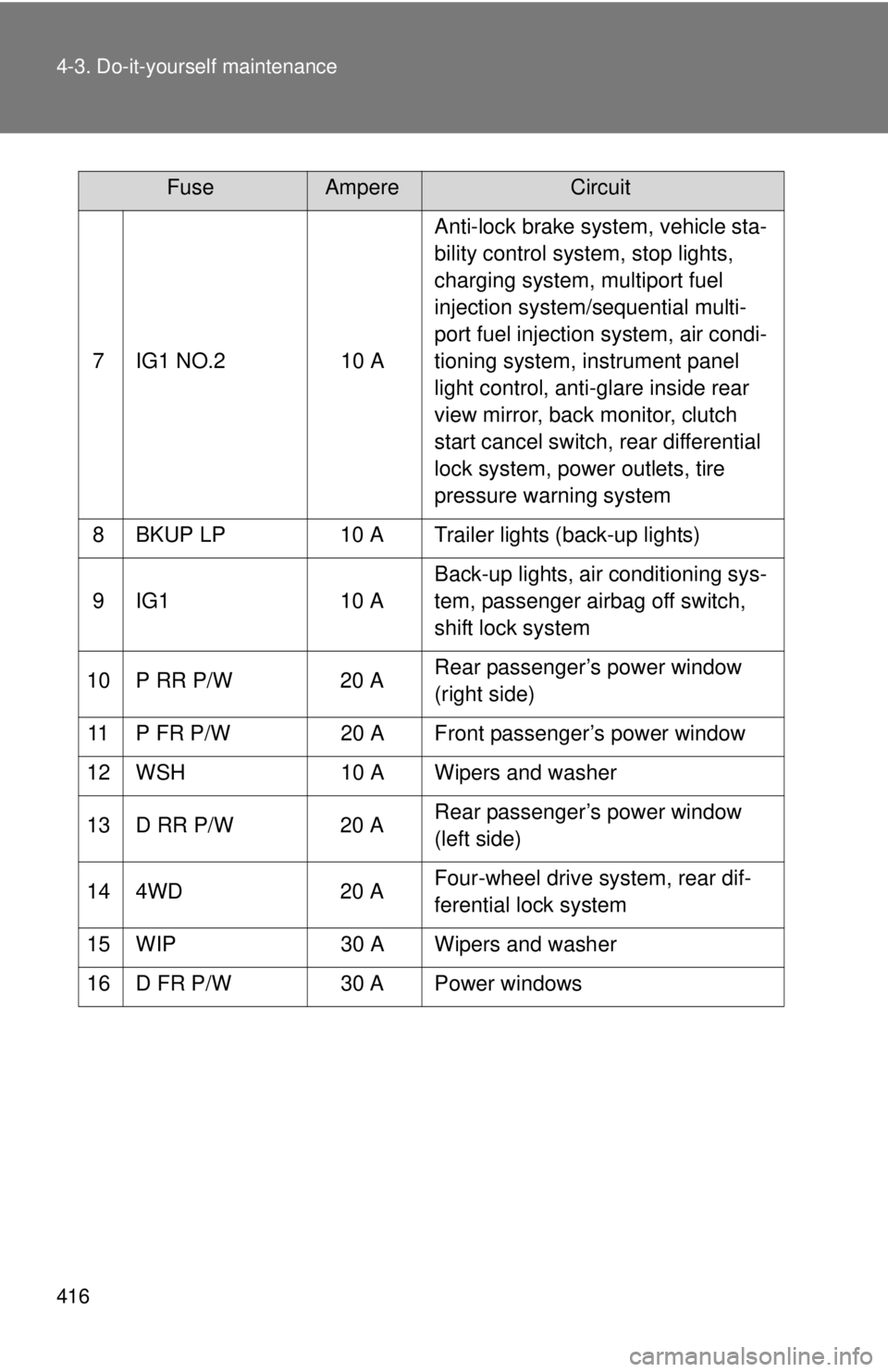
7 IG1 NO.210 AAnti-lock brake system, vehicle sta-
bility control system, stop lights,
charging system, multiport fuel
injection system/sequential multi-
port fuel injection system, air condi-
tioning system, instrument panel
light control, anti-glare inside rear
view mirror, back monitor, clutch
start cancel switch, rear differential
lock system, power outlets, tire
pressure warning system
8 BKUP LP 10 A Trailer lights (back-up lights)
9 IG1 10 ABack-up lights, air conditioning sys-
tem, passenger airbag off switch,
shift lock system
10 P RR P/W 20 ARear passenger’s power window
(right side)
11 P FR P/W 20 A Front passenger’s power window
12 WSH 10 A Wipers and washer
13 D RR P/W 20 ARear passenger’s power window
(left side)
14 4WD 20 AFour-wheel drive system, rear dif-
ferential lock system
15 WIP 30 A Wipers and washer
16 D FR P/W 30 A Power windows
FuseAmpereCircuit
Page 429 of 548
When trouble arises5
429
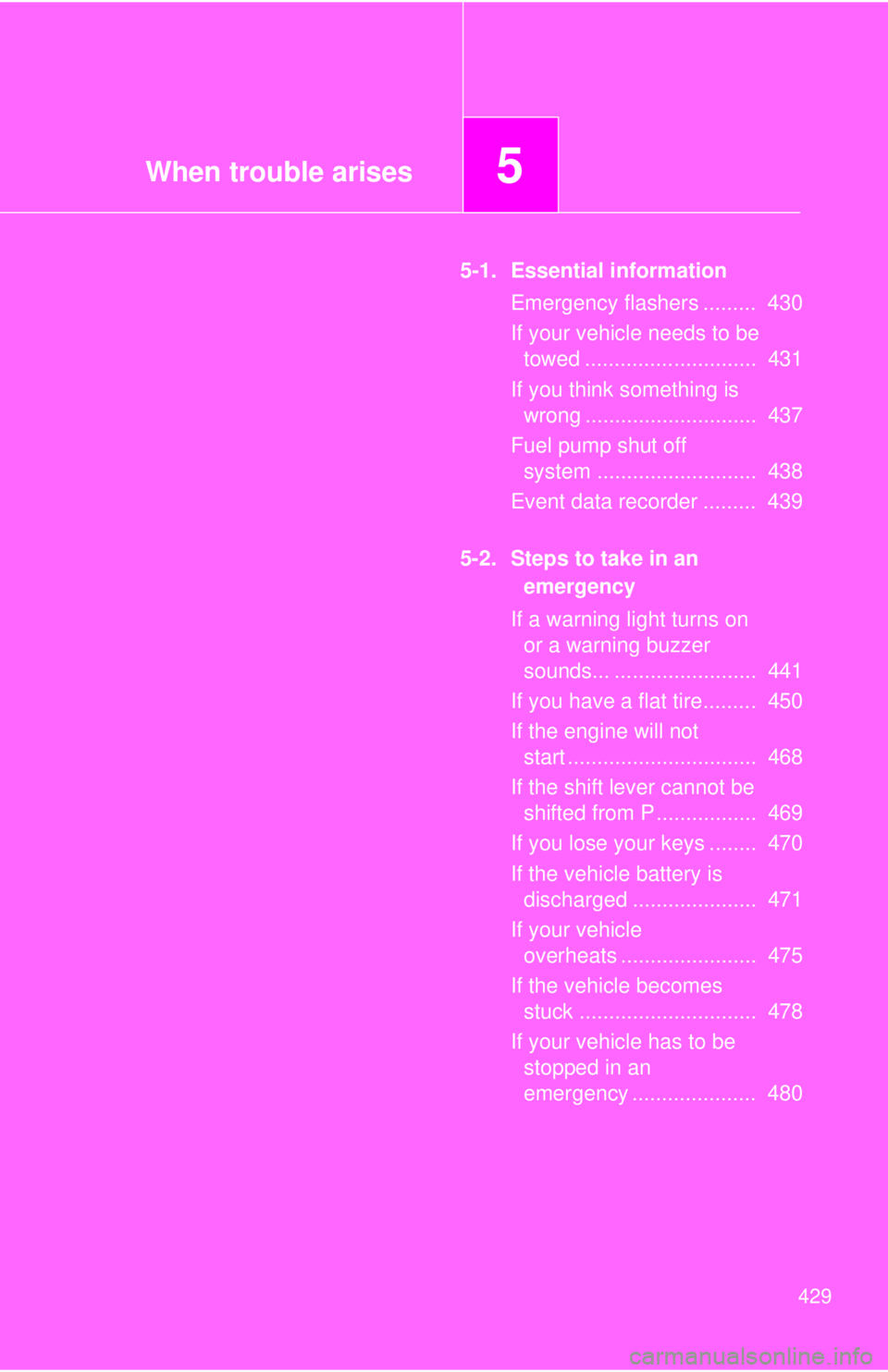
5-1. Essential informationEmergency flashers ......... 430
If your vehicle needs to be towed ............................. 431
If you think something is wrong ............................. 437
Fuel pump shut off system ........................... 438
Event data recorder ......... 439
5-2. Steps to take in an emergency
If a warning light turns on or a warning buzzer
sounds... ........................ 441
If you have a flat tire......... 450
If the engine will not start ................................ 468
If the shift lever cannot be shifted from P................. 469
If you lose your keys ........ 470
If the vehicle battery is discharged ..................... 471
If your vehicle overheats ....................... 475
If the vehicle becomes stuck .............................. 478
If your vehicle has to be stopped in an
emergency ..................... 480
Page 441 of 548
5
When trouble arises
441
5-2. Steps to take in an emergency
If a war ning light turns on or a war ning buzzer sounds...
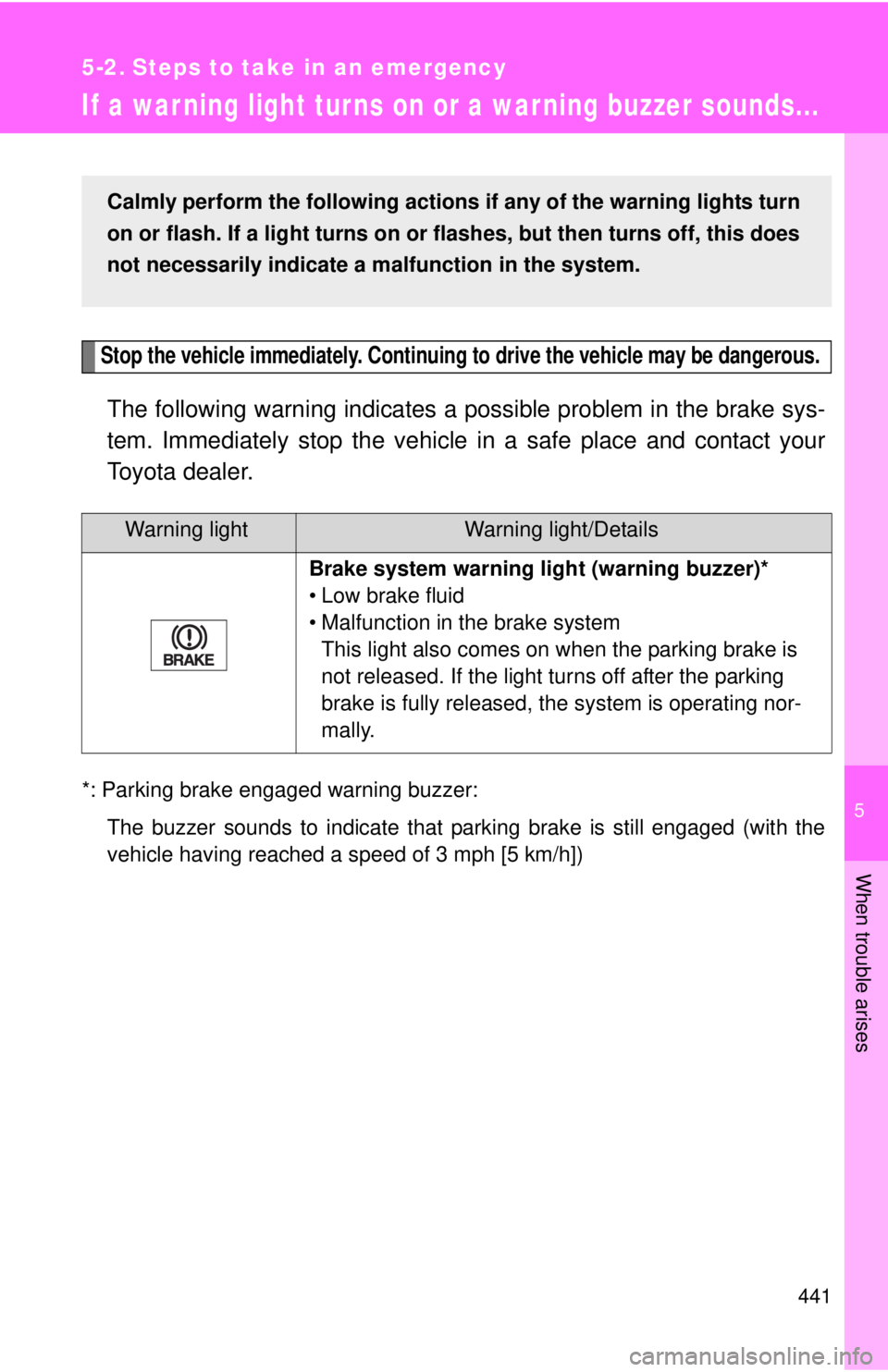
Stop the vehicle immediately. Continuing to drive the vehicle may be dangerous.
The following warning indicates a possible problem in the brake sys-
tem. Immediately stop the vehicle in a safe place and contact your
Toyota dealer.
*: Parking brake engaged warning buzzer:
The buzzer sounds to indicate that parking brake is still engaged (with the
vehicle having reached a speed of 3 mph [5 km/h])
Warning lightWarning light/Details
Brake system warning li ght (warning buzzer)*
• Low brake fluid
• Malfunction in the brake system This light also comes on when the parking brake is
not released. If the light turns off after the parking
brake is fully released, the system is operating nor-
mally.
Calmly perform the following actions if any of the warning lights turn
on or flash. If a light turns on or flashes, but then turns off, this does
not necessarily indicate a malfunction in the system.
Page 442 of 548
442 5-2. Steps to take in an emergency
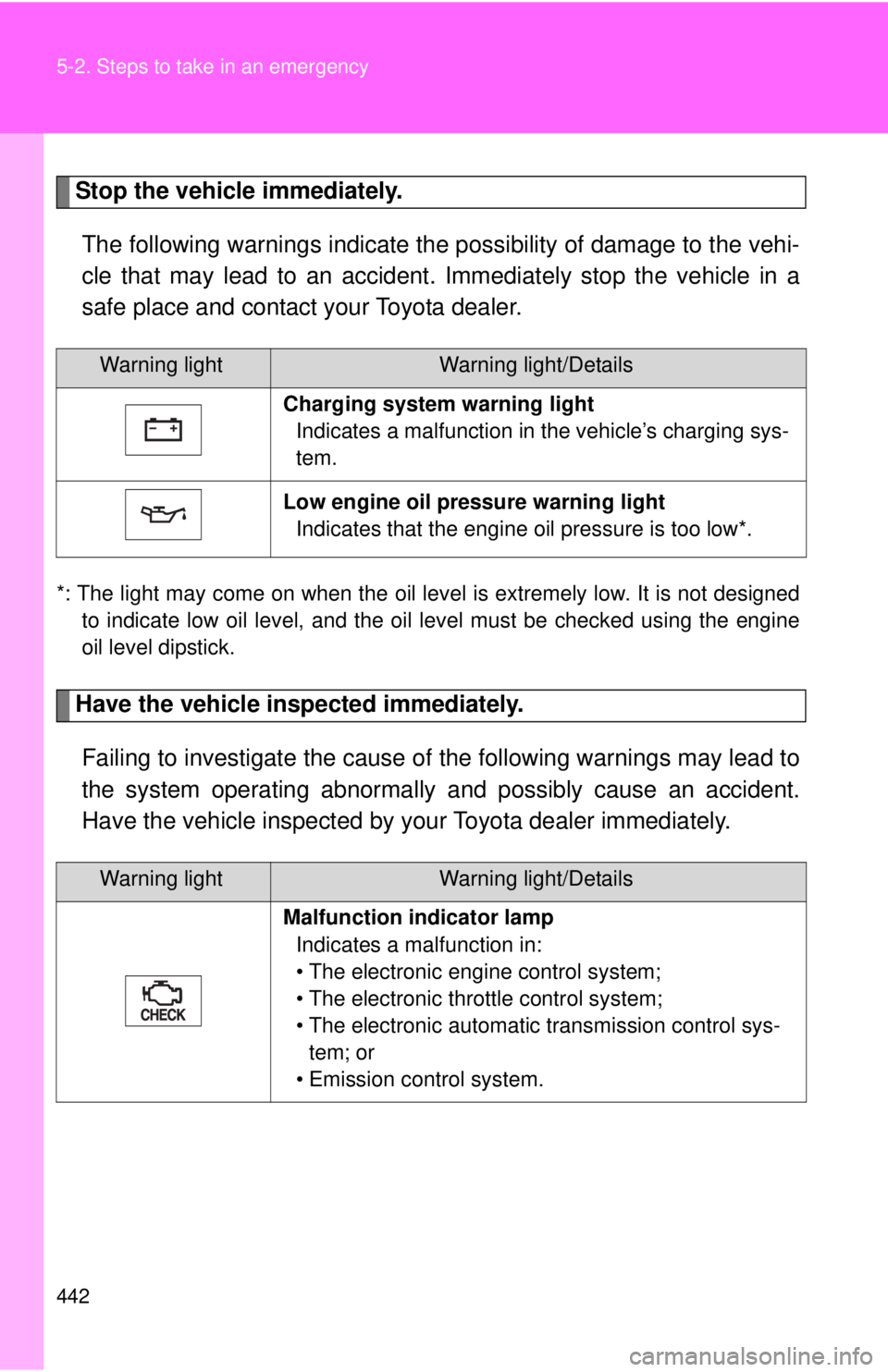
Stop the vehicle immediately.The following warnings indicate the possibility of damage to the vehi-
cle that may lead to an accident. Immediately stop the vehicle in a
safe place and contact your Toyota dealer.
*: The light may come on when the oil level is extremely low. It is not designed to indicate low oil level, and the oil level must be checked using the engine
oil level dipstick.
Have the vehicle inspected immediately.
Failing to investigate the cause of the following warnings may lead to
the system operating abnormally and possibly cause an accident.
Have the vehicle inspected by your Toyota dealer immediately.
Warning lightWarning light/Details
Charging system warning light Indicates a malfunction in the vehicle’s charging sys-
tem.
Low engine oil pressure warning light Indicates that the engine oil pressure is too low*.
Warning lightWarning light/Details
Malfunction indicator lamp Indicates a malfunction in:
• The electronic engine control system;
• The electronic throttle control system;
• The electronic automatic transmission control sys-tem; or
• Emission control system.
Page 443 of 548
5
When trouble arises
443
5-2. Steps to take in an emergency
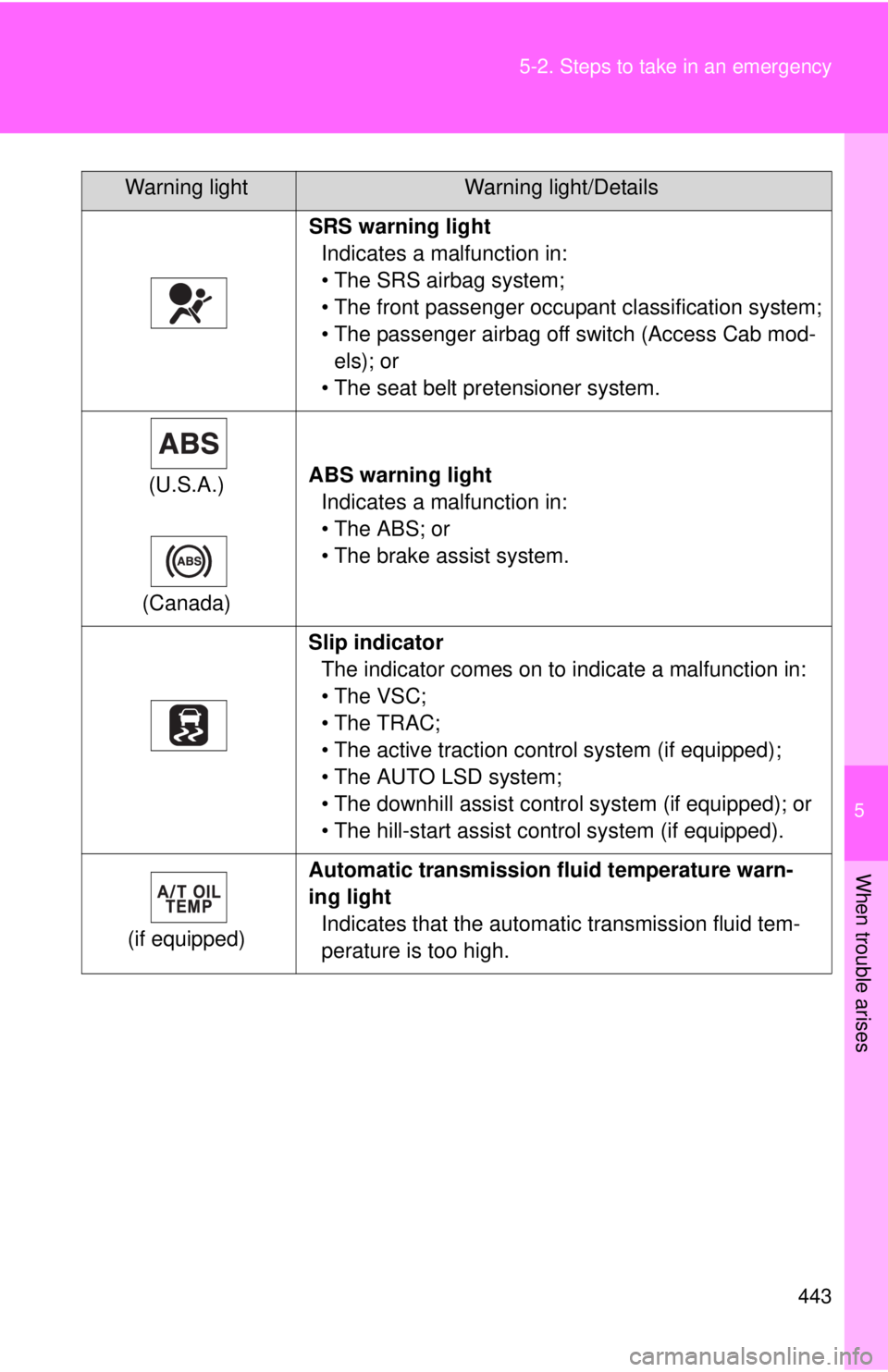
SRS warning light
Indicates a malfunction in:
• The SRS airbag system;
• The front passenger occupant classification system;
• The passenger airbag off switch (Access Cab mod-els); or
• The seat belt pretensioner system.
(U.S.A.)
(Canada) ABS warning light
Indicates a malfunction in:
• The ABS; or
• The brake assist system.
Slip indicator The indicator comes on to indicate a malfunction in:
• The VSC;
• The TRAC;
• The active traction control system (if equipped);
• The AUTO LSD system;
• The downhill assist control system (if equipped); or
• The hill-start assist control system (if equipped).
(if equipped) Automatic transmission
fluid temperature warn-
ing light Indicates that the automatic transmission fluid tem-
perature is too high.
Warning lightWarning light/Details
Page 444 of 548
444 5-2. Steps to take in an emergency
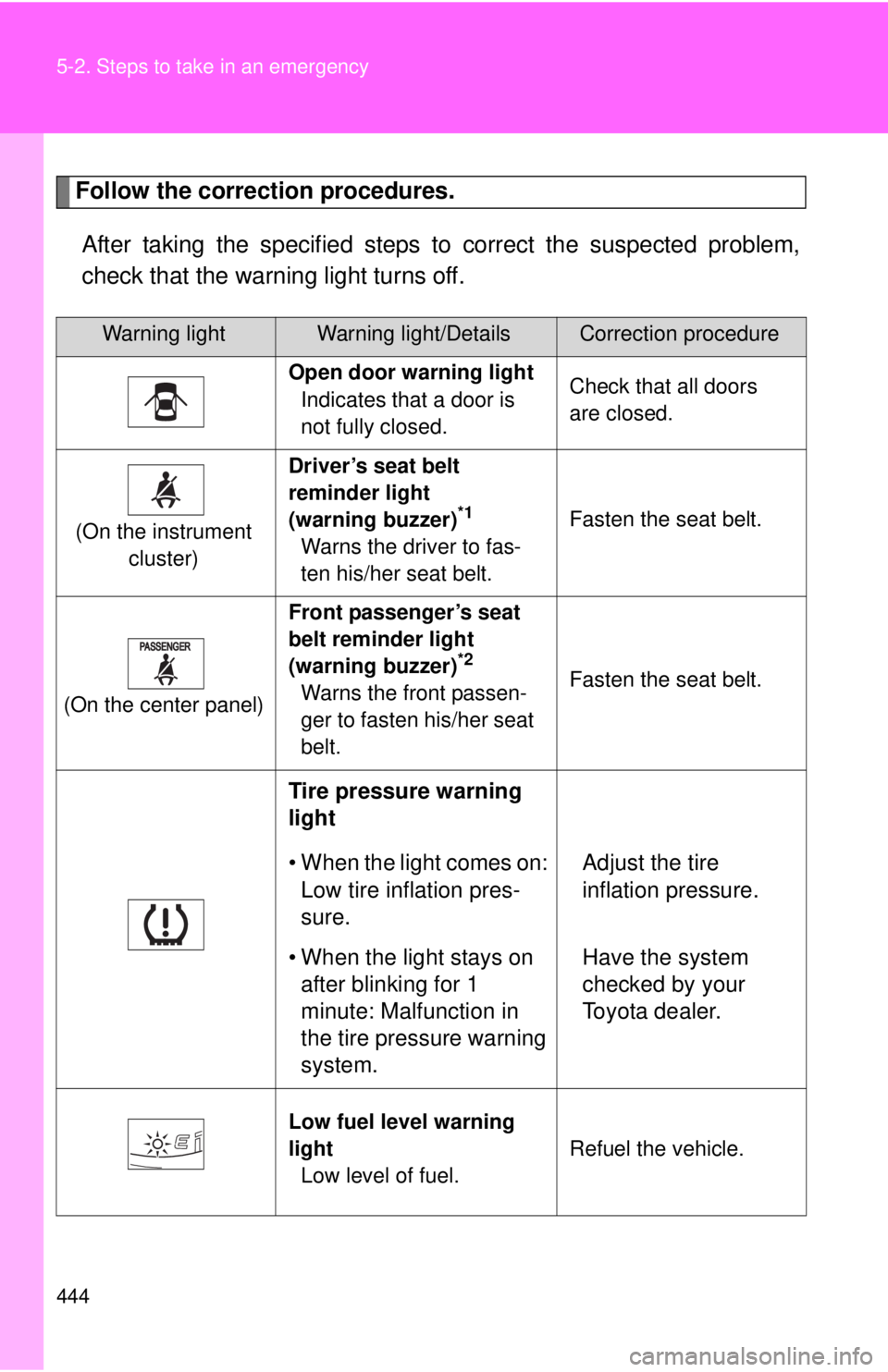
Follow the correction procedures.After taking the specified steps to correct the suspected problem,
check that the warning light turns off.
Warning lightWarning light/DetailsCorrection procedure
Open door warning light Indicates that a door is
not fully closed. Check that all doors
are closed.
(On the instrument cluster) Driver’s seat belt
reminder light
(warning buzzer)
*1
Warns the driver to fas-
ten his/her seat belt.
Fasten the seat belt.
(On the center panel) Front passenger’s seat
belt reminder light
(warning buzzer)
*2
Warns the front passen-
ger to fasten his/her seat
belt.
Fasten the seat belt.
Tire pressure warning
light
• When the light comes on:
Low tire inflation pres-
sure. Adjust the tire
inflation pressure.
• When the light stays on after blinking for 1
minute: Malfunction in
the tire pressure warning
system. Have the system
checked by your
Toyota dealer.
Low fuel level warning
light
Low level of fuel. Refuel the vehicle.
Page 445 of 548
5
When trouble arises
445
5-2. Steps to take in an emergency
*1: Driver’s seat belt reminder:
The driver’s seat belt reminder sounds to alert the driver that his or her seat
belt is not fastened. Once the engine switch is turned to the ON or START
position, the buzzer sounds for 6 seconds. If the vehicle has reached a
speed of at least 12 mph (20 km/h), the buzzer sounds intermittently for 10
seconds. Then, if the seat belt is still unfastened, the buzzer will sound in a
different tone for 20 more seconds.
*2: Front passenger’s seat belt reminder:
The front passenger’s seat belt reminder sounds to alert the front passenger
that his or her seat belt is not fastened. The buzzer sounds intermittently for
10 seconds after the vehicle has reached a speed of at least 12 mph (20 km/
h). Then, if the seat belt is still unfastened, the buzzer will sound in a different
tone for 20 more seconds.
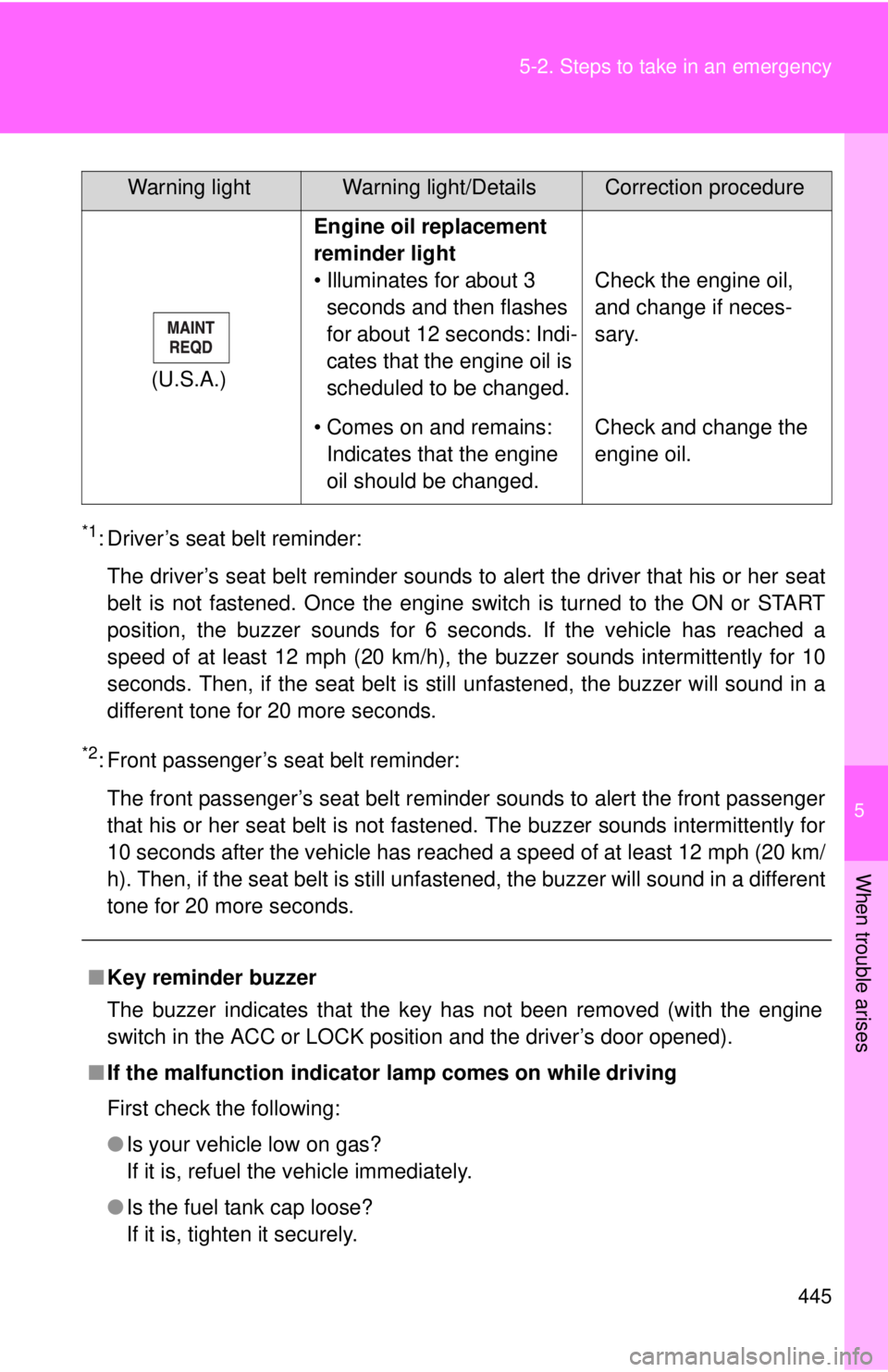
(U.S.A.) Engine oil replacement
reminder light
• Illuminates for about 3
seconds and then flashes
for about 12 seconds: Indi-
cates that the engine oil is
scheduled to be changed. Check the engine oil,
and change if neces-
sary.
• Comes on and remains: Indicates that the engine
oil should be changed. Check and change the
engine oil.
■ Key reminder buzzer
The buzzer indicates that the key has not been removed (with the engine
switch in the ACC or LOCK position and the driver’s door opened).
■ If the malfunction indicator lamp comes on while driving
First check the following:
● Is your vehicle low on gas?
If it is, refuel the vehicle immediately.
● Is the fuel tank cap loose?
If it is, tighten it securely.
Warning lightWarning light/DetailsCorrection procedure