fuse TOYOTA TACOMA 2011 Owners Manual (in English)
[x] Cancel search | Manufacturer: TOYOTA, Model Year: 2011, Model line: TACOMA, Model: TOYOTA TACOMA 2011Pages: 548, PDF Size: 9.84 MB
Page 4 of 548

TABLE OF CONTENTSIndex
4
3-4. Using the interior lightsInterior lights list ................. 308
• Interior light ....................... 309
• Personal lights ................. 309
3-5. Using the storage features List of storage features....... 310
• Glove box ........................ 311
• Console boxes ................. 311
• Cup holders ...................... 312
• Bottle holders ................... 314
• Auxiliary boxes ................. 316
• Overhead console ............ 318
3-6. Other interior features Sun visors .......................... 319
Vanity mirrors ..................... 320
Clock .................................. 321
Outside temperature display (vehicles with accessory
meter) ............................... 322
Cigarette lighter .................. 323
Power outlet (12V DC) ....... 324
Power outlet (115V AC) ..... 325
Seatback table ................... 331
Floor mat ............................ 332
Luggage compartment features ............................ 334
Garage door opener box .... 343
Compass (vehicles with accessory meter).............. 347 4-1. Maintenance and care
Cleaning and protecting the vehicle exterior ........... 354
Cleaning and protecting the vehicle interior ............ 357
4-2. Maintenance Maintenance requirements .................... 360
General maintenance ......... 362
Emission inspection and maintenance (I/M)
programs .......................... 365
4-3. Do-it-yourself maintenance Do-it-yourself service precautions ....................... 366
Hood ................................... 370
Engine compartment .......... 372
Tires.................................... 388
Tire inflation pressure ......... 396
Wheels................................ 401
Air conditioning filter ........... 403
Wireless remote control battery .............................. 406
Checking and replacing fuses ................................. 408
Light bulbs .......................... 418
4Maintenance and care
Page 281 of 548
281
3-3. Using the hand
s-free phone system (for cellular phone)
3
Interior and exterior features
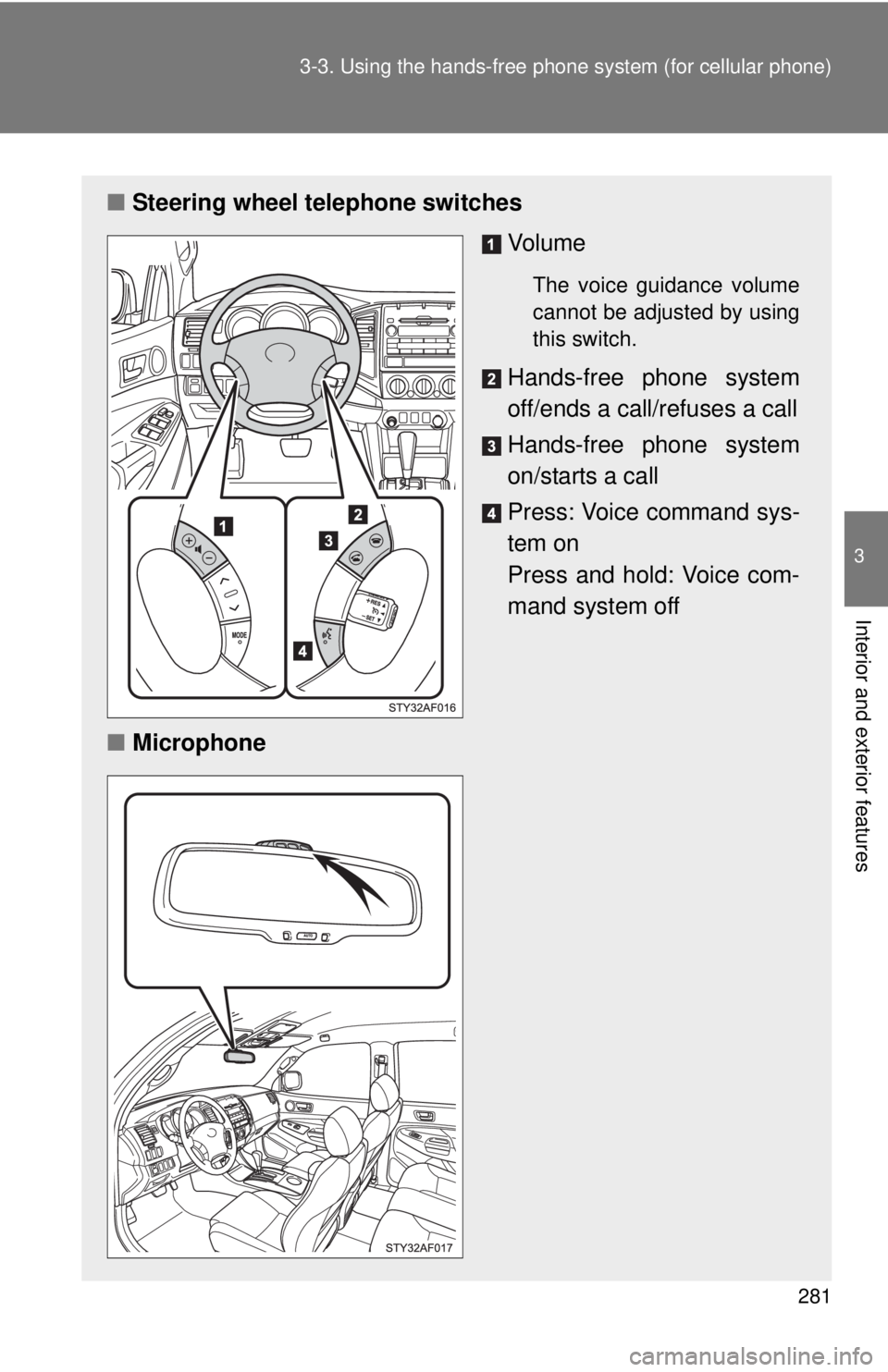
■Steering wheel telephone switches
Vo l u m e
The voice guidance volume
cannot be adjusted by using
this switch.
Hands-free phone system
off/ends a call/refuses a call
Hands-free phone system
on/starts a call
Press: Voice command sys-
tem on
Press and hold: Voice com-
mand system off
■ Microphone
Page 324 of 548
324
3-6. Other interior features
Power outlet (12V DC)
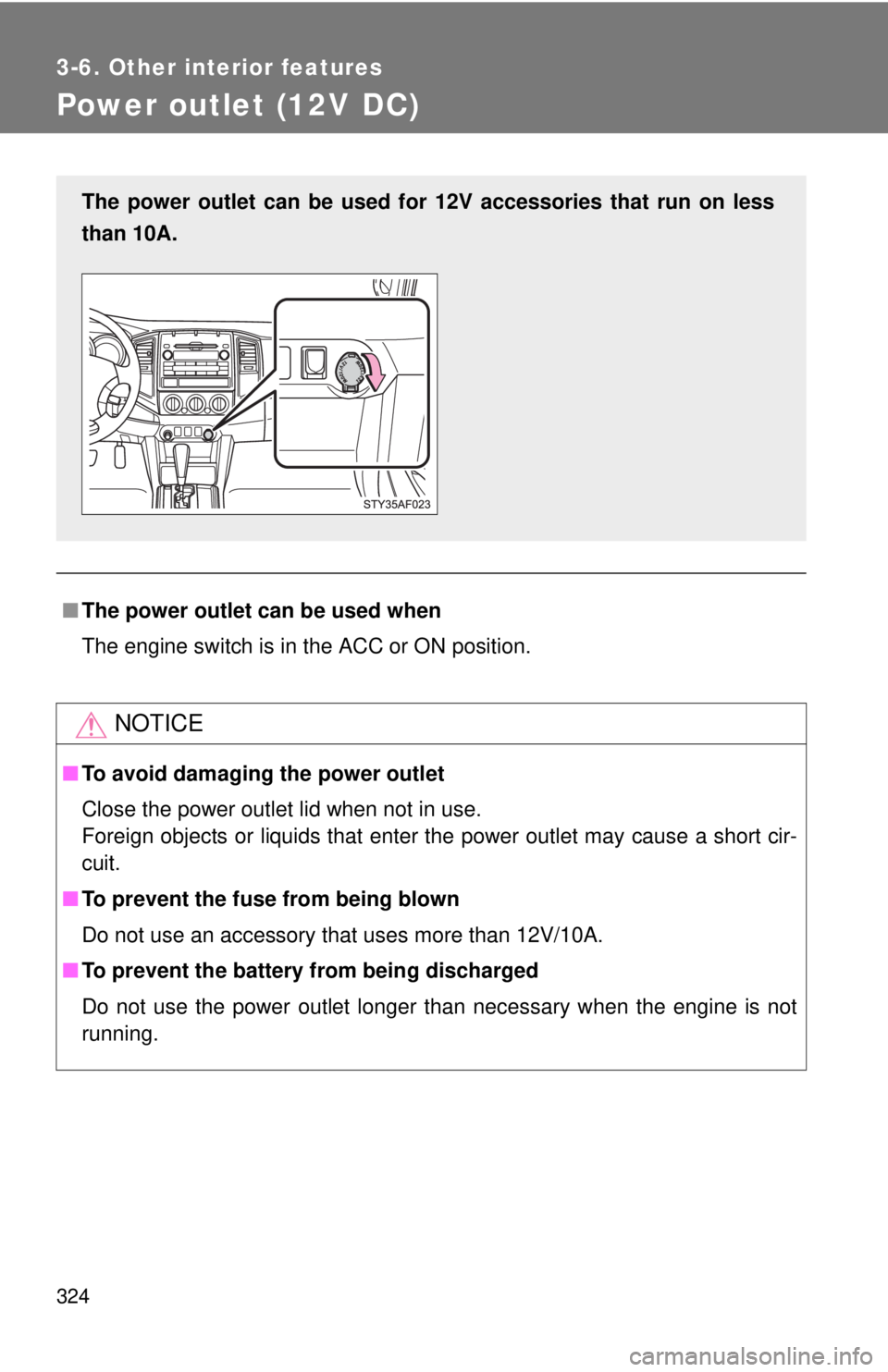
■The power outlet can be used when
The engine switch is in the ACC or ON position.
NOTICE
■To avoid damaging the power outlet
Close the power outlet lid when not in use.
Foreign objects or liquids that enter the power outlet may cause a short cir-
cuit.
■ To prevent the fuse from being blown
Do not use an accessory that uses more than 12V/10A.
■ To prevent the battery from being discharged
Do not use the power outlet longer than necessary when the engine is not\
running.
The power outlet can be used for 12V accessories that run on less
than 10A.
Page 329 of 548
329
3-6. Other interior features
3
Interior and exterior features
NOTICE
■
To avoid damaging the power outlet and the plug
●Close the power outlet lid when not in use.
● Foreign objects or liquids that enter the power outlet may cause a short
circuit.
● Do not use plug adaptors to connect too many plugs to the power outlet.
● After inserting a plug, gently close the power outlet lid.
■ To prevent the fuse from being blown
Do not use a 115V AC appliance that requires more than maximum capacity.
If a 115V AC appliance that consumes more than maximum capacity is
used, the protection circuit will cut the power supply.
■ Appliances that may not ope rate properly (115V AC)
The following 115V AC appliances may not operate even if their power con-
sumption is under maximum capacity.
● Appliances with high initial peak wattage
● Measuring devices that process precise data
● Other appliances that require an extremely stable power supply
■ To prevent the battery from being discharged
Turn off all the vehicle’s electronic equipment and accessories, such as the
headlights and air conditioning, when electrical appliances that consume in
excess of 100W are used continuously for long periods of time.
■ To prevent any damage caused by heat
●Do not use any electrical appliances that give off intense heat such as
toasters, in any locations including the internal or external trim, seats and
deck.
● Do not use any electrical appliances, which are easily affected by vibration
or heat, inside the vehicle.
Vibration while driving, or the heat of the sun while parking, may result in
damage to those electrical appliances.
Page 353 of 548
Maintenance and care4
353
4-1. Maintenance and careCleaning and protectingthe vehicle exterior ......... 354
Cleaning and protecting the vehicle interior .......... 357
4-2. Maintenance Maintenancerequirements .................. 360
General maintenance....... 362
Emission inspection and maintenance (I/M)
programs........................ 365
4-3. Do-it-yourself maintenance Do-it-yourself serviceprecautions .................... 366
Hood ................................ 370
Engine compartment ........ 372
Tires ................................. 388
Tire inflation pressure ...... 396
Wheels ............................. 401
Air conditioning filter......... 403
Wireless remote control battery ............................ 406
Checking and replacing fuses .............................. 408
Light bulbs........................ 418
Page 366 of 548
366
4-3. Do-it-yourself maintenance
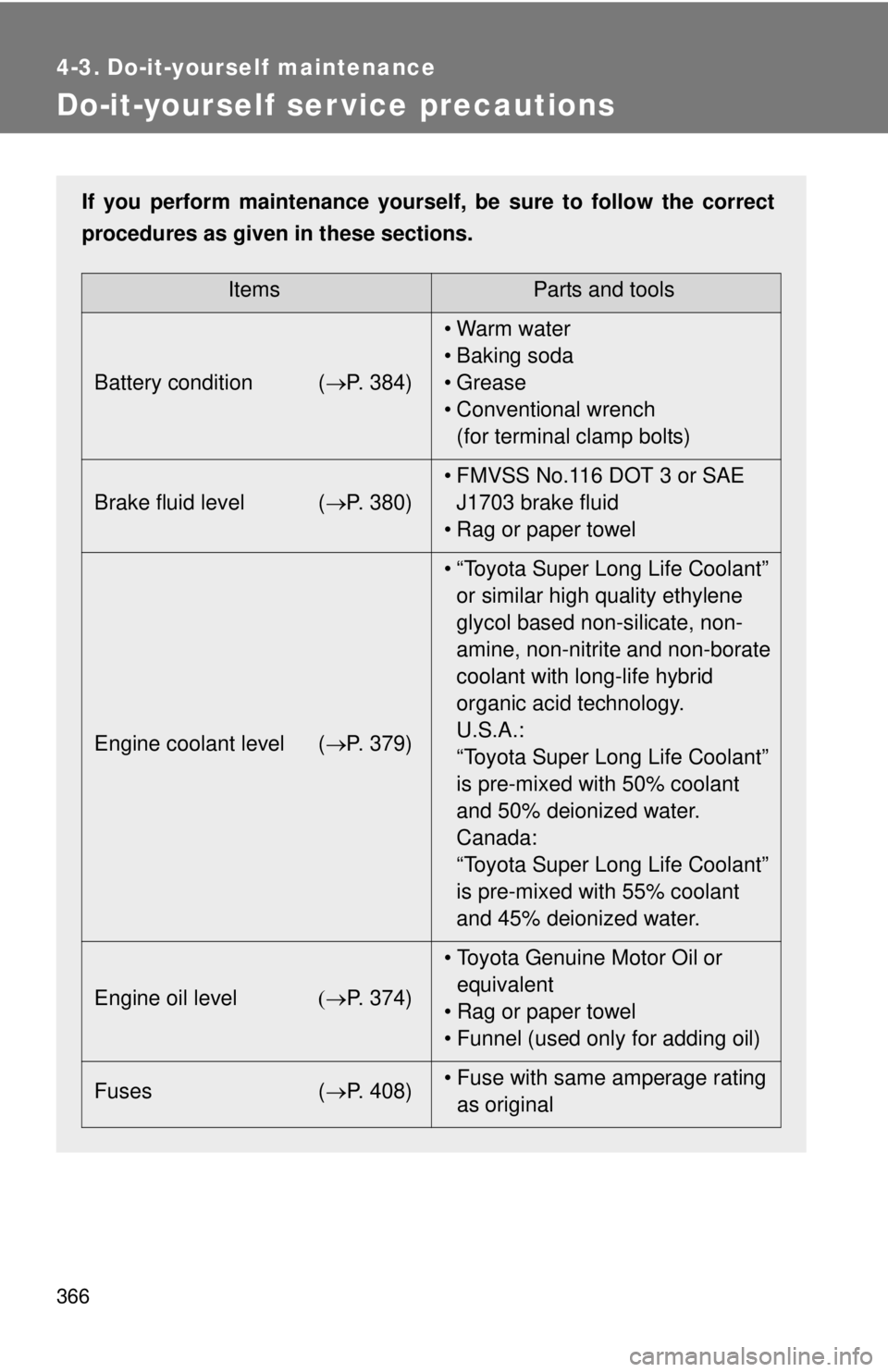
Do-it-yourself ser vice precautions
If you perform maintenance yourself, be sure to follow the correct
procedures as given in these sections.
ItemsParts and tools
Battery condition ( P. 384)•Warm water
• Baking soda
• Grease
• Conventional wrench
(for terminal clamp bolts)
Brake fluid level ( P. 380)• FMVSS No.116 DOT 3 or SAE
J1703 brake fluid
• Rag or paper towel
Engine coolant level ( P. 379)• “Toyota Super Long Life Coolant”
or similar high quality ethylene
glycol based non-silicate, non-
amine, non-nitrite and non-borate
coolant with long-life hybrid
organic acid technology.
U.S.A.:
“Toyota Super Long Life Coolant”
is pre-mixed with 50% coolant
and 50% deionized water.
Canada:
“Toyota Super Long Life Coolant”
is pre-mixed with 55% coolant
and 45% deionized water.
Engine oil level P. 374) • Toyota Genuine Motor Oil or
equivalent
• Rag or paper towel
• Funnel (used only for adding oil)
Fuses ( P. 408)• Fuse with same amperage rating
as original
Page 372 of 548
372
4-3. Do-it-yourself maintenance
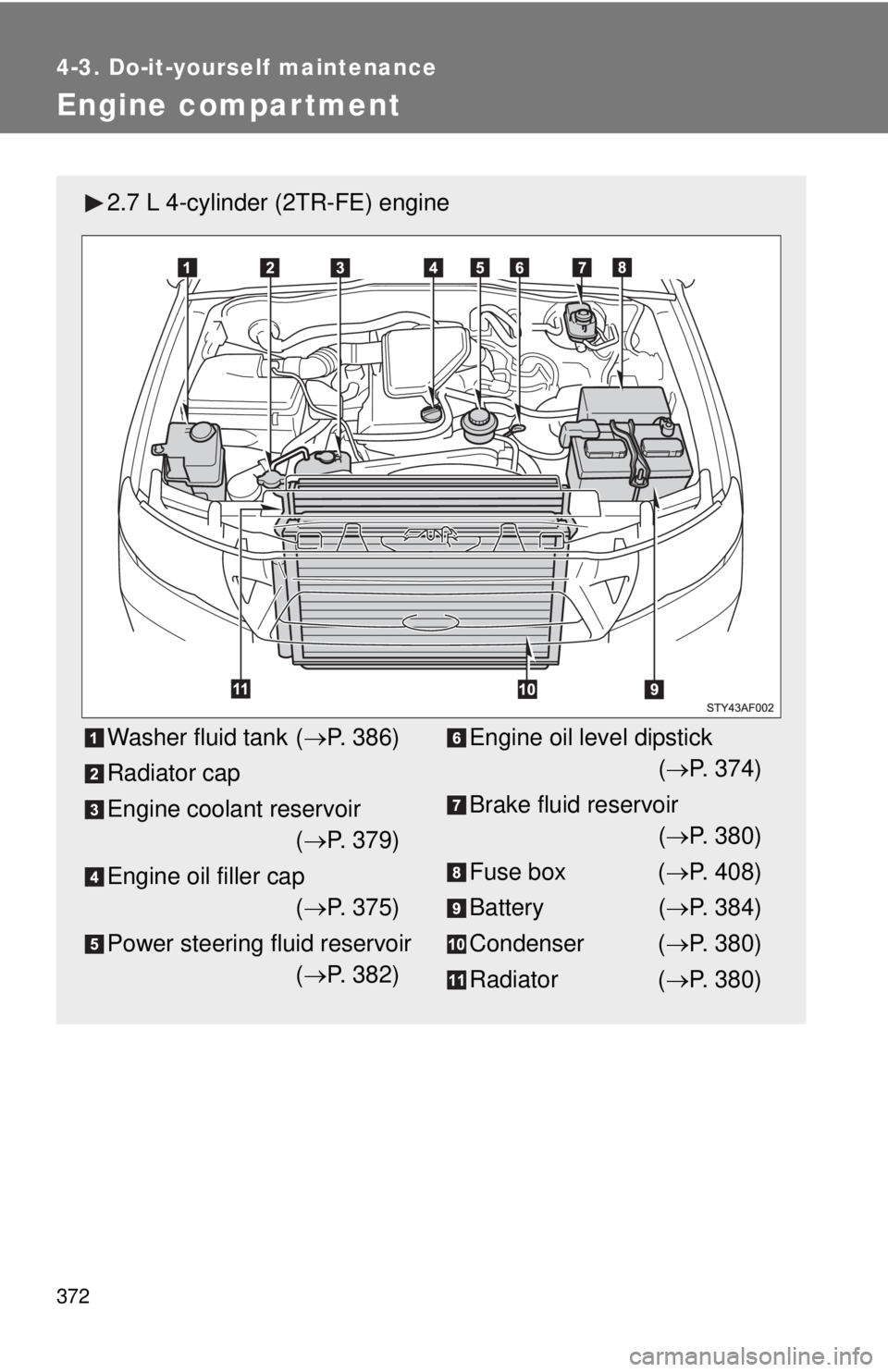
Engine compar tment
2.7 L 4-cylinder (2TR-FE) engine
Washer fluid tank (P. 386)
Radiator cap
Engine coolant reservoir ( P. 379)
Engine oil filler cap ( P. 375)
Power steering fluid reservoir ( P. 382)Engine oil level dipstick
( P. 374)
Brake fluid reservoir ( P. 380)
Fuse box ( P. 408)
Battery ( P. 384)
Condenser ( P. 380)
Radiator ( P. 380)
Page 373 of 548
373
4-3. Do-it-yourself maintenance
4
Maintenance and care
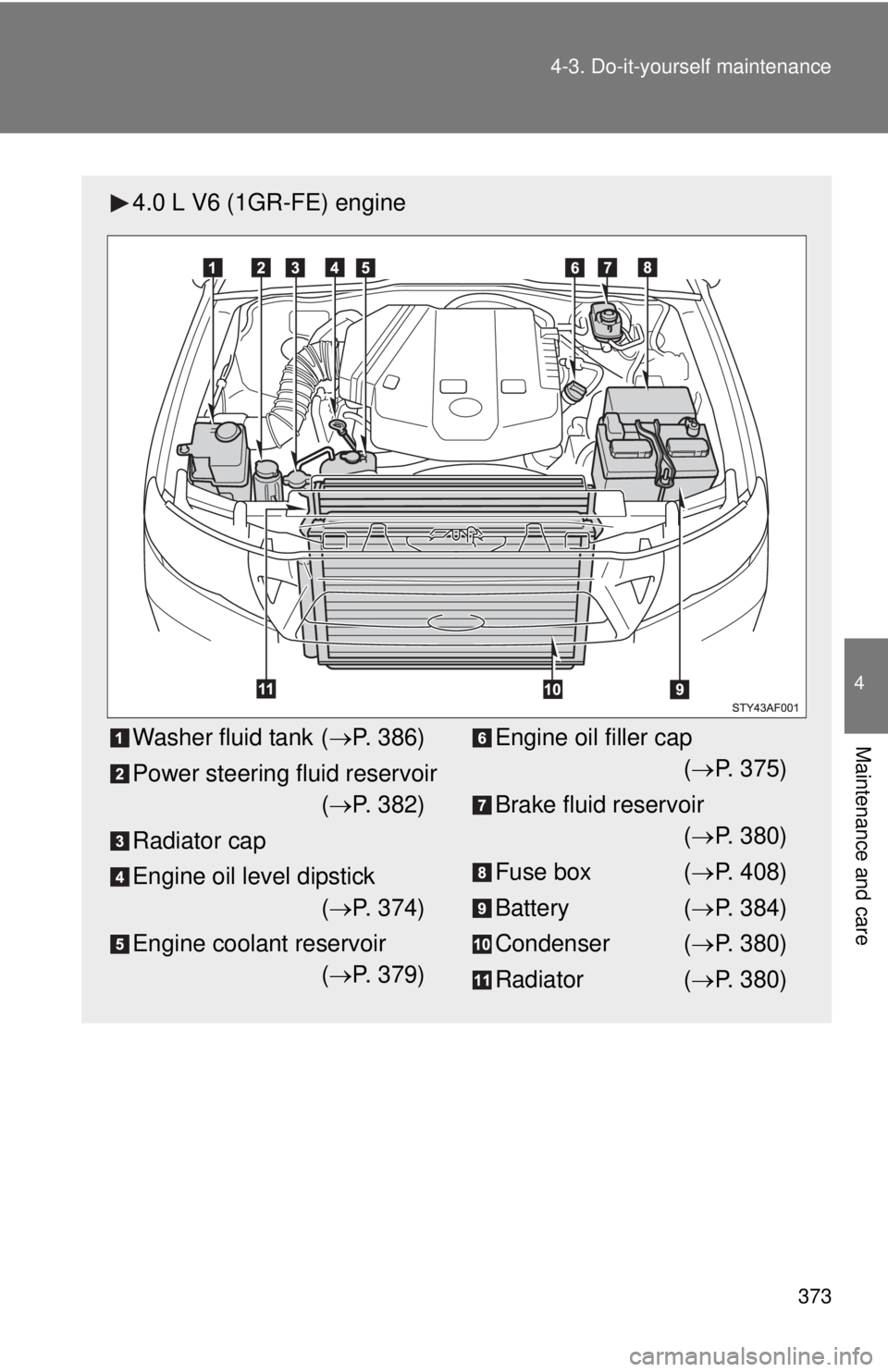
4.0 L V6 (1GR-FE) engine
Washer fluid tank (
P. 386)
Power steering fluid reservoir ( P. 382)
Radiator cap
Engine oil level dipstick ( P. 374)
Engine coolant reservoir ( P. 379)Engine oil filler cap
( P. 375)
Brake fluid reservoir ( P. 380)
Fuse box ( P. 408)
Battery ( P. 384)
Condenser ( P. 380)
Radiator ( P. 380)
Page 408 of 548
408
4-3. Do-it-yourself maintenance
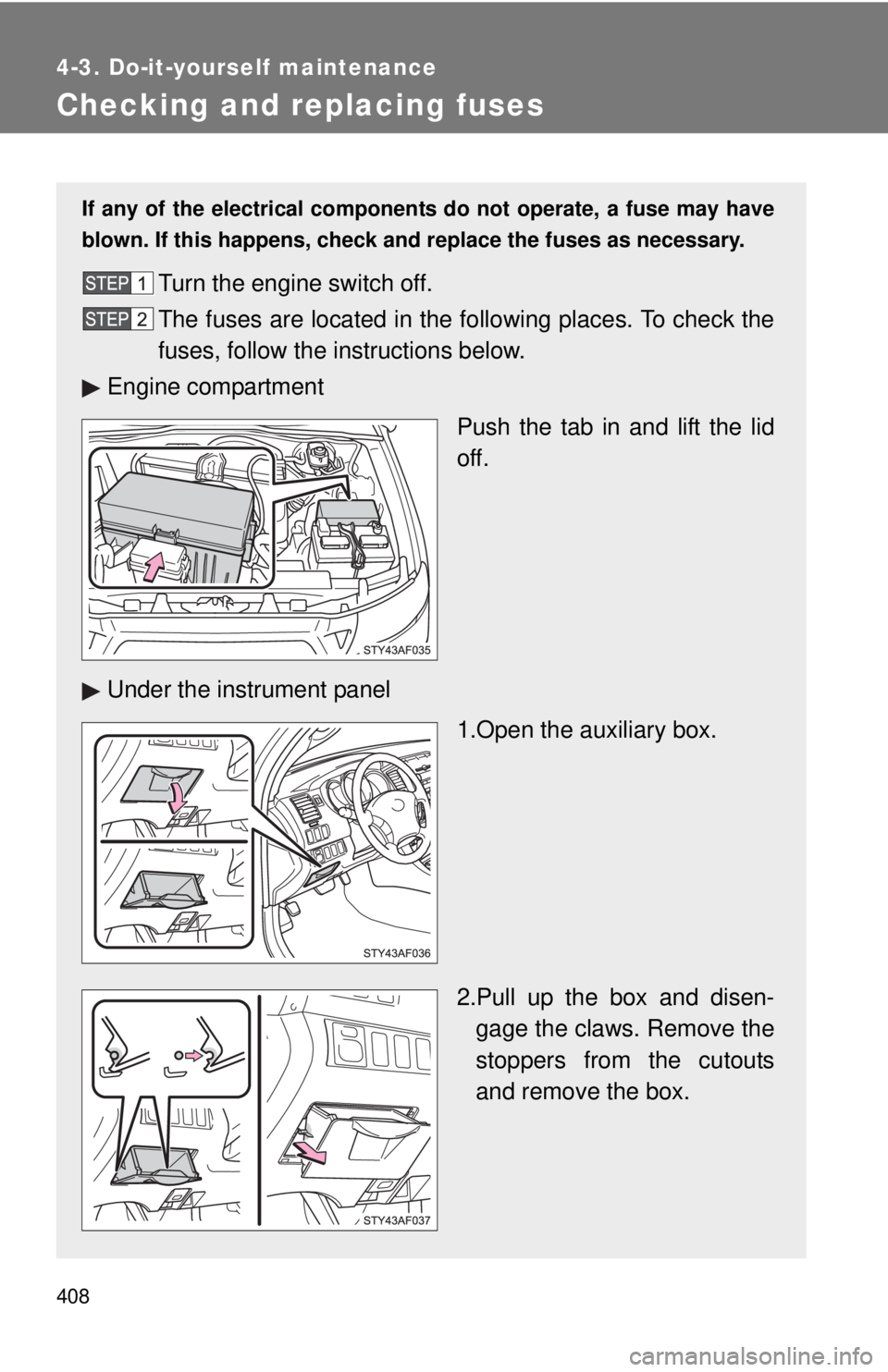
Checking and replacing fuses
If any of the electrical components do not operate, a fuse may have
blown. If this happens, check and replace the fuses as necessary.
Turn the engine switch off.
The fuses are located in the following places. To check the
fuses, follow the in structions below.
Engine compartment
Push the tab in and lift the lid
off.
Under the instrument panel 1.Open the auxiliary box.
2.Pull up the box and disen-gage the claws. Remove the
stoppers from the cutouts
and remove the box.
Page 409 of 548
409
4-3. Do-it-yourself maintenance
4
Maintenance and care
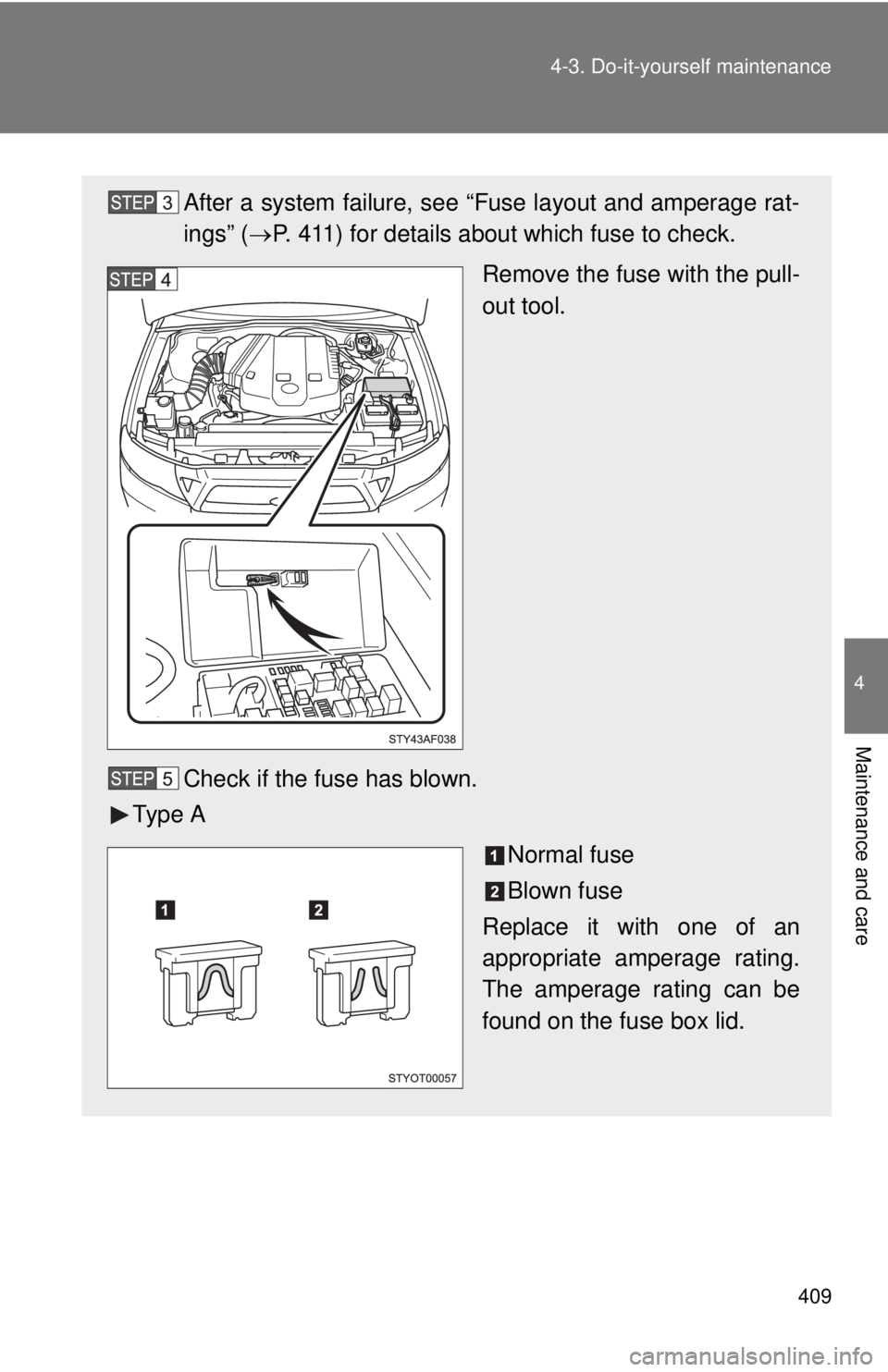
After a system failure, see “Fuse layout and amperage rat-
ings” (
P. 411) for details about which fuse to check.
Remove the fuse with the pull-
out tool.
Check if the fuse has blown.
Ty p e A
Normal fuse
Blown fuse
Replace it with one of an
appropriate amperage rating.
The amperage rating can be
found on the fuse box lid.