warning lights TOYOTA tC 2010 Owners Manual (in English)
[x] Cancel search | Manufacturer: TOYOTA, Model Year: 2010, Model line: tC, Model: TOYOTA tC 2010Pages: 282, PDF Size: 3.43 MB
Page 12 of 282
4
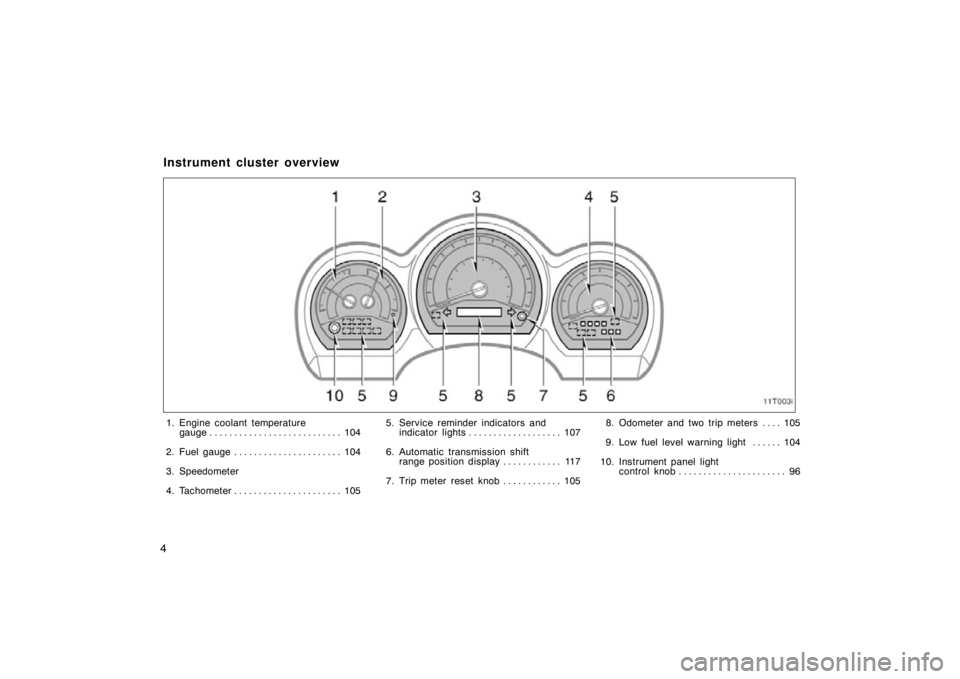
1. Engine coolant temperature gauge 104 . . . . . . . . . . . . . . . . . . . . . . . . . . .
2. Fuel gauge 104 . . . . . . . . . . . . . . . . . . . . . .
3. Speedometer
4. Tachometer 105 . . . . . . . . . . . . . . . . . . . . . . 5. Service reminder indicators and
indicator lights 107 . . . . . . . . . . . . . . . . . . .
6. Automatic transmission shift range position display 117 . . . . . . . . . . . .
7. Trip meter reset knob 105 . . . . . . . . . . . . 8. Odometer and two trip meters 105
. . . .
9. Low fuel level warning light 104 . . . . . .
10. Instrument panel light control knob 96 . . . . . . . . . . . . . . . . . . . . . .
Instrument cluster overview
Page 13 of 282

5
Indicator symbols on the instrument cluster
Brake system warning light∗1
Driver ’s seat belt reminder light∗1
Charging system warning light∗1
Malfunction indicator lamp∗1
Low engine oil pressure warning light∗1
Anti–lock brake system warning light∗1
SRS warning light∗1
Tire pressure warning light∗1
Turn signal indicator lights Headlight high beam indicator light
Cruise control indicator light
∗2
Front passenger ’s seat belt reminder light∗1
Open door warning light∗1 ∗
1
: For details, see “Service reminder indicators and warning
buzzers” on page 107.
∗2: If this light flashes, see “Cruise control” on page 127.
Engine oil replacement reminder light∗1Automatic transmission indicator lights
Page 54 of 282
46
The front passenger ’s seat belt pretension-
er will not activate if no passenger is
detected in the front passenger seat by
the front passenger occupant classification
system. However, the front passenger ’s
seat belt pretensioner may activate if lug-
gage is put on the seat, or the seat belt
is buckled up regardless of the presence
of an occupant in the seat. (As for the
front passenger occupant classification
system, see “—Front pass enger occupant
classification system” on page 65.)
The seat belt pretensioners and SRS air-
bags may not operate together in all colli-
sions.
13T015
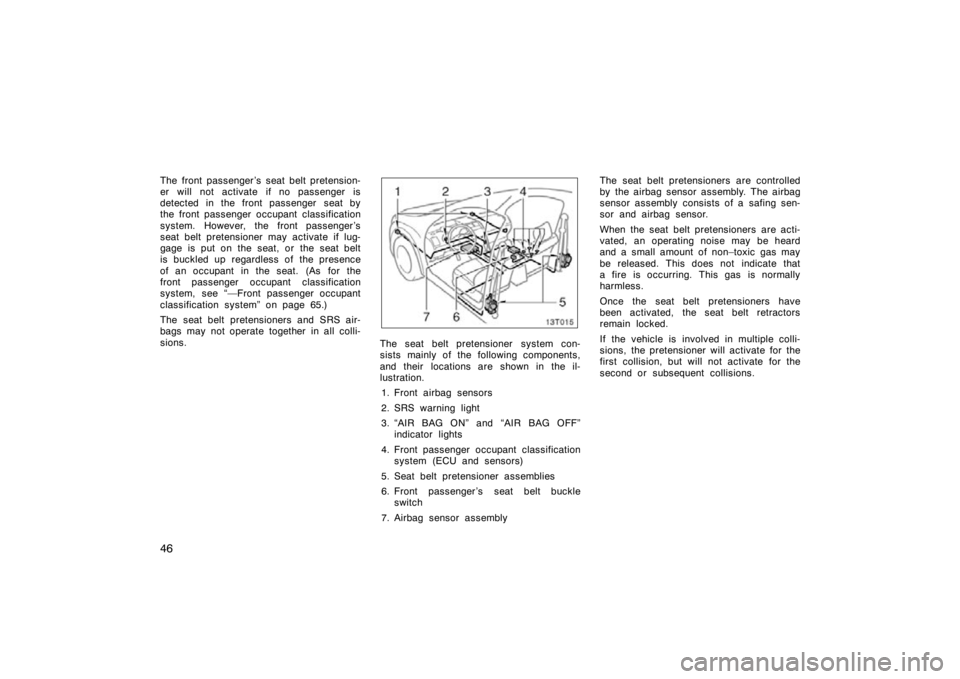
The seat belt pretensioner system con-
sists mainly of the following components,
and their locations are shown in the il-
lustration.
1. Front airbag sensors
2. SRS warning light
3. “AIR BAG ON” and “AIR BAG OFF” indicator lights
4. Front passenger occupant classification system (ECU and sensors)
5. Seat belt pretensioner assemblies
6. Front passenger ’s seat belt buckle switch
7. Airbag sensor assembly The seat belt pretensioners are controlled
by the airbag sensor assembly. The airbag
sensor assembly consists of a safing sen-
sor and airbag sensor.
When the seat belt pretensioners are acti-
vated, an operating noise may be heard
and a small amount of non–toxic gas may
be released. This does not indicate that
a fire is occurring. This gas is normally
harmless.
Once the seat belt pretensioners have
been activated, the seat belt retractors
remain locked.
If the vehicle is involved in multiple colli-
sions, the pretensioner will activate for the
first collision, but will not activate for the
second or subsequent collisions.
Page 59 of 282
51
13T021
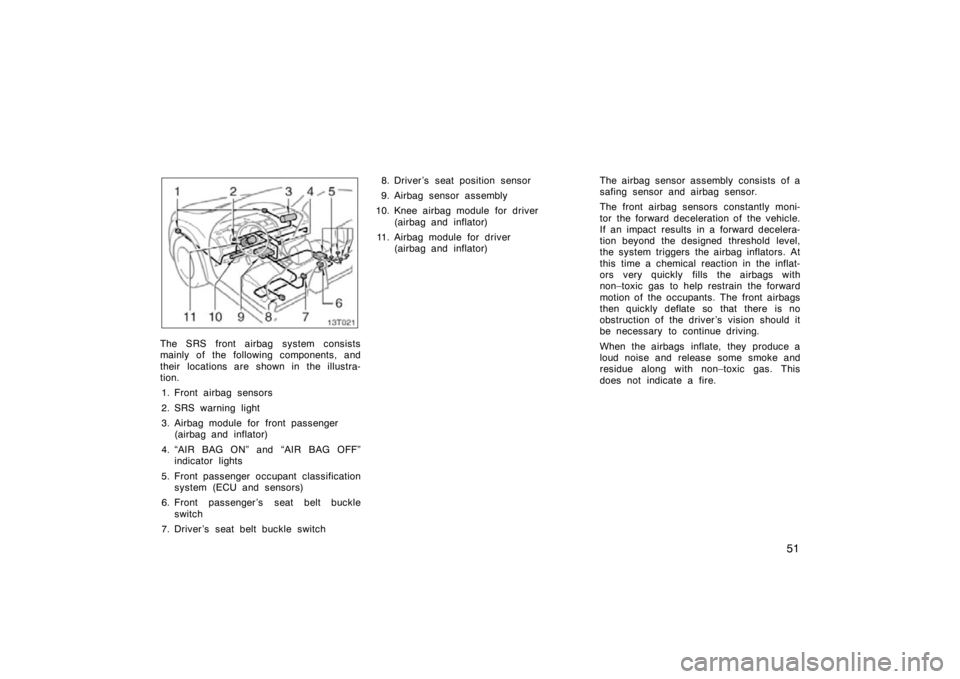
The SRS front airbag system consists
mainly of the following components, and
their locations are shown in the illustra-
tion.1. Front airbag sensors
2. SRS warning light
3. Airbag module for front passenger (airbag and inflator)
4. “AIR BAG ON” and “AIR BAG OFF” indicator lights
5. Front passenger occupant classification system (ECU and sensors)
6. Front passenger ’s seat belt buckle switch
7. Driver ’s seat belt buckle switch 8. Driver ’s seat position sensor
9. Airbag sensor assembly
10. Knee airbag module for driver (airbag and inflator)
11. Airbag module for driver (airbag and inflator) The airbag sensor assembly consists of a
safing sensor and airbag sensor.
The front airbag sensors constantly moni-
tor the forward deceleration of the vehicle.
If an impact results in a forward decelera-
tion beyond the designed threshold level,
the system triggers the airbag inflators. At
this time a chemical reaction in the inflat-
ors very quickly fills the airbags with
non–toxic gas to help restrain the forward
motion of the occupants. The front airbags
then quickly deflate so that there is no
obstruction of the driver ’s vision should it
be necessary to continue driving.
When the airbags inflate, they produce a
loud noise and release some smoke and
residue along with non–toxic gas. This
does not indicate a fire.
Page 67 of 282
59
13T030
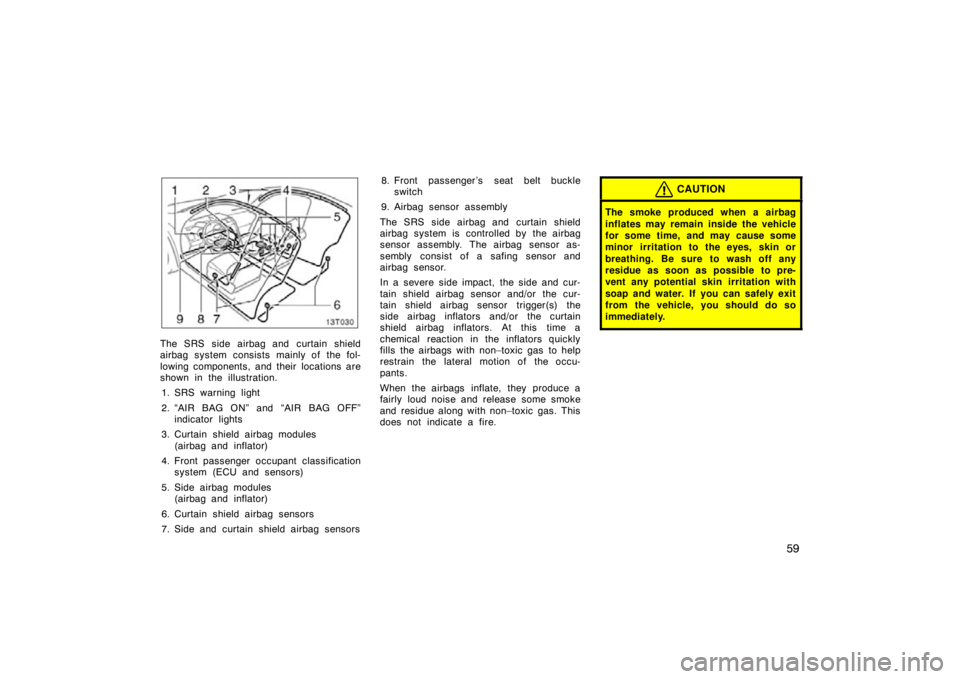
The SRS side airbag and curtain shield
airbag system consists mainly of the fol-
lowing components, and their locations are
shown in the illustration.1. SRS warning light
2. “AIR BAG ON” and “AIR BAG OFF” indicator lights
3. Curtain shield airbag modules (airbag and inflator)
4. Front passenger occupant classification system (ECU and sensors)
5. Side airbag modules (airbag and inflator)
6. Curtain shield airbag sensors
7. Side and curtain shield airbag sensors 8. Front passenger ’s seat belt buckle
switch
9. Airbag sensor assembly
The SRS side airbag and curtain shield
airbag system is controlled by the airbag
sensor assembly. The airbag sensor as-
sembly consist of a safing sensor and
airbag sensor.
In a severe side impact, the side and cur-
tain shield airbag sensor and/or the cur-
tain shield airbag sensor trigger(s) the
side airbag inflators and/or the curtain
shield airbag inflators. At this time a
chemical reaction in the inflators quickly
fills the airbags with non–toxic gas to help
restrain the lateral motion of the occu-
pants.
When the airbags inflate, they produce a
fairly loud noise and release some smoke
and residue along with non–toxic gas. This
does not indicate a fire.
CAUTION
The smoke produced when a airbag
inflates may remain inside the vehicle
for some time, and may cause some
minor irritation to the eyes, skin or
breathing. Be sure to wash off any
residue as soon as possible to pre-
vent any potential skin irritation with
soap and water. If you can safely exit
from the vehicle, you should do so
immediately.
Page 74 of 282
66
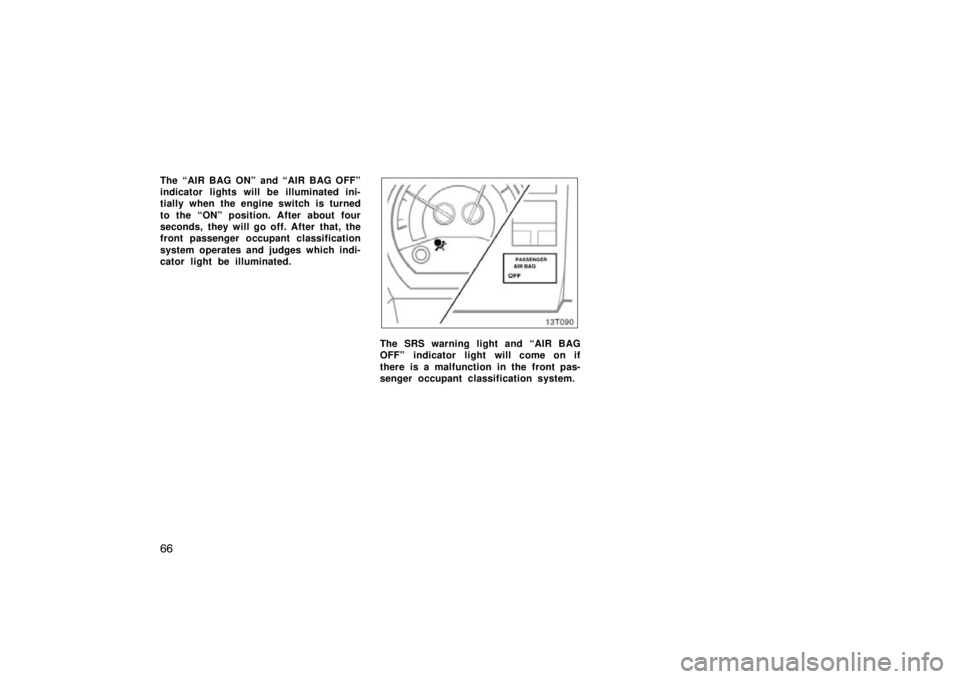
The “AIR BAG ON” and “AIR BAG OFF”
indicator lights will be illuminated ini-
tially when the engine switch is turned
to the “ON” position. After about four
seconds, they will go off. After that, the
front passenger occupant classification
system operates and judges which indi-
cator light be illuminated.
13T090
The SRS warning light and “AIR BAG
OFF” indicator light will come on if
there is a malfunction in the front pas-
senger occupant classification system.
Page 75 of 282

67
Condition and operation in the front passenger occupant classification systemCondition detected by the front
passenger occupant
classification system
Indicator/ warning lightDevices
“AIR BAG ON”
and
“AIR BAG OFF” indicator lightsSRS warning
lightFront
passenger’s seat belt
reminder lightFront
passenger airbagSide airbag
on the front passenger seatCurtain shield
airbag in the front
passenger sideFront
passenger’s seat belt
pretensioner
1. Adult*1“AIR BAG ON”OffFlashing*4Activated
2. Child*2 or child
restraint system*3“AIR BAG OFF” *5OffFlashing*4Deactivated
Activated
Activated
3. UnoccupiedNot illuminatedOffOffDeactivatedDeactivated
4. There is a malfunction in the system“AIR BAG OFF”OnOffDeactivatedActivated
*1: The system judges a person of adult size as an adult. When a smaller adult sits in the front passenger seat, the system may
recognize him/her as a child depending on his/her physique and posture.
*2: When a larger child who has outgrown a child restraint system sits in the front passenger seat, the system may recognize him/heras an adult depending on his/her physique or posture.
*3: Never install a rear −facing child restraint system on the front passenger seat. A forward− facing child restraint system should only
be installed on the front passenger seat when it is unavoidable. (See “Child restraint” on page 69 as for installing the child restraint
system.)
*4: In the event that the front passenger does not wear a seat belt.
*5: In case the indicator is not illuminated, see “Child restraint” on page 69 as for installing the child restraint system proper ly.
Page 232 of 282

224
Exhaust system
If you notice any change in the sound of
the exhaust or smell exhaust fumes, have
the cause located and corrected immedi-
ately. (See “Engine exhaust cautions” on
page 156.)
INSIDE THE VEHICLE
Items listed below should be checked
regularly, e.g. while performing periodic
services, cleaning the vehicle, etc.
Lights
Make sure the headlights, stop lights, tail
lights, turn signal lights, and other lights
are all working. Check headlight aim.
Service reminder indicators and warning
buzzers
Check that all service reminder indicators
and warning buzzers function properly.
Steering wheel
Check that it has specified free play. Be
alert for changes in steering condition,
such as hard steering or strange noise.Seats
Check that all front seat controls such as
seat adjusters, seatback recliner, etc. op-
erate smoothly and that all latches lock
securely in any position. Check that the
head restraints move up and down
smoothly and that the locks hold securely
in any latched position. For folding–down
rear seatbacks, check that the latches
lock securely.
Seat belts
Check that the seat belt system such as
buckles, retractors and anchors operate
properly and smoothly. Make sure the belt
webbing is not cut, frayed, worn or dam-
aged.
Accelerator pedal
Check the pedal for smooth operation and
uneven pedal effort or catching.
Clutch pedal
Check the pedal for smooth operation.
Brake pedal
Check the pedal for smooth operation and
that the pedal has the proper clearance.
Check the brake booster function.
Brakes
In a safe place, check that the brakes do
not pull to one side when applied.Parking brake
Check that the lever has the proper travel
and that, on a safe incline, your vehicle
is held securely with only the parking
brake applied.
Automatic transmission “Park” mecha-
nism
Check the lock release button of the shift
lever for proper and smooth operation. On
a safe incline, check that your vehicle is
held securely with the shift lever in “P”
position and all brakes released.
OUTSIDE THE VEHICLE
Items listed below should be performed
from time to time, unless otherwise
specified.
Fluid leaks
Check underneath for leaking fuel, oil, wa-
ter or other fluid after the vehicle has
been parked for a while. If you smell fuel
fumes or notice any leak, have the cause
found and corrected immediately.
Doors and engine hood
Check that all the side doors and back
door operate smoothly and all latches lock
securely. Make sure the engine hood sec-
ondary latch secures the hood from open-
ing when the primary latch is released.