flat tire TOYOTA tC 2013 Owners Manual (in English)
[x] Cancel search | Manufacturer: TOYOTA, Model Year: 2013, Model line: tC, Model: TOYOTA tC 2013Pages: 484, PDF Size: 9.41 MB
Page 1 of 484
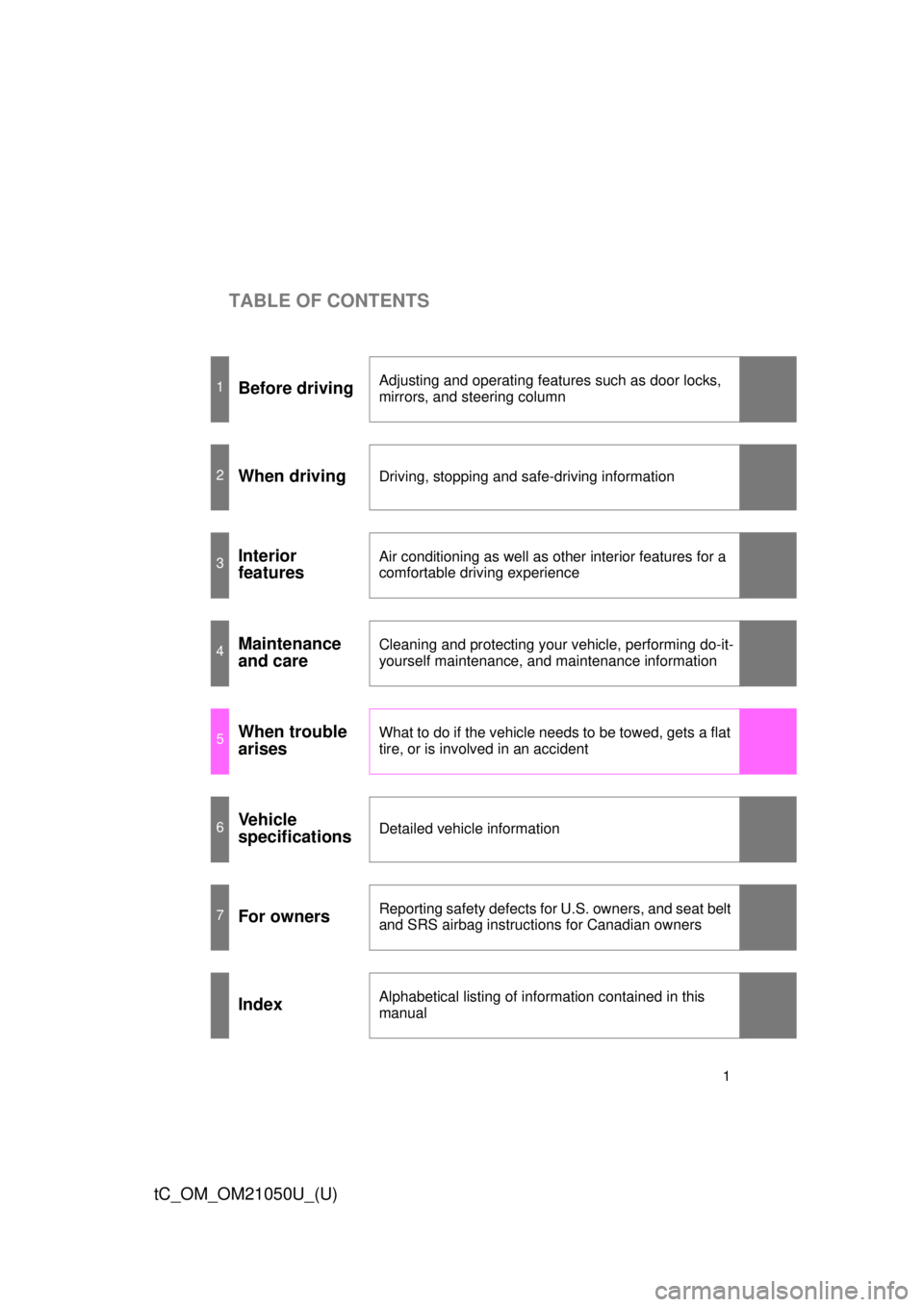
TABLE OF CONTENTS
1
tC_OM_OM21050U_(U)
1Before drivingAdjusting and operating features such as door locks,
mirrors, and steering column
2When drivingDriving, stopping and safe-driving information
3Interior
featuresAir conditioning as well as other interior features for a
comfortable driving experience
4Maintenance
and careCleaning and protecting your vehicle, performing do-it-
yourself maintenance, and maintenance information
5When trouble
arisesWhat to do if the vehicle needs to be towed, gets a flat
tire, or is involved in an accident
6Vehicle
specificationsDetailed vehicle information
7For ownersReporting safety defects for U.S. owners, and seat belt
and SRS airbag instructions for Canadian owners
IndexAlphabetical listing of information contained in this
manual
Page 4 of 484
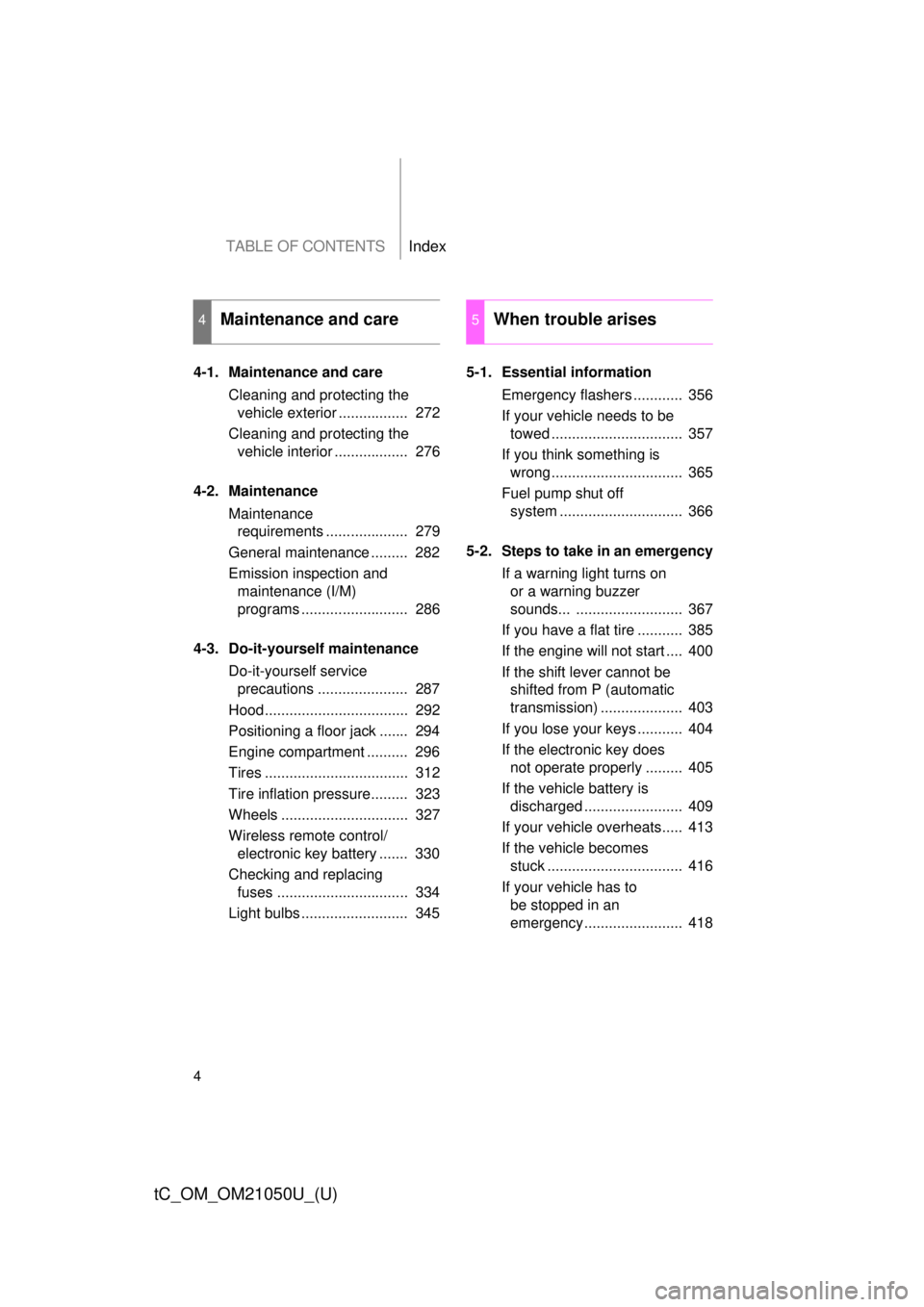
TABLE OF CONTENTSIndex
4
tC_OM_OM21050U_(U)
4-1. Maintenance and careCleaning and protecting the vehicle exterior ................. 272
Cleaning and protecting the vehicle interior .................. 276
4-2. Maintenance Maintenance requirements .................... 279
General maintenance ......... 282
Emission inspection and maintenance (I/M)
programs .......................... 286
4-3. Do-it-yourself maintenance Do-it-yourself service precautions ...................... 287
Hood................................... 292
Positioning a floor jack ....... 294
Engine compartment .......... 296
Tires ................................... 312
Tire inflation pressure......... 323
Wheels ............................... 327
Wireless remote control/ electronic key battery ....... 330
Checking and replacing fuses ................................ 334
Light bulbs .......................... 345 5-1. Essential information
Emergency flashers ............ 356
If your vehicle needs to be towed ................................ 357
If you think something is wrong ................................ 365
Fuel pump shut off system .............................. 366
5-2. Steps to take in an emergency If a warning light turns on or a warning buzzer
sounds... .......................... 367
If you have a flat tire ........... 385
If the engine will not start .... 400
If the shift lever cannot be shifted from P (automatic
transmission) .................... 403
If you lose your keys ........... 404
If the electronic key does not operate properly ......... 405
If the vehicle battery is discharged ........................ 409
If your vehicle overheats..... 413
If the vehicle becomes stuck ................................. 416
If your vehicle has to be stopped in an
emergency ........................ 418
4Maintenance and care5When trouble arises
Page 7 of 484

7
tC_OM_OM21050U_(U)
: If equipped
Tires
●Rotation
● Replacement
● Inflation pressure
● Information
P. 312
P. 385
P. 323
P. 436
License plate lights P. 197
Rear turn signal lights P. 185
Side doors P. 55
Stop/tail and rear side marker lights
P. 197Rear window wiper P. 205
Fuel filler door P. 95Rear window defogger
P. 242
Back door P. 62
Page 161 of 484

161
2-1. Driving procedures
2
When driving
tC_OM_OM21050U_(U)
NOTICE
■
When parking the vehicle (vehicl es with an automatic transmission)
Always put the shift lever in P. Failure to do so may cause the vehicle to
move or the vehicle may accelerate suddenly if the accelerator pedal is acci-
dentally depressed.
■ Avoiding damage to vehicle parts
● Do not turn the steering wheel fully in either direction and hold it there for
an extended period of time.
Doing so may damage the power steering motor.
● When driving over bumps in the road, drive as slowly as possible to avoid
damaging the wheels, underside of the vehicle, etc.
■ If you get a flat tire while driving
A flat or damaged tire may cause the following situations. Hold the steering
wheel firmly and gradually depress the brake pedal to slow down the vehicle.
● It may be difficult to control your vehicle.
● The vehicle will make abnormal sounds or vibrations.
● The vehicle will lean abnormally.
Information on what to do in case of a flat tire. ( P. 385)
Page 216 of 484

216 2-4. Using other driving systems
tC_OM_OM21050U_(U)
CAUTION
■Replacing tires
Make sure that all tires are of the specified size, brand, tread pattern and
total load capacity. In addition, make sure that the tires are inflated to the
recommended tire inflation pressure level.
The ABS and VSC systems will not function correctly if different tires are
installed on the vehicle.
Contact your Scion dealer for further information when replacing tires or
wheels.
■ Handling of tires and the suspension
Using tires with any kind of problem or modifying the suspension will affect
the driving assist systems, and may cause a system to malfunction.
Page 271 of 484

Maintenance and care4
271
tC_OM_OM21050U_(U)
4-1. Maintenance and careCleaning and protecting the vehicle exterior......... 272
Cleaning and protecting the vehicle interior.......... 276 4-2. Maintenance
Maintenance requirements .................. 279
General maintenance....... 282
Emission inspection and maintenance (I/M)
programs ........................ 286
4-3. Do-it-yourself maintenance Do-it-yourself service precautions .................... 287
Hood ................................ 292
Positioning a floor jack ..... 294
Engine compartment ........ 296
Tires ................................. 312
Tire inflation pressure ...... 323
Wheels ............................. 327
Wireless remote control/ electronic key battery ..... 330
Checking and replacing fuses .............................. 334
Light bulbs........................ 345
Page 285 of 484

285
4-2. Maintenance
4
Maintenance and care
tC_OM_OM21050U_(U)
Vehicle exterior
ItemsCheck points
Doors • Do the doors operate smoothly?
Engine hood • Does the engine hood lock sys-
tem work properly?
Fluid leaks • There should not be any signs of
fluid leakage after the vehicle has
been parked.
Tires • Is the tire inflation pressure cor-
rect?
• The tires should not be dam- aged or excessively worn.
• Have the tires been rotated according to the maintenance
schedule?
• The wheel nuts should not be loose.
CAUTION
■ If the engine is running
Turn the engine off and ensure that there is adequate ventilation before per-
forming maintenance checks.
Page 289 of 484

289
4-3. Do-it-yourself maintenance
4
Maintenance and care
tC_OM_OM21050U_(U)
ItemsParts and tools
Light bulbs
(P. 345)
• Bulb with same number and watt-
age rating as original
• Flathead screwdriver
Radiator and condenser (P. 303)
Tire inflation pressure ( P. 323)• Tire pressure gauge
• Compressed air source
Washer fluid (P. 310)
• Water or washer fluid containing
antifreeze (for winter use)
• Funnel (used only for adding water or washer fluid)
Page 313 of 484

313
4-3. Do-it-yourself maintenance
4
Maintenance and care
tC_OM_OM21050U_(U)
Installing tire pressure warning
valves and transmitters (U.S.A.
only)
When replacing tires or wheels, tire pressure warning valves and
transmitters must also be installed.
When new tire pressure warning valves and transmitters are
installed, new ID codes must be registered in the tire pressure warn-
ing computer and the tire pressure warning system must be initial-
ized. Have tire pressure warning valve and transmitter ID codes
registered by your Scion dealer. ( P. 315)
■ Tire pressure warning system (U.S.A. only)
Your vehicle is equipped with a tire pressure warning system
that uses tire pressure warning valves and transmitters to
detect low tire inflation pressure before serious problems arise.
( P. 373)
Page 314 of 484

314 4-3. Do-it-yourself maintenance
tC_OM_OM21050U_(U)
Initializing the tire pressure warning system (U.S.A. only)■ The tire pressure warning system must be initialized in the fol-
lowing circumstances:
●When rotating front and rear tires which have different tire infla-
tion pressures
● When changing the tire size
When the tire pressure warning system is initialized, the current
tire inflation pressure is set as the pressure benchmark.
■ How to initialize the tire pressure warning system
Park the vehicle in a safe pl ace and turn the engine switch
(vehicles without a smart key system) or the “ENGINE START
STOP” switch (vehicles with a smart key system) off.
While the vehicle is moving, in itialization is not performed.
Adjust the tire inflation pressure to the specified cold tire infla-
tion pressure level. ( P. 431)
Make sure to adjust the tire pressure to the specified cold tire
inflation pressure level. The ti re pressure warning system will
operate based on this pressure level.
Turn the engine switch to the “O N” position (vehicles without a
smart key system) or the “ENGINE START STOP” switch to
IGNITION ON mode (vehicles with a smart key system).
STEP 1
STEP 2
STEP 3