fuel pressure TOYOTA tC 2015 Owners Manual (in English)
[x] Cancel search | Manufacturer: TOYOTA, Model Year: 2015, Model line: tC, Model: TOYOTA tC 2015Pages: 492, PDF Size: 9.63 MB
Page 4 of 492

TABLE OF CONTENTSIndex
4
tC_OM_OM21057U_(U)
4-1. Maintenance and careCleaning and protecting the vehicle exterior ........... 274
Cleaning and protecting the vehicle interior ............ 278
4-2. Maintenance Maintenance requirements .................... 281
General maintenance ......... 284
Emission inspection and maintenance (I/M)
programs .......................... 288
4-3. Do-it-yourself maintenance Do-it-yourself service precautions ...................... 289
Hood................................... 294
Positioning a floor jack ....... 296
Engine compartment .......... 298
Tires ................................... 314
Tire inflation pressure......... 325
Wheels ............................... 329
Air conditioning filter ........... 332
Wireless remote control/ electronic key battery ....... 335
Checking and replacing fuses ................. 341
Light bulbs .......................... 352 5-1. Essential information
Emergency flashers ............ 364
If your vehicle needs to be towed ........................... 365
If you think something is wrong ............................ 374
Fuel pump shut off system .............................. 375
5-2. Steps to take in an emergency If a warning light turns on or a warning buzzer
sounds... .......................... 376
If you have a flat tire ........... 394
If the engine will not start .................................. 408
If the shift lever cannot be shifted from P (automatic
transmission) .................... 411
If you lose your keys ........... 412
If the electronic key does not operate properly ......... 413
If the vehicle battery is discharged .................... 417
If your vehicle overheats..... 421
If the vehicle becomes stuck ................................. 424
If your vehicle has to be stopped in an
emergency........................ 426
4Maintenance and care5When trouble arises
Page 7 of 492
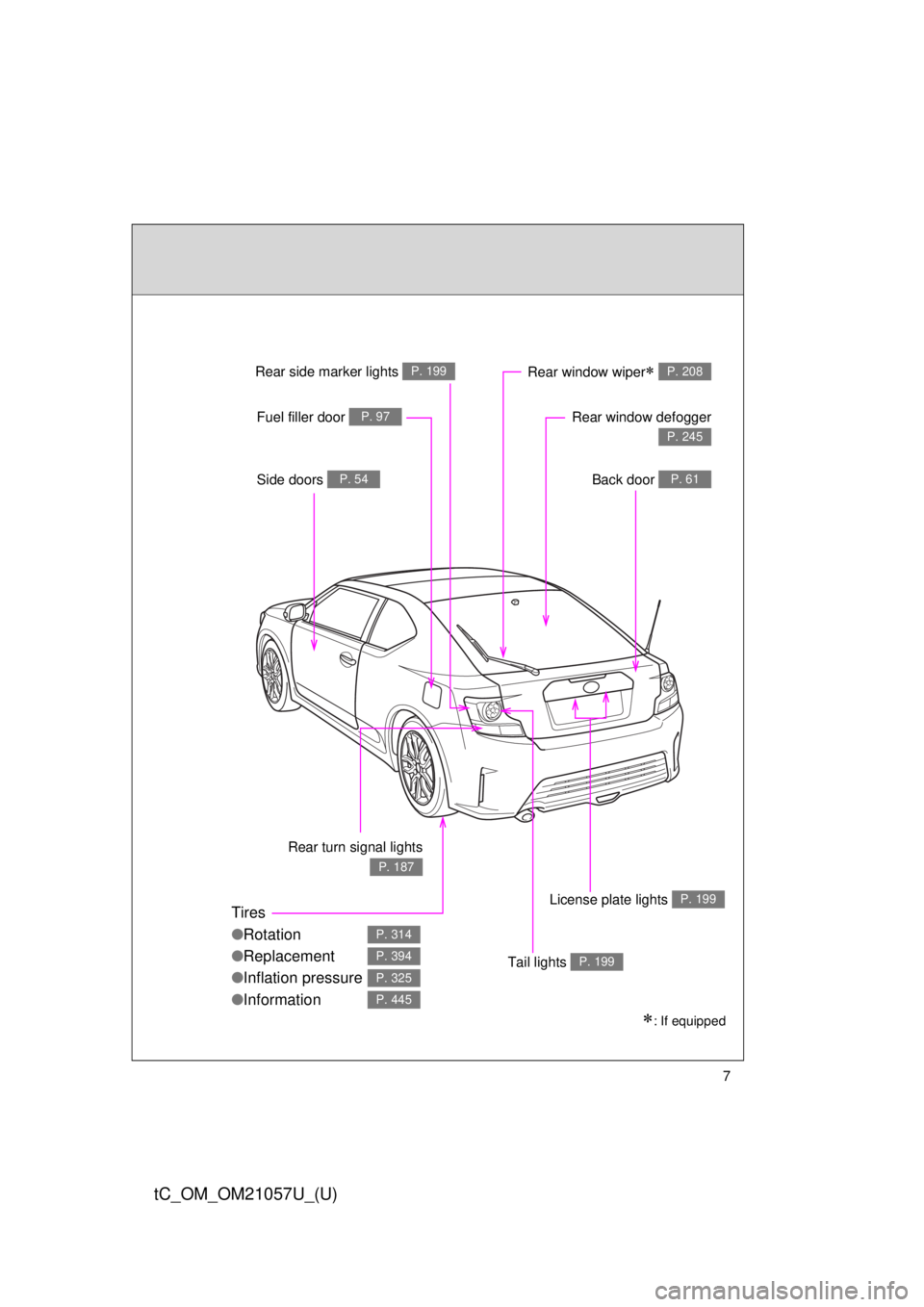
7
tC_OM_OM21057U_(U)
: If equipped
Tires
●Rotation
● Replacement
● Inflation pressure
● Information
P. 314
P. 394
P. 325
P. 445
License plate lights P. 199
Tail lights P. 199
Side doors P. 54
Rear side marker lights P. 199Rear window wiper P. 208
Fuel filler door P. 97Rear window defogger
P. 245
Back door P. 61
Rear turn signal lights
P. 187
Page 275 of 492

275
4-1. Maintenance and care
4
Maintenance and care
tC_OM_OM21057U_(U)
■
Automatic car washes
●Fold the mirrors and remove the antenna before washing the vehicle.
Start washing from the front of the vehicle. Make sure to re-install the
antenna and extend the mirrors before driving.
● Brushes used in automatic car washes may scratch the vehicle surface
and harm your vehicle’s paint.
■ High pressure car washes
●Do not allow the nozzles of the car wash to come within close proximity
of the windows.
● Before using the car wash, check that the fuel filler door on your vehicle
is closed properly.
■ Aluminum wheels
●Remove any dirt immediately by using a neutral detergent. Do not use
hard brushes or abrasive cleaners. Do not use strong or harsh chemical
cleaners.
Use the same mild detergent and wax as used on the paint.
● Do not use detergent on the wheels when they are hot, for example after
driving for long distance in the hot weather.
● Wash detergent from the wheels immediately after use.
■ Bumpers and side moldings
Do not scrub with abrasive cleaners.
■ Notes for a smart key system (if equipped)
●If the door handle becomes wet while the electronic key is within the
effective range, the door may lock and unlock repeatedly. Place the key
in a position 6 ft. (2 m) or more separate from the vehicle while the vehi-
cle is being washed. (Take care to ensure that the key is not stolen.)
● If the electronic key is inside the vehicle and a door handle becomes wet
during a car wash, a buzzer will sound outside the vehicle. To turn off the
alarm, lock all the doors.
Page 327 of 492

327
4-3. Do-it-yourself maintenance
4
Maintenance and care
tC_OM_OM21057U_(U)
■Effects of incorrect tire inflation pressure
Driving with incorrect ti
re inflation pressure ma y result in the following:
●Reduced fuel economy
●Reduced driving comfort and poor handling
●Reduced tire life due to wear
●Reduced safety
●Damage to the drive train
If a tire needs frequent inflating, ha ve it checked by your Scion dealer.
■Instructions for checking tire inflation pressure
When checking tire inflation pressure, observe the following:
●Check only when the tires are cold.
If your vehicle has been parked for at least 3 hours or has not been
driven for more than 1 mile or 1.5 km, you will get an accurate cold
tire inflation pressure reading.
●Always use a tire pressure gauge.
It is difficult to judge if a tire is properly inflated based only on its
appearance.
●It is normal for the tire inflation pressure to be higher after driving as
heat is generated in the tire. Do not reduce tire inflation pressure after
driving.
●Never exceed the vehicle capacity weight.
Passengers and luggage weight should be placed so that the vehicle
is balanced.
Page 392 of 492

392 5-2. Steps to take in an emergency
tC_OM_OM21057U_(U)
CAUTION
■Maintenance of the tires (U.S.A. only)
Each tire, including the spare (if provided), should be checked monthly
when cold and inflated to the inflation pressure recommended by the
vehicle manufacturer on the vehicle placard or tire inflation pressure
label (tire and load information label). (If your vehicle has tires of a differ-
ent size than the size indicated on the vehicle placard or tire inflation
pressure label [tire and load information label], you should determine the
proper tire inflation pr essure for those tires.)
As an added safety feature, your vehicle has been equipped with a tire
pressure monitoring system (TPMS-ti re pressure warning system) that
illuminates a low tire pressure telltal e (tire pressure warning light) when
one or more of your tires is significantly under-inflated. Accordingly,
when the low tire pressu re telltale (tire pressure warning light) illumi-
nates, you should stop and check your tires as soon as possible, and
inflate them to the proper pressure. Driving on a significantly under-
inflated tire causes the tire to overheat and can lead to tire failure.
Under-inflation also reduces fuel effi ciency and tire tread life, and may
affect the vehicle’s handling and stopping ability.
Please note that the TPMS (tire pressure warning system) is not a sub-
stitute for proper tire main tenance, and it is the driver’s responsibility to
maintain correct tire pressure, even if under-inflation has not reached the
level to trigger illu mination of the TPMS low tire pressure telltale (tire
pressure warning light).
Page 452 of 492

452 6-1. Specifications
tC_OM_OM21057U_(U)
Glossary of tire terminology
Tire related termMeaning
Cold tire inflation pres-
sure Tire pressure when the vehicle has been
parked for three hours or more, or has not
been driven more than 1 mile or 1.5 km under
that condition
Maximum inflation
pressure The maximum cold inflated
pressure to which a
tire may be inflated, s hown on the sidewall of
the tire
Recommended infla-
tion pressure Cold tire inflation pressure recommended by a
manufacturer
Accessory weight The combined weight (in excess of those stan-
dard items which may be replaced) of auto-
matic transmission, power steering, power
brakes, power windows, power seats, radio
and heater, to the extent that these items are
available as factory-installed equipment
(whether installed or not)
Curb weight The weight of a motor vehicle with standard
equipment, including the maximum capacity of
fuel, oil and coolant, and if so equipped, air
conditioning and additional weight optional
engine
Page 487 of 492

487
Alphabetical index
tC_OM_OM21057U_(U)
Tachometer .............................. 190
Tail lights
Replacing light bulbs ............ 352
Switch ................................... 199
Wattage ................................ 440
Theft deterrent system
Engine immobilizer system... 102
Theft prevention labels ........... 105
Tire inflation pressure ............ 325
Tire information Glossary ............................... 452
Size ...................................... 448
Tire identification number ..... 447
Uniform Tire Quality Grading .............................. 449
Tires Chains .................................. 226
Checking .............................. 314
If you have a flat tire ............. 394
Inflation pressure .......... 325, 439
Inflation pressure sensor ...... 315
Information ........................... 445
Replacing ............................. 394
Rotating tires ........................ 314
Size ...................................... 439
Snow tires............................. 226
Spare tire .............................. 394
Tire pressure warning system................................ 314
Tools......................................... 394
Total load capacity .................. 225
Towing Dinghy towing ............... 233, 234
Emergency towing ................ 369
Trailer towing ........................ 232
TRAC ........................................ 215
Traction control ....................... 215
Trailer towing........................... 232
Trip meter................................. 190
Turn signal lights Replacing light bulbs ............ 352
Switch ................................... 187
Wattage ................................ 440 Vanity mirrors...........................259
Vehicle data recordings ............20
Vehicle identification
number ...................................431
Vehicle stability control...........215
VSC............................................215
Warning buzzers Brake system ........................376
Open door .............................380
Seat belt reminder .................380
Warning lights Anti-lock brake system ..........378
Automatic transmission fluid temperature ........................379
Brake assist system ..............378
Brake system ........................376
Charging system .... ...............377
Electric power steering system warning light........................379
Electronic engine control
system ................................378
High coolant temperature ......380
Low engine oil pressure ........377
Low fuel level ........................380
Low tire pressure...................382
Low washer fluid ...................380
Malfunction indicator lamp ....378
Open door .............................380
Pretensioners ........................378
Seat belt reminder light .........380
Smart key system... ...............384
SRS airbags ..........................378
Tire pressure warning light ....382
Washer Checking ...............................312
Preparing and checking
before winter .......................226
Switch....................................204
Washing and waxing ...............274TV
W
Page 490 of 492
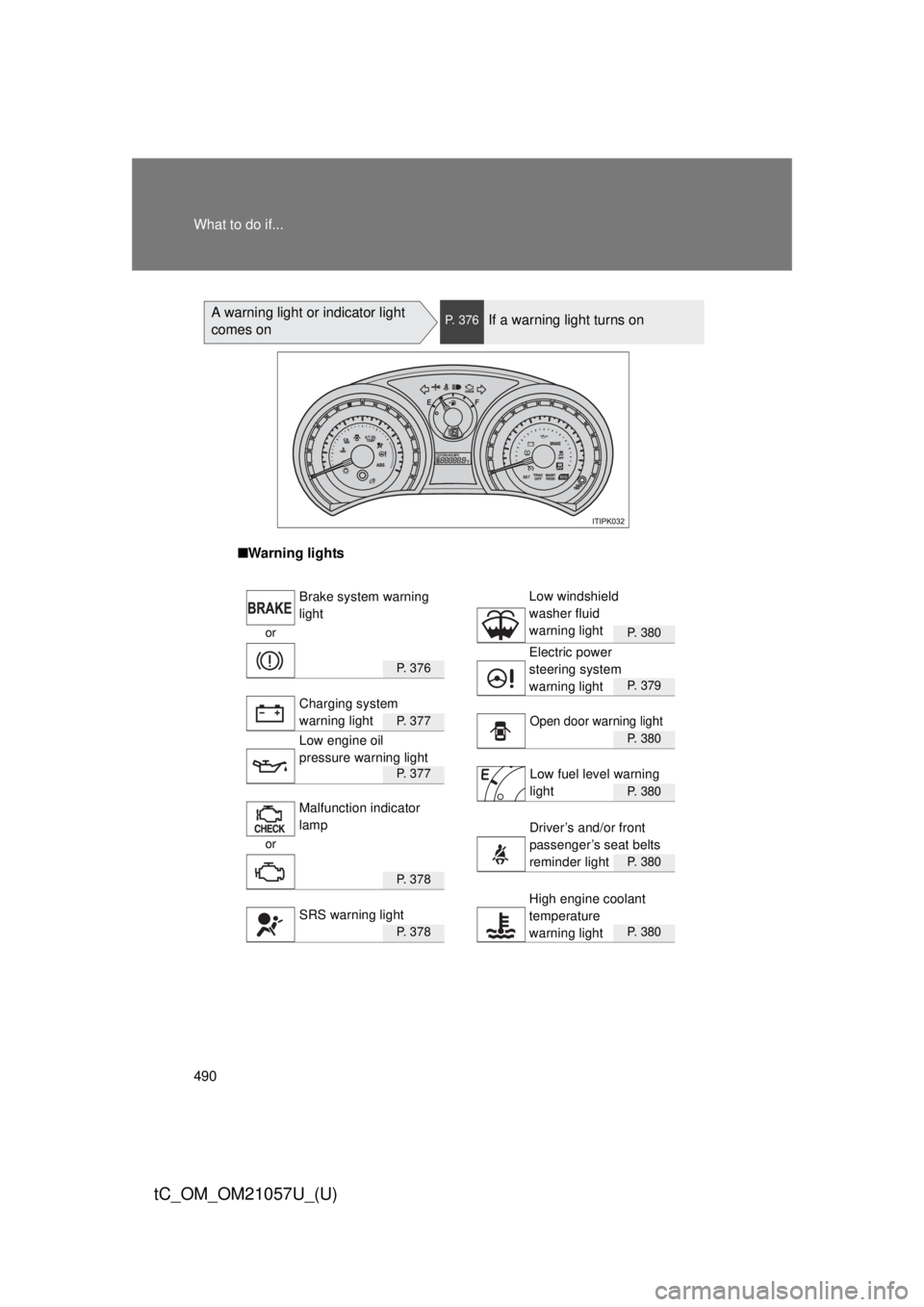
490 What to do if...
tC_OM_OM21057U_(U)
A warning light or indicator light
comes onP. 376If a warning light turns on
■Warning lights
orP. 380
P. 3 7 6
P. 379
P. 3 7 7
P. 380
P. 3 7 7
P. 380
or
P. 380
P. 3 7 8
P. 3 7 8P. 380
Brake system warning
light
Charging system
warning light
Open door warning light
Low fuel level warning
light
Malfunction indicator
lamp
SRS warning light
Low engine oil
pressure warning light
High engine coolant
temperature
warning light Low windshield
washer fluid
warning light
Electric power
steering system
warning lightDriver’s and/or front
passenger’s seat belts
reminder light
Page 492 of 492
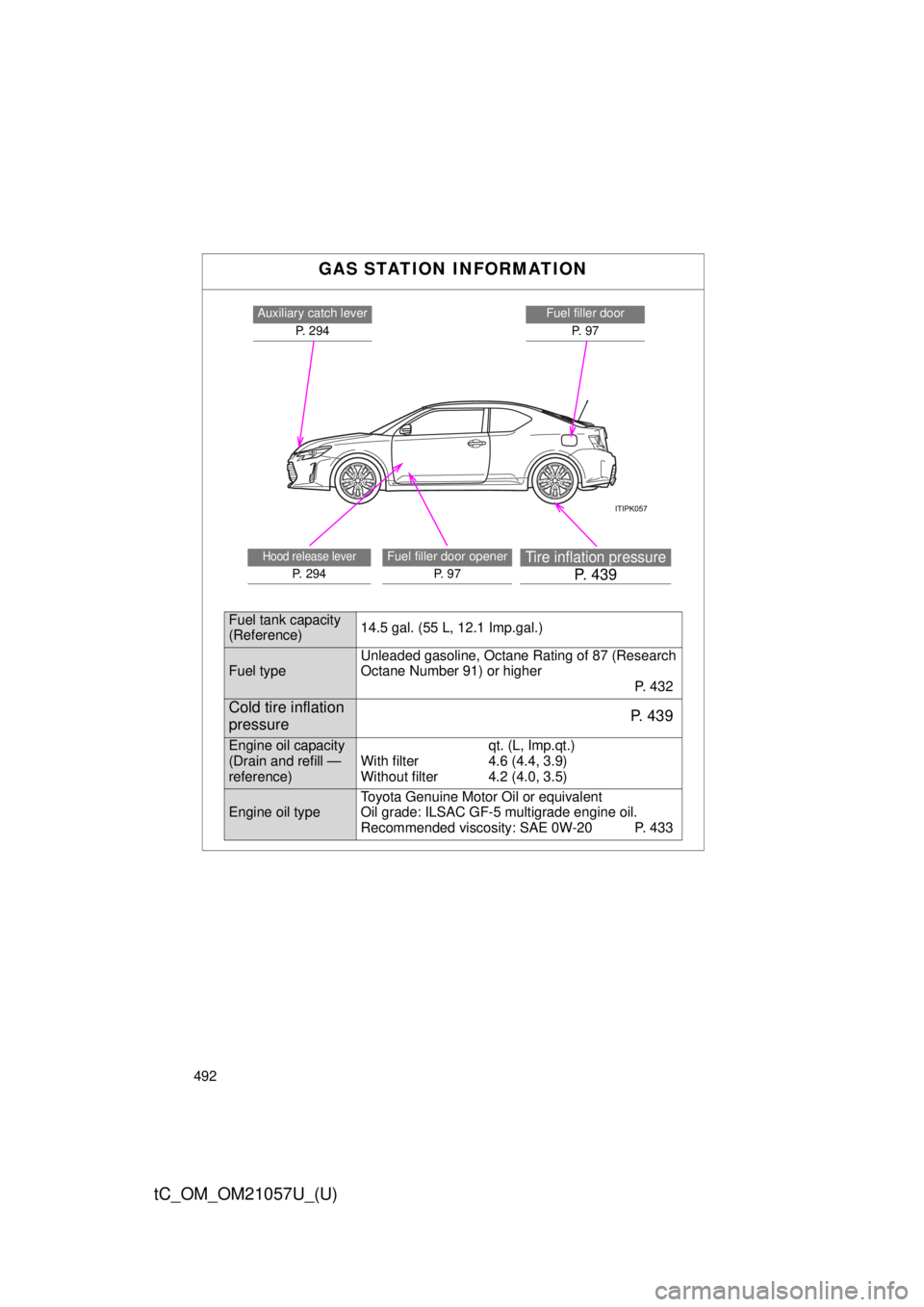
492
tC_OM_OM21057U_(U)GAS STATION INFORMATION
Auxiliary catch lever
P. 294Fuel filler doorP. 9 7
Hood release lever
P. 294
Fuel filler door opener P. 9 7Tire inflation pressure
P. 439
Fuel tank capacity
(Reference) 14.5 gal. (55 L,
12.1 Imp.gal.)
Fuel type Unleaded gasoline, Octane Rating of 87 (Research
Octane Number 91) or higher
P. 4 3 2
Cold tire inflation
pressure P. 439
Engine oil capacity
(Drain and refill —
reference)qt. (L, Imp.qt.)
With filter 4.6 (4.4, 3.9)
Without filter 4.2 (4.0, 3.5)
Engine oil type Toyota Genuine Motor Oil or equivalent
Oil grade: ILSAC GF-5 multigrade engine oil.
Recommended viscosity: SAE 0W-20 P. 433