spare wheel TOYOTA TERCEL 1999 Owners Manual
[x] Cancel search | Manufacturer: TOYOTA, Model Year: 1999, Model line: TERCEL, Model: TOYOTA TERCEL 1999Pages: 203, PDF Size: 2.59 MB
Page 140 of 203
'99 TERCEL (U)139
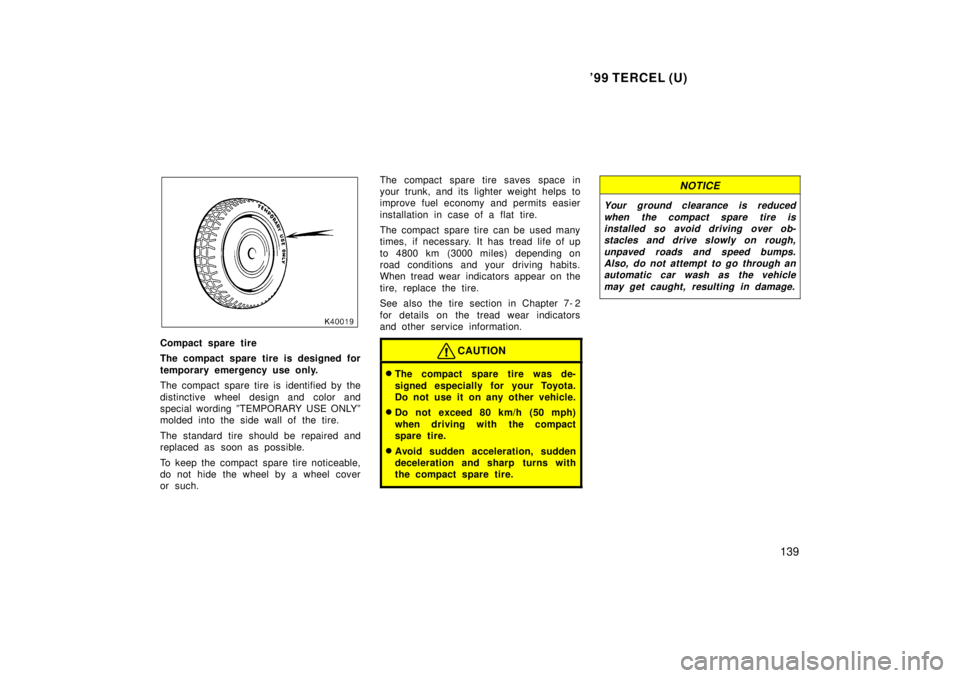
Compact spare tire
The compact spare tire is designed for
temporary emergency use only.
The compact spare tire is identified by the
distinctive wheel design and color and
special wording ºTEMPORARY USE ONLYº
molded into the side wall of the tire.
The standard tire should be repaired and
replaced as soon as possible.
To keep the compact spare tire noticeable,
do not hide the wheel by a wheel cover
or such. The compact spare tire saves space in
your trunk, and its lighter weight helps to
improve fuel economy and permits easier
installation in case of a flat tire.
The compact spare tire can be used many
times, if necessary. It has tread life of up
to 4800 km (3000 miles) depending on
road conditions and your driving habits.
When tread wear indicators appear on the
tire, replace the tire.
See also the tire section in Chapter 7- 2
for details on the tread wear indicators
and other service information.CAUTION
The compact spare tire was de-
signed especially for your Toyota.
Do not use it on any other vehicle.
Do not exceed 80 km/h (50 mph)
when driving with the compact
spare tire.
Avoid sudden acceleration, sudden
deceleration and sharp turns with
the compact spare tire.
NOTICE
Your ground clearance is reduced
when the compact spare tire isinstalled so avoid driving over ob- stacles and drive slowly on rough,
unpaved roads and speed bumps.Also, do not attempt to go through anautomatic car wash as the vehicle
may get caught, resulting in damage.
Page 141 of 203

'99 TERCEL (U)
140
1. Get the required tools and spare tire.
1 Wheel nut wrench
2 Jack
3 Jack handle
4 Spare tire
To prepare yourself for an emergency, you
should fam iliarize yourself with the use of
the jack, each of the tools and their stor-
age locations.Turn the jack joint by hand.
To remove: Turn the joint in direction 1
until the jack is free.
To store: Turn the joint in direction 2 until
the jack is firmly secured to prevent it
flying forward during a collision or s udden
braking.To remove the spare tire:
1. Remove the spare tire cover.
2. Loosen the bolt and remove it.
Then take the spare tire out of the ve-
hicle.
When storing the spare tire, put it in place
with the outer side of the wheel facing up.
Then secure the tire by repeating the
above removal steps in reverse order to
prevent it from flying forward during a
collision or s udden braking.
ÐRequired tools and spare
tire
Page 143 of 203

'99 TERCEL (U)
142
ÐLoosening wheel nuts
4. Loosen all the wheel nuts.
Always loosen the wheel nuts before rais-
ing the vehicle.
The nuts turn counterclockwise to loosen.
To get maximum leverage, fit the wrench
to the nut so that the handle is on the
right side, as shown above. Grab the
wrench near the end of the handle and
pull up on the handle. Be careful that the
wrench does not slip off the nut.
Do not remove the nuts yetÐjust unscrew
them about one- half turn. ÐPositioning the jack5. Position the jack at the correct jack
point as shown.
Make sure the jack is positioned on a
level and solid place. ÐRaising your vehicle6. After making sure that no one is in
the vehicle, raise it high enough so
that the spare tire can be installed.
Remember you will need more ground
clearance when putting on the spare tire
than when removing the flat tire.
To raise the vehicle, insert the jack handle
into the jack (it is a loose fit) and turn it
clockwise. As the jack touches the vehicle
and begins to lift, double- check that it is
properly positioned.
Page 144 of 203
'99 TERCEL (U)143
CAUTION
Never get under the vehicle when the
vehicle is supported by the jack
alone.
ÐChanging wheels
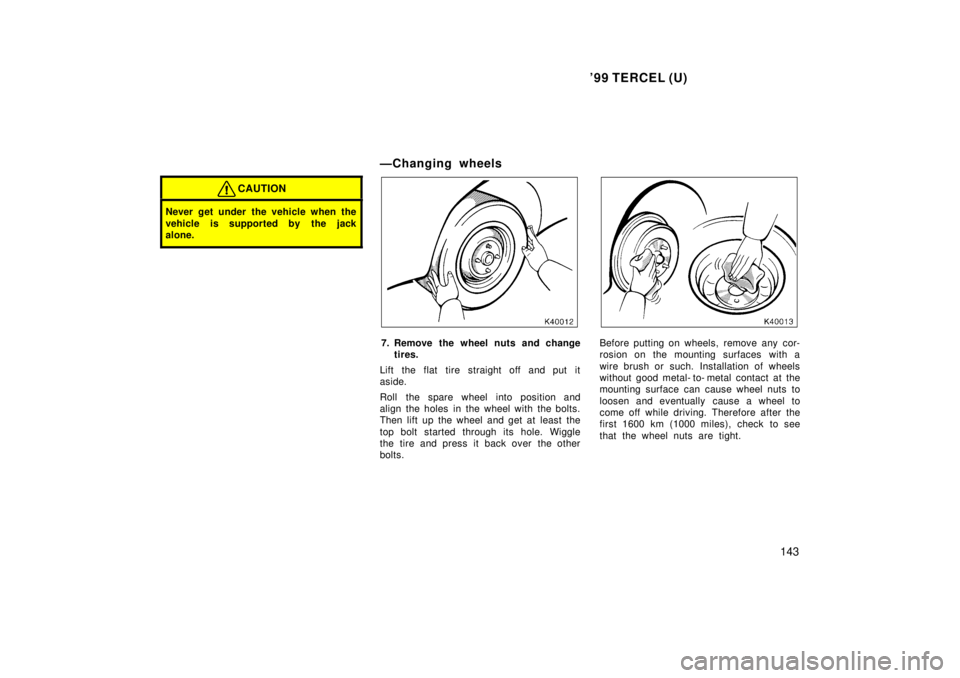
7. Remove the wheel nuts and changetires.
Lift the flat tire straight off and put it
aside.
Roll the spare wheel into position and
align the holes in the wheel with the bolts.
Then lift up the wheel and get at least the
top bolt started through its hole. Wiggle
the tire and press it back over the other
bolts.Before putting on wheels, remove any cor-
rosion on the mounting surfaces with a
wire brush or such. Installation of wheels
without good metal- to- metal contact at the
mounting surface can cause wheel nuts to
loosen and eventually cause a wheel to
come off while driving. Therefore after the
first 1600 km (1000 miles), check to see
that the wheel nuts are tight.
Page 146 of 203
'99 TERCEL (U)145
ÐReinstalling wheel ornament
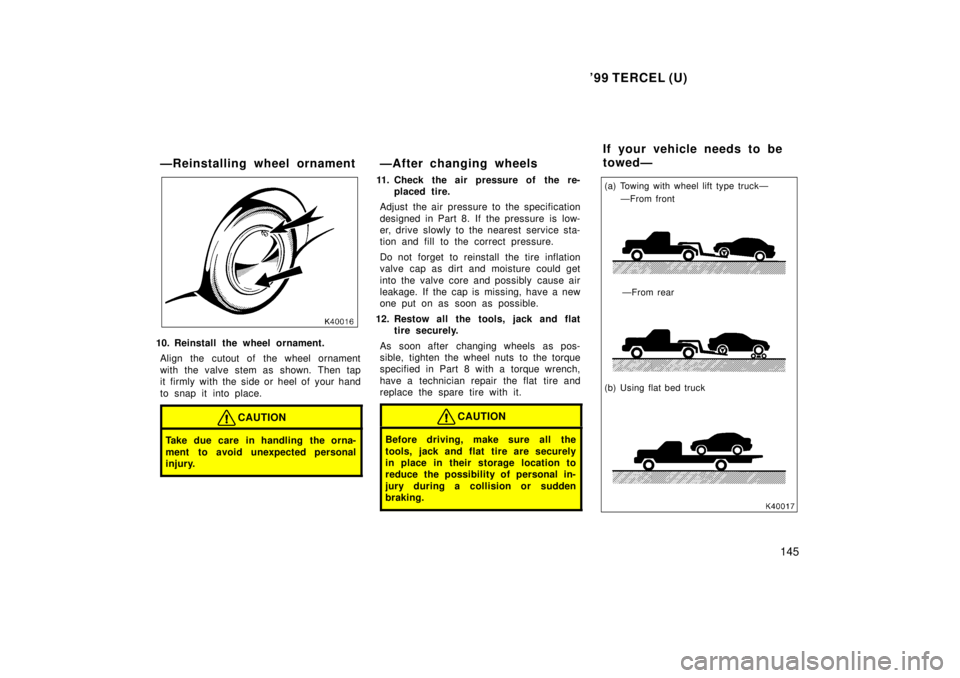
10. Reinstall the wheel ornament.
Align the cutout of the wheel ornament
with the valve stem as shown. Then tap
it firmly with the side or heel of your hand
to snap it into place.
CAUTION
Take due care in handling the orna-
ment to avoid unexpected personal
injury.
ÐAfter changing wheels
11. Check the air pressure of the re- placed tire.
Adjust the air pressure to the specification
designed in Part 8. If the pressure is low-
er, drive slowly to the nearest service sta-
tion and fill to the correct pressure.
Do not forget to reinstall the tire inflation
valve cap as dirt and moisture could get
into the valve core and possibly cause air
leakage. If the cap is missing, have a new
one put on as soon as possible.
12. Restow all the tools, jack and flat tire securely.
As soon after changing wheels as pos-
sible, tighten the wheel nuts to the torque
specified in Part 8 with a torque wrench,
have a technician repair the flat tire and
replace the spare tire with it.
CAUTION
Before driving, make sure all the
tools, jack and flat tire are securely
in place in their storage location to
reduce the possibility of personal in-
jury during a collision or s udden
braking.
ÐFrom front
ÐFrom rear
(a) Towing with wheel lift type truckÐ
(b) Using flat bed truck
If your vehicle needs to be
towedÐ
Page 178 of 203
'99 TERCEL (U)177
Check the tires regularly for damage
such as cuts, splits and cracks. If any
damage is found, consult with a techni-
cian and have the tire repaired or re-
placed.
Even if the damage does not appear seri-
ous, a qualified technician should examine
the damage. Objects which have pene-
trated the tire may have caused internal
damage.
Any tires which are over six years old
must be checked by a qualified techni-
cian even if damage is not obvious.
Tires deteriorate with age even if they
have never or seldom been used.
This also applies to the spare tire and
tires stored for future use.
REPLACING YOUR TIRES
When replacing a tire, use only the
same size and construction as original-
ly installed and with the same or great-
er load capacity.
Using any other size or type of tire may
seriously affect handling, ride, speedome-
ter/odometer calibration, ground clearance,
and clearance between the body and tires
or snow chains.
CAUTION
Do not mix radial, bias belted, or
bias- ply tires on your vehicle. It
can cause dangerous handling char-
acteristics, resulting in loss of con-
trol.
Do not use tires or wheels other
than the manufacturer 's recom-
mended size.
Toyota recommends all four tires, or at
least both of the front or rear tires be
replaced at a time as a set.
See ºIf you have a flat tireº in Part 4 for
tire change procedure.
When a tire is replaced, the wheel
should always be balanced.
An unbalanced wheel may affect vehicle
handling and tire life. Wheels can get out
of balance with regular use and should
therefore be balanced occasionally.
When replacing a tubeless tire, the air
valve should also be replaced with a
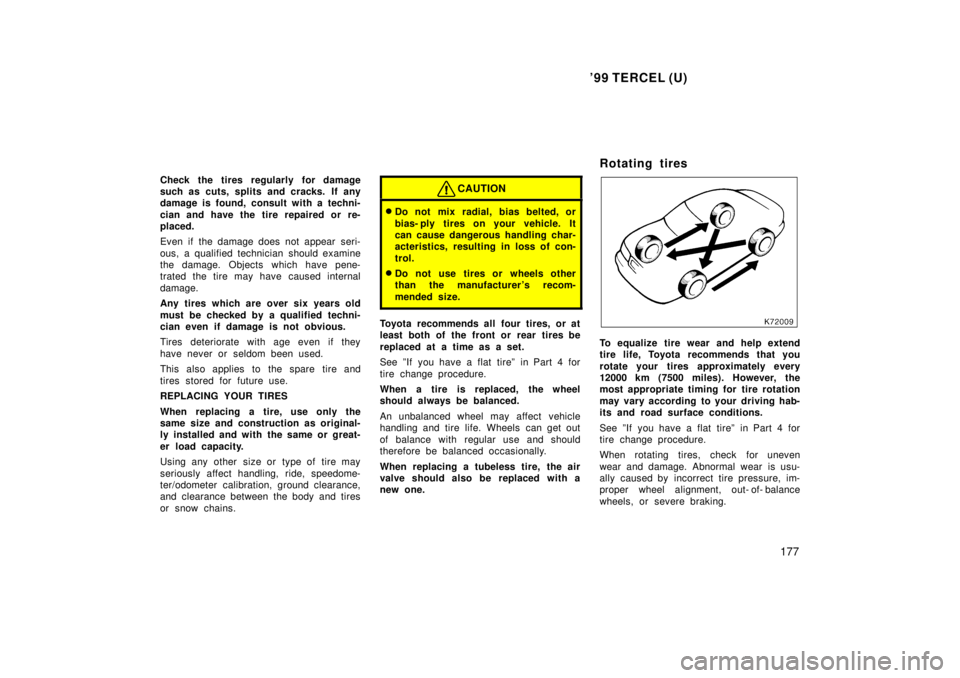
new one. Rotating tires
To equalize tire wear and help extend
tire life, Toyota recommends that you
rotate your tires approximately every
12000 km (7500 miles). However, the
most appropriate timing for tire rotation
may vary according to your driving hab-
its and road surface conditions.
See ºIf you have a flat tireº in Part 4 for
tire change procedure.
When rotating tires, check for uneven
wear and damage. Abnormal wear is usu-
ally caused by incorrect tire pressure, im-
proper wheel alignment, out- of- balance
wheels, or severe braking.
Page 179 of 203
'99 TERCEL (U)
178
CAUTION
Do not include a compact spare tire
when rotating the tires. It is designed
for temporary use only.
WHEN TO USE SNOW TIRES OR
CHAINS
Snow tires or chains are recommended
when driving on snow or ice.
On wet or dry roads, conventional tires
provide better traction than snow tires.
SNOW TIRE SELECTION
If you need snow tires, select the same
size, construction and load capacity as
the original tires on your Toyota.
Do not use tires other than those men-
tioned above. Do not install studded tires
without first checking local regulations for
possible restrictions.
SNOW TIRE INSTALLATION
Snow tires should be installed on all
wheels.
Installing snow tires on the front w heels
only can lead to an excessive difference
in road grip capab ility between the front
and rear tires which could cause loss of
vehicle control.
When storing removed tires, you should
store them in a cool dry place. Mark the direction of rotation and be sure
to install them in the same direction when
replacing.
CAUTION
Do not drive with the snow tires
incorrectly inflated.
Never drive over 120 km/h (75 mph)
with any type of snow tires.
TIRE CHAIN SELECTION
Use the tire chains of correct size and
type.
Use SAE Class ºSº type radial tire chains
except radial cable chains or V- bar type
chains.
Regulations regarding the use of tire
chains vary according to location or
type of road, so always check them
before installing chains.
CHAIN INSTALLATION
Install the chains on the front tires as
tightly as possible. Do not use tire
chains on the rear tires. Retighten
chains after driving 0.5Ð1.0 km
(1/4Ð1/2 mile).
Installing snow tires and
chains
Page 180 of 203
'99 TERCEL (U)179
When installing chains on your tires, care-
fully follow the instructions of the chain
manufacturer.
If wheel covers are used, they will be
scratched by the chain band, so remove
the covers before putting on the chains.
CAUTION
Do not exceed 50 km/h (30 mph) or
the chain manufacturer 's recom-
mended speed limit, whichever is
lower.
Drive carefully avoiding bumps,
holes, and sharp turns, which may
cause the vehicle to bounce.
Avoid sharp turns or locked- wheel
braking, as use of chains may ad-
versely affect vehicle handling.
NOTICE
Do not attempt to use a tire chain on
the compact spare tire, as it may re-sult in damage to the vehicle as wellas the tire.
Replacing wheels
WHEN TO REPLACE YOUR WHEELS
If you have wheel damage such as
bending, cracks or heavy corrosion, the
wheel should be replaced.
If you fail to replace damaged wheels, the
tire may slip off the wheel or they may
cause loss of handling control.
WHEEL SELECTION
When replacing wheels, care should be
taken to ensure that the wheels are re-
placed by ones with the same load ca-
pacity, diameter, rim width, and offset.
This must be observed on compact spare
tires, too.
Correct replacement wheels are available
at your Toyota dealer.
A wheel of a different size or type may
adversely affect handling, wheel and bear-
ing life, brake cooling, speedometer/odom-
eter calibration, stopping ab ility, headlight
aim, bumper height, vehicle ground clear-
ance, and tire or snow chain clearance to
the body and chassis. Replacement with used wheels is not rec-
ommended as they may have been sub-
jected to rough treatment or high mileage
and could fail without warning. Also, bent
wheels which have been straightened may
have structural damage and therefore
should not be used. Never use an inner
tube in a leaking wheel which is designed
for a tubeless tire.
Page 195 of 203

'99 TERCEL (U)
194
Tires
Tire size:
Spare tire T115/70D14 88M
T105/70D14 83M
Except spare tire 155SR13 (155/80R 79S)
P185/60R14 82H
P175/65R14 81S
Tire pressure, kPa (kgf/cm 2
or bar, psi):
Spare tire 420 (4.2, 60)
Except spare tire 155SR13 (155/80R 79S) Front 240 (2.4, 34)
Rear 220 (2.2, 32)
P185/60R14 82H
180 (1.8, 26)
P175/65R14 81S 200 (2.0, 28)
Wheel size: Spare tire 14 4T
Except spare tire 155 SR13 13 4 1/2J
P185/60R14 82H 14 5 1/2J
P175/65R14 81S 14 5 1/2J
Wheel nut torque, N´m (kgf´m, ft´lbf):
103 (10.5, 76) Fuses
Engine compartment (U.S.A.)
Fuses (type A) 1. HEAD (LH) 10 A: Left- hand headlight
2. HEAD (RH) 10 A: Right- hand headlight
3. AM2 15 A: Ignition system, charging
system, multiport fuel injection sys-
tem/sequential multiport fuel injection
system, SRS airbag system, seat belt
pretensioners, starter system
4. HAZ- HORN 15 A: Horns, emergency
flashers, theft deterrent system
5. EFI 15 A: Multiport fuel injection sys-
tem/sequential multiport fuel injection
systemEngine compartment (Canada)
6. DOME 10 A: Interior lights, open door
warning light, clock, car audio system,
theft deterrent system, daytime running
light system
7. OBD- II 7.5 A: On- board diagnosis sys-
tem
8. ALT- S 5 A: Charging system
9. DRL 5 A: Daytime running light system
10. HEAD (RH- LWR) 10 A: Right- hand
headlight (low beam)
11. HEAD (LH- LWR) 10 A: Left- hand
headlight (low beam)
12. HEAD (RH- UPR) 10 A: Right- hand
headlight (high beam)