ECU TOYOTA TUNDRA 2001 Owner's Guide
[x] Cancel search | Manufacturer: TOYOTA, Model Year: 2001, Model line: TUNDRA, Model: TOYOTA TUNDRA 2001Pages: 297, PDF Size: 3.21 MB
Page 219 of 297
'01 TUNDRA_U (L/O 0008)
2112001 TUNDRA (OM 34416U)
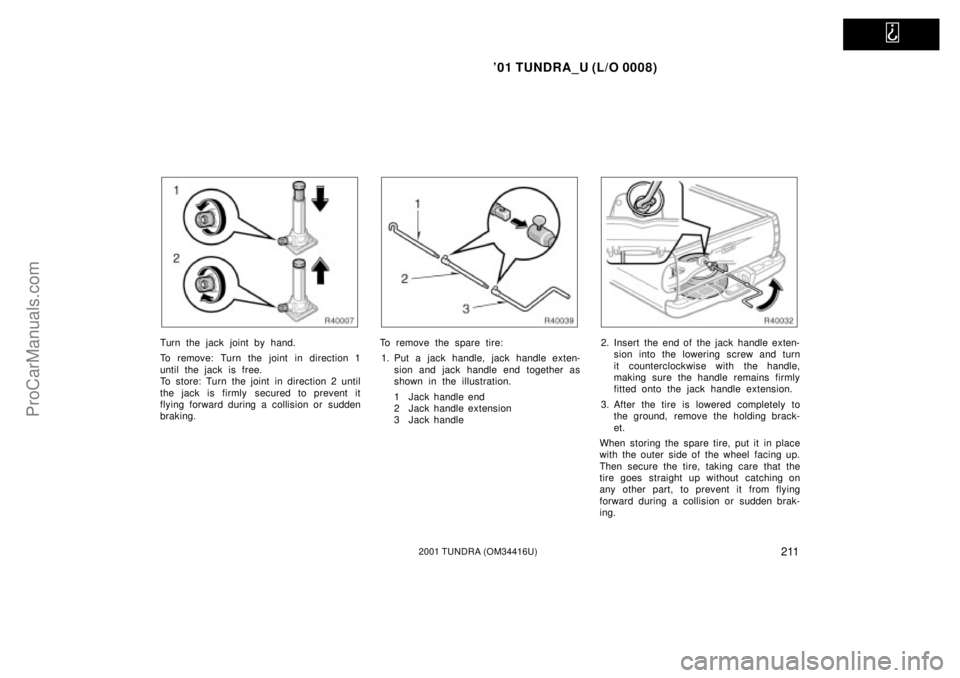
Turn the jack joint by hand.
To remove: Turn the joint in direction 1
until the jack is free.
To store: Turn the joint in direction 2 until
the jack is firmly secured to prevent it
flying forward during a collision or s udden
braking.To remove the spare tire:
1. Put a jack handle, jack handle exten- sion and jack handle end together as
shown in the illustration.
1 Jack handle end
2 Jack handle extension
3 Jack handle2. Insert the end of the jack handle exten-sion into the lowering screw and turn
it counterclockwise with the handle,
making sure the handle remains firmly
fitted onto the jack handle extension.
3. After the tire is lowered completely to the ground, remove the holding brack-
et.
When storing the spare tire, put it in place
with the outer side of the wheel facing up.
Then secure the tire, taking care that the
tire goes straight up without catching on
any other part, to prevent it from flying
forward during a collision or s udden brak-
ing.
ProCarManuals.com
Page 223 of 297
'01 TUNDRA_U (L/O 0008)
2152001 TUNDRA (OM 34416U)
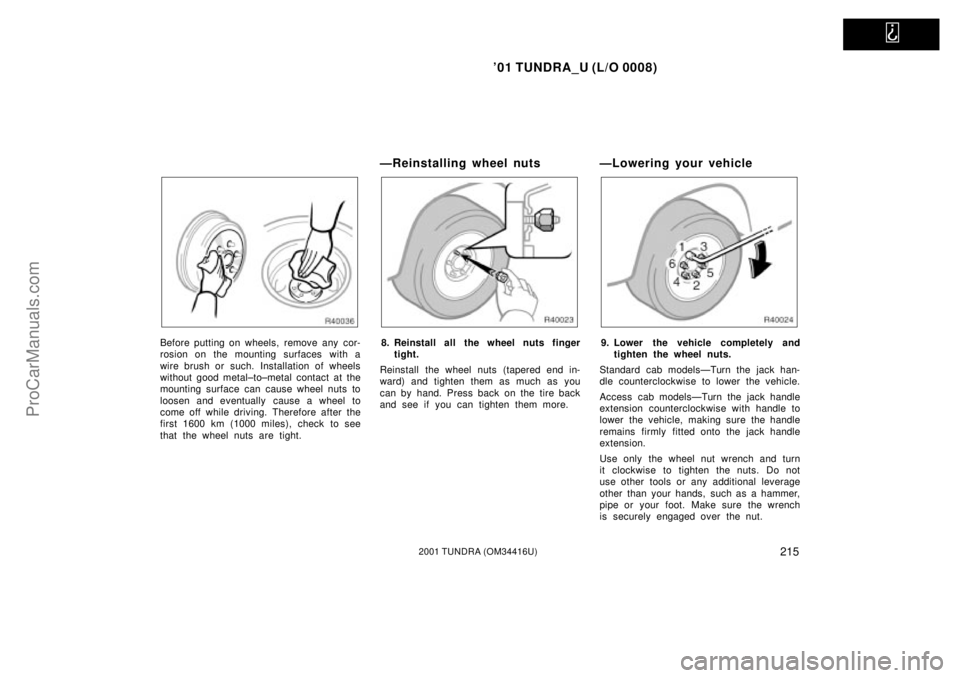
Before putting on wheels, remove any cor-
rosion on the mounting surfaces with a
wire brush or such. Installation of wheels
without good metal±to±metal contact at the
mounting surface can cause wheel nuts to
loosen and eventually cause a wheel to
come off while driving. Therefore after the
first 1600 km (1000 miles), check to see
that the wheel nuts are tight.
ÐReinstalling wheel nuts
8. Reinstall all the wheel nuts finger
tight.
Reinstall the wheel nuts (tapered end in-
ward) and tighten them as much as you
can by hand. Press back on the tire back
and see if you can tighten them more.
ÐLowering your vehicle
9. Lower the vehicle completely and tighten the wheel nuts.
Standard cab modelsÐTurn the jack han-
dle counterclockwise to lower the vehicle.
Access cab modelsÐTurn the jack handle
extension counterclockwise with handle to
lower the vehicle, making sure the handle
remains firmly fitted onto the jack handle
extension.
Use only the wheel nut wrench and turn
it clockwise to tighten the nuts. Do not
use other tools or any additional leverage
other than your hands, such as a hammer,
pipe or your foot. Make sure the wrench
is securely engaged over the nut.
ProCarManuals.com
Page 225 of 297
'01 TUNDRA_U (L/O 0008)
2172001 TUNDRA (OM 34416U)
ÐAfter changing wheels
11. Check the air pressure of the re-
placed tire.
Adjust the air pressure to the specification
designated in Section 8. If the pressure is
lower, drive slowly to the nearest service
station and fill to the correct pressure.
Do not forget to reinstall the tire inflation
valve cap as dirt and moisture could get
into the valve core and possibly cause air
leakage. If the cap is missing, have a new
one put on as soon as possible.
12. Restow all the tools, jack and flat tire securely.
As soon after changing wheels as pos-
sible, tighten the wheel nuts to the torque
specified in Section 8 with a torque
wrench. Have a technician repair the flat
tire.
CAUTION
Before driving, make sure all the
tools, jack and flat tire are securely
in place in their storage location to
reduce the possibility of personal in-
jury during a collision or s udden
braking.
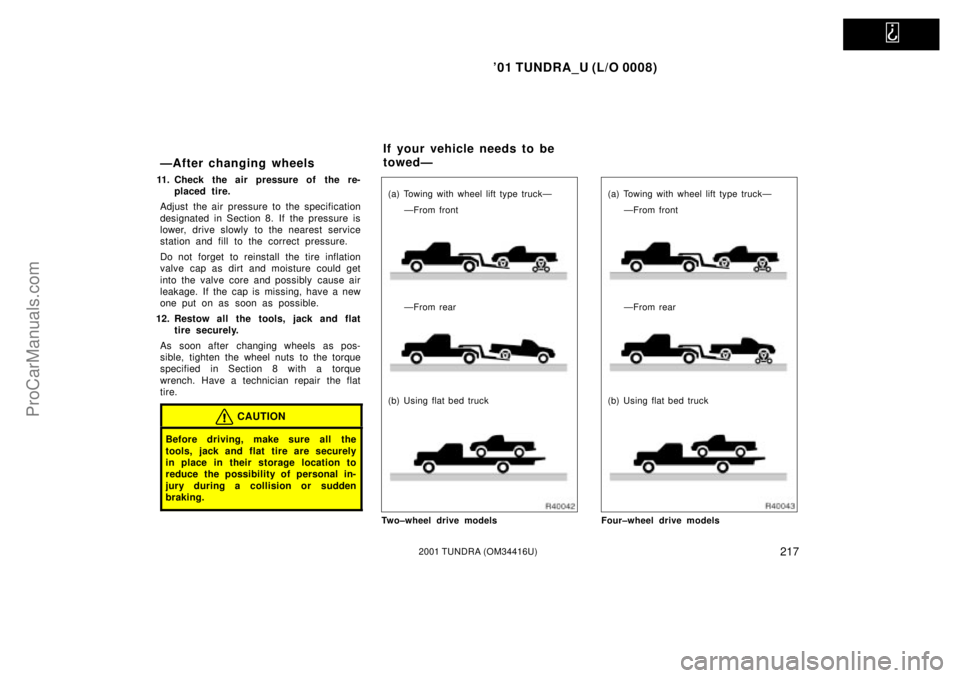
(a) Towing with wheel lift type truckÐ
ÐFrom front
ÐFrom rear
(b) Using flat bed truck
Two±wheel drive models
(b) Using flat bed truck (a) Towing with wheel lift type truckÐ ÐFrom front
ÐFrom rear
Four±wheel drive models
If your vehicle needs to be
towedÐ
ProCarManuals.com
Page 228 of 297
'01 TUNDRA_U (L/O 0008)
2202001 TUNDRA (OM 34416U)
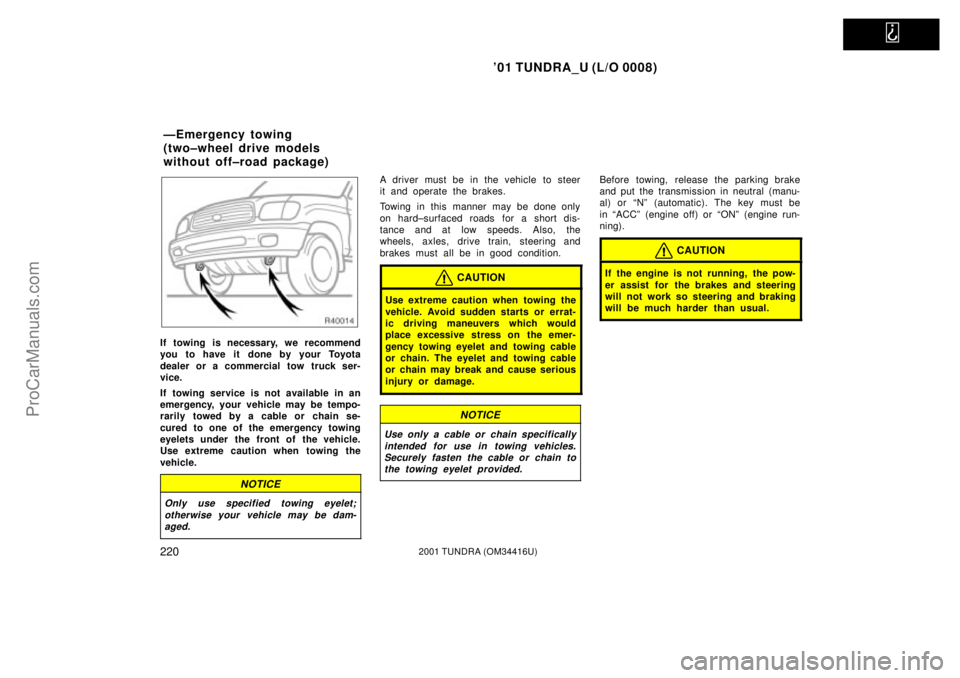
If towing is necessary, we recommend
you to have it done by your Toyota
dealer or a commercial tow truck ser-
vice.
If towing service is not available in an
emergency, your vehicle may be tempo-
rarily towed by a cable or chain se-
cured to one of the emergency towing
eyelets under the front of the vehicle.
Use extreme caution when towing the
vehicle.
NOTICE
Only use specified towing eyelet;
otherwise your vehicle may be dam-aged.
A driver must be in the vehicle to steer
it and operate the brakes.
Towing in this manner may be done only
on hard±surfaced roads for a short dis-
tance and at low speeds. Also, the
wheels, axles, drive train, steering and
brakes must all be in good condition.
CAUTION
Use extreme caution when towing the
vehicle. Avoid sudden starts or errat-
ic driving maneuvers which would
place excessive stress on the emer-
gency towing eyelet and towing cable
or chain. The eyelet and towing cable
or chain may break and cause serious
injury or damage.
NOTICE
Use only a cable or chain specifically
intended for use in towing vehicles.Securely fasten the cable or chain tothe towing eyelet provided.
Before towing, release the parking brake
and put the transmission in neutral (manu-
al) or ªNº (automatic). The key must be
in ªACCº (engine off) or ªONº (engine run-
ning).
CAUTION
If the engine is not running, the pow-
er assist for the brakes and steering
will not work so steering and braking
will be much harder than usual.
ÐEmergency towing
(two±wheel drive models
without off±road p ackage)
ProCarManuals.com
Page 229 of 297
'01 TUNDRA_U (L/O 0008)
2212001 TUNDRA (OM 34416U)
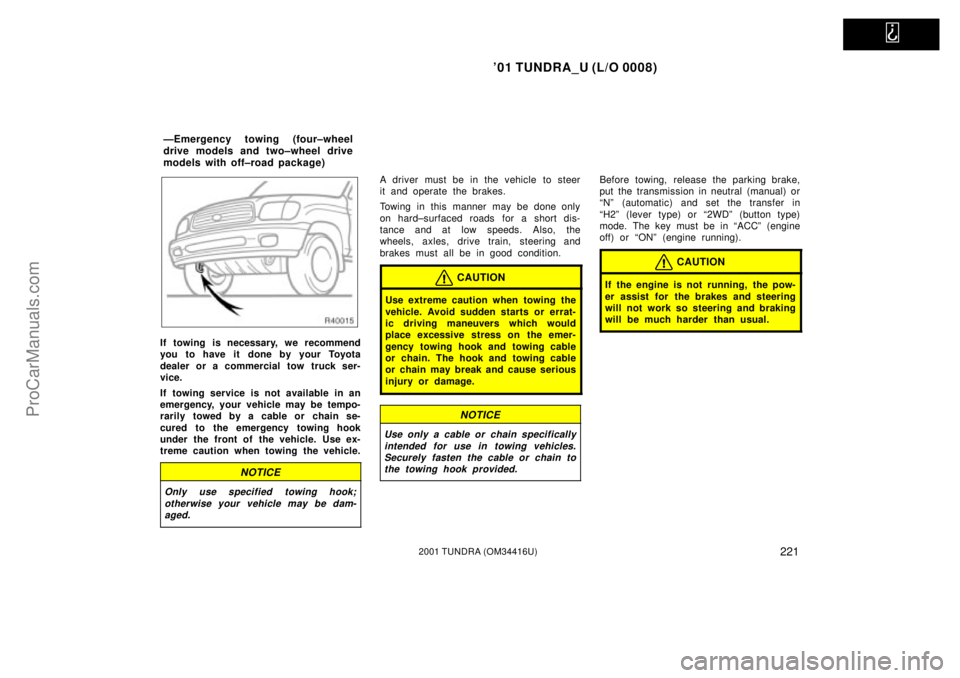
If towing is necessary, we recommend
you to have it done by your Toyota
dealer or a commercial tow truck ser-
vice.
If towing service is not available in an
emergency, your vehicle may be tempo-
rarily towed by a cable or chain se-
cured to the emergency towing hook
under the front of the vehicle. Use ex-
treme caution when towing the vehicle.
NOTICE
Only use specified towing hook;
otherwise your vehicle may be dam-aged.
A driver must be in the vehicle to steer
it and operate the brakes.
Towing in this manner may be done only
on hard±surfaced roads for a short dis-
tance and at low speeds. Also, the
wheels, axles, drive train, steering and
brakes must all be in good condition.
CAUTION
Use extreme caution when towing the
vehicle. Avoid sudden starts or errat-
ic driving maneuvers which would
place excessive stress on the emer-
gency towing hook and towing cable
or chain. The hook and towing cable
or chain may break and cause serious
injury or damage.
NOTICE
Use only a cable or chain specifically
intended for use in towing vehicles.Securely fasten the cable or chain tothe towing hook provided.
Before towing, release the parking brake,
put the transmission in neutral (manual) or
ªNº (automatic) and set the transfer in
ªH2º (lever type) or ª2WDº (button type)
mode. The key must be in ªACCº (engine
off) or ªONº (engine running).
CAUTION
If the engine is not running, the pow-
er assist for the brakes and steering
will not work so steering and braking
will be much harder than usual.
ÐEmergency towing (four±wheel
drive models and two±wheel drive
models with off±road package)
ProCarManuals.com
Page 241 of 297
'01 TUNDRA_U (L/O 0008)
2332001 TUNDRA (OM 34416U)
What about do±it±yourself maintenance?
Many of the maintenance items are easy
to do yourself if you have a little mechani-
cal ability and a few basic automotive
tools. Simple instructions for how to per-
form them are presented in Section 7.
If you are a skilled do±it±yourself mechan-
ic, the Toyota service manuals are recom-
mended. Please be aware that do±it±your-
self maintenance can affect your warranty
coverage. See ªOwner 's Warranty Informa-
tion Bookletº or ªOwner 's Manual Supple-
mentº for the details.
General maintenance
Listed below are the general maintenance
items that should be performed as fre-
quently as specified. In addition to check-
ing the items listed, if you notice any
unusual noise, smell or vibration, you
should investigate the cause or take your
vehicle to your Toyota dealer or a quali-
fied service shop immediately. It is recom-
mended that any problem you notice be
brought to the attention of your dealer or
the qualified service shop for their advice.
CAUTION
Make these checks only where ade-
quate ventilation can be obtained if
you run the engine.
OUTSIDE THE VEHICLE
Items listed below should be performed
from time to time, unless otherwise
specified.
Tire pressure
Check the pressure with a gauge every
two weeks, or at least once a month. See
Section 7±2 for additional information. Tire surface and wheel nuts
Check the tires carefully for cuts, damage
or excessive wear. See Section 7±2 for
additional information. When checking the
tires, make sure no nuts are missing, and
check the nuts for looseness. Tighten
them if necessary.
Tire rotation
Rotate the tires according to the mainte-
nance schedule. (For scheduled mainte-
nance information, please refer to the
ªScheduled Maintenance Guideº or ªOwn-
er 's Manual Supplementº.). See Section
7±2 for additional information.
Fluid leaks
Check underneath for leaking fuel, oil, wa-
ter or other fluid after the vehicle has
been parked for a while. If you smell fuel
fumes or notice any leak, have the cause
found and corrected immediately.
Doors and engine hood
Check that all doors including tailgate op-
erate smoothly and all latches lock se-
curely. Make sure the engine hood sec-
ondary latch secures the hood from
opening when the primary latch is re-
leased.
ProCarManuals.com
Page 242 of 297

'01 TUNDRA_U (L/O 0008)
2342001 TUNDRA (OM 34416U)
INSIDE THE VEHICLE
Items listed below should be checked
regularly, e.g. while performing periodic
services, cleaning the vehicle, etc.
Lights
Make sure the headlights, stop lights, tail
lights, turn signal lights, and other lights
are all working. Check headlight aim.
Service reminder indicators and warning
buzzers
Check that all service reminder indicators
and warning buzzers function properly.
Steering wheel
Be alert for changes in steering condition,
such as hard steering or strange noise.
Seats
Check that all seat controls such as seat
adjusters, seatback recliner, etc. operate
smoothly and that all latches lock securely
in any position. Check that the head re-
straints move up and down smoothly and
that the locks hold securely in any latched
position. For folding±down seatback
(bench seat), check that the latches lock
securely. Seat belts
Check that the seat belt system such as
buckles, retractors and anchors operate
properly and smoothly. Make sure the belt
webbing is not cut, frayed, worn or dam-
aged.
Accelerator pedal
Check the pedal for smooth operation and
uneven pedal effort or catching.
Clutch pedal
Check the pedal for smooth operation.
Brake pedal
Check the pedal for smooth operation and
that the pedal has the proper clearance.
Check the brake booster function.
Brakes
At a safe place, check that the brakes do
not pull to one side when applied.
Parking brake (pedal type)
Check that the pedal has the proper travel
and that, on a safe incline, your vehicle
is held securely with only the parking
brake applied.
Parking brake (lever type)
Check that the lever has the proper travel
and that, on a safe incline, your vehicle
is held securely with only the parking
brake applied.
Automatic transmission ªParkº mecha-
nism
On a safe incline, check that your vehicle
is held securely with the selector lever in
ªPº position and all brakes released.
IN THE ENGINE COMPARTMENT
Items listed below should be checked
from time to time, e.g. each time when
refueling.
Washer fluid
Make sure there is sufficient fluid in the
tank. See Section 7±3 for additional in-
formation.
Engine coolant level
Make sure the coolant level is between
the ªFº and ªLº lines on the see±through
reservoir when the engine is cold. See
Section 7±2 for additional information.
ProCarManuals.com
Page 287 of 297
'01 TUNDRA_U (L/O 0008)
2792001 TUNDRA (OM 34416U)
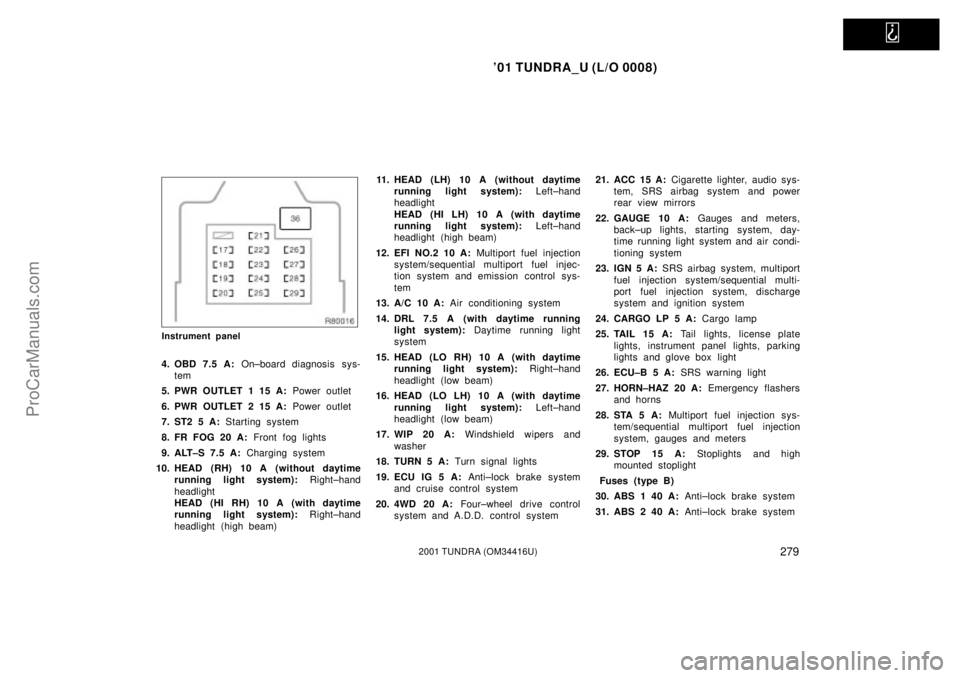
Instrument panel
4. OBD 7.5 A: On±board diagnosis sys-
tem
5. PWR OUTLET 1 15 A: Power outlet
6. PWR OUTLET 2 15 A: Power outlet
7. ST2 5 A: Starting system
8. FR FOG 20 A: Front fog lights
9. ALT±S 7.5 A: Charging system
10. HEAD (RH) 10 A (without daytime running light system): Right±hand
headlight
HEAD (HI RH) 10 A (with daytime
running light system): Right±hand
headlight (high beam) 11. HEAD (LH) 10 A (without daytime
running light system): Left±hand
headlight
HEAD (HI LH) 10 A (with daytime
running light system): Left±hand
headlight (high beam)
12. EFI NO.2 10 A: Multiport fuel injection
system/s equential multiport fuel injec-
tion system and emission control sys-
tem
13. A/C 10 A: Air conditioning system
14. DRL 7.5 A (with daytime running light system): Daytime running light
system
15. HEAD (LO RH) 10 A (with daytime running light system): Right±hand
headlight (low beam)
16. HEAD (LO LH) 10 A (with daytime running light system): Left±hand
headlight (low beam)
17. WIP 20 A: Windshield wipers and
washer
18. TURN 5 A: Turn signal lights
19. ECU IG 5 A: Anti±lock brake system
and cruise control system
20. 4WD 20 A: Four±wheel drive control
system and A.D.D. control system 21. ACC 15 A:
Cigarette lighter, audio sys-
tem, SRS airbag system and power
rear view mirrors
22. GAUGE 10 A: Gauges and meters,
back±up lights, starting system, day-
time running light system and air condi-
tioning system
23. IGN 5 A: SRS airbag system, multiport
fuel injection system/sequential multi-
port fuel injection system, discharge
system and ignition system
24. CARGO LP 5 A: Cargo lamp
25. TAIL 15 A: Tail lights, license plate
lights, instrument panel lights, parking
lights and glove box light
26. ECU±B 5 A: SRS warning light
27. HORN±HAZ 20 A: Emergency flashers
and horns
28. STA 5 A: Multiport fuel injection sys-
tem/sequential multiport fuel injection
system, g auges and meters
29. STOP 15 A: Stoplights and high
mounted stoplight
Fuses (type B)
30. ABS 1 40 A: Anti±lock brake system
31. ABS 2 40 A: Anti±lock brake system
ProCarManuals.com
Page 288 of 297

'01 TUNDRA_U (L/O 0008)
2802001 TUNDRA (OM 34416U)
32. J/B 50 A: All components in ªPWRº,
ªHORN´HAZº, ªTAILº, ªCARGO LPº,
ªSTOPº and ªECU±Bº fuses
33. AM2 40 A: Ignition system
34. AM1 40 A: Starting system
35. HTR 50 A: Air conditioning system
36. POWER 30 A: Power door lock sys-
tem, power windows and power seat
37. FL 30 A: Trailer lights
Fuse (type C)
38. ALT 120 A: All components in ªAM1º,
ªALT±Sº, ªHTRº, ªFR FOGº, ªPWR
OUTLET 1º and ªPWR OUTLET 2º
fuses
ProCarManuals.com
Page 293 of 297
'01 TUNDRA_U (L/O 0008)
2852001 TUNDRA (OM 34416U)
The total cargo load should not exceed
the truck's cargo weight rating and the
camper 's center of gravity should fall with-
in the truck's recommended center of
gravity zone when installed.
CAUTION
Be carefulÐoverloading can cause
dangerous braking and handling prob-
lems, and can damage your vehicle
and its tires.
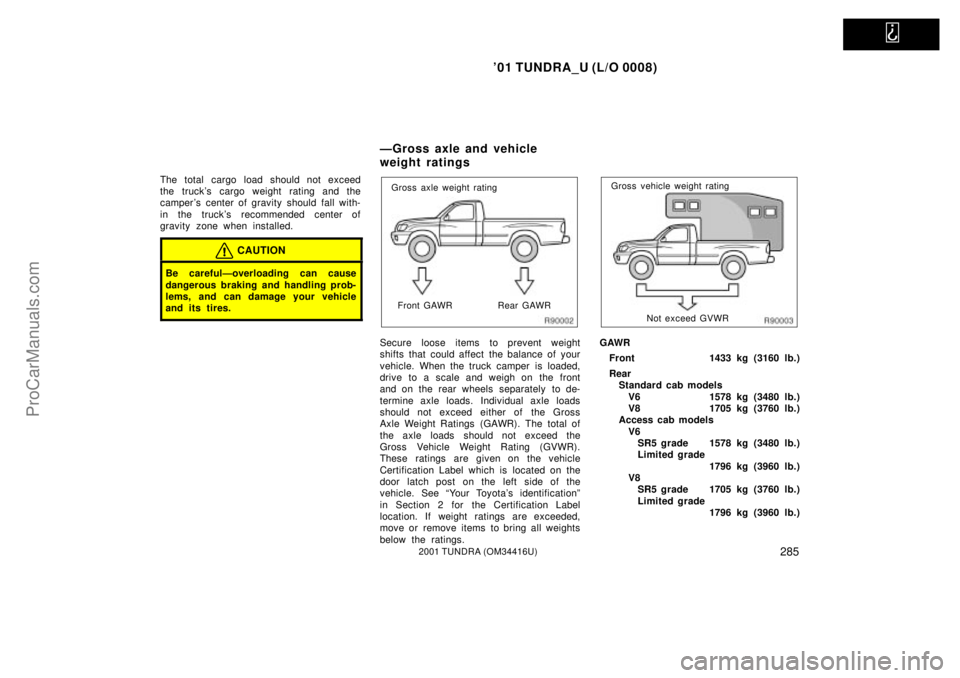
Gross axle weight rating
Front GAWR Rear GAWR
Secure loose items to prevent weight
shifts that could affect the balance of your
vehicle. When the truck camper is loaded,
drive to a scale and weigh on the front
and on the rear wheels separately to de-
termine axle loads. Individual axle loads
should not exceed either of the Gross
Axle Weight Ratings (GAWR). The total of
the axle loads should not exceed the
Gross Vehicle Weight Rating (GVWR).
These ratings are given on the vehicle
Certification Label which is located on the
door latch post on the left side of the
vehicle. See ªYour Toyota's identificationº
in Section 2 for the Certification Label
location. If weight ratings are exceeded,
move or remove items to bring all weights
below the ratings.
Gross vehicle weight rating
Not exceed GVWR
GAWRFront 1433 kg (3160 lb.)
RearStandard cab models
V6 1578 kg (3480 lb.)
V8 1705 kg (3760 lb.)
Access cab models
V6SR5 grade 1578 kg (3480 lb.)
Limited grade
1796 kg (3960 lb.)
V8 SR5 grade 1705 kg (3760 lb.)
Limited grade 1796 kg (3960 lb.)
ÐGross axle and vehicle
weight ratings
ProCarManuals.com