engine TOYOTA TUNDRA 2011 2.G Owners Manual
[x] Cancel search | Manufacturer: TOYOTA, Model Year: 2011, Model line: TUNDRA, Model: TOYOTA TUNDRA 2011 2.GPages: 732, PDF Size: 16.65 MB
Page 565 of 732
565
4-3. Do-it-yourself maintenance
4
Maintenance and care
Checking and replacing fuses
If any of the electrical components do not operate, a fuse may have
blown. If this happens, check and replace the fuses as necessary.
Turn the engine switch off.
The fuses are located in the following places. To check the
fuses, follow the in structions below.
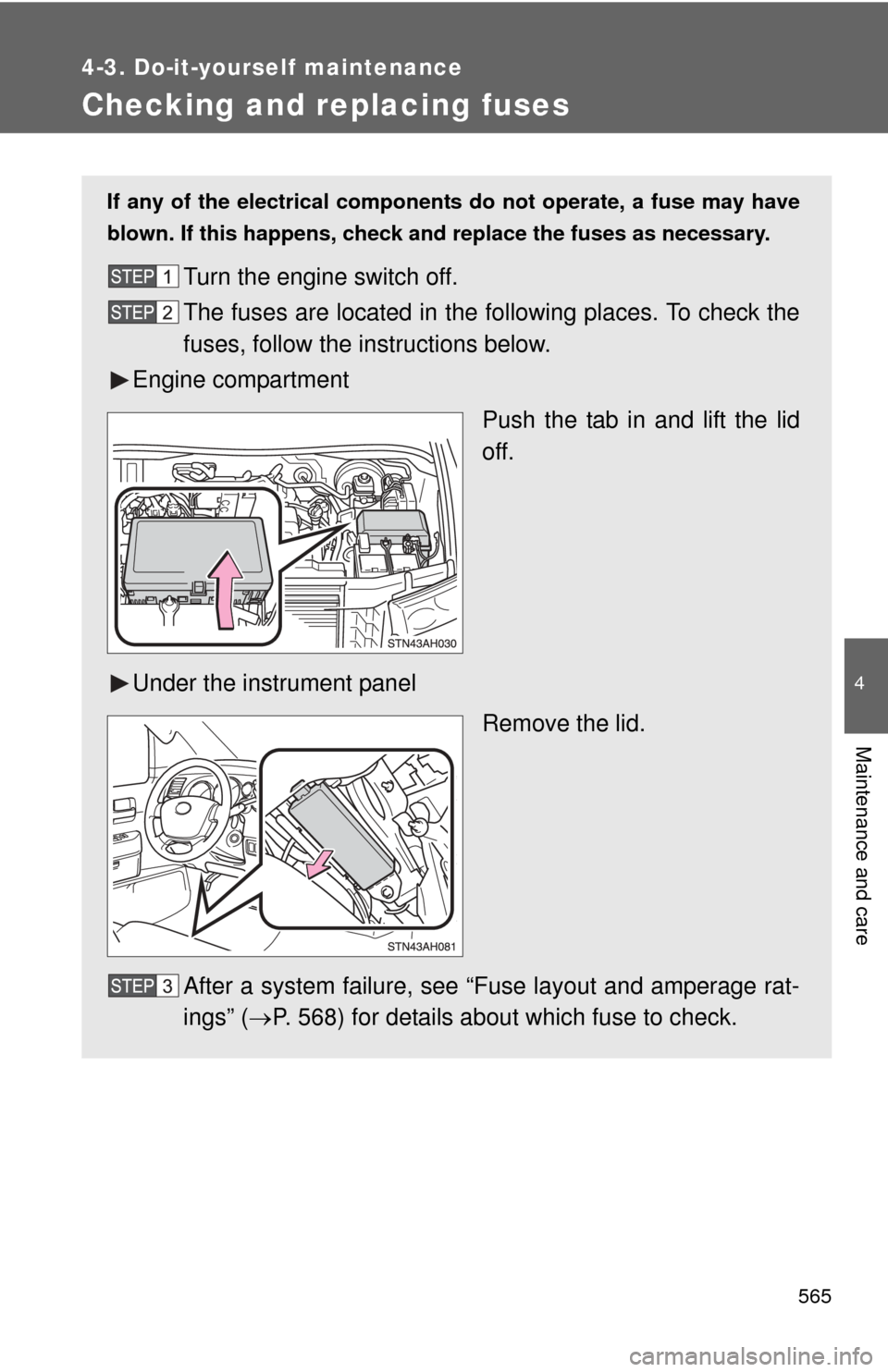
Engine compartment
Push the tab in and lift the lid
off.
Under the instrument panel Remove the lid.
After a system failure, see “Fuse layout and amperage rat-
ings” ( P. 568) for details about which fuse to check.
Page 568 of 732
568 4-3. Do-it-yourself maintenance
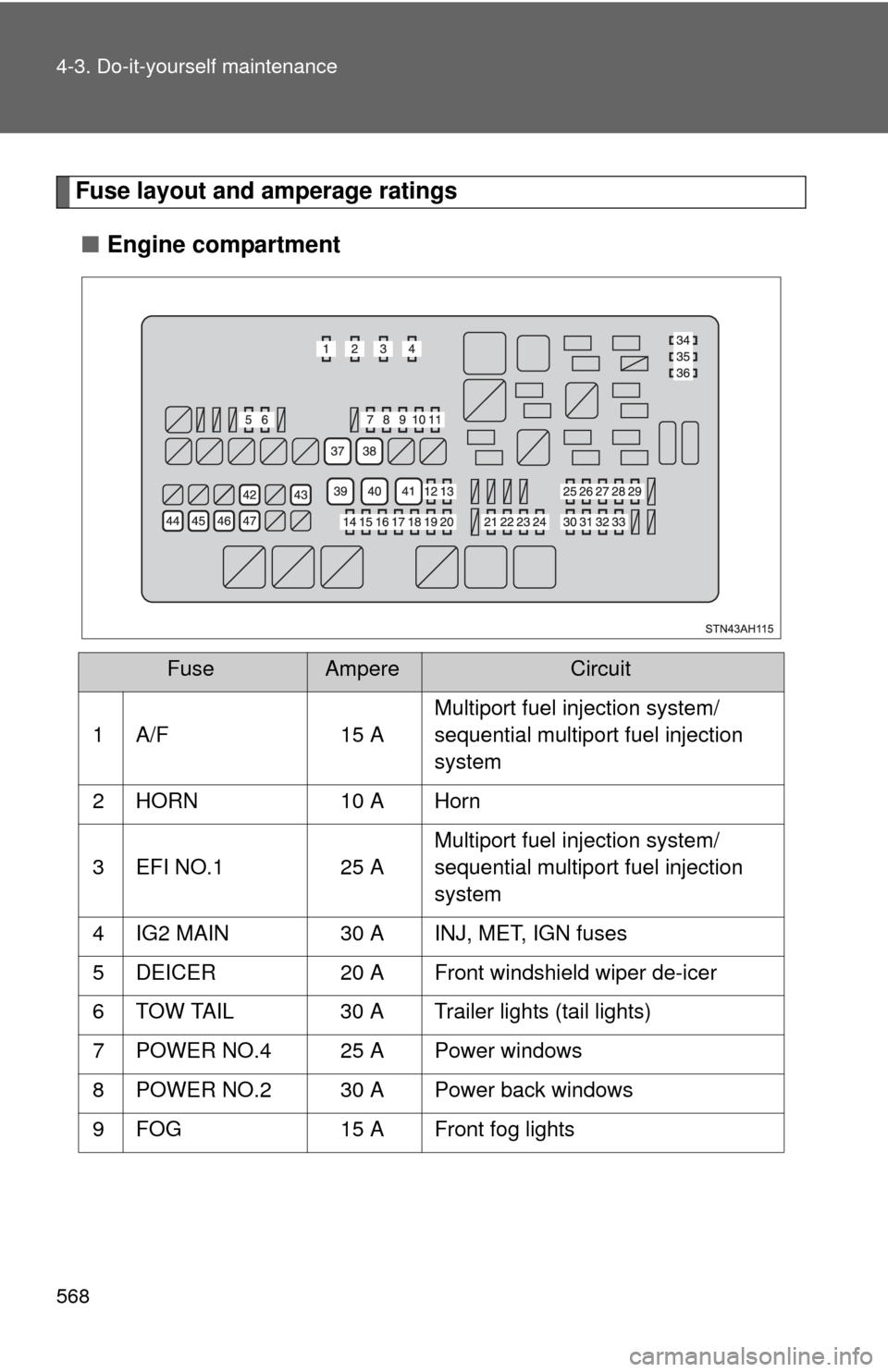
Fuse layout and amperage ratings■ Engine compartment
FuseAmpereCircuit
1 A/F 15 A Multiport fuel injection system/
sequential multiport fuel injection
system
2 HORN 10 A Horn
3 EFI NO.1 25 A Multiport fuel injection system/
sequential multiport fuel injection
system
4 IG2 MAIN 30 A INJ, MET, IGN fuses
5 DEICER 20 A Front windshield wiper de-icer
6 TOW TAIL 30 A Trailer lights (tail lights)
7 POWER NO.4 25 A Power windows
8 POWER NO.2 30 A Power back windows
9 FOG 15 A Front fog lights
Page 570 of 732

570 4-3. Do-it-yourself maintenance
23 ECU-B17.5 AMultiplex communication system,
Multiport fuel injection system/
sequential multiport fuel injection
system, auto anti-glare inside rear
view mirror, power outlets, power
front driver’s seat, power tilt and
power telescopic
24 DOME 7.5 AInterior lights, personal lights, van-
ity lights, engine switch light, foot
light, accessory meter
25 HEAD LH 15 ALeft-hand headlight
(high beam)
26 HEAD LL 15 ALeft-hand headlight
(low beam)
27 INJ 10 AMultiport fuel injection system/
sequential multiport fuel injection
system, ignition system
28 MET 7.5 A Gauges and meters
29 IGN 10 ASRS airbag system, multiport fuel
injection system/sequential multi-
port fuel injection system, cruise
control system
30 HEAD RH 15 ARight-hand headlight
(high beam)
31 HEAD RL 15 ARight-hand headlight
(low beam)
32 EFI NO.2 10 AMultiport fuel injection system/
sequential multiport fuel injection
system, leak detection pump
33 DEF I/UP 5 A No circuit
34 SPARE 5 A Spare fuse
35 SPARE 15 A Spare fuse
36 SPARE 30 A Spare fuse
FuseAmpereCircuit
Page 587 of 732
When trouble arises5
587
5-1. Essential informationEmergency flashers ......... 588
If your vehicle needs to be towed ........................ 589
If you think something is wrong ............................. 595
Fuel pump shut off system ........................... 596
Event data recorder ......... 597 5-2. Steps to take in
an emergency
If a warning light turns on or a warning buzzer
sounds... ........................ 599
If a warning message is displayed (vehicles
with multi-information
display) .......................... 608
If you have a flat tire......... 612
If the engine will not start ................................ 628
If the shift lever cannot be shifted from P............ 630
If you lose your keys ........ 633
If the vehicle battery is discharged ..................... 634
If your vehicle overheats ....................... 637
If the vehicle becomes stuck .............................. 640
If your vehicle has to be stopped in
an emergency ................ 641
Page 588 of 732
588
5-1. Essential information
Emergency flashers
NOTICE
■To prevent battery discharge
Do not leave the emergency flashers on longer than necessary when the
engine is not running.
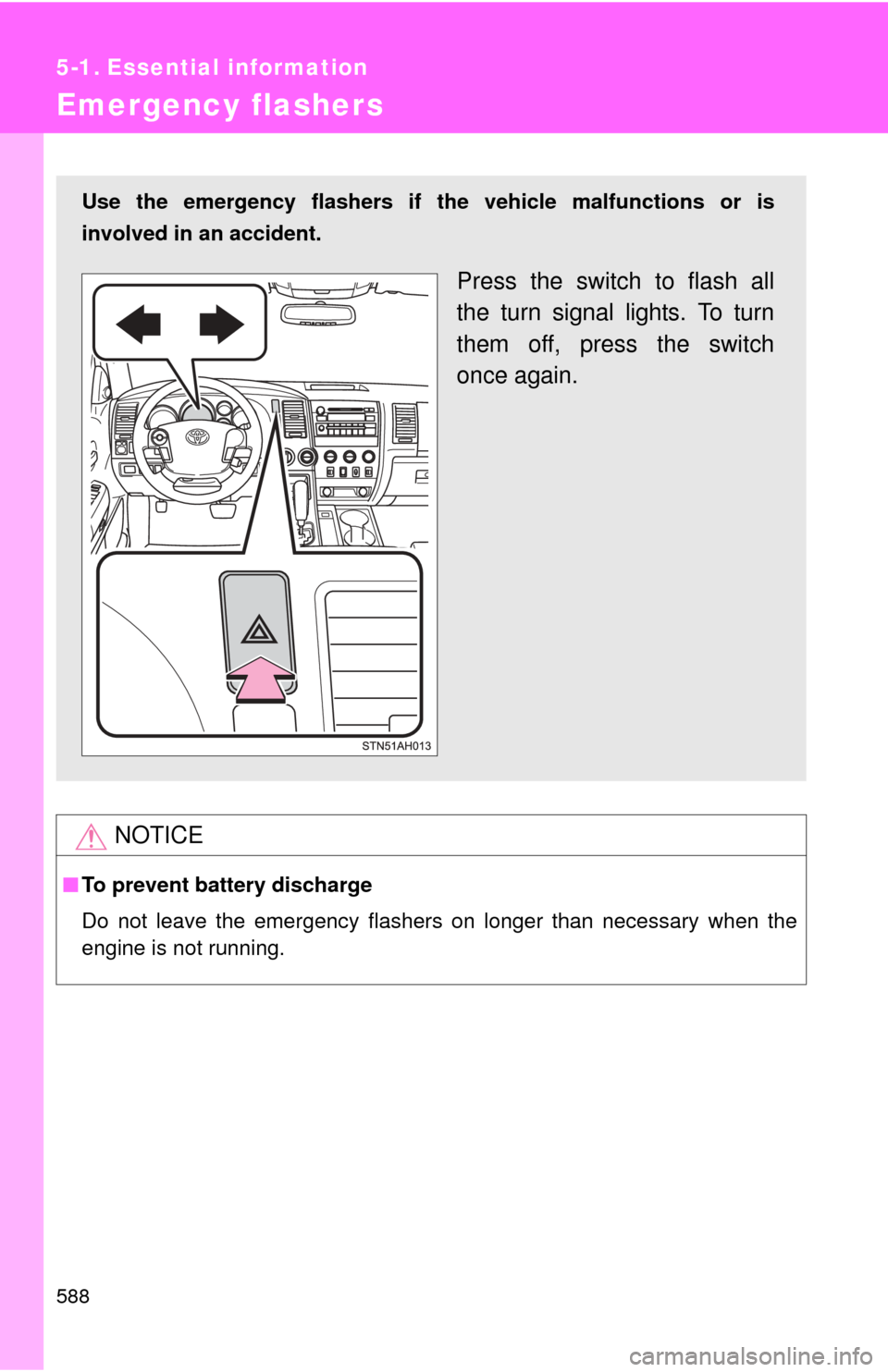
Use the emergency flashers if th e vehicle malfunctions or is
involved in an accident.
Press the switch to flash all
the turn signal lights. To turn
them off, press the switch
once again.
Page 589 of 732
5
When trouble arises
589
5-1. Essential information
If your vehicle needs to be towed
Before towingThe following may indicate a problem with your transmission. Contact
your Toyota dealer before towing.
● The engine is running, but the vehicle will not move.
● The vehicle makes an abnormal sound.
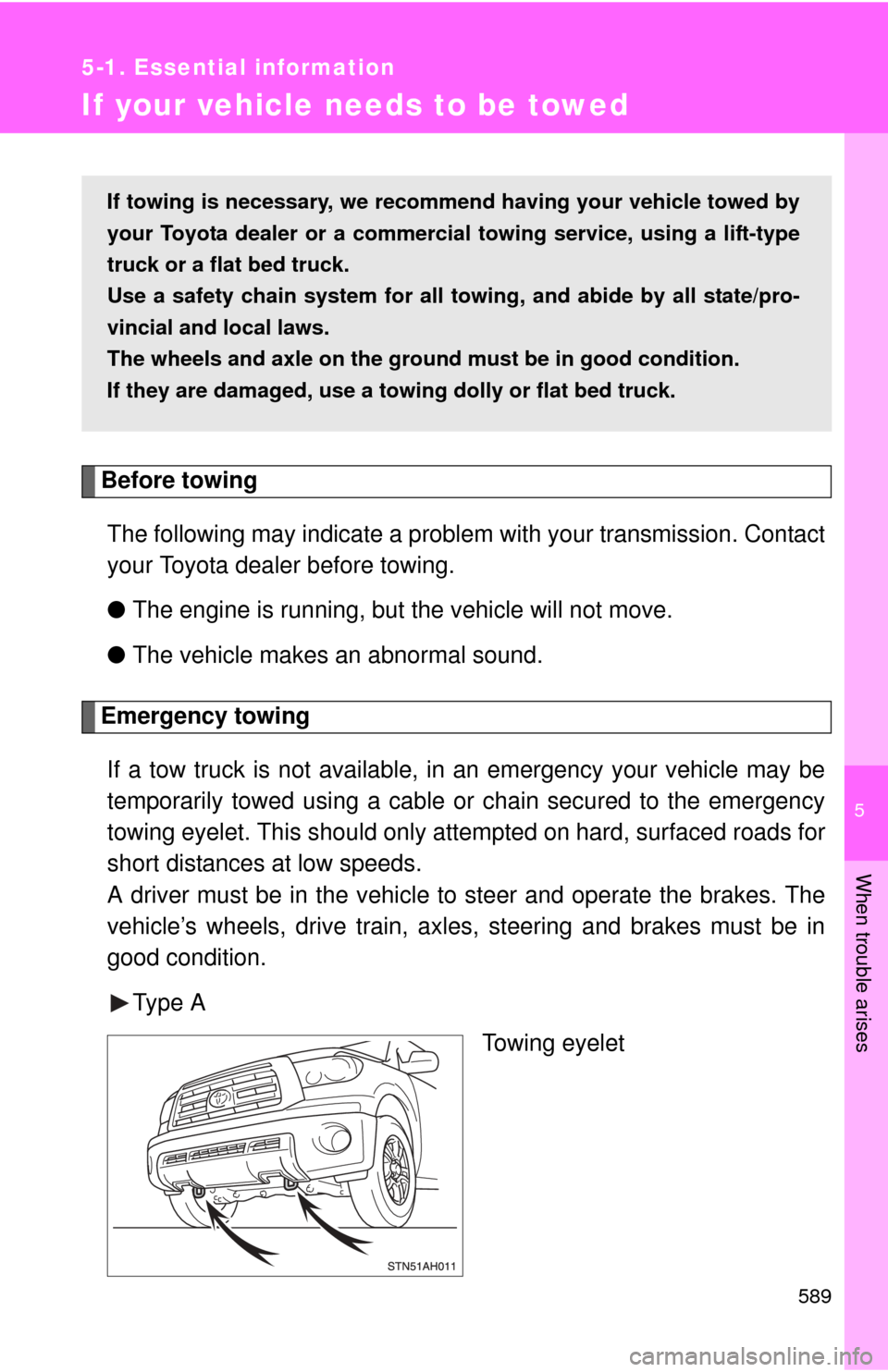
Emergency towing
If a tow truck is not available, in an emergency your vehicle may be
temporarily towed using a cable or chain secured to the emergency
towing eyelet. This should only attempted on hard, surfaced roads for
short distances at low speeds.
A driver must be in the vehicle to steer and operate the brakes. The
vehicle’s wheels, drive train, axles, steering and brakes must be in
good condition.
Type A Towing eyelet
If towing is necessary, we recommend having your vehicle towed by
your Toyota dealer or a commerci al towing service, using a lift-type
truck or a flat bed truck.
Use a safety chain system for all to wing, and abide by all state/pro-
vincial and local laws.
The wheels and axle on the groun d must be in good condition.
If they are damaged, use a towing dolly or flat bed truck.
Page 590 of 732
590 5-1. Essential information
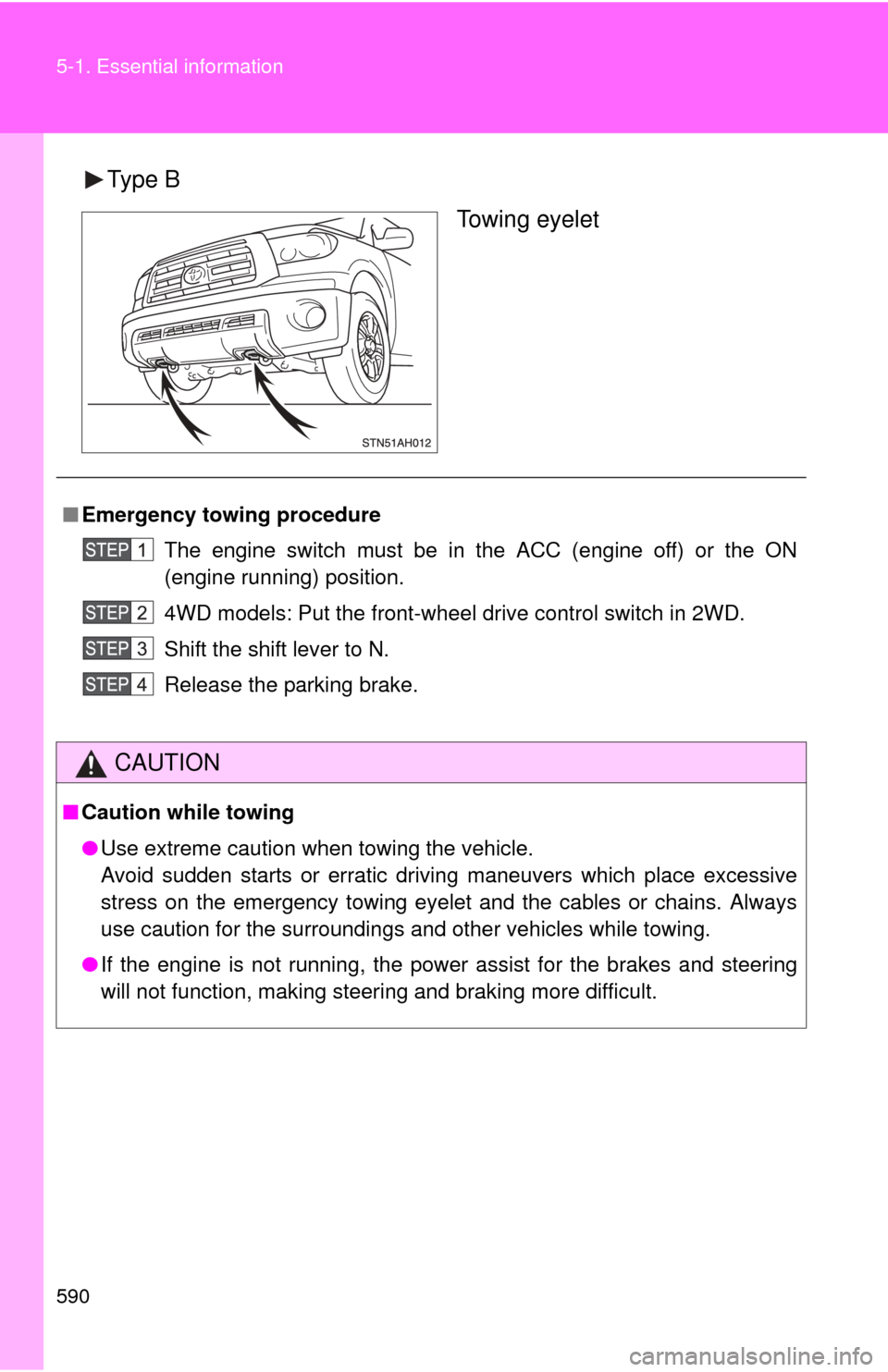
Type BTowing eyelet
■Emergency towin g procedure
The engine switch must be in the ACC (engine off) or the ON
(engine running) position.
4WD models: Put the front-wheel drive control switch in 2WD.
Shift the shift lever to N.
Release the parking brake.
CAUTION
■ Caution while towing
●Use extreme caution when towing the vehicle.
Avoid sudden starts or erratic driving maneuvers which place excessive
stress on the emergency towing eyelet and the cables or chains. Always
use caution for the surroundings and other vehicles while towing.
● If the engine is not running, the power assist for the brakes and steering
will not function, making steering and braking more difficult.
Page 592 of 732
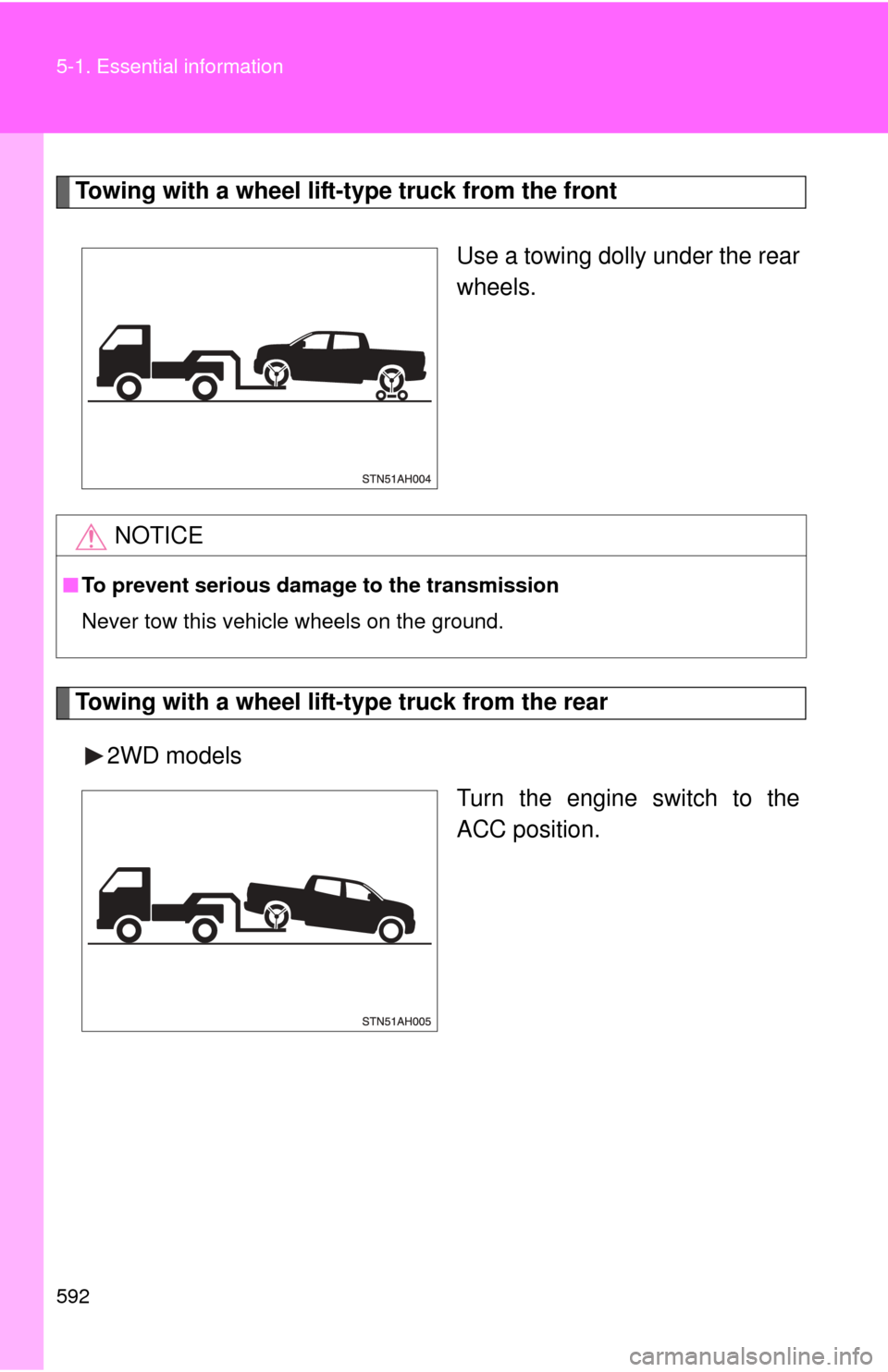
592 5-1. Essential information
Towing with a wheel lift-type truck from the frontUse a towing dolly under the rear
wheels.
Towing with a wheel lift-type truck from the rear2WD models Turn the engine switch to the
ACC position.
NOTICE
■To prevent serious damage to the transmission
Never tow this vehicle wheels on the ground.
Page 593 of 732
5
When trouble arises
593
5-1. Essential information
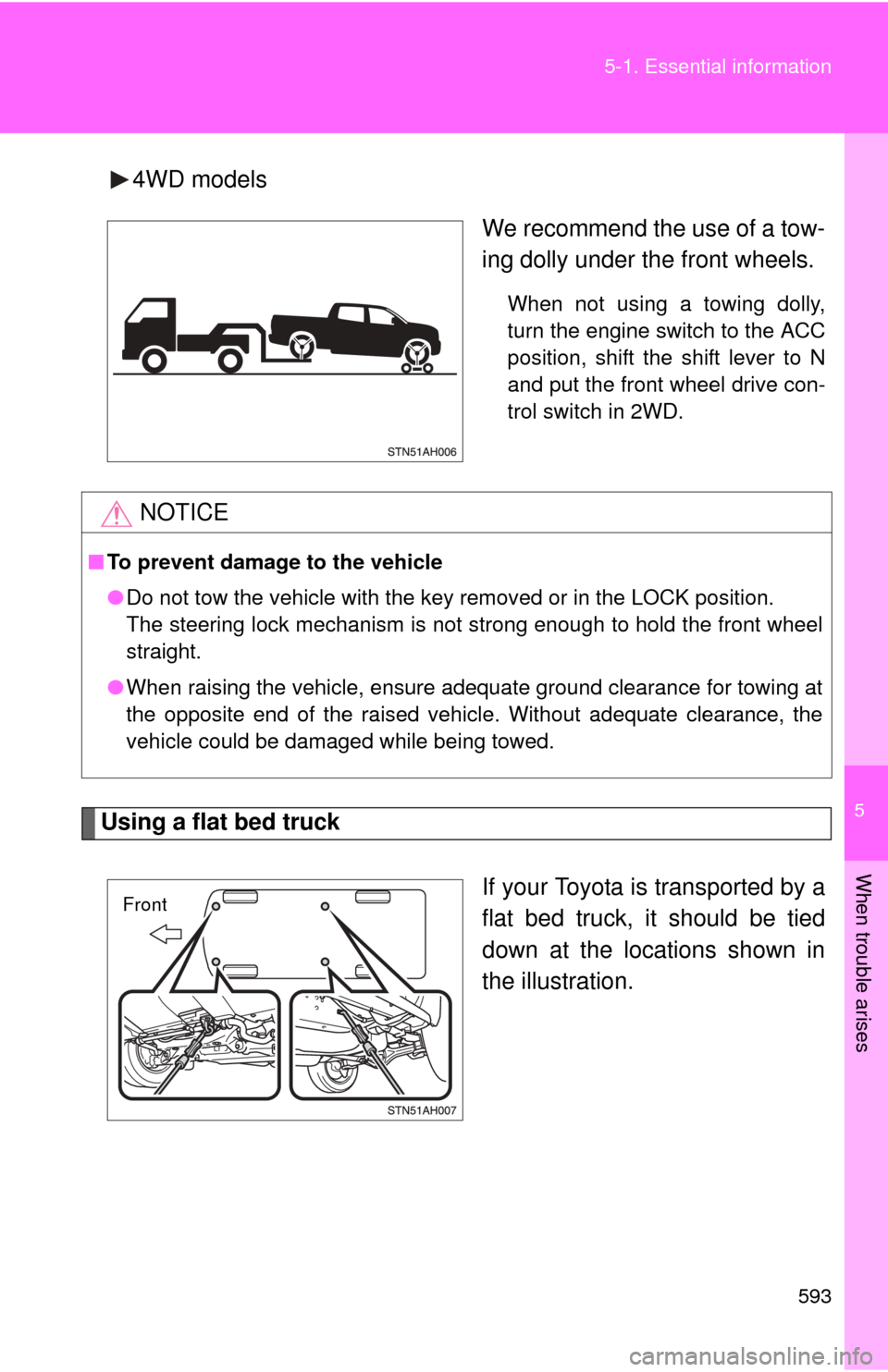
4WD models
We recommend the use of a tow-
ing dolly under the front wheels.
When not using a towing dolly,
turn the engine switch to the ACC
position, shift the shift lever to N
and put the front wheel drive con-
trol switch in 2WD.
Using a flat bed truck
If your Toyota is transported by a
flat bed truck, it should be tied
down at the locations shown in
the illustration.
NOTICE
■To prevent damage to the vehicle
●Do not tow the vehicle with the key removed or in the LOCK position.
The steering lock mechanism is not strong enough to hold the front wheel
straight.
● When raising the vehicle, ensure adequate ground clearance for towing at
the opposite end of the raised vehicle. Without adequate clearance, the
vehicle could be damaged while being towed.
Front
Page 595 of 732
5
When trouble arises
595
5-1. Essential information
If you think something is wrong
If you notice any of the following symptoms, your vehicle probably
needs adjustment or repair. Contact your Toyota dealer as soon as
possible.
■ Visible symptoms
●Fluid leaks under the vehicle
(Water dripping from the air cond itioning after use is normal.)
● Flat-looking tires or uneven tire wear
● Engine coolant temperature g auge needle continually points
higher than normal
● Voltmeter continually points higher or lower than normal
(if equipped)
● Engine oil pressure gauge continually points lower than nor-
mal (if equipped)
● Automatic transmission fluid temperature gauge needle con-
tinually points higher than normal (if equipped)
■ Audible symptoms
●Changes in exhaust sound
● Excessive tire squeal when cornering
● Strange noises related to the suspension system
● Pinging or other noises related to the engine
■ Operational symptoms
●Engine missing, stumbling or running rough
● Appreciable loss of power
● Vehicle pulls heavily to one side when braking
● Vehicle pulls heavily to one side when driving on a level road
● Loss of brake effectiveness, s pongy feeling, pedal almost
touches the floor